switch MERCEDES-BENZ E-Class COUPE 2013 C207 Service Manual
[x] Cancel search | Manufacturer: MERCEDES-BENZ, Model Year: 2013, Model line: E-Class COUPE, Model: MERCEDES-BENZ E-Class COUPE 2013 C207Pages: 372, PDF Size: 12.69 MB
Page 98 of 372
The soft top is not locked if:
R
the Convertible Top in Operation
message appears in the multifunction
display.
R you hear a warning tone for up to ten
seconds
when pulling away or while driving.
Locking You can lock the soft top again if it is not
locked fully.
X
Pull over and stop the vehicle safely as soon
as possible, paying attention to road and
traffic conditions.
X Turn the SmartKey to position 2 in the
ignition lock.
X Press the soft-top switch (Y page 90). Trunk partition
General notes !
To avoid damaging the soft top or load
when
folding back the soft top, observe the
following:
R when the trunk partition is open, do not
place any objects in or behind the net on
the side that are so long they could
obstruct the trunk partition or damage
the opened soft top.
R make sure that the cargo does not push
the trunk partition upwards.
The soft top can only be opened when the
trunk partition is closed.
The trunk partition can be used to cover
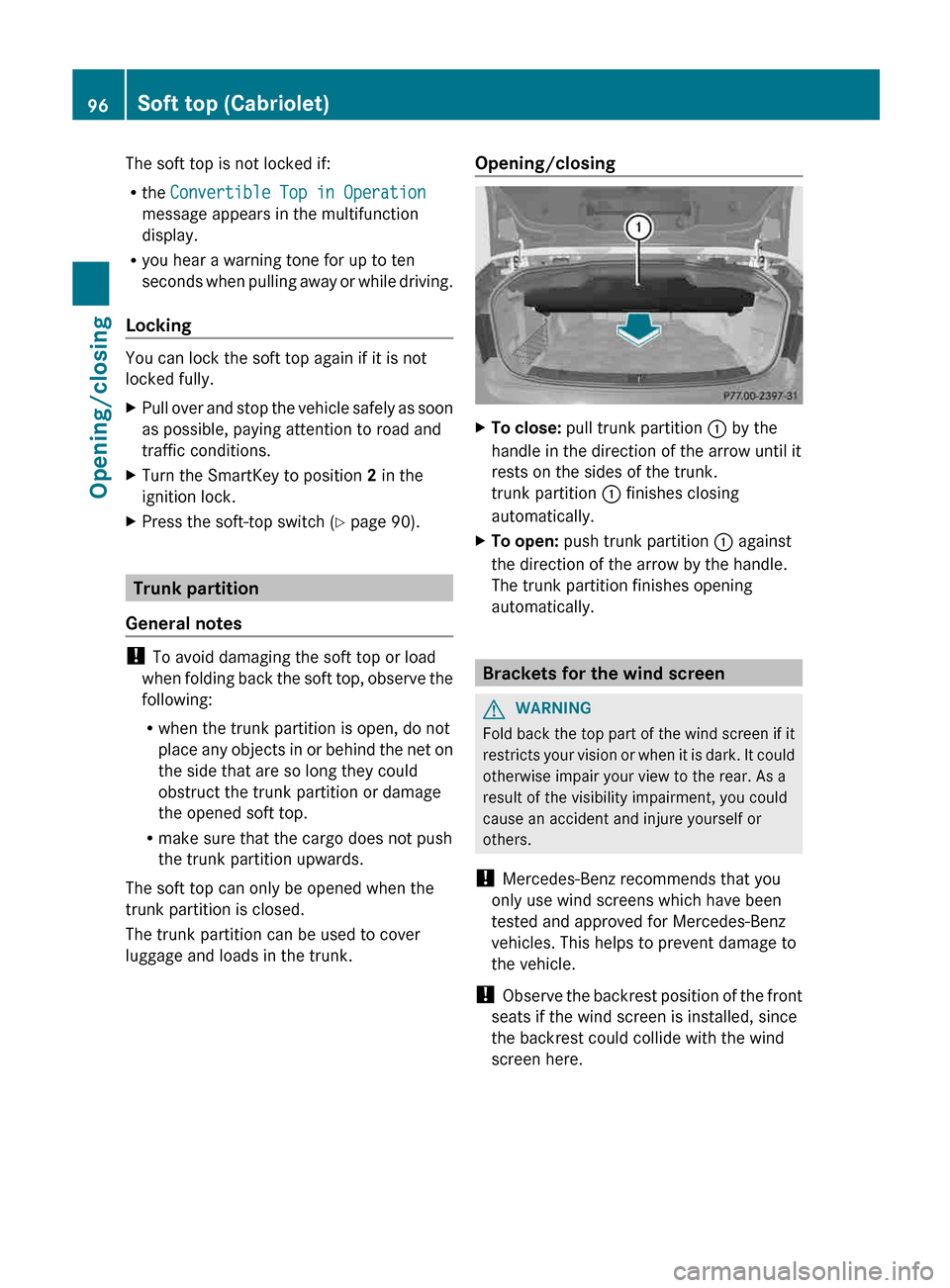
luggage and loads in the trunk. Opening/closing
X
To close: pull trunk partition : by the
handle in the direction of the arrow until it
rests on the sides of the trunk.
trunk partition : finishes closing
automatically.
X To open: push trunk partition : against
the direction of the arrow by the handle.
The trunk partition finishes opening
automatically. Brackets for the wind screen
G
WARNING
Fold back the top part of the wind screen if it
restricts
your vision or when it is dark. It could
otherwise impair your view to the rear. As a
result of the visibility impairment, you could
cause an accident and injure yourself or
others.
! Mercedes-Benz recommends that you
only use wind screens which have been
tested and approved for Mercedes-Benz
vehicles. This helps to prevent damage to
the vehicle.
! Observe the backrest position of the front
seats if the wind screen is installed, since
the backrest could collide with the wind
screen here. 96
Soft top (Cabriolet)
Opening/closing
Page 102 of 372
Problems with the soft top
Problem Possible causes/consequences and
M SolutionsThe soft top will not
open or close. The ignition is not switched on.
X
Make sure that the SmartKey is in position 2 in the ignition lock.The trunk lid is open.
X
Close the trunk lid ( Y page 96). The trunk partition is not closed.
X
Close the trunk partition (Y page 96). The roll bars have been deployed.
X
Visit a qualified specialist workshop. The head restraints in the rear compartment do not retract
automatically.
X
Lower the head restraints in the rear compartment manually,
see the Digital Operator's Manual, keyword "Head restraint". The soft-top mechanism or control system is defective.
X
Close the soft top manually if necessary ( Y page 91).
X Visit a qualified specialist workshop. The soft top has been opened and closed several times in a row.
The soft-top drive has been deactivated automatically for safety
reasons.
You
can open and close the soft top again after approximately ten
minutes.
X Switch off the ignition and turn it back on.
X Repeat the opening or closing procedure. Sliding sunroof (Coupe)
Important safety notes
G
WARNING
When opening or closing the sliding sunroof,
make sure that there is no danger of anyone
being harmed by the opening/closing
procedure.
The sliding sunroof is equipped with
automatic
operation and the anti-entrapment
feature. If the movement of the sliding sunroof is blocked during the closing procedure, the
sliding sunroof will stop and open slightly.
The
sliding sunroof operates differently when
the sliding sunroof switch is pressed and held.
See the "Problems with the sliding sunroof"
section for more details.
The opening/closing procedure of the sliding
sunroof can be immediately halted by
releasing the sliding sunroof switch or, if the
sliding sunroof switch was moved past the
resistance point and released, by moving the
sliding sunroof switch in any direction. 100
Sliding sunroof (Coupe)
Opening/closing
Page 103 of 372
G
WARNING
The sliding sunroof is made out of glass. In the
event of an accident, the glass may shatter.
This may result in an opening in the roof.
In a vehicle rollover, occupants not wearing
their seat belts or not wearing them properly
may be thrown out of the opening. Such an
opening
also presents a potential for injury for
occupants wearing their seat belts properly,
as entire body parts or portions of them may
protrude from the passenger compartment.
! Only open the sliding sunroof if it is free
of snow and ice. Otherwise, malfunctions
may occur.
Do not allow anything to protrude from the
sliding sunroof. Otherwise, the seals could
be damaged.
! The weather can change abruptly. It could
start to rain or snow. Make sure that the
sliding sunroof is closed when you leave the
vehicle. The vehicle electronics can be
damaged if water enters the vehicle
interior.
i Resonance noises can occur in addition
to the usual airflow noises when the sliding
sunroof is open. They are caused by minor
pressure fluctuations in the vehicle interior.
Change the position of the sliding sunroof
or open a side window slightly to reduce or
eliminate these noises.
In this section, the term "sliding sunroof"
refers to the panorama roof with power tilt/
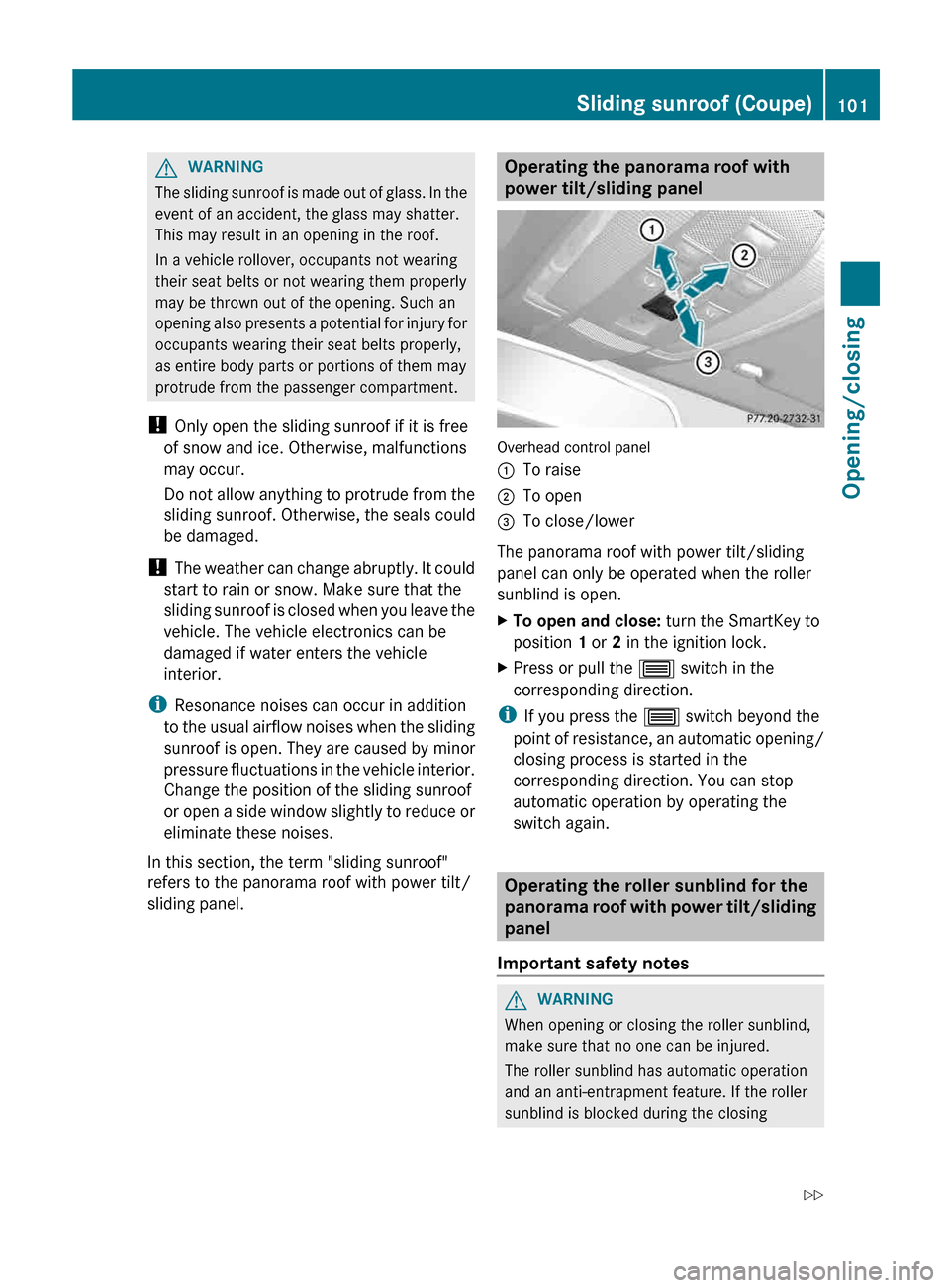
sliding panel. Operating the panorama roof with
power tilt/sliding panel
Overhead control panel
:
To raise
; To open
= To close/lower
The panorama roof with power tilt/sliding
panel can only be operated when the roller
sunblind is open.
X To open and close: turn the SmartKey to
position 1 or 2 in the ignition lock.
X Press or pull the 3 switch in the
corresponding direction.
i If you press the 3 switch beyond the
point
of resistance, an automatic opening/
closing process is started in the
corresponding direction. You can stop
automatic operation by operating the
switch again. Operating the roller sunblind for the
panorama
roof with power tilt/sliding
panel
Important safety notes G
WARNING
When opening or closing the roller sunblind,
make sure that no one can be injured.
The roller sunblind has automatic operation
and an anti-entrapment feature. If the roller
sunblind is blocked during the closing Sliding sunroof (Coupe)
101
Opening/closing
Z
Page 104 of 372
procedure, the anti-entrapment feature stops
the
roller sunblind and it opens again slightly.
The manual opening and closing of the roller
sunblind can be terminated immediately by
releasing the button. In automatic operation,
press the button briefly in any direction to
stop the roller sunblind.
The roller sunblind shields the vehicle interior
from sunlight. The roller sunblind can only be
opened and closed when the panorama roof
with power tilt/sliding panel is closed.
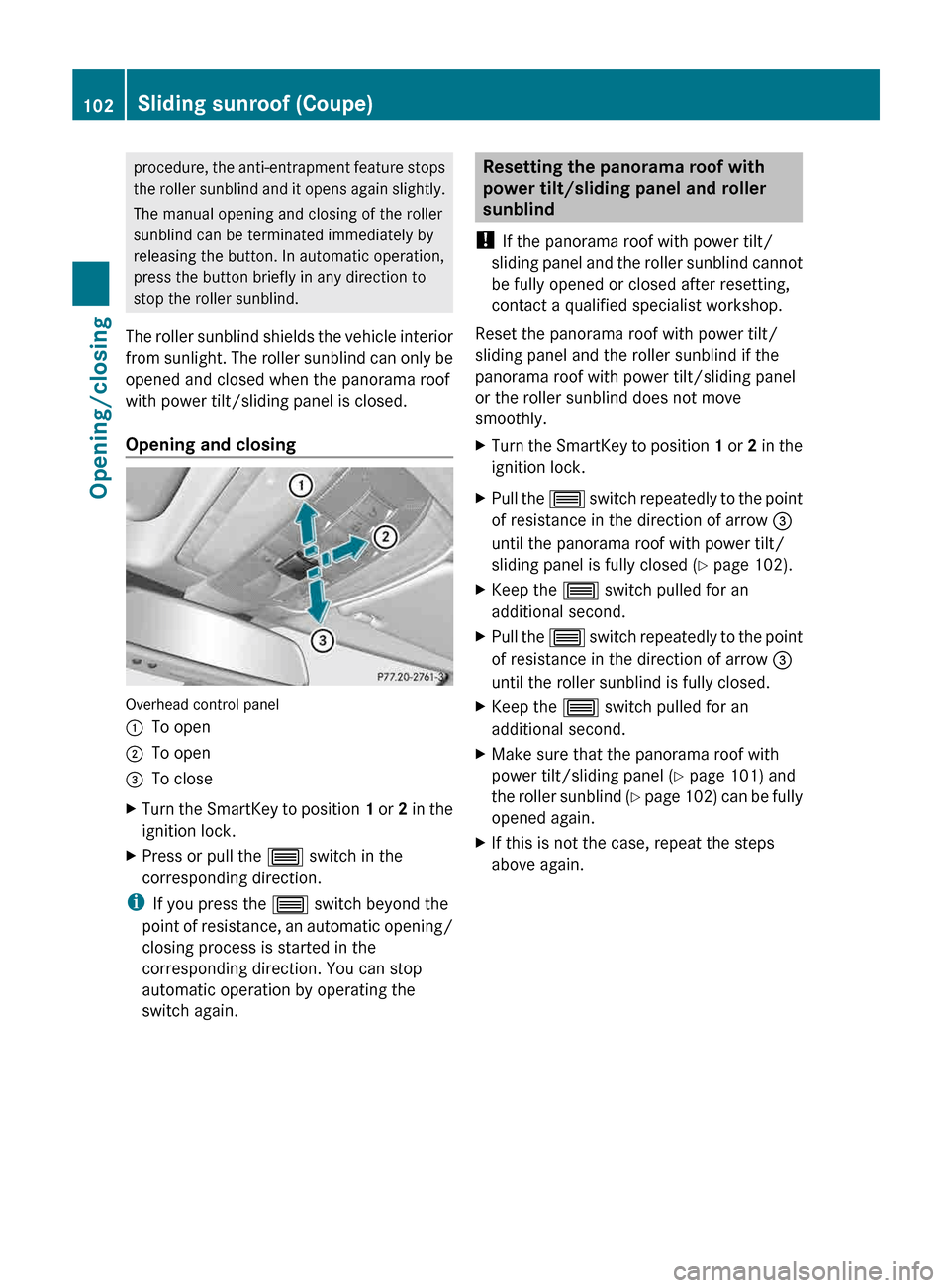
Opening and closing Overhead control panel
:
To open
; To open
= To close
X Turn the SmartKey to position 1
or 2 in the
ignition lock.
X Press or pull the 3 switch in the
corresponding direction.
i If you press the 3 switch beyond the
point
of resistance, an automatic opening/
closing process is started in the
corresponding direction. You can stop
automatic operation by operating the
switch again. Resetting the panorama roof with
power tilt/sliding panel and roller
sunblind
! If the panorama roof with power tilt/
sliding
panel and the roller sunblind cannot
be fully opened or closed after resetting,
contact a qualified specialist workshop.
Reset the panorama roof with power tilt/
sliding panel and the roller sunblind if the
panorama roof with power tilt/sliding panel
or the roller sunblind does not move
smoothly.
X Turn the SmartKey to position 1
or 2 in the
ignition lock.
X Pull the 3
switch repeatedly to the point
of resistance in the direction of arrow =
until the panorama roof with power tilt/
sliding panel is fully closed ( Y page 102).
X Keep the 3 switch pulled for an
additional second.
X Pull the 3
switch repeatedly to the point
of resistance in the direction of arrow =
until the roller sunblind is fully closed.
X Keep the 3 switch pulled for an
additional second.
X Make sure that the panorama roof with
power tilt/sliding panel
(Y page 101) and
the roller sunblind (Y page 102) can be fully
opened again.
X If this is not the case, repeat the steps
above again.102
Sliding sunroof (Coupe)
Opening/closing
Page 105 of 372
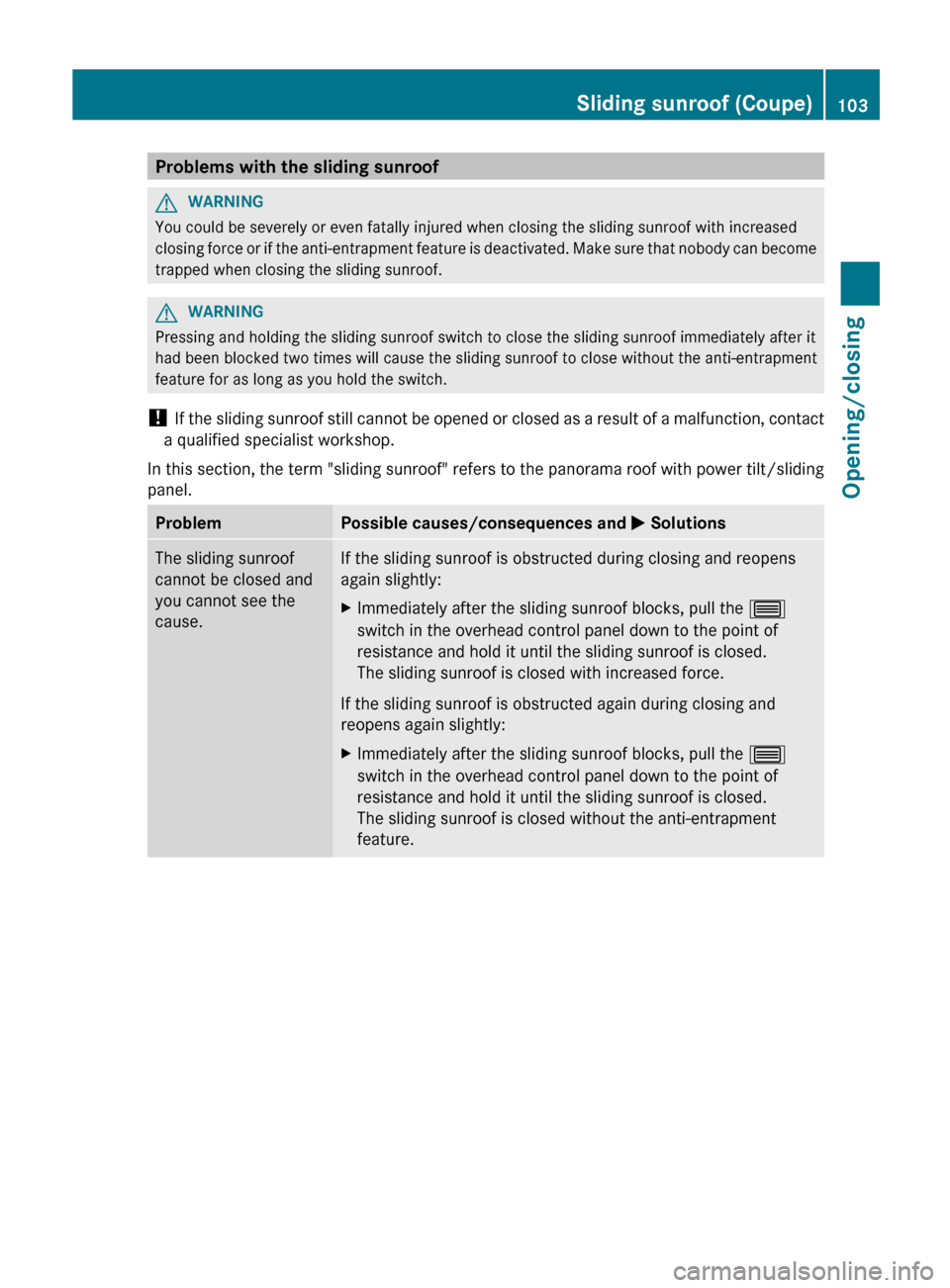
Problems with the sliding sunroof
G
WARNING
You could be severely or even fatally injured when closing the sliding sunroof with increased
closing force or if the anti-entrapment feature is deactivated. Make sure that nobody can become
trapped when closing the sliding sunroof. G
WARNING
Pressing and holding the sliding sunroof switch to close the sliding sunroof immediately after it
had been blocked two times will cause the sliding sunroof to close without the anti-entrapment
feature for as long as you hold the switch.
! If
the sliding sunroof still cannot be opened or closed as a result of a malfunction, contact
a qualified specialist workshop.
In this section, the term "sliding sunroof" refers to the panorama roof with power tilt/sliding
panel. Problem Possible causes/consequences and
M SolutionsThe sliding sunroof
cannot be closed and
you cannot see the
cause. If the sliding sunroof is obstructed during closing and reopens
again slightly:
X
Immediately after the sliding sunroof blocks, pull the 3
switch in the overhead control panel down to the point of
resistance and hold it until the sliding sunroof is closed.
The sliding sunroof is closed with increased force.
If the sliding sunroof is obstructed again during closing and
reopens again slightly:
X Immediately after the sliding sunroof blocks, pull the 3
switch in the overhead control panel down to the point of
resistance and hold it until the sliding sunroof is closed.
The sliding sunroof is closed without the anti-entrapment
feature. Sliding sunroof (Coupe)
103
Opening/closing Z
Page 109 of 372
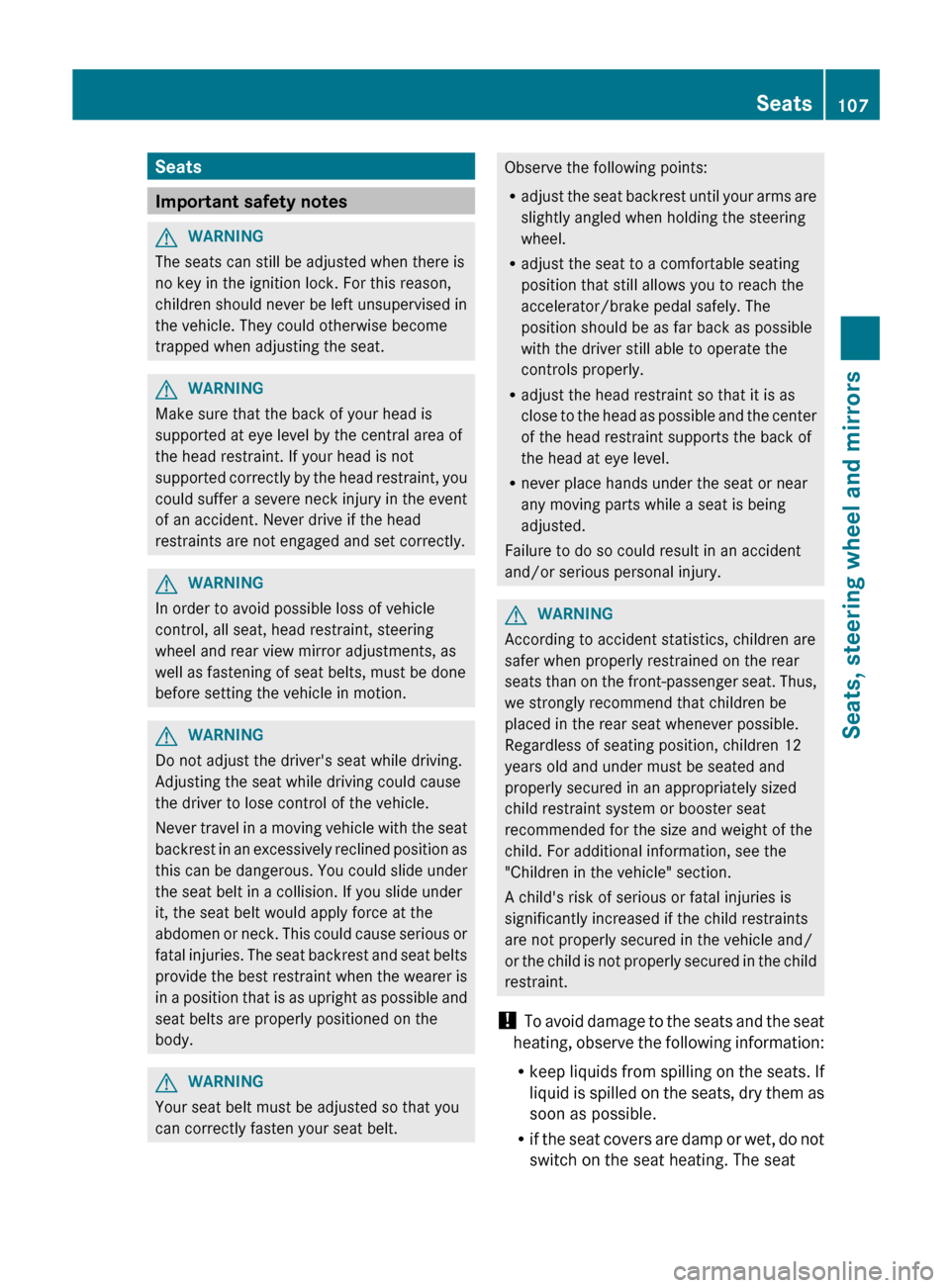
Seats
Important safety notes
G
WARNING
The seats can still be adjusted when there is
no key in the ignition lock. For this reason,
children should never be left unsupervised in
the vehicle. They could otherwise become
trapped when adjusting the seat. G
WARNING
Make sure that the back of your head is
supported at eye level by the central area of
the head restraint. If your head is not
supported
correctly by the head restraint, you
could suffer a severe neck injury in the event
of an accident. Never drive if the head
restraints are not engaged and set correctly. G
WARNING
In order to avoid possible loss of vehicle
control, all seat, head restraint, steering
wheel and rear view mirror adjustments, as
well as fastening of seat belts, must be done
before setting the vehicle in motion. G
WARNING
Do not adjust the driver's seat while driving.
Adjusting the seat while driving could cause
the driver to lose control of the vehicle.
Never
travel in a moving vehicle with the seat
backrest in an excessively reclined position as
this can be dangerous. You could slide under
the seat belt in a collision. If you slide under
it, the seat belt would apply force at the
abdomen or neck. This could cause serious or
fatal injuries. The seat backrest and seat belts
provide the best restraint when the wearer is
in a position that is as upright as possible and
seat belts are properly positioned on the
body. G
WARNING
Your seat belt must be adjusted so that you
can correctly fasten your seat belt. Observe the following points:
R
adjust
the seat backrest until your arms are
slightly angled when holding the steering
wheel.
R adjust the seat to a comfortable seating
position that still allows you to reach the
accelerator/brake pedal safely. The
position should be as far back as possible
with the driver still able to operate the
controls properly.
R adjust the head restraint so that it is as
close to the head as possible and the center
of the head restraint supports the back of
the head at eye level.
R never place hands under the seat or near
any moving parts while a seat is being
adjusted.
Failure to do so could result in an accident
and/or serious personal injury. G
WARNING
According to accident statistics, children are
safer when properly restrained on the rear
seats
than on the front-passenger seat. Thus,
we strongly recommend that children be
placed in the rear seat whenever possible.
Regardless of seating position, children 12
years old and under must be seated and
properly secured in an appropriately sized
child restraint system or booster seat
recommended for the size and weight of the
child. For additional information, see the
"Children in the vehicle" section.
A child's risk of serious or fatal injuries is
significantly increased if the child restraints
are not properly secured in the vehicle and/
or the child is not properly secured in the child
restraint.
! To avoid damage to the seats and the seat
heating, observe the following information:
R keep liquids from spilling on the seats. If
liquid is spilled on the seats, dry them as
soon as possible.
R if the seat covers are damp or wet, do not
switch on the seat heating. The seat Seats
107
Seats, steering wheel and mirrors Z
Page 110 of 372
heating should also not be used to dry
the seats.
R clean the seat covers as recommended;
see the "Interior care" section.
R do not transport heavy loads on the
seats.
Do not place sharp objects on the
seat cushions, e.g. knives, nails or tools.
The seats should only be occupied by
passengers, if possible.
R when the seat heating is in operation, do
not cover the seats with insulating
materials, e.g. blankets, coats, bags,
seat covers, child seats or booster seats.
! To avoid damage to the seats and the seat
heating, observe the following information:
R keep liquids from spilling on the seats. If
liquid is spilled on the seats, dry them as
soon as possible.
R if the seat covers are damp or wet, do not
switch on the seat heating. The seat
heating should also not be used to dry
the seats.
R clean the seat covers as recommended;
see "Interior care".
R do not transport heavy loads on the
seats. Do not place sharp objects on the
seat cushions, e.g. knives, nails or tools.
The seats should only be occupied by
passengers, if possible.
R when the seat heating is in operation, do
not cover the seats with insulating
materials, e.g. blankets, coats, bags,
seat covers, child seats or booster seats.
! Make sure that there are no objects in the
footwell or behind the seats when resetting
the seats. There is a risk that the seats
and/or the objects could be damaged.
i The head restraints in the front seats are
installed with the NECK-PRO system
(Y page 51). For this reason, it is not
possible to remove the head restraints
from the front seats.
For more information, contact a qualified
specialist workshop. i
Further related subjects:
R Through-loading feature in the rear
bench seat (Coupe) (folding the rear
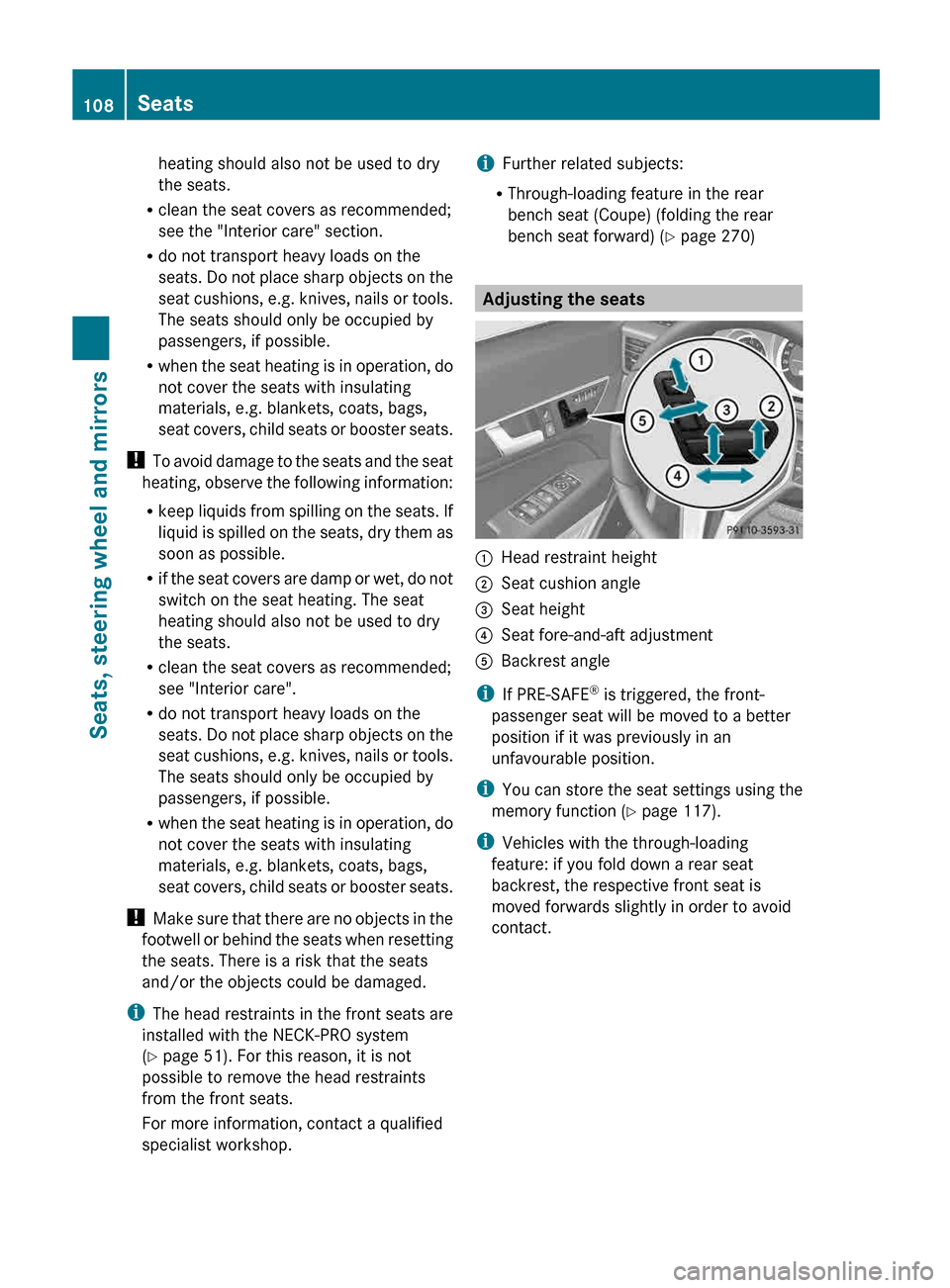
bench seat forward) ( Y page 270) Adjusting the seats
:
Head restraint height
; Seat cushion angle
= Seat height
? Seat fore-and-aft adjustment
A Backrest angle
i If PRE-SAFE ®
is triggered, the front-
passenger seat will be moved to a better
position if it was previously in an
unfavourable position.
i You can store the seat settings using the
memory function ( Y page 117).
i Vehicles with the through-loading
feature: if you fold down a rear seat
backrest, the respective front seat is
moved forwards slightly in order to avoid
contact. 108
Seats
Seats, steering wheel and mirrors
Page 111 of 372
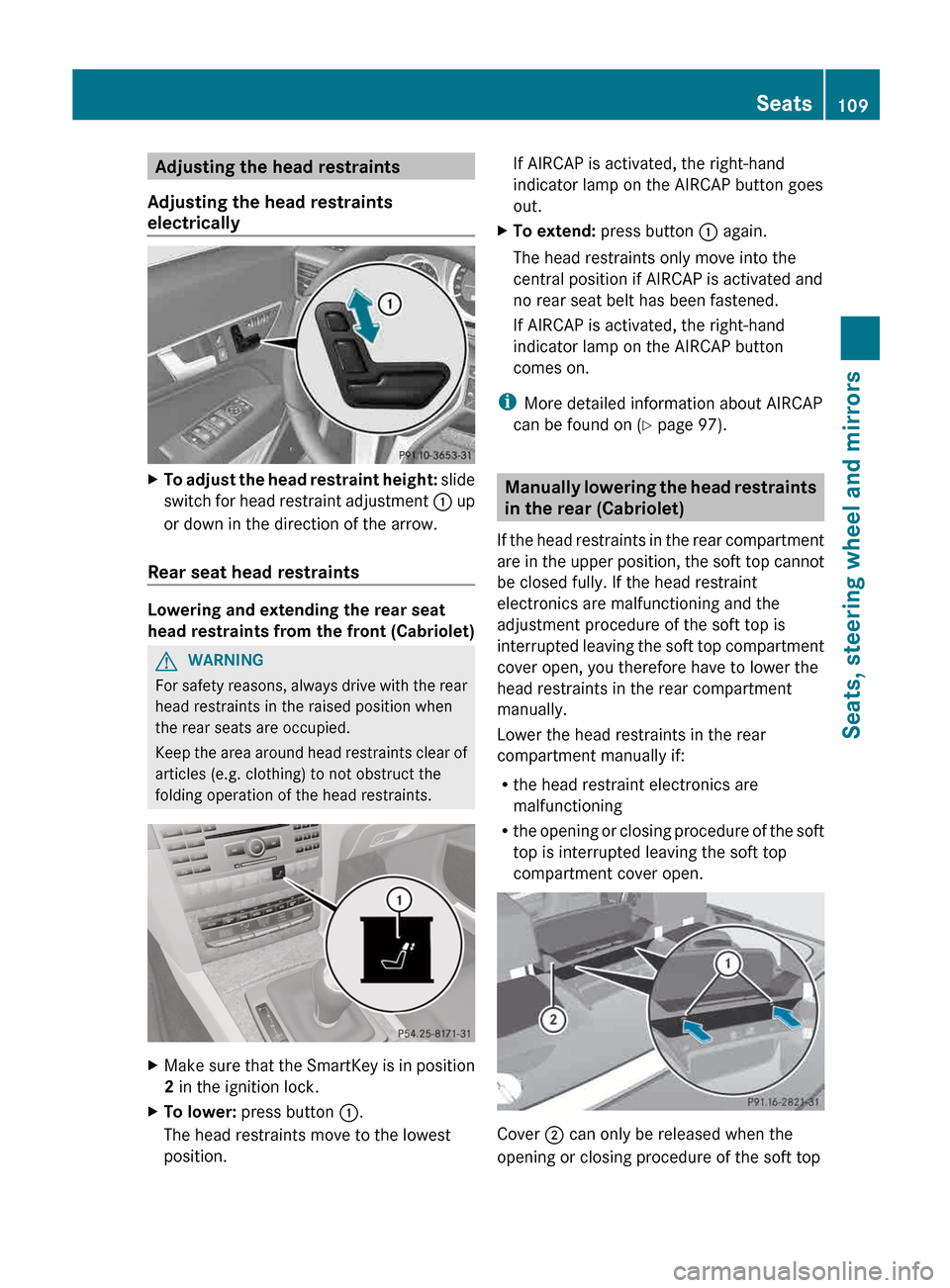
Adjusting the head restraints
Adjusting the head restraints
electrically X
To adjust the head restraint height: slide
switch for head restraint adjustment : up
or down in the direction of the arrow.
Rear seat head restraints Lowering and extending the rear seat
head restraints from the front (Cabriolet)
G
WARNING
For safety reasons, always drive with the rear
head restraints in the raised position when
the rear seats are occupied.
Keep
the area around head restraints clear of
articles (e.g. clothing) to not obstruct the
folding operation of the head restraints. X
Make sure that the SmartKey is in position
2 in the ignition lock.
X To lower: press button :.
The head restraints move to the lowest
position. If AIRCAP is activated, the right-hand
indicator lamp on the AIRCAP button goes
out.
X To extend: press button : again.
The head restraints only move into the
central position if AIRCAP is activated and
no rear seat belt has been fastened.
If AIRCAP is activated, the right-hand
indicator lamp on the AIRCAP button
comes on.
i More detailed information about AIRCAP
can be found on (Y page 97). Manually lowering the head restraints
in the rear (Cabriolet)
If
the head restraints in the rear compartment
are in the upper position, the soft top cannot
be closed fully. If the head restraint
electronics are malfunctioning and the
adjustment procedure of the soft top is
interrupted leaving the soft top compartment
cover open, you therefore have to lower the
head restraints in the rear compartment
manually.
Lower the head restraints in the rear
compartment manually if:
R the head restraint electronics are
malfunctioning
R the opening or closing procedure of the soft
top is interrupted leaving the soft top
compartment cover open. Cover ; can only be released when the
opening or closing procedure of the soft top Seats
109
Seats, steering wheel and mirrors Z
Page 112 of 372
is interrupted leaving the soft top
compartment cover open.
X
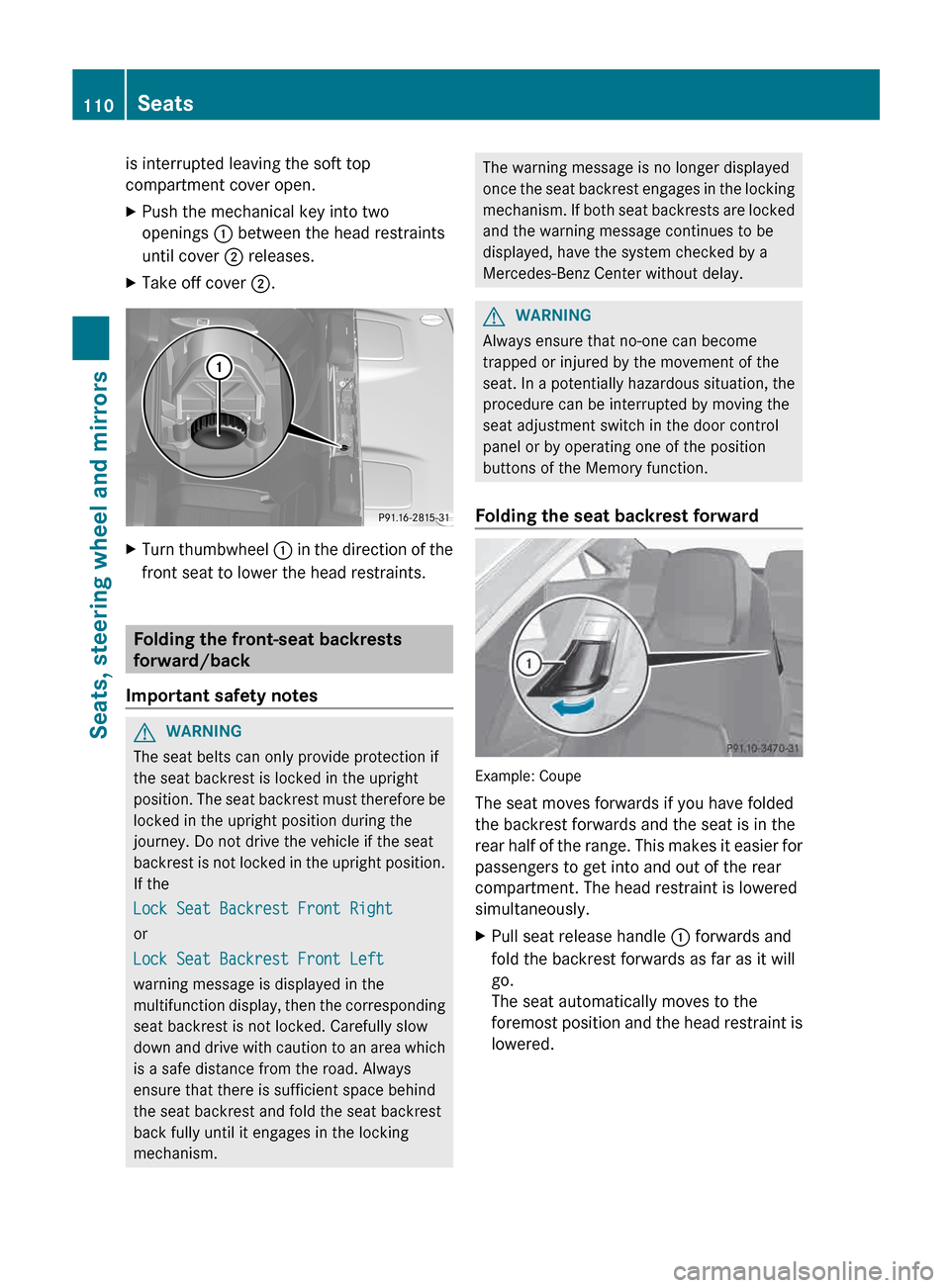
Push the mechanical key into two
openings : between the head restraints
until cover ; releases.
X Take off cover ;. X
Turn thumbwheel : in the direction of the
front seat to lower the head restraints. Folding the front-seat backrests
forward/back
Important safety notes G
WARNING
The seat belts can only provide protection if
the seat backrest is locked in the upright
position.
The seat backrest must therefore be
locked in the upright position during the
journey. Do not drive the vehicle if the seat
backrest is not locked in the upright position.
If the
Lock Seat Backrest Front Right
or
Lock Seat Backrest Front Left
warning message is displayed in the
multifunction display, then the corresponding
seat backrest is not locked. Carefully slow
down and drive with caution to an area which
is a safe distance from the road. Always
ensure that there is sufficient space behind
the seat backrest and fold the seat backrest
back fully until it engages in the locking
mechanism. The warning message is no longer displayed
once
the seat backrest engages in the locking
mechanism. If both seat backrests are locked
and the warning message continues to be
displayed, have the system checked by a
Mercedes-Benz Center without delay. G
WARNING
Always ensure that no-one can become
trapped or injured by the movement of the
seat.
In a potentially hazardous situation, the
procedure can be interrupted by moving the
seat adjustment switch in the door control
panel or by operating one of the position
buttons of the Memory function.
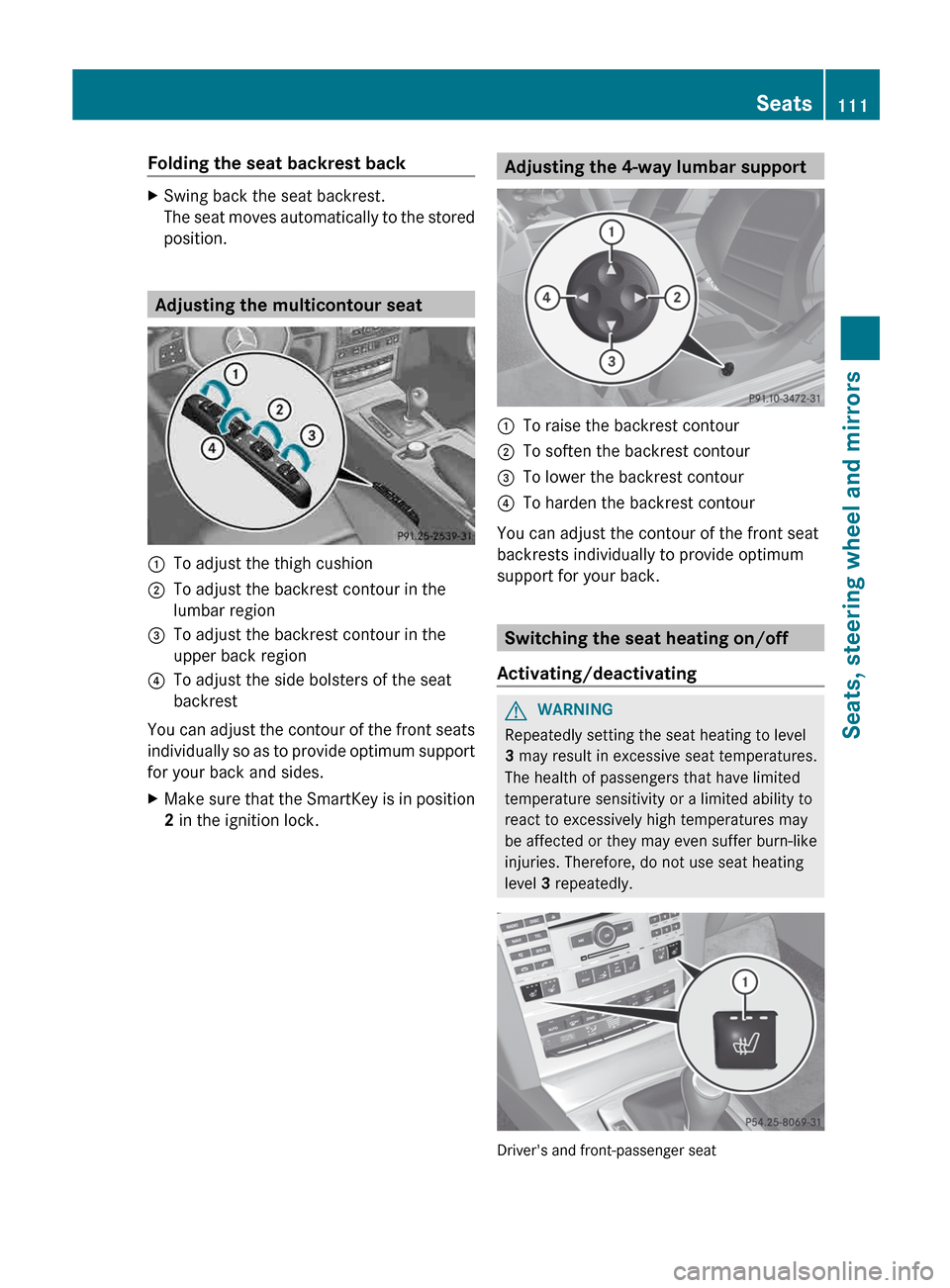
Folding the seat backrest forward Example: Coupe
The seat moves forwards if you have folded
the backrest forwards and the seat is in the
rear
half of the range. This makes it easier for
passengers to get into and out of the rear
compartment. The head restraint is lowered
simultaneously.
X Pull seat release handle : forwards and
fold the backrest forwards as far as it will
go.
The seat automatically moves to the
foremost
position and the head restraint is
lowered. 110
Seats
Seats, steering wheel and mirrors
Page 113 of 372
Folding the seat backrest back
X
Swing back the seat backrest.
The
seat moves automatically to the stored
position. Adjusting the multicontour seat
:
To adjust the thigh cushion
; To adjust the backrest contour in the
lumbar region
= To adjust the backrest contour in the
upper back region
? To adjust the side bolsters of the seat
backrest
You can adjust the contour of the front seats
individually
so as to provide optimum support
for your back and sides.
X Make sure that the SmartKey is in position
2 in the ignition lock. Adjusting the 4-way lumbar support
:
To raise the backrest contour
; To soften the backrest contour
= To lower the backrest contour
? To harden the backrest contour
You can adjust the contour of the front seat
backrests individually to provide optimum
support for your back. Switching the seat heating on/off
Activating/deactivating G
WARNING
Repeatedly setting the seat heating to level
3 may result in excessive seat temperatures.
The health of passengers that have limited
temperature sensitivity or a limited ability to
react to excessively high temperatures may
be affected or they may even suffer burn-like
injuries. Therefore, do not use seat heating
level 3 repeatedly. Driver's and front-passenger seat Seats
111Seats, steering wheel and mirrors Z