ABS MERCEDES-BENZ E-Class COUPE 2017 C207 Owner's Manual
[x] Cancel search | Manufacturer: MERCEDES-BENZ, Model Year: 2017, Model line: E-Class COUPE, Model: MERCEDES-BENZ E-Class COUPE 2017 C207Pages: 318, PDF Size: 7.35 MB
Page 5 of 318
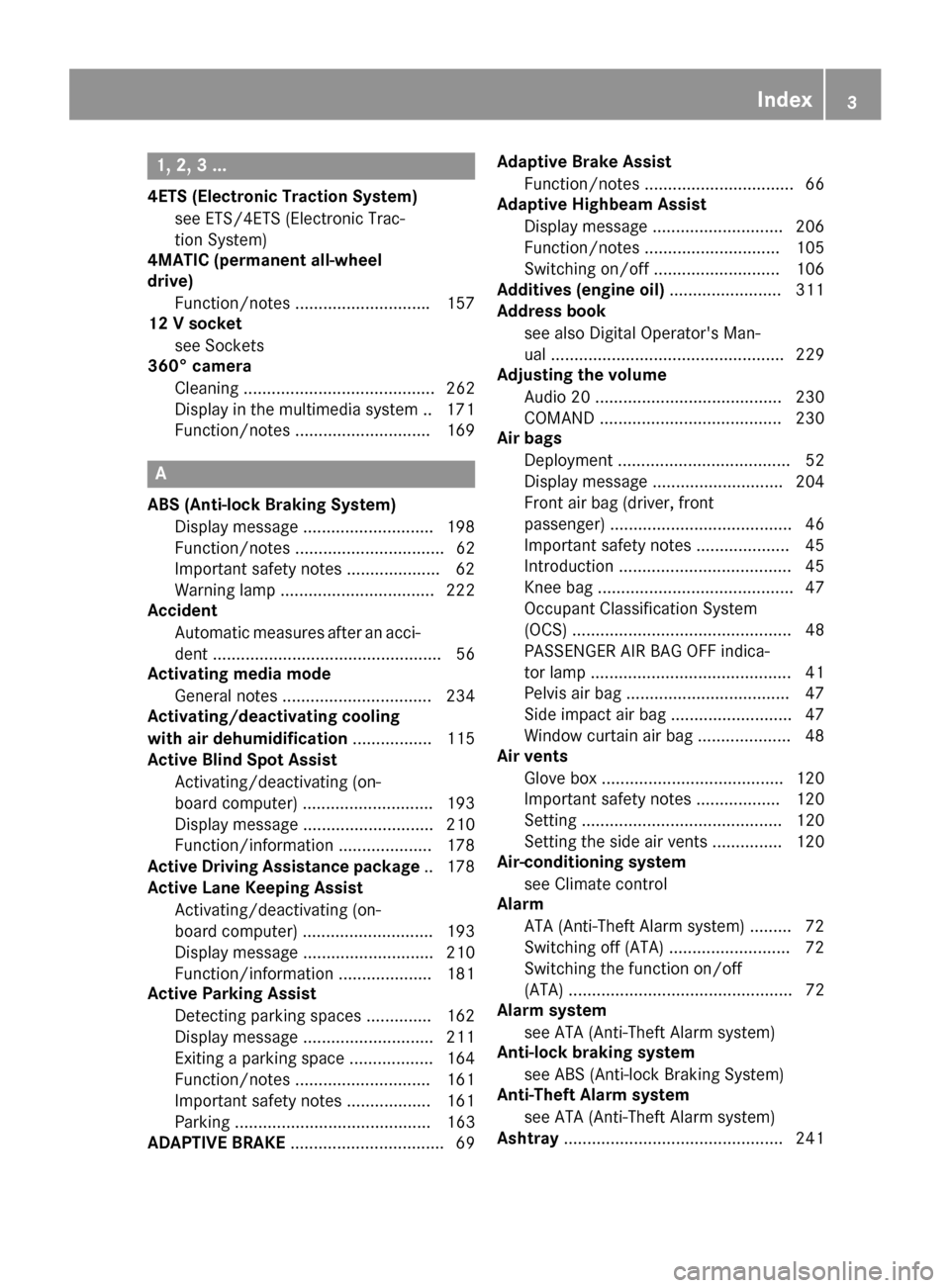
1, 2, 3 ...
4ETS (Electronic Traction System)see ETS/4ETS (Electronic Trac-
tion System)
4MATIC (permanent all-wheel
drive)
Function/notes ............................ .157
12 V socket
see Sockets
360° camera
Cleaning ......................................... 262
Display in the multimedia system .. 171
Function/notes .............................1 69
A
ABS (Anti-lock Braking System)
Display message ............................ 198
Function/notes ................................ 62
Important safety notes .................... 62
Warning lamp ................................. 222
Accident
Automatic measures after an acci-
dent ................................................. 56
Activating media mode
General notes ................................ 234
Activating/deactivating cooling
with air dehumidification ................. 115
Active Blind Spot Assist
Activating/deactivating (on-
board computer) ............................ 193
Display message ............................ 210
Function/information .................... 178
Active Driving Assistance package .. 178
Active Lane Keeping Assist
Activating/deactivating (on-
board computer) ............................ 193
Display message ............................ 210
Function/information .................... 181
Active Parking Assist
Detecting parking spaces .............. 162
Display message ............................ 211
Exiting a parking space .................. 164
Function/notes ............................. 161
Important safety notes .................. 161
Parking .......................................... 163
ADAPTIVE BRAKE ................................. 69 Adaptive Brake Assist
Function/notes ................................ 66
Adaptive Highbeam Assist
Display message ............................ 206
Function/notes ............................. 105
Switching on/off ........................... 106
Additives (engine oil) ........................ 311
Address book
see also Digital Operator's Man-
ual .................................................. 229
Adjusting the volume
Audio 20 ........................................ 230
COMAND ....................................... 230
Air bags
Deployment ..................................... 52
Display message ............................ 204
Front air bag (driver, front
passenger) ....................................... 46
Important safety notes .................... 45
Introduction ..................................... 45
Knee bag .......................................... 47
Occupant Classification System
(OCS) ............................................... 48
PASSENGER AIR BAG OFF indica-
tor lamp ........................................... 41
Pelvis air bag ................................... 47
Si
de impact air bag .......................... 47
Window curtain air bag .................... 48
Air vents
Glove box ....................................... 120
Important safety notes .................. 120
Setting ........................................... 120
Setting the side air vents ............... 120
Air-conditioning system
see Climate control
Alarm
ATA (Anti-Theft Alarm system) ......... 72
Switching off (ATA) .......................... 72
Switching the function on/off
(ATA) ................................................ 72
Alarm system
see ATA (Anti-Theft Alarm system)
Anti-lock braking system
see ABS (Anti-lock Braking System)
Anti-Theft Alarm system
see ATA (Anti-Theft Alarm system)
Ashtray ............................................... 241
Index3
Page 7 of 318
see Active Blind Spot Assist
Bluetooth®
Connecting another mobile
phone ............................................ 234
Searching for a mobile phone ........ 233
see also Digital Operator's Man-
ual .................................................. 229
Telephony ...................................... 232
Brake Assist
see BAS (Brake Assist System)
Brake fluid
Display message ............................2 00
Notes ............................................. 311
Brake force distribution
see EBD (electronic brake force
distribution)
Brake lamps
Display message ............................ 206
Brakes
ABS ..................................................6 2
Adaptive Brake Assist ...................... 66
BAS .................................................. 63
BAS PLUS with Cross-Traffic
Assist ............................................... 63
Brake fluid (notes) ......................... 311
Display message ............................ 198
HOLD function ............................... 156
Important safety notes .................. 142
Maintenance .................................. 143
Parking brake ................................ 139
Riding tips ...................................... 142
Warning lamp ................................. 221
Breakdown
Where will I find...? ........................ 266
see Flat tire
Brightness control (instrument
cluster lighting) ................................... 33
Bulbs
see Replacing bulbs
C
CaliforniaImportant notice for retail cus-
tomers and lessees .......................... 25
Calling up a malfunction
see Display messages Car
see Vehicle
Care
360° camera ................................. 262
Car wash ........................................ 259
Carpets .......................................... 265
Display ........................................... 263
Exhaust pipe .................................. 263
Exterior lights ................................ 262
Gear or selector lever .................... 263
Interior ........................................... 263
Matte finish ................................... 261
Notes ............................................. 259
Paint .............................................. 260
Plastic trim .................................... 263
Power washer ................................ 260
Rear view camera .......................... 262
Roof lining ...................................... 265
Seat belt ........................................ 264
Seat cover ..................................... 264
Sensors ......................................... 262
Steering wheel ............................... 263
Trim pieces .................................... 264
Washing by hand ........................... 260
Wheels ........................................... 261
Windows ........................................ 261
Wiper blades .................................. 261
Wooden trim .................................. 264
Cargo tie down rings ......................... 238
CD
see also Digital Operator's Man-
ual .................................................. 229
CD player (on-board computer) ........ 189
Center console
Lower section .................................. 37
Upper section .................................. 36
Central locking
Automatic locking (on-board com-puter) ............................................. 195
Locking/unlocking (SmartKey) ........ 73
Changing bulbs
High-beam headlamps ................... 108
Child
Restraint system .............................. 58
Child seat
Forward-facing restraint system ...... 60
LATCH-type (ISOFIX) child seat
anchors ............................................ 59
Index5
Page 9 of 318
Cup holderCenter console .............................. 240
Important safety notes .................. 240
Rear compartment ........................ .240
Customer Assistance Center
(CAC) ..................................................... 28
Customer Relations Department ....... 28
D
Dashboard
see Instrument cluster
Data
see Technical data
Data carrier
Selecting ........................................ 189
Daytime running lamps
Display message ............................ 206
Function/notes .............................1 03
Switching on/off (on-board com-
puter) ............................................. 194
Declarations of conformity ................. 27
Delayed switch-off
Exterior lighting (on-board com-
puter) ............................................. 194
Interior lighting .............................. 195
Diagnostics connection ......................28
Digital Operator's Manua l
Help ................................................ .22
Introduction .....................................2 2
Digital speedomete r........................ .187
DIRECT SELECT lever
Automatic transmission ................. 128
Display messages
ASSYST PLUS ................................ 257
Calling up (on-board computer) ..... 197
Driving systems .............................2 09
Engine ............................................ 207
General notes ................................ 197
Hiding (on-board computer) ........... 197
KEYLESS-GO .................................. 218
Lights ............................................. 206
Safety systems .............................. 198
SmartKey ....................................... 218
Tires ............................................... 214
Vehicle ...........................................2 15
Distance recorder .............................1 86
Distance warning (warning lamp) .... 227Distance warning function
Function/notes ................................ 65
DISTRONIC PLUS
Activating ....................................... 149
Activation conditions ..................... 149
Deactivating ................................... 152
Display message ............................ 211
Displays in the multifunction dis-
play ............................ .................... 152
Fu
nction/notes .............................1 47
Important safety notes .................. 147
Setting the specified minimum
distance ......................................... 151
Stopping ........................................ 150
Doors
Automatic locking (on-board com-
puter) ............................................. 195
Automatic locking (switch) ...............7 9
Central locking/unlocking
(SmartKey) ...................................... .73
Control panel .................................. .39
Display message ............................ 217
Emergency locking ........................... 80
Emergency unlocking ....................... 80
Important safety notes .................... 78
Opening (from inside) ...................... 78
Drinking and driving ......................... 141
Drive program
Automatic ...................................... 132
Display (DIRECT SELECT lever) ...... 128
Manual ........................................... 132
Manual (vehicles with Sports
package AMG) ............................... 133
Driver's door
see Doors
Driving abroad
Mercedes-Benz Service ................. 258
Driving on flooded roads .................. 144
Driving safety systems
ABS (Anti-lock Braking System) ....... 62
ADAPTIVE BRAKE ............................. 69
Adaptive Brake Assist ...................... 66
BAS (Brake Assist System) .............. 63
BAS PLUS with Cross-Traffic
Assist ............................................... 63
COLLISION PREVENTION ASSIST
PLUS ................................................ 65
Distance warning function ............... 65
Index7
Page 22 of 318
Locking (in an emergency) ............... 80
Locking (SmartKey) .......................... 73
Lowering ........................................ 303
Maintenance .................................... 26
Parking for a long period ................ 140
Pulling away ................................... 124
Raising ........................................... 301
Reporting problems ......................... 28
Securing from rolling away ............ 300
Towing away .................................. 276
Transporting .................................. 278
Unlocking (in an emergency) ........... 80
Unlocking (SmartKey) ...................... 73
Vehicle data ................................... 313
Vehicle data ....................................... 313
Vehicle dimensions ........................... 313
Vehicle emergency locking ................ 80
Vehicle identification number
see VIN
Vehicle identification plate .............. 307
Vehicle tool kit .................................. 266
Video
Operating the DVD ......................... 189
see also Digital Operator's Man-
ual .................................................. 229
VIN
Seat ............................................... 308
Type plate ...................................... 307
Voice Control System
see Separate operating instructions
W
Warning and indicator lampsABS ................................................ 222
Brakes ........................................... 221
Check Engine ................................. 225
Coolant .......................................... 225
Distance warning ........................... 227
ESP
®.............................................. 222
ESP®OFF ....................................... 223
Fuel tank ........................................ 225
General notes ................................ 219
Overview .......................................... 33
PASSENGER AIR BAG OFF ............... 41
Reserve fuel ................................... 225
Restraint system ............................ 224
Seat belt ........................................ 220 Tire pressure monitor .................... 228
Warranty .............................................. 25
Washer fluid
Display message ............................ 218
Wheel and tire combinations
Tires ............................................... 303
Wheel bolt tightening torque ........... 303
Wheel chock ...................................... 300
Wheels
Changing a wheel .......................... 299
Checking ........................................ 281
Cleaning ......................................... 261
Emergency spare wheel ................. 304
Important safety notes .................. 281
Information on driving .................... 281
Interchanging/changing ................ 299
Mounting a new wheel ................... 302
Mounting a wheel .......................... 300
Removing a wheel .......................... 302
Storing ........................................... 300
Tightening torque ........................... 303
Wheel size/tire size ....................... 303
Window curtain air bag
Operation ......................................... 48
Windows
see Side windows
Windshield
Defrosting ...................................... 117
Windshield washer fluid
see Windshield washer system
Windshield washer system
Adding washer fluid ....................... 257
Important safety notes .................. 312
Windshield wipers
Problem (malfunction) ................... 110
Replacing the wiper blades ............ 109
Switching on/off ........................... 108
Winter driving
Important safety notes .................. 283
Slippery road surfaces ................... 144
Snow chains .................................. 283
Winter tires
M+S tires ....................................... 283
Wiper blades
Cleaning ......................................... 261
Important safety notes .................. 109
Replacing ....................................... 109
20Index
Page 35 of 318
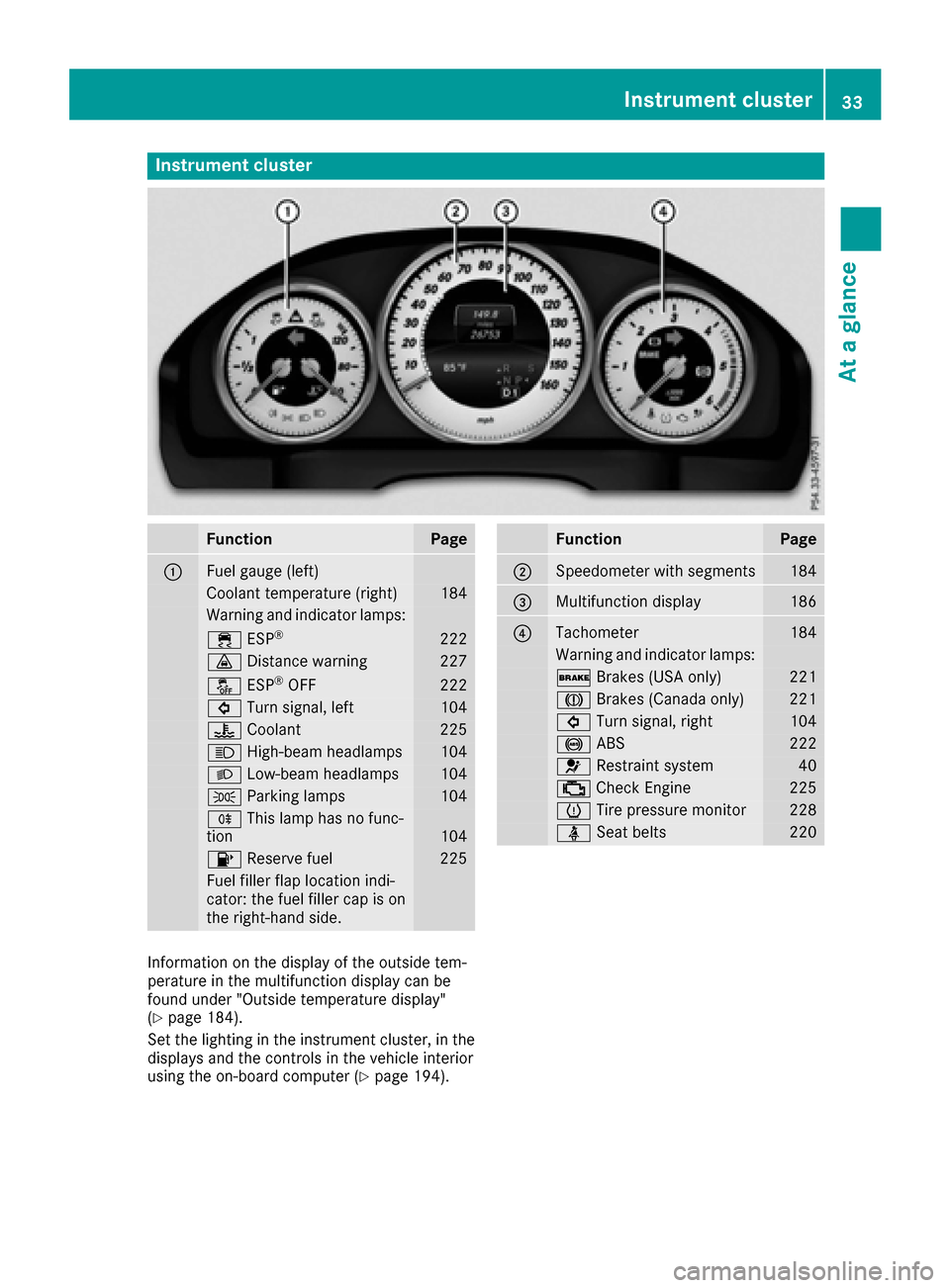
Instrument cluster
FunctionPage
:Fuelgauge (left)
Coolan ttemperature (right )184
Warning and indicator lamps:
÷ ESP®22 2
· Distanc ewarning22 7
å ESP®OF F222
# Turn signal, lef t104
? Coolan t225
K High-beam headlamps104
L Low-beam headlamps104
T Parking lamp s104
R This lamp has no func-
tion10 4
8 Reserve fuel225
Fue lfiller flap location indi-
cator: th efuel filler cap is on
th eright-hand side .
FunctionPage
;Speedometer wit hsegments18 4
=Multifunction display186
?Tachometer184
Warning and indicator lamps:
$ Brakes(US Aonly)22 1
J Brakes(Canada only)22 1
# Turn signal, right104
! ABS222
6 Restrain tsystem40
; CheckEngin e225
h Tirepressur emonitor22 8
ü Seat belt s220
Information on th edisplay of th eoutside tem-
peratur ein th emultifunction display can be
foun dunder "Outside temperature display"
(
Ypage 184).
Se tth elighting in th einstrumen tcluster, in th e
displays and th econtrol sin th evehicl einterior
usin gth eon-board computer (
Ypage 194).
Instrument cluster33
At a glance
Page 44 of 318
The seat belt system comprises:
RSeat belts
REmergency Tensioning Devices for the front
seat belts and the outer seat belts in the rear
RSeat belt force limiters for the front seat belts
and the outer seat belts in the rear
If the seat belt is pulled by the seat belt extender
quickly or with a jerky movement, the belt
retractor locks. The belt strap cannot be extrac-
ted any further.
The Emergency Tensioning Device tightens the
seat belt in an accident, pulling the belt close
against the body. However it does not pull the
vehicle occupant back in the direction of the
backrest.
The Emergency Tensioning Device does not cor-
rect an incorrect seat position or the routing of
an incorrectly fastened seat belt.
When triggered, a seat belt force limiter helps to
reduce the force exerted by the seat belt on the
vehicle occupant.
The seat belt force limiters for the front seats are
synchronized with the front air bags, which
absorb part of the deceleration force. This can
reduce the force exerted on the vehicle occu-
pants during an accident.
!If the front-passenger seat is not occupied,
do not engage the seat belt tongue in the
buckle on the front-passenger seat. Other-
wise, in the event of an accident, the Emer-
gency Tensioning Device and front-passenger
front air bag may be triggered and would need
to be replaced.
Important safety notes
The use of seat belts and child restraint systems
is required by law in:
Rall 50 states
Rthe U.S. territories
Rthe District of Columbia
Rall Canadian provinces
Even where this is not required by law, all vehicle
occupants should correctly fasten their seat
belts before starting the journey.
GWARNING
If the seat belt is incorrectly fastened, it can-
not protect as intended. Furthermore, an
incorrectly fastened seat belt can cause addi-
tional injury, for example, in an accident, dur-
ing braking or when abruptly changing direc-
tion. This poses an increased risk of injury or
even fatal injury.
Make sure that all vehicle occupants are
seated properly with a correctly fastened seat belt.
GWARNING
The seat belt does not offer the intended level of protection if you have not moved the back-
rest to an almost vertical position. When brak-
ing or in the event of an accident, you could
slide underneath the seat belt and sustain
abdomen or neck injuries, for example. This
poses an increased risk of injury or even fatal injury.
Adjust the seat properly before beginning
your journey. Always ensure that the backrest
is in an almost vertical position and that the
shoulder section of your seat belt is routed
across the center of your shoulder.
GWARNING
Persons under 5 ft (1.50 m) in height cannot
fasten the seat belt correctly without an addi- tional suitable restraint system. If the seat
belt is incorrectly fastened, it cannot protect
as intended. Furthermore, an incorrectly fas-
tened seat belt can cause additional injury, for
example, in an accident, during braking or an
abrupt change of direction. This poses an
increased risk of injury or even fatal injury.
For this reason, always secure persons under
5 ft (1.50 m) in height in suitable restraint
systems.
If a child younger than twelve years old and
under 5 ft (1.50 m)in height is traveling in the
vehicle:
Ralways secure the child in a child restraint
system suitable for this Mercedes-Benz vehi-
cle. The child restraint system must be appro-
priate to the age, weight and size of the child
Ralways observe the instructions and safety
notes on "Children in the vehicle"
(
Ypage 56) in addition to the child restraint
42Occupant safety
Safety
Page 51 of 318
Prerequisites
To be classified correctly, the front passenger
must sit:
Rwith the seat belt fastened correctly
Rin an almost upright position with their back
against the seat backrest
Rwith their feet resting on the floor, if possible
If the front passenger does not observe these
conditions, OCS may produce a false classifica-
tion, e.g. because the front passenger:
Rtransfers their weight by supporting them-
selves on a vehicle armrest
Rsits in such a way that their weight is raised
from the seat cushion
If it is absolutely necessary to install a child
restraint system on the front-passenger seat, be
sure to observe the correct positioning of the
child restraint system. Never place objects
under or behind the child restraint system, e.g.
cushions. The entire base of the child restraint
system must always rest on the seat cushion of the front-passenger seat. The backrest of the
forward-facing child restraint system must lie as
flat as possible against the backrest of the front-
passenger seat.
The child restraint system must not touch the
roof or be subjected to a load by the head
restraint. Adjust the angle of the seat backrest
and the head restraint position accordingly.
Only then can OCS be guaranteed to function
correctly. Always observe the child restraint sys-
tem manufacturer's installation instructions.
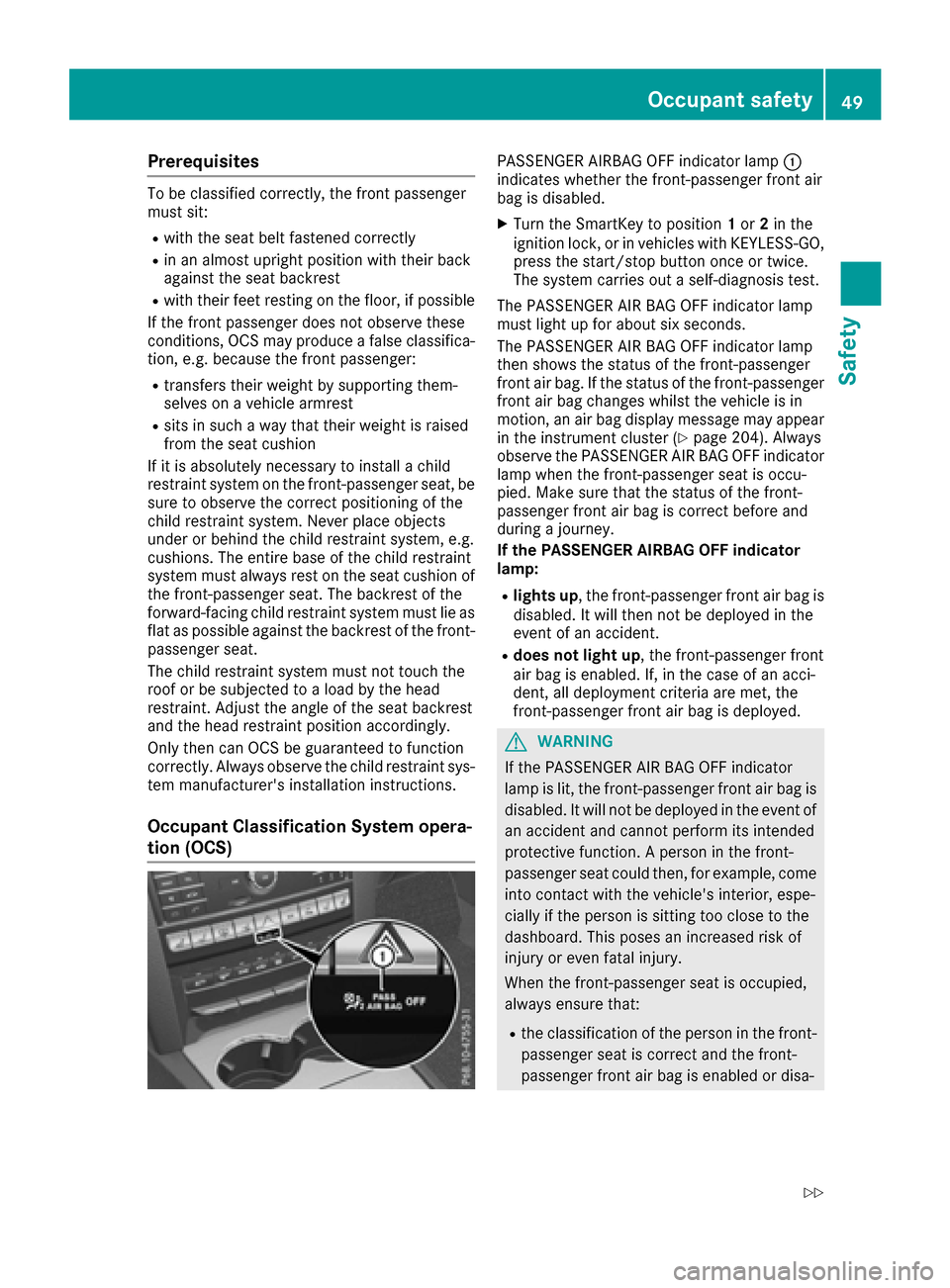
Occupant Classification System opera-
tion (OCS)
PASSENGER AIRBAG OFF indicator lamp :
indicates whether the front-passenger front air
bag is disabled.
XTurn the SmartKey to position 1or 2in the
ignition lock, or in vehicles with KEYLESS-GO,
press the start/stop button once or twice.
The system carries out a self-diagnosis test.
The PASSENGER AIR BAG OFF indicator lamp
must light up for about six seconds.
The PASSENGER AIR BAG OFF indicator lamp
then shows the status of the front-passenger
front air bag. If the status of the front-passenger
front air bag changes whilst the vehicle is in
motion, an air bag display message may appear
in the instrument cluster (
Ypage 204). Always
observe the PASSENGER AIR BAG OFF indicator
lamp when the front-passenger seat is occu-
pied. Make sure that the status of the front-
passenger front air bag is correct before and
during a journey.
If the PASSENGER AIRBAG OFF indicator
lamp:
Rlights up, the front-passenger front air bag is
disabled. It will then not be deployed in the
event of an accident.
Rdoes not light up, the front-passenger front
air bag is enabled. If, in the case of an acci-
dent, all deployment criteria are met, the
front-passenger front air bag is deployed.
GWARNING
If the PASSENGER AIR BAG OFF indicator
lamp is lit, the front-passenger front air bag is
disabled. It will not be deployed in the event of
an accident and cannot perform its intended
protective function. A person in the front-
passenger seat could then, for example, come
into contact with the vehicle's interior, espe-
cially if the person is sitting too close to the
dashboard. This poses an increased risk of
injury or even fatal injury.
When the front-passenger seat is occupied,
always ensure that:
Rthe classification of the person in the front- passenger seat is correct and the front-
passenger front air bag is enabled or disa-
Occupant safety49
Safety
Z
Page 60 of 318
Child restraint system
The use of seat belts and child restraint systems
is required by law in:
Rall 50 states
Rthe U.S. territories
Rthe District of Columbia
Rall Canadian provinces
You can obtain further information about the
correct child restraint system from any author-
ized Mercedes-Benz Center.
GWARNING
If the child restraint system is installed incor-
rectly on a suitable seat, it cannot protect as
intended. The child cannot then be restrained
in the event of an accident, heavy braking or
sudden changes of direction. There is an
increased risk of injury, possibly even fatal.
Make sure that you observe the child restraint
system manufacturer's installation instruc-
tions and the notes on use. Please ensure,
that the base of the child restraint system is
always resting completely on the seat cush-
ion. Never place objects, e.g. cushions, under or behind the child restraint system. Only use
child restraint systems with the original cover
designed for them. Only replace damaged
covers with genuine covers.
GWARNING
If the child restraint system is installed incor-
rectly or is not secured, it can come loose in
the event of an accident, heavy braking or a
sudden change in direction. The child
restraint system could be thrown about, strik-
ing vehicle occupants. There is an increased
risk of injury, possibly even fatal.
Always install child restraint systems prop-
erly, even if they are not being used. Make
sure that you observe the child restraint sys-
tem manufacturer's installation instructions.
You will find further information on stowing
objects, luggage or loads under "Loading guide-
lines" (
Ypage 235).
GWARNING
Child restraint systems or their securing sys-
tems which have been damaged or subjected
to a load in an accident can no longer protect
as intended. The child cannot then be
restrained in the event of an accident, heavy
braking or sudden changes of direction. There is an increased risk of injury, possibly even
fatal.
Replace child restraint systems which have
been damaged or subjected to a load in an
accident as soon as possible. Have the secur-
ing systems on the child restraint system
checked at a qualified specialist workshop,
before you install a child restraint system
again.
The securing systems of child restraint systems
are:
Rthe seat belt system
Rthe LATCH-type (ISOFIX) securing rings
Rthe Top Tether anchorages
If it is absolutely necessary to carry a child on
the front-passenger seat, be sure to observe the
information on the "Occupant Classification
System (OCS)" (
Ypage 48). There you will also
find information on deactivating the front-
passenger front air bag.
All child restraint systems must meet the fol-
lowing standards:
RU.S. Federal Motor Vehicle Safety Standards
213 and 225
RCanadian Motor Vehicle Safety Standards
213 and 210.2
Confirmation that the child restraint system cor-
responds to the standards can be f
ound on an
instruction label on the child restraint system.
This confirmation can also be found in the instal-
lation instructions that are included with the
child restraint system.
Observe the warning labels in the vehicle inte-
rior and on the child restraint system.
58Children in the vehicle
Safety
Page 62 of 318
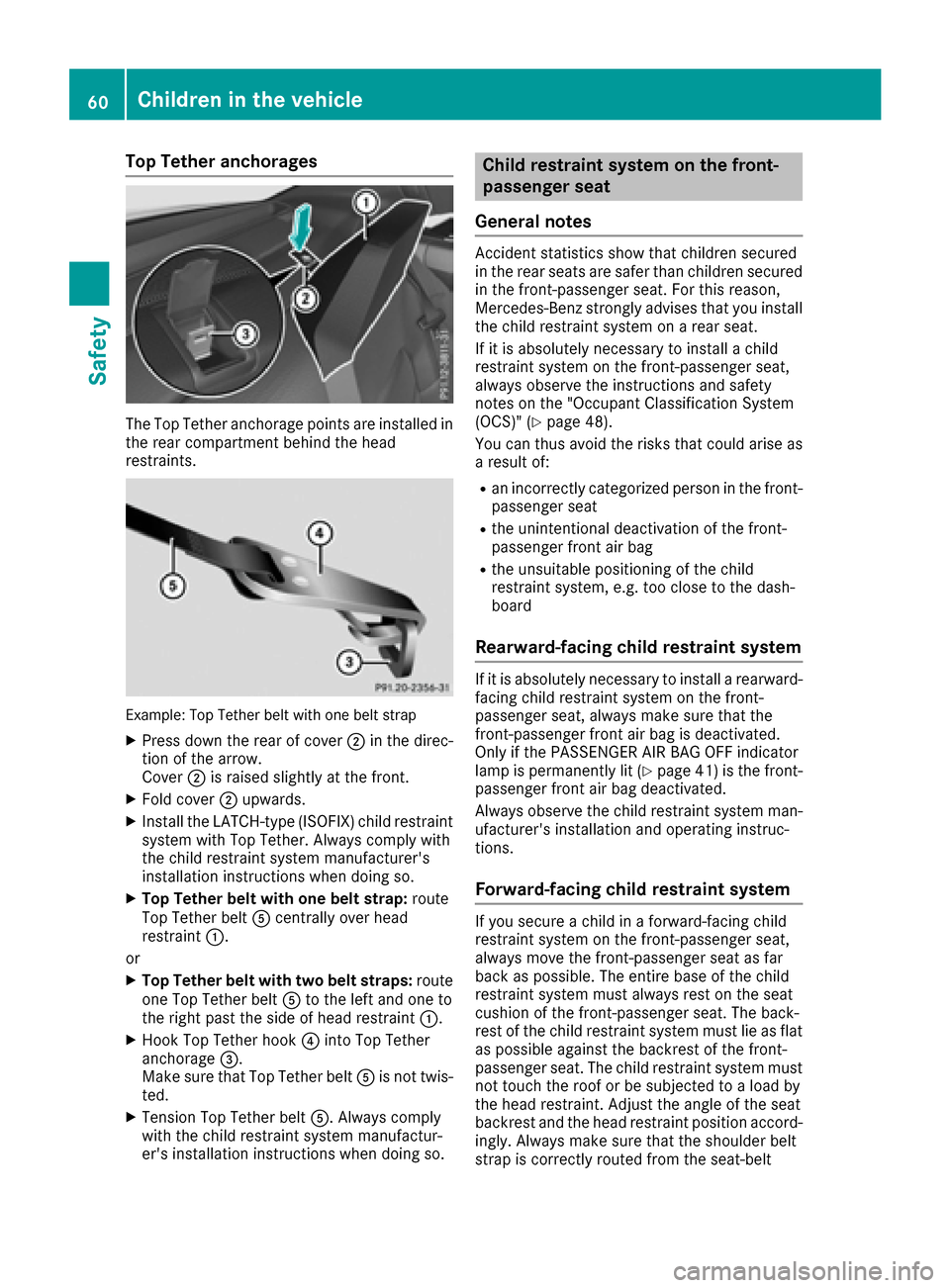
Top Tether anchorages
The Top Tether anchorage points are installed in
the rear compartment behind the head
restraints.
Example: Top Tether belt with one belt strap
XPress down the rear of cover ;in the direc-
tion of the arrow.
Cover ;is raised slightly at the front.
XFold cover ;upwards.
XInstall the LATCH-type (ISOFIX) child restraint
system with Top Tether. Always comply with
the child restraint system manufacturer's
installation instructions when doing so.
XTop Tether belt with one belt strap: route
Top Tether belt Acentrally over head
restraint :.
or
XTop Tether belt with two belt straps: route
one Top Tether belt Ato the left and one to
the right past the side of head restraint :.
XHook Top Tether hook?into Top Tether
anchorage =.
Make sure that Top Tether belt Ais not twis-
ted.
XTension Top Tether belt A. Always comply
with the child restraint system manufactur-
er's installation instructions when doing so.
Child restraint system on the front-
passenger seat
General notes
Accident statistics show that children secured
in the rear seats are safer than children secured
in the front-passenger seat. For this reason,
Mercedes-Benz strongly advises that you install
the child restraint system on a rear seat.
If it is absolutely necessary to install a child
restraint system on the front-passenger seat,
always observe the instructions and safety
notes on the "Occupant Classification System
(OCS)" (
Ypage 48).
You can thus avoid the risks that could arise as a result of:
Ran incorrectly categorized person in the front-
passenger seat
Rthe unintentional deactivation of the front-
passenger front air bag
Rthe unsuitable positioning of the child
restraint system, e.g. too close to the dash-
board
Rearward-facing child restraint system
If it is absolutely necessary to install a rearward-
facing child restraint system on the front-
passenger seat, always make sure that the
front-passenger front air bag is deactivated.
Only if the PASSENGER AIR BAG OFF indicator
lamp is permanently lit (
Ypage 41 )is the front-
passenger front air bag deactivated.
Always observe the child restraint system man-
ufacturer's installation and operating instruc-
tions.
Forward-facing child restraint system
If you secure a child in a forward-facing child
restraint system on the front-passenger seat,
always move the front-passenger seat as far
back as possible. The entire base of the child
restraint system must always rest on the seat
cushion of the front-passenger seat. The back-
rest of the child restraint system must lie as flat as possible against the backrest of the front-
passenger seat. The child restraint system must
not touch the roof or be subjected to a load by
the head restraint. Adjust the angle of the seat
backrest and the head restraint position accord-ingly. Always make sure that the shoulder belt
strap is correctly routed from the seat-belt
60Children in the vehicle
Safety
Page 64 of 318
Pets in the vehicle
GWARNING
If you leave animals unattended or unsecured
in the vehicle, they could press buttons or
switches, for example.
As a result, they could:
Ractivate vehicle equipment and become
trapped, for example
Ractivate or deactivate systems, thereby
endangering other road users
Unsecured animals could also be flung around
the vehicle in the event of an accident or sud-
den steering or braking, thereby injuring vehi-
cle occupants. There is a risk of an accident
and injury.
Never leave animals unattended in the vehi-
cle. Always secure animals properly during
the journey, e.g. use a suitable animal trans-
port box.
Driving safety systems
Overview of driving safety systems
In this section, you will find information about
the following driving safety systems:
RABS (Anti-lock BrakingSystem)
(Ypage 62)
RBAS ( Brake Assist System) (Ypage 63)
RBAS PLUS ( BrakeAssist System PLUS) with
Cross-Traffic Assist (Ypage 63)
RCOLLISION PREVENTION ASSIST PLUS
(Ypage 65)
RESP®(Electronic StabilityProgram)
(Ypage 67)
REBD ( Electronic Brake force Distribution)
(Ypage 69)
RADAPTIVE BRAKE (Ypage 69)
RPRE-SAFE®Brake (Ypage 69)
RSTEER CONTROL (Ypage 71)
Important safety notes
If you fail to adapt your driving style or if you are
inattentive, the driving safety systems can nei- ther reduce the risk of an accident nor override
the laws of physics. Driving safety systems are
merely aids designed to assist driving. You are
responsible for maintaining the distance to the
vehicle in front, for vehicle speed, for braking in
good time, and for staying in lane. Always adapt
your driving style to suit the prevailing road and weather conditions and maintain a safe distance
from the vehicle in front. Drive carefully.
The driving safety systems described only work as effectively as possible when there is ade-
quate contact between the tires and the road
surface. Please pay special attention to the
notes on tires, recommended minimum tire
tread depths, etc. (
Ypage 281).
In wintry driving conditions, always use winter
tires (M+S tires) and if necessary, snow chains.
Only in this way will the driving safety systems
described in this section work as effectively as
possible.
ABS (Anti-lock Braking System)
General information
ABS regulates brake pressure in such a way that
the wheels do not lock when you brake. This
allows you to continue steering the vehicle when
braking.
The ! ABS warning lamp in the instrument
cluster lights up when the ignition is switched
on. It goes out when the engine is running.
ABS works from a speed of about 5 mph
(8 km/h), regardless of road-surface conditions.
ABS works on slippery surfaces, even when you
only brake gently.
Important safety notes
iObserve the "Important safety notes" sec-
tion (Ypage 62).
GWARNING
If ABS is faulty, the wheels could lock when
braking. The steerability and braking charac-
teristics may be severely impaired. Addition-
ally, further driving safety systems are deac-
tivated. There is an increased danger of skid-
ding and accidents.
Drive on carefully. Have ABS checked imme-
diately at a qualified specialist workshop.
62Driving safety systems
Safety