warning light MERCEDES-BENZ E-CLASS COUPE 2018 Workshop Manual
[x] Cancel search | Manufacturer: MERCEDES-BENZ, Model Year: 2018, Model line: E-CLASS COUPE, Model: MERCEDES-BENZ E-CLASS COUPE 2018Pages: 486, PDF Size: 6.31 MB
Page 311 of 486
Battery disconnection periods
The ASSYST PLUS service inter val display
can only calculate the service due da tewhen
th e batte ryis connected.
#Notedown the service due date displa yed in
th e instrument display before disconnecting
th e battery (
→page 308).
Engine compartment
Ac tive hood (pedestrian pr otection)
Operation of the active hood (pedestrian pro‐
te ction)
In cer tain accident situations, therisk of injury
to pedestrians can be reduced bythe actuation
of the active hood. The rear area of the engine
hood is raised byappr oximately 85 mm.
Fo rth e drive tothewo rkshop, reset the trig‐
ge red active hood yourself. Ifth e active hood
has been triggered, pedestrian pr otection may
be limited.
A qu alified specialist workshop must re-ins tate
th e full functionality of the active hood. The active hood is not
available in all countries.
Re setting the active hood
&
WARNING Risk of burn s from hot com‐
ponent parts in the engine compartment
Cer tain component parts in the engine com‐
partment can be very hot, e.g. the engine,
th e cooler and parts of theex haust sy stem.
#Let the engine cool down and only
to uch the component parts described
as follo ws .
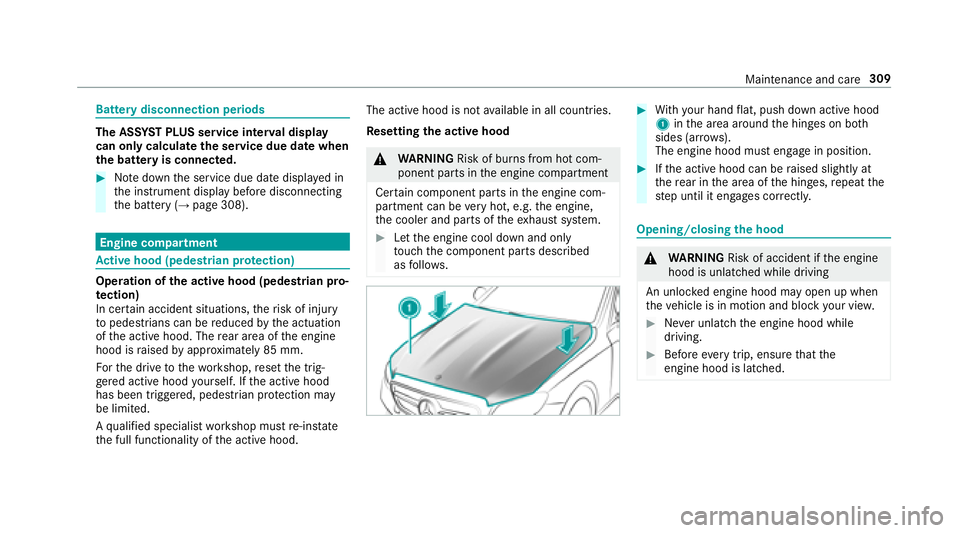
#With your hand flat, push down active hood
1 inthe area around the hinges on bo th
sides (ar rows).
The engine hood must engage in position.
#If th e active hood can be raised slightly at
th ere ar in the area of the hinges, repeat the
st ep until it engages cor rectl y.
Opening/closing the hood
&
WARNING Risk of accident if the engine
hood is unlatched while driving
An unloc ked engine hood may open up when
th eve hicle is in motion and block your vie w.
#Never unlatch the engine hood while
driving.
#Before every trip, ensure that the
engine hood is latched.
Maintenance and care 309
Page 313 of 486
&WARNING Risk of injury from usingthe
windshield wipers while the engine hood
is open
When the engine hood is open and the wind‐
shield wipers are set in motion, you can be
trapped bythe wiper linkage.
#Alw ays switch off the windshield wipers
and ignition before opening the engine
hood.
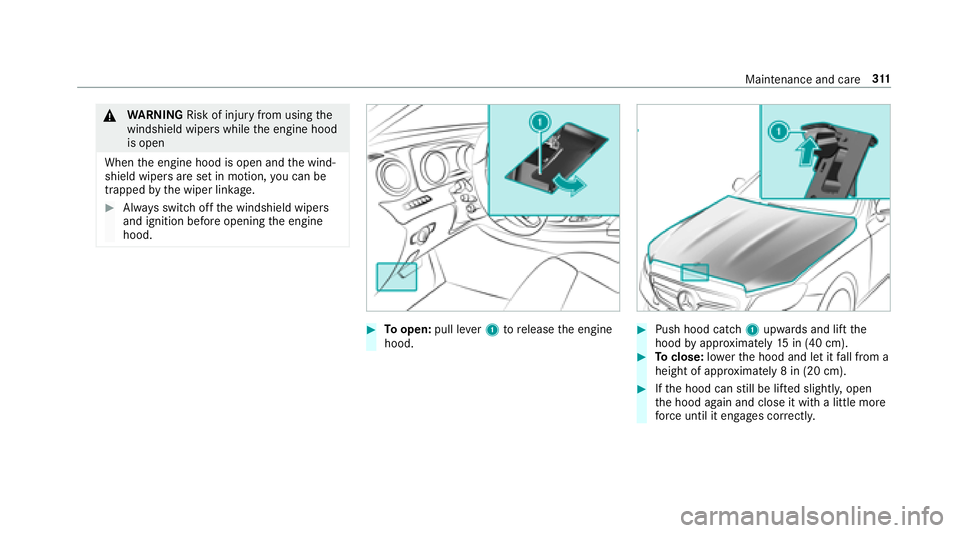
#To open: pull lever1 torelease the engine
hood.#Push hood catch 1upwards and lift the
hood byappr oximately 15in (40 cm).
#Toclose: lowe rth e hood and let it fall from a
height of appr oximately 8 in (20 cm).
#Ifth e hood can still be lif ted slightl y,open
th e hood again and close it with a little more
fo rc e until it engages cor rectl y.
Maintenance and care 31
1
Page 318 of 486
RThe blowerfo rth eve ntilation/heating is
switched off.
RThe windshield wiper switch is in position 0.
RIn car washes with a towing mechanism: neu‐
tral iis engaged.
RThe SmartK eyis at a dis tance of at least
10 ft(3 m) away from theve hicle, otherwise
th e trunk lid could open unintentionall y.
% Remo vethewa x from the windshield and
wiper rubber af terth e car wash; this will pre‐
ve nt smearing and reduce wiper noise.
Information on using a po werwa sher
&
WARNING Risk of accident when using
high-pressure cleaning equipment wi th
ro und-s pray nozzles
The wate r jet from a round-s pray nozzle (dirt
grinder) may cause damage totires and sus‐
pension components that is not visible.
Components damaged in this wa yma yfa il
unexpec tedly.
#Do not use high-pressure cleaning
equipment wi thround-spr aynozzles to
clean your vehicle.
#Damaged tires or suspension compo‐
nents must be replaced immediatel y.
Toavo id damage to yourvehicle, obser vethefo l‐
lowing when using a po werwa sher:
RKeep the SmartK eyat least 10ft(3 m) away
from theve hicle. Otherwise the trunk lid
could open unintentionall y.
RMaintain a distance of at least 11.8 in
(30 cm) totheve hicle.
RVe hicles with deco rative foil: parts of your
ve hicle are co vered with a decorative foil.
Maintain a dis tance of at least 27.6 in
(70 cm) between thefo il-c ove red parts of the
ve hicle and the nozzle of the high pressure
cleaner. Mo vethe po werwa sher nozzle
around whilst cleaning.
RObser vethe information on the cor rect dis‐
ta nce in the equipment manufacturer's oper‐
ating instructions.
RDo not point the nozzle of the po werwa sher
directly at sensitive parts such as tires, slits,
electrical component parts, batteries, light
sources and ventilation slot s.
Washing the vehicle byhand
Obser velegal requ irements, forex ample in
some countries washing byhand is only allo wed
at specially equipped washing ba ys.
#Use a mild cleaning agent such as car sham‐
poo.
#Wa shtheve hicle with luk ewarmwate r and a
soft car sponge. While doing so, do not
ex pose theve hicle todirect sunlight.
#Hose down theve hicle carefully with water
and dry it with a leather clo th. Make sure
th at thewate r jet is not pointed directly into
th e air inlet grille.
31 6
Maintenance and care
Page 321 of 486
Information on cleaning and careAvoiding vehicle damage
Wi per blades
Fold out the wiper blades and clean them using a damp clo th.D o not clean the wiper blades too of ten.
Ex terior lighting
Cleanthe lenses with a wet sponge and mild de terg ent, e.g.
car shampoo. Only use cleaning agents or cleaning clo
thsth at are suitable
fo r plast ic lenses.
Sensors Cleanthe sensors in the front and rear bumpers and in the
ra diator grille with a soft clo thand car shampoo. When using a high-pressure
water jet, maintain a minimum
dis tance of 11.8 in (30 cm).
Re ar view camera
and 360° Camera
ROpen the camera co ver with the multimedia sys‐
te m(→page 184) .
RUse clear water and a soft clo thtoclean the camera lens. Do not use a high-pressure
water jet.
Ta ilpipes
Clean with cleaning agents recommended byMercedes-Benz,
particular lyin the winter and af terwa shing theve hicle. Use acid-free cleaning agents.
Note
s on care of the interior
&
WARNING Risk of injury from plastic
parts breaking off af terth e use of sol‐
ve nt-based care products
Ca reand cleaning products con taining sol‐
ve nts can cause surf aces inthe cockpit to
become porous.
When the airbags are deplo yed, plastic parts
may break away.
#Do not use any care or cleaning prod‐
ucts containing sol vents toclean the
cockpit.
& WARNING Risk of injury or death from
bleached seat belts
Bleaching or dyeing seat belts can se verely
we aken them.
This can, forex ample, cause seat belts to
te ar or fail in an accident.
#Ne ver bleach or dye seat belts.
Maintenance and care 31
9
Page 330 of 486
#Correct the tire pressure if it is still at least
13 0 kPa (1.3 bar/19 psi). See theTire and
Loading Info rmation placard on the driver's
side B‑pillar or the tire pressure table in the
fuel filler flap forva lues.
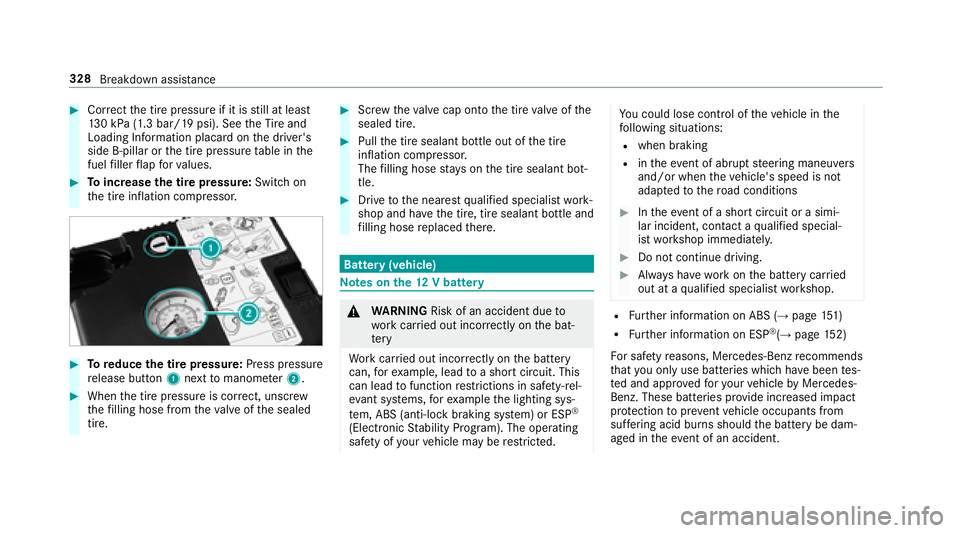
#To increase the tire pressure: Switchon
th e tire inflation compressor.
#To reduce the tire pressure: Press pressure
re lease button 1next tomanome ter2.
#When the tire pressure is cor rect, unscr ew
th efilling hose from theva lve of the sealed
tire.
#Scr ew theva lve cap onto the tire valve of the
sealed tire.
#Pull the tire sealant bottle out of the tire
inflation compressor.
The filling hose stay s on the tire sealant bot‐
tle.
#Drive tothe nearest qualified specialist work‐
shop and ha vethe tire, tire sealant bottle and
fi lling hose replaced there.
Bat tery (vehicle)
Note s onthe12 V battery
&
WARNING Risk of an accident due to
wo rkcar ried out incor rectly on the bat‐
te ry
Wo rkcar ried out incor rectly on the battery
can, forex ample, lead toa short circuit. This
can lead tofunction restrictions in saf ety-re l‐
eva nt sy stems, forex ample the lighting sys‐
te m, ABS (anti-lock braking system) or ESP
®
(Elect ronic Stability Prog ram). The operating
saf etyof your vehicle may be restricted.
Yo u could lose cont rol of theve hicle in the
fo llowing situations:
Rwhen braking
Rin theeve nt of ab rupt steering maneuvers
and/or when theve hicle's speed is not
adap tedto thero ad conditions
#In theeve nt of a short circuit or a simi‐
lar incident, contact a qualified special‐
ist workshop immediately.
#Do not continue driving.
#Alw ays ha vewo rkon the battery car ried
out at a qualified specialist workshop.
RFu rther information on ABS (→page 151)
RFu rther information on ESP®(→page 152)
Fo r saf etyre asons, Mercedes-Benz recommends
th at you only use batte ries which ha vebeen tes‐
te d and appr oved foryo ur vehicle byMercedes-
Benz. These batteries pr ovide inc reased impact
pr otection toprev ent vehicle occupants from
suf fering acid bu rns should the battery be dam‐
aged in theev ent of an accident.
328
Breakdown assis tance
Page 333 of 486
#Make surethat the positive term inal of
th e connected battery does not come
into conta ct withvehicle parts.
#Ne ver place me tal objects or tools on a
batter y.
#When connecting and disconnecting the
batter y,yo u must observ eth e descri‐
bed order forth e battery clamps.
#When giving starting assis tance, al ways
make sure that you only connect bat‐
te ry term inals with identical polarity.
#During starting assis tance, you must
observ eth e described order for con‐
necting and disconnecting the jumper
cables.
#Do not connect or disconnect the bat‐
te ry cla mp s while the engine is running.
&
WARNING Risk ofexplosion during
ch arging process and starting assis tance
During thech arging process and starting
assis tance, the battery may release an explo‐
sive gas mixture.
#Av oid fire , open flames, creating spar ks
and smoking.
#Make sure that there is suf ficient venti‐
lation du ring thech arging process and
during starting assis tance.
#Do not lean over a batter y.
Ifth e indicator/warning lamps in the instrument
clus ter do not light up at low temp eratures, it is
ve ry likely that the dischar ged battery has fro‐
zen.
& WARNING Risk ofexplosion from a fro‐
zen battery
A dischar ged battery may freeze at temp era‐
tures slightly abo veor below freezing point.
During starting assis tance or battery charg‐
ing, batte rygas may be released.
#Alw aysth aw a frozen batte ryout firs t
before charging it or per form ing start‐
ing assis tance.
The service li feof a battery that has been
th awe d may be dramatically shor tened. It is
recommended that you ha veathaw ed bat‐
te ry checked at a qualified specialist workshop.
All vehicles
* NO
TEDama gecaused bynumerous or
ex tended attem ptsto start the engine
Nume rous or extended attem ptsto start the
engine may damage the catalytic con verter
due tonon-combu sted fuel.
#Av oid numerous and extended attem pts
to start the engine.
Obser vethefo llowing points during starting
assis tance and when charging the battery:
ROnly use undamaged jumper cables/charg‐
ing cables with a suf ficient cross-section and
insula tedte rm inal clamps.
RNon- insulated parts of thete rm inal clamps
must not come into con tact wi thother me tal
parts while the jumper cable/charging cable
is connected tothe battery/jump-s tart con‐
nection point.
Breakdown assis tance 331
Page 347 of 486
&WARNING Risk of accident caused by
re peated drop in tire pressure
If th e tire pressure drops repeatedl y,the
wheel, valve or tire may be damaged.
Insuf ficient tire pressure can cause the tires
to bur st.
#Inspect the tire for signs of fore ign
objects.
#Check whe ther the wheel or valve has a
leak.
#If yo u are unab leto rectify the damage,
conta ct aqualified specialist workshop.
Yo u can find information on tire pressure forth e
ve hicle's factor y-ins talled tires on thefo llowing
labels:
RTi re and Loading Info rmation placard on the
B‑pillar of your vehicle (→page 349).
RTire pressure table on the inside of the fuel
fi ller flap (→page 345).
Observ eth e maximum tire pressure
(
→page 356). Use a suitable pressure
gauge tocheck the tire
pressure. The outer appearance of a tire does
not permit any reliable conclusion about the tire
pressure.
Ve hicles with a tire pressure monitoring sys‐
te m: You can also check the tire pressure using
th e on-board computer.
Only cor rect tire pressure when the tires are
cold. Conditions for cold tires:
RThe vehicle has been par ked with the tires
out of direct sunlight for at least th ree hours.
RThe vehicle has tr aveled less than 1 mile
(1.6 km).
A rise in the tire temp erature of 18°F (10 °C)
increases the tire pressure byappr ox.10 kPa
(0.1 bar/1.5 psi). Take this into account when
ch ecking the tire pressure of warm tires.
The tire pressure re commendedfor increased
load/speed in the tire pressure table can af fect
th eride comfort.
&
WARNING Risk of accident from unsuita‐
ble accessori es onthe tire valves
If yo u mount unsuitable accessories onto tire
va lves, the tire valves may be overloaded and
malfunction, which can cause tire pressure
loss. Tire pressure monitoring sy stems for
re trofitting will cause the tire valve toremain
open. This can also result in tire pressure
loss.
#Only scr ewstandard valve caps or valve
caps specifically appr ovedby
Mercedes-Benz foryo ur vehicle onto
th e tire valve.
Ti re pressure table
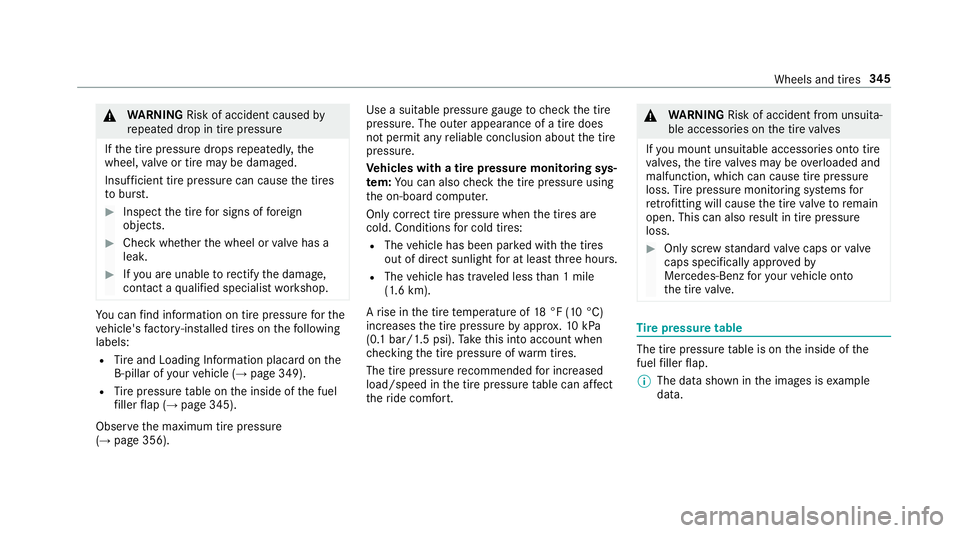
The tire pressure table is on the inside of the
fuel filler flap.
% The data shown in the images is example
data.
Wheels and tires 34
5
Page 349 of 486
Further related subjects:
RNo tes on tire pressure (→page 343)
RTire pressure table (→page 345)
RTire and Loading Info rmation placard
(→page 349)
Ti re pressure moni toring sy stem
Fu nction of the tire pressure moni toring sys‐
te m
&
DANG ER Risk of accident due toincor‐
re ct tire pressure
Every tire, including the spare (if pr ovided),
should be checked when cold at least once a
month and inflated tothe pressure recom‐
mended bytheve hicle manufacturer (see
Ti re and Loading Info rmation placard on the
B-pillar on the driver ’sside or the tire pres‐
sure label on the inside of the fuel filler flap
of your vehicle). If your vehicle has tires of a
dif fere nt size than the size indicated on the
Ti re and Loading Info rmation placard or the
tire pressure table, you need todeterm ine
th e proper tire pressure forth ose tires.
As an added saf etyfe ature, your vehicle has
been equipped with a tire pressure monitor‐
ing sy stem (TPMS) that illuminates a low tire
pressure indicator lamp when one or more of
yo ur tires are signif icantly underinflated.
Ac cording ly, if the low tire pressure indicator
lamp lights up, you should stop and check
yo ur tires as soon as possible, and inflate
th em tothe proper pressure. Driving on a
significantly underinflated tire causes the tire
to ove rheat and can lead totire failure.
Un derinflation also increases fuel consump‐
tion and reduces tire tread life, and may
af fect theve hicle's handling and braking abil‐
ity. Please no tethat the TPMS is not a substi‐
tute for proper tire maintenance, and it is the
driver's responsibility tomaintain cor rect tire
pressure, even if underinflation has not
re ached the le velto trig ger illumination of
th e TPMS low tire pressure indicator lamp.
Yo ur vehicle has also been equipped with a
TPMS malfunction indicator toindicate whenthe sy stem is not operating proper ly. The
TPMS malfunction indica tor is combined with
th e low tire pressure indicator lamp. When
th e sy stem de tects a malfunction, the indica‐
to r lamp will flash for app roxima tely a minute
and then remain continuously illumina ted.
This sequence will continue upon subsequent
ve hicle start-ups as long as the malfunction
ex ists.
When the malfunction indicator is illumina‐
te d, the sy stem may not be able todetect or
signal low tire pressure as intended. TPMS
malfunctions may occur for a variet yof rea‐
sons, including the ins tallation of incompati‐
ble replacement or alternate tires or wheels
on theve hicle that pr eventthe TPMS from
functioning properly.
Alw aysch eck the TPMS malfunction warning
lamp af terre placing one or more tires or
wheels on your vehicle toensure that the
re placement or alternate tires and wheels
allow the TPMS tocontinue tofunction prop‐
erly.
Wheels and tires 34
7
Page 382 of 486
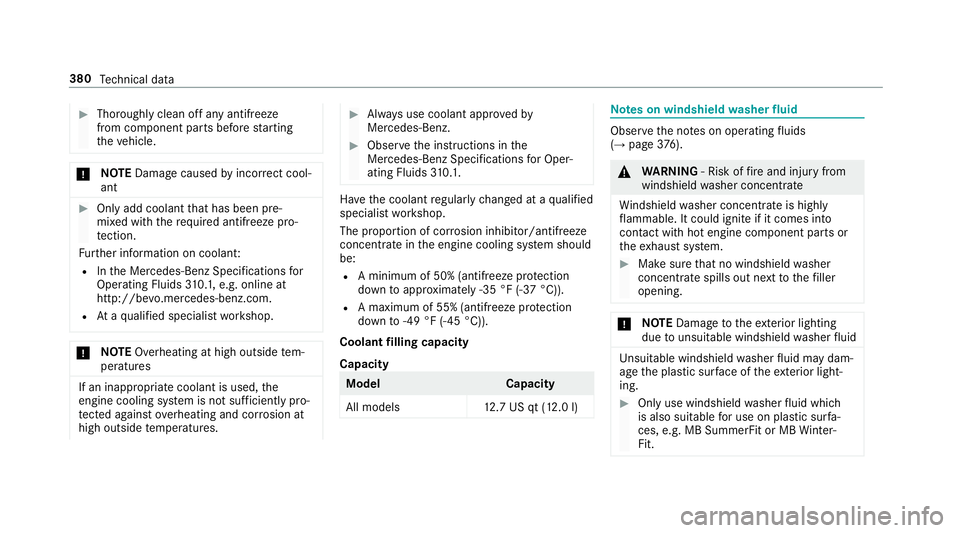
#Thoroughly clean off any antifreeze
from component parts beforestarting
th eve hicle.
* NO
TEDama gecaused byincor rect cool‐
ant
#Only add coolant that has been pre‐
mixed with therequ ired antifreeze pro‐
te ction.
Fu rther information on coolant:
RIn the Mercedes-Benz Specifications for
Operating Fluids 310.1, e.g. online at
http://be vo.mercedes-benz.com.
RAt aqu alified specialist workshop.
* NO
TEOverheating at high outside tem‐
peratures
If an inappro priate coolant is used, the
engine cooling sy stem is not suf ficiently pro‐
te cted against overheating and cor rosion at
high outside temp eratures.
#Alw ays use coolant appr ovedby
Mercedes-Benz.
#Obser vethe instructions in the
Mercedes-Benz Specifications for Oper‐
ating Fluids 310.1.
Ha ve the coolant regularly changed at a qualified
specialist workshop.
The proportion of cor rosion inhibitor/antifreeze
concentrate in the engine cooling sy stem should
be:
RA minimum of 50% (antifreeze pr otection
down toappr oximately -35 °F (-37 °C)).
RA maximum of 55% (antifreeze pr otection
down to-49 °F (-45 °C)).
Coolant filling capacity
Capacity
Model Capacity
All models 12.7 US qt (12.0 l)
Note s on windshield washer fluid
Obser vethe no tes on operating fluids
(→page 376).
&
WARNING ‑ Risk of fire and injury from
windshield washer concentrate
Wi ndshield washer concentrate is highly
fl ammable. It could ignite if it comes into
con tact wi thhot engine component parts or
th eex haust sy stem.
#Make sure that no windshield washer
concentrate spills out next tothefiller
opening.
* NO
TEDama getotheex terior lighting
due tounsuitable windshield washer fluid
Uns uitable windshield washer fluid may dam‐
age the plastic sur face of theex terior light‐
ing.
#Only use windshield washer fluid which
is also suit ablefor use on plast ic surfa‐
ces, e.g. MB SummerFit or MB Winter‐
Fit.
380 Tech nical da ta
Page 388 of 486
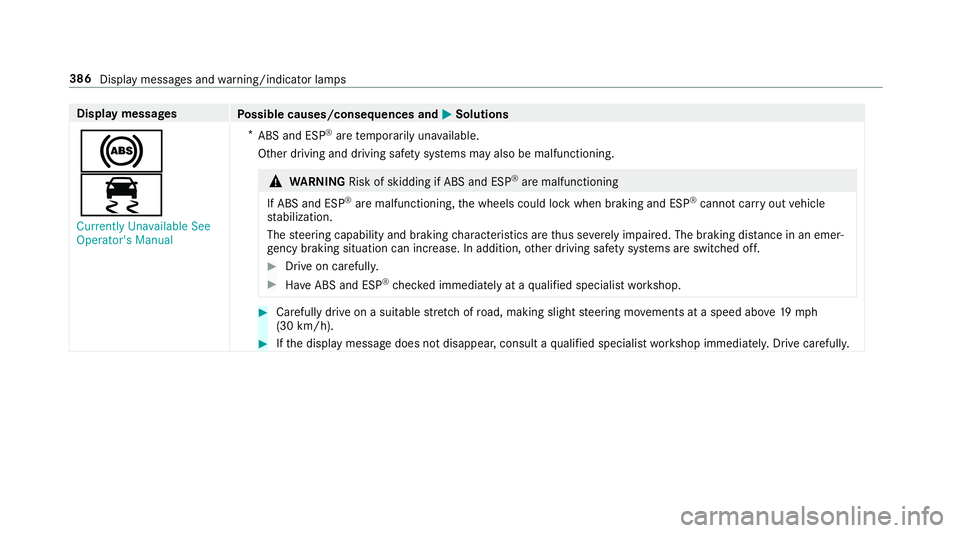
Displaymessages
Possible causes/consequences and MSolutions
!
÷
&XUUHQWO\ 8QDYDLODEOH 6HH
2SHUDWRU
V 0DQXDO*
ABS and ESP
®are temp orarily una vailable.
Other driving and driving saf etysy stems may also be malfunctioning.
&
WARNING Risk of skidding if ABS and ESP®are malfunctioning
If ABS and ESP
®are malfunctioning, the wheels could lock when braking and ESP®cannot carryout vehicle
st abilization.
The steering capability and braking characteristics are thus se verely impaired .Th ebr aking dis tance in an emer‐
ge ncy braking situation can increase. In addition, other driving saf etysy stems are switched off.
#Drive on carefull y.
#Have ABS and ESP®checked immediately at a qualified specialist workshop.
#Carefully drive on a suitable stre tch of road, making slight steering mo vements at a speed abo ve19 mp h
(30 km/h).
#If th e display message does not disappear, consult a qualified specialist workshop immediately. Drive carefully.
386
Display messages and warning/indicator lamps