brake MERCEDES-BENZ E-CLASS COUPE 2018 Repair Manual
[x] Cancel search | Manufacturer: MERCEDES-BENZ, Model Year: 2018, Model line: E-CLASS COUPE, Model: MERCEDES-BENZ E-CLASS COUPE 2018Pages: 486, PDF Size: 6.31 MB
Page 364 of 486
Changing a wheel
Notes on selecting, mounting and replacing
tires
Yo u can ask for information rega rding permitte d
wheel/tire combination at an authorized
Mercedes-Benz Center.
& WARNING Risk of accident due toincor‐
re ct dimensions of wheels and tires
If wheels and tires of the wrong size are
ins talled, the wheel brakes or wheel suspen‐
sion components may be damaged.
#Alw aysre place wheels and tires with
th ose that fulfill the specifications of
th e original part.
When replacing wheels, make sure tofit th e
cor rect:
RDesignation
RModel
When replacing tires, make sure toins tallth e
cor rect:
RDesignation
RManufactu rer
RModel
&
WARNING Risk of injury thro ugh exceed‐
ing the specified tire load rating or the
permissible speed rating
Exceeding the specified tire load rating or
th e permissible speed rating may lead totire
damage andtothe tires bur sting.
#Therefore, only use tire types and sizes
appr ovedfo ryo ur vehicle model.
#Obser vethe tire load rating and speed
ra ting requ ired foryo ur vehicle.
* NO
TEDama getovehicle and tires due to
non-app rove d tire types and sizes
Fo r saf etyre asons, only use wheels, tires
and accessories which havebeen appr oved
fo ryo ur vehicle byMercedes-Benz.
These tires ha vebeen specially adap tedfo r
use with the control sy stems, e.g. ABS or
ESP
®, and are mar ked as follo ws :
RMO = Mercedes-Benz Original
RMOE = Mercedes-Benz Original Extended
(run-flat tires only for cer tain wheels)
RMO1 = Mercedes-Benz Original (only cer‐
tain AMG tires)
Cer tain characteristics, e.g. handling, vehicle
noise emissions or fuel consum ption, may
ot herwise be adversely af fected. In addition,
when driving wi tha load, tire dimension var‐
iations could cause the tires tocome into
contact wi th the body and axle components.
This could result in damage tothe tires or the
ve hicle.
362
Wheels and tires
Page 366 of 486
Observethefo llowing when selecting, mounting
and replacing tires:
ROnly use tires and wheels of the same type
(summer tires, winter tires, MOEx tended
tires) and make .
ROnly mount wheels of the same size on one
axle (left and right).
It is only permissible tomount a dif fere nt
wheel size in theeve nt of a flat tire in order
to drive tothe specialist workshop.
ROnly mount tires of the cor rect size onto the
wheels.
RVe hicles with a tire pressure monitoring
sy stem: All mounte d wheels must be equip‐
ped with functioning sensors forth e tire
pressure monitoring sy stem.
RAt temp eratures below 45 °F (7 °C), use win‐
te r tires or all-season tires mar ked M+S for
all wheels.
Wi nter tires bearing thei snowflake sym‐
bol in addition tothe M+S marking pr ovide
th e best possible grip in wintry road condi‐
tions.
RFo r M+S tires, only use tires with the same
tread.
RObser vethe maximum permissible speed for
th e M+S tires mounted.
If th is is below theve hicle's maximum speed,
th is must be indicated in an appropriate label
in the driver's field of vision.
RBreak in new tires at moderate speeds for
th efirs t 60 miles (100 km).
RRe place the tires af ter six years at the latest,
re ga rdless of wear.
RWhen replacing with tires that do not fea‐
ture run-flat charac
teristics: Vehicles with
MOExtended tires are not equipped with a
TIREFIT kit at thefa ctor y.Equip theve hicle
with a TIREFIT kit af terre placing with tires
th at do not feature run-flat characteristics,
e.g. winter tires.
Fo r more information on wheels and tires, con‐
ta ct a qualified specialist workshop.
Be sure toalso observ eth efo llowing fur ther
re lated subjects:
RNo tes on tire pressure (→page 343)
RTire and Loading Info rmation placard
(→page 349)
RTi re size designation, load-beari ng capacity,
speed rating and load ind ex(→page 357)
RTire pressure table (→page 345)
Note s on inter changing wheels
&
WARNING Risk of injury thro ugh dif fer‐
ent wheel sizes
Inter changing the front and rear wheels if the
wheels or tires ha vediffere nt dimensions
may se verely impair the driving characteris‐
tics.
The wheel brakes or wheel suspension com‐
ponents may also be damaged.
#Ro tate front and rear wheels only ifth e
wheels and tires are of the same dimen‐
sions.
364 Wheels and tires
Page 368 of 486
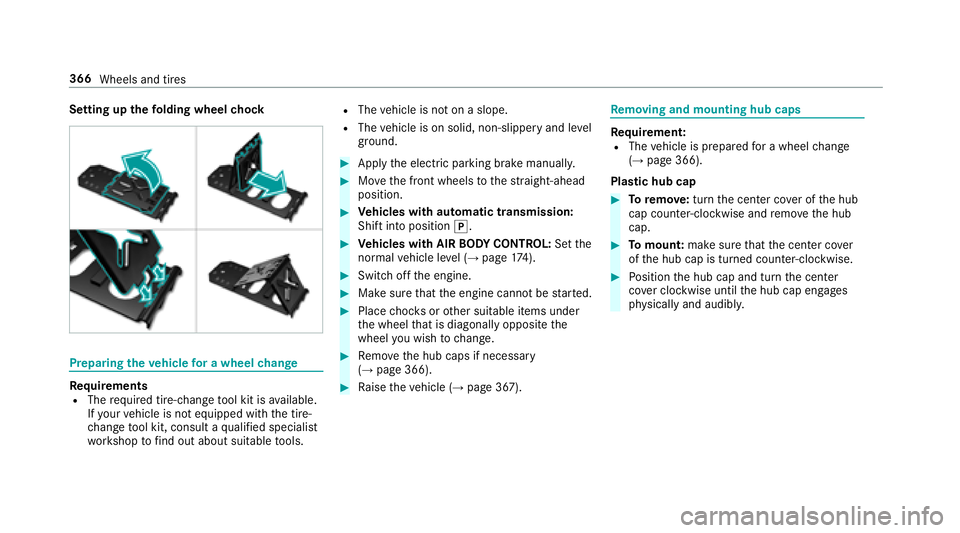
Setting upthefo lding wheel chock
Prepa ring theve hicle for a wheel change
Re quirementsRThe requ ired tire-change tool kit is available.
If yo ur vehicle is not equipped with the tire-
ch ange tool kit, consult a qualified specialist
wo rkshop tofind out about suitable tools.
RThe vehicle is not on a slope.
RThe vehicle is on solid, non-slippery and le vel
ground .
#Applythe electric parking brake manually.
#Mo vethe front wheels tothest ra ight-ahead
position.
#Ve hicles with automatic transmission:
Shift into position j.
#Vehicles with AIR BODY CONT ROL:Set the
normal vehicle le vel (→page 174).
#Switch off the engine.
#Make sure that the engine cannot bestar ted.
#Place choc ks orother suitable items under
th e wheel that is diagonally opposite the
wheel you wish tochange.
#Re mo vethe hub caps if necessary
(→page 366).
#Ra ise theve hicle (→page 367).
Re moving and mounting hub caps
Requirement:RThe vehicle is prepared for a wheel change
(→page 366).
Plast ic hub cap
#Toremo ve:turn the center co ver of the hub
cap counter-clockwise and remo vethe hub
cap.
#To mount: makesurethat the center co ver
of the hub cap is turned counter-clockwise.
#Po sition the hub cap and turn the center
co ver clockwise until the hub cap engages
ph ysically and audibly.
366
Wheels and tires
Page 369 of 486
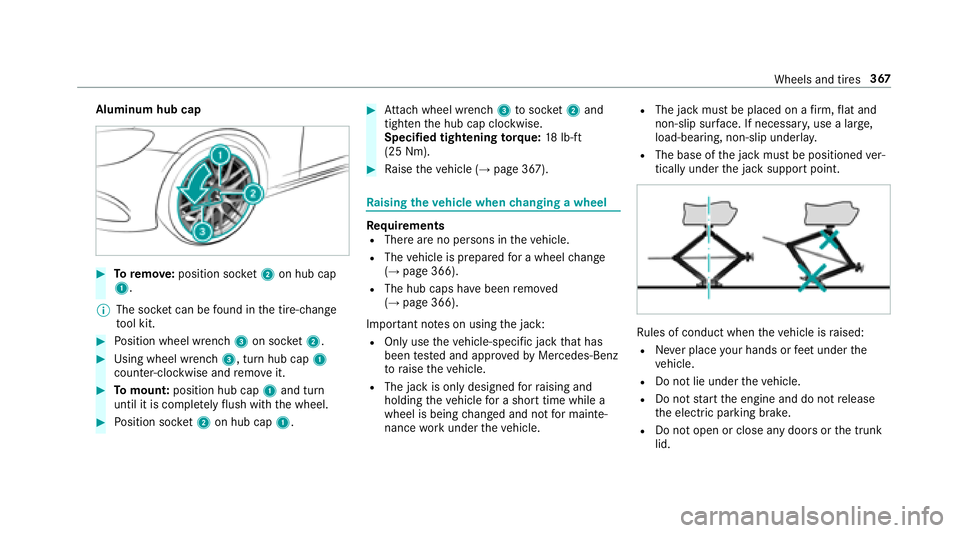
Aluminum hub cap
#Toremo ve:position soc ket2 on hub cap
1.
% The soc ket can be found inthe tire-change
to ol kit.
#Po sition wheel wrench 3on soc ket2.
#Using wheel wrench 3, turn hub cap1
counter-clo ckwise and remo veit.
#To mount: position hub cap 1and turn
until it is compl etely flush withth e wheel.
#Po sition soc ket2 on hub cap 1.
#Attach wheel wrench 3tosoc ket2 and
tighten the hub cap clockwise.
Specified tightening torq ue: 18lb-ft
(25 Nm).
#Ra ise theve hicle (→page 367).
Ra ising theve hicle when changing a wheel
Re quirementsRThere are no persons in theve hicle.
RThe vehicle is prepared for a wheel change
(→page 366).
RThe hub caps ha vebeen remo ved
(→page 366).
Impor tant no tes on using the jack:
ROnly use theve hicle-specific jack that has
been tested and appr ovedby Mercedes-Benz
to raise theve hicle.
RThe jack is only designed forra ising and
holding theve hicle for a short time while a
wheel is being changed and not for mainte‐
nance workunder theve hicle.
RThe jack must be placed on a firm ,fl at and
non-slip sur face. If necessar y,use a lar ge,
load-bearing, non-slip underla y.
RThe base ofthe jack must be positioned ver‐
tically under the jack support point.
Ru les of conduct when theve hicle is raised:
RNe ver place your hands or feet under the
ve hicle.
RDo not lie under theve hicle.
RDo not start the engine and do not release
th e electric parking brake.
RDo not open or close any doors or the trunk
lid.
Wheels and tires 367
Page 371 of 486
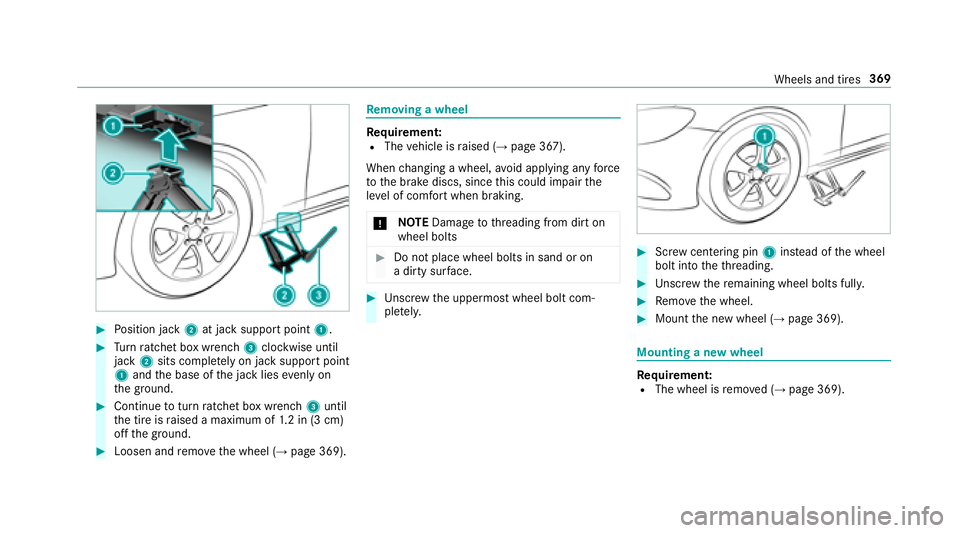
#Position jack 2at jack support point 1.
#Turn ratchet box wrench 3clockwise until
jack 2sits comple tely on ja cksupport point
1 and the base of the jack lies evenly on
th e ground.
#Continue toturn ratchet box wrench 3until
th e tire is raised a maximum of 1.2 in (3 cm)
off the ground.
#Loosen and remo vethe wheel (→page 369).
Re moving a wheel
Requirement:RThe vehicle is raised (→page 367).
When changing a wheel, avoid applying any forc e
to the brake discs, since this could impair the
le ve l of com fort when braking.
* NO
TEDama getothre ading from dirt on
wheel bolts
#Do not place wheel bolts in sand or on
a dirty sur face.
#Un scr ew the uppermost wheel bolt com‐
ple tely.
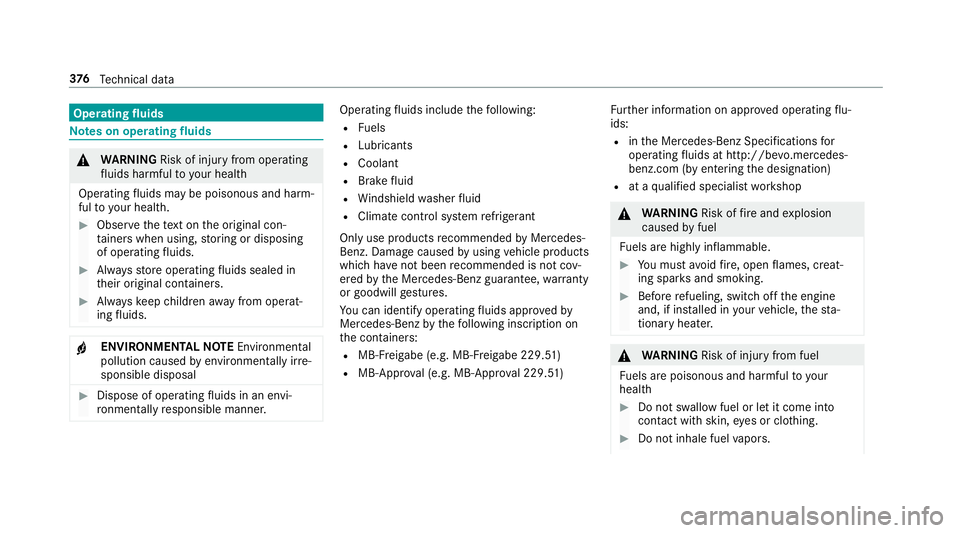
#Scr ew centering pin 1instead of the wheel
bolt into theth re ading.
#Un scr ew there maining wheel bolts fully.
#Re mo vethe wheel.
#Mount the new wheel (→page 369).
Mounting a new wheel
Re quirement:RThe wheel is remo ved (→page 369).
Wheels and tires 369
Page 378 of 486
Operatingfluids
Note s on operating fluids
&
WARNING Risk of injury from operating
fl uids harmful to your health
Operating fluids maybe pois onous and harm‐
ful to yo ur health.
#Obser vethete xt on the original con‐
ta iners when using, storing or disposing
of operating fluids.
#Alw aysst ore operating fluids sealed in
th eir original conta iners.
#Alwayske ep children away from operat‐
ing fluids.
+ENV IRONMEN TALNO TEEnvironmental
pollution caused byenvironmen tally ir re‐
sponsible disposal
#Dispose of operating fluids in an envi‐
ro nmentally responsible manner.
Operating fluids include thefo llowing:
RFu els
RLubricants
RCoolant
RBrake fluid
RWi ndshield washer fluid
RClimate cont rol sy stem refrigerant
Only use products recommended byMercedes-
Benz. Damage caused byusing vehicle products
which ha venot been recommended is not cov‐
ered bythe Mercedes-Benz guarantee, warranty
or goodwill gestures.
Yo u can identify operating fluids appr ovedby
Mercedes-Benz bythefo llowing insc ript ion on
th e conta iners:
RMB-Freigabe (e.g. MB-Fr eigabe 229.51)
RMB-Approval (e.g. MB-App rova l 229.51) Fu
rther information on appr oved operating flu‐
ids:
Rin the Mercedes-Benz Specifications for
operating fluids at http://be vo.mercedes-
benz.com (byen tering the designation)
Rat a qualified specialist workshop
&
WARNING Risk offire and explosion
caused byfuel
Fu els are highly inflammable.
#You must avoidfire , open flames, creat‐
ing spar ksand smoking.
#Before refueling, switch off the engine
and, if ins talled in your vehicle, thest a‐
tionary heater.
& WARNING Risk of injury from fuel
Fu els are poisonous and harmful to your
health
#Do not swallow fuel or let it come into
contact with skin, eyes or clo thing.
#Do not inhale fuel vapors.
37 6
Tech nical da ta
Page 381 of 486
Mercedes-Benzrecommends that you ha vethe
oil change car ried out at a qualified specialist
wo rkshop.
Fu rther information on engine oils and oil filters:
RIn the Mercedes-Benz Specifications for
Operating Fluids at http://be vo.mercedes-
benz.com (byen tering the designation)
RAt aqu alified specialist workshop
Quality and filling capacity of engine oil
MB- Freigabe or MB-A pproval
Gasoline enginesM B-Freigabe or MB-
Appr oval
All models 229.5, 229.6
Thefollowing values referto an oil change,
including the oil filter.
Re placement amount
Mode lR eplacement
amount
All models6 .9 US qt (6.5 l)
Notes on brake fluid
Obser vethe no tes on operating fluids
(→page 376).
&
WARNING Risk of an accident due to
va por poc kets form ing in the brake sys‐
te m
The brake fluid cons tantly absorbs moist ure
from the air. This lo wersthe boiling point of
th e brake fluid. Ifth e boiling point is too lo w,
va por poc kets may form inthe brake sy stem
when the brakes are applied hard.
This causes the braking ef fect to be
impaired.
#Ha ve the brake fluid rene we d at the
specified inter vals.
Ha ve the brake fluid regularly changed at a quali‐
fi ed specialist workshop.
Only use brake fluid appr ovedby Mercedes-Benz
according toMB-F reigabe or MB-Appr oval 33 1.0. Fu
rther information on brake fluid:
RIn the Mercedes-Benz Specifications for
Operating Fluids at http://be vo.mercedes-
benz.com
RAt aqu alified specialist workshop
Coolant
Note s on coolant
Obser vethe no tes on operating fluids
(
→page 376).
&
WARNING ‑ Risk of fire and injury from
antifreeze
If antifreeze comes into con tact wi thhot
component parts in the engine compart‐
ment, it may ignite.
#Allow the engine tocool down before
adding antifreeze.
#Make surethat no antifreeze spills out
next tothefiller opening.
Te ch nical da ta37
9
Page 390 of 486
Displaymessages
Possible causes/consequences and MSolutions
÷
,QRSHUDWLYH 6HH 2SHUDWRU
V
0DQXDO*
ESP
®is malfunctioning.
Other driving sy stems and driving saf etysy stems may also malfunction.
The brake sy stem continues tooperate normally. The braking dis tance in an emergency braking situation can
increase.
& WARNING Risk of skidding if ESP®is malfunctioning
If ESP
®is malfunctioning, ESP®cannot car ryout vehicle stabilization. In addition, other driving saf etysy stems
are switched off.
#Drive on carefull y.
#Have ESP®checked at a qualified specialist workshop.
#Drive on carefully.
#Vi sit a qualified specialist workshop immediatel y.
388
Display messages and warning/indicator lamps
Page 391 of 486
Displaymessages
Possible causes/consequences and MSolutions
T
!
÷
,QRSHUDWLYH 6HH 2SHUDWRU
V
0DQXDO*
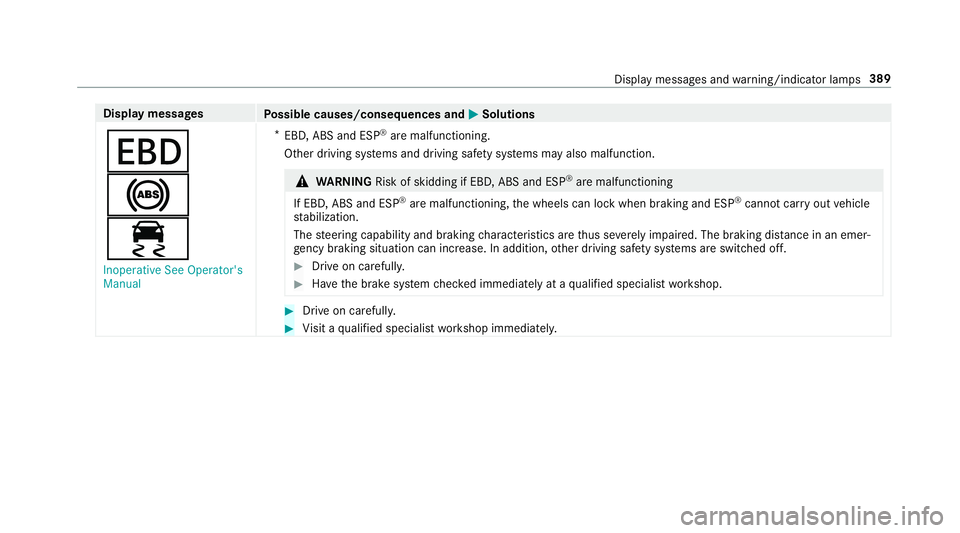
EBD, ABS and ESP
®are malfunctioning.
Other driving sy stems and driving saf etysy stems may also malfunction.
&
WARNING Risk of skidding if EBD, ABS and ESP®are malfunctioning
If EBD, ABS and ESP
®are malfunctioning, the wheels can lock when braking and ESP®cannot carryout vehicle
st abilization.
The steering capability and braking characteristics are thus se verely impaired .Th ebr aking dis tance in an emer‐
ge ncy braking situation can increase. In addition, other driving saf etysy stems are switched off.
#Drive on carefull y.
#Have the brake sy stem checked immediately at a qualified specialist workshop.
#Drive on carefully.
#Vi sit a qualified specialist workshop immediatel y.
Displaymessage s andwarning/indicator lamps 389
Page 392 of 486
Displaymessages
Possible causes/consequences and MSolutions
F
(USA only)
!
(Canada only)
7XUQ 2Q WKH ,JQLWLRQ WR
5HOHDVH WKH 3DUNLQJ %UDNH *
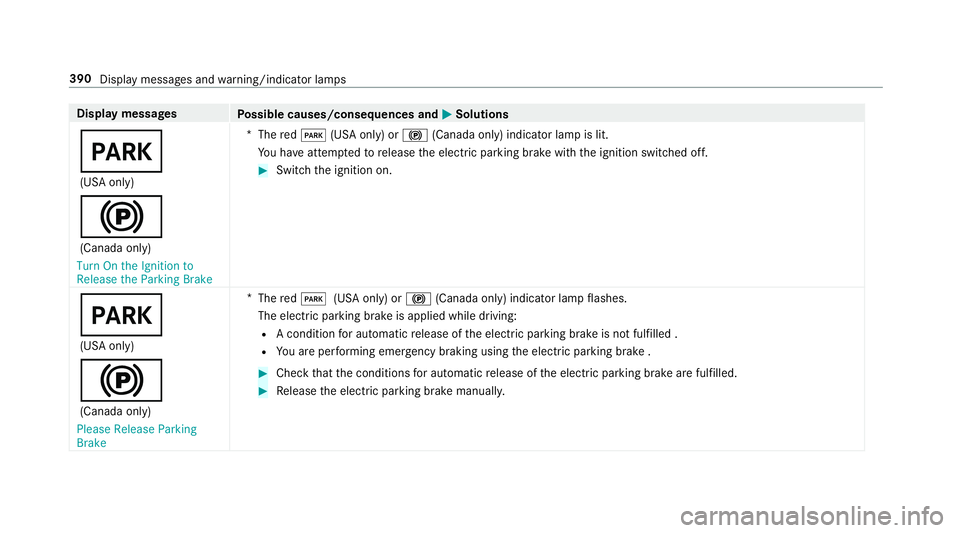
The redF (USA only) or !(Canada only) indicator lamp is lit.
Yo u ha veattem ptedto release the electric parking brake with the ignition switched off.
#Switch the ignition on.
F
(USA only)
!
(Canada only)
3OHDVH 5HOHDVH 3DUNLQJ
%UDNH *
The redF (USA only) or !(Canada only) indicator lamp flashes.
The electric parking brake is applied while driving:
RA condition for au tomatic release of the electric parking brake is not fulfilled .
RYo u are per form ing emer gency braking using the electric parking brake .
#Check that the conditions for au tomatic release of the electric parking brake are fulfilled.
#Re lease the electric parking brake manually.
390
Display messages and warning/indicator lamps