tow MERCEDES-BENZ E-CLASS COUPE 2018 Repair Manual
[x] Cancel search | Manufacturer: MERCEDES-BENZ, Model Year: 2018, Model line: E-CLASS COUPE, Model: MERCEDES-BENZ E-CLASS COUPE 2018Pages: 486, PDF Size: 6.31 MB
Page 318 of 486
RThe blowerfo rth eve ntilation/heating is
switched off.
RThe windshield wiper switch is in position 0.
RIn car washes with a towing mechanism: neu‐
tral iis engaged.
RThe SmartK eyis at a dis tance of at least
10 ft(3 m) away from theve hicle, otherwise
th e trunk lid could open unintentionall y.
% Remo vethewa x from the windshield and
wiper rubber af terth e car wash; this will pre‐
ve nt smearing and reduce wiper noise.
Information on using a po werwa sher
&
WARNING Risk of accident when using
high-pressure cleaning equipment wi th
ro und-s pray nozzles
The wate r jet from a round-s pray nozzle (dirt
grinder) may cause damage totires and sus‐
pension components that is not visible.
Components damaged in this wa yma yfa il
unexpec tedly.
#Do not use high-pressure cleaning
equipment wi thround-spr aynozzles to
clean your vehicle.
#Damaged tires or suspension compo‐
nents must be replaced immediatel y.
Toavo id damage to yourvehicle, obser vethefo l‐
lowing when using a po werwa sher:
RKeep the SmartK eyat least 10ft(3 m) away
from theve hicle. Otherwise the trunk lid
could open unintentionall y.
RMaintain a distance of at least 11.8 in
(30 cm) totheve hicle.
RVe hicles with deco rative foil: parts of your
ve hicle are co vered with a decorative foil.
Maintain a dis tance of at least 27.6 in
(70 cm) between thefo il-c ove red parts of the
ve hicle and the nozzle of the high pressure
cleaner. Mo vethe po werwa sher nozzle
around whilst cleaning.
RObser vethe information on the cor rect dis‐
ta nce in the equipment manufacturer's oper‐
ating instructions.
RDo not point the nozzle of the po werwa sher
directly at sensitive parts such as tires, slits,
electrical component parts, batteries, light
sources and ventilation slot s.
Washing the vehicle byhand
Obser velegal requ irements, forex ample in
some countries washing byhand is only allo wed
at specially equipped washing ba ys.
#Use a mild cleaning agent such as car sham‐
poo.
#Wa shtheve hicle with luk ewarmwate r and a
soft car sponge. While doing so, do not
ex pose theve hicle todirect sunlight.
#Hose down theve hicle carefully with water
and dry it with a leather clo th. Make sure
th at thewate r jet is not pointed directly into
th e air inlet grille.
31 6
Maintenance and care
Page 324 of 486
Emergency
Re moving the saf etyve st
The saf etyve sts are located in the saf etyve st
compart ments in the driver's and front
passenger door stowage compartments.
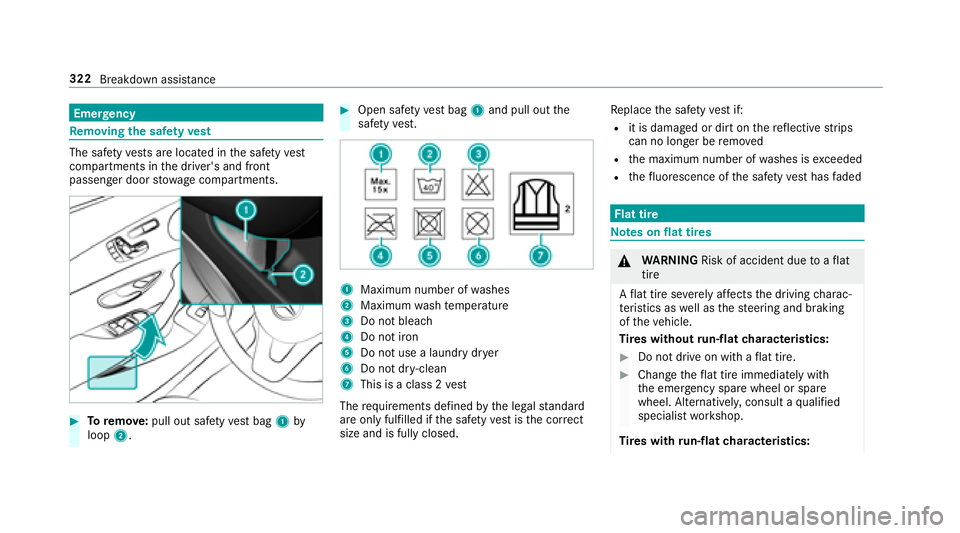
#Toremo ve:pull out safe tyvest bag 1by
loop 2.
#Open saf etyve st bag 1and pull out the
saf etyve st.
1Maximum number of washes
2Maximum wash temp erature
3Do not bleach
4Do not iron
5Do not use a laundry dr yer
6Do not dr y-clean
7This is a class 2 vest
The requ irements defined bythe legal standard
are only fulfille difth e saf etyve st isthe cor rect
size and is fully closed. Re
place the saf etyve st if:
Rit is damaged or dirt on there flective strips
can no longer be remo ved
Rthe maximum number of washes is exceeded
Rthefluorescence of the saf etyve st has faded
Flat tire
Note s onflat tires
&
WARNING Risk of accident due toaflat
tire
A flat tire se verely affects the driving charac‐
te rist ics as well as thesteering and braking
of theve hicle.
Ti re s without run-flat characteristics:
#Do not drive on with a flat tire.
#Change theflat tire immediately with
th e emer gency spa rewheel or spare
wheel. Alternativel y,consult a qualified
specialist workshop.
Ti re s with run-flat characteristics:
322
Breakd own assist ance
Page 335 of 486
Whenthest arting assis tance/charging process
is compl ete:
#Fir st,re mo vethe jumper cable/charging
cable from ground point 3and the negative
pole of the donor batter y,then from positive
clamp 2and the positive pole of the donor
batter y.Begin each time with the conta cts
on your ow nve hicle firs t.
#Af terre moving the jumper cable/charging
cable, close co ver1 of positive clamp 2.Yo
u can obtain fur ther information on starting
assis tance at any qualified specialist workshop.
To w starting or towing away
Perm itted towing me thods
Mercedes-Benz recommends transporting your
ve hicle in the case of a breakdown, rath er than
to wing it away. *
NO
TEDama getotheve hicle due to tow‐
ing away incor rectly
#Obser vethe instructions and no tes on
to wing away.
Breakdown assis tance 333
Page 336 of 486
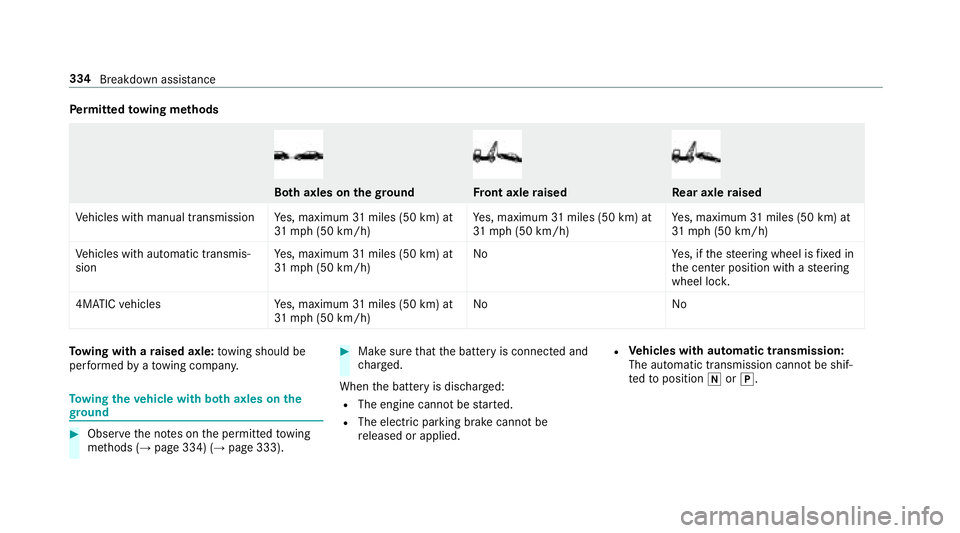
Perm itted towing me thods
Bo th axles on thegr oundFront axle raisedRe ar axle raised
Ve hicles with manual transmission Yes, maximum 31miles (50 km) at
31 mp h (50 km/h) Ye
s, maximum 31miles (50 km) at
31 mp h (50 km/h) Ye
s, maximum 31miles (50 km) at
31 mp h (50 km/h)
Ve hicles with automatic transmis‐
sion Ye
s, maximum 31miles (50 km) at
31 mp h (50 km/h) No
Yes, if thesteering wheel is fixe d in
th e center position with a steering
wheel loc k.
4MATIC vehicles Yes, maximum 31miles (50 km) at
31 mp h (50 km/h) No
No
Towing wit h araised axle: towing should be
per form ed byato wing compan y.
Towing theve hicle with bo thaxles on the
gr ound
#Obser vethe no tes on the permitted towing
me thods (→page 334) (→page 333).
#Make sure that the battery is connected and
ch arge d.
When the battery is dischar ged:
RThe engine cann otbe star ted.
RThe elect ric park ing brake cannot be
re leased or applied.
RVe hicles with automatic transmission:
The au tomatic transmission cannot be shif‐
te dto position iorj.
334
Breakdown assis tance
Page 337 of 486
%Vehicles with automatic transmission: If
th e automatic transmission cannot be shif‐
te dto position i, havetheve hicle trans‐
por tedaw ay (
→page 336). A towing vehicle
with lifting equipment is requiredforve hicle
transport.
* NO
TEDama gedue to to wing away at
exc essively high speeds or over long dis‐
ta nces
The driv etra in could be damaged when tow‐
ing at excessively high speeds or over long
dis tances.
#A towing speed of 30 mph (50 km/h)
must not be exceeded.
#Atowing dis tance of 30 miles (50 km)
must not be exceeded.
&
WARNING Risk of accident when towing
a ve hicle which is too heavy
If th eve hicle being tow- star ted or towe d
aw ay is heavier than the permissible gross
mass of your vehicle, thefo llowing situations
can occur:
RThe towing eye may become de tach ed.
RThe vehicle/trailer combination may
swer veoreve nov erturn.
#If ano ther vehicle is tow- star ted or
to we daw ay, its weight must not exceed
th e permissible gross mass of your ow n
ve hicle.
If a vehicle must be tow star ted or towe daw ay,
its weight must not exceed the permissible gross
mass of theto wing vehicle.
#Information on the permissible gross mass of
th eve hicle can be found on theve hicle iden‐
tification plate .
#Ve hicles with automatic transmission: Do
not open the driver's door or front passenger
door, otherwise the automatic transmission
automatically shifts toposition j.
#Installth eto wing eye (→page 338).
#Attach theto w bar.
* NO
TEDama gedue toincor rect connec‐
tion
#Only connect theto w rope or tow bar to
th eto wing eyes.
#Deactivate the automatic locking mechanism
(→page 62).
#Do not activate the HOLD function.
#Deactivate Active Brake Assi st(→page 159).
#Ve hicles with automatic transmission:
Shift the automatic transmission toposition
i.
#Re lease the electric parking brake.
Breakdown assis tance 335
Page 338 of 486
&WARNING Risk of accident due tolimi‐
te d saf ety-re lated functions during the
to wing process
Saf ety-re lated functions are limited or no lon‐
ge rav ailable in thefo llowing situations:
Rth e ignition is switched off.
Rthe brake sy stem or po werst eering sys‐
te m is malfunctioning.
Rth e energy supply or the on-board electri‐
cal sy stem is malfunctioning.
When your vehicle is then towe daw ay, signif‐
icantly more ef fort may be requ ired tosteer
and brake than is no rmally requ ired.
#Use a tow bar.
#Make sure that thesteering wheel can
mo vefreely, before towing theve hicle
aw ay.
* NO
TEDama gedue toexcessive tracti ve
po we r
Ifyo u pull away sharpl y,the tractive po wer
may be too high and theve hicles could be
damaged.
#Pull away slowly and smoo thly.
Loading the vehicle for transport
#Obser vethe no tes on towing away
(→page 334).
#Connect theto w bar totheto wing eyeto
load theve hicle.
#Ve hicles with automatic transmission:
Shift the automatic transmission toposition
i.
% Ve
hicles with automatic transmission:
The au tomatic transmission may be loc ked
in position jintheeve nt of damage tothe
electrics. Toshift toi, pr ovide the on-
board electrical sy stem with po wer
(
→page 330).
#Load theve hicle onto the transpor ter.
#Ve hicles with automatic transmission:
Shift the automatic transmission toposition
j.
#Use the electric parking brake tosecure the
ve hicle and pr event it from rolling away.
#Only secure theve hicle bythe wheels.
Ve hicles with ADS PLUS (Adaptive Damping
Sy stem PLUS)
&
WARNING Risk of accident when trans‐
porting vehicles with AIR BODY CON‐
TROL
The reduced damping forc es on theve hicle
being transpor ted can cause theve hicle/
trailer combination tostart toswing.
As a result, when transporting vehicles with
AIR BODY CONTROL theve hicle/trailer com‐
bination may start toskid. Consequentl y,yo u
could lose control of your vehicle.
There is a risk of accident and injur y.
336
Breakdown assis tance
Page 339 of 486
#Loadtheve hicle cor rectly onto the
transpo rter.
#Secure theve hicle on all four wheels
wit h suit abletensioning stra ps.
#Do not exceed the maximum permissi‐
ble speed of 35 mph(6 0 km/h) when
transpo rting.
* NO
TEDama getotheve hicle from secur‐
ing it incor rectly
#Af ter loading, theve hicle must be
secured at all four wheels. Otherwise,
th eve hicle could be damaged.
#A minimum dis tance of 8 in (20 cm) up
and 4 in (10 cm) down must bekept to
th e transport platform.
#Secure theve hicle on all four wheels af ter
loading. 4MATIC
vehicles/ve hicles with automatic
transmission
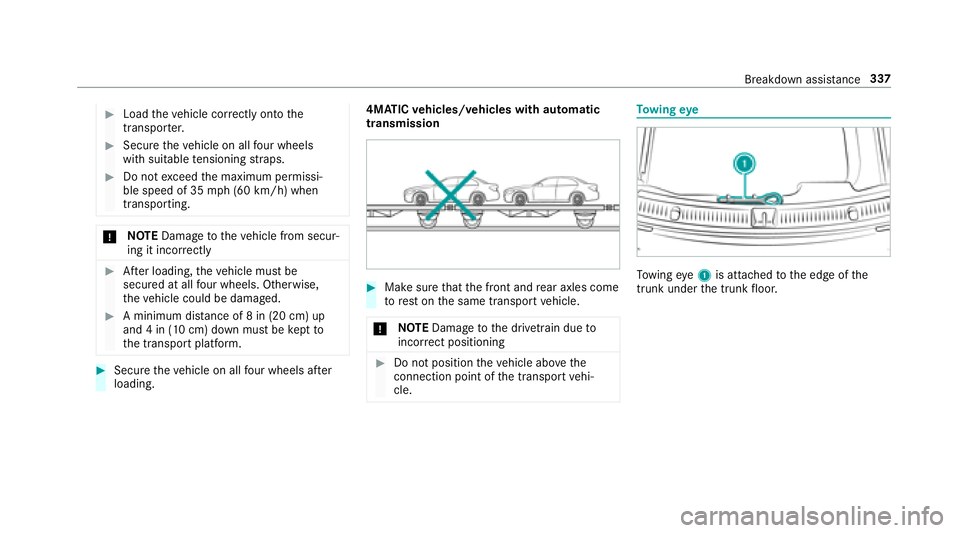
#Make sure that the front and rear axles come
to rest on the same transport vehicle.
* NO
TEDama getothe driv etra in due to
incor rect positioning
#Do not position theve hicle abo vethe
connection point of the transport vehi‐
cle.
To wing eye
Towing eye1 is attached tothe edge of the
trunk under the trunk floor.
Breakdown assis tance 337
Page 340 of 486
Installingtheto wing eye
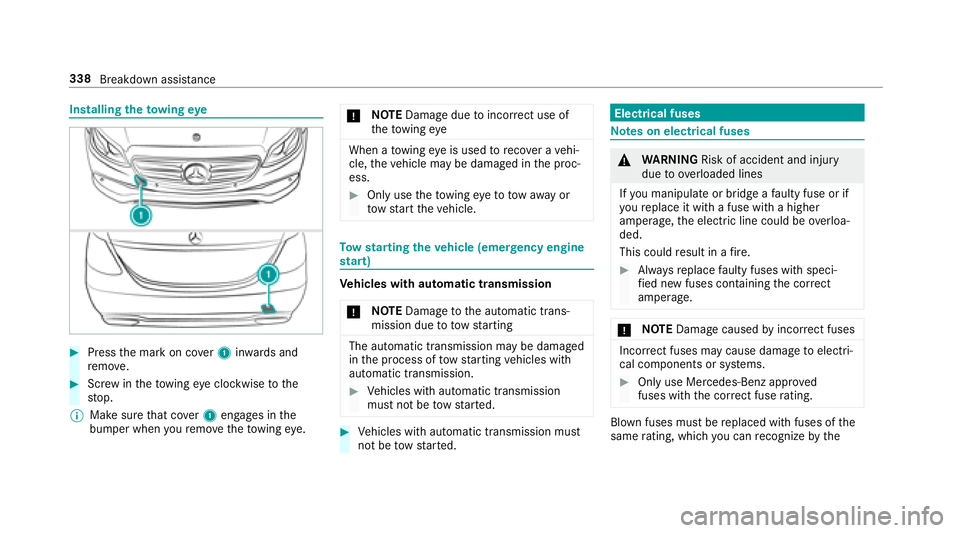
#Press the mark on co ver1 inwa rds and
re mo ve.
#Scr ew intheto wing eyeclockwise tothe
st op.
% Make sure that co ver1 engages in the
bumper when youre mo vetheto wing eye. *
NO
TEDama gedue toincor rect use of
th eto wing eye
When a towing eye is used toreco ver a vehi‐
cle, theve hicle may be damaged in the proc‐
ess.
#Only use theto wing eyeto to waw ay or
to w start theve hicle.
To w starting theve hicle (eme rgency engine
st art)
Ve hicles with automatic transmission
* NO
TEDama getothe automatic trans‐
mission due to towstarting
The automatic transmission may be damaged
in the process of tow starting vehicles with
automatic transmission.
#Ve hicles with automatic transmission
must not be tow star ted.
#Ve hicles with automatic transmission must
not be tow star ted.
Electrical fuses
Note s on electrical fuses
&
WARNING Risk of accident and injury
due to ov erloaded lines
If yo u manipulate or bridge a faulty fuse or if
yo ure place it with a fuse with a higher
amperage, the electric line could be overloa‐
ded.
This could result in a fire .
#Alw aysre place faulty fuses with speci‐
fi ed new fuses conta iningthe cor rect
amperage.
* NO
TEDama gecaused byincor rect fuses
Incor rect fuses may cause damage toelectri‐
cal components or sy stems.
#Only use Mercedes-Benz appr oved
fuses with the cor rect fuse rating.
Blown fuses must bereplaced with fuses of the
same rating, which you can recognize bythe
338
Breakdown assis tance
Page 365 of 486
Only use tires, wheels or accessoriestested
and appr ovedby Mercedes-Benz.
* NO
TERisk todriving saf etyfrom retrea‐
ded tires
Re treaded tires are nei ther tested nor recom‐
mended byMercedes-Benz, since pr evious
damage cannot alw ays be de tected on
re treaded tires.
Fo rth is reason driving saf etycanno tbe guar ‐
anteed.
#Do no tuse used ti res if you ha veno
information about their pr evious usage.
* NO
TEPossible damage towheels or tires
when driving over obs tacles
Large wheels ha vea lo wer tire section wid th.
The lo werth e tire section width, the greater
is therisk of damage towheels or tires when
driving over obs tacles.
#Av oid obs tacles or drive part icularly
carefully.
* NO
TEDama getoelectronic component
parts from the use of tire-mounting tools
Ve hicles with a tire pressure monitoring
sy stem: Electronic component parts are
located in the wheel. Tire -mounting tools
should not be used in the area of theva lve.
This could otherwise damage the electronic
component parts.
#Ha ve the tires changed at a qualified
specialist workshop onl y.
*NO
TEDama getosummer tires at low
ambient temp eratures
Using summer tires at very low ambient tem‐
peratures can cause crac kstoform ,th ereby
damaging the tires permanentl y.
#Attemp eratures below 45 °F (7 °C) use
M+S tires.
Ac cessory part sth at are not appr ovedfo ryo ur
ve hicle byMercedes-Benz or are not being used
cor rectly can impair the operating saf ety. Before purc
hasing and using non-appr oved
accessori es, visit a qualified specialist workshop
and inquire about:
RSuitability
RLegal stipulations
RFa ctory recommendations
&
WARNING Risk of accident wi thhigh
per form ance tires
The special tire tread in combination with the
optimized tire compound means that therisk
of skidding or hydroplaning on wetro ads is
inc reased.
In addition, the tire grip is greatly reduced at
a low outside temp erature and tire running
te mp erature.
#Switch on the ESP®and adapt your
dr ivin gst yle accordingly.
#Use M+S tire at outside temp eratures
of less than 10 °C (50 °F).
Wheels and tires 363
Page 379 of 486
#Keep children away from fuel.
If yo u or other people come into contact with
fuel, obser vethefo llowing:
#Immediately rinse fuel off your skin wit h
soap and water.
#If fuel comes into contact with your
ey es, immediately rinse them thor‐
oughly with clean water.Seek medical
attention immediately.
#If yo u sw allow fuel, seek medical atten‐
tion immediatel y.Do not induce vomit‐
ing.
#Change immediately out of clo thing that
has come into con tact wi thfuel.
Fuel
Note s on fuel grades forve hicles with a gas‐
oline engine
Obser vethe no tes on operating fluids
(
→page 376). *
NO
TEDama gecaused bythe wrong fuel
Even small amounts of the wrong fuel could
re sult in damage tothe fuel sy stem, the
engine and the emission control sy stem.
#Only refuel with lo w-sulfur premium
grade fuel.
This fuel may contain up to10 %ethanol.
Yo ur vehicle is suitable for use with E10 fuel.
Do not refuel using:
RDiesel
RE15, E85, E100
RGasoline containing me thanol (M15, M30,
M85, M100)
RGasoline with additives con taining me tal
If yo u accidenta llyrefuel with the wrong fuel:
#Do not switch the ignition on.
#Consult a qualified specialist workshop.
Ifth eav ailable fuel is not suf ficiently low in sul‐
fur, this can produce unpleasant odors. Only
refuel with fuel that has at least the octane
number specified in the information table in the
fuel filler flap (
→page 140). This may reduce
engine output and increase fuel consum ption.
If yo uwa nt maximum engine output: only
re fuel with unleaded premium grade gasoline
with at least 91AKI/95 RON.
Ne verre fuel using gasoline with a lo werRO N.
* NO
TEPremature wear caused byunlea‐
ded regular gasoline
Unleaded regular gasoline can cause the
engine towe ar more quickly and impair lon‐
ge vity and per form ance.
If unleaded premium grade gasoline is
una vailable and you ha vetorefuel using
unleaded regular gasoline:
#Only fill th e fuel tank tohalf full with
unleaded regular gasoline and refill as
soon as possible with unleaded pre‐
mium grade gasoline.
#Do not drive at the maximum speed.
Te ch nical da ta37
7