tow MERCEDES-BENZ E-CLASS ESTATE 2008 User Guide
[x] Cancel search | Manufacturer: MERCEDES-BENZ, Model Year: 2008, Model line: E-CLASS ESTATE, Model: MERCEDES-BENZ E-CLASS ESTATE 2008Pages: 401, PDF Size: 6.89 MB
Page 22 of 401
19
Exterior view
....................................... 20
Cockpit ................................................. 22
Instrument cluster ..............................26
Multi-function steering wheel ............30
Centre console .................................... 31
Overhead control panel ......................34
Door control panel .............................. 35
Stowage compartments .....................36 At a glance
211_AKB; 2; 5, en-GB
mkalafa,
Version: 2.9.4 2008-02-29T16:57:07+01:00 - Seite 19Dateiname: 6515_3416_02_buchblock.pdf; preflight
Page 24 of 401
Exterior view
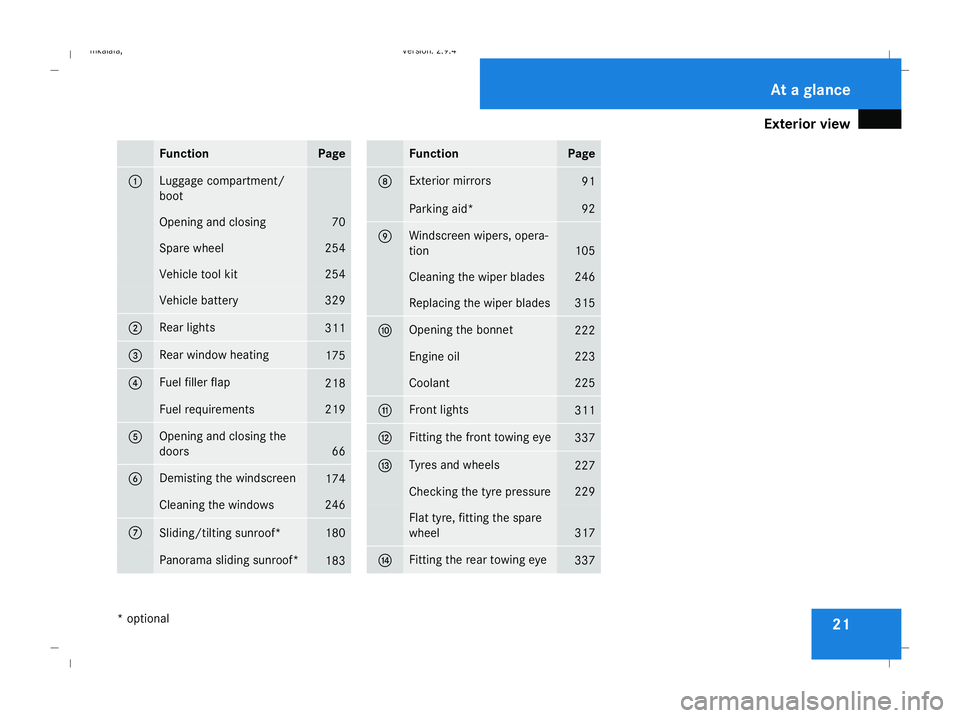
21Function Page
1 Luggage compartment/
boot Opening and closing 70
Spare wheel 254
Vehicle tool kit 254
Vehicle battery 329
2 Rear lights
311
3 Rear window heating
175
4 Fuel filler flap
218
Fuel requirements 219
5 Opening and closing the
doors 66
6 Demisting the windscreen
174
Cleaning the windows 246
7
Sliding/tilting sunroof* 180
Panorama sliding sunroof*
183 Function Page
8 Exterior mirrors
91
Parking aid* 92
9 Windscreen wipers, opera-
tion
105
Cleaning the wiper blades 246
Replacing the wiper blades 315
a Opening the bonnet
222
Engine oil 223
Coolant 225
b Front lights
311
c Fitting the front towing eye
337
d Tyres and wheels
227
Checking the tyre pressure 229
Flat tyre, fitting the spare
wheel
317
e Fitting the rear towing eye
337 At a glance
* optional
211_AKB; 2; 5, en-GB
mkalafa,
Version: 2.9.4
2008-02-29T16:57:07+01:00 - Seite 21 Dateiname: 6515_3416_02_buchblock.pdf; preflight
Page 34 of 401
Centre console
31Centre console
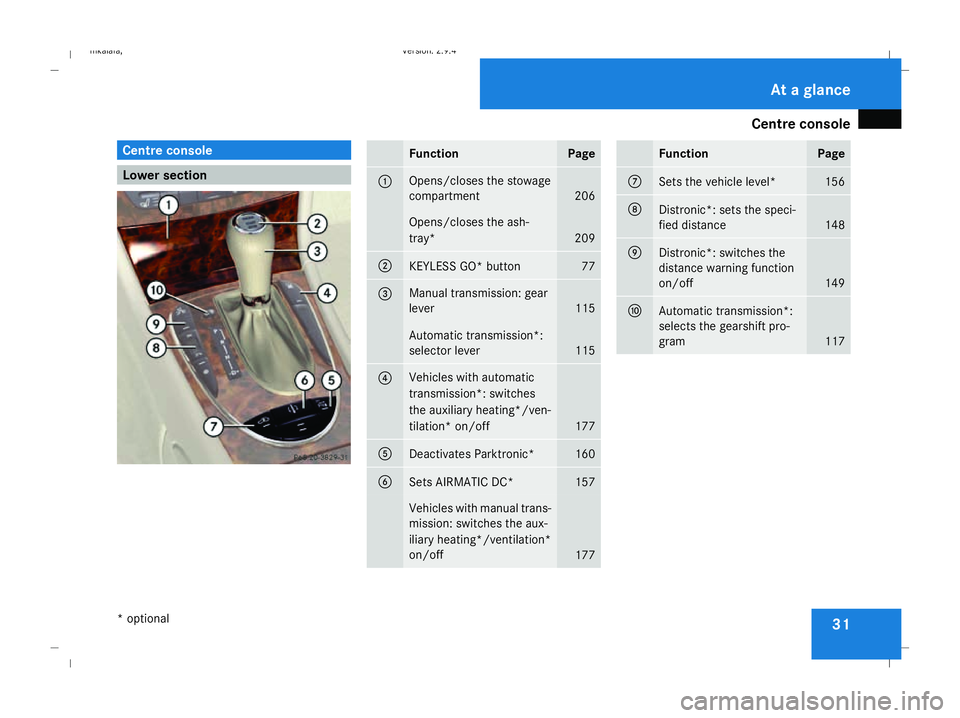
Lower section Function Page
1 Opens/closes the stowage
compartment
206
Opens/closes the ash-
tray*
209
2
KEYLESS GO* button 77
3 Manual transmission: gear
lever
115
Automatic transmission*:
selector lever
115
4 Vehicles with automatic
transmission*: switches
the auxiliary heating
*/ven-
tilation* on/off 177
5
Deactivates Parktronic* 160
6
Sets AIRMATIC DC* 157
Vehicles with manual trans-
mission: switches the aux-
iliary heating*/ventilation*
on/off
177 Function Page
7
Sets the vehicle level* 156
8
Distronic*: sets the speci-
fied distance
148
9
Distronic*: switches the
distance warning function
on/off
149
a
Automatic transmission*:
selects the gearshift pro-
gram
117At a glance
* optional
211_AKB; 2; 5, en-GB
mkalafa,
Version: 2.9.4 2008-02-29T16:57:07+01:00 - Seite 31Dateiname: 6515_3416_02_buchblock.pdf; preflight
Page 37 of 401
Overhead control panel
34 Overhead control panel
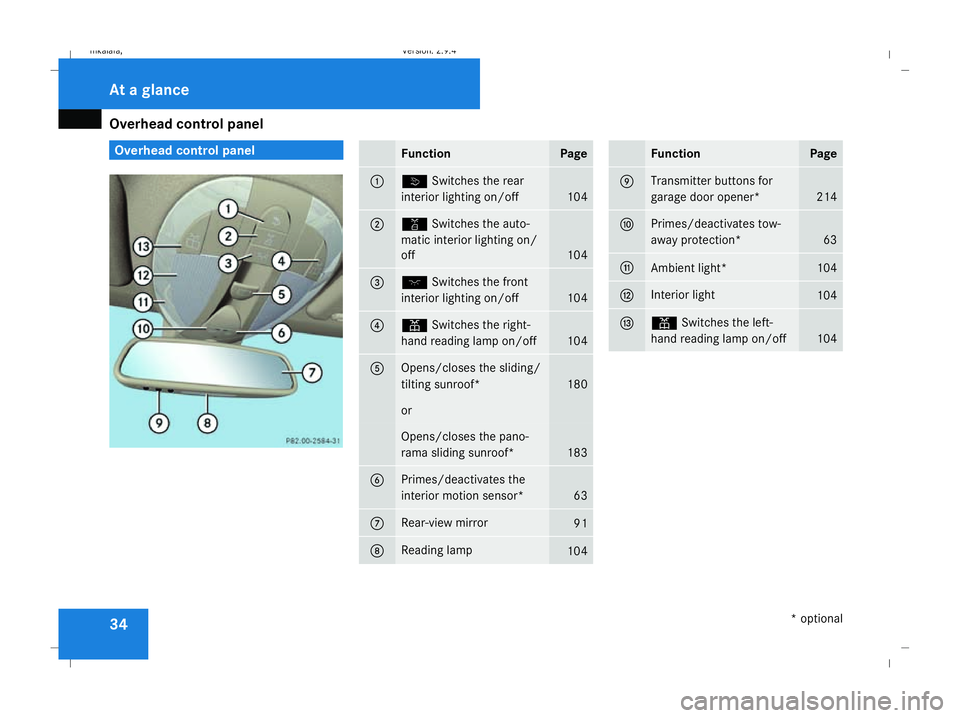
Function Page
1 ò
Switches the rear
interior lighting on/off 104
2 ¡
Switches the auto-
matic interior lighting on/
off 104
3 ð
Switches the front
interior lighting on/off 104
4 X
Switches the right-
hand reading lamp on/off 104
5 Opens/closes the sliding/
tilting sunroof*
180
or
Opens/closes the pano-
rama sliding sunroof*
183
6 Primes/deactivates the
interior motion sensor*
63
7 Rear-view mirror
91
8 Reading lamp
104 Function Page
9 Transmitter buttons for
garage door opener*
214
a Primes/deactivates tow-
away protection*
63
b
Ambient light* 104
c Interior light
104
d X
Switches the left-
hand reading lamp on/off 104At a glance
* optional
211_AKB; 2; 5, en-GB
mkalafa,
Version: 2.9.4 2008-02-29T16:57:07+01:00 - Seite 34Dateiname: 6515_3416_02_buchblock.pdf; preflight
Page 39 of 401
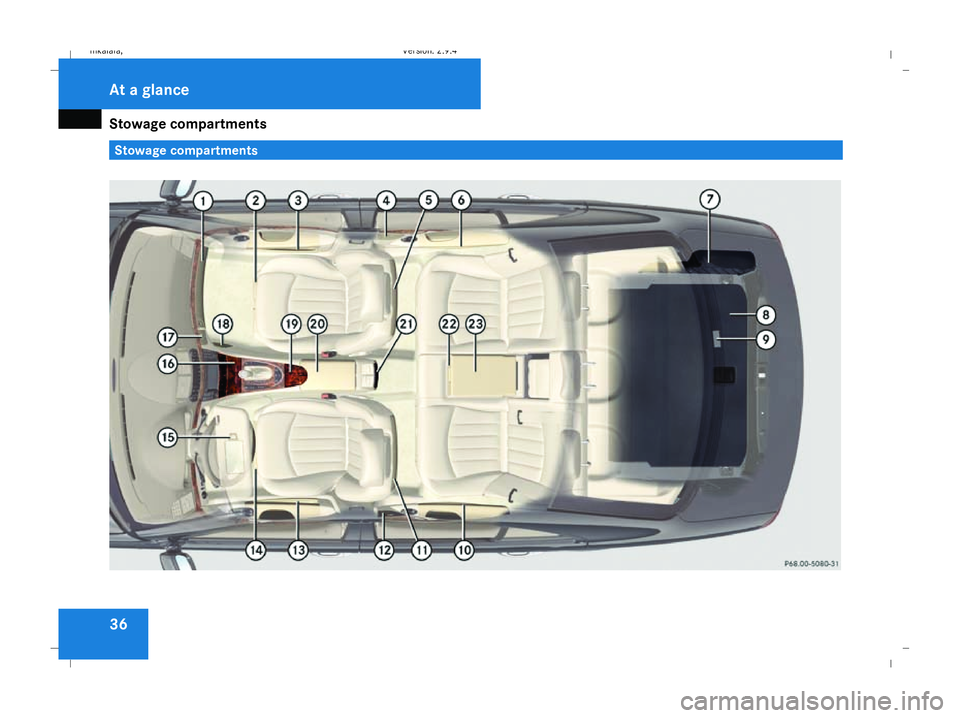
Stowage compartments
36 Stowage compartmentsAt a glance
211_AKB; 2; 5, en-GB
mkalafa,
Version: 2.9.4
2008-02-29T16:57:07+01:00 - Seite 36 Dateiname: 6515_3416_02_buchblock.pdf; preflight
Page 40 of 401
Stowage compartments
37Function Page
1 Glove compartment
205
2 Front-passenger seat stow-
age compartment with first-
aid kit 253
3 Door stowage pocket
4
Ashtray* 209
5 Ruffled pocket
6 Door stowage pocket
7 Luggage net
8 Stowage well under the
boot floor
192
9 Hooks at the top of the boot
195
a Door stowage pocket
b Ruffled pocket
c
Ashtray* 209
d Door stowage pocket Function Page
e Driver's seat stowage com-
partment with fire extin-
guisher*
253
f Sun visor card clip
207
g Stowage compartment in
the centre console
206
Socket 210
Ashtray* 209
Cigarette lighter* 209
h Spectacles compartment/
mobile phone compart-
ment
206
j Luggage net in the front-
passenger footwell
190
k Stowage compartment in
front of the armrest
206
Cup holder* in the centre
console
186 Function Page
l Stowage compartment/
telephone compartment
under the armrest
206
m Stowage compartment in
the centre console at the
rear
207
Socket 210
n Cup holder in the rear seat
armrest
186
o Stowage compartment in
the rear seat armrest
207At a glance
* optional
211_AKB; 2; 5, en-GB
mkalafa,
Version: 2.9.4 2008-02-29T16:57:07+01:00 - Seite 37Dateiname: 6515_3416_02_buchblock.pdf; preflight
Page 41 of 401
Stowage compartments
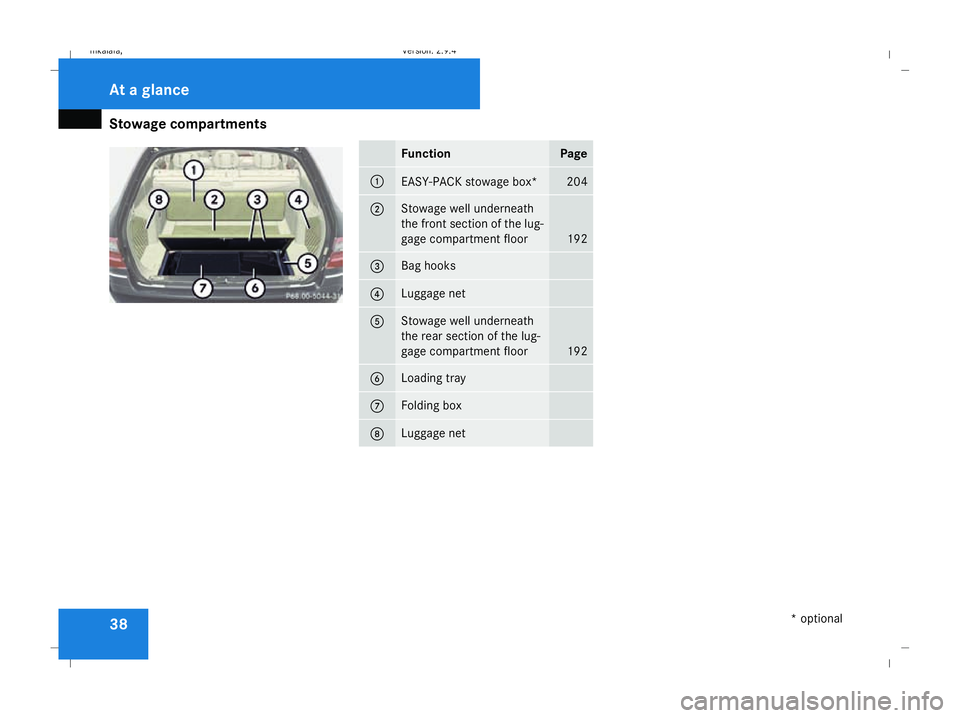
38 Function Page
1
EASY-PACK stowage box* 204
2 Stowage well underneath
the front section of the lug-
gage compartment floor
192
3 Bag hooks
4 Luggage net
5 Stowage well underneath
the rear section of the lug-
gage compartment floor
192
6 Loading tray
7 Folding box
8 Luggage netAt a glance
* optional
211_AKB; 2; 5, en-GB
mkalafa,
Version: 2.9.4 2008-02-29T16:57:07+01:00 - Seite 38Dateiname: 6515_3416_02_buchblock.pdf; preflight
Page 43 of 401
Occupant safety
40 Occupant safety
Notes on occupant safety
Seat belts, together with belt tensioners, belt
force limiters and airbags, are coordinated
restraint systems. They reduce the risk of
injury in defined accident situations and
thereby increase occupant safety. However,
seat belts and airbags generally do not pro-
tect against objects penetrating the vehicle
from the outside.
To ensure that the restraint systems can
deliver their full potential protection, you
should ensure that:
R the seat and head restraint are adjusted
properly (Y page 77)
R the seat belt has been fastened properly
(Y page 95)
R the airbags can inflate properly if they are
deployed (Y page 43)
R the steering wheel is adjusted properly
(Y page 89)
R the restraint systems have not been modi-
fied
i An airbag increases the protection of
vehicle occupants wearing a seat belt. However, airbags are only an additional
restraint system which complements, but
does not replace, the seat belt. All vehicle
occupants must wear their seat belt cor-
rectly at all times, even if the vehicle is
equipped with airbags. This is because - on
the one hand - airbags are not deployed in
all types of accident, as in some situations
airbag deployment would not increase the
protection afforded to vehicle occupants,
provided they are wearing their seat belt
correctly. On the other hand, airbag deploy-
ment only provides increased protection if
the seat belt is worn correctly because:
R
the seat belt helps to keep the vehicle
occupant in the best position in relation
to the airbag
R for example, in a head-on collision, the
seat belt can more adequately prevent
the occupant from being propelled
towards the force of the impact, and is
thus better suited to prevent injury
Therefore, in accident situations where an
airbag is deployed, it only provides protec-
tion in addition to the seat belt if the seat
belt is being worn correctly. G
Risk of accident and injury
Always have maintenance work carried out
at a qualified specialist workshop which
has the necessary specialist knowledge
and tools to carry out the work required.
Mercedes-Benz recommends that you use
a Mercedes-Benz Service Centre for this
purpose.
In particular, work relevant to safety or on
safety-related systems must be carried out
at a qualified specialist workshop. If this
work is not carried out correctly, the oper-
ating safety of your vehicle may be affec-
ted. There is a risk of an accident and injury. G
Risk of injury
The restraint system may not work as inten-
ded if the following components have been
modified or work on these components has
not been performed correctly:
R restraint system, consisting of the seat
belts and anchorages, belt tensioners,
belt force limiters, airbags
R wiring
R networked electronic systems
Airbags or belt tensioners could then fail,
e.g. in the event of an accident in which the Safety
211_AKB; 2; 5, en-GB
mkalafa,
Version: 2.9.4 2008-02-29T16:57:07+01:00 - Seite 40Dateiname: 6515_3416_02_buchblock.pdf; preflight
Page 45 of 401
Occupant safety
42
ess is pre-emptive in nature as the airbag
must be deployed during – and not at the end
of – the collision.
i Airbags are not deployed in all types of
accidents. They are controlled by complex
sensor technology and evaluation logic.
This process is pre-emptive in nature as
airbag deployment must take place during
the impact and must be adapted to provide
calculated, additional protection for the
vehicle occupants. Not all airbags are
deployed in an accident.
The different airbag systems work inde-
pendently of each other. However, the
deployment of each individual system will
depend on the type of accident determined
by the control system in the first stages of
the collision (head-on collision, side impact
and overturn) and the extent of the acci-
dent (in particular, the vehicle's rate of
deceleration or acceleration).
The rate of vehicle deceleration or accelera-
tion and the direction of the force are basi-
cally determined by:
R the distribution of forces during the colli-
sion
R the collision angle R
the deformation characteristics of the vehi-
cle
R the characteristics of the object with which
the vehicle has collided, e.g. the other vehi-
cle
Factors which can only be seen and measured
after a collision has occurred do not play a
decisive role in the deployment of an airbag,
nor do they provide an indication of it.
The vehicle may be deformed significantly,
e. g. on the bonnet or the wing, without an
airbag being deployed. This is the case if only
parts which are relatively easily deformed are
affected and the necessary deceleration does
not occur. Conversely, airbags may be
deployed even though the vehicle suffers only
minor deformations. This is the case if, for
example, very rigid vehicle parts such as lon-
gitudinal body members are affected and suf-
ficient deceleration occurs as a result.
Belt tensioners, belt force limiters The front seat belts and the outer seat belts
in the rear are equipped with belt tensioners.
!
Do not engage the seat belt tongue in the
buckle on the front-passenger seat if the
seat is not occupied. Otherwise the belt tensioner could be activated in an emer-
gency.
If the seat belt is also equipped with a belt
force limiter, the force exerted by the seat
belt on the seat occupant is reduced.
Belt tensioners tighten the seat belts in an
accident, pulling them close against the body.
i Belt tensioners do not correct incorrect
seat positions or incorrectly fastened seat
belts.
Belt tensioners do not pull occupants back
towards the backrest.
The front belt force limiters are synchronised
with the front airbags, which distribute the
forces exerted by the belt force limiters on
the occupant over a greater area.
When the ignition is switched on, the belt ten-
sioner is triggered:
R only if the restraint systems are operational
(the 1 warning lamp lights up after the
ignition is switched on and goes out once
the engine is running) (Y page 41)
R for each three-point seat belt in the front of
the vehicle when the belt tongue is
engaged in the buckle
R in the event of a head-on or rear-end colli-
sion if the vehicle decelerates or acceler- Safety
211_AKB; 2; 5, en-GB
mkalafa,
Version: 2.9.4 2008-02-29T16:57:07+01:00 - Seite 42Dateiname: 6515_3416_02_buchblock.pdf; preflight
Page 63 of 401
Driving safety sys
tems60 ESP
®
(Electronic Stability Program)
ESP ®
monitors driving stability and traction,
i.e. power transmission between the tyres
and the road surface.
If ESP ®
detects that the vehicle is deviating
from the direction desired by the driver, one
or more wheels are braked to stabilise the
vehicle. The engine output is also modified, if
necessary, to keep the vehicle on the desired
course within physical limits. ESP ®
assists
the driver when pulling away on wet or slip-
pery roads. ESP ®
can also stabilise the vehi-
cle during braking.
When ESP ®
intervenes, the vwarning
lamp flashes in the instrument cluster. G
Risk of accident
If the v warning lamp in the instrument
cluster flashes, proceed as follows:
R Do not deactivate ESP ®
under any cir-
cumstances.
R Only depress the accelerator pedal as far
as necessary when pulling away.
R Adapt your driving style to suit the pre-
vailing road and weather conditions.
The vehicle could otherwise go into a skid. ESP
®
cannot reduce the risk of an accident
if you drive too fast. ESP ®
cannot override
the laws of physics.
! If the vehicle is to be towed with the front
or rear axle raised, the ignition must be
switched off (key in position 0or 1in the
ignition lock). Application of the brakes by
ESP ®
could otherwise destroy the brake
system on the front or rear axle.
! Vehicles with 4MATIC* may not be towed
with the front or rear axle raised.
i Only use wheels with the recommended
tyre sizes. Only then will ESP ®
function
properly.
Deactivating/activating ESP ® ESP
®
is activated automatically when the
engine is running.
It may be best to deactivate ESP ®
in the fol-
lowing situations:
R when using snow chains
R in deep snow
R on sand or gravel G
Risk of accident
Activate ESP ®
as soon as the situations
described above no longer apply. ESP ®
will
otherwise not be able to stabilise the vehi-
cle if the vehicle starts to skid or a wheel
starts to spin.
If you deactivate ESP ®
:
R ESP ®
no longer improves driving stability.
R engine torque is not limited and the drive
wheels are able to spin. The spinning
wheels produce a cutting effect for better
traction.
R traction control is still activated.
R ESP ®
still provides support when you
brake.
i If ESP ®
is deactivated and one or more
wheels start to spin, the vwarning lamp
in the instrument cluster flashes. In such
situations ESP ®
will not stabilise the vehi-
cle. Safety
* optional
211_AKB; 2; 5, en-GB
mkalafa
,V ersion: 2.9.4
2008-02-29T16:57:07+01:00 - Seite 60 Dateiname: 6515_3416_02_buchblock.pdf; preflight