weight MERCEDES-BENZ E-CLASS ESTATE 2009 User Guide
[x] Cancel search | Manufacturer: MERCEDES-BENZ, Model Year: 2009, Model line: E-CLASS ESTATE, Model: MERCEDES-BENZ E-CLASS ESTATE 2009Pages: 373, PDF Size: 12.37 MB
Page 191 of 373
Even if you follow all the loading guidelines,
the load will increase the risk of injury in the
event of an accident.
The handling characteristics of a laden vehi-
cle are dependent on the distribution of the
load within the vehicle. For this reason, you
should observe the following notes when
transporting a load:
R when transporting a load, never exceed the
maximum permissible gross vehicle weight
or the permissible axle loads for the vehicle
(including occupants).
R position heavy loads as far forwards and as
low in the boot or luggage compartment as
possible.
R the load must not protrude above the upper
edge of the seat backrests.
R always place the load against the rear or
front seat backrests. Make sure that the
seat backrests are securely locked into
place.
R always place the load behind unoccupied
seats if possible.
R secure the load with sufficiently strong and
wear-resistant load restraints. pad sharp
edges for protection.
i Load restraints are available at any quali-
fied specialist workshop, e.g. a Mercedes-
Benz Service Centre. Stowage compartments
G
Risk of injury
The stowage compartments must be closed
when items are stored in them. Luggage nets
are not designed to secure heavy items of
luggage.
You or other vehicle occupants could be
injured by objects being thrown around if you: R
brake sharply
R change direction suddenly
R are involved in an accident
Sharp-edged and fragile objects must not be
placed in the luggage net.
Do not place hard objects in the map pockets.
Objects must not protrude from the map
pockets.
Glove compartment i
Depending on the vehicle's equipment,
there is an AUX-IN connection installed in
the glove compartment, or a Media Inter-
face*, which is a universal interface for
portable audio equipment, e.g. for an iPod
or USB device; see the separate Audio or
COMAND APS* operating instructions. X
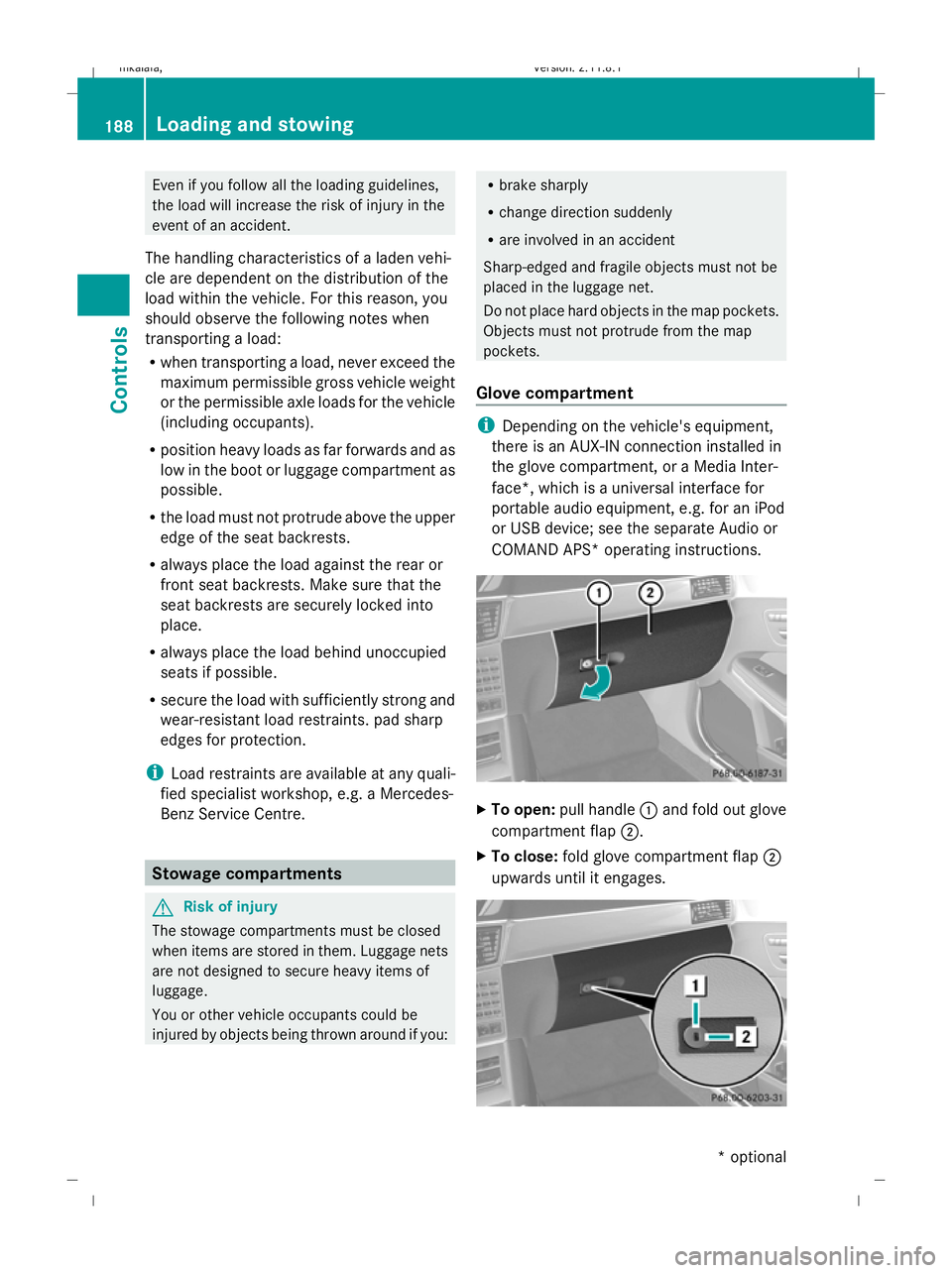
To open: pull handle :and fold out glove
compartment flap ;.
X To close: fold glove compartment flap ;
upwards until it engages. 188
Loading and sto
wingControls
* optional
212_AKB; 2; 4, en-GB
mkalafa
,V ersion: 2.11.8.1
2009-05-05T14:17:16+02:00 - Seite 188
Dateiname: 6515346702_buchblock.pdf; erzeugt am 07. May 2009 14:16:34; WK
Page 196 of 373
Cup holder in the folding bench seat*
X
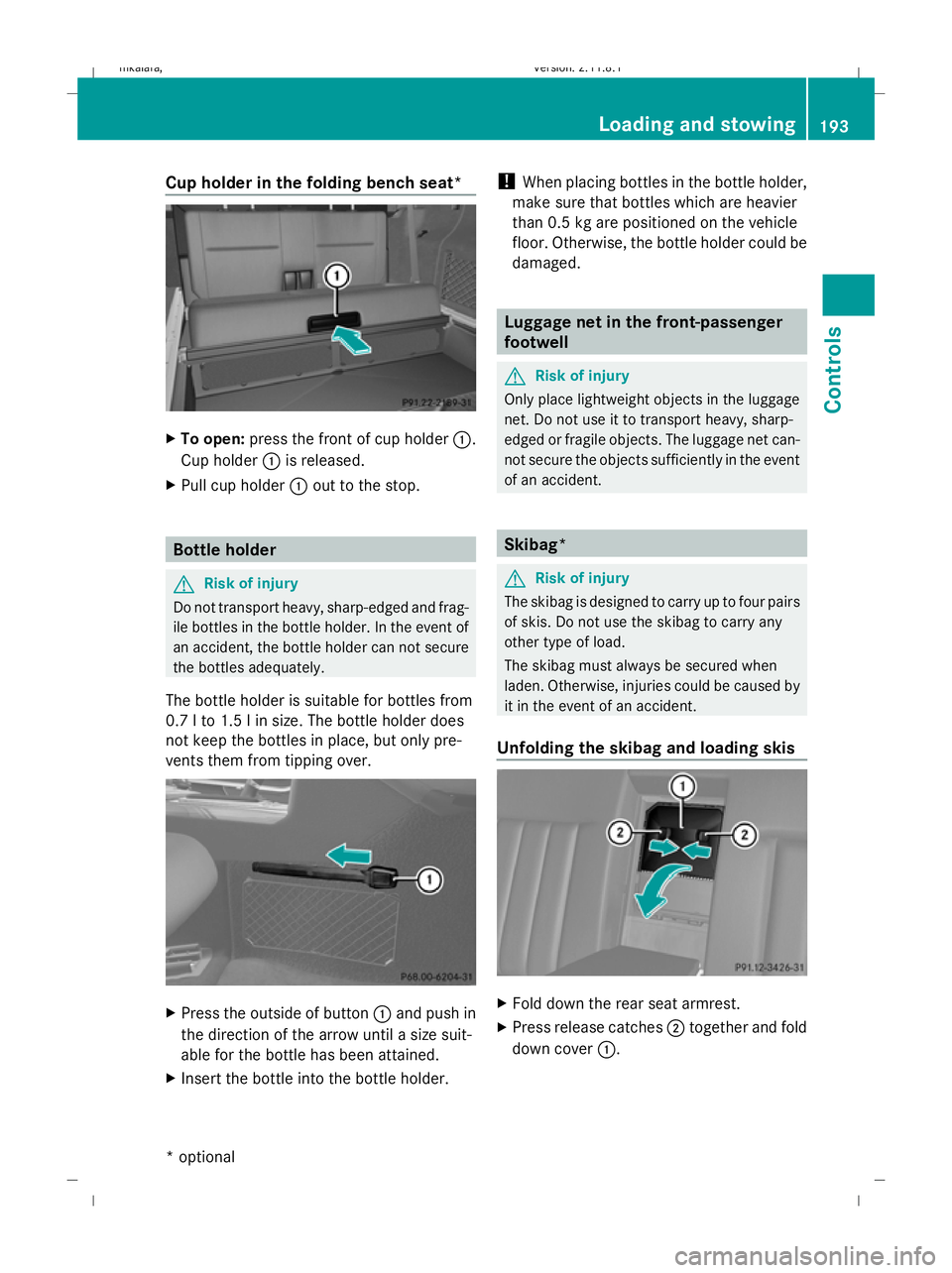
To open: press the front of cup holder :.
Cup holder :is released.
X Pull cup holder :out to the stop. Bottle holder
G
Risk of injury
Do not transport heavy, sharp-edged and frag-
ile bottles in the bottle holder. In the event of
an accident, the bottle holder can not secure
the bottles adequately.
The bottle holder is suitable for bottles from
0.7 l to 1.5 l in size. The bottle holder does
not keep the bottles in place, but only pre-
vents them from tipping over. X
Press the outside of button :and push in
the direction of the arrow until a size suit-
able for the bottle has been attained.
X Insert the bottle into the bottle holder. !
When placing bottles in the bottle holder,
make sure that bottles which are heavier
than 0.5 kg are positioned on the vehicle
floor. Otherwise, the bottle holder could be
damaged. Luggage net in the front-passenger
footwell
G
Risk of injury
Only place lightweight objects in the luggage
net. Do not use it to transport heavy, sharp-
edged or fragile objects. The luggage net can-
not secure the objects sufficiently in the event
of an accident. Skibag*
G
Risk of injury
The skibag is designed to carry up to four pairs
of skis. Do not use the skibag to carry any
other type of load.
The skibag must always be secured when
laden. Otherwise, injuries could be caused by
it in the event of an accident.
Unfolding the skibag and loading skis X
Fold down the rear seat armrest.
X Press release catches ;together and fold
down cover :. Loading and stowing
193Controls
* optional
212_AKB; 2; 4, en-GB
mkalafa
,V ersion: 2.11.8.1
2009-05-05T14:17:16+02:00 - Seite 193 Z
Dateiname: 6515346702_buchblock.pdf; erzeugt am 07. May 2009 14:16:38; WK
Page 221 of 373
soon as sulphur-free fuel (sulphur content
< 10 ppm) is used for refuelling, the odours
are reduced.
AMG vehicles !
Refuel using only unleaded super grade
petrol with a minimum octane number of
98 RON/88 MON conforming to European
standard EN 228.
Otherwise, you could impair engine output
or damage the engine.
i If the recommended fuel is not available
and only as a temporary measure, you may
also use premium unleaded petrol,
95 RON/85 MON. This may reduce engine
performance and increase fuel consump-
tion. You must avoid driving at full throttle.
! In emergencies, and only when the rec-
ommended fuel is not available, you may
also use standard unleaded petrol,
91 RON/82.5 MON.
However, using this fuel results in consid-
erably higher petrol consumption and sig-
nificantly reduced engine output. Avoid
driving at full throttle.
If no fuel other than regular petrol with
91 RON/82.5 MON or a lower grade is per-
manently available, you should have the
vehicle adapted to run on this fuel by the
local after-sales service. Diesel (EN 590, DIN 51628)
G
Risk of fire
Do not use petrol to refuel vehicles with a die-
sel engine. Never mix diesel with petrol. This
causes damage to the fuel system and engine
and could result in the vehicle catching fire.
! Refuel using only diesel which conforms
to European standard EN 590 or German
standard DIN 51628. Otherwise, you could
impair engine output or damage the engine. !
When refuelling vehicles with a diesel par-
ticulate filter in countries outside the EU,
only low-sulphur Euro diesel with less than
0.005 percent sulphur content by weight
(50 ppm) should be used.
! In countries in which diesel with a higher
sulphur content is available, the engine oil
should be renewed at more frequent inter-
vals. More information about intervals for
changing the engine oil can be obtained
from any Mercedes-Benz Service Centre.
! Using fuel that does not comply with the
European standard EN 590 or the German
standard DIN 51628 can lead to increased
wear, engine damage and damage to the
exhaust system.
Do not use the following:
R marine diesel
R heating oil
R bio-diesel
R vegetable oil
R petrol
R paraffin
R kerosene
Do not add such fuels to diesel fuel and do
not use any special additives (exception:
flow improvers – see "Low outside temper-
atures").
Damage caused by the use of unapproved
fuels or additives is not covered by the
implied warranty.
Further information on "Fuel" (Y page 334).
Low outside temperatures The flow properties of diesel may be inade-
quate at low ambient temperatures.
Diesel fuel with improved cold flow qualities
is available during the winter months. In
Europe, the different climate-dependant cold
categories are defined in standard EN 590.
Refuelling with diesel fuel which complies218
RefuellingOperation
212_AKB; 2; 4, en-GB
mkalafa,
Version: 2.11.8.1 2009-05-05T14:17:16+02:00 - Seite 218
Dateiname: 6515346702_buchblock.pdf; erzeugt am 07. May 2009 14:16:54; WK
Page 238 of 373
X
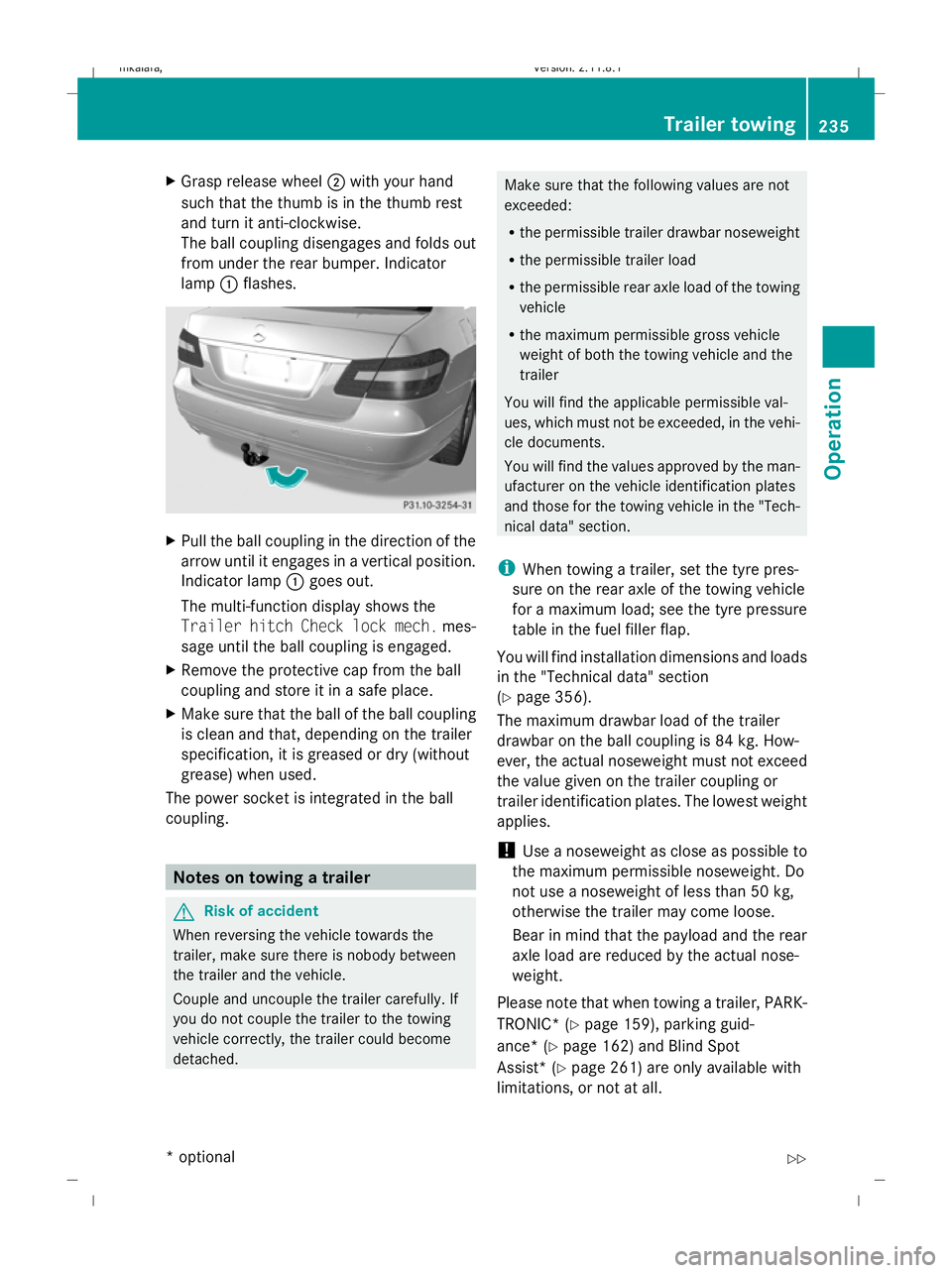
Grasp release wheel ;with your hand
such that the thumb is in the thumb rest
and turn it anti-clockwise.
The ball coupling disengages and folds out
from under the rear bumper. Indicator
lamp :flashes. X
Pull the ball coupling in the direction of the
arrow until it engages in a vertical position.
Indicator lamp :goes out.
The multi-function display shows the
Trailer hitch Check lock mech. mes-
sage until the ball coupling is engaged.
X Remove the protective cap from the ball
coupling and store it in a safe place.
X Make sure that the ball of the ball coupling
is clean and that, depending on the trailer
specification, it is greased or dry (without
grease) when used.
The power socket is integrated in the ball
coupling. Notes on towing a trailer
G
Risk of accident
When reversing the vehicle towards the
trailer, make sure there is nobody between
the trailer and the vehicle.
Couple and uncouple the trailer carefully. If
you do not couple the trailer to the towing
vehicle correctly, the trailer could become
detached. Make sure that the following values are not
exceeded:
R
the permissible trailer drawbar noseweight
R the permissible trailer load
R the permissible rear axle load of the towing
vehicle
R the maximum permissible gross vehicle
weight of both the towing vehicle and the
trailer
You will find the applicable permissible val-
ues, which must not be exceeded, in the vehi-
cle documents.
You will find the values approved by the man-
ufacturer on the vehicle identification plates
and those for the towing vehicle in the "Tech-
nical data" section.
i When towing a trailer, set the tyre pres-
sure on the rear axle of the towing vehicle
for a maximum load; see the tyre pressure
table in the fuel filler flap.
You will find installation dimensions and loads
in the "Technical data" section
(Y page 356).
The maximum drawbar load of the trailer
drawbar on the ball coupling is 84 kg. How-
ever, the actual noseweight must not exceed
the value given on the trailer coupling or
trailer identification plates. The lowest weight
applies.
! Use a noseweight as close as possible to
the maximum permissible noseweight. Do
not use a noseweight of less than 50 kg,
otherwise the trailer may come loose.
Bear in mind that the payload and the rear
axle load are reduced by the actual nose-
weight.
Please note that when towing a trailer, PARK-
TRONIC* ( Ypage 159), parking guid-
ance* (Y page 162) and Blind Spot
Assist* (Y page 261) are only available with
limitations, or not at all. Trailer towing
235Operation
* optional
212_AKB; 2; 4, en-GB
mkalafa
,V ersion: 2.11.8.1
2009-05-05T14:17:16+02:00 - Seite 235 Z
Dateiname: 6515346702_buchblock.pdf; erzeugt am 07. May 2009 14:16:59; WK
Page 327 of 373
X
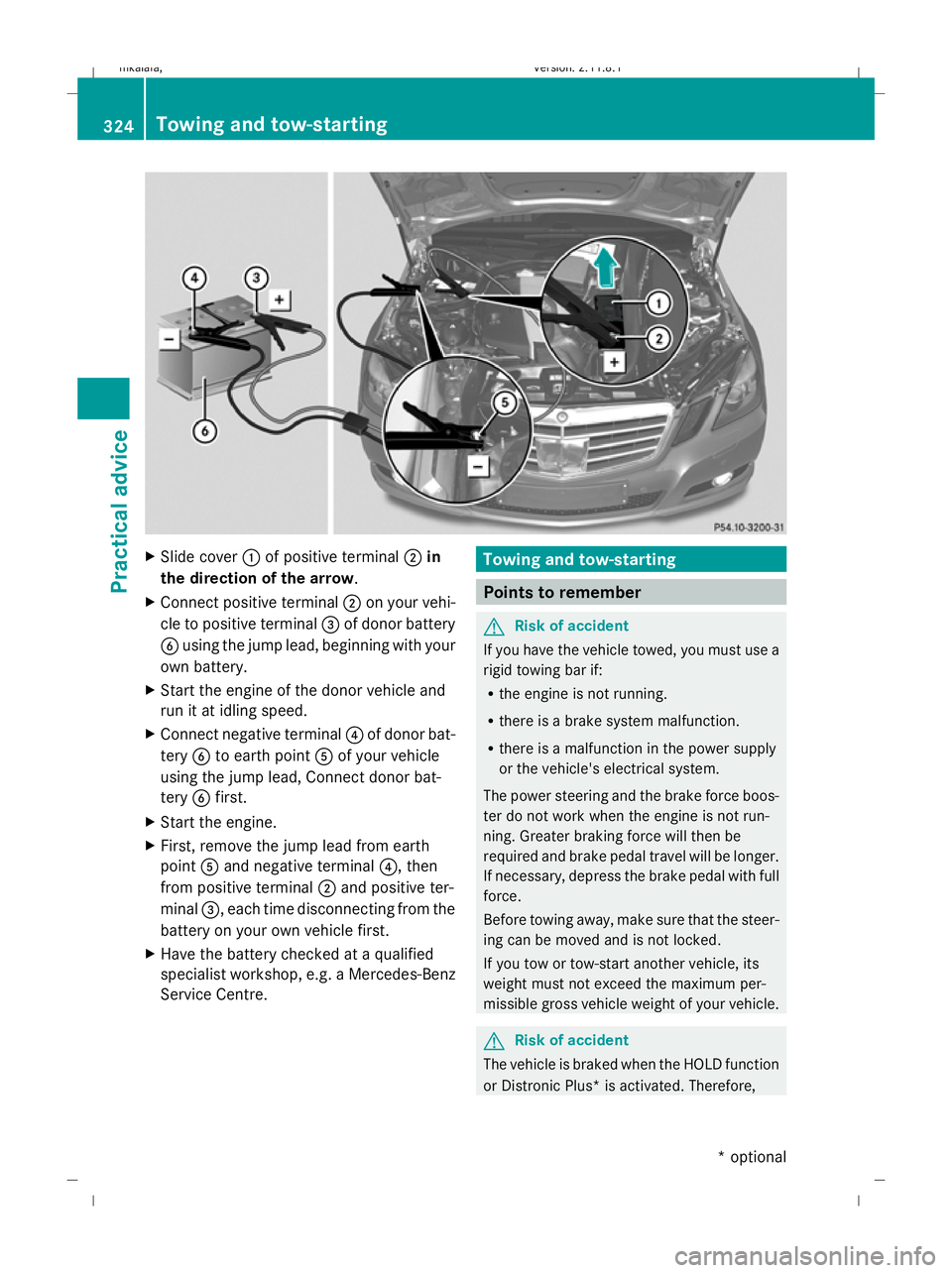
Slide cover :of positive terminal ;in
the direction of the arrow .
X Connect positive terminal ;on your vehi-
cle to positive terminal =of donor battery
B using the jump lead, beginning with your
own battery.
X Start the engine of the donor vehicle and
run it at idling speed.
X Connect negative terminal ?of donor bat-
tery Bto earth point Aof your vehicle
using the jump lead, Connect donor bat-
tery Bfirst.
X Start the engine.
X First, remove the jump lead from earth
point Aand negative terminal ?, then
from positive terminal ;and positive ter-
minal =, each time disconnecting from the
battery on your own vehicle first.
X Have the battery checked at a qualified
specialist workshop, e.g. a Mercedes-Benz
Service Centre. Towing and tow-starting
Points to remember
G
Risk of accident
If you have the vehicle towed, you must use a
rigid towing bar if:
R the engine is not running.
R there is a brake system malfunction.
R there is a malfunction in the power supply
or the vehicle's electrical system.
The power steering and the brake force boos-
ter do not work when the engine is not run-
ning. Greater braking force will then be
required and brake pedal travel will be longer.
If necessary, depress the brake pedal with full
force.
Before towing away, make sure that the steer-
ing can be moved and is not locked.
If you tow or tow-start another vehicle, its
weight must not exceed the maximum per-
missible gross vehicle weight of your vehicle. G
Risk of accident
The vehicle is braked when the HOLD function
or Distronic Plus* is activated. Therefore, 324
Towing and tow-startingPractical advice
* optional
212_AKB; 2; 4, en-GB
mkalafa
,V ersion: 2.11.8.1
2009-05-05T14:17:16+02:00 - Seite 324
Dateiname: 6515346702_buchblock.pdf; erzeugt am 07. May 2009 14:17:27; WK
Page 336 of 373
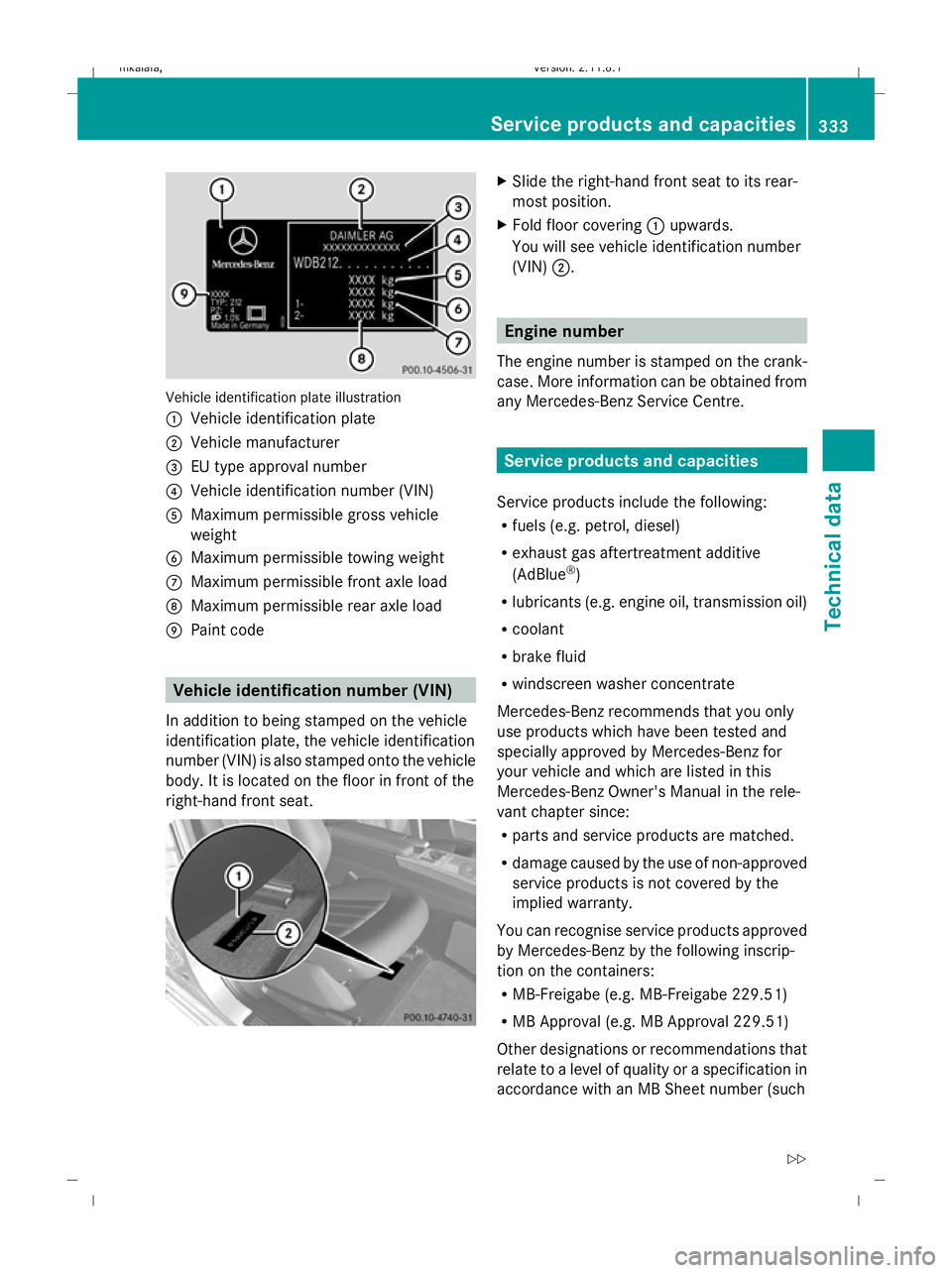
Vehicle identification plate illustration
:
Vehicle identification plate
; Vehicle manufacturer
= EU type approval number
? Vehicle identification number (VIN)
A Maximum permissible gross vehicle
weight
B Maximum permissible towing weight
C Maximum permissible front axle load
D Maximum permissible rear axle load
E Paint code Vehicle identification number (VIN)
In addition to being stamped on the vehicle
identification plate, the vehicle identification
number (VIN) is also stamped onto the vehicle
body. It is located on the floor in front of the
right-hand front seat. X
Slide the right-hand front seat to its rear-
most position.
X Fold floor covering :upwards.
You will see vehicle identification number
(VIN) ;. Engine number
The engine number is stamped on the crank-
case. More information can be obtained from
any Mercedes-Benz Service Centre. Service products and capacities
Service products include the following:
R fuels (e.g. petrol, diesel)
R exhaust gas aftertreatment additive
(AdBlue ®
)
R lubricants (e.g. engine oil, transmission oil)
R coolant
R brake fluid
R windscreen washer concentrate
Mercedes-Benz recommends that you only
use products which have been tested and
specially approved by Mercedes-Benz for
your vehicle and which are listed in this
Mercedes-Benz Owner's Manual in the rele-
vant chapter since:
R parts and service products are matched.
R damage caused by the use of non-approved
service products is not covered by the
implied warranty.
You can recognise service products approved
by Mercedes-Benz by the following inscrip-
tion on the containers:
R MB-Freigabe (e.g. MB-Freigabe 229.51)
R MB Approval (e.g. MB Approval 229.51)
Other designations or recommendations that
relate to a level of quality or a specification in
accordance with an MB Sheet number (such Service products and capacities
333Technical data
212_AKB; 2; 4, en-GB
mkalafa, Version: 2.11.8.1 2009-05-05T14:17:16+02:00 - Seite 333 Z
Dateiname: 6515346702_buchblock.pdf; erzeugt am 07. May 2009 14:17:32; WK
Page 342 of 373
driving downhill). This would impair braking
efficiency.
Have the brake fluid renewed every two years
with a brake fluid that has been approved by
Mercedes-Benz and have this confirmed in
the Service Booklet.
i There is usually a notice in the engine
compartment to remind you when the next
brake fluid change is due. Windscreen washer system
The headlamp cleaning system* and wind-
screen washer system are both supplied from
the washer fluid reservoir.
Further information on windscreen washer
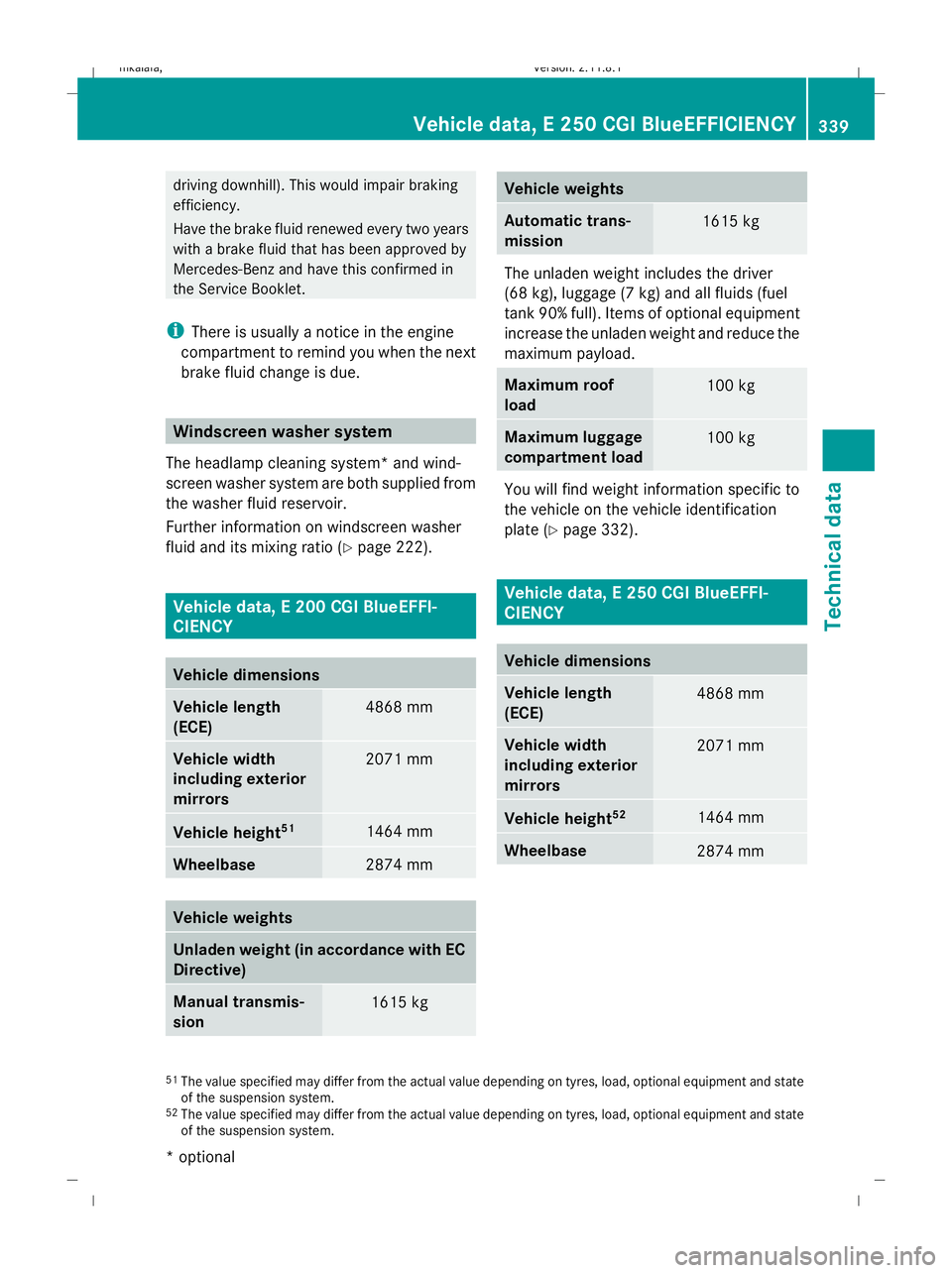
fluid and its mixing ratio ( Ypage 222). Vehicle data, E 200 CGI BlueEFFI-
CIENCY
Vehicle dimensions
Vehicle length
(ECE)
4868 mm
Vehicle width
including exterior
mirrors
2071 mm
Vehicle height
51 1464 mm
Wheelbase
2874 mm
Vehicle weights
Unladen weight (in accordance with EC
Directive)
Manual transmis-
sion
1615 kg Vehicle weights
Automatic trans-
mission
1615 kg
The unladen weight includes the driver
(68 kg), luggage (7 kg) and all fluids (fuel
tank 90% full). Items of optional equipment
increase the unladen weight and reduce the
maximum payload.
Maximum roof
load
100 kg
Maximum luggage
compartment load
100 kg
You will find weight information specific to
the vehicle on the vehicle identification
plate (Y
page 332). Vehicle data, E 250 CGI BlueEFFI-
CIENCY
Vehicle dimensions
Vehicle length
(ECE)
4868 mm
Vehicle width
including exterior
mirrors
2071 mm
Vehicle height
52 1464 mm
Wheelbase
2874 mm
51
The value specified may differ from the actual value depending on tyres, load, optional equipment and state
of the suspension system.
52 The value specified may differ from the actual value depending on tyres, load, optional equipment and state
of the suspension system. Vehicle data, E 250 CGI BlueEFFICIENCY
339Technical data
* optional
212_AKB; 2; 4, en-GB
mkalafa,
Version: 2.11.8.1 2009-05-05T14:17:16+02:00 - Seite 339 Z
Dateiname: 6515346702_buchblock.pdf; erzeugt am 07. May 2009 14:17:33; WK
Page 343 of 373
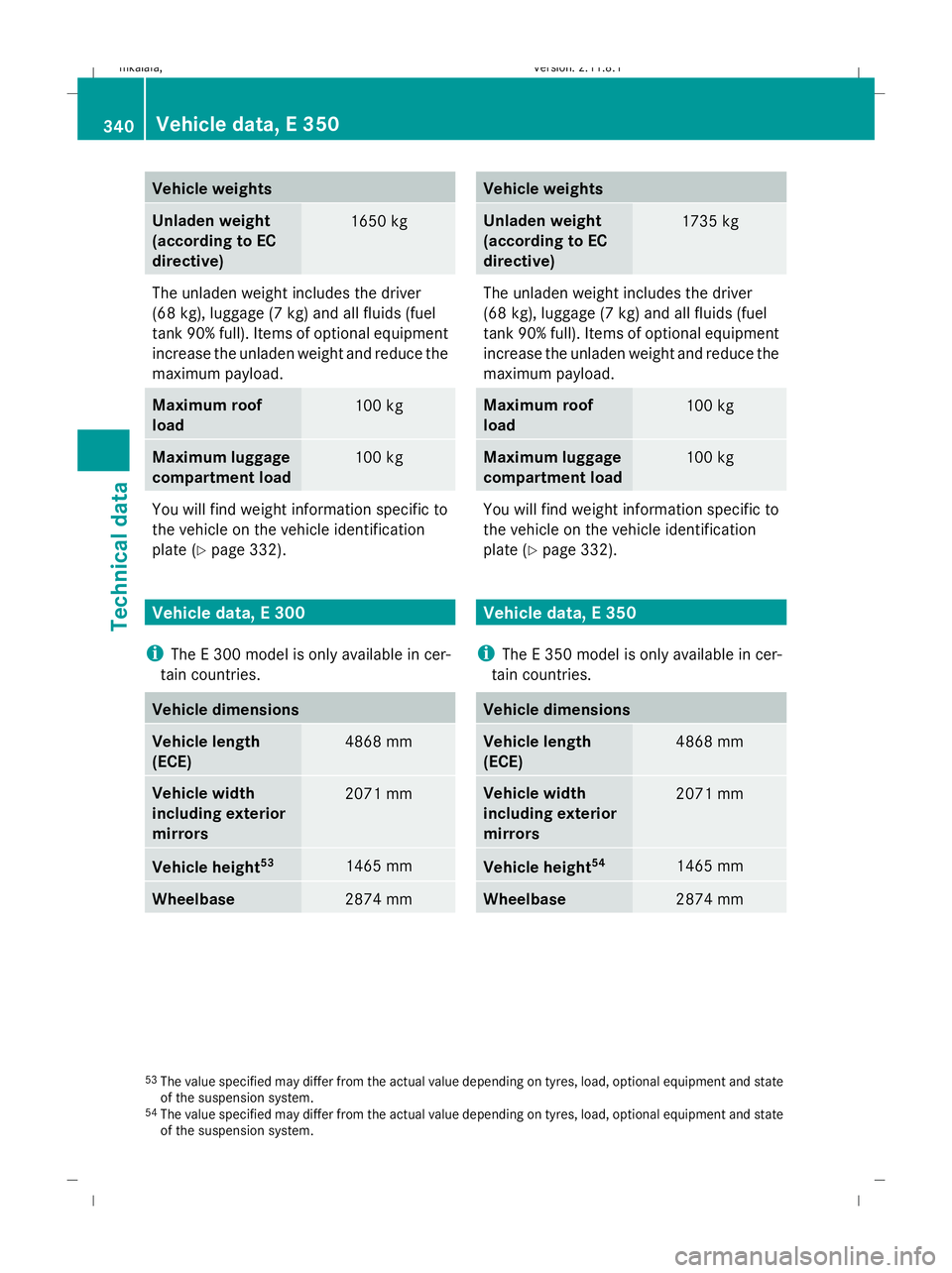
Vehicle weights
Unladen weight
(according to EC
directive)
1650 kg
The unladen weight includes the driver
(68 kg), luggage (7 kg) and all fluids (fuel
tank 90% full). Items of optional equipment
increase the unladen weight and reduce the
maximum payload. Maximum roof
load
100 kg
Maximum luggage
compartment load
100 kg
You will find weight information specific to
the vehicle on the vehicle identification
plate (Y page 332). Vehicle data, E 300
i The E 300 model is only available in cer-
tain countries. Vehicle dimensions
Vehicle length
(ECE)
4868 mm
Vehicle width
including exterior
mirrors
2071 mm
Vehicle height
53 1465 mm
Wheelbase
2874 mm Vehicle weights
Unladen weight
(according to EC
directive)
1735 kg
The unladen weight includes the driver
(68 kg), luggage (7 kg) and all fluids (fuel
tank 90% full). Items of optional equipment
increase the unladen weight and reduce the
maximum payload.
Maximum roof
load
100 kg
Maximum luggage
compartment load
100 kg
You will find weight information specific to
the vehicle on the vehicle identification
plate (Y
page 332). Vehicle data, E 350
i The E 350 model is only available in cer-
tain countries. Vehicle dimensions
Vehicle length
(ECE)
4868 mm
Vehicle width
including exterior
mirrors 2071 mm
Vehicle height
54 1465 mm
Wheelbase
2874 mm
53
The value specified may differ from the actual value depending on tyres, load, optional equipment and state
of the suspension system.
54 The value specified may differ from the actual value depending on tyres, load, optional equipment and state
of the suspension system. 340
Vehicle data, E 350Technical data
212_AKB; 2; 4, en-GB
mkalafa
,V ersion: 2.11.8.1
2009-05-05T14:17:16+02:00 - Seite 340
Dateiname: 6515346702_buchblock.pdf; erzeugt am 07. May 2009 14:17:33; WK
Page 344 of 373
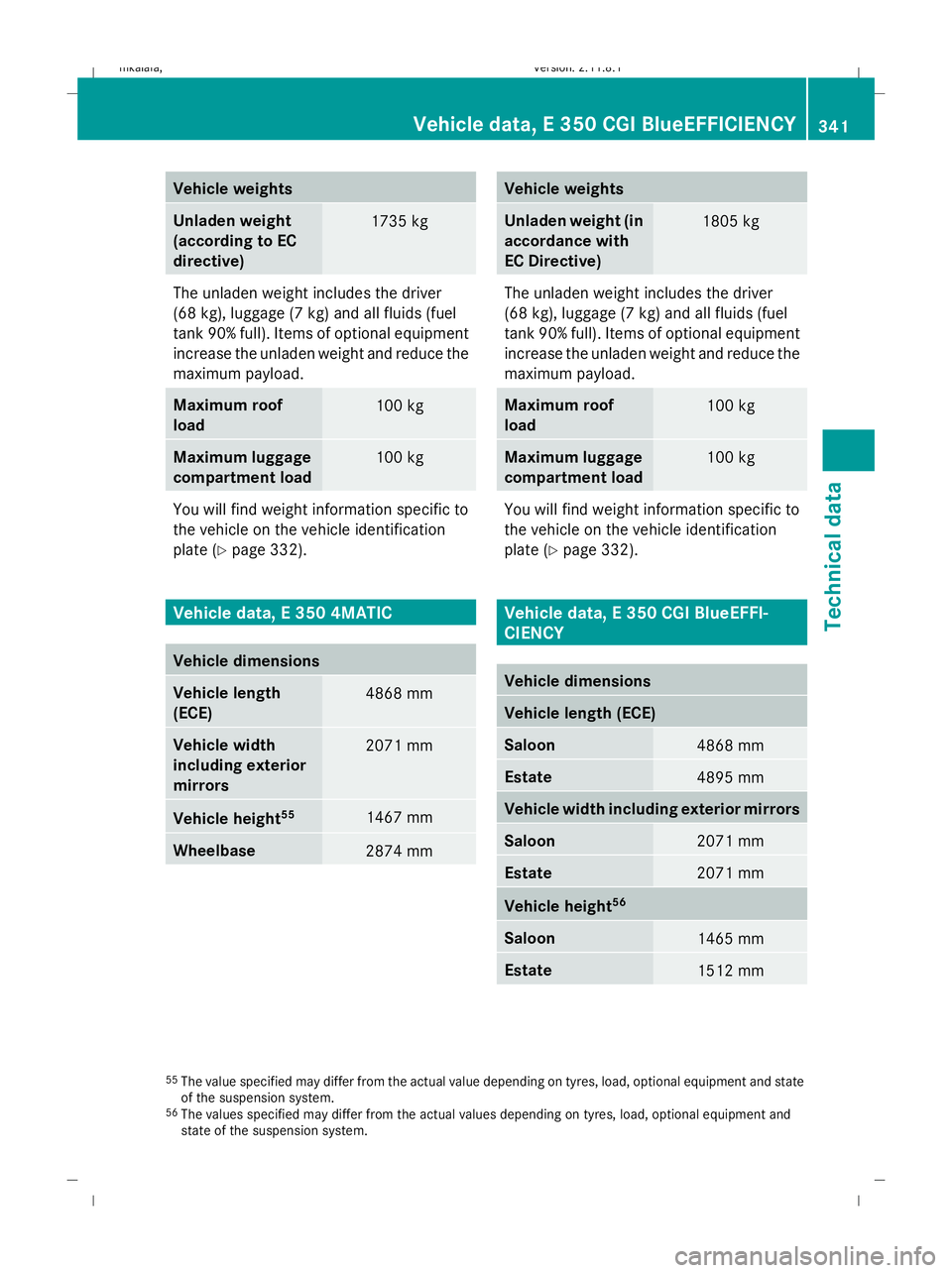
Vehicle weights
Unladen weight
(according to EC
directive) 1735 kg
The unladen weight includes the driver
(68 kg), luggage (7 kg) and all fluids (fuel
tank 90% full). Items of optional equipment
increase the unladen weight and reduce the
maximum payload. Maximum roof
load
100 kg
Maximum luggage
compartment load
100 kg
You will find weight information specific to
the vehicle on the vehicle identification
plate (Y page 332). Vehicle data, E 350 4MATIC
Vehicle dimensions
Vehicle length
(ECE)
4868 mm
Vehicle width
including exterior
mirrors
2071 mm
Vehicle height
55 1467 mm
Wheelbase
2874 mm Vehicle weights
Unladen weight (in
accordance with
EC Directive)
1805 kg
The unladen weight includes the driver
(68 kg), luggage (7 kg) and all fluids (fuel
tank 90% full). Items of optional equipment
increase the unladen weight and reduce the
maximum payload. Maximum roof
load
100 kg
Maximum luggage
compartment load
100 kg
You will find weight information specific to
the vehicle on the vehicle identification
plate (Y
page 332). Vehicle data, E 350 CGI BlueEFFI-
CIENCY
Vehicle dimensions
Vehicle length (ECE)
Saloon
4868 mm
Estate
4895 mm
Vehicle width including exterior mirrors
Saloon
2071 mm
Estate
2071 mm
Vehicle height
56 Saloon
1465 mm
Estate
1512 mm
55
The value specified may differ from the actual value depending on tyres, load, optional equipment and state
of the suspension system.
56 The values specified may differ from the actual values depending on tyres, load, optional equipment and
state of the suspension system. Vehicle data, E 350 CGI BlueEFFICIENCY
341Technical data
212_AKB; 2; 4, en-GB
mkalafa,V ersion: 2.11.8.1
2009-05-05T14:17:16+02:00 - Seite 341 Z
Dateiname: 6515346702_buchblock.pdf; erzeugt am 07. May 2009 14:17:33; WK
Page 345 of 373
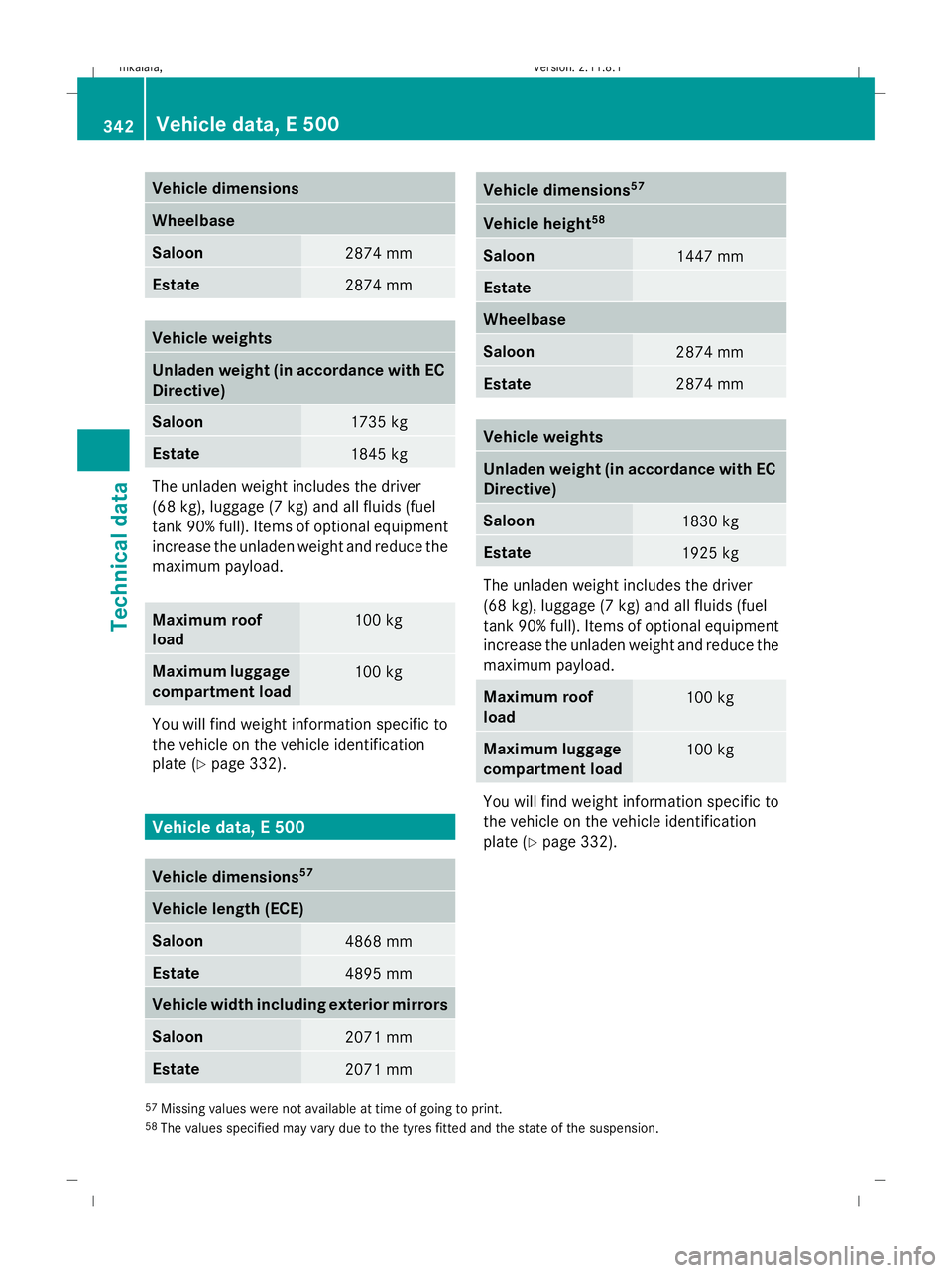
Vehicle dimensions
Wheelbase
Saloon
2874 mm
Estate
2874 mm
Vehicle weights
Unladen weight (in accordance with EC
Directive) Saloon
1735 kg
Estate
1845 kg
The unladen weight includes the driver
(68 kg), luggage (7 kg) and all fluids (fuel
tank 90% full). Items of optional equipment
increase the unladen weight and reduce the
maximum payload. Maximum roof
load
100 kg
Maximum luggage
compartment load
100 kg
You will find weight information specific to
the vehicle on the vehicle identification
plate (Y page 332). Vehicle data, E 500
Vehicle dimensions
57 Vehicle length (ECE)
Saloon
4868 mm
Estate
4895 mm
Vehicle width including exterior mirrors
Saloon
2071 mm
Estate
2071 mm Vehicle dimensions
57 Vehicle height
58 Saloon
1447 mm
Estate
Wheelbase
Saloon
2874 mm
Estate
2874 mm
Vehicle weights
Unladen weight (in accordance with EC
Directive)
Saloon
1830 kg
Estate
1925 kg
The unladen weight includes the driver
(68 kg), luggage (7 kg) and all fluids (fuel
tank 90% full). Items of optional equipment
increase the unladen weight and reduce the
maximum payload.
Maximum roof
load
100 kg
Maximum luggage
compartment load
100 kg
You will find weight information specific to
the vehicle on the vehicle identification
plate (Y
page 332). 57
Missing values were not available at time of going to print.
58 The values specified may vary due to the tyres fitted and the state of the suspension. 342
Vehicle data, E 500Technical data
212_AKB; 2; 4, en-GB
mkalafa
,V ersion: 2.11.8.1
2009-05-05T14:17:16+02:00 - Seite 342
Dateiname: 6515346702_buchblock.pdf; erzeugt am 07. May 2009 14:17:33; WK