height MERCEDES-BENZ E-CLASS SALOON 2008 User Guide
[x] Cancel search | Manufacturer: MERCEDES-BENZ, Model Year: 2008, Model line: E-CLASS SALOON, Model: MERCEDES-BENZ E-CLASS SALOON 2008Pages: 401, PDF Size: 6.89 MB
Page 226 of 401
Engine compartment
223
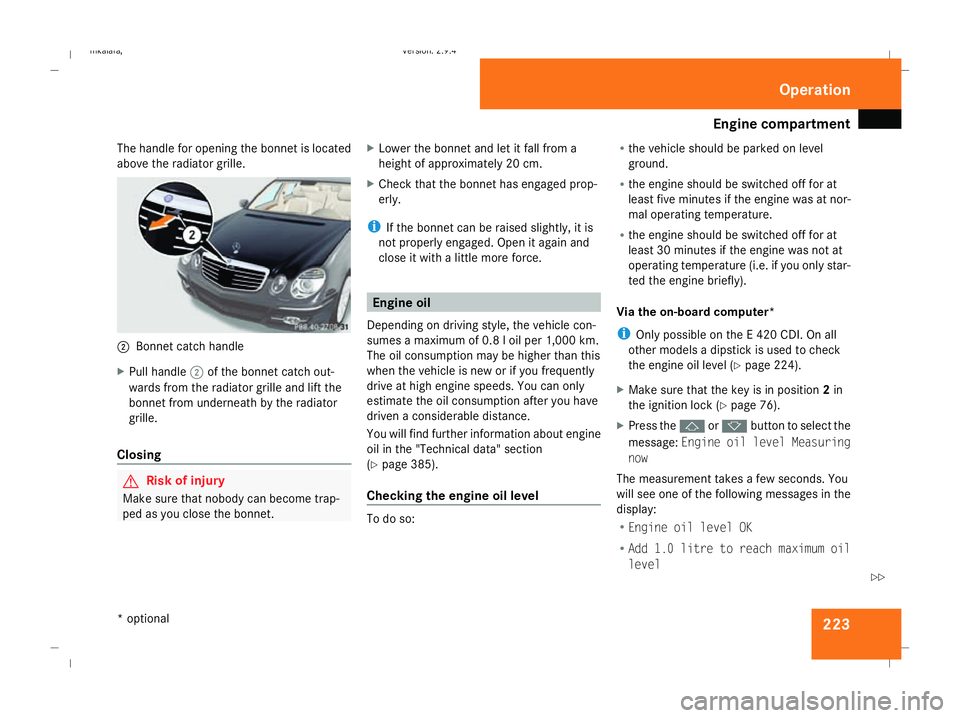
The handle for opening the bonnet is located
above the radiator grille. 2
Bonnet catch handle
X Pull handle 2of the bonnet catch out-
wards from the radiator grille and lift the
bonnet from underneath by the radiator
grille.
Closing G
Risk of injury
Make sure that nobody can become trap-
ped as you close the bonnet. X
Lower the bonnet and let it fall from a
height of approximately 20 cm.
X Check that the bonnet has engaged prop-
erly.
i If the bonnet can be raised slightly, it is
not properly engaged. Open it again and
close it with a little more force. Engine oil
Depending on driving style, the vehicle con-
sumes a maximum of 0.8 l oil per 1,000 km.
The oil consumption may be higher than this
when the vehicle is new or if you frequently
drive at high engine speeds. You can only
estimate the oil consumption after you have
driven a considerable distance.
You will find further information about engine
oil in the "Technical data" section
(Y page 385).
Checking the engine oil level To do so:R
the vehicle should be parked on level
ground.
R the engine should be switched off for at
least five minutes if the engine was at nor-
mal operating temperature.
R the engine should be switched off for at
least 30 minutes if the engine was not at
operating temperature (i.e. if you only star-
ted the engine briefly).
Via the on-board computer*
i Only possible on the E 420 CDI. On all
other models a dipstick is used to check
the engine oil level (Y page 224).
X Make sure that the key is in position 2in
the ignition lock (Y page 76).
X Press the jork button to select the
message: Engine oil level Measuring
now
The measurement takes a few seconds. You
will see one of the following messages in the
display:
R Engine oil level OK
R Add 1.0 litre to reach maximum oil
level Operation
* optional
211_AKB; 2; 5, en-GB
mkalafa,
Version: 2.9.4 2008-02-29T16:57:07+01:00 - Seite 223 ZDateiname: 6515_3416_02_buchblock.pdf; preflight
Page 243 of 401
Trailer towing
240
X
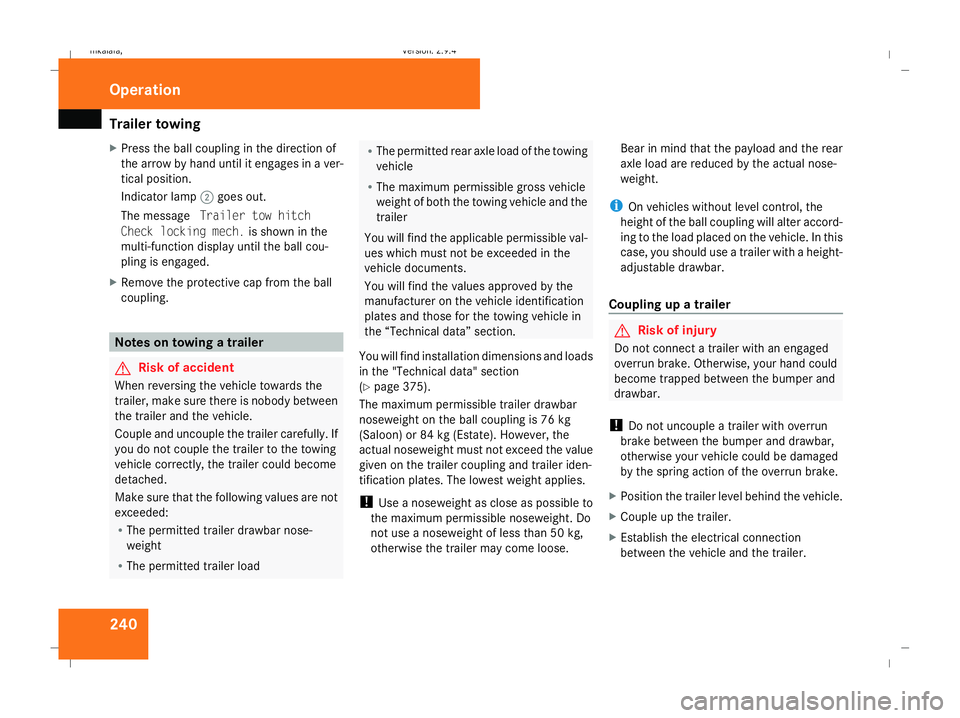
Press the ball coupling in the direction of
the arrow by hand until it engages in a ver-
tical position.
Indicator lamp 2goes out.
The message Trailer tow hitch
Check locking mech. is shown in the
multi-function display until the ball cou-
pling is engaged.
X Remove the protective cap from the ball
coupling. Notes on towing a trailer
G
Risk of accident
When reversing the vehicle towards the
trailer, make sure there is nobody between
the trailer and the vehicle.
Couple and uncouple the trailer carefully. If
you do not couple the trailer to the towing
vehicle correctly, the trailer could become
detached.
Make sure that the following values are not
exceeded:
R The permitted trailer drawbar nose-
weight
R The permitted trailer load R
The permitted rear axle load of the towing
vehicle
R The maximum permissible gross vehicle
weight of both the towing vehicle and the
trailer
You will find the applicable permissible val-
ues which must not be exceeded in the
vehicle documents.
You will find the values approved by the
manufacturer on the vehicle identification
plates and those for the towing vehicle in
the “Technical data” section.
You will find installation dimensions and loads
in the "Technical data" section
(Y page 375).
The maximum permissible trailer drawbar
noseweight on the ball coupling is 76 kg
(Saloon) or 84 kg (Estate). However, the
actual noseweight must not exceed the value
given on the trailer coupling and trailer iden-
tification plates. The lowest weight applies.
! Use a noseweight as close as possible to
the maximum permissible noseweight. Do
not use a noseweight of less than 50 kg,
otherwise the trailer may come loose. Bear in mind that the payload and the rear
axle load are reduced by the actual nose-
weight.
i On vehicles without level control, the
height of the ball coupling will alter accord-
ing to the load placed on the vehicle. In this
case, you should use a trailer with a height-
adjustable drawbar.
Coupling up a trailer G
Risk of injury
Do not connect a trailer with an engaged
overrun brake. Otherwise, your hand could
become trapped between the bumper and
drawbar.
! Do not uncouple a trailer with overrun
brake between the bumper and drawbar,
otherwise your vehicle could be damaged
by the spring action of the overrun brake.
X Position the trailer level behind the vehicle.
X Couple up the trailer.
X Establish the electrical connection
between the vehicle and the trailer. Operation
211_AKB; 2; 5, en-GB
mkalafa
,V ersion: 2.9.4
2008-02-29T16:57:07+01:00 - Seite 240 Dateiname: 6515_3416_02_buchblock.pdf; preflight
Page 257 of 401
Where will I find...?
254 Vehicle tool kit, jack and spare
wheel*
The vehicle tool kit is located in a stowage
compartment underneath the floor of the
boot/luggage compartment. G
Risk of injury
The jack is designed only to raise and hold
the vehicle for a short time while a wheel
is being changed.
If you are carrying out work on the vehicle,
you must use stands.
Make sure that the jack is placed on a firm,
non-slip and level surface. Do not use
wooden blocks or similar objects as a jack
underlay. Otherwise, the jack will not be
able to achieve its load-bearing capacity
due to the restricted height.
Do not start the engine at any time while a
wheel is being changed.
Do not lie under the vehicle when it is being
supported by the jack. If you do not raise
the vehicle as described, it could slip off the
jack (e.g. if the engine is started or a door
or the boot lid/tailgate is opened or closed)
and you could be seriously injured. i
When using the jack, you should also
observe the safety notes in the "Flat tyre"
section (Y page 324).
Saloon X
Fold up the boot floor (Y page 192).
Estate X
Open the luggage compartment floor
(Y page 193).
Vehicles with folding bench seat*
X Open the luggage compartment floor
(Y page 193).
i To reach the vehicle tool kit, the side
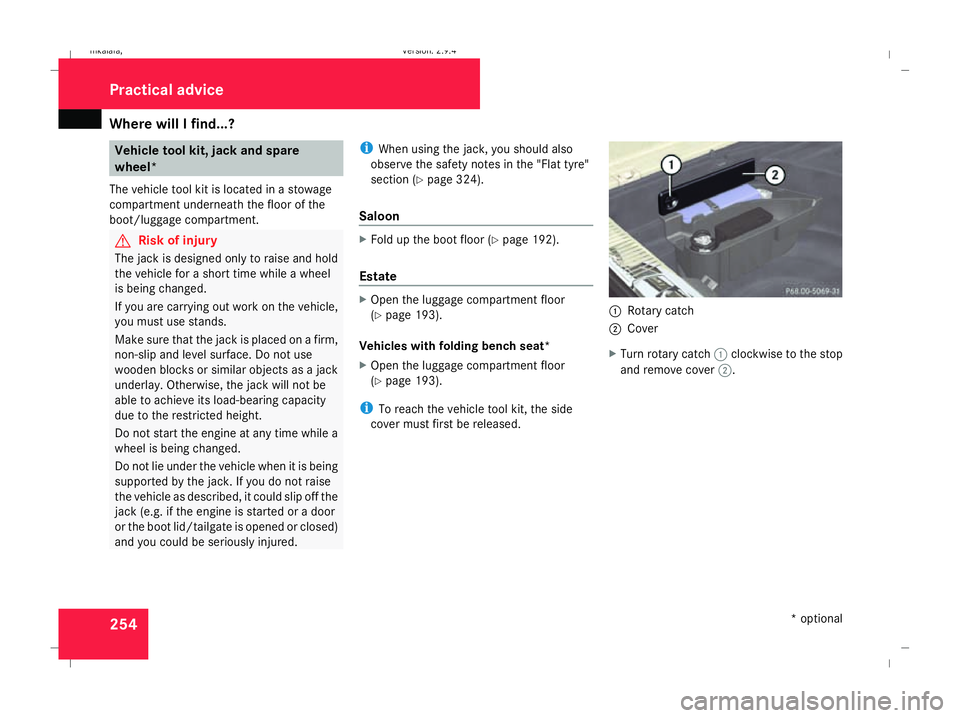
cover must first be released. 1
Rotary catch
2 Cover
X Turn rotary catch 1clockwise to the stop
and remove cover 2. Practical advice
* optional
211_AKB; 2; 5, en-GB
mkalafa,
Version: 2.9.4 2008-02-29T16:57:07+01:00 - Seite 254Dateiname: 6515_3416_02_buchblock.pdf; preflight
Page 321 of 401
Flat tyre
318 Make sure that the jack is placed on a firm,
non-slip, level surface. Do not use wooden
blocks or similar as jacking supports. Oth-
erwise, the jack will not be able to achieve
its load-bearing capacity due to the restric-
ted height.
Do not start the engine at any time while
the wheel is being changed.
Do not lie under the vehicle when it is being
supported by the jack. If you do not raise
the vehicle as described, it could slip off the
jack (e.g. if the engine is started or a door
or the boot lid/tailgate is opened or closed)
and you could sustain serious injuries. Using the TIREFIT kit
You can use the TIREFIT kit to seal small
punctures, particularly those in the tyre tread.
You can use TIREFIT in outdoor temperatures
down to -20 °C. G
Risk of accident
In the following situations, your safety is at
particular risk and TIREFIT is unable to pro-
vide breakdown assistance: R
if there are cuts or punctures in the tyre
greater than 4 mm
R if the wheel rim is damaged
R if you have driven at very low tyre pres-
sures or on a flat tyre
Do not drive any further. Consult a qualified
specialist workshop which has the neces-
sary specialist knowledge and tools to carry
out the work required.
Mercedes-Benz recommends that you use
a Mercedes-Benz Service Centre for this
purpose. In particular, work relevant to
safety or on safety-related systems must be
carried out at a qualified specialist work-
shop.
X Do not remove any foreign objects which
have penetrated the tyre, e.g. screws or
nails.
X Remove TIREFIT, the accompanying "max.
80 km/h "sticker and the electric air pump
from the stowage well underneath the
boot/luggage compartment floor
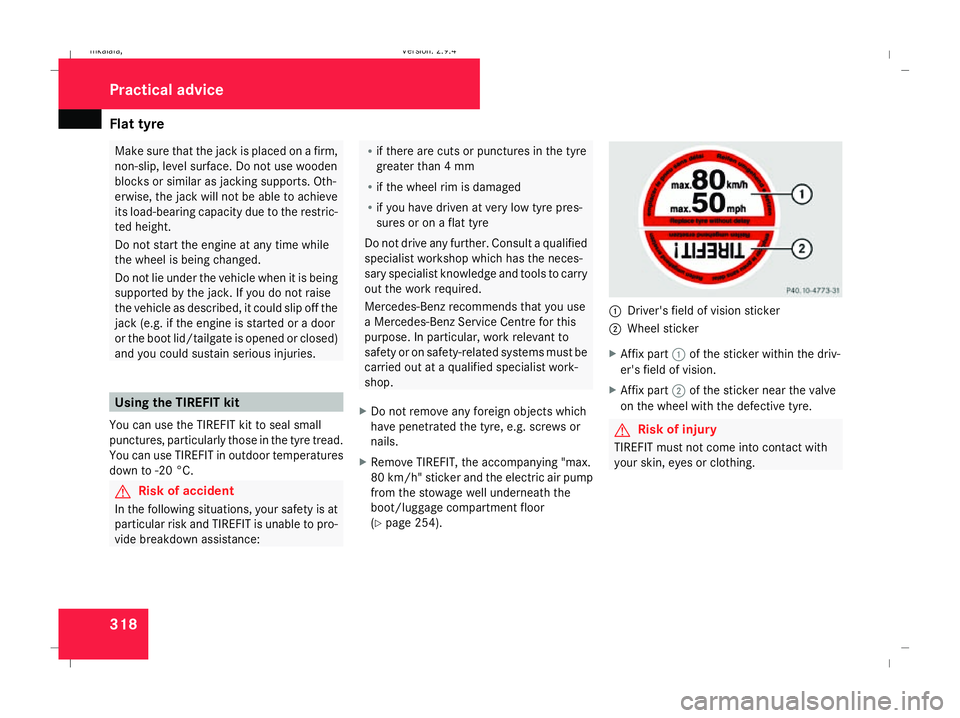
(Y page 254). 1
Driver's field of vision sticker
2 Wheel sticker
X Affix part 1of the sticker within the driv-
er's field of vision.
X Affix part 2of the sticker near the valve
on the wheel with the defective tyre. G
Risk of injury
TIREFIT must not come into contact with
your skin, eyes or clothing. Practical advice
211_AKB; 2; 5, en-GB
mkalafa
, Version: 2.9.4 2008-02-29T16:57:07+01:00 - Seite 318Dateiname: 6515_3416_02_buchblock.pdf; preflight
Page 369 of 401
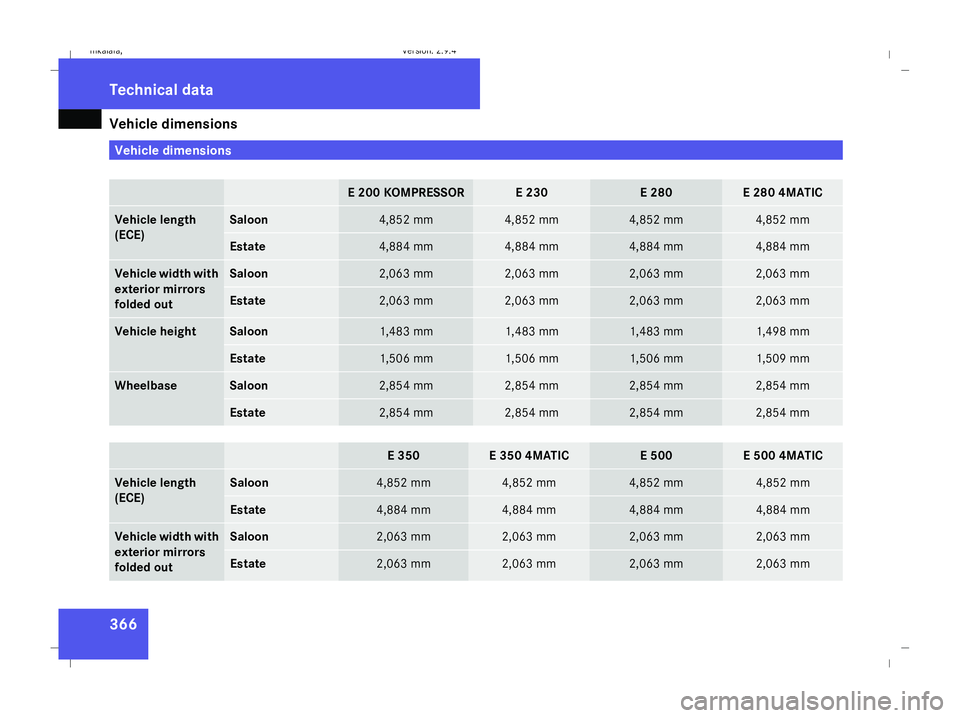
Vehicle dimensions
366 Vehicle dimensions
E 200 KOMPRESSOR E 230 E 280 E 280 4MATIC
Vehicle length
(ECE) Saloon 4,852 mm 4,852 mm 4,852 mm 4,852 mm
Estate 4,884 mm 4,884 mm 4,884 mm 4,884 mm
Vehicle width with
exterior mirrors
folded out Saloon 2,063 mm 2,063 mm 2,063 mm 2,063 mm
Estate 2,063 mm 2,063 mm 2,063 mm 2,063 mm
Vehicle height Saloon 1,483 mm 1,483 mm 1,483 mm 1,498 mm
Estate 1,506 mm 1,506 mm 1,506 mm 1,509 mm
Wheelbase Saloon 2,854 mm 2,854 mm 2,854 mm 2,854 mm
Estate 2,854 mm 2,854 mm 2,854 mm 2,854 mm
E 350 E 350 4MATIC E 500 E 500 4MATIC
Vehicle length
(ECE) Saloon 4,852 mm 4,852 mm 4,852 mm 4,852 mm
Estate 4,884 mm 4,884 mm 4,884 mm 4,884 mm
Vehicle width with
exterior mirrors
folded out Saloon 2,063 mm 2,063 mm 2,063 mm 2,063 mm
Estate 2,063 mm 2,063 mm 2,063 mm 2,063 mmTechnical data
211_AKB; 2; 5, en-GB
mkalafa,
Version: 2.9.4 2008-02-29T16:57:07+01:00 - Seite 366Dateiname: 6515_3416_02_buchblock.pdf; preflight
Page 370 of 401
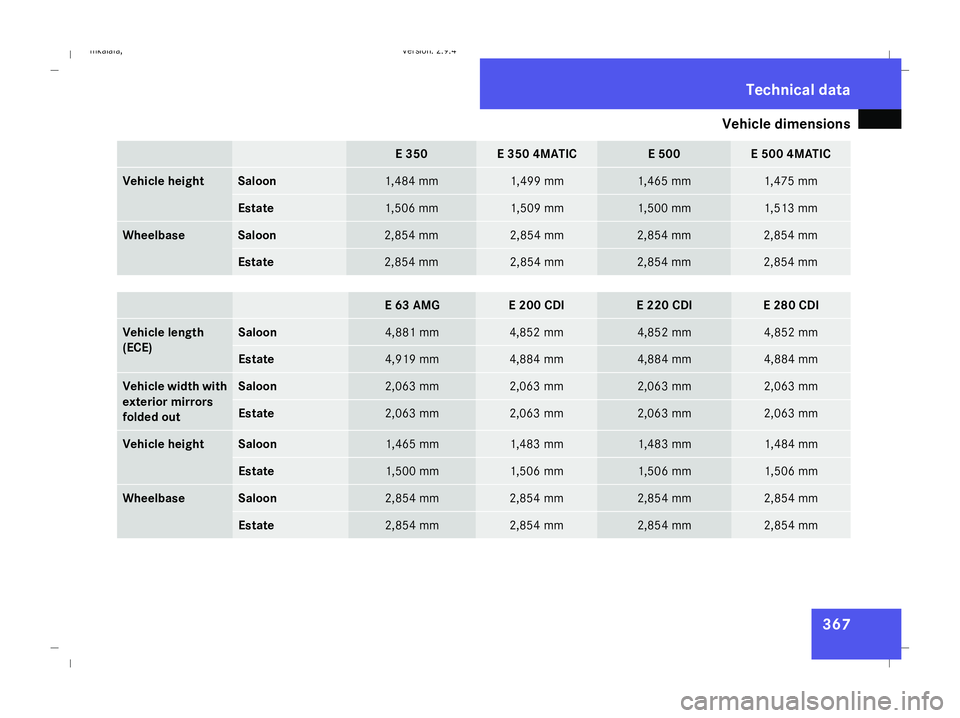
Vehicle dimensions
367E 350 E 350 4MATIC E 500 E 500 4MATIC
Vehicle height Saloon 1,484 mm 1,499 mm 1,465 mm 1,475 mm
Estate 1,506 mm 1,509 mm 1,500 mm 1,513 mm
Wheelbase Saloon 2,854 mm 2,854 mm 2,854 mm 2,854 mm
Estate 2,854 mm 2,854 mm 2,854 mm 2,854 mm
E 63 AMG E 200 CDI E 220 CDI E 280 CDI
Vehicle length
(ECE) Saloon 4,881 mm 4,852 mm 4,852 mm 4,852 mm
Estate 4,919 mm 4,884 mm 4,884 mm 4,884 mm
Vehicle width with
exterior mirrors
folded out Saloon 2,063 mm 2,063 mm 2,063 mm 2,063 mm
Estate 2,063 mm 2,063 mm 2,063 mm 2,063 mm
Vehicle height Saloon 1,465 mm 1,483 mm 1,483 mm 1,484 mm
Estate 1,500 mm 1,506 mm 1,506 mm 1,506 mm
Wheelbase Saloon 2,854 mm 2,854 mm 2,854 mm 2,854 mm
Estate 2,854 mm 2,854 mm 2,854 mm 2,854 mmTechnical data
211_AKB; 2; 5, en-GB
mkalafa,
Version: 2.9.4
2008-02-29T16:57:07+01:00 - Seite 367 ZDateiname: 6515_3416_02_buchblock.pdf; preflight
Page 371 of 401
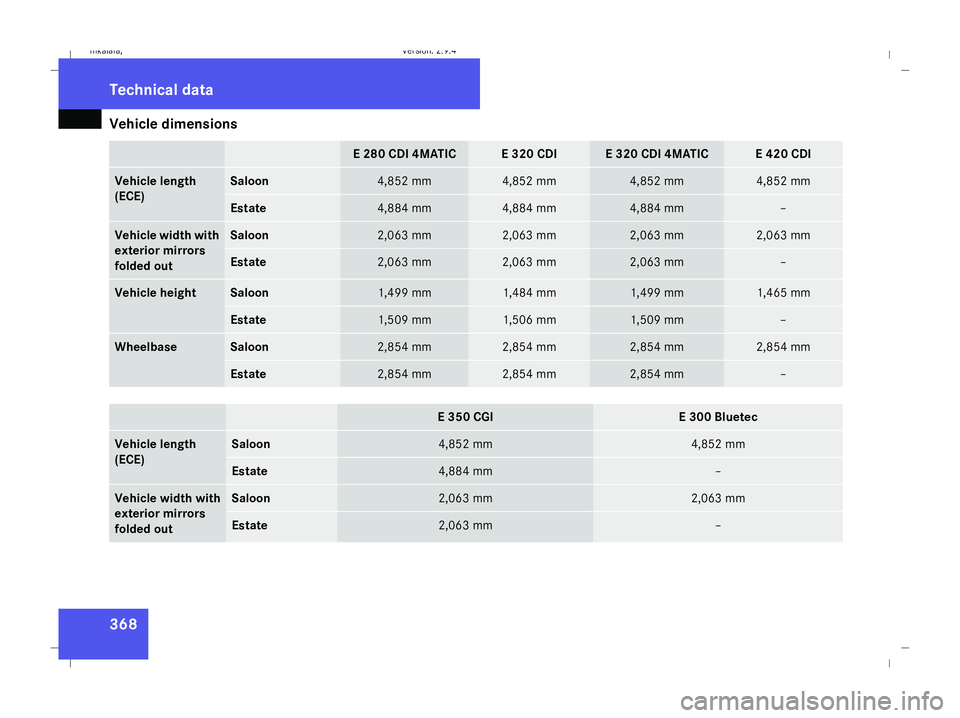
Vehicle dimensions
368 E 280 CDI 4MATIC E 320 CDI E 320 CDI 4MATIC E 420 CDI
Vehicle length
(ECE) Saloon 4,852 mm 4,852 mm 4,852 mm 4,852 mm
Estate 4,884 mm 4,884 mm 4,884 mm –
Vehicle width with
exterior mirrors
folded out Saloon 2,063 mm 2,063 mm 2,063 mm 2,063 mm
Estate 2,063 mm 2,063 mm 2,063 mm –
Vehicle height Saloon 1,499 mm 1,484 mm 1,499 mm 1,465 mm
Estate 1,509 mm 1,506 mm 1,509 mm –
Wheelbase Saloon 2,854 mm 2,854 mm 2,854 mm 2,854 mm
Estate 2,854 mm 2,854 mm 2,854 mm –
E 350 CGI E 300 Bluetec
Vehicle length
(ECE) Saloon 4,852 mm 4,852 mm
Estate 4,884 mm –
Vehicle width with
exterior mirrors
folded out Saloon 2,063 mm 2,063 mm
Estate 2,063 mm –Technical data
211_AKB; 2; 5, en-GB
mkalafa,
Version: 2.9.4 2008-02-29T16:57:07+01:00 - Seite 368Dateiname: 6515_3416_02_buchblock.pdf; preflight
Page 372 of 401
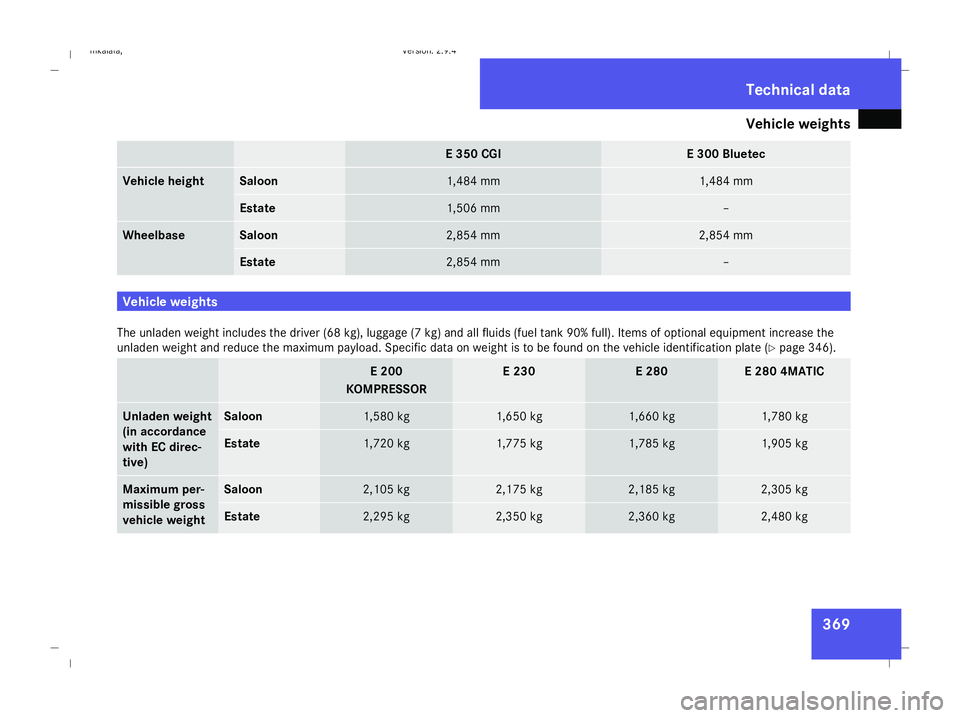
Vehicle weights
369E 350 CGI E 300 Bluetec
Vehicle height Saloon 1,484 mm 1,484 mm
Estate 1,506 mm –
Wheelbase Saloon 2,854 mm 2,854 mm
Estate 2,854 mm –
Vehicle weights
The unladen weight includes the driver (68 kg), luggage (7 kg) and all fluids (fuel tank 90% full). Items of optional equipment increase the
unladen weight and reduce the maximum payload. Specific data on weight is to be found on the vehicle identification plate (Y page 346).E 200
KOMPRESSOR E 230 E 280 E 280 4MATIC
Unladen weight
(in accordance
with EC direc-
tive) Saloon 1,580 kg 1,650 kg 1,660 kg 1,780 kg
Estate 1,720 kg 1,775 kg 1,785 kg 1,905 kg
Maximum per-
missible gross
vehicle weight Saloon 2,105 kg 2,175 kg 2,185 kg 2,305 kg
Estate 2,295 kg 2,350 kg 2,360 kg 2,480 kgTechnical data
211_AKB; 2; 5, en-GB
mkalafa,
Version: 2.9.4 2008-02-29T16:57:07+01:00 - Seite 369 ZDateiname: 6515_3416_02_buchblock.pdf; preflight