wheel MERCEDES-BENZ E-CLASS SALOON 2008 User Guide
[x] Cancel search | Manufacturer: MERCEDES-BENZ, Model Year: 2008, Model line: E-CLASS SALOON, Model: MERCEDES-BENZ E-CLASS SALOON 2008Pages: 401, PDF Size: 6.89 MB
Page 26 of 401
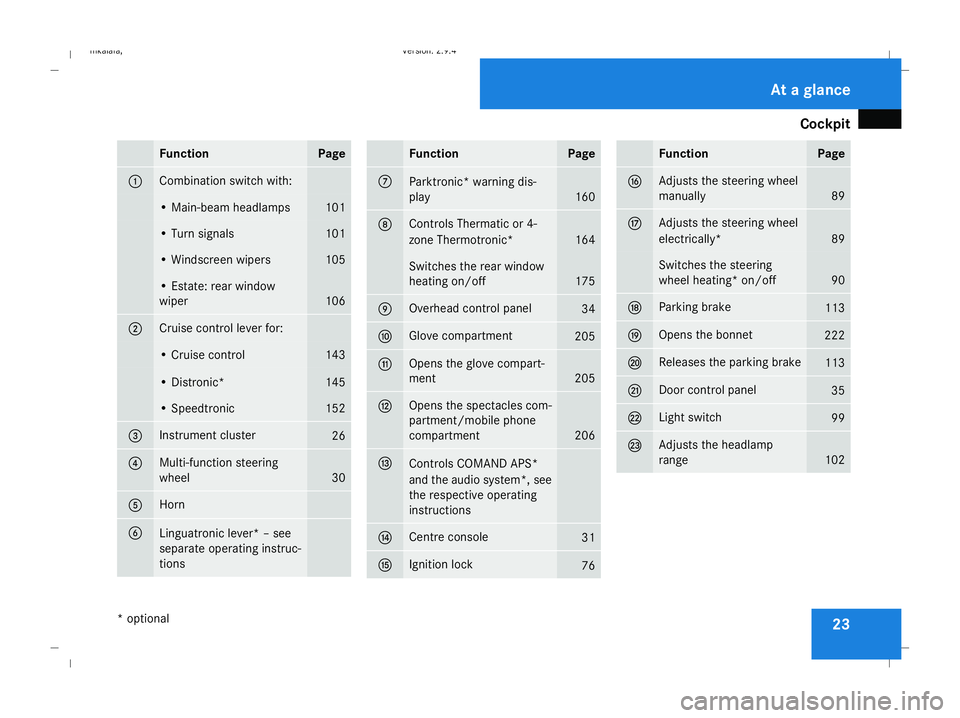
Cockpit
23Function Page
1 Combination switch with:
• Main-beam headlamps 101
• Turn signals 101
• Windscreen wipers 105
• Estate: rear window
wiper
106
2 Cruise control lever for:
• Cruise control 143
• Distronic* 145
• Speedtronic 152
3 Instrument cluster
26
4 Multi-function steering
wheel
30
5 Horn
6
Linguatronic lever* – see
separate operating instruc-
tions Function Page
7
Parktronic* warning dis-
play
160
8 Controls Thermatic or 4-
zone Thermotronic*
164
Switches the rear window
heating on/off
175
9 Overhead control panel
34
a Glove compartment
205
b Opens the glove compart-
ment
205
c Opens the spectacles com-
partment/mobile phone
compartment
206
d
Controls COMAND APS*
and the audio system*, see
the respective operating
instructions
e Centre console
31
f Ignition lock
76 Function Page
g Adjusts the steering wheel
manually
89
h Adjusts the steering wheel
electrically*
89
Switches the steering
wheel heating* on/off
90
j Parking brake
113
k Opens the bonnet
222
l Releases the parking brake
113
m Door control panel
35
n Light switch
99
o Adjusts the headlamp
range
102At a glance
* optional
211_AKB; 2; 5, en-GB
mkalafa,
Version: 2.9.4 2008-02-29T16:57:07+01:00 - Seite 23Dateiname: 6515_3416_02_buchblock.pdf; preflight
Page 28 of 401
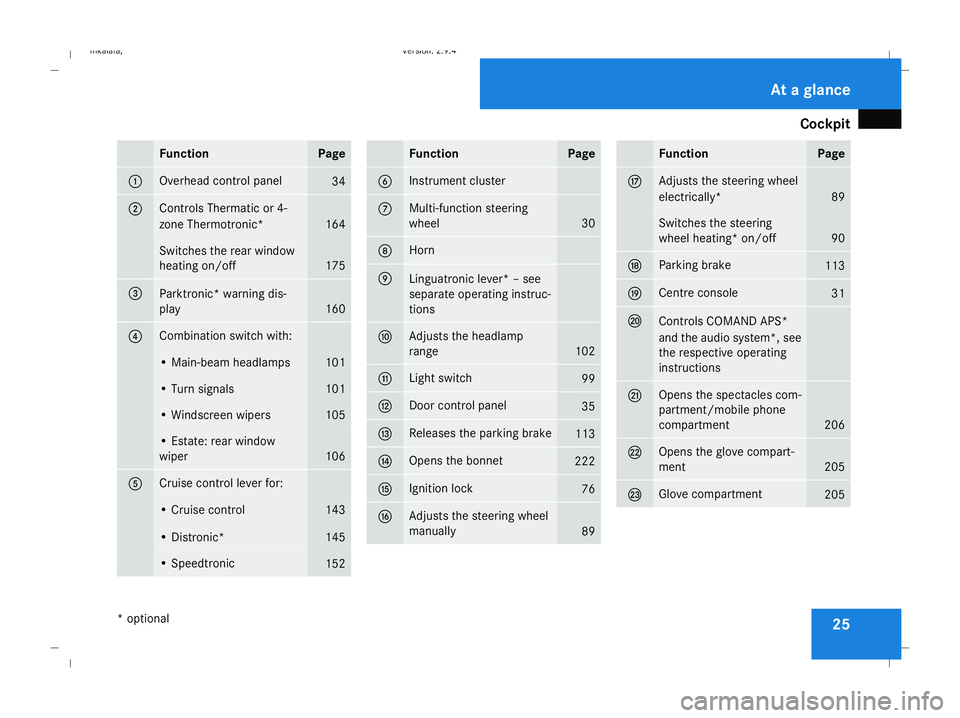
Cockpit
25Function Page
1 Overhead control panel
34
2 Controls Thermatic or 4-
zone Thermotronic*
164
Switches the rear window
heating on/off
175
3
Parktronic* warning dis-
play
160
4 Combination switch with:
• Main-beam headlamps 101
• Turn signals 101
• Windscreen wipers 105
• Estate: rear window
wiper
106
5 Cruise control lever for:
• Cruise control 143
• Distronic* 145
• Speedtronic
152 Function Page
6 Instrument cluster
7 Multi-function steering
wheel
30
8 Horn
9
Linguatronic lever* – see
separate operating instruc-
tions
a Adjusts the headlamp
range
102
b Light switch
99
c Door control panel
35
d Releases the parking brake
113
e Opens the bonnet
222
f Ignition lock
76
g Adjusts the steering wheel
manually
89 Function Page
h Adjusts the steering wheel
electrically*
89
Switches the steering
wheel heating* on/off
90
j Parking brake
113
k Centre console
31
l
Controls COMAND APS*
and the audio system*, see
the respective operating
instructions
m Opens the spectacles com-
partment/mobile phone
compartment
206
n Opens the glove compart-
ment
205
o Glove compartment
205At a glance
* optional
211_AKB; 2; 5, en-GB
mkalafa,
Version: 2.9.4 2008-02-29T16:57:07+01:00 - Seite 25Dateiname: 6515_3416_02_buchblock.pdf; preflight
Page 33 of 401
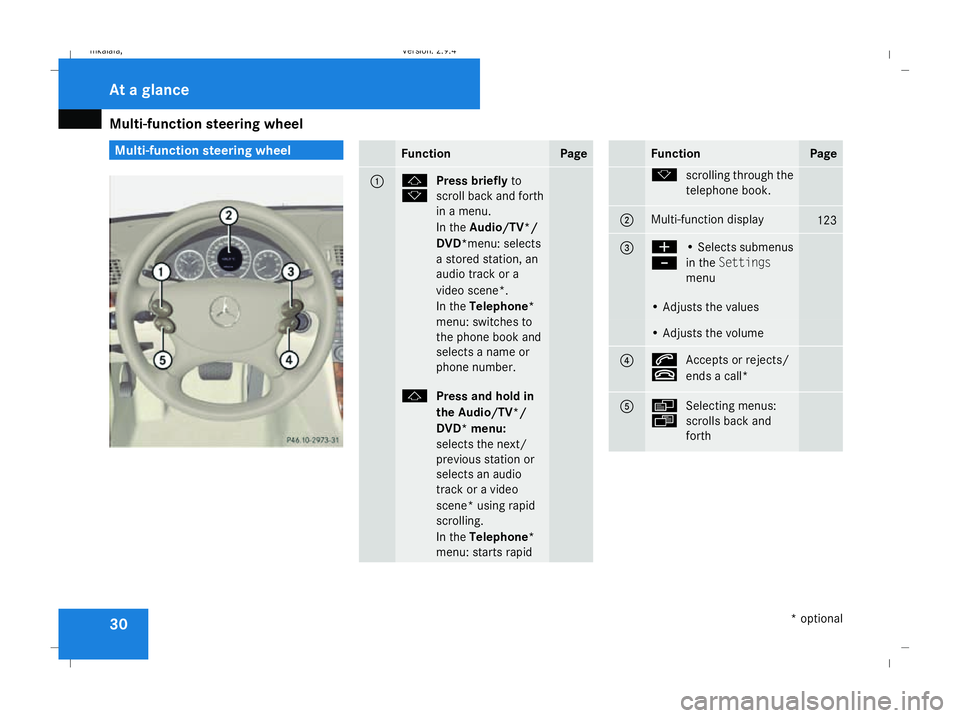
Multi-function steering wheel
30 Multi-function steering wheel
Function Page
1 j
k
Press briefly
to
scroll back and forth
in a menu.
In the Audio/TV*/
DVD*menu: selects
a stored station, an
audio track or a
video scene*.
In the Telephone*
menu: switches to
the phone book and
selects a name or
phone number. j
Press and hold in
the Audio/TV*/
DVD* menu:
selects the next/
previous station or
selects an audio
track or a video
scene* using rapid
scrolling.
In the Telephone*
menu: starts rapid Function Page
k
scrolling through the
telephone book. 2 Multi-function display
123
3 æ
-
• Selects submenus
in the
Settings
menu • Adjusts the values
• Adjusts the volume
4 s
t
Accepts or rejects/
ends a call* 5 è
ÿ
Selecting menus:
scrolls back and
forth At a glance
* optional
211_AKB; 2; 5, en-GB
mkalafa
, Version: 2.9.4 2008-02-29T16:57:07+01:00 - Seite 30Dateiname: 6515_3416_02_buchblock.pdf; preflight
Page 38 of 401
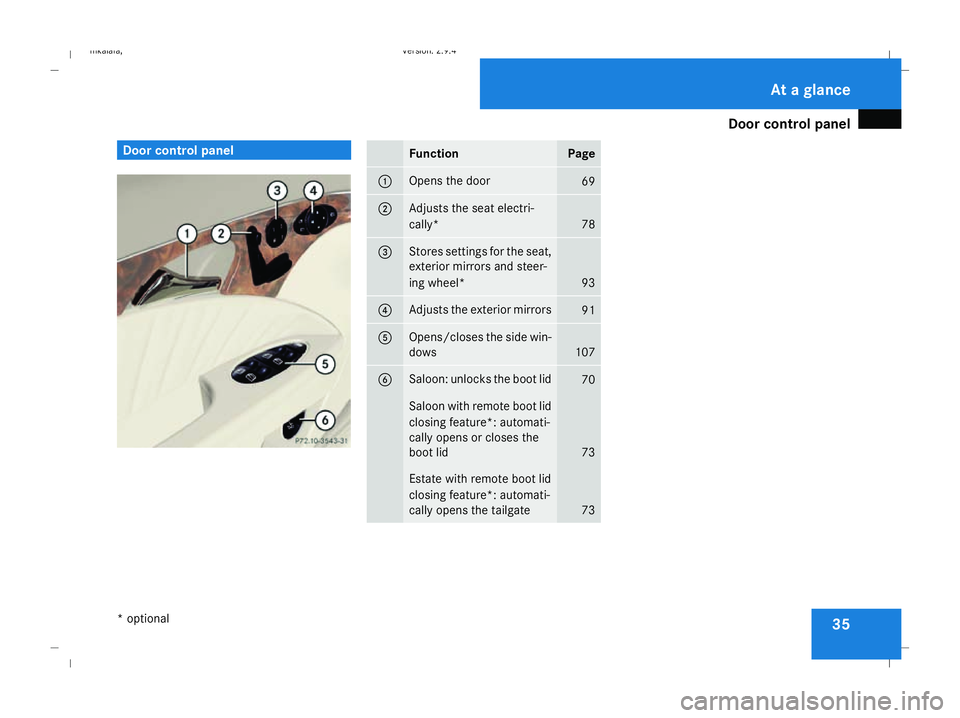
Door cont
rol panel 35Door control panel
Function Page
1 Opens the door
69
2 Adjusts the seat electri-
cally*
78
3 Stores settings for the seat,
exterior mirrors and steer-
ing wheel*
93
4 Adjusts the exterior mirrors
91
5 Opens/closes the side win-
dows
107
6 Saloon: unlocks the boot lid
70
Saloon with remote boot lid
closing feature*: automati-
cally opens or closes the
boot lid 73
Estate with remote boot lid
closing feature*: automati-
cally opens the tailgate
73 At a glance
* optional
211_AKB; 2; 5, en-GB
mkalafa,
Version: 2.9.4 2008-02-29T16:57:07+01:00 - Seite 35Dateiname: 6515_3416_02_buchblock.pdf; preflight
Page 43 of 401
Occupant safety
40 Occupant safety
Notes on occupant safety
Seat belts, together with belt tensioners, belt
force limiters and airbags, are coordinated
restraint systems. They reduce the risk of
injury in defined accident situations and
thereby increase occupant safety. However,
seat belts and airbags generally do not pro-
tect against objects penetrating the vehicle
from the outside.
To ensure that the restraint systems can
deliver their full potential protection, you
should ensure that:
R the seat and head restraint are adjusted
properly (Y page 77)
R the seat belt has been fastened properly
(Y page 95)
R the airbags can inflate properly if they are
deployed (Y page 43)
R the steering wheel is adjusted properly
(Y page 89)
R the restraint systems have not been modi-
fied
i An airbag increases the protection of
vehicle occupants wearing a seat belt. However, airbags are only an additional
restraint system which complements, but
does not replace, the seat belt. All vehicle
occupants must wear their seat belt cor-
rectly at all times, even if the vehicle is
equipped with airbags. This is because - on
the one hand - airbags are not deployed in
all types of accident, as in some situations
airbag deployment would not increase the
protection afforded to vehicle occupants,
provided they are wearing their seat belt
correctly. On the other hand, airbag deploy-
ment only provides increased protection if
the seat belt is worn correctly because:
R
the seat belt helps to keep the vehicle
occupant in the best position in relation
to the airbag
R for example, in a head-on collision, the
seat belt can more adequately prevent
the occupant from being propelled
towards the force of the impact, and is
thus better suited to prevent injury
Therefore, in accident situations where an
airbag is deployed, it only provides protec-
tion in addition to the seat belt if the seat
belt is being worn correctly. G
Risk of accident and injury
Always have maintenance work carried out
at a qualified specialist workshop which
has the necessary specialist knowledge
and tools to carry out the work required.
Mercedes-Benz recommends that you use
a Mercedes-Benz Service Centre for this
purpose.
In particular, work relevant to safety or on
safety-related systems must be carried out
at a qualified specialist workshop. If this
work is not carried out correctly, the oper-
ating safety of your vehicle may be affec-
ted. There is a risk of an accident and injury. G
Risk of injury
The restraint system may not work as inten-
ded if the following components have been
modified or work on these components has
not been performed correctly:
R restraint system, consisting of the seat
belts and anchorages, belt tensioners,
belt force limiters, airbags
R wiring
R networked electronic systems
Airbags or belt tensioners could then fail,
e.g. in the event of an accident in which the Safety
211_AKB; 2; 5, en-GB
mkalafa,
Version: 2.9.4 2008-02-29T16:57:07+01:00 - Seite 40Dateiname: 6515_3416_02_buchblock.pdf; preflight
Page 47 of 401
Occupant safety
44 secure a forward-facing child restraint
system to the front-passenger seat, you
must move the front-passenger seat as
far back as possible.
R Make sure there are no heavy or sharp-
edged objects in pockets of clothing.
R Do not lean forwards, e.g. over the cover
of the driver's front airbag, particularly
when the vehicle is in motion.
R Do not put your feet on the dashboard.
R Only hold the steering wheel by the rim.
This allows the airbag to inflate fully. You
could be injured if the airbag is deployed
and you are holding the inside of the
steering wheel.
R Do not lean on the doors from inside the
vehicle.
R Make sure that there are no people, ani-
mals or objects between the vehicle
occupants and the area of deployment of
the airbag.
R Do not place any objects between the
seat backrest and the door. R
Do not hang any hard objects, for exam-
ple coat hangers, on the grab handles or
coat hooks.
R Do not attach accessories, e.g. cup hold-
ers, to the doors.
It is not possible to rule out a risk of injuries
caused by an airbag due to the high speed
at which the airbag is required to deploy. G
Risk of injury
The airbag's functionality can only be guar-
anteed if the following parts are not cov-
ered and no badges or stickers are
attached to them:
R Padded steering wheel boss
R Front-passenger front airbag cover
R Outer side of front seats
R Rear door trims G
Risk of injury
When an airbag deploys, a small amount of
powder is released. The powder may cause
short-term breathing difficulties to persons
suffering from asthma or other pulmonary
conditions. In order to prevent potential breathing dif-
ficulties you should leave the vehicle as
soon as it is safe to do so. You can also open
the window to allow fresh air to enter the
interior. The powder does not constitute a
health hazard and does not indicate that
there is a fire in the vehicle. G
Risk of injury
The airbag parts are hot after the airbag has
been deployed. Do not touch them, other-
wise you may burn yourself.
Have the airbags checked at a qualified
specialist workshop. Otherwise, occupants
are not protected by the airbags in the
event of another accident.
Front airbags
The front airbags are designed to increase
protection for the driver's and front-
passenger head and chest. Safety
211_AKB; 2; 5, en-GB
mkalafa,
Version: 2.9.4 2008-02-29T16:57:07+01:00 - Seite 44Dateiname: 6515_3416_02_buchblock.pdf; preflight
Page 48 of 401
Occupant safety
45
The driver's front airbag and front-passenger
front airbag are deployed:
R at the start of an accident with a high rate
of vehicle acceleration or deceleration in a
longitudinal direction
R if the system determines that airbag
deployment can offer additional protection
to that provided by the seat belt
R if the seat belt is fastened
R independently of other airbags in the vehi-
cle
R if the vehicle overturns, but only if the sys-
tem detects high vehicle deceleration in a
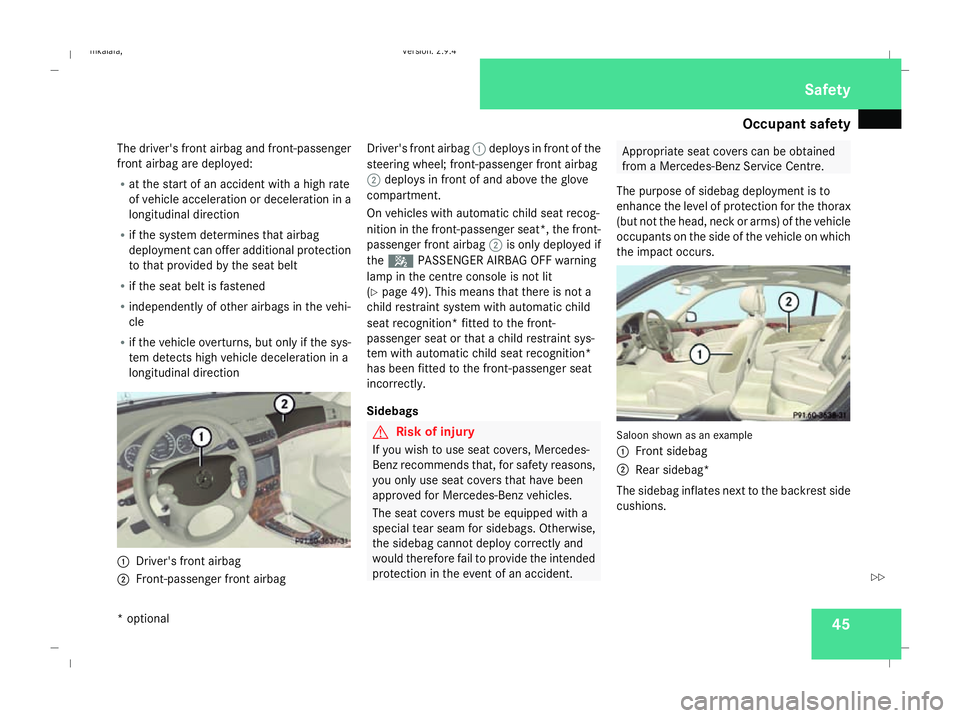
longitudinal direction 1
Driver's front airbag
2 Front-passenger front airbag Driver's front airbag
1deploys in front of the
steering wheel; front-passenger front airbag
2 deploys in front of and above the glove
compartment.
On vehicles with automatic child seat recog-
nition in the front-passenger seat*, the front-
passenger front airbag 2is only deployed if
the 5 PASSENGER AIRBAG OFF warning
lamp in the centre console is not lit
(Y page 49). This means that there is not a
child restraint system with automatic child
seat recognition* fitted to the front-
passenger seat or that a child restraint sys-
tem with automatic child seat recognition*
has been fitted to the front-passenger seat
incorrectly.
Sidebags G
Risk of injury
If you wish to use seat covers, Mercedes-
Benz recommends that, for safety reasons,
you only use seat covers that have been
approved for Mercedes-Benz vehicles.
The seat covers must be equipped with a
special tear seam for sidebags. Otherwise,
the sidebag cannot deploy correctly and
would therefore fail to provide the intended
protection in the event of an accident. Appropriate seat covers can be obtained
from a Mercedes-Benz Service Centre.
The purpose of sidebag deployment is to
enhance the level of protection for the thorax
(but not the head, neck or arms) of the vehicle
occupants on the side of the vehicle on which
the impact occurs. Saloon shown as an example
1
Front sidebag
2 Rear sidebag*
The sidebag inflates next to the backrest side
cushions. Safety
* optional
211_AKB; 2; 5, en-GB
mkalafa,
Version: 2.9.4 2008-02-29T16:57:07+01:00 - Seite 45 ZDateiname: 6515_3416_02_buchblock.pdf; preflight
Page 61 of 401
Driving safety sys
tems58
X
To deactivate: press button1.
Indicator lamp 2goes out. You can oper-
ate the rear side windows using the
switches in the rear compartment. Driving safety systems
Overview of driving safety systems
In this section, you will find information about
the following driving safety systems:
R ABS ( Anti-lock Braking System)
R BAS ( Brake Assist System)
R Adaptive brake lamps
R ESP ®
( Electronic Stability Program)
R EBV (electronic brake-power distribution)
R ADAPTIVE BRAKE
i In wintry road conditions, always use win-
ter tyres (M+S tyres) and, where necessary,
snow chains. Only in this way will the driv-
ing safety systems described in this section
work as effectively as possible. G
Risk of accident
The risk of an accident is significantly
increased by driving too fast. This is partic-
ularly the case when cornering as well as
on wet or slippery roads or when driving too
close to the vehicle in front.
The driving safety systems described in this
section cannot reduce this risk nor override
the laws of physics. For this reason, always adapt your driving
style to suit the prevailing road and weather
conditions. Maintain sufficient distance
from other road users and objects on the
road.
ABS (Anti-lock Braking System)
ABS regulates brake pressure in such a way
that the wheels do not lock when you brake.
This allows you to continue steering the vehi-
cle when braking.
ABS works from a speed of about 8 km/h
upwards, regardless of road surface condi-
tions. ABS works on slippery surfaces, even
when you only brake gently. G
Risk of accident
Do not depress the brake pedal several
times in quick succession (pumping).
Depress the brake firmly and evenly. Pump-
ing the brake pedal reduces the braking
effect.
Braking If ABS intervenes when braking, you will feel
a pulsing in the brake pedal.Safety
211_AKB; 2; 5, en-GB
mkalafa
,V ersion: 2.9.4
2008-02-29T16:57:07+01:00 - Seite 58 Dateiname: 6515_3416_02_buchblock.pdf; preflight
Page 62 of 401
Driving safety sys
tems 59
X
If ABS intervenes: continue to depress the
brake pedal with force until the braking sit-
uation is over.
X To make a full brake application:
depress the brake pedal with full force. G
Risk of accident
If ABS is faulty, the wheels could lock when
braking. This limits the steerability of the
vehicle when braking and the braking dis-
tance may increase.
If ABS is deactivated due to a malfunction,
then BAS and ESP are also deactivated.
There is an increased risk of your vehicle
skidding in certain situations.
You should always adapt your driving style
to suit the prevailing road and weather con-
ditions. BAS (Brake Assist)
BAS operates in emergency braking situa-
tions. If you depress the brake pedal quickly,
BAS automatically boosts the braking force,
thus shortening the stopping distance.
X Keep the brake pedal firmly depressed until
the emergency braking situation is over.
ABS prevents the wheels from locking.
The brakes will function as usual once you
release the brake pedal. BAS is deactivated. G
Risk of accident
If BAS has malfunctioned, the braking sys-
tem remains available with full brake boost-
ing effect. However, braking force is not
automatically increased in emergency
braking situations and the stopping dis-
tance may increase. Adaptive brake lamps
i Adaptive brake lamps are only available in
certain countries.
If you brake sharply from a speed of more
than 50 km/h or if braking is assisted by BAS,
the brake lamps flash rapidly. In this way,
traffic travelling behind you is warned in an
even more noticeable manner.
If you brake sharply from a speed of more
than 70 km/h to a standstill, the hazard warn-
ing lamps are activated automatically. If the
brakes are applied again, the brake lamps
light up continuously. The hazard warning
lamps switch off automatically if you drive
faster than 10 km/h again. You can also
switch off the hazard warning lamps using the
hazard warning switch button (Y page 102). Safety
211_AKB; 2; 5, en-GB
mkalafa
,V ersion: 2.9.4
2008-02-29T16:57:07+01:00 - Seite 59 ZDateiname: 6515_3416_02_buchblock.pdf; preflight
Page 63 of 401
Driving safety sys
tems60 ESP
®
(Electronic Stability Program)
ESP ®
monitors driving stability and traction,
i.e. power transmission between the tyres
and the road surface.
If ESP ®
detects that the vehicle is deviating
from the direction desired by the driver, one
or more wheels are braked to stabilise the
vehicle. The engine output is also modified, if
necessary, to keep the vehicle on the desired
course within physical limits. ESP ®
assists
the driver when pulling away on wet or slip-
pery roads. ESP ®
can also stabilise the vehi-
cle during braking.
When ESP ®
intervenes, the vwarning
lamp flashes in the instrument cluster. G
Risk of accident
If the v warning lamp in the instrument
cluster flashes, proceed as follows:
R Do not deactivate ESP ®
under any cir-
cumstances.
R Only depress the accelerator pedal as far
as necessary when pulling away.
R Adapt your driving style to suit the pre-
vailing road and weather conditions.
The vehicle could otherwise go into a skid. ESP
®
cannot reduce the risk of an accident
if you drive too fast. ESP ®
cannot override
the laws of physics.
! If the vehicle is to be towed with the front
or rear axle raised, the ignition must be
switched off (key in position 0or 1in the
ignition lock). Application of the brakes by
ESP ®
could otherwise destroy the brake
system on the front or rear axle.
! Vehicles with 4MATIC* may not be towed
with the front or rear axle raised.
i Only use wheels with the recommended
tyre sizes. Only then will ESP ®
function
properly.
Deactivating/activating ESP ® ESP
®
is activated automatically when the
engine is running.
It may be best to deactivate ESP ®
in the fol-
lowing situations:
R when using snow chains
R in deep snow
R on sand or gravel G
Risk of accident
Activate ESP ®
as soon as the situations
described above no longer apply. ESP ®
will
otherwise not be able to stabilise the vehi-
cle if the vehicle starts to skid or a wheel
starts to spin.
If you deactivate ESP ®
:
R ESP ®
no longer improves driving stability.
R engine torque is not limited and the drive
wheels are able to spin. The spinning
wheels produce a cutting effect for better
traction.
R traction control is still activated.
R ESP ®
still provides support when you
brake.
i If ESP ®
is deactivated and one or more
wheels start to spin, the vwarning lamp
in the instrument cluster flashes. In such
situations ESP ®
will not stabilise the vehi-
cle. Safety
* optional
211_AKB; 2; 5, en-GB
mkalafa
,V ersion: 2.9.4
2008-02-29T16:57:07+01:00 - Seite 60 Dateiname: 6515_3416_02_buchblock.pdf; preflight