seats MERCEDES-BENZ E-CLASS SALOON 2008 Owner's Manual
[x] Cancel search | Manufacturer: MERCEDES-BENZ, Model Year: 2008, Model line: E-CLASS SALOON, Model: MERCEDES-BENZ E-CLASS SALOON 2008Pages: 401, PDF Size: 6.89 MB
Page 98 of 401
Seat belts
95Seat belts
Wearing seat belts
Seat belts are the most effective means of
restraining the movement of vehicle occu-
pants in the event of an accident. This
reduces the risk of vehicle occupants coming
into contact with the vehicle interior. G
Risk of injury
A seat belt which is not worn correctly, or
which has not been engaged in the seat belt
buckle correctly, cannot perform its inten-
ded protective function. Under certain cir-
cumstances this could cause severe or
even fatal injuries.
Make sure that all occupants – in particular,
pregnant women – wear their seat belt cor-
rectly at all times.
R The seat belt must pass closely over your
body and must not be twisted. You
should therefore avoid wearing bulky
clothing (e.g. a winter coat). The shoulder
belt section must be routed across the
middle of your shoulder – on no account
across your neck or under your arm – and
pulled tight against your upper body. The
lap belt must always pass across your lap
as low down as possible, i.e. over your hip joints – not across your abdomen. If
necessary, push down the belt strap
slightly and then retighten it in the roll-up
direction.
R Do not route the belt strap across sharp
or fragile objects, especially if these are
located on or in your clothing, e.g. spec-
tacles, pencils, keys, etc. The seat belt
strap could be damaged and tear in an
accident and you or other vehicle occu-
pants could be injured.
R Only one person should use each seat
belt at any one time. Children must never
travel sitting on the lap of other occu-
pants. It would not be possible to restrain
the child in the event of a sudden change
in direction, braking or an accident. This
could result in severe or even fatal inju-
ries to the child and other occupants.
R Persons less than 1.50 m tall cannot
wear the seat belts correctly. For this
reason, secure persons less than 1.50 m
tall in specially designed, suitable
restraint systems.
R Children less than 1.50 m tall or under
12 years of age cannot wear the seat
belts properly. Therefore, always secure
these children in suitable child restraint systems on suitable vehicle seats. You
can find more information under "Chil-
dren in the vehicle" in the "Safety" sec-
tion of the Owner's Manual. Follow the
manufacturer's installation instructions
when fitting the child restraint system.
R Do not secure any objects with a seat belt
if the seat belt is also being used by one
of the vehicle's occupants. G
Risk of injury
The seat belt does not offer the intended
level of protection unless the backrest is
almost vertical. Under certain circumstan-
ces this could cause severe or even fatal
injuries.
Before starting a journey, make sure that
the seat is properly adjusted and that the
backrest is almost vertical. G
Risk of injury
A dirty or damaged seat belt or a seat belt
that has been subjected to a load in an
accident or modified no longer offers the
intended level of protection. Under certain
circumstances this could cause severe or
even fatal injuries. Controls
211_AKB; 2; 5, en-GB
mkalafa,
Version: 2.9.4
2008-02-29T16:57:07+01:00 - Seite 95 ZDateiname: 6515_3416_02_buchblock.pdf; preflight
Page 100 of 401
Seat belts
97Belt warning for driver and front
passenger
The < seat belt warning lamp in the instru-
ment cluster reminds you that all occupants
should fasten their seat belts. The
or it may flash. Additionally, there may be a
warning tone.
The < seat belt warning lamp goes out and
the warning tone ceases when the driver and
the front passenger have fastened their seat
belt.
For certain countries only: regardless of
whether the driver or the front passenger is
already secured, the
has been started. The
front passenger have fastened their seat belt.
i Further information about the
You can adjust the seat belt height on the fol-
lowing seats:
R Driver's seat
R Front-passenger seat
R Outer rear seats
Adjust the belt to a height that allows it to be
routed across the middle of your shoulder. 1
Release catch
X To raise: slide the belt sash guide upwards.
The belt sash guide engages in various posi-
tions.
X To lower: press and hold release button
1. X
Slide the belt sash guide downwards.
X Let go of release button 1and make sure
that the belt sash guide has engaged. Correct driver's seat position
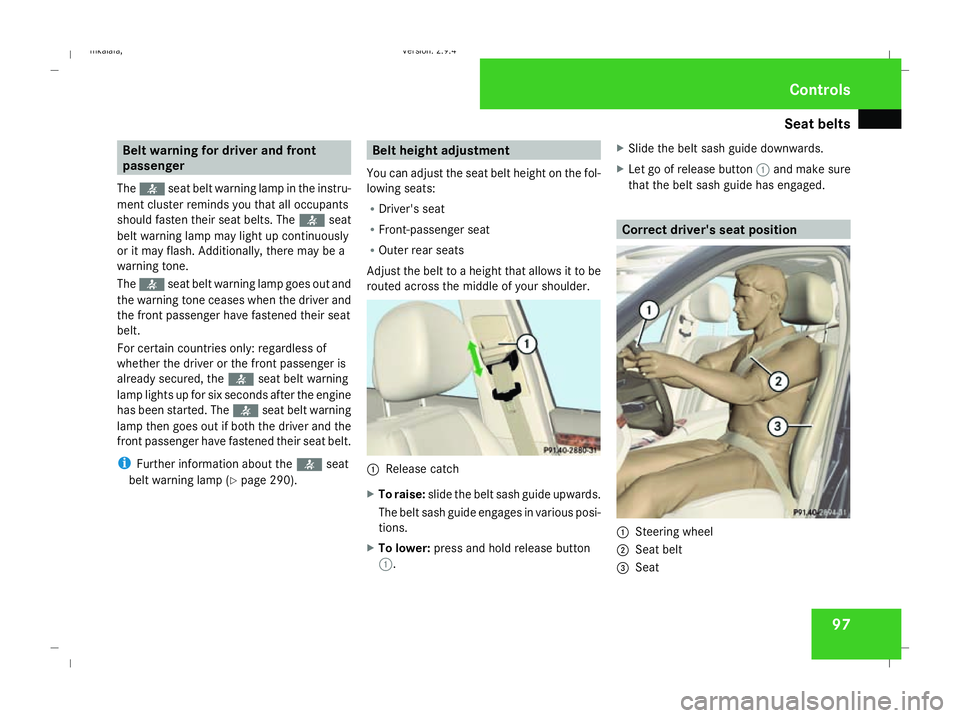
1
Steering wheel
2 Seat belt
3 Seat Controls
211_AKB; 2; 5, en-GB
mkalafa,
Version: 2.9.4 2008-02-29T16:57:07+01:00 - Seite 97 ZDateiname: 6515_3416_02_buchblock.pdf; preflight
Page 105 of 401
Lights
102 Hazard warning lamps
Centre console
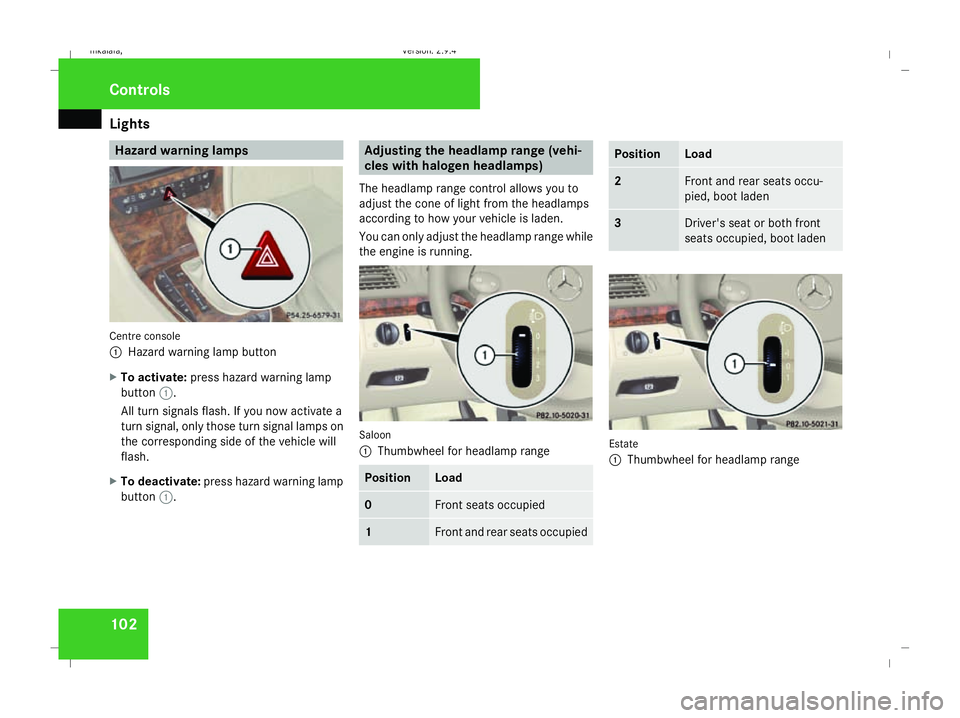
1
Hazard warning lamp button
X To activate: press hazard warning lamp
button 1.
All turn signals flash. If you now activate a
turn signal, only those turn signal lamps on
the corresponding side of the vehicle will
flash.
X To deactivate: press hazard warning lamp
button 1. Adjusting the headlamp range (vehi-
cles with halogen headlamps)
The headlamp range control allows you to
adjust the cone of light from the headlamps
according to how your vehicle is laden.
You can only adjust the headlamp range while
the engine is running. Saloon
1
Thumbwheel for headlamp range Position Load
0 Front seats occupied
1 Front and rear seats occupied Position Load
2 Front and rear seats occu-
pied, boot laden
3 Driver's seat or both front
seats occupied, boot laden
Estate
1
Thumbwheel for headlamp range Controls
211_AKB; 2; 5, en-GB
mkalafa,
Version: 2.9.4
2008-02-29T16:57:07+01:00 - Seite 102 Dateiname: 6515_3416_02_buchblock.pdf; preflight
Page 106 of 401
Lights
103Position Load
-1 Front and rear seats occupied
or
Front and rear seats occu-
pied, luggage compartment
laden
0 Front seats occupied
1 Driver's seat occupied, lug-
gage compartment laden
X
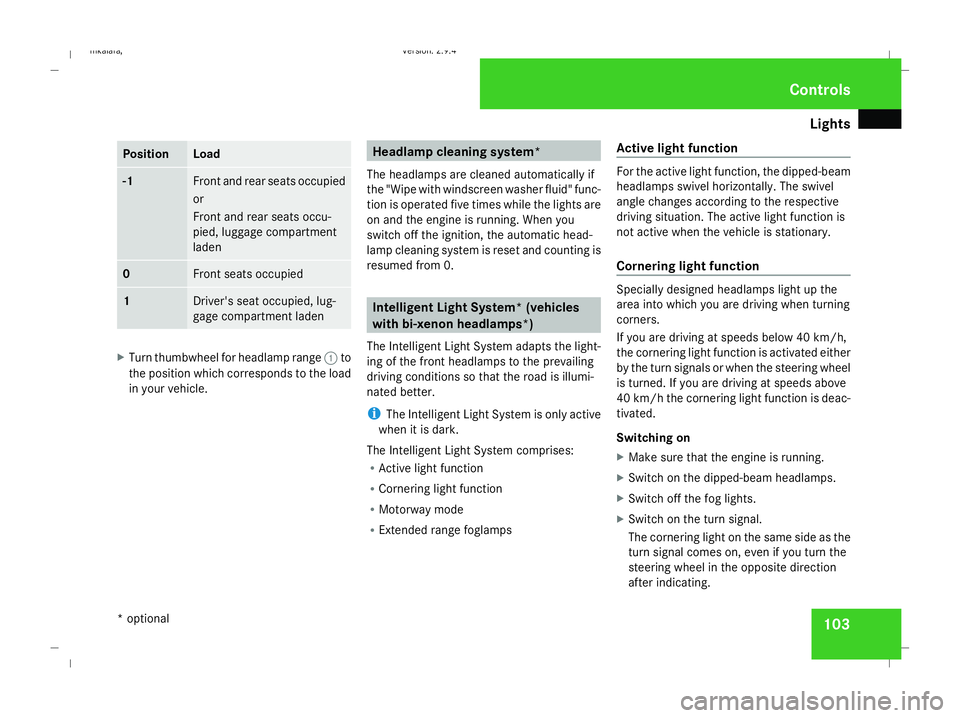
Turn thumbwheel for headlamp range 1to
the position which corresponds to the load
in your vehicle. Headlamp cleaning system*
The headlamps are cleaned automatically if
the "Wipe with windscreen washer fluid" func-
tion is operated five times while the lights are
on and the engine is running. When you
switch off the ignition, the automatic head-
lamp cleaning system is reset and counting is
resumed from 0. Intelligent Light System* (vehicles
with bi-xenon headlamps*)
The Intelligent Light System adapts the light-
ing of the front headlamps to the prevailing
driving conditions so that the road is illumi-
nated better.
i The Intelligent Light System is only active
when it is dark.
The Intelligent Light System comprises:
R Active light function
R Cornering light function
R Motorway mode
R Extended range foglamps Active light function For the active light function, the dipped-beam
headlamps swivel horizontally. The swivel
angle changes according to the respective
driving situation. The active light function is
not active when the vehicle is stationary.
Cornering light function
Specially designed headlamps light up the
area into which you are driving when turning
corners.
If you are driving at speeds below 40 km/h,
the cornering light function is activated either
by the turn signals or when the steering wheel
is turned. If you are driving at speeds above
40 km/h the cornering light function is deac-
tivated.
Switching on
X
Make sure that the engine is running.
X Switch on the dipped-beam headlamps.
X Switch off the fog lights.
X Switch on the turn signal.
The cornering light on the same side as the
turn signal comes on, even if you turn the
steering wheel in the opposite direction
after indicating. Controls
* optional
211_AKB; 2; 5, en-GB
mkalafa,
Version: 2.9.4
2008-02-29T16:57:07+01:00 - Seite 103 ZDateiname: 6515_3416_02_buchblock.pdf; preflight
Page 193 of 401
Loading and stowing
190 Luggage net in the front-passenger
footwell
G
Risk of injury
Only place lightweight objects in the lug-
gage net. Do not use it to transport heavy,
sharp-edged or fragile objects. The luggage
net cannot secure the objects sufficiently
in the event of an accident. Loading guidelines
G
Risk of injury
Secure and position the load as described
in the loading guidelines.
Otherwise, vehicle occupants could
be injured by the load being thrown around
in the event of sharp braking, a sudden
change in direction or an accident. This also
applies to seats which have been removed.
You will find further information in the
"Securing a load" section.
Even if you follow all the loading guidelines,
the load will increase the risk of injury in the
event of an accident. G
Risk of poisoning
Keep the boot lid/tailgate closed while the
vehicle is in operation. Otherwise, exhaust
fumes could enter the vehicle interior and
poison you.
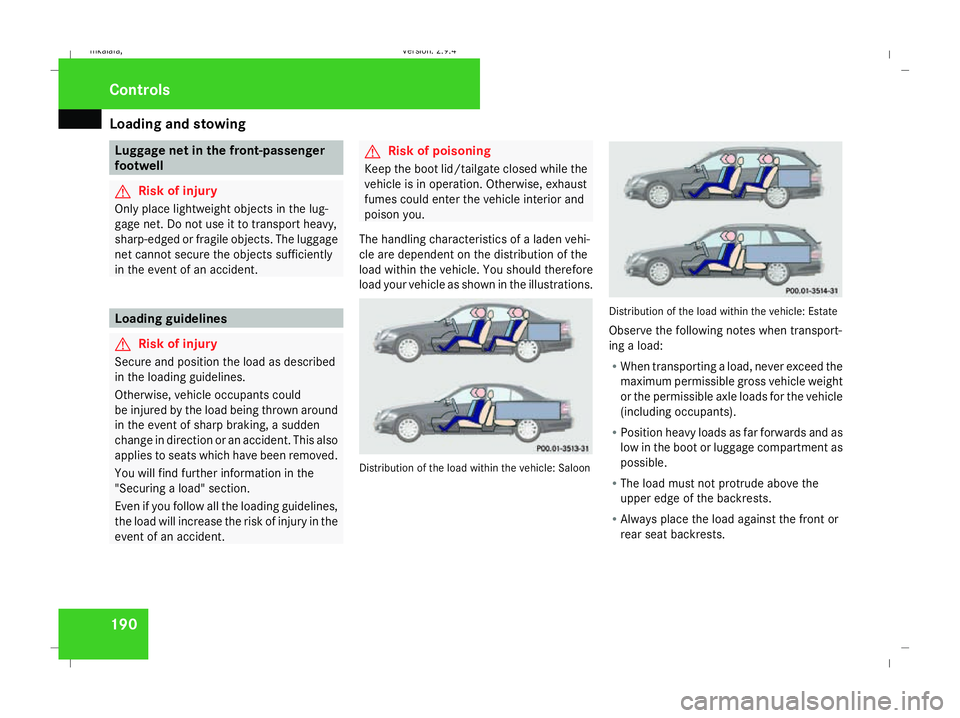
The handling characteristics of a laden vehi-
cle are dependent on the distribution of the
load within the vehicle. You should therefore
load your vehicle as shown in the illustrations. Distribution of the load within the vehicle: Saloon Distribution of the load within the vehicle: Estate
Observe the following notes when transport-
ing a load:
R
When transporting a load, never exceed the
maximum permissible gross vehicle weight
or the permissible axle loads for the vehicle
(including occupants).
R Position heavy loads as far forwards and as
low in the boot or luggage compartment as
possible.
R The load must not protrude above the
upper edge of the backrests.
R Always place the load against the front or
rear seat backrests. Controls
211_AKB; 2; 5, en-GB
mkalafa,
Version: 2.9.4 2008-02-29T16:57:07+01:00 - Seite 190Dateiname: 6515_3416_02_buchblock.pdf; preflight
Page 194 of 401
Loading and stowing
191
R
Only load the additional loading floor in the
boot up to a maximum of 20 kg.
R Secure the load with sufficiently strong and
wear-resistant load restraints. Pad sharp
edges for protection.
i Load restraints are available at any quali-
fied specialist workshop, e.g. a Mercedes-
Benz Service Centre. R
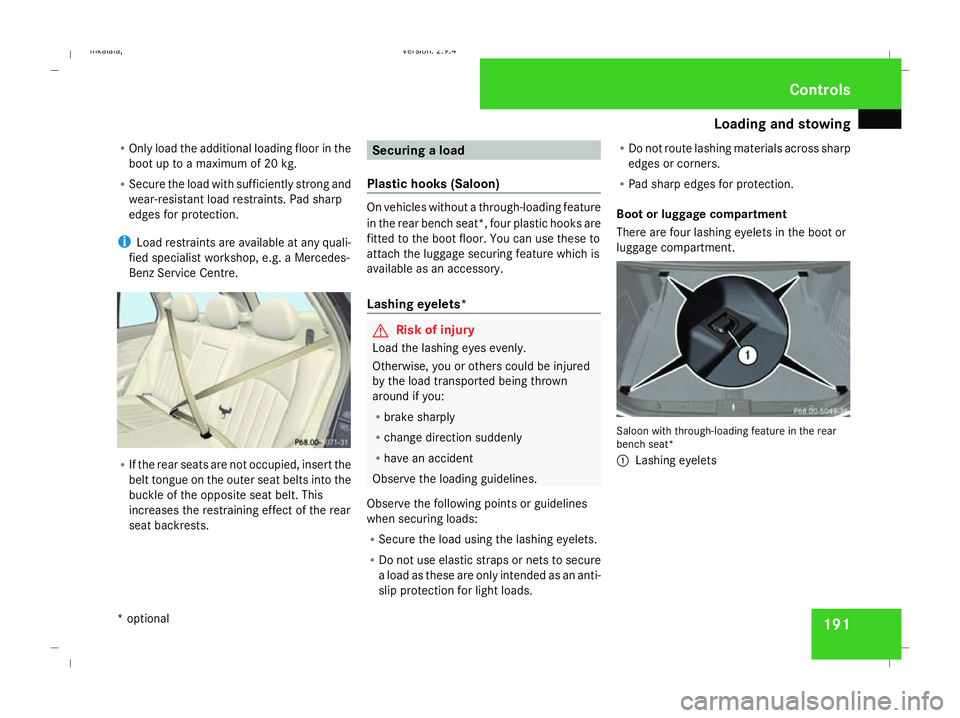
If the rear seats are not occupied, insert the
belt tongue on the outer seat belts into the
buckle of the opposite seat belt. This
increases the restraining effect of the rear
seat backrests. Securing a load
Plastic hooks (Saloon) On vehicles without a through-loading feature
in the rear bench seat*, four plastic hooks are
fitted to the boot floor. You can use these to
attach the luggage securing feature which is
available as an accessory.
Lashing eyelets*
G
Risk of injury
Load the lashing eyes evenly.
Otherwise, you or others could be injured
by the load transported being thrown
around if you:
R brake sharply
R change direction suddenly
R have an accident
Observe the loading guidelines.
Observe the following points or guidelines
when securing loads:
R Secure the load using the lashing eyelets.
R Do not use elastic straps or nets to secure
a load as these are only intended as an anti-
slip protection for light loads. R
Do not route lashing materials across sharp
edges or corners.
R Pad sharp edges for protection.
Boot or luggage compartment
There are four lashing eyelets in the boot or
luggage compartment. Saloon with through-loading feature in the rear
bench seat*
1
Lashing eyelets Controls
* optional
211_AKB; 2; 5, en-GB
mkalafa,
Version: 2.9.4 2008-02-29T16:57:07+01:00 - Seite 191 ZDateiname: 6515_3416_02_buchblock.pdf; preflight
Page 198 of 401
Loading and stowing
195
ers
6on front luggage compartment floor
1.
i You must release both retainers 6to
remove transverse brace 4. To do this,
press the tabs under retainer 6forwards.
i You can insert loading tray 2under
either the rear or the front luggage com-
partment floor.
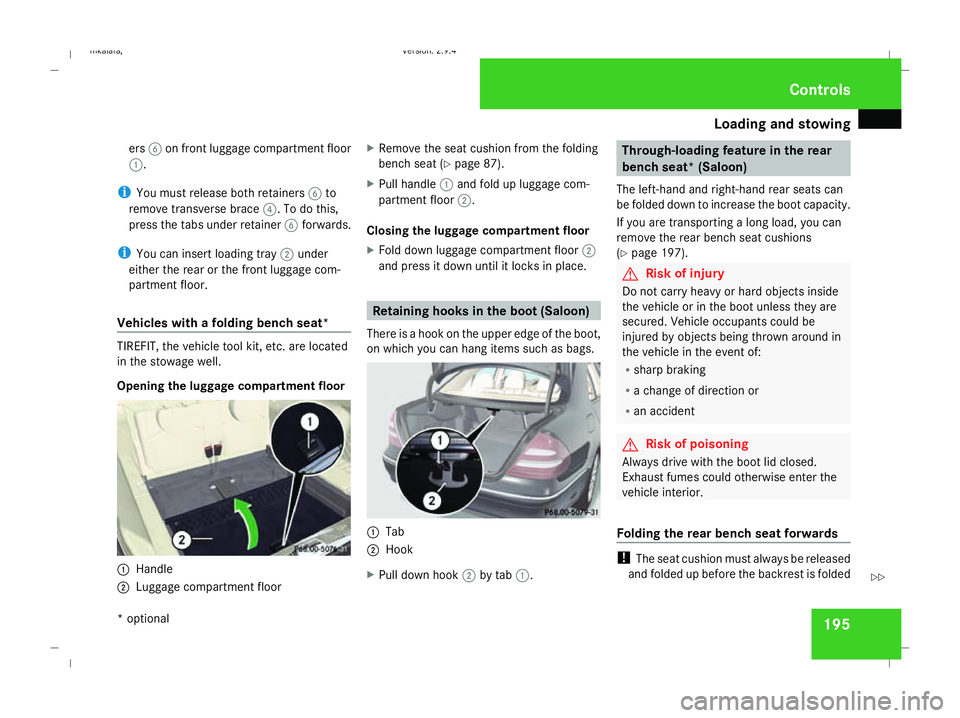
Vehicles with a folding bench seat* TIREFIT, the vehicle tool kit, etc. are located
in the stowage well.
Opening the luggage compartment floor
1
Handle
2 Luggage compartment floor X
Remove the seat cushion from the folding
bench seat (Y page 87).
X Pull handle 1and fold up luggage com-
partment floor 2.
Closing the luggage compartment floor
X Fold down luggage compartment floor 2
and press it down until it locks in place. Retaining hooks in the boot (Saloon)
There is a hook on the upper edge of the boot,
on which you can hang items such as bags. 1
Tab
2 Hook
X Pull down hook 2by tab 1. Through-loading feature in the rear
bench seat* (Saloon)
The left-hand and right-hand rear seats can
be folded down to increase the boot capacity.
If you are transporting a long load, you can
remove the rear bench seat cushions
(Y page 197). G
Risk of injury
Do not carry heavy or hard objects inside
the vehicle or in the boot unless they are
secured. Vehicle occupants could be
injured by objects being thrown around in
the vehicle in the event of:
R sharp braking
R a change of direction or
R an accident G
Risk of poisoning
Always drive with the boot lid closed.
Exhaust fumes could otherwise enter the
vehicle interior.
Folding the rear bench seat forwards !
The seat cushion must always be released
and folded up before the backrest is folded Controls
* optional
211_AKB; 2; 5, en-GB
mkalafa,
Version: 2.9.4 2008-02-29T16:57:07+01:00 - Seite 195 ZDateiname: 6515_3416_02_buchblock.pdf; preflight
Page 199 of 401
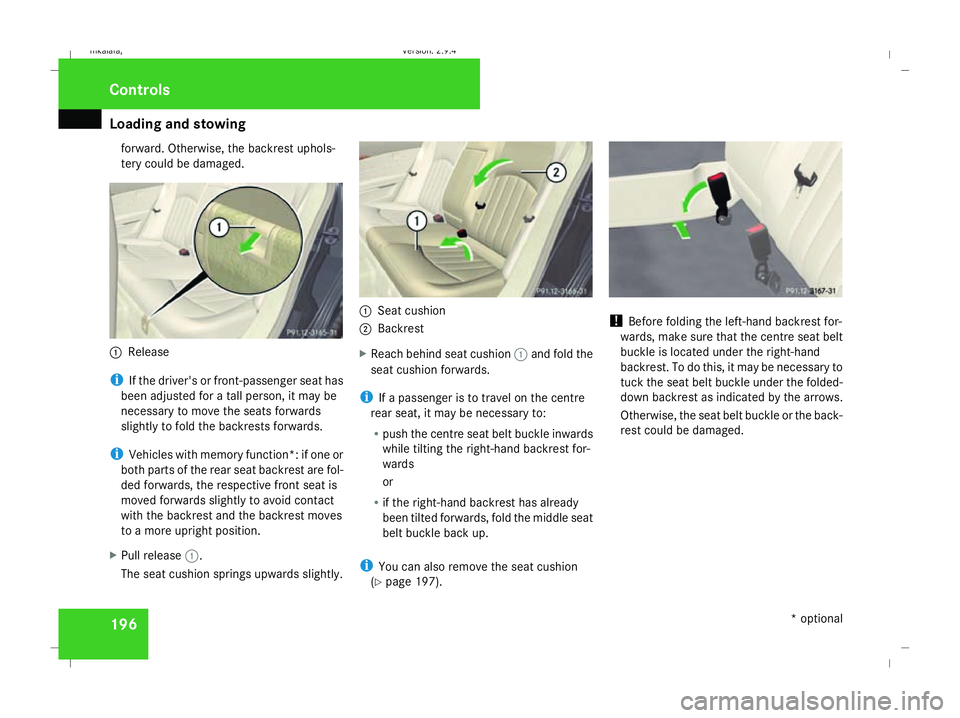
Loading and stowing
196forward. Otherwise, the backrest uphols-
tery could be damaged. 1
Release
i If the driver's or front-passenger seat has
been adjusted for a tall person, it may be
necessary to move the seats forwards
slightly to fold the backrests forwards.
i Vehicles with memory function*: if one or
both parts of the rear seat backrest are fol-
ded forwards, the respective front seat is
moved forwards slightly to avoid contact
with the backrest and the backrest moves
to a more upright position.
X Pull release 1.
The seat cushion springs upwards slightly. 1
Seat cushion
2 Backrest
X Reach behind seat cushion 1and fold the
seat cushion forwards.
i If a passenger is to travel on the centre
rear seat, it may be necessary to:
R push the centre seat belt buckle inwards
while tilting the right-hand backrest for-
wards
or
R if the right-hand backrest has already
been tilted forwards, fold the middle seat
belt buckle back up.
i You can also remove the seat cushion
(Y page 197). !
Before folding the left-hand backrest for-
wards, make sure that the centre seat belt
buckle is located under the right-hand
backrest. To do this, it may be necessary to
tuck the seat belt buckle under the folded-
down backrest as indicated by the arrows.
Otherwise, the seat belt buckle or the back-
rest could be damaged. Controls
* optional
211_AKB; 2; 5, en-GB
mkalafa,
Version: 2.9.4 2008-02-29T16:57:07+01:00 - Seite 196Dateiname: 6515_3416_02_buchblock.pdf; preflight
Page 201 of 401
Loading and stowing
198seat heating connector
2from the seat
cushion.
i Join the connections for the seat heating,
making sure the connector clicks into
place, when replacing the cushion.
X Pull seat cushion release catch 1and
remove the seat cushion upwards.
! Leave the seat cushion hinge in this posi-
tion. If you fold it back, you could damage
the upholstery. X
Fold the backrest forward. Enlarging the luggage compartment
(Estate)
The left-hand and right-hand rear seats can
be folded down to increase the luggage com-
partment capacity.
If the combined luggage cover and net is fit-
ted with the luggage compartment cover and
safety net, you can only fold the right-hand
backrest forwards on its own or both backr-
ests if you first fold the right-hand backrest
forwards. G
Risk of injury
Do not carry heavy or hard objects inside
the vehicle or in the luggage compartment
unless they are secured.
Otherwise, you and other vehicle occu-
pants could be injured by objects being
thrown around the vehicle in the event of
sharp braking, a sudden change in direction
or an accident.
You must always fold the seat cushions
forward and attach the safety net when
using the luggage compartment enlarge-
ment. G
Risk of poisoning
Always drive with the tailgate closed.
Exhaust fumes could otherwise enter the
vehicle interior.
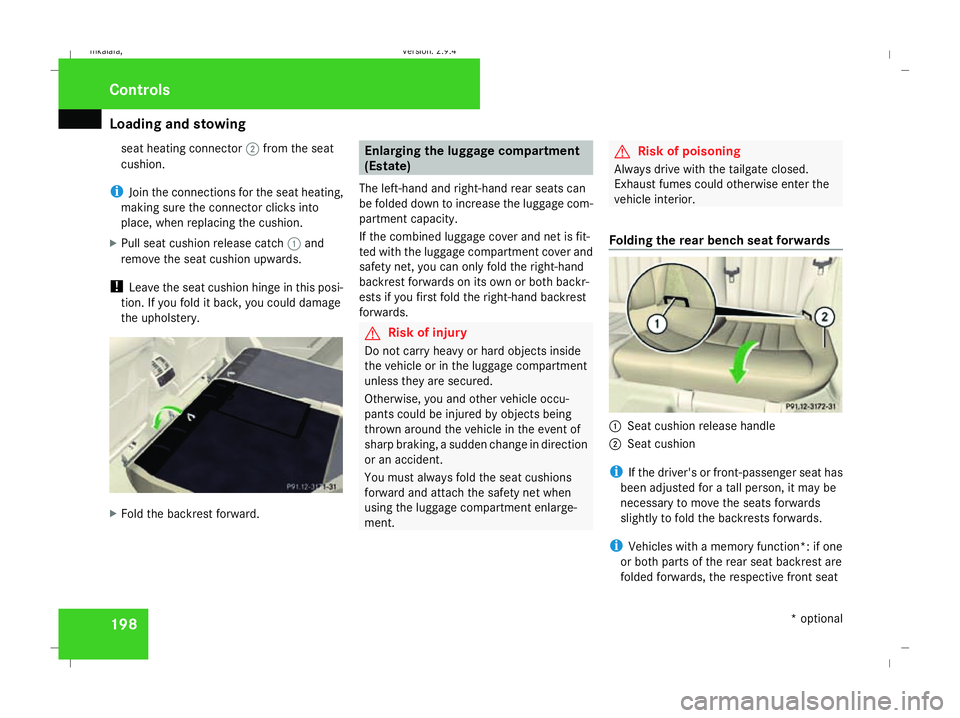
Folding the rear bench seat forwards 1
Seat cushion release handle
2 Seat cushion
i If the driver's or front-passenger seat has
been adjusted for a tall person, it may be
necessary to move the seats forwards
slightly to fold the backrests forwards.
i Vehicles with a memory function*: if one
or both parts of the rear seat backrest are
folded forwards, the respective front seat Controls
* optional
211_AKB; 2; 5, en-GB
mkalafa,
Version: 2.9.4 2008-02-29T16:57:07+01:00 - Seite 198Dateiname: 6515_3416_02_buchblock.pdf; preflight
Page 204 of 401
Loading and stowing
201
Adjusting the backrest position
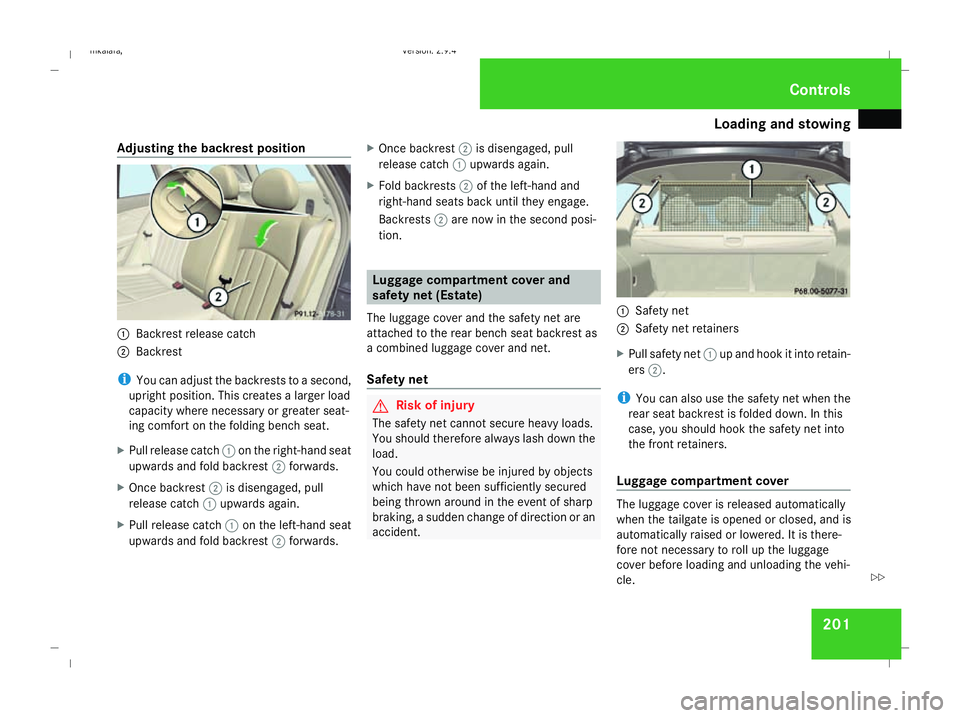
1
Backrest release catch
2 Backrest
i You can adjust the backrests to a second,
upright position. This creates a larger load
capacity where necessary or greater seat-
ing comfort on the folding bench seat.
X Pull release catch 1on the right-hand seat
upwards and fold backrest 2forwards.
X Once backrest 2is disengaged, pull
release catch 1upwards again.
X Pull release catch 1on the left-hand seat
upwards and fold backrest 2forwards. X
Once backrest 2is disengaged, pull
release catch 1upwards again.
X Fold backrests 2of the left-hand and
right-hand seats back until they engage.
Backrests 2are now in the second posi-
tion. Luggage compartment cover and
safety net (Estate)
The luggage cover and the safety net are
attached to the rear bench seat backrest as
a combined luggage cover and net.
Safety net G
Risk of injury
The safety net cannot secure heavy loads.
You should therefore always lash down the
load.
You could otherwise be injured by objects
which have not been sufficiently secured
being thrown around in the event of sharp
braking, a sudden change of direction or an
accident. 1
Safety net
2 Safety net retainers
X Pull safety net 1up and hook it into retain-
ers 2.
i You can also use the safety net when the
rear seat backrest is folded down. In this
case, you should hook the safety net into
the front retainers.
Luggage compartment cover The luggage cover is released automatically
when the tailgate is opened or closed, and is
automatically raised or lowered. It is there-
fore not necessary to roll up the luggage
cover before loading and unloading the vehi-
cle. Controls
211_AKB; 2; 5, en-GB
mkalafa,
Version: 2.9.4
2008-02-29T16:57:07+01:00 - Seite 201 ZDateiname: 6515_3416_02_buchblock.pdf; preflight