airbag disable MERCEDES-BENZ E-CLASS SALOON 2009 Owners Manual
[x] Cancel search | Manufacturer: MERCEDES-BENZ, Model Year: 2009, Model line: E-CLASS SALOON, Model: MERCEDES-BENZ E-CLASS SALOON 2009Pages: 373, PDF Size: 12.37 MB
Page 42 of 373
G
Risk of injury
If the seat belt tensioners have been trig-
gered, they provide no additional protection
in the event of another accident. Therefore,
have belt tensioners which have been trig-
gered replaced at a qualified specialist work-
shop.
Comply with safety regulations when dispos-
ing of belt tensioners. Any Mercedes-Benz
Service Centre can provide details of these
regulations.
Airbags Airbag deployment slows down and restricts
the movement of the vehicle occupant.
If the airbags are deployed, you will hear a
bang and a small amount of powder may also
be released. Only in rare cases will the bang
affect your hearing. The powder that escapes
does not generally constitute a health hazard.
The SRS warning lamp 6lights up.
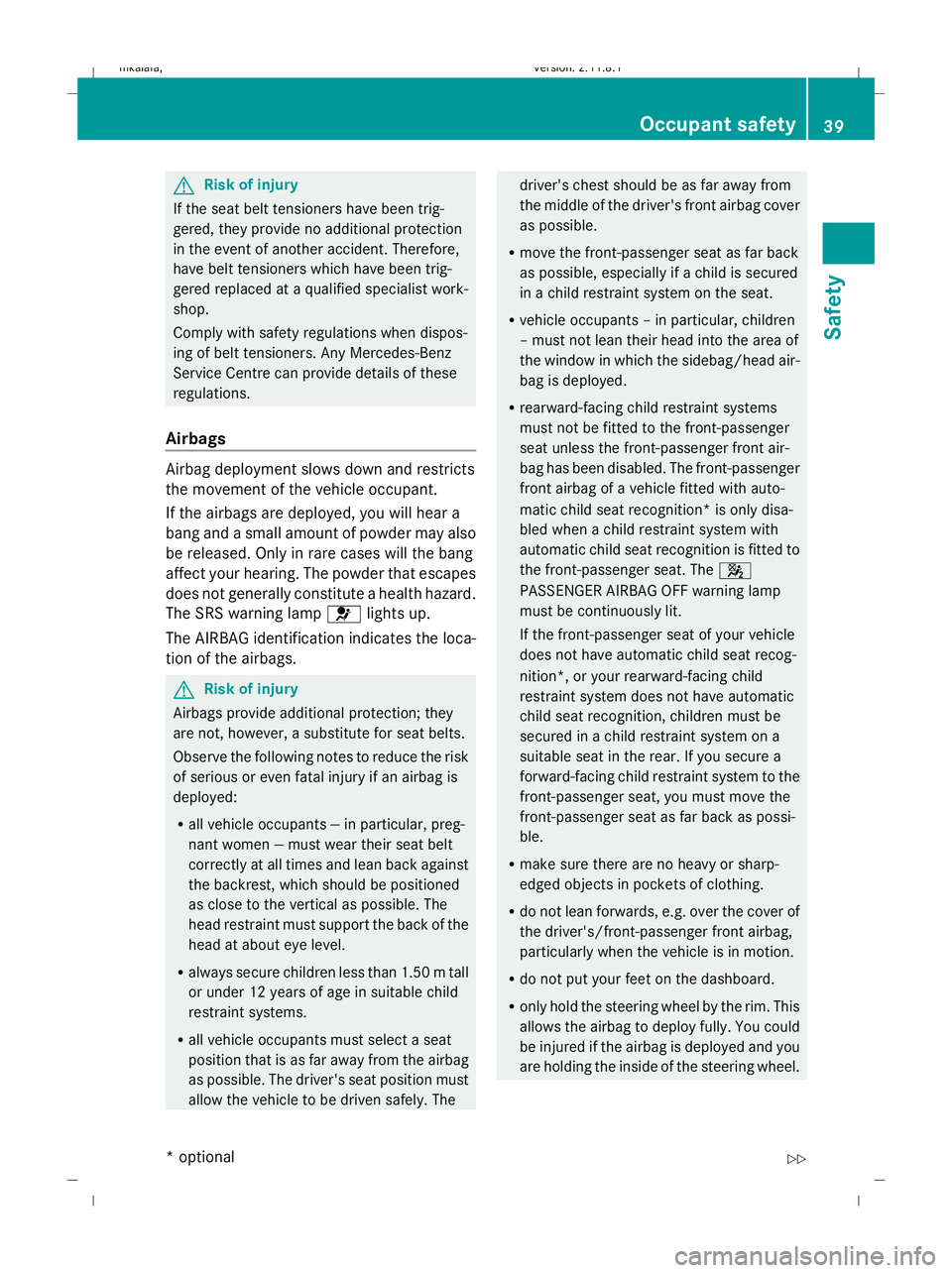
The AIRBAG identification indicates the loca-
tion of the airbags. G
Risk of injury
Airbags provide additional protection; they
are not, however, a substitute for seat belts.
Observe the following notes to reduce the risk
of serious or even fatal injury if an airbag is
deployed:
R all vehicle occupants ― in particular, preg-
nant women ― must wear their seat belt
correctly at all times and lean back against
the backrest, which should be positioned
as close to the vertical as possible. The
head restraint must support the back of the
head at about eye level.
R always secure children less than 1.50 m tall
or under 12 years of age in suitable child
restraint systems.
R all vehicle occupants must select a seat
position that is as far away from the airbag
as possible. The driver's seat position must
allow the vehicle to be driven safely. The driver's chest should be as far away from
the middle of the driver's front airbag cover
as possible.
R move the front-passenger seat as far back
as possible, especially if a child is secured
in a child restraint system on the seat.
R vehicle occupants – in particular, children
– must not lean their head into the area of
the window in which the sidebag/head air-
bag is deployed.
R rearward-facing child restraint systems
must not be fitted to the front-passenger
seat unless the front-passenger front air-
bag has been disabled. The front-passenger
front airbag of a vehicle fitted with auto-
matic child seat recognition* is only disa-
bled when a child restraint system with
automatic child seat recognition is fitted to
the front-passenger seat. The 4
PASSENGER AIRBAG OFF warning lamp
must be continuously lit.
If the front-passenger seat of your vehicle
does not have automatic child seat recog-
nition*, or your rearward-facing child
restraint system does not have automatic
child seat recognition, children must be
secured in a child restraint system on a
suitable seat in the rear. If you secure a
forward-facing child restraint system to the
front-passenger seat, you must move the
front-passenger seat as far back as possi-
ble.
R make sure there are no heavy or sharp-
edged objects in pockets of clothing.
R do not lean forwards, e.g. over the cover of
the driver's/front-passenger front airbag,
particularly when the vehicle is in motion.
R do not put your feet on the dashboard.
R only hold the steering wheel by the rim. This
allows the airbag to deploy fully. You could
be injured if the airbag is deployed and you
are holding the inside of the steering wheel. Occupant safety
39Safety
* optional
212_AKB; 2; 4, en-GB
mkalafa
,V ersion: 2.11.8.1
2009-05-05T14:17:16+02:00 - Seite 39 Z
Dateiname: 6515346702_buchblock.pdf; erzeugt am 07. May 2009 14:15:36; WK
Page 49 of 373
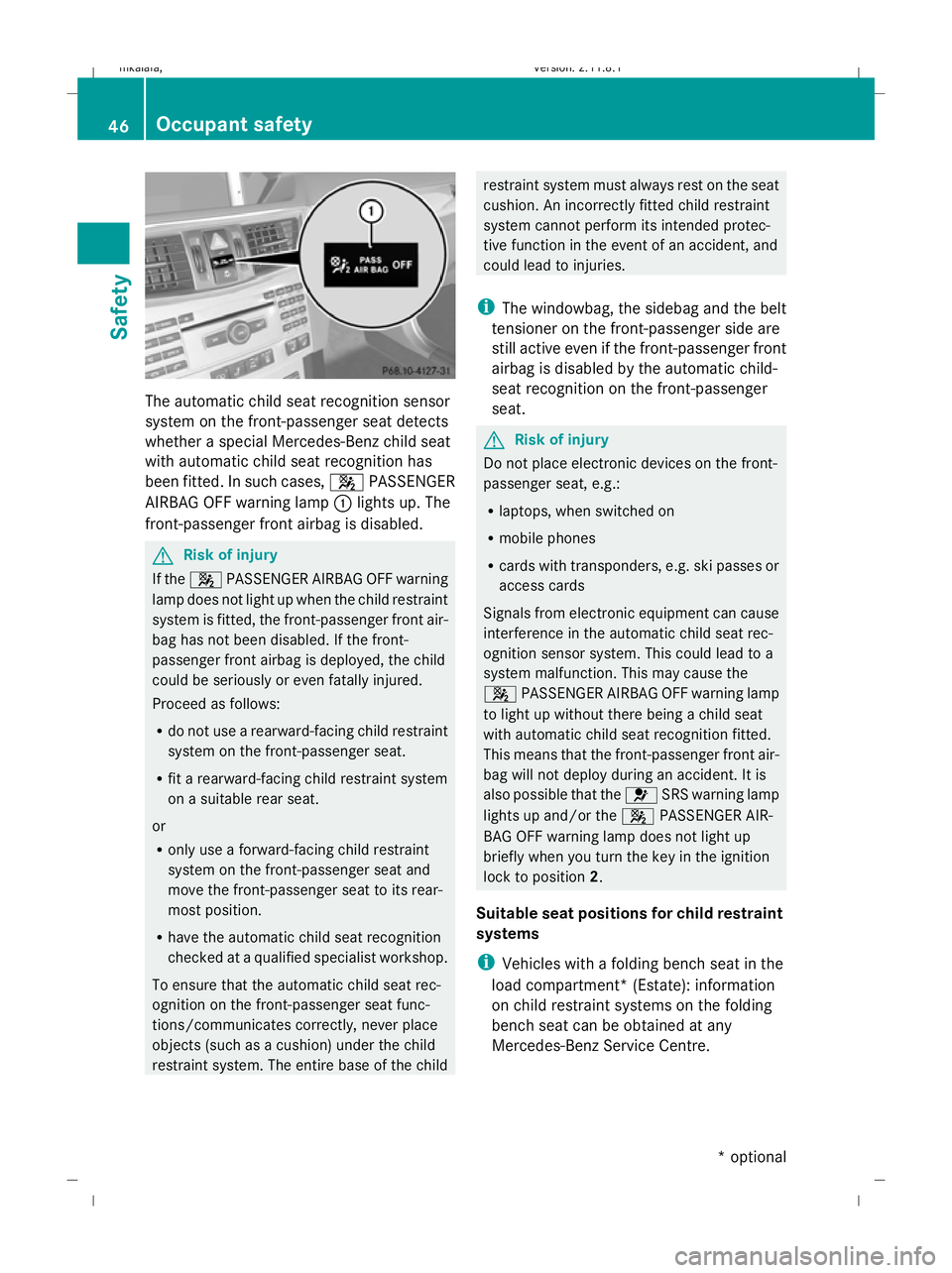
The automatic child seat recognition sensor
system on the front-passenger seat detects
whether a special Mercedes-Benz child seat
with automatic child seat recognition has
been fitted. In such cases, 4PASSENGER
AIRBAG OFF warning lamp :lights up. The
front-passenger front airbag is disabled. G
Risk of injury
If the 4 PASSENGER AIRBAG OFF warning
lamp does not light up when the child restraint
system is fitted, the front-passenger front air-
bag has not been disabled. If the front-
passenger front airbag is deployed, the child
could be seriously or even fatally injured.
Proceed as follows:
R do not use a rearward-facing child restraint
system on the front-passenger seat.
R fit a rearward-facing child restraint system
on a suitable rear seat.
or
R only use a forward-facing child restraint
system on the front-passenger seat and
move the front-passenger seat to its rear-
most position.
R have the automatic child seat recognition
checked at a qualified specialist workshop.
To ensure that the automatic child seat rec-
ognition on the front-passenger seat func-
tions/communicates correctly, never place
objects (such as a cushion) under the child
restraint system. The entire base of the child restraint system must always rest on the seat
cushion. An incorrectly fitted child restraint
system cannot perform its intended protec-
tive function in the event of an accident, and
could lead to injuries.
i The windowbag, the sidebag and the belt
tensioner on the front-passenger side are
still active even if the front-passenger front
airbag is disabled by the automatic child-
seat recognition on the front-passenger
seat. G
Risk of injury
Do not place electronic devices on the front-
passenger seat, e.g.:
R laptops, when switched on
R mobile phones
R cards with transponders, e.g. ski passes or
access cards
Signals from electronic equipment can cause
interference in the automatic child seat rec-
ognition sensor system. This could lead to a
system malfunction. This may cause the
4 PASSENGER AIRBAG OFF warning lamp
to light up without there being a child seat
with automatic child seat recognition fitted.
This means that the front-passenger front air-
bag will not deploy during an accident. It is
also possible that the 6SRS warning lamp
lights up and/or the 4PASSENGER AIR-
BAG OFF warning lamp does not light up
briefly when you turn the key in the ignition
lock to position 2.
Suitable seat positions for child restraint
systems
i Vehicles with a folding bench seat in the
load compartment* (Estate): information
on child restraint systems on the folding
bench seat can be obtained at any
Mercedes-Benz Service Centre. 46
Occupant safetySafety
* optional
212_AKB; 2; 4, en-GB
mkalafa,
Version: 2.11.8.1 2009-05-05T14:17:16+02:00 - Seite 46
Dateiname: 6515346702_buchblock.pdf; erzeugt am 07. May 2009 14:15:39; WK
Page 50 of 373
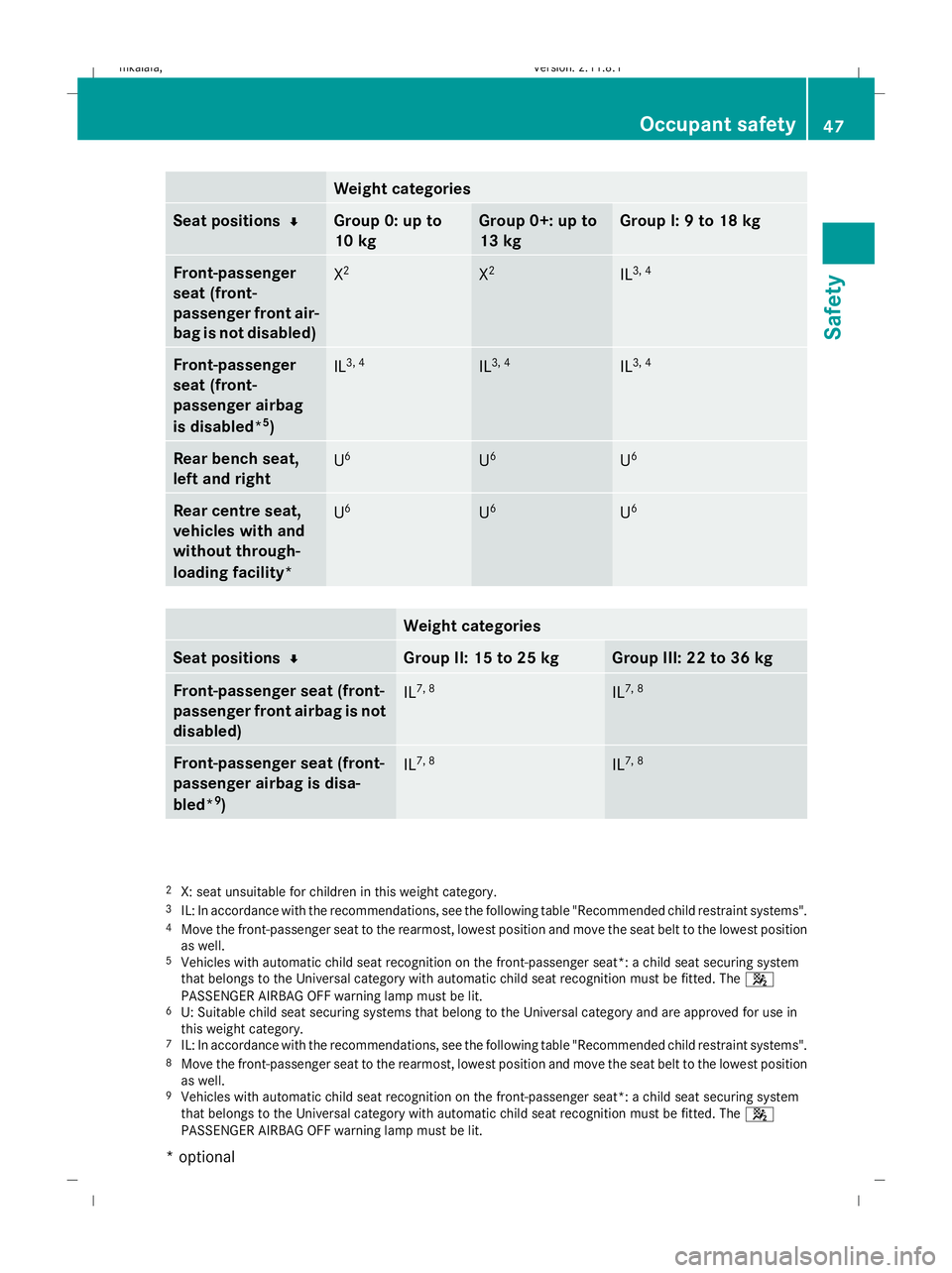
Weight categories
Seat positions
¬
¬ Group 0: up to
10 kg Group 0+: up to
13 kg Group I: 9 to 18 kg
Front-passenger
seat (front-
passenger front air-
bag is not disabled)
X
2 X
2 IL
3, 4 Front-passenger
seat (front-
passenger airbag
is disabled*
5
) IL
3, 4 IL
3, 4 IL
3, 4 Rear bench seat,
left and right
U
6 U
6 U
6 Rear centre seat,
vehicles with and
without through-
loading facility*
U
6 U
6 U
6 Weight categories
Seat positions
¬ ¬ Group II: 15 to 25 kg Group III: 22 to 36 kg
Front-passenger seat (front-
passenger front airbag is not
disabled)
IL
7, 8 IL
7, 8 Front-passenger seat (front-
passenger airbag is disa-
bled*
9
) IL
7, 8 IL
7, 8 2
X: seat unsuitable for children in this weight category.
3 IL: In accordance with the recommendations, see the following table "Recommended child restraint systems".
4 Move the front-passenger seat to the rearmost, lowest position and move the seat belt to the lowest position
as well.
5 Vehicles with automatic child seat recognition on the front-passenger seat*: a child seat securing system
that belongs to the Universal category with automatic child seat recognition must be fitted. The 4
PASSENGER AIRBAG OFF warning lamp must be lit.
6 U: Suitable child seat securing systems that belong to the Universal category and are approved for use in
this weight category.
7 IL: In accordance with the recommendations, see the following table "Recommended child restraint systems".
8 Move the front-passenger seat to the rearmost, lowest position and move the seat belt to the lowest position
as well.
9 Vehicles with automatic child seat recognition on the front-passenger seat*: a child seat securing system
that belongs to the Universal category with automatic child seat recognition must be fitted. The 4
PASSENGER AIRBAG OFF warning lamp must be lit. Occupant safety
47Safety
* optional
212_AKB; 2; 4, en-GB
mkalafa,
Version: 2.11.8.1
2009-05-05T14:17:16+02:00 - Seite 47 Z
Dateiname: 6515346702_buchblock.pdf; erzeugt am 07. May 2009 14:15:39; WK
Page 283 of 373
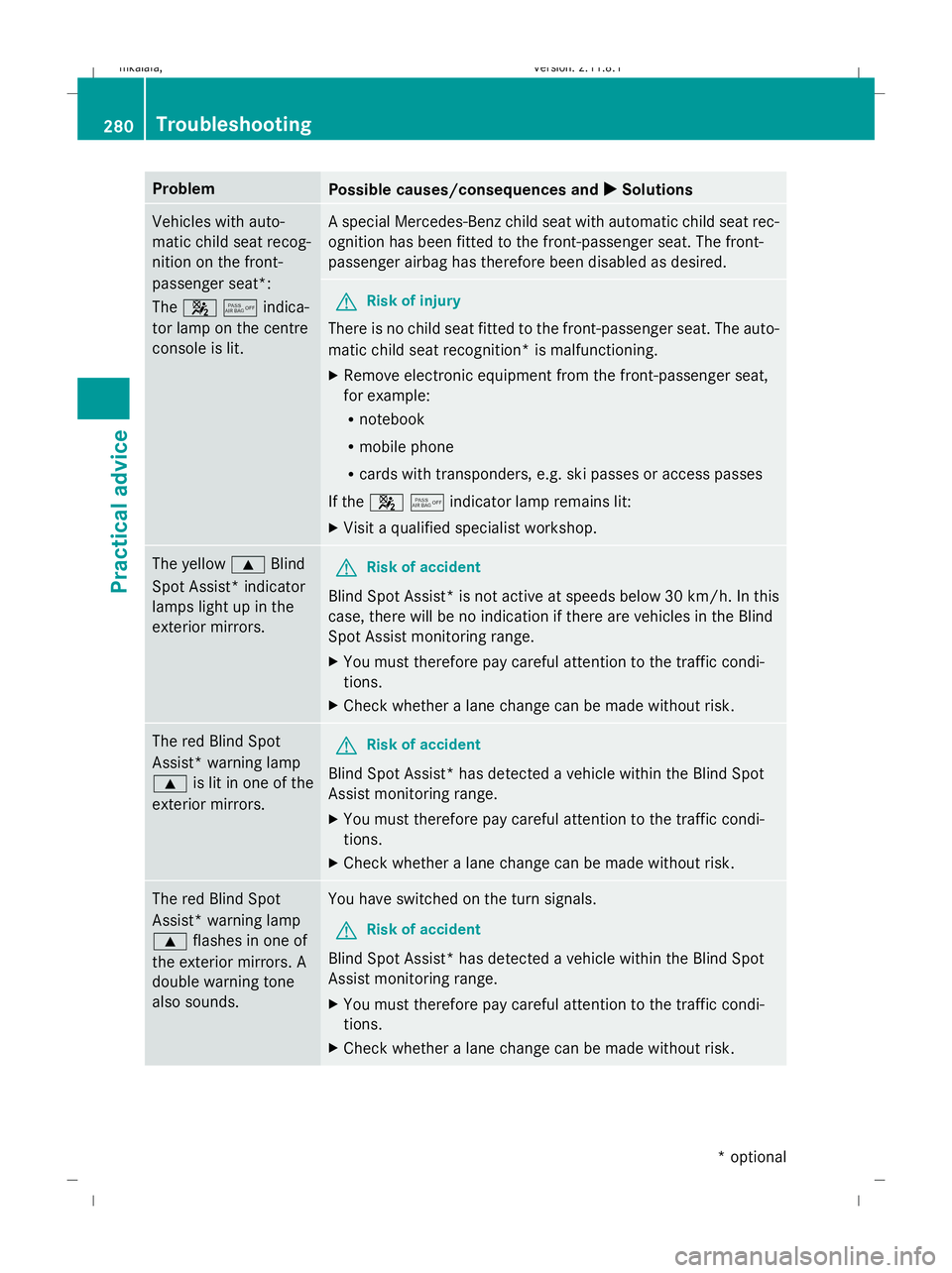
Problem
Possible causes/consequences and
X XSolutions Vehicles with auto-
matic child seat recog-
nition on the front-
passenger seat*:
The
45indica-
tor lamp on the centre
console is lit. A special Mercedes-Benz child seat with automatic child seat rec-
ognition has been fitted to the front-passenger seat. The front-
passenger airbag has therefore been disabled as desired.
G
Risk of injury
There is no child seat fitted to the front-passenger seat. The auto-
matic child seat recognition* is malfunctioning.
X Remove electronic equipment from the front-passenger seat,
for example:
R
notebook
R mobile phone
R cards with transponders, e.g. ski passes or access passes
If the 45indicator lamp remains lit:
X Visit a qualified specialist workshop. The yellow
9Blind
Spot Assist* indicator
lamps light up in the
exterior mirrors. G
Risk of accident
Blind Spot Assist *is not active at speeds below 30 km/h. In this
case, there will be no indication if there are vehicles in the Blind
Spot Assist monitoring range.
X You must therefore pay careful attention to the traffic condi-
tions.
X Check whether a lane change can be made without risk. The red Blind Spot
Assist* warning lamp
9
is lit in one of the
exterior mirrors. G
Risk of accident
Blind Spot Assist* has detected a vehicle within the Blind Spot
Assist monitoring range.
X You must therefore pay careful attention to the traffic condi-
tions.
X Check whether a lane change can be made without risk. The red Blind Spot
Assist* warning lamp
9
flashes in one of
the exterior mirrors. A
double warning tone
also sounds. You have switched on the turn signals.
G Risk of accident
Blind Spot Assist* has detected a vehicle within the Blind Spot
Assist monitoring range.
X You must therefore pay careful attention to the traffic condi-
tions.
X Check whether a lane change can be made without risk. 280
TroubleshootingPractical advice
* optional
212_AKB; 2; 4, en-GB
mkalafa,
Version: 2.11.8.1 2009-05-05T14:17:16+02:00 - Seite 280
Dateiname: 6515346702_buchblock.pdf; erzeugt am 07. May 2009 14:17:11; WK