weight MERCEDES-BENZ E-CLASS SALOON 2009 Owners Manual
[x] Cancel search | Manufacturer: MERCEDES-BENZ, Model Year: 2009, Model line: E-CLASS SALOON, Model: MERCEDES-BENZ E-CLASS SALOON 2009Pages: 373, PDF Size: 12.37 MB
Page 20 of 373
TV
Operating (on-board computer) .....127
Two-way radio
Installation ..................................... 331
Type identification plate
see vehicle identification plate ......332
Tyre grip ............................................. 233
Tyre pressure ................................... .225
Calling up (on-board computer) ....228
Display message .................... 258, 276
Tyre pressure loss warning system
............................................................ 226
Tyre pressure monitor
Warning lamp ................................. 286
Tyres
Direction of rotatio n...................... 224
General notes ................................ 223
Technical data ............................... 350
Tyre tread .......................................... .224 U
Unladen weight ................................. 339
Unlocking Emergency unlocking ..................... 299
From the inside (central unlocking
button) ............................................. 71
Up (display message) ........................ 123 V
Vanity mirror Sun visor ........................................ 207
Variable Speedtronic ........................148
Vehicle Emergency unlocking ..................... 299
Individual settings (on-board com-
puter) ............................................. 131
Leaving parked up .........................298
Towing ........................................... 326
Tow-starting ................................... 326
Transporting .................................. 327
Vehicle battery .................................. 319
Vehicle dimensions ...................339, 348
Vehicle electronics ...........................330
Vehicle identification number
(VIN) .......................................... 332, 333
Vehicle identification plate ..............332Vehicle level
.............................. 154, 155
Display message ............................ 268
Vehicle tool kit .................................. 249
Vehicle weights ................................. 339 W
Warning and indicator lamp ESP ®
Sport .................................... 283
Warning and indicator lamps
ABS (yellow) ................................... 281
Blind Spot Assist ............................ 280
Distronic Plus (red) ........................281
ESP ®
........................................ 60, 282
ESP ®
OFF ....................................... 282
LIM (cruise control) ........................ 138
LIM (Distronic Plus) .......................141
LIM (variable Speedtronic) .............149
Malfunction indicator lamp ............279
Tyre pressure monitor ...................286
Warning lamps
see Warning and indicator lamps
Warning tone ..................................... 287
Warning triangle ................................ 248
Washer fluid Display message ............................ 278
Washer fluid reservoir ..............222, 339
Filling capacity ............................... 339
Wearing seat belts .............................. 89
Wheel bolts Tightening torque ........................... 318
Wheel chock
Use ................................................ 315
Wheels
Cleaning ......................................... 242
General notes ................................ 223
Interchanging ................................. 229
Technical data ............................... 350
Windowbag .......................................... 42
Windowbags Display message ............................ 278
Windows
Cleaning ......................................... 242
see Side windows
Windscreen washer fluid ..................339
Topping up ..................................... 222
Windscreen washer system .....222, 339 Index
17 212_AKB; 2; 4, en-GB
mkalafa,
Version: 2.11.8.1 2009-05-05T14:17:16+02:00 - Seite 17Dateiname: 6515346702_buchblock.pdf; erzeugt am 07. May 2009 14:15:27; WK
Page 22 of 373
Protection of the environment
H
Environmental note
Daimler's declared policy is one of integrated
environmental protection.
The objectives are for the natural resources
which form the basis of our existence on this
planet to be used sparingly and in a manner
which takes the requirements of both nature
and humanity into account.
You too can help to protect the environment
by operating your vehicle in an environmen-
tally-responsible manner.
Fuel consumption and the rate of engine,
transmission, brake and tyre wear depend on
the following factors:
R operating conditions of your vehicle
R your personal driving style
You can influence both factors.
You should bear the following in mind:
Operating conditions
R avoid short trips as these increase fuel con-
sumption.
R make sure that the tyre pressures are
always correct.
R do not carry any unnecessary weight.
R keep an eye on the vehicle's fuel consump-
tion.
R remove roof racks once you no longer need
them.
R a regularly serviced vehicle will contribute
to environmental protection. You should
therefore adhere to the service intervals.
R always have maintenance work carried out
at a qualified specialist workshop, e.g. a
Mercedes-Benz Service Centre. Personal driving style
R
do not depress the accelerator pedal when
starting the engine.
R do not warm up the engine with the vehicle
stationary.
R drive carefully and maintain a safe distance
from the vehicle in front.
R avoid frequent, sudden acceleration.
R change gear in good time and use each gear
only up to 2
/ 3of its maximum engine speed.
R switch off the engine in stationary traffic. Returning used vehicles
Mercedes-Benz will take back your
Mercedes-Benz to dispose of it in an environ-
mentally-responsible manner, in accordance
with the European Union (EU) End of Life
Vehicles Directive.
The End of Life Vehicles Directive applies to
vehicles of up to 3.5 t gross vehicle weight, in
accordance with national regulations. For
several years, Mercedes-Benz has been
meeting all the legal requirements for a
design which allows for recycling and re-use.
There is a network of return points and dis-
assembly plants which can recycle your vehi-
cle in an environmentally-responsible man-
ner. The options for recycling vehicles and
parts are constantly being developed and
improved. This means that your Mercedes-
Benz will also continue to meet even the
increased recycling quotas in the future in
good time. You can obtain further information
from your national Mercedes-Benz homepage
or your national hotline number. Introduction
19212_AKB; 2; 4, en-GB
mkalafa,
Version: 2.11.8.1 2009-05-05T14:17:16+02:00 - Seite 19 ZDateiname: 6515346702_buchblock.pdf; erzeugt am 07. May 2009 14:15:27; WK
Page 50 of 373
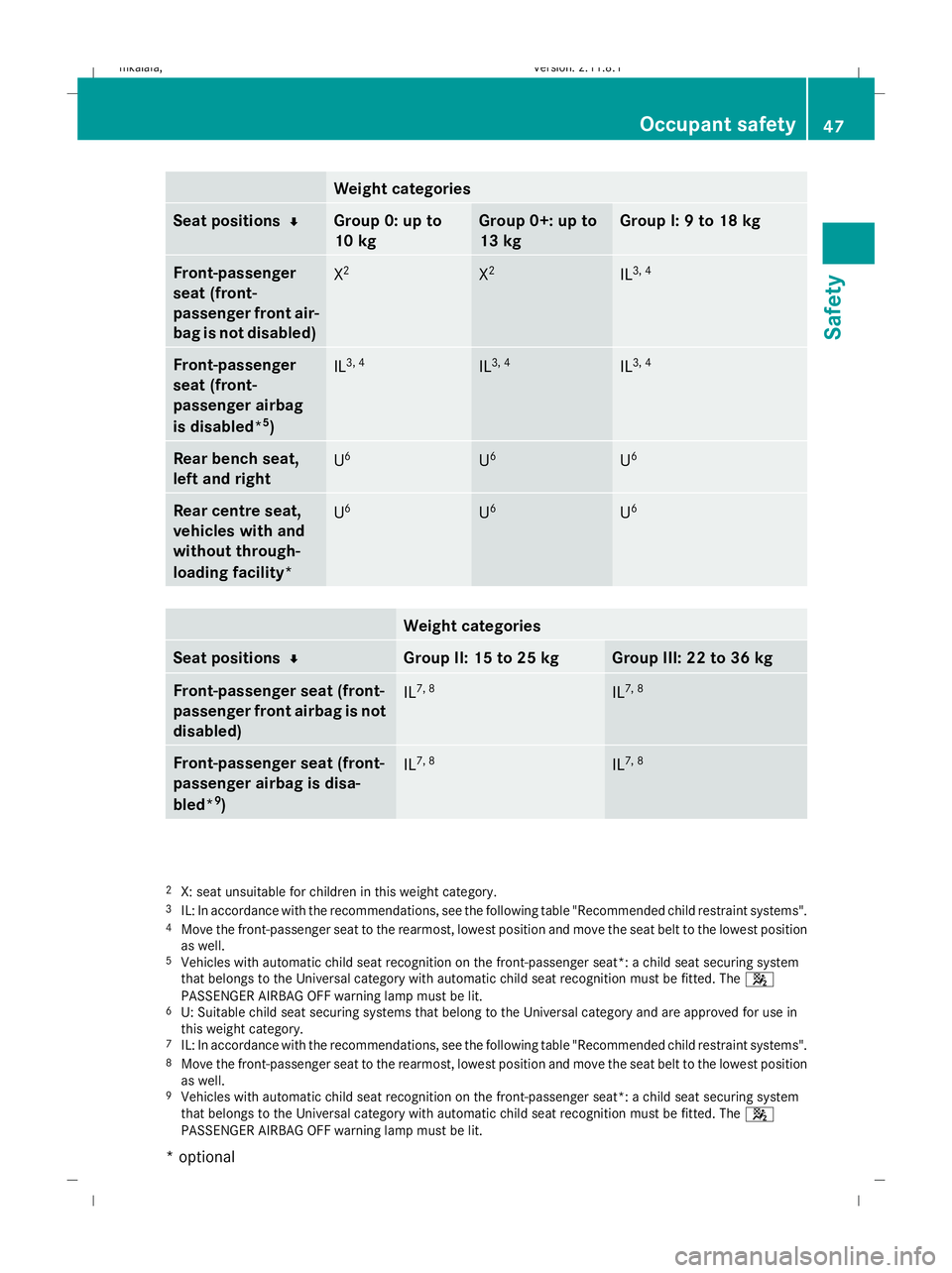
Weight categories
Seat positions
¬
¬ Group 0: up to
10 kg Group 0+: up to
13 kg Group I: 9 to 18 kg
Front-passenger
seat (front-
passenger front air-
bag is not disabled)
X
2 X
2 IL
3, 4 Front-passenger
seat (front-
passenger airbag
is disabled*
5
) IL
3, 4 IL
3, 4 IL
3, 4 Rear bench seat,
left and right
U
6 U
6 U
6 Rear centre seat,
vehicles with and
without through-
loading facility*
U
6 U
6 U
6 Weight categories
Seat positions
¬ ¬ Group II: 15 to 25 kg Group III: 22 to 36 kg
Front-passenger seat (front-
passenger front airbag is not
disabled)
IL
7, 8 IL
7, 8 Front-passenger seat (front-
passenger airbag is disa-
bled*
9
) IL
7, 8 IL
7, 8 2
X: seat unsuitable for children in this weight category.
3 IL: In accordance with the recommendations, see the following table "Recommended child restraint systems".
4 Move the front-passenger seat to the rearmost, lowest position and move the seat belt to the lowest position
as well.
5 Vehicles with automatic child seat recognition on the front-passenger seat*: a child seat securing system
that belongs to the Universal category with automatic child seat recognition must be fitted. The 4
PASSENGER AIRBAG OFF warning lamp must be lit.
6 U: Suitable child seat securing systems that belong to the Universal category and are approved for use in
this weight category.
7 IL: In accordance with the recommendations, see the following table "Recommended child restraint systems".
8 Move the front-passenger seat to the rearmost, lowest position and move the seat belt to the lowest position
as well.
9 Vehicles with automatic child seat recognition on the front-passenger seat*: a child seat securing system
that belongs to the Universal category with automatic child seat recognition must be fitted. The 4
PASSENGER AIRBAG OFF warning lamp must be lit. Occupant safety
47Safety
* optional
212_AKB; 2; 4, en-GB
mkalafa,
Version: 2.11.8.1
2009-05-05T14:17:16+02:00 - Seite 47 Z
Dateiname: 6515346702_buchblock.pdf; erzeugt am 07. May 2009 14:15:39; WK
Page 51 of 373
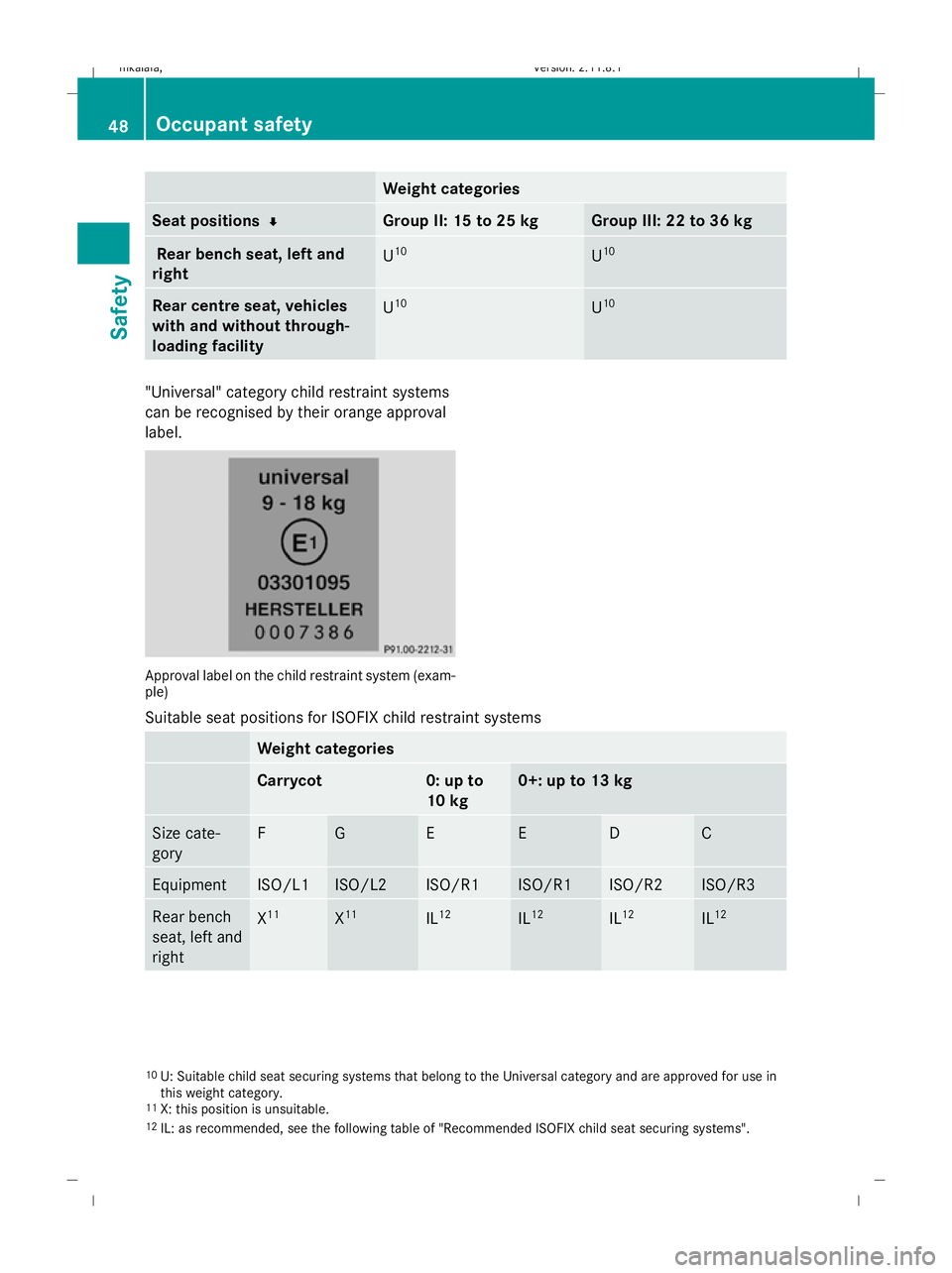
Weight categories
Seat positions
¬
¬ Group II: 15 to 25 kg Group III: 22 to 36 kg
Rear bench seat, left and
right U
10 U
10 Rear centre seat, vehicles
with and without through-
loading facility
U
10 U
10 "Universal" category child restraint systems
can be recognised by their orange approval
label. Approval label on the child restraint system (exam-
ple)
Suitable seat positions for ISOFIX child restraint systems Weight categories
Carrycot 0: up to
10 kg 0+: up to 13 kg
Size cate-
gory F G E E D C
Equipment ISO/L1 ISO/L2 ISO/R1 ISO/R1 ISO/R2 ISO/R3
Rear bench
seat, left and
right
X
11 X
11 IL
12 IL
12 IL
12 IL
12 10
U: Suitable child seat securing systems that belong to the Universal category and are approved for use in
this weight category.
11 X: this position is unsuitable.
12 IL: as recommended, see the following table of "Recommended ISOFIX child seat securing systems". 48
Occupant safetySafety
212_AKB; 2; 4, en-GB
mkalafa,
Version: 2.11.8.1 2009-05-05T14:17:16+02:00 - Seite 48
Dateiname: 6515346702_buchblock.pdf; erzeugt am 07. May 2009 14:15:39; WK
Page 52 of 373
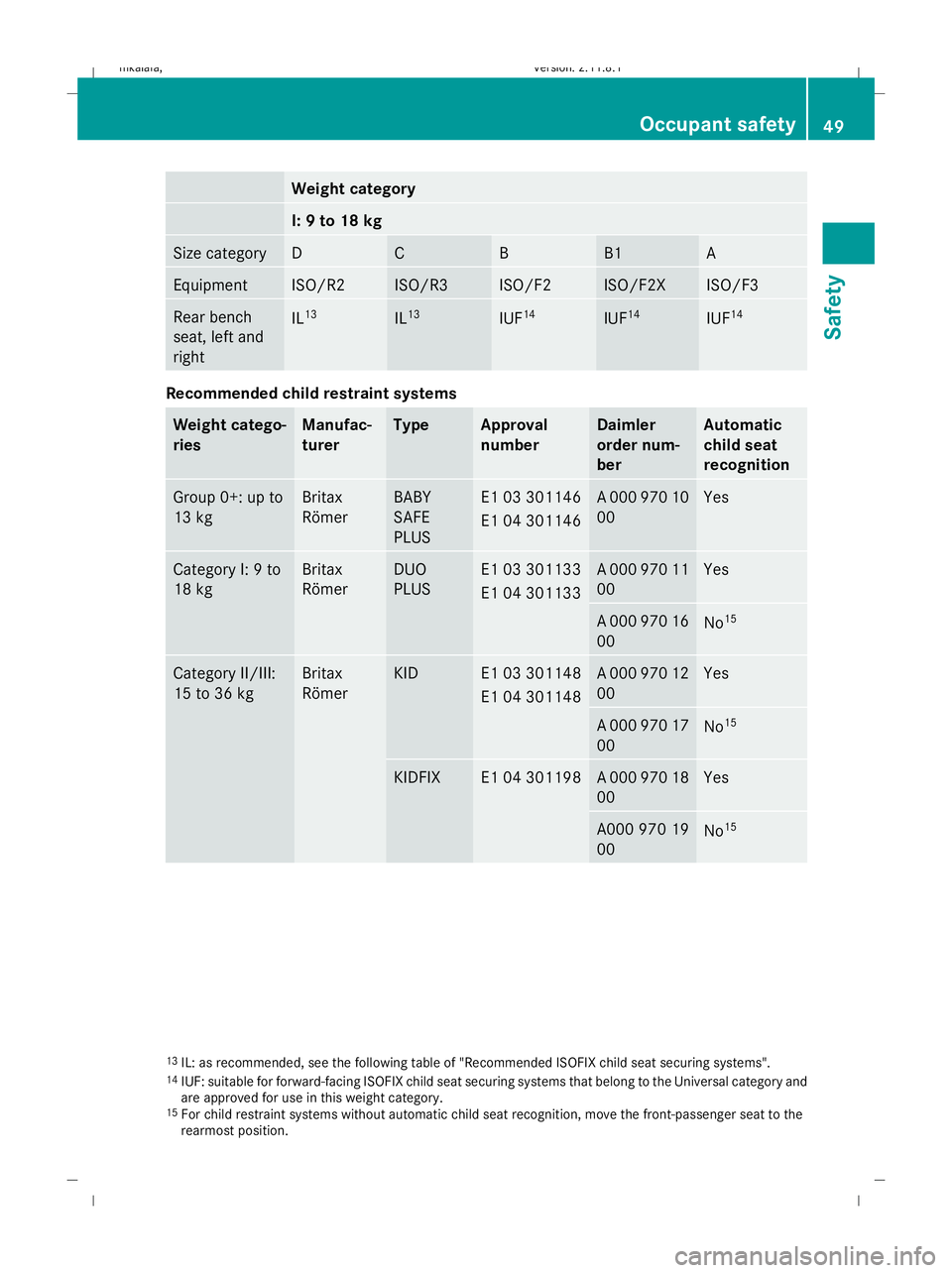
Weight category
I: 9 to 18 kg
Size category D C B B1 A
Equipment ISO/R2 ISO/R3 ISO/F2 ISO/F2X ISO/F3
Rear bench
seat, left and
right
IL
13 IL
13 IUF
14 IUF
14 IUF
14 Recommended child restraint systems
Weight catego-
ries Manufac-
turer Type Approval
number Daimler
order num-
ber Automatic
child seat
recognition
Group 0+: up to
13 kg Britax
Römer BABY
SAFE
PLUS E1 03 301146
E1 04 301146 A 000 970 10
00 Yes
Category I: 9 to
18 kg Britax
Römer DUO
PLUS E1 03 301133
E1 04 301133 A 000 970 11
00 Yes
A 000 970 16
00
No
15 Category II/III:
15 to 36 kg Britax
Römer KID E1 03 301148
E1 04 301148 A 000 970 12
00 Yes
A 000 970 17
00
No
15 KIDFIX E1 04 301198 A 000 970 18
00 Yes
A000 970 19
00
No
15 13
IL: as recommended, see the following table of "Recommended ISOFIX child seat securing systems".
14 IUF: suitable for forward-facing ISOFIX child seat securing systems that belong to the Universal category and
are approved for use in this weight category.
15 For child restraint systems without automatic child seat recognition, move the front-passenger seat to the
rearmost position. Occupant safety
49Safety
212_AKB; 2; 4, en-GB
mkalafa, Version: 2.11.8.1 2009-05-05T14:17:16+02:00 - Seite 49 Z
Dateiname: 6515346702_buchblock.pdf; erzeugt am 07. May 2009 14:15:39; WK
Page 53 of 373
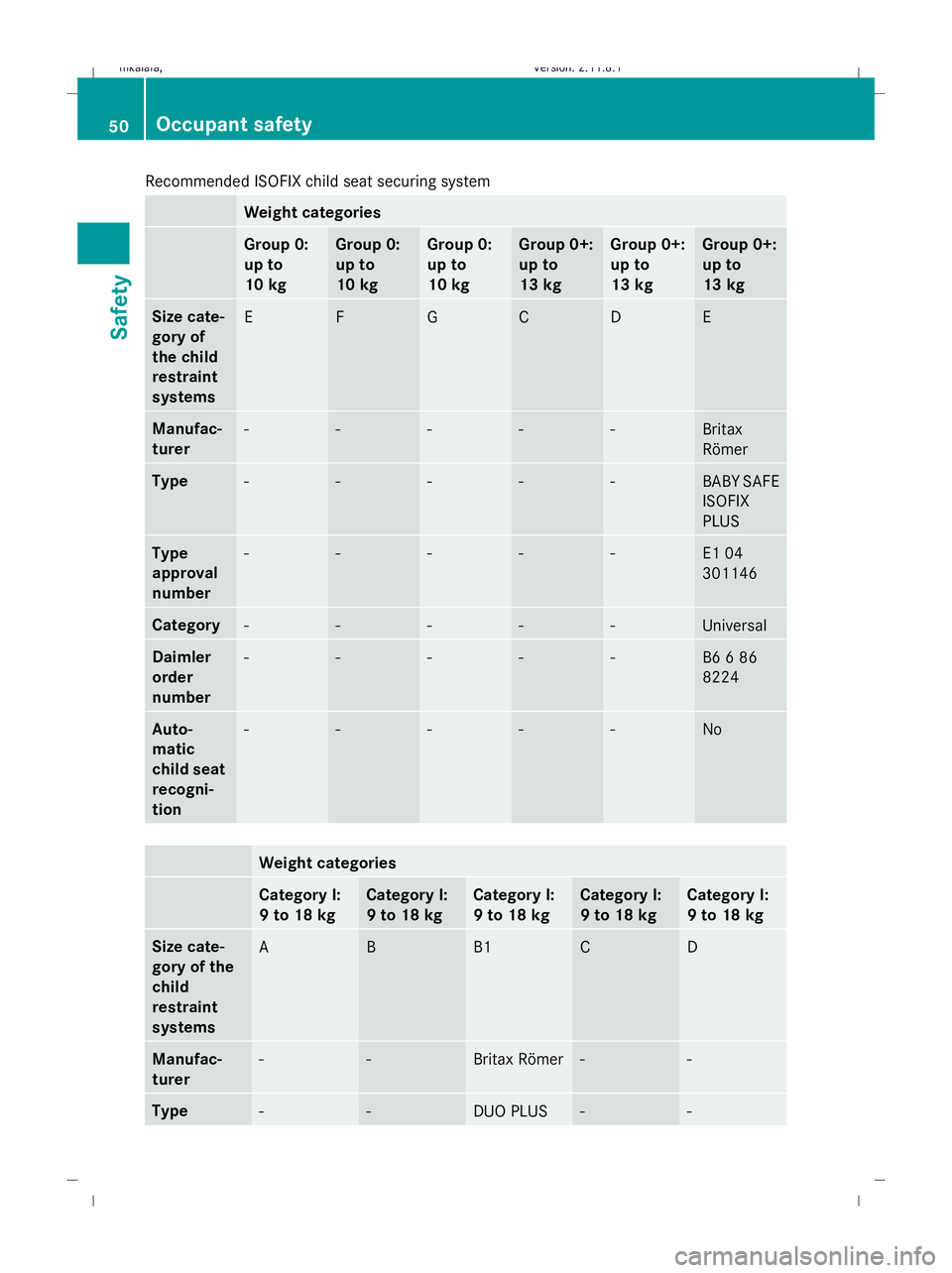
Recommended ISOFIX child seat securing system
Weight categories
Group 0:
up to
10 kg Group 0:
up to
10 kg Group 0:
up to
10 kg Group 0+:
up to
13 kg Group 0+:
up to
13 kg Group 0+:
up to
13 kg
Size cate-
gory of
the child
restraint
systems
E F G C D E
Manufac-
turer
- - - - - Britax
Römer Type
- - - - - BABY SAFE
ISOFIX
PLUS
Type
approval
number
- - - - - E1 04
301146
Category
- - - - - Universal
Daimler
order
number
- - - - - B6 6 86
8224
Auto-
matic
child seat
recogni-
tion
- - - - - No
Weight categories
Category I:
9 to 18 kg Category I:
9 to 18 kg Category I:
9 to 18 kg Category I:
9 to 18 kg Category I:
9 to 18 kg
Size cate-
gory of the
child
restraint
systems
A B B1 C D
Manufac-
turer
- - Britax Römer - -
Type
- - DUO PLUS - -50
Occupant safetySafety
212_AKB; 2; 4, en-GB
mkalafa,
Version: 2.11.8.1 2009-05-05T14:17:16+02:00 - Seite 50
Dateiname: 6515346702_buchblock.pdf; erzeugt am 07. May 2009 14:15:39; WK
Page 54 of 373
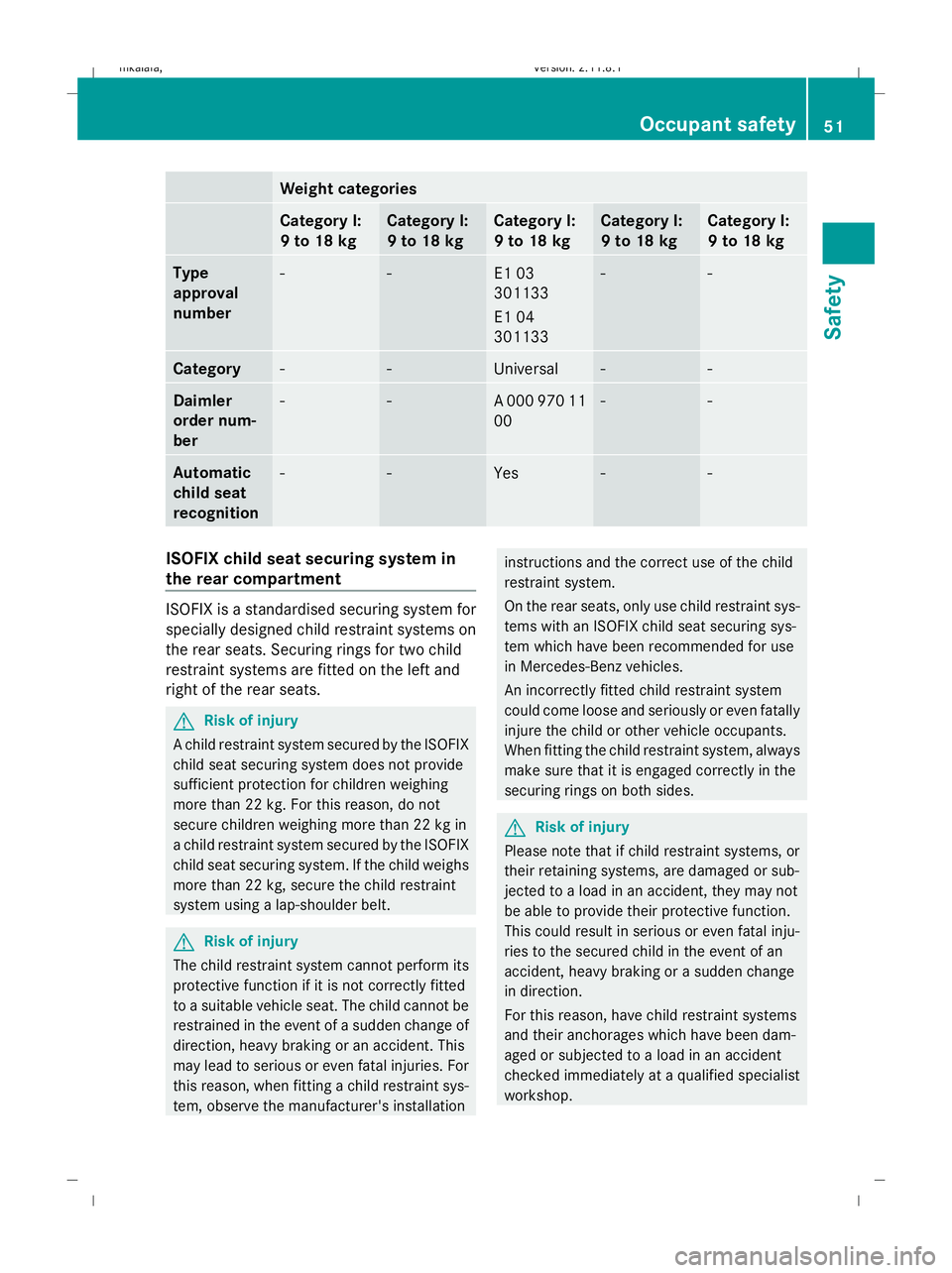
Weight categories
Category I:
9 to 18 kg Category I:
9 to 18 kg Category I:
9 to 18 kg Category I:
9 to 18 kg Category I:
9 to 18 kg
Type
approval
number
- - E1 03
301133
E1 04
301133 - -
Category
- - Universal - -
Daimler
order num-
ber
- - A 000 970 11
00 - -
Automatic
child seat
recognition
- - Yes - -
ISOFIX child seat securing system in
the rear compartment ISOFIX is a standardised securing system for
specially designed child restraint systems on
the rear seats. Securing rings for two child
restraint systems are fitted on the left and
right of the rear seats. G
Risk of injury
A child restraint system secured by the ISOFIX
child seat securing system does not provide
sufficient protection for children weighing
more than 22 kg. For this reason, do not
secure children weighing more than 22 kg in
a child restraint system secured by the ISOFIX
child seat securing system. If the child weighs
more than 22 kg, secure the child restraint
system using a lap-shoulder belt. G
Risk of injury
The child restraint system cannot perform its
protective function if it is not correctly fitted
to a suitable vehicle seat. The child cannot be
restrained in the event of a sudden change of
direction, heavy braking or an accident. This
may lead to serious or even fatal injuries. For
this reason, when fitting a child restraint sys-
tem, observe the manufacturer's installation instructions and the correct use of the child
restraint system.
On the rear seats, only use child restraint sys-
tems with an ISOFIX child seat securing sys-
tem which have been recommended for use
in Mercedes-Benz vehicles.
An incorrectly fitted child restraint system
could come loose and seriously or even fatally
injure the child or other vehicle occupants.
When fitting the child restraint system, always
make sure that it is engaged correctly in the
securing rings on both sides.
G
Risk of injury
Please note that if child restraint systems, or
their retaining systems, are damaged or sub-
jected to a load in an accident, they may not
be able to provide their protective function.
This could result in serious or even fatal inju-
ries to the secured child in the event of an
accident, heavy braking or a sudden change
in direction.
For this reason, have child restraint systems
and their anchorages which have been dam-
aged or subjected to a load in an accident
checked immediately at a qualified specialist
workshop. Occupant safety
51Safety
212_AKB; 2; 4, en-GB
mkalafa, Version: 2.11.8.1 2009-05-05T14:17:16+02:00 - Seite 51 Z
Dateiname: 6515346702_buchblock.pdf; erzeugt am 07. May 2009 14:15:39; WK
Page 56 of 373
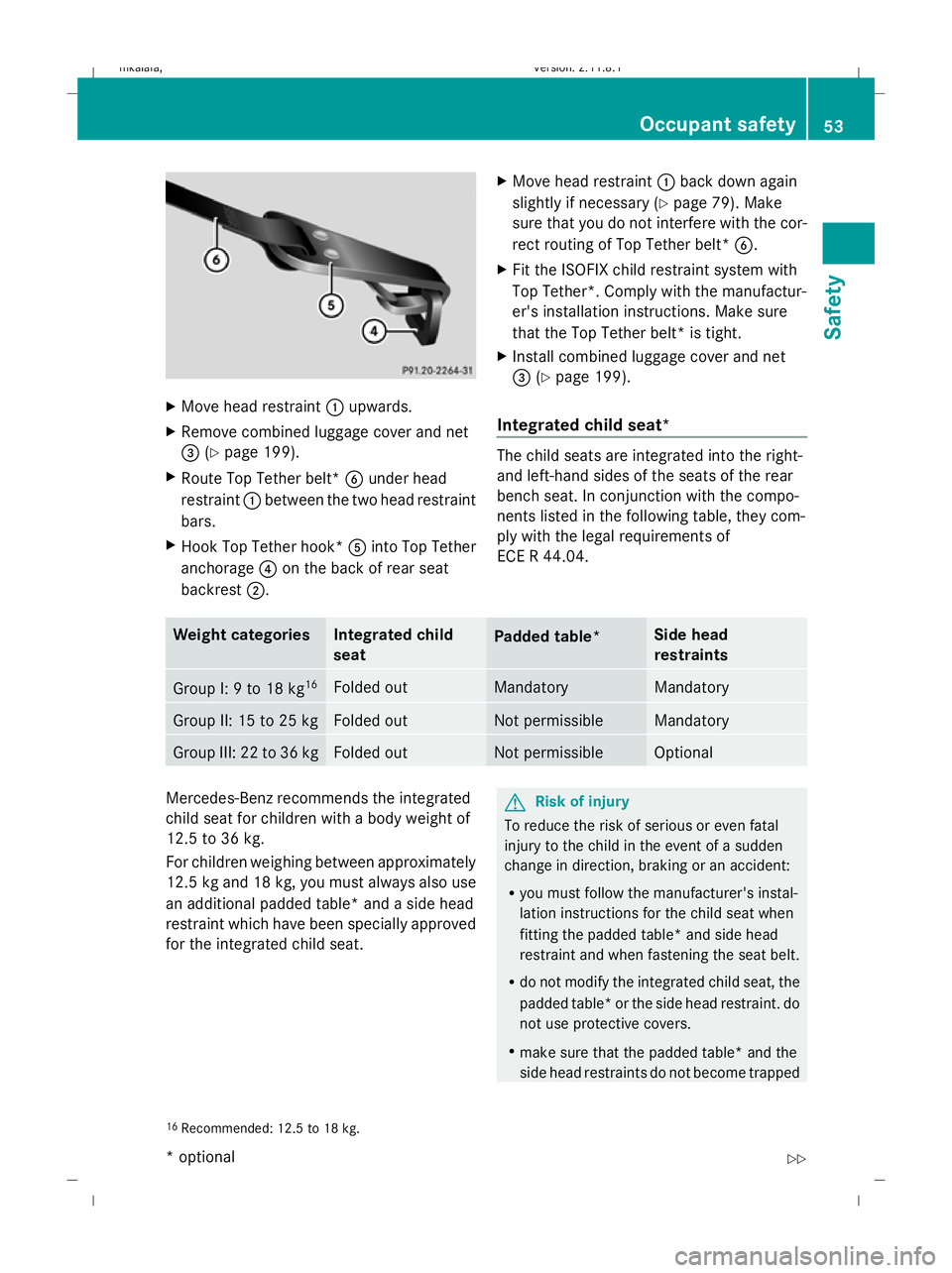
X
Move head restraint :upwards.
X Remove combined luggage cover and net
= (Ypage 199).
X Route Top Tether belt* Bunder head
restraint :between the two head restraint
bars.
X Hook Top Tether hook* Ainto Top Tether
anchorage ?on the back of rear seat
backrest ;. X
Move head restraint :back down again
slightly if necessary (Y page 79). Make
sure that you do not interfere with the cor-
rect routing of Top Tether belt* B.
X Fit the ISOFIX child restraint system with
Top Tether*. Comply with the manufactur-
er's installation instructions. Make sure
that the Top Tether belt* is tight.
X Install combined luggage cover and net
= (Ypage 199).
Integrated child seat* The child seats are integrated into the right-
and left-hand sides of the seats of the rear
bench seat. In conjunction with the compo-
nents listed in the following table, they com-
ply with the legal requirements of
ECE R 44.04.
Weight categories Integrated child
seat
Padded table* Side head
restraints
Group I: 9 to 18 kg
16 Folded out Mandatory Mandatory
Group II: 15 to 25 kg Folded out Not permissible Mandatory
Group III: 22 to 36 kg Folded out Not permissible Optional
Mercedes-Benz recommends the integrated
child seat for children with a body weight of
12.5 to 36 kg.
For children weighing between approximately
12.5 kg and 18 kg, you must always also use
an additional padded table* and a side head
restraint which have been specially approved
for the integrated child seat. G
Risk of injury
To reduce the risk of serious or even fatal
injury to the child in the event of a sudden
change in direction, braking or an accident:
R you must follow the manufacturer's instal-
lation instructions for the child seat when
fitting the padded table* and side head
restraint and when fastening the seat belt.
R do not modify the integrated child seat, the
padded table* or the side head restraint. do
not use protective covers.
R make sure that the padded table* and the
side head restraints do not become trapped
16 Recommended: 12.5 to 18 kg. Occupant safety
53Safety
* optional
212_AKB; 2; 4, en-GB
mkalafa,
Version: 2.11.8.1 2009-05-05T14:17:16+02:00 - Seite 53 Z
Dateiname: 6515346702_buchblock.pdf; erzeugt am 07. May 2009 14:15:40; WK
Page 58 of 373
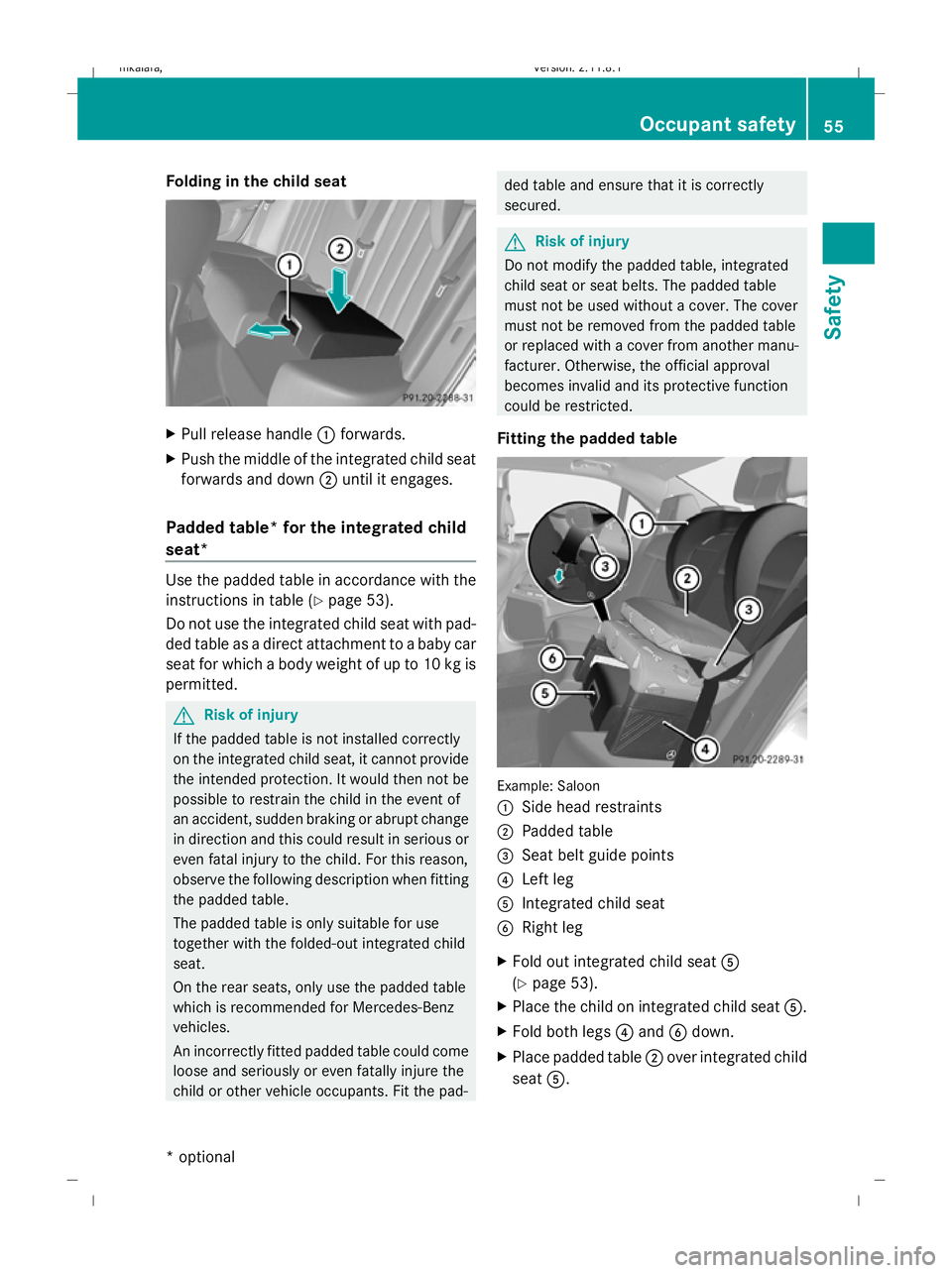
Folding in the child seat
X
Pull release handle :forwards.
X Push the middle of the integrated child seat
forwards and down ;until it engages.
Padded table* for the integrated child
seat* Use the padded table in accordance with the
instructions in table (Y
page 53).
Do not use the integrated child seat with pad-
ded table as a direct attachment to a baby car
seat for which a body weight of up to 10 kg is
permitted. G
Risk of injury
If the padded table is not installed correctly
on the integrated child seat, it cannot provide
the intended protection. It would then not be
possible to restrain the child in the event of
an accident, sudden braking or abrupt change
in direction and this could result in serious or
even fatal injury to the child. For this reason,
observe the following description when fitting
the padded table.
The padded table is only suitable for use
together with the folded-out integrated child
seat.
On the rear seats, only use the padded table
which is recommended for Mercedes-Benz
vehicles.
An incorrectly fitted padded table could come
loose and seriously or even fatally injure the
child or other vehicle occupants. Fit the pad- ded table and ensure that it is correctly
secured.
G
Risk of injury
Do not modify the padded table, integrated
child seat or seat belts. The padded table
must not be used without a cover. The cover
must not be removed from the padded table
or replaced with a cover from another manu-
facturer. Otherwise, the official approval
becomes invalid and its protective function
could be restricted.
Fitting the padded table Example: Saloon
:
Side head restraints
; Padded table
= Seat belt guide points
? Left leg
A Integrated child seat
B Right leg
X Fold out integrated child seat A
(Y page 53).
X Place the child on integrated child seat A.
X Fold both legs ?and Bdown.
X Place padded table ;over integrated child
seat A. Occupant safety
55Safety
* optional
212_AKB; 2; 4, en-GB
mkalafa
,V ersion: 2.11.8.1
2009-05-05T14:17:16+02:00 - Seite 55 Z
Dateiname: 6515346702_buchblock.pdf; erzeugt am 07. May 2009 14:15:41; WK
Page 85 of 373
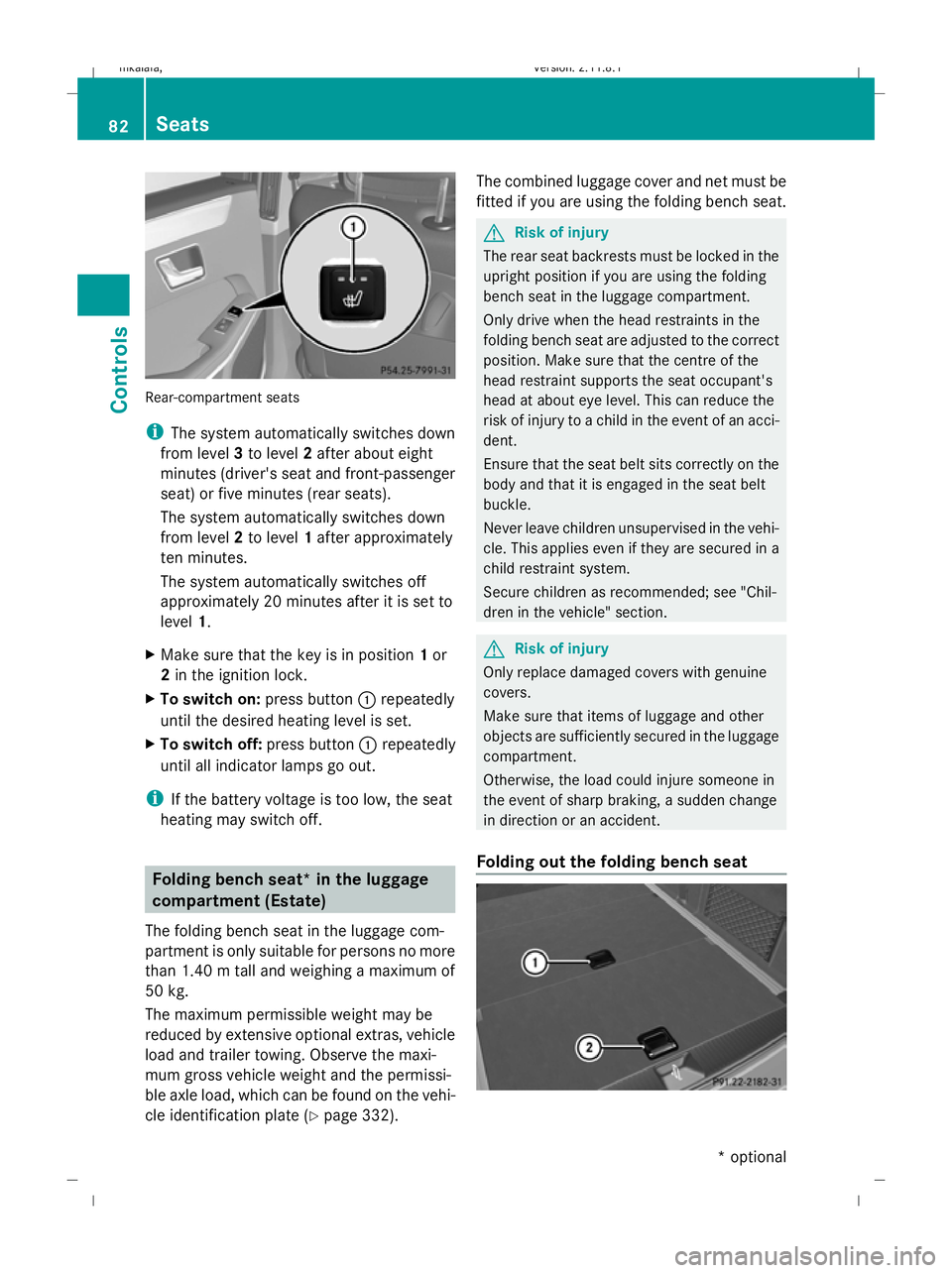
Rear-compartment seats
i
The system automatically switches down
from level 3to level 2after about eight
minutes (driver's seat and front-passenger
seat) or five minutes (rear seats).
The system automatically switches down
from level 2to level 1after approximately
ten minutes.
The system automatically switches off
approximately 20 minutes after it is set to
level 1.
X Make sure that the key is in position 1or
2 in the ignition lock.
X To switch on: press button:repeatedly
until the desired heating level is set.
X To switch off: press button:repeatedly
until all indicator lamps go out.
i If the battery voltage is too low, the seat
heating may switch off. Folding bench seat* in the luggage
compartment (Estate)
The folding bench seat in the luggage com-
partment is only suitable for persons no more
than 1.40 m tall and weighing a maximum of
50 kg.
The maximum permissible weight may be
reduced by extensive optional extras, vehicle
load and trailer towing. Observe the maxi-
mum gross vehicle weight and the permissi-
ble axle load, which can be found on the vehi-
cle identification plate (Y page 332).The combined luggage cover and net must be
fitted if you are using the folding bench seat. G
Risk of injury
The rear seat backrests must be locked in the
upright position if you are using the folding
bench seat in the luggage compartment.
Only drive when the head restraints in the
folding bench seat are adjusted to the correct
position. Make sure that the centre of the
head restraint supports the seat occupant's
head at about eye level. This can reduce the
risk of injury to a child in the event of an acci-
dent.
Ensure that the seat belt sits correctly on the
body and that it is engaged in the seat belt
buckle.
Never leave children unsupervised in the vehi-
cle. This applies even if they are secured in a
child restraint system.
Secure children as recommended; see "Chil-
dren in the vehicle" section. G
Risk of injury
Only replace damaged covers with genuine
covers.
Make sure that items of luggage and other
objects are sufficiently secured in the luggage
compartment.
Otherwise, the load could injure someone in
the event of sharp braking, a sudden change
in direction or an accident.
Folding out the folding bench seat 82
SeatsCont
rols
* optional
212_AKB; 2; 4, en-GB
mkalafa
,V ersion: 2.11.8.1
2009-05-05T14:17:16+02:00 - Seite 82
Dateiname: 6515346702_buchblock.pdf; erzeugt am 07. May 2009 14:15:53; WK