fold seats MERCEDES-BENZ E-CLASS SALOON 2011 Owners Manual
[x] Cancel search | Manufacturer: MERCEDES-BENZ, Model Year: 2011, Model line: E-CLASS SALOON, Model: MERCEDES-BENZ E-CLASS SALOON 2011Pages: 409, PDF Size: 10.47 MB
Page 20 of 409
Rear-view mirror
Anti-dazzle mode (automatic) ........118
Dipping (manual )........................... 116
Rear window blind ............................310
Rear window heating Problem (fault) ............................... 143
Switching on/off ........................... 143
Rear window wiper
Switching on/off ........................... 133
Refuelling
Fuel gauge ....................................... 30
Important safety notes ..................172
Refuelling proces s......................... 173
see Fuel
Releasing the parking loc kman-
ually (automatic transmission) ........172
Remote control Auxiliary heating/ventilation .......... 146
Changing the batteries (auxiliary
heating) ......................................... 148
Garage door opene r....................... 315
Programming (garage door
opener) .......................................... 315
Replacing the battery (auxiliary
heating remote control) .................... 148
Reserve (fuel tank) see Fuel
Reserve fuel
Display message ............................ 264
Warning lamp ................................. 285
Residual heat (climate control) ........145
Restraint system see SRS (Supplemental Restraint
System)
Rev counter ........................................ 230
Reverse gear Engaging (automatic transmis-
sion) ............................................... 165
Engaging (manual transmission) ....164
Reversing camera
Cleaning instructions .....................330
Function/notes ............................. 206
Reversing lamp (display message) ..261
Roller blind see Roller sunblind Roller sunblind
Panorama sliding sunroo f.............. 100
Rea rwindow .................................. 310
Roof carrier ........................................ 306
Roof lining and carpets (cleaning
instructions) ...................................... 333
Roof load (maximum) ........................392
Route (navigation) see Route guidance (navigation)
Route guidance (navigation) ............236 S
Safety Childre ninthe vehicle ..................... 53
Child restraint systems ....................53
Safety net .......................................... .301
Attaching ....................................... 301
Safety systems
see Driving safety systems
Seat
Active multicontour sea t................ 109
Folding the backres t(rear com-
partment) forwards/back ..............297
Seat belt
Adjusting the driver's and front-
passenger sea tbelt ......................... 51
Adjusting the height ......................... 51
Belt force limiter .............................. 53
Belt tensione r.................................. 53
Centre rear-compartment sea t........ 52
Cleaning ......................................... 332
Display message ............................ 257
Fastening ......................................... 51
Important safety guidelines .............49
Rea rseat belt status indicator .........52
Releasing ......................................... 52
Switching belt adjustment on/off
(on-board computer) ......................249
Warning lamp ................................. 280
Warning lamp (function) ................... 52
Seats
Adjusting (electrically). ..................106
Adjusting (manually and electri-
cally) .............................................. 106
Adjusting lumba rsuppor t.............. 110
Adjusting the 4-way lumba rsup-
por t................................................ 110 Index
17
Page 55 of 409
X
Slide the belt sash guide downwards.
X Release belt sash guide release :and
make sure tha tthe belt sash guide has
engaged.
Wearing the rear centre seat belt If the left-hand rear seat backrest is folded
down and back up again, the rear centre seat
belt may lock. The seat belt can then not be
pulled out.
X To release the rear centre seat belt: pull
the seat belt out approximately 20 mm at
the belt outlet on the backrest and then
release it again.
The seat belt is retracted and released.
Releasing seat belts X
Press release button ?(Ypage 51) and
guide belt tongue ;back towards belt
sash guide :.
! Make sure that the seat belt is fully rolled
up. Otherwise, the seat belt or belt tongue
will be trapped in the door or in the seat
mechanism. This could damage the door,
the door trim panel and the seat belt. Dam-
aged seat belts can no longer fulfil their
protective function and must be replaced.
Visit a qualified specialist workshop.
Belt warning for driver and front
passenger The
7 seat belt warning lamp in the instru-
ment cluster is a reminder for all occupants
to fasten their seat belts. It may light up con-
tinuously or flash. In addition, there may be a
warning tone.
The 7 seat belt warning lamp goes out and
the warning tone ceases when the driver and
the front passenger have fastened their seat
belt.
For certain countries only: regardless of
whether the driver and the front passenger
have fastened their seat belts, the 7seat belt warning lamp lights up for six seconds
after the engine is started. It then goes out if
the driver and the front passenger have fas-
tened their seat belts.
i
For more information on the 7seat
belt warning lamp, see "Warning and indi-
cator lamps in the instrumentc luster, seat
belt" (Y page 280).
Rear seat belt status indicator The rear-compartmen
tseat belt status indi-
cator tells you if the rear passengers have
their seat belts fastened.
The rear-compartment seat belt status indi-
cator indicates the rear seat on which the belt
is fastened.
The rear-compartment seat belt status indi-
cator appears in the multifunction display for
around 30 seconds if:
R you drive off and reach a speed of approx-
imately 10 km/h.
R the rear passengers fasten or unfasten
their seat belts while the vehicle is in
motion.
R someone gets in or out of the vehicle and
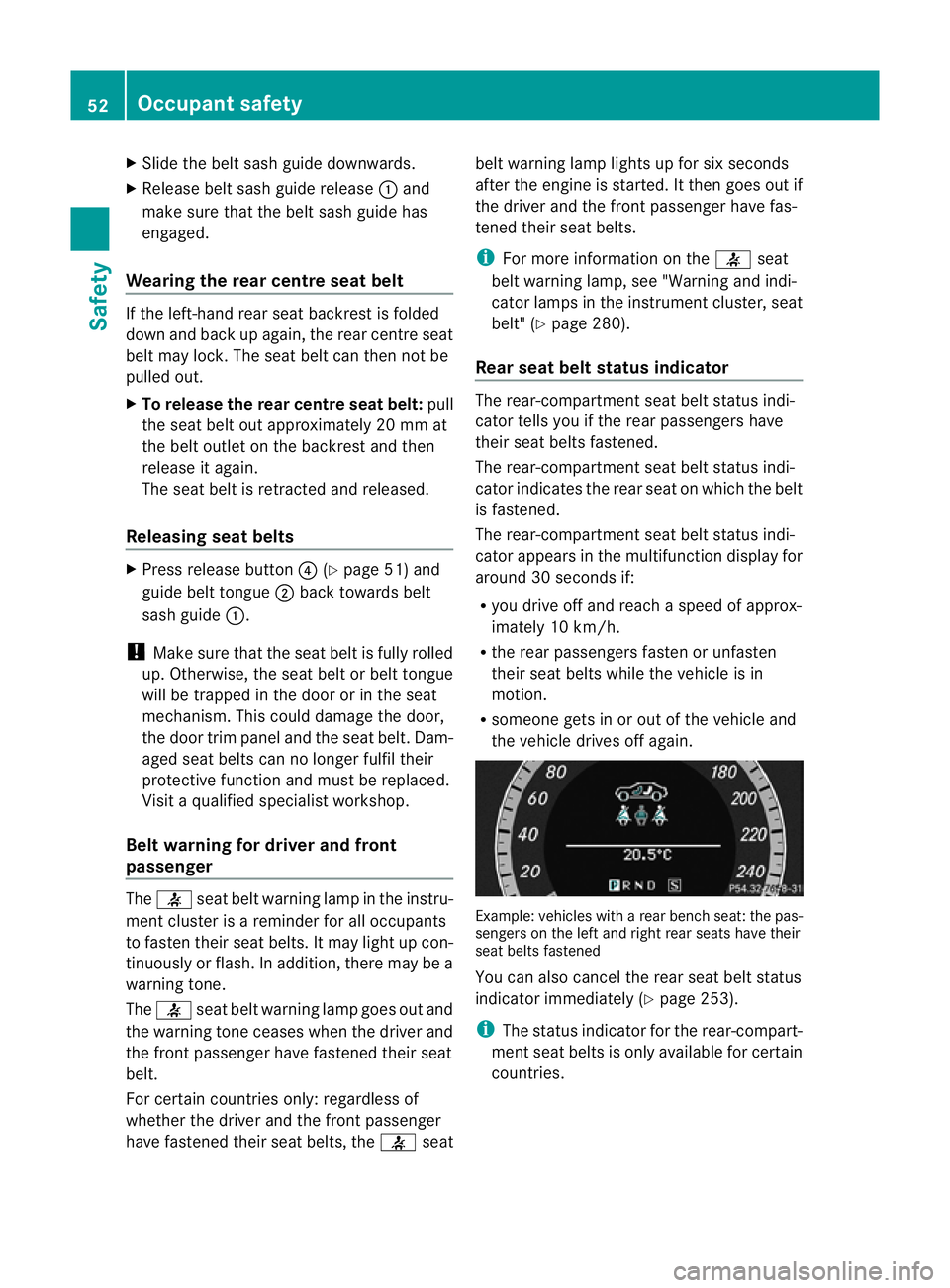
the vehicle drives off again. Example: vehicles with
arear bench seat: the pas-
sengers on the left and right rear seats have their
seat belts fastened
You can also cancel the rear seat belt status
indicato rimmediately (Y page 253).
i The status indicator for the rear-compart-
ment seat belts is only available for certain
countries. 52
Occupant safetySafety
Page 65 of 409
R
is routed as low as possible across the pel-
vic area, in front of the hips
R is tightened across the lap by pulling
upwards on the shoulder section of the seat
belt
R is tigh tand is routed across the centre of
the child's shoulder
R is not twisted and does not pass across the
child's neck or under the child's arm
X Adjust the head restraint if necessary; see
(Y page 108).
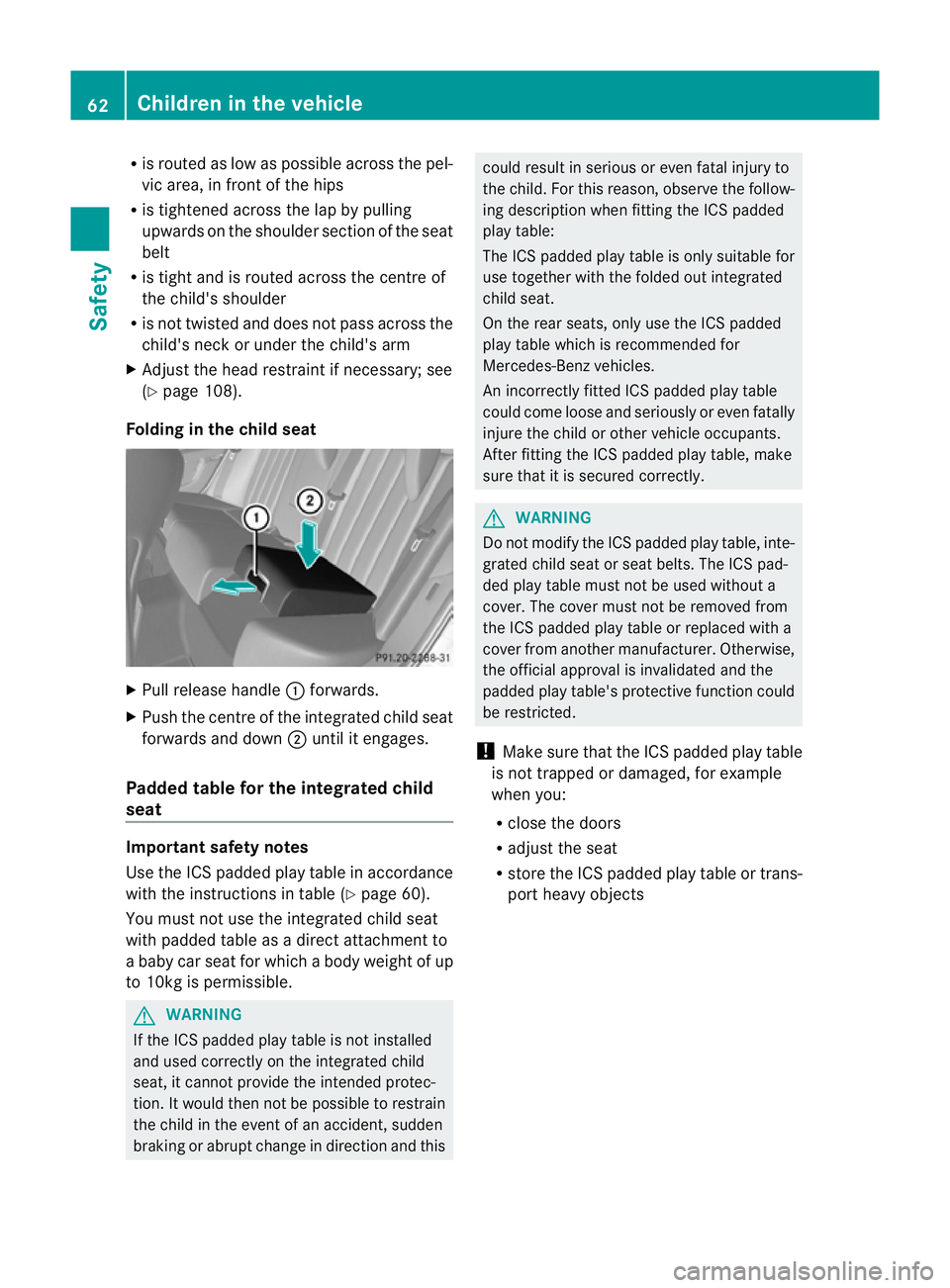
Folding in the chil dseat X
Pull release handle :forwards.
X Push the centre of the integrated child seat
forwards and down ;until it engages.
Padded table for the integrated child
seat Important safety notes
Use the ICS padded play table in accordance
with the instructions in table (Y page 60).
You must not use the integrated child seat
with padded table as a direc tattachment to
a baby car seat for which a body weight of up
to 10kg is permissible. G
WARNING
If the IC Spadded play table is no tinstalled
and used correctly on the integrated child
seat, it canno tprovide the intended protec-
tion. It would then not be possible to restrain
the child in the event of an accident, sudden
braking or abrupt change in directio nand this could resul
tinserious or even fatal injury to
the child. For this reason, observe the follow-
ing description when fitting the ICS padded
play table:
The ICS padded play table is only suitable for
use together with the folded out integrated
child seat.
On the rear seats, only use the ICS padded
play table which is recommended for
Mercedes-Benz vehicles.
An incorrectly fitted ICS padded play table
could come loose and seriously or even fatally
injure the child or other vehicle occupants.
After fitting the ICS padded play table, make
sure that it is secured correctly. G
WARNING
Do not modify the ICS padded play table, inte-
grated child seat or seat belts. The ICS pad-
ded play table must not be used without a
cover. The cover must not be removed from
the ICS padded play table or replaced with a
cover from another manufacturer. Otherwise,
the official approval is invalidated and the
padded play table's protective function could
be restricted.
! Make sure that the ICS padded play table
is not trapped or damaged, for example
when you:
R close the doors
R adjust the seat
R store the ICS padded play table or trans-
port heavy objects 62
Children in the vehicleSafety
Page 109 of 409
rials, e.g. blankets, coats, bags, seat cov-
ers, child seats or booster seats.
! Make sure that there are no objects in the
footwell or behind the seats when moving
the seat back. There is a risk that the seats
and/or the objects could be damaged.
i The head restraints in the front seats are
fitted with the NECK-PRO system
(Y page 49). For this reason, it is not pos-
sible to remove the head restraints from
the front seats.
Vehicles without the through-loading fea-
ture: the head restraints cannot be
removed from the rear compartment seats.
For more information, contact a qualified
specialist workshop.
i Further related subjects:
R Through-loading feature in the rear
bench seat (Saloon)
R EASY-PACK through-loading feature in
the rear bench seat (Estate) Adjusting the seats manually and
electrically :
Seat cushion angle
; Seat height =
Backrest angle
? Seat fore-and-aft adjustment
i Adjust the seat cushion angle so that your
thighs are lightly supported.
Seat fore-and-aft adjustment X
Lift handle ?and slide the seat forwards
or backwards.
X Release lever ?again.
Make sure that you heart he seat engage in
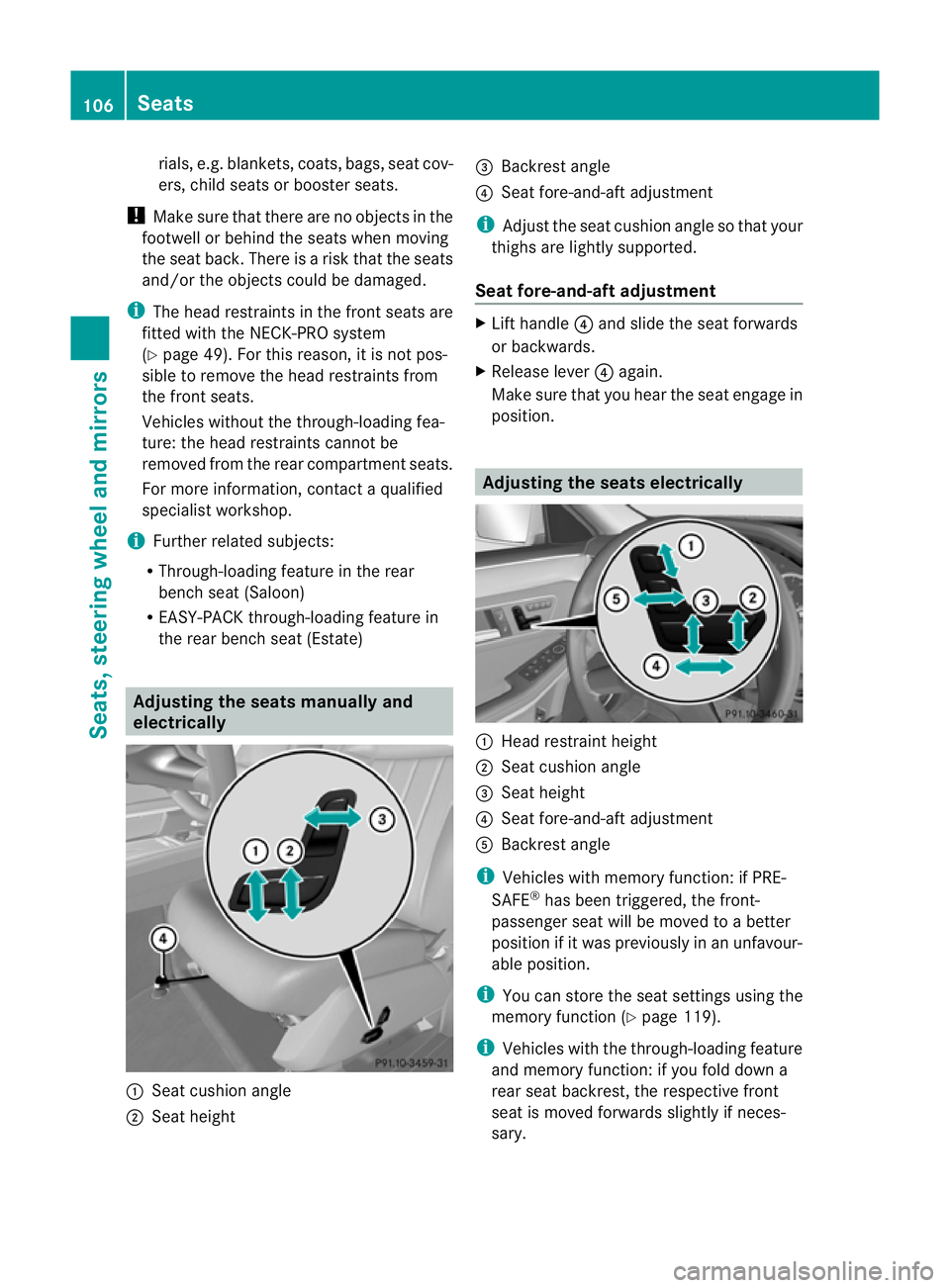
position. Adjusting the seats electrically
:
Head restraint height
; Seat cushion angle
= Seat height
? Seat fore-and-aft adjustment
A Backrest angle
i Vehicles with memory function: if PRE-
SAFE ®
has been triggered, the front-
passenger seat will be moved to a better
position if it was previously in an unfavour-
able position.
i You can store the seat settings using the
memory function (Y page 119).
i Vehicles with the through-loading feature
and memory function: if you fold down a
rear seat backrest, the respective front
seat is moved forwards slightly if neces-
sary. 106
SeatsSeats, steering wheel and mirrors
Page 110 of 409
i
Vehicles with memory function: when the
seat is moved forwards or backwards, the
headresti s moved up or down automati-
cally. Adjusting the head restraints
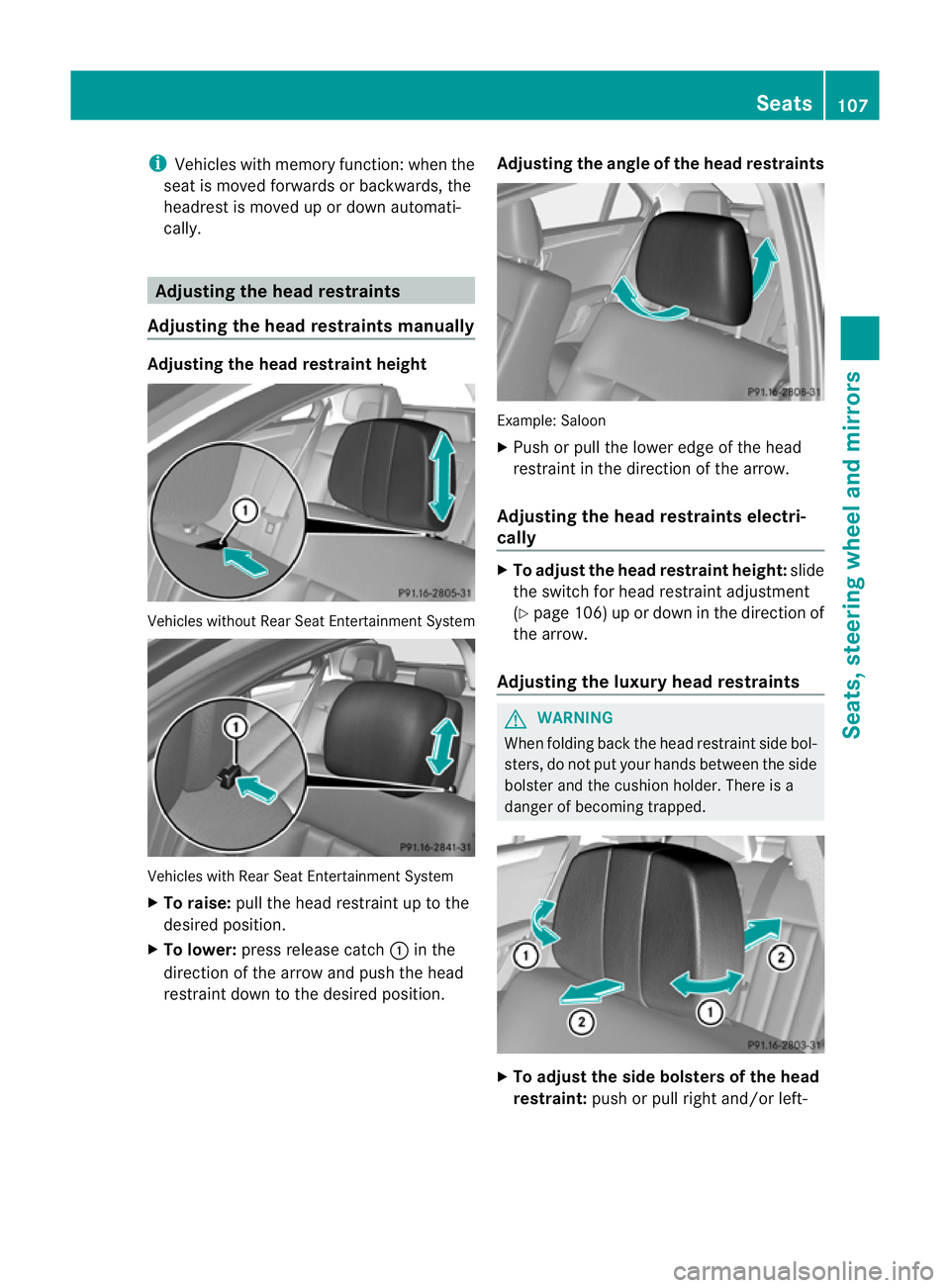
Adjusting the head restraints manually Adjusting the head restraint height
Vehicles without Rear Seat Entertainment System
Vehicles with Rear Seat Entertainment System
X To raise: pull the head restraint up to the
desired position.
X To lower: press release catch :in the
direction of the arrow and push the head
restraint down to the desired position. Adjusting the angle of the head restraints Example: Saloon
X
Push or pull the lower edge of the head
restraint in the direction of the arrow.
Adjusting the head restraints electri-
cally X
To adjust the head restraint height: slide
the switch for head restraint adjustment
(Y page 106) up or down in the direction of
the arrow.
Adjusting the luxury head restraints G
WARNING
When folding back the head restraint side bol-
sters, do not put your hands between the side
bolster and the cushion holder. There is a
danger of becoming trapped. X
To adjust the side bolsters of the head
restraint: push or pull right and/or left- Seats
107Seats, steering wheel and mirrors Z
Page 112 of 409
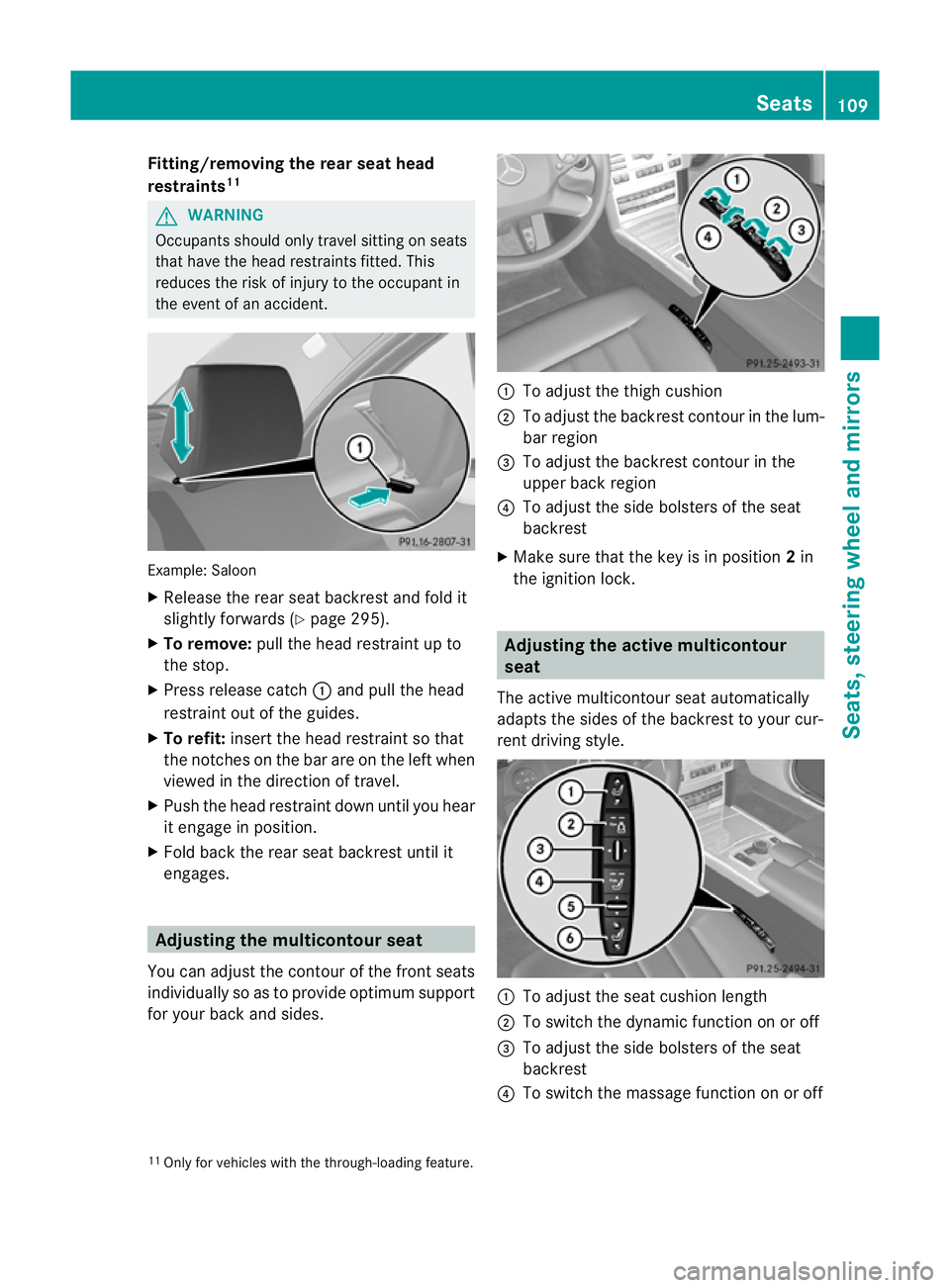
Fitting/removing the rea
rseat head
restraints 11 G
WARNING
Occupants should only travel sitting on seats
that have the head restraints fitted .This
reduces the risk of injury to the occupant in
the event of an accident. Example: Saloon
X
Release the rear seat backrest and fold it
slightly forwards (Y page 295).
X To remove: pull the head restraint up to
the stop.
X Press release catch :and pull the head
restraint out of the guides.
X To refit: insert the head restraint so that
the notches on the bar are on the left when
viewed in the direction of travel.
X Push the head restraint down until you hear
it engage in position.
X Fold back the rear seat backrest until it
engages. Adjusting the multicontour seat
You can adjust the contour of the front seats
individually so as to provide optimum support
for your back and sides. :
To adjust the thigh cushion
; To adjust the backrest contour in the lum-
bar region
= To adjust the backrest contour in the
upper back region
? To adjust the side bolsters of the seat
backrest
X Make sure that the key is in position 2in
the ignition lock. Adjusting the active multicontour
seat
The active multicontour seat automatically
adapts the sides of the backrest to your cur-
rent driving style. :
To adjust the seat cushion length
; To switch the dynamic function on or off
= To adjust the side bolsters of the seat
backrest
? To switch the massage function on or off
11 Only for vehicles with the through-loading feature. Seats
109Seats, steering wheel and mirrors Z
Page 114 of 409
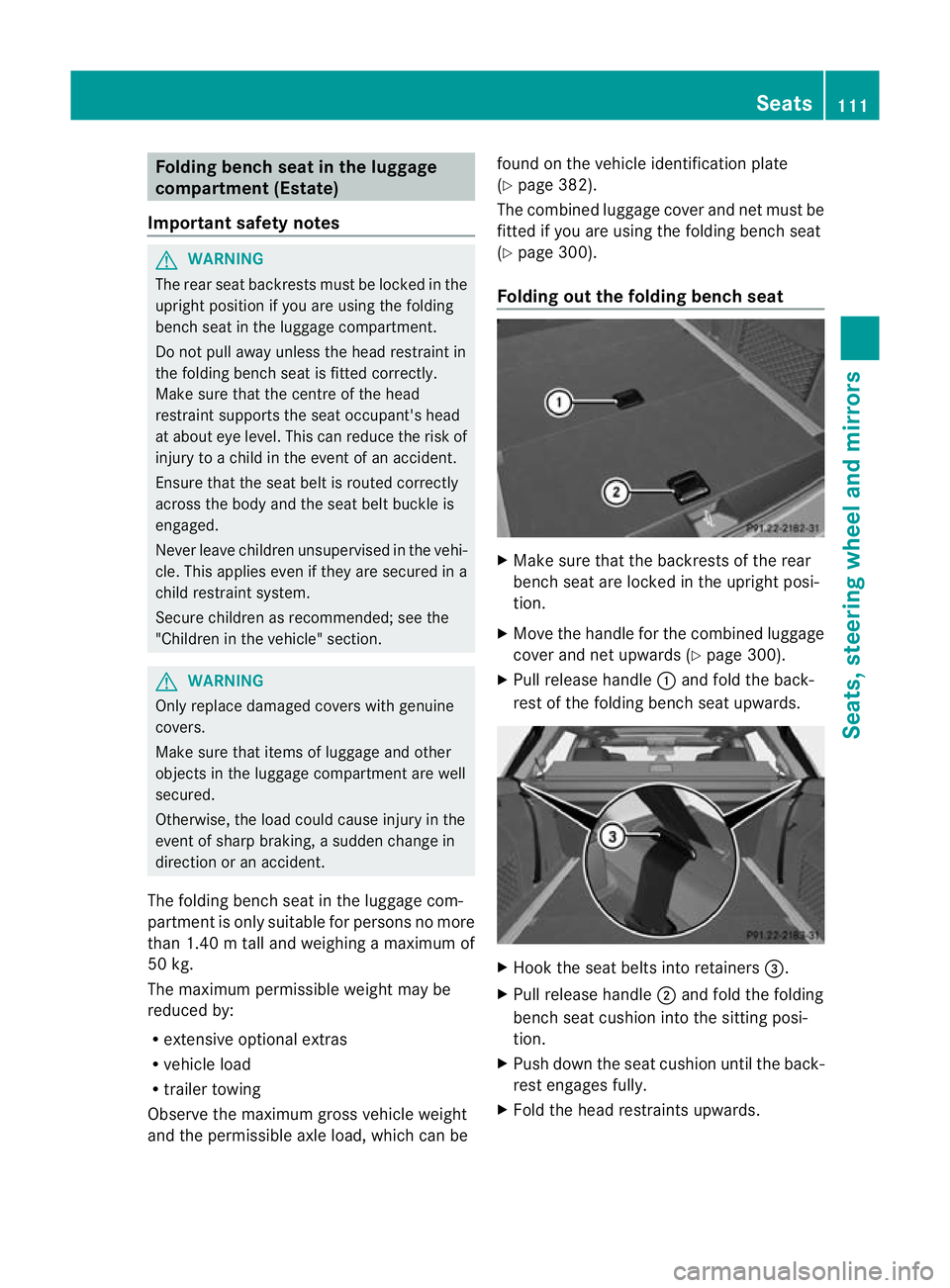
Folding bench seat in the luggage
compartment (Estate)
Important safety notes G
WARNING
The rear seat backrests must be locked in the
upright position if you are using the folding
bench seat in the luggage compartment.
Do no tpull away unless th ehead restraint in
the folding bench seat is fitted correctly.
Make sure that the centre of the head
restraint supports the seat occupant's head
at about eye level. This can reduce the risk of
injury to a child in the event of an accident.
Ensure that the seat belt is routed correctly
across the body and the seat belt buckle is
engaged.
Never leave children unsupervised in the vehi-
cle. This applies even if they are secured in a
child restraint system.
Secure children as recommended; see the
"Children in the vehicle" section. G
WARNING
Only replace damaged covers with genuine
covers.
Make sure that items of luggage and other
objects in the luggage compartment are well
secured.
Otherwise, the load could cause injury in the
event of sharp braking, a sudden change in
direction or an accident.
The folding bench seat in the luggage com-
partmen tis only suitable for persons no more
than 1.40 m tall and weighing a maximum of
50 kg.
The maximum permissible weight may be
reduced by:
R extensive optional extras
R vehicle load
R trailer towing
Observe the maximum gross vehicle weight
and the permissible axle load, which can be found on the vehicle identification plate
(Y
page 382).
The combined luggage cover and net must be
fitted if you are using the folding bench seat
(Y page 300).
Folding out the folding benchs eat X
Make sure that the backrests of the rear
bench seat are locked in the uprigh tposi-
tion.
X Move the handle for the combined luggage
cover and net upwards (Y page 300).
X Pull release handle :and fold the back-
rest of the folding bench seat upwards. X
Hook the seat belts into retainers =.
X Pull release handle ;and fold the folding
bench seat cushion into the sitting posi-
tion.
X Push down the seat cushion until the back-
rest engages fully.
X Fold the head restraints upwards. Seats
111Seats, steering wheel and mirrors Z
Page 115 of 409
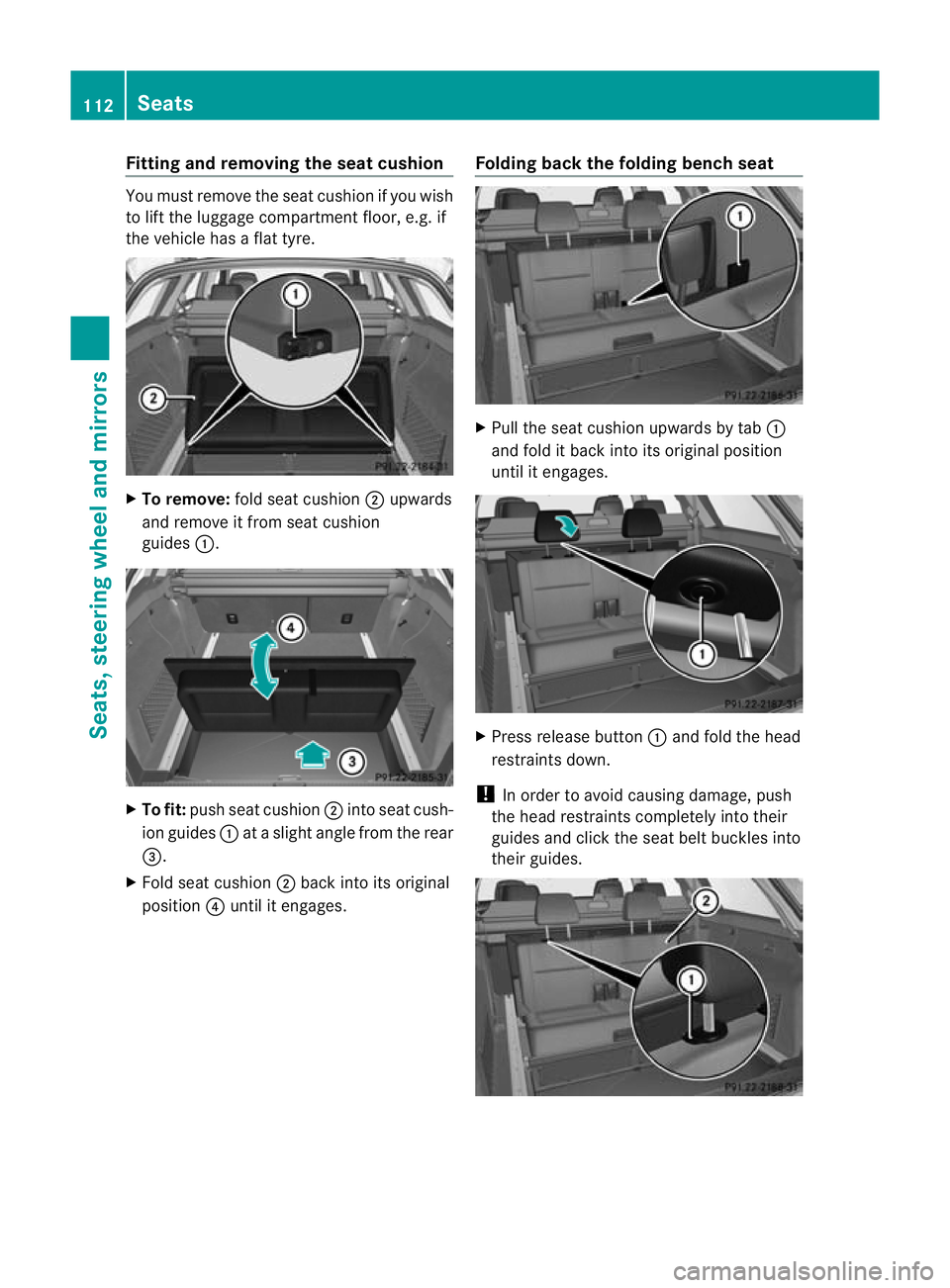
Fitting and removing the seat cushion
You must remove the seat cushion if you wish
to lift the luggage compartmen tfloor, e.g. if
the vehicle has a flat tyre. X
To remove: fold seat cushion ;upwards
and remove it fro mseat cushion
guides :. X
To fit: push seat cushion ;into seat cush-
ion guides :at a slight angle from the rear
=.
X Fold seat cushion ;back into its original
position ?until it engages. Folding back the folding bench seat X
Pull the seat cushion upwards by tab :
and fold it back into its original position
until it engages. X
Press release button :and fold the head
restraints down.
! In order to avoid causing damage, push
the head restraints completely into their
guides and click the seat belt buckles into
their guides. 112
SeatsSeats, steering wheel and mirrors
Page 116 of 409
X
Press release catch :and push the head
restraints in fully.
X Fold backrest ;of the folding bench seat
into its original position until it engages. Switching the seat heating on/off
Switching on/off G
WARNING
Repeatedly setting the seat heating to level
3 may result in excessive seat temperatures.
The health of passengers that have limited
temperature sensitivity or a limited ability to
react to excessively high temperatures may
be affected or they may even suffer burn-like
injuries. Therefore, do not use seat heating
level 3repeatedly.
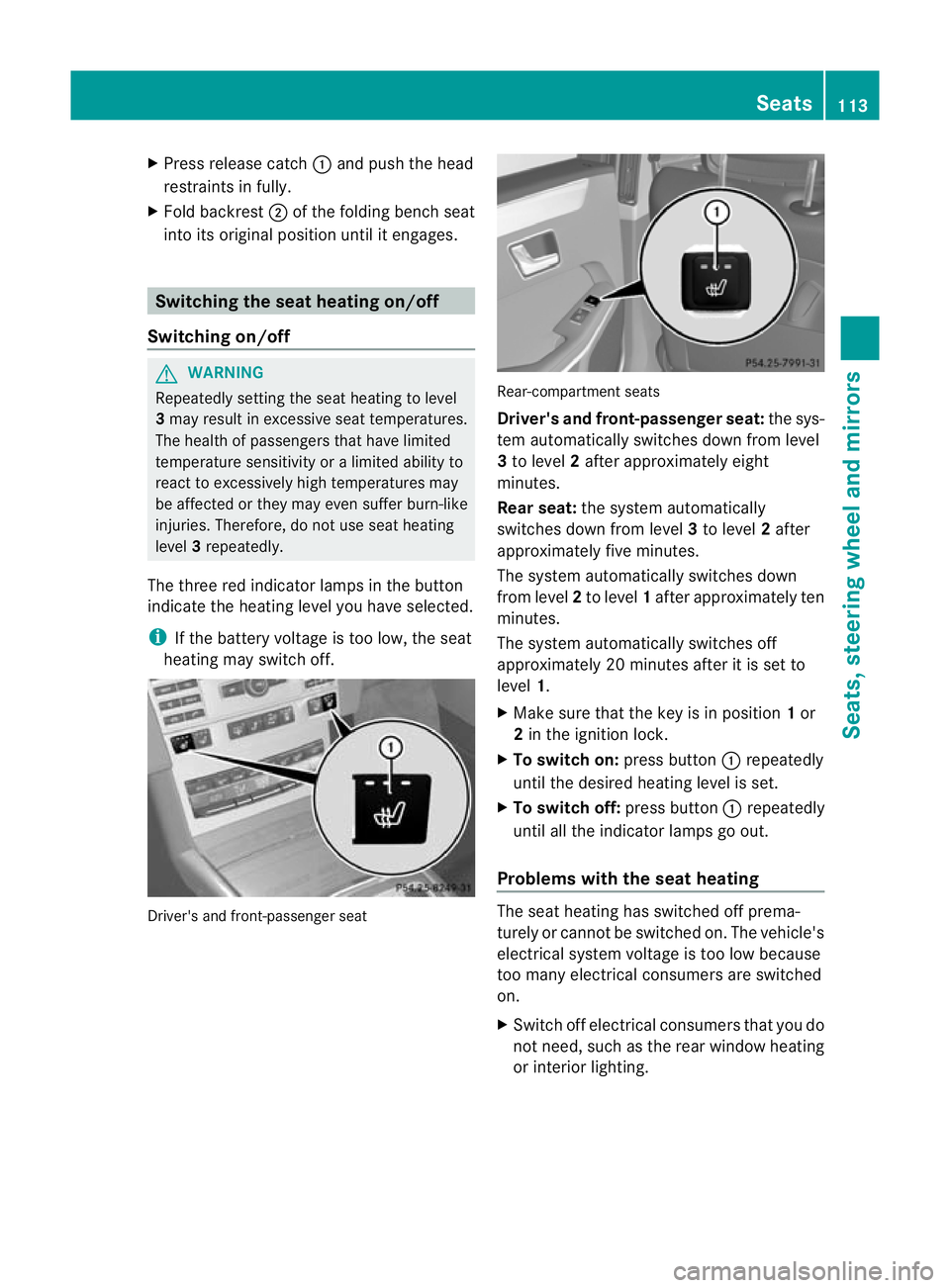
The three red indicator lamps in the button
indicate the heating level you have selected.
i If the battery voltage is too low, the seat
heating may switch off. Driver's and front-passenger seat Rear-compartment seats
Driver's and front-passenger seat:
the sys-
tem automatically switches down from level
3 to level 2after approximately eight
minutes.
Rear seat: the system automatically
switches down from level 3to level 2after
approximately five minutes.
The system automatically switches down
from level 2to level 1after approximately ten
minutes.
The system automatically switches off
approximately 20 minutes after it is set to
level 1.
X Make sure that the key is in position 1or
2 in the ignition lock.
X To switch on: press button:repeatedly
until the desired heating level is set.
X To switch off: press button:repeatedly
until all the indicator lamps go out.
Problems with the seat heating The seat heating has switched off prema-
turely or cannot be switched on. The vehicle's
electrical system voltage is too low because
too many electrical consumers are switched
on.
X
Switch off electrical consumers that you do
not need, such as the rear window heating
or interior lighting. Seats
113Seats, steering wheel and mirrors Z
Page 120 of 409
Exterior mirrors
Adjusting the exterior mirrors G
WARNING
The exterior mirrors reduce the size of the
image .Objects are actually closer than they
appear. You could misjudge the distance from
vehicles driving behind and cause an acci-
dent, e.g. when changing lane. For this rea-
son, make sure of the actual distance from the
vehicle driving behind by glancing over your
shoulder.
The convex exterior mirrors provide a larger
field of vision.
The exterior mirrors are automatically heated
if the rear window heating is switched on and
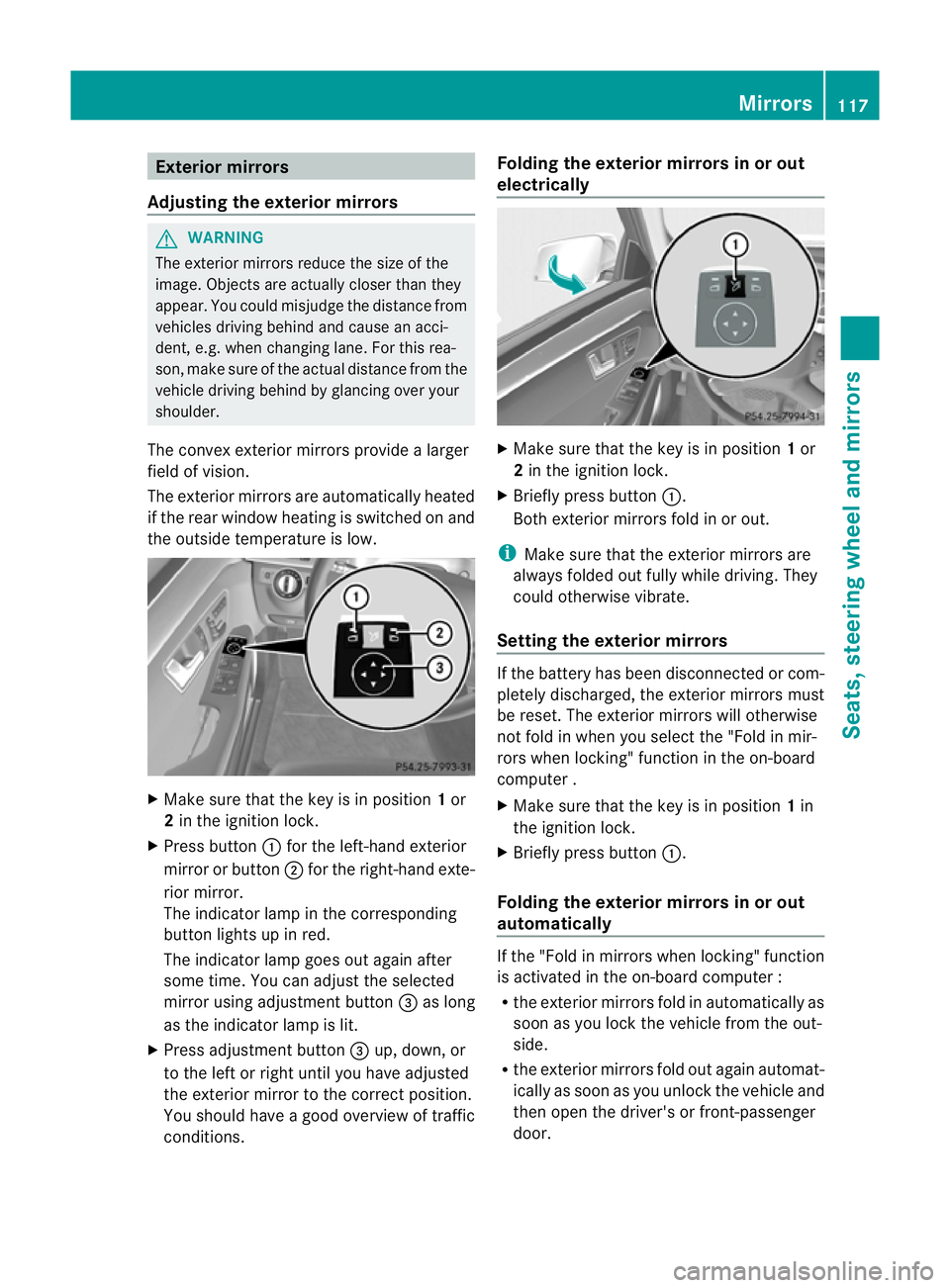
the outside temperature is low. X
Make sure that the key is in position 1or
2 in the ignition lock.
X Press button :for the left-hand exterior
mirror or button ;for the right-hand exte-
rior mirror.
The indicator lamp in the corresponding
butto nlights up in red.
The indicator lamp goes out again after
some time. You can adjust the selected
mirror using adjustment button =as long
as the indicator lamp is lit.
X Press adjustmen tbutton =up, down, or
to the left or right until you have adjusted
the exterior mirror to the correct position.
You should have a good overview of traffic
conditions. Folding the exterior mirrors in or out
electrically
X
Make sure that the key is in position 1or
2 in the ignition lock.
X Briefly press button :.
Both exterior mirrors fold in or out.
i Make sure that the exterior mirrors are
always folded out fully while driving .They
could otherwise vibrate.
Setting the exterior mirrors If the battery has been disconnected or com-
pletely discharged, the exterior mirrors must
be reset. The exterior mirrors will otherwise
not fold in when you select the "Fold in mir-
rors when locking" function in the on-board
computer .
X
Make sure that the key is in position 1in
the ignition lock.
X Briefly press button :.
Folding the exterior mirrors in or out
automatically If the "Fold in mirrors when locking" function
is activated in the on-board computer :
R
the exterior mirrors fold in automatically as
soon as you lock the vehicle from the out-
side.
R the exterior mirrors fold out again automat-
ically as soon as you unlock the vehicle and
then open the driver's or front-passenger
door. Mirrors
117Seats, steering wheel and mirrors Z