ESP MERCEDES-BENZ E-CLASS SALOON 2015 Owners Manual
[x] Cancel search | Manufacturer: MERCEDES-BENZ, Model Year: 2015, Model line: E-CLASS SALOON, Model: MERCEDES-BENZ E-CLASS SALOON 2015Pages: 497, PDF Size: 16.23 MB
Page 373 of 497
to synchronise the rolling code
(Y
page 370).
X Releas ebutton Bof remote control Aof
the garage door drive.
If indicator lamp :lights up red :repea tthe
programming proces sfor the correspond-
ing button on the rear-view mirror. When
doing so ,varyt he distance between remote
control Aand the rear-view mirror.
Th er equired distance between remote
control Aand the integrated garage door
opene rdepen ds on the garage door drive
system. Severa lattempts ma yberequired.
Yo us houl dteste very positio nfor at least
25 second sbefore trying another position.
Synchronising the rolling code
Observe the "Important safety notes"
(Y page 369).
If the garage door system uses arolling code,
you will also have to synchronise the garage
door system with the integrated garage door
opener in the rear-view mirror .Todothis you
will need to use the programming button on
the door drive control panel. The program-
ming button may be placed at differen tloca-
tion sdepending on the manufacturer. It is
usually located on the door drive unit on the
garage ceiling.
Familiarise yourself with the garage door
drive operatin ginstructions, e.g. under "Pro-
grammin gofadditional remot econtrols",
before carrying out the following steps.
Your vehicle must be within range of the
garage door or gate opener drive. Make sure
that neither your vehicle nor any persons/
objects are present within the sweep of the
door or gate.
X Turn the key to position 2in the ignition
lock (Y page 179).
X Get out of the vehicle.
X Press the programming button on the door
drive unit.
Usually, you now have 30 seconds to ini-
tiate the nexts tep. X
Get intot he vehicle.
X Press previously programmed button ;,
= or? of the integrated garage door
opener until the door closes.
The rolling code synchronisation is then
complete.
Problems when programming
If you have problems when programming the
integrated garage door opener, please note
the following: R Check the transmitter frequenc yused by
garage door drive remot econtrol Aand
whether it is supported. The transmitter
frequenc ycan usually be found on the back
of the garage door drive remot econtrol.
R Replace the batteries in garage door
remot econtrol A.This increases the like-
lihood that garage door remot econtrol A
will transmit astrong and precise signal to
the integrated garage door opener in the
rear-view mirror.
R When programming, hold remot econtrol
A at varying distances and angles from the
button which you are programming. Try var- ious angles at adistanc ebetween 5and
30 cm or at the same angle but at varying
distances.
R If ther eisanother remot econtrol for the
same garage door drive, perform the pro-
grammin gsteps again using this remote
control. Befor eperforming these steps,
make sure that new batteries have been
fitted in garage door drive remot econtrol
A.
R Note that some remot econtrols transmit
only for alimited period (the indicator lamp
on the remot econtrol goes out). Press but-
ton Bon remot econtrol Aagain before
transmission ends.
R Align the aerial cable of the garage door
opener unit. This can improve signal recep-
tion/transmission. 370
FeaturesStowing and features
Page 382 of 497
i
The active bonnet is only available in cer-
tain countries. It is available for all models,
except for AMG vehicles.
The active bonnet can reduce the risk of injury to pedestrians in certain accident situations.
Raising the active bonnet increases the clear-
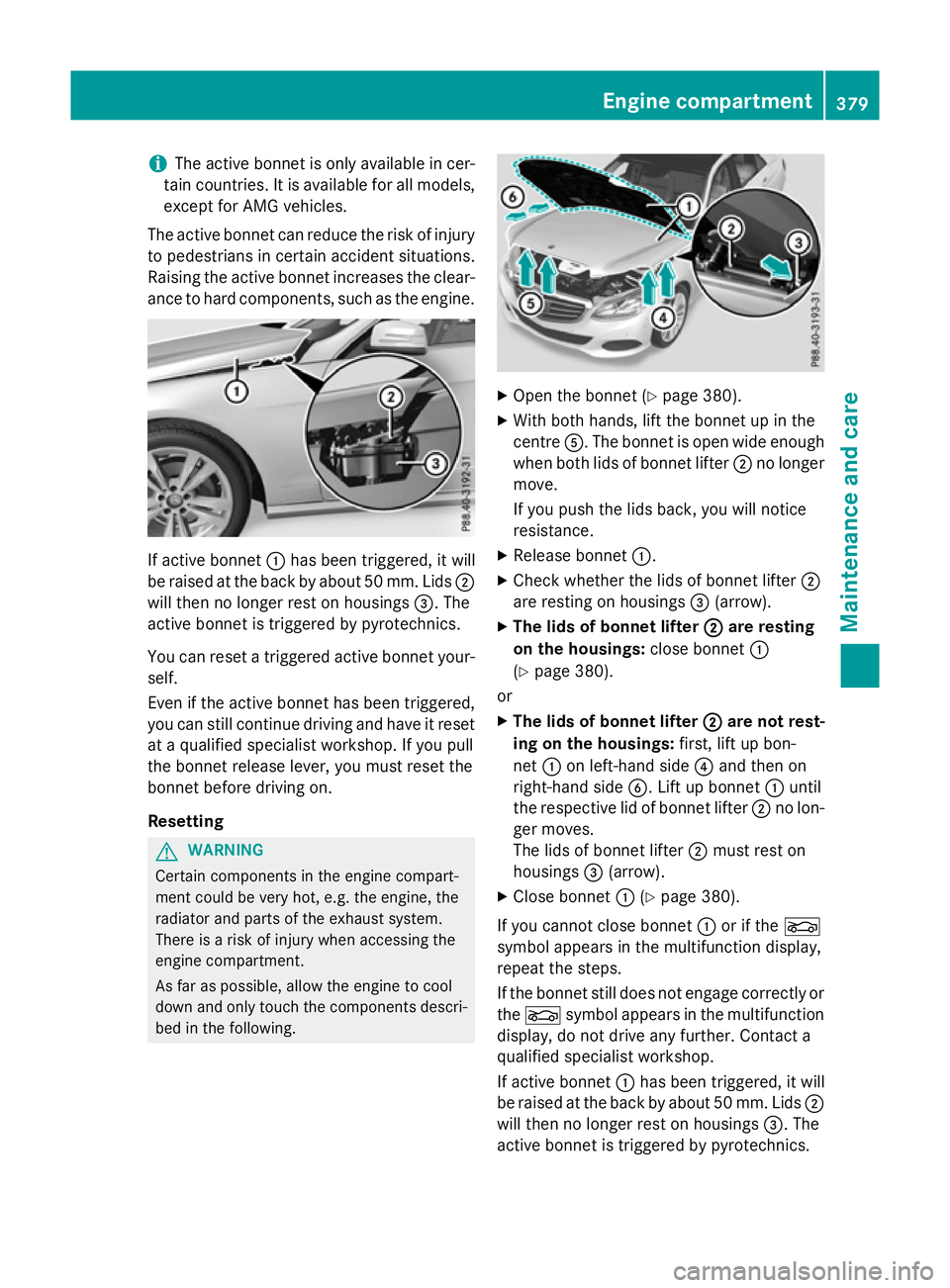
ance to hard components, such as the engine. If active bonnet
:has been triggered, it will
be raised at the back by about 50 mm. Lids ;
will then no longer rest on housings =.The
active bonnet is triggered by pyrotechnics.
You can reset atriggered active bonnet your-
self.
Even if the active bonnet has been triggered,
you can still continue driving and have it reset
at aq ualified specialist workshop. If you pull
the bonnet release lever, you must reset the
bonnet before driving on.
Resetting G
WARNING
Certain components in the engine compart-
ment could be very hot, e.g. the engine, the
radiator and parts of the exhaust system.
There is arisk of injury when accessing the
engine compartment.
As far as possible, allow the engine to cool
down and only touch the components descri- bed in the following. X
Open the bonnet (Y page 380).
X With both hands, lift the bonnet up in the
centre A.The bonnet is open wide enough
when both lids of bonnet lifter ;no longer
move.
If you push the lids back, you will notice
resistance.
X Release bonnet :.
X Check whether the lids of bonnet lifter ;
are restin gonhousings =(arrow).
X The lids of bonnet lifter ; ;are resting
on the housings: close bonnet:
(Y page 380).
or
X The lids of bonnet lifter ;
;are not rest-
ing on the housings: first, lift up bon-
net :on left-hand side ?and then on
right-hand side B.Lift up bonnet :until
the respective lid of bonnet lifter ;no lon-
ger moves.
The lids of bonnet lifter ;must rest on
housings =(arrow).
X Close bonnet :(Ypage 380).
If you cannot close bonnet :or if the L
symbol appears in the multifunction display,
repeat the steps.
If the bonnet still does not engage correctly or
the L symbol appears in the multifunction
display ,donot drive any further .Contact a
qualified specialist workshop.
If active bonnet :has been triggered, it will
be raised at the back by about 50 mm. Lids ;
will then no longer rest on housings =.The
active bonnet is triggered by pyrotechnics. Engine compartment
379Maintenance and care Z
Page 388 of 497

Special service requirements
The prescribed service interval is based on
normal operation of the vehicle. Service work
will need to be performed more often if the
vehicle is operated under arduousc onditions
or increased loads, for example:
R regular city driving with frequent intermedi-
ate stops
R if the vehicle is primarily used to travel
short distances
R for frequent operation in mountainous ter-
rain or on poor road surfaces
R if the engine is often left idling for long peri-
ods
In these or similar operating conditions, have,
for example, the air filter, engine oil and oil
filter changed more frequently. The tyres
must be checked more frequently if the vehi-
cle is operated under increased loads. Fur-
ther information can be obtained at aquali-
fied specialist workshop, e.g. aMercedes-
Benz Service Centre.
Driving abroad
An extensive Mercedes-Benz Service network is also available in other countries. You can
obtain further information from any
Mercedes-Benz Service Centre. AdBlue
®
service indicator
i For BlueTEC vehicles only.
To function properly, BlueTEC exhaust gas
aftertreatment must be operated with the
reducing agent AdBlue ®
.A dBlue ®
is topped
up as part of the service. Under normal oper-
ating conditions, afull tank of AdBlue ®
should
last until the next service due date.
Depending on how and where the vehicle is
used, there may be an increase in the
AdBlue ®
consumption, resulting in the next
service due date being brought forward.
Certain display messages show that AdBlue ®
must be topped up, e.g.: Refill AdBlue at workshop See Own‐ Refill AdBlue at workshop See Own‐
er's Manual er's Manual
Refill AdBlue at workshop No start Refill AdBlue at workshop No start
in .. km in .. km
Aw
arning signal also sounds.
You can no longer start the vehicle when the
AdBlue ®
supply has been used up
(Y page 314).
! Have the AdBlue ®
tank topped up at a
qualified specialist workshop only. The
vehicle may otherwise be damaged or
soiled.
Before driving your vehicle outside Europe,
have the AdBlue ®
supply checked at aquali-
fied specialist workshop. If necessary, have
AdBlue ®
topped up. Before aprolonged stay
outside of Europe, consult aqualified special-
ist workshop.
Observe the notes on AdBlue ®
(Y page 477).
Further information about BlueTEC exhaust
gas aftertreatment and AdBlue ®
can be
obtained at aqualified specialist workshop,
e.g. aMercedes-Benz Service Centre. Care
General notes
H
Environmental note
Dispose of empty packaging and cleaning
cloths in an environmentally responsible man- ner.
! For cleaning your vehicle, do not use any
of the following:
R dry, rough or hard cloths
R abrasive cleaning agents
R solvents
R cleaning agents containing solvents
Do not scrub.
Do not touch the surfaces or protective
films with hard objects, e.g. aring or ice
scraper. You could otherwise scratchor
damage the surfaces and protective film. Care
385Maintenance and care Z
Page 393 of 497
X
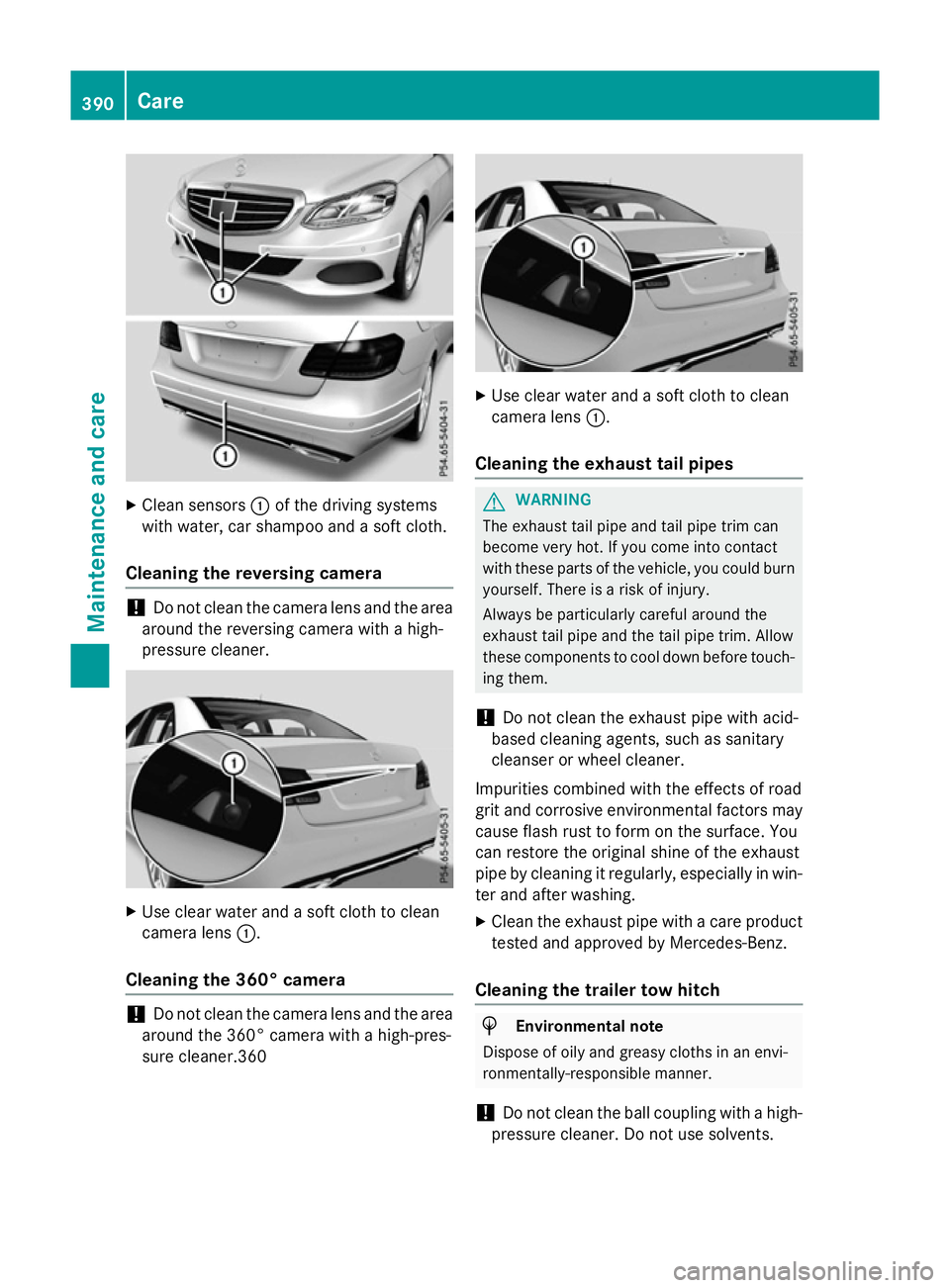
Clean sensors :of th edriving systems
wit hw ater, car shampoo and asoftc loth.
Cleaning th ereversing camera !
Do no
tclean th ecamera len sand th earea
aroun dthe reversing camera wit hahigh-
pressur ecleaner. X
Use clear wate rand asoftc loth to clean
camera lens :.
Cleaning th e360° camera !
Do no
tclean th ecamera len sand th earea
aroun dthe 360° camera wit hahigh-pres-
sure cleaner.360 X
Use clear wate rand asoftc loth to clean
camera lens :.
Cleaning th eexhaust tail pipes G
WARNING
The exhaust tai lpipe and tai lpipe trim can
become ver yhot.Ify ou come int ocontact
wit hthese part softhevehicle, you could burn
yourself. Ther eisariskofi njury.
Always be particularly careful aroun dthe
exhaust tai lpipe and th etailp ipe trim. Allow
these component stocooldown before touch-
ing them.
! Do no
tclean th eexhaust pipe wit hacid-
based cleanin gagents ,suc hass anitary
cleanser or wheel cleaner.
Impurities combined wit hthe effect sofroad
gri tand corrosiv eenvironmental factors may
caus eflas hrust to for monthesurface .You
can restore th eoriginal shin eoftheexhaust
pipe by cleanin gitregularly, especially in win-
te ra nd after washing.
X Clean th eexhaust pipe wit hacarep roduct
tested and approve dbyMercedes-Benz.
Cleaning th etraile rtow hitch H
Environmental note
Dispose of oily and greasy cloth sinanenvi-
ronmentally-responsible manner.
! Do no
tclean th eball couplin gwithah igh-
pressur ecleaner. Do no tuse solvents. 390
CareMaintenance and care
Page 401 of 497
MOExtended tyres (tyres with run-flat
characteristics)
General notes With MOExtended tyres (tyre
swith run-flat
characteristics), you can continue to drive
yourv ehicleeven if there is atotal loss of
pressure in one or more tyres. The affected
tyre must not show any clearly visible dam-
age.
You can recognise MOExtended tyres by the
MOExtended marking which appears on the
tyre wall. You willf ind this marking next to the
tyre size designation, the load-bearing capa-
city and the spee dindex.
MOExtended tyres may only be usedinc on-
junction with an activated tyre pressure loss
warning system or tyre pressure monitor.
If ap ressure lossw arningmessage
appears in the multifunction display:
R observe the instructions in the display mes-
sage s(Ypage3 22)
R check the tyre for damage
R if driving on, observe the following notes
The driving distance possible in run-fla tmode
is approximately 80 km when the vehicl eis
partiallyl aden and approximately 30 km
when the vehicl eisfullyladen.
In addition to the vehicl eload, the driving dis-
tance possible depends upon:
R vehicl espeed
R road condition
R outside temperature
The driving distance possible in run-fla tmode
may be reduced by extreme driving condi-
tions/manoeuvres ,oritcan be increased
through amoderate style of driving.
The driving distance possible in run-fla tmode
is counted from the moment the tyre pressure loss warning appears in the multifunction dis-
play.
You must not exceed amaximu mspee dof
80 km/h. When replacing one or all tyres, observe the
following specifications for yourv
ehicle's
tyres:
R size
R the type and
R the "MOExtended "mark.
If at yre has gone flat and cannot be replaced
with an MOExtended tyre, astandard tyre
may be usedasat emporary measure. Make
sure that you use the prope rsize and type
(summer or winter tyre).
Vehicles with MOExtended tyres are not
equipped with aTIREFIT kit at the factory. It is
therefore recommende dthat you additionally
equip yourv ehiclewithaTIREFIT kit if you fit
tyres that do not feature run-fla tcharacteris-
tics, e.g. winter tyres. ATIREFIT kit can be
obtained from aqualified specialist work-
shop.
Important safety notes G
WARNING
When driving in emergency mode, the driving characteristics deteriorate, e.g. when corner-
ing, accelerating quickly and when braking.
There is arisk of accident.
Do not exceed the stated maximu mspeed.
Avoid abrupt steering and driving manoeu-
vres, and driving over obstacles (kerbs, pot-
holes, off-road). This appliesinp articulartoa
laden vehicle.
Stop driving in emergency mode if:
R you hearb anging noises.
R the vehicl estarts to shake.
R you see smoke and smell rubber.
R ESP ®
is intervening constantly.
R there are tears in the sidewalls of the tyre.
After driving in emergency mode, have the
whee lrims checked at aqualified specialist
worksho pwith regard to their further use .The
faulty tyre must be replaced. 398
Flat tyreBreakdown assistance
Page 402 of 497
TIREFI
Tkit
Important safety notes TIREFIT is
atyres ealan t.
Yo uc an us eTIREFIT to seal punctures of up to
4m m, particularly thos einthe tyr etread. You
can us eTIREFIT at outside temperatures
down to Ò20 †. G
WARNING
In the following situations, the tyr esealant is
unabl etop rovidesufficient breakdow nassis-
tance ,asitisu nabletos ealthe tyr eproperly:
R there ar ecuts or punctures in the tyre
large rtha nt hos em entione dabove.
R the whee lrim is damaged.
R youh aved riven at ver ylow tyrep ressures
or on aflatt yre.
There is ariskofana ccident.
Do not drive any further. Contact aquali fied
specialis tworkshop. G
WARNING
The tyr esealant is harmfu land causes irrita-
tion. It must not come into contact with your
skin, eyes or clothing or be swallowed. Do not inhal eTIREFIT fumes .Keept yres ealant away
fro mc hildren. There is ariskofi njury.
If yo ucome into contact with the tyr esealant,
observe the following:
R Rinse off the tyr esealant fro myours kin
immediatel ywithw ater.
R If the tyr esealant come sinto contact with
your eyes, immediatel yrinse the mthor-
oughl ywithc lean water.
R If tyr esealant is swallowed, immediately
rinse your mouth ou tthoroughl yand drink
plenty of water. Do not induce vomiting,
and see kmedica lattentio nimmediately.
R Immediately change ou tofclothing which
ha sc ome into contact with tyr esealant.
R If an allergi creactio noccurs, see kmedical
attentio nimmediately. !
Do not operate the tyr
einflation com-
presso rfor longe rtha ne ight minute sata
time withou tabreak. It ma yotherwise
overheat.
The tyr einflation compressor can be oper-
ate dagain once it ha scoole ddown.
Compl ywitht he manufacturer's safety
instructions on the sticker on the tyr einfla-
tio nc ompressor.
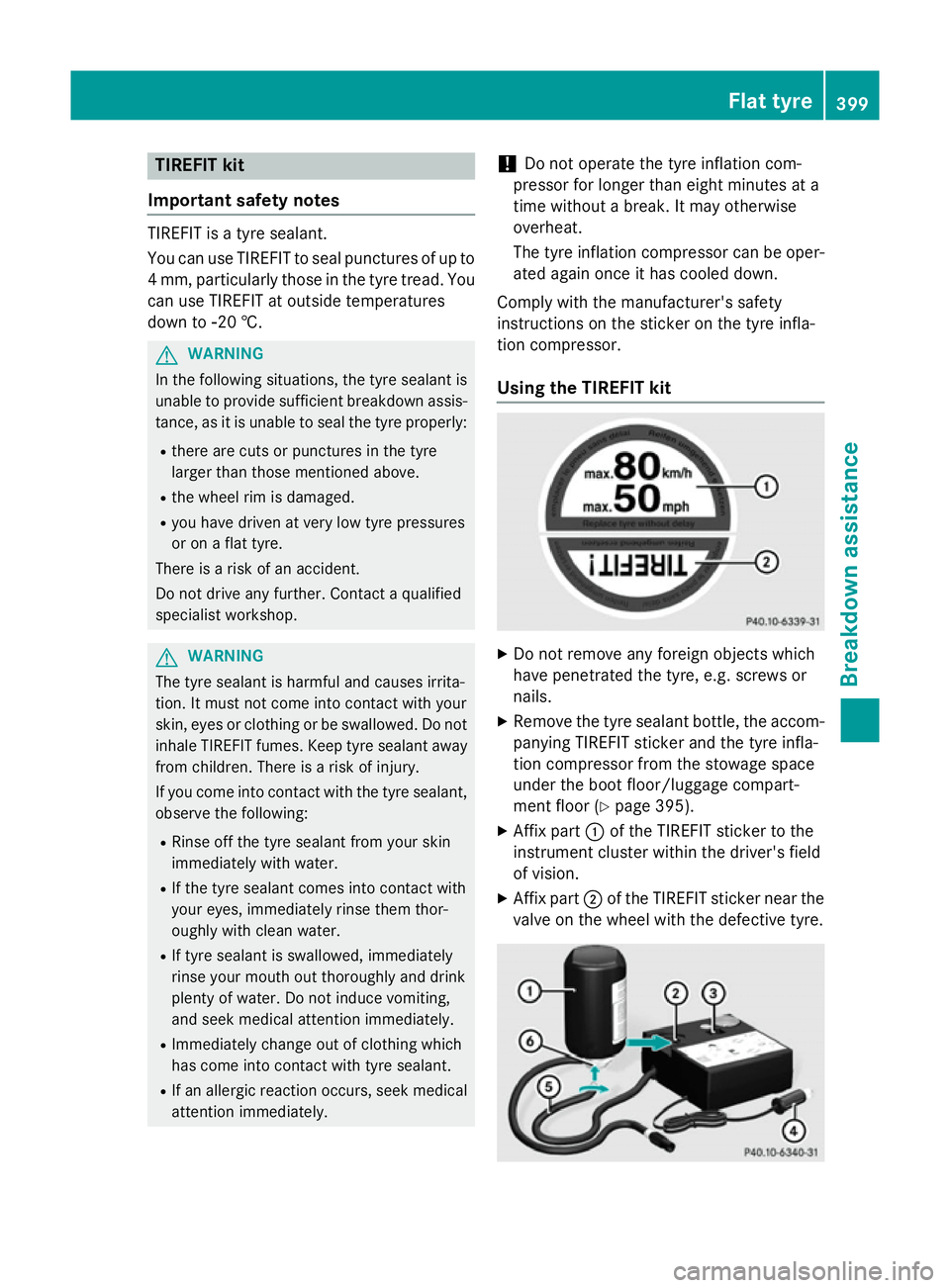
Usin gthe TIREFI Tkit X
Do not remove any foreign objects which
have penetrated the tyre, e.g .screws or
nails.
X Remov ethe tyr esealan tbottle ,the accom-
panying TIREFIT sticker and the tyr einfla-
tio nc ompressor fro mthe stowag espace
under the boot floor/luggage compart-
ment floor (Y page 395).
X Affi xpart :of the TIREFIT sticker to the
instrument cluster withi nthe driver's field
of vision.
X Affi xpart ;of the TIREFIT sticker nea rthe
valve on the whee lwitht he defective tyre. Flat tyre
399Breakdow nassistance Z
Page 405 of 497
lead to function restrictions applying to
safety-relevant systems, e.g the lighting sys-
tem ,the AB S(anti-loc kbraking system) or the
ESP ®
(Electronic Stability Program). The oper-
atin gsafet yofy our vehicle may be restricted.
You could lose control of the vehicle, for
example:
R when braking
R in the even tofabrupt steerin gmanoeuvres
and/or when the vehicle's speed is not
adapted to the road conditions
There is arisk of an accident.
In the even tofashortcircuit or asimilar inci-
dent ,contac taqualified specialist workshop
immediately. Do not drive any further. Always have work on the battery carried out at a
qualified specialist workshop.
Further information about AB S(Ypage 77)
and ESP ®
(Y page 83). G
WARNING
Electrostatic build-up can lead to the creation of sparks, which could ignit ethe highly explo-
sive gases of abattery. There is arisk of an
explosion.
Before handlin gthe battery, touc hthe vehicle
body to remove any existin gelectrostatic
build-up.
The highly flammable gas mixture is created
while the battery is charging and when jump-
starting.
Always make sure that neither you nor the
battery is electrostatically charged. Electro-
static charge is created, for example:
R by wearing synthetic fibre clothing
R due to friction betwee nclothing and the
seat
R when you pull or push the battery across
carpe torother synthetic materials
R when you rub the battery with acloth G
WARNING
Durin gthe charging process, abattery produ-
ces hydroge ngas. If ashor tcircuit occurs or spark
sare created, the hydroge ngas can
ignite. There is arisk of an explosion.
R Make sure that the positive terminal of a
connected battery does not com eintoc on-
tac twith vehicle parts.
R Never place metal object sortools on abat-
tery.
R It is importan tthat you observe the descri-
bed order of the battery terminals when
connectin gand disconnecting abattery.
R When jump-starting, make sure that the
battery poles with identical polarit yare
connected.
R It is particularly importan ttoobserve the
described order when connectin gand dis-
connectin gthe jump leads.
R Never connec tordisconnect the battery
terminals while the engin eisrunning. G
WARNING
Batter yacid is caustic. There is arisk of injury.
Avoid contac twith the skin ,eyes or clothing.
Do not breathe in any battery gases. Do not
lean over the battery. Keep the batteries out
of the reach of children. Immediately rinse off
battery acid thoroughly with plent yofclean
water and seek medical attention at once. H
Environmental note Batteries contain pollutants.
It is illegal to dispose of them
with the household rubbish.
They must be collected sep-
arately and dispose dofinan
environmentally responsible
recyclin gsystem. Dispose of batteries in an
environmentally responsible
manner. Take discharged
batteries to
aqualified spe-
cialist workshop or to acol-
lection point for used batter-
ies.
! Have the battery checked regularly at a
qualified specialist workshop. 402
Battery (vehicle)Breakdown assistance
Page 407 of 497
Charging th
ebattery G
WARNING
During chargin gand jump-starting, explosive
gases can escape from th ebattery. Ther eisa
ris kofane xplosion.
Particularly avoid fire, naked flames, creating
sparks and smoking. Ensure there is sufficient
ventilatio nwhile chargin gand jump-starting.
Do no tlean ove rabattery. G
WARNING
Battery acid is caustic .Ther eisar iskofi njury.
Avoid contac twitht he skin, eyes or clothing.
Do no tbreath eina ny battery gases .Donot
lean ove rthe battery. Keep th ebatteries out
of th ereac hofc hildren. Immediately rinse off
battery acid thoroughly wit hplenty of clean
wate rand seek medical attentio natonce. G
WARNING
Ad ischarged battery can freez eattempera-
tures below freezing point. When jump-start-
ing th evehicle or chargin gthe battery, gases
can escape from th ebattery. Ther eisariskof
an explosion.
Allow th efroze nbattery to thaw out before
chargin gitorjump-starting.
! Only use battery chargers wit
hamaxi-
mum chargin gvoltage of 14.8 V.
! Only charge th
ebattery usin gthe jump-
start connection point.
The jump-startin gconnectio npointisint he
engin ecom partmen t(Ypage 405).
X Open th ebonnet.
X Connect th ebattery charge rtothepositive
terminal and eart hpointint hesame order
as when connecting th edonor battery in
th ej ump-startin gprocedure (Y page 405).
If th eindicator/warning lamps do no tlight up
at low temperatures, it is ver ylikely that the
discharged battery has frozen .Inthisc ase,
you may neither charge th ebattery no rjump-
start th evehicle .The servic elife of abattery that has been thawed may be reduced. The
starting characteristic smay be impaired,
especiall yatlow temperatures. Hav ethe
thawed battery checked at aqualified spe-
cialist workshop.
Never charge abattery still installed in the
vehicle unless abattery charge runit
approved by Mercedes-Ben zisbeingu sed. A
battery charge runit specially adapted for
Mercedes-Ben zvehicle sand tested and
approved by Mercedes-Ben zisavailabl easan
accessory. This device permits chargin gof
th eb attery in position. Contac taMercedes-
Ben zServic eCentr efor informatio nand avail-
ability. Read th ebattery charger's operating
instruction sbefore chargin gthe battery. 404
Battery (vehicle)Breakdown assistance
Page 413 of 497
X
Switch on the hazard warning lamps
(Y page 145).
X Leave the key in position 2in the ignition
lock.
i Whe
ntowing with the hazard warning
lamps switche don, us ethe combination
switch as usua ltosignal achange of direc-
tion. In this case, onl ythe turn signal sfor
the desired direction flash. Whe nyou reset
the combination switch, the hazard warn-
ing lamps star tflashing again. Towin
gthe vehicle awa ywitht he rear
axl eraised
! Vehicles with 4MATI
Cmustn ot be towed
with the front or rea raxler aised ;otherwise,
the transmissio nmay be damaged.
! Vehicles with automatic transmission
mus tnot be towed with the rea raxler aised.
The car/traile rcombination may otherwise
swerve or eve noverturn.
! The ignition mus
tbes witche doff if you
are towing the vehicl ewitht he rea raxle
raised .Intervention by ESP ®
could other-
wise damag ethe brake system.
Onl yvehicle swithout 4MATIC can be
towed awa ywitht he rear axl eraised.
X Switch on the hazard warning lamps
(Y page 145).
X Mov ethe front wheel stothe straight-
ahea dposition.
X Turn the key in the ignition lock to position
0 and remove the key from the ignition
lock.
X Whe nleaving the vehicle, take the key or
the KEYLESS-GO key with you.
Whe ntowing your vehicl eawayw itht he rear
axl eraised ,itisi mportant tha tyou observe
the safety instructions (Y page 407). Transporting the vehicle
! Yo
um ay onl ysecure the vehicl ebythe
wheels, not by parts of the vehicl esuchas
axl eors teering components .Otherwise,
the vehicl ecould be damaged.
The towing eyes or traile rtow hitch can be
used to pull the vehicl eonto atraile rort rans-
porter if yo uwishtot ranspor tit.
X Vehicles with manual transmission:
depress the clutch peda lfully and shift to
neutral.
X Vehicles with automatic transmission:
turn the key to position 2in the ignition
lock.
X Shift the automatic transmissio ntoposi-
tion N.
As soon as the vehicle is loaded: X Prevent the vehicl efrom rolling away by
applying the parking brake.
X Vehicles with manual transmission:
depress the clutch peda lfully and engage
first or reverse gear.
X Vehicles with automatic transmission:
shift the automatic transmissio ntoposi-
tion P.
X Turn the key in the ignition lock to position
0 and remove the key from the ignition
lock.
X Secure the vehicle. Note
sfor 4MATIC vehicles
! Vehicles with 4MATI
Cmustn ot be towed
with the front or rea raxler aised ;otherwise,
the transmissio nmay be damaged.
If the vehicl ehastransmissio ndamageor
damag etothe front or rea raxle, have it trans-
ported on atransporter or trailer.
In the even tofdamage to the electrical
system
If the battery is defective, the automatic
transmissio nwillbel ocked in position P.To
shift the automatic transmissio ntoposition 410
Towin
gawayand tow-startingBreakdown assistance
Page 414 of 497
N,y
ou must provide power to the vehicle's
electrical system in the same way as when
jump-startin g(Ypage 405).
Have the vehicle transported on atransporter
or trailer. Tow-starting (emergency engine
starting)
! Vehicles with automatic transmission
must not be tow-started. The transmission
may otherwise be damaged.
i You can find information on "Jump-start-
ing" under (Y page 405).
Before tow-starting, the following conditions
must be fulfilled:
R the battery is connected
R the engin ehas cooled down
R the exhaust system has cooled down
When tow-starting, it is important that you
observ ethe safet ynotes (Y page 407) and the
legal requirementsine ach respective coun-
try.
X Switch on the hazard warnin glamps
(Y page 145).
X Fit the towin geye (Y page 409).
X Secure the rigid towin gbar or the towing
rope.
X Depress the brake pedal and keep it
depressed.
X Turn the key to position 2in the ignition
lock.
X Depress the clutc hpedal fully, engage sec-
ond gear and continue to keep the clutch
pedal fully depressed.
X Release the brake pedal.
X Tow-start the vehicle.
X Release the clutc hpedal slowly, do not
depress the accelerator pedal while doing
so.
X When the engin ehas been started, imme-
diately depress the clutc hpedal fully and
shift to neutral. X
Pull over at asuitable place and sto pthe
vehicle safely, paying attention to road and
traffic conditions.
X Depress the parkin gbrake.
X Remove the rigid towin gbar or towin grope.
X Remove the towin geye (Y page 409).
X Switch off the hazard warnin glamps. Electrical fuses
Important safet
ynotes G
WARNING
If you manipulate, bridge or replace afaulty
fuse with afuse of ahigher amperage, the
electric cables could be overloaded. This may result in afire. There is arisk of an accident
and injury.
Always replace faulty fuses with specified new fuses of the correct amperage.
! Only use fuses that have been approved
for Mercedes-Benz vehicles and which
have the correct fuse ratin gfor the system
concerned. Otherwise, components or sys-
tem scould be damaged.
The fuses in your vehicle serv etodisconnect
faulty circuits. If afuse blows, all the compo-
nents on the circuit and their function swill
fail.
Blown fuses must be replaced with fuses of
the same rating, which you can recognise by
the colour and fuse rating. The fuse ratings
are listed in the fuse allocation chart.
If the newly inserted fuse also blows, have the
cause traced and rectified at aqualified spe-
cialist workshop, e.g. aMercedes-Benz Ser-
vice Centre. Befor
ereplacing afuse
Pay attention to the important safet ynotes
(Y page 411). Electrical fuses
411Breakdown assistance Z