brake MERCEDES-BENZ E-CLASS SALOON 2015 User Guide
[x] Cancel search | Manufacturer: MERCEDES-BENZ, Model Year: 2015, Model line: E-CLASS SALOON, Model: MERCEDES-BENZ E-CLASS SALOON 2015Pages: 497, PDF Size: 16.23 MB
Page 31 of 497
QR code for rescue card
The QR code is secured in the fuel filler flap
and on the opposite side on the B-pillar. In the
event of an accident ,rescue services can use
the QR code to quickly find the appropriate
rescue card for your vehicle. The curren tres-
cue card contains, in acompact form, the
most importan tinformation about your vehi-
cle, e.g. the routing of the electric cables.
You can find more information under https:// portal.aftersales.i.daimler.com/public/
content/asportal/en/communication/
informationen_fuer/QRCode.html. Data stored in the vehicle
Aw ide range of electronic componentsin
your vehicle contain data memories.
These data memories temporarily or perma-
nently stor etechnical information about:
R the vehicle's operating state
R events
R faults
In general, this technical information docu-
ment sthe stat eofac omponent,am odule, a
system or the surroundings.
These include, for example:
R operating conditions of system compo-
nents, e.g. fluid levels
R the vehicle's status messages and those of
its individual components, e.g. number of
wheel revolutions/speed, deceleration in
movement, lateral acceleration, accelera-
tor pedal position
R malfunctions and defect sinimportan tsys-
tem components, e.g. lights, brakes
R vehicle reactions and operating conditions
in special driving situations ,e.g. airbag
deployment, intervention of stability con-
trol systems
R ambient conditions, e.g. outside tempera-
ture This data is of an exclusively technical nature
and can be used to:
R assist in detecting and rectifying faults and
defects
R analyse vehicle functions, e.g. after an acci-
dent
R optimise vehicle functions
The data cannot be used to trac ethe vehicle's
movements.
When your vehicle is serviced, technical infor-
mation can be read from the event data mem- ory and fault data memory.
Services include, for example:
R repair services
R service processes
R warranty events
R quality assurance
It is read by employees of the service network (including manufacturers) using special diag-
nostic testers. More detailed information is
obtained from it, if required.
After afault has been rectified, the informa-
tion is deleted from the fault memory or is
continually overwritten.
When operating the vehicle, situations are
conceivable in which this technical data, in
connection with other information (if neces-
sary, under consultation with an authorised
expert), could be traced to aperson.
Examples include:
R accident reports
R damage to the vehicle
R witness statements
Further additional functions that have been
contractually agreed upon with the customer
allow certain vehicle data to be conveyed by
the vehicle as well. The additional functions
include, for example, vehicle location in case of an emergency. 28
Introduction
Page 35 of 497
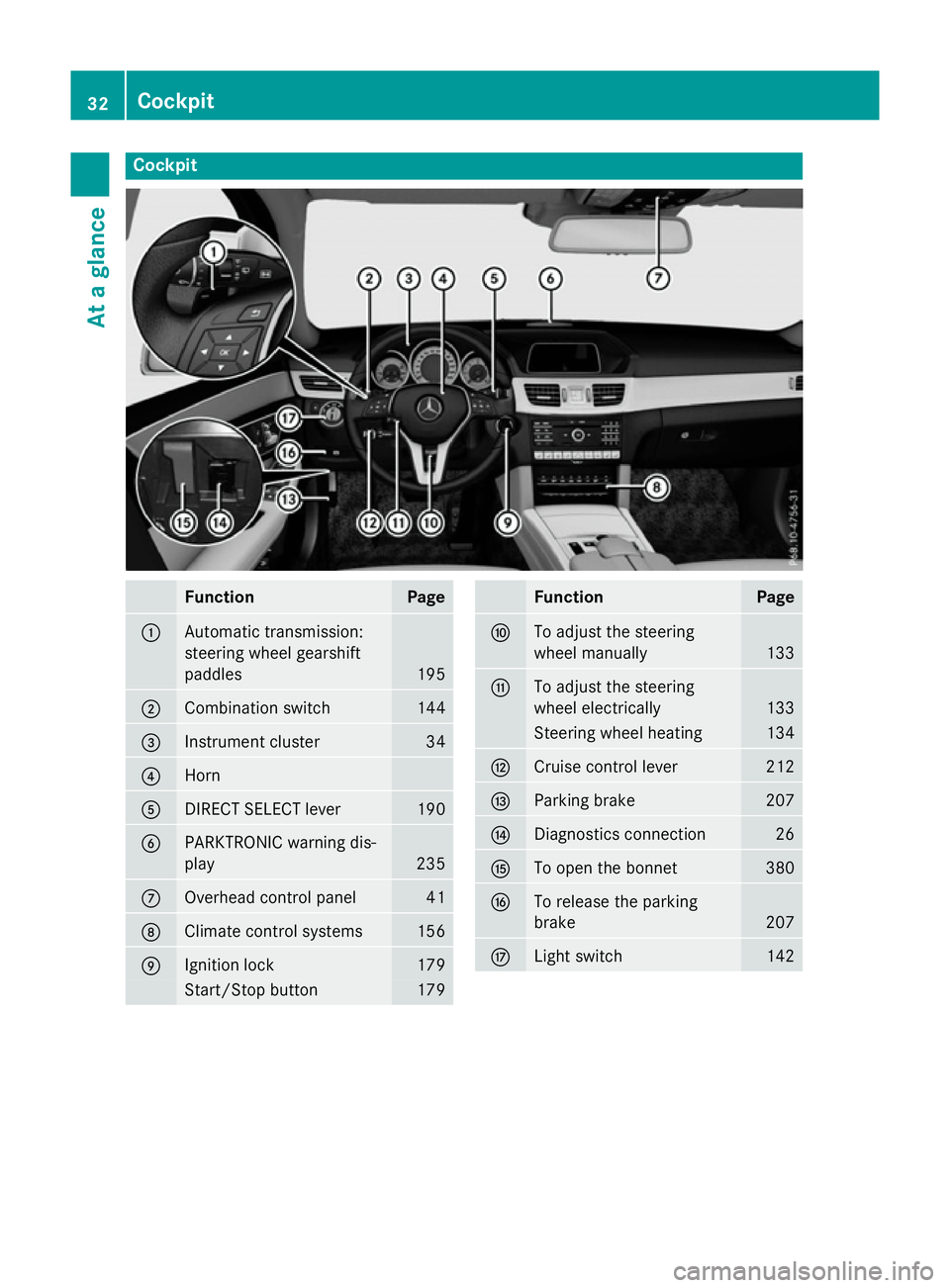
Cockpit
Function Page
:
Automatic transmission:
steering wheel gearshift
paddles
195
;
Combination switch 144
=
Instrumen
tcluster 34
?
Horn
A
DIRECT SELECT lever 190
B
PARKTRONIC warning dis-
play
235
C
Overhead control panel 41
D
Climat
econtro lsystems 156
E
Ignition lock 179
Start/Sto
pbutton 179 Function Page
F
To adjust th
esteering
wheel manually 133
G
To adjust th
esteering
wheel electrically 133
Steering wheel heating 134
H
Cruise control lever 212
I
Parking brake 207
J
Diagnostics connection 26
K
To open th
ebonnet 380
L
To release th
eparking
brake 207
M
Ligh
tswitch 14232
CockpitAt
ag lance
Page 36 of 497
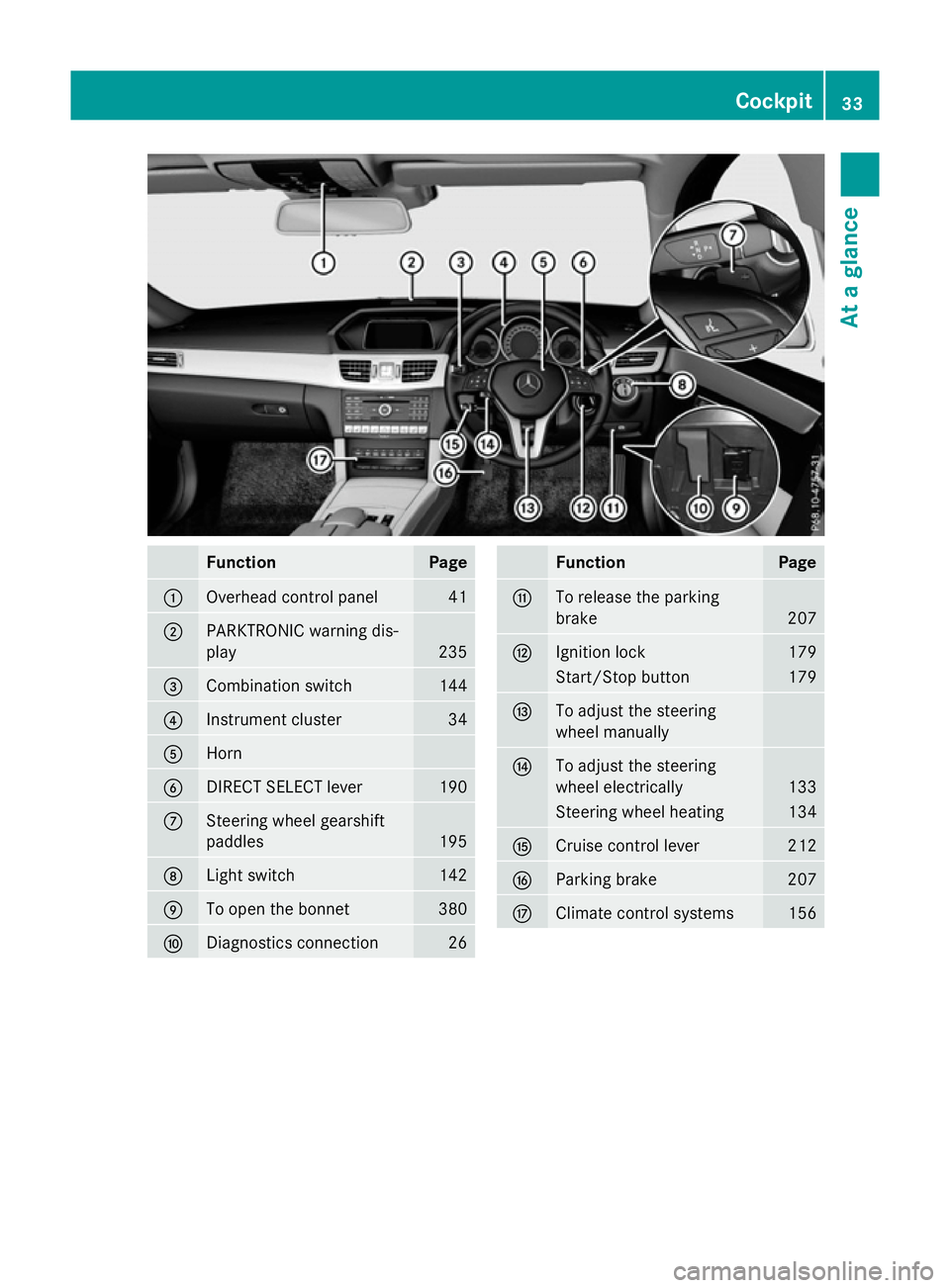
Function Page
:
Overhead control panel 41
;
PARKTRONIC warning dis-
play 235
=
Combination switch 144
?
Instrumen
tcluster 34
A
Horn
B
DIRECT SELECT lever 190
C
Steering wheel gearshift
paddles
195
D
Ligh
tswitch 142
E
To open th
ebonnet 380
F
Diagnostics connection 26 Function Page
G
To release th
eparking
brake 207
H
Ignition lock 179
Start/Sto
pbutton 179
I
To adjust th
esteering
wheel manually J
To adjust th
esteering
wheel electrically 133
Steering wheel heating 134
K
Cruis
econtro llever 212
L
Parking brake 207
M
Climat
econtro lsystems 156Cockpit
33Atag lance
Page 38 of 497
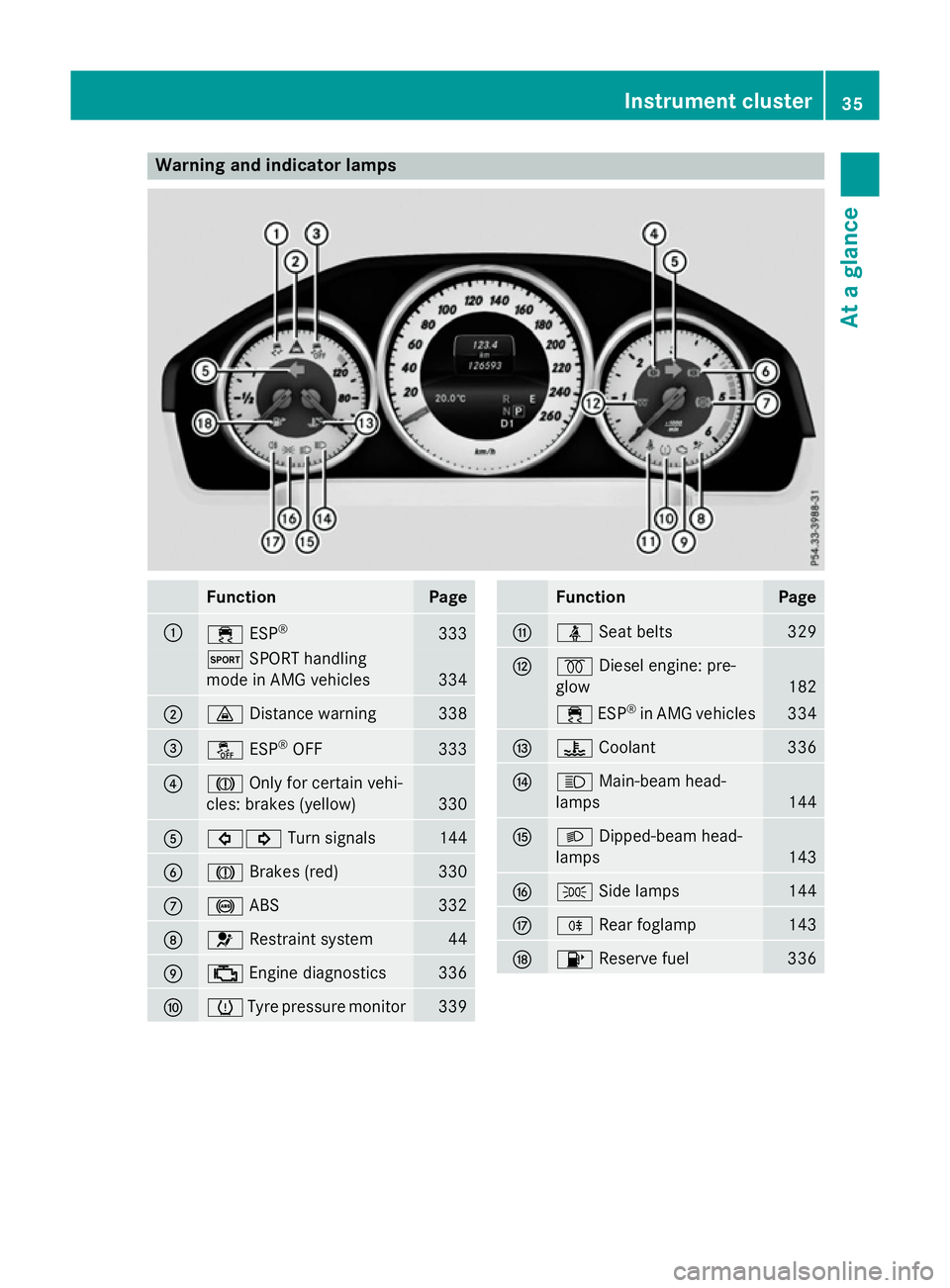
Warning and indicator lamps
Function Page
:
÷
ESP® 333
M
SPORT handling
mode in AMG vehicles 334
;
·
Distance warning 338
=
å
ESP®
OFF 333
?
J
Only for certain vehi-
cles: brakes (yellow) 330
A
#!
Turn signals 144
B
J
Brakes (red) 330
C
!
ABS 332
D
6
Restraint system 44
E
;
Engine diagnostics 336
F
h
Tyre pressure monitor 339 Function Page
G
ü
Seat belts 329
H
%
Diesel engine: pre-
glow 182
÷
ESP®
in AMG vehicles 334
I
?
Coolant 336
J
K
Main-beam head-
lamps 144
K
L
Dipped-bea mhead-
lamps 143
L
T
Side lamps 144
M
R
Rearfoglamp 143
N
8
Reserve fuel 336Instrument cluster
35Atag lance
Page 60 of 497
R
vehicles with the memory function: the
front-passenge rseat is adjusted if it is in an
unfavourable position.
R vehicles with amulticontour seat or active
multicontour seat: the air pressure in the
side bolsters of the backrest is increased.
If the hazardous situation passes without
resulting in an accident, PRE-SAFE ®
slackens
the beltp re-tensioning. On vehicles with mul-
ticontour seats/active multicontour seats,
the air pressure in the side bolsters is reduced
again. All settings made by PRE-SAFE ®
can
then be reversed.
If the seat beltp re-tensioning is not reduced:
X Move the seat backrest or seat back
slightly when the vehicl eisstationary.
Seat beltp re-tensioning is reduced and the
locking mechanism is released.
The seat-belt adjustment is an integral part of
the PRE-SAFE ®
convenience function. Infor-
mation about the convenience function can
be found under "Bel tadjustment"
(Y page4 9). PRE-SAFE
®
PLUS( anticipatory occu-
pant protectio nPLUS)
Introduction PRE-SAFE
®
PLUS is only available in vehicles
with the Driving Assistance package.
Using the rada rsensor system, PRE-SAFE ®
PLUS is abletod etect thatahead-on or rear-
end collision is imminent. In certain hazard-
ous situations, PRE-SAFE ®
PLUS takes pre-
emptive measures to protect the vehicle
occupants.
Important safety notes The intervention of PRE-SAFE
®
PLUS cannot
prevent an imminent collision.
The drive risnot warned before the interven-
tion of PRE-SAFE ®
PLUS. PRE-SAFE
®
PLUS does not intervene:
R if the vehicl eisreversing
R when the vehicl eistowing atrailer and
there is arisk of arear-end collision
PRE-SAFE ®
PLUS does not perform braking
actions while the vehicl eisinmotion or when
Parking Guidance is active.
Function PRE-SAFE
®
PLUS intervenes in certain situa-
tions if the rada rsensor system detects an
imminent head-on or rear-end collision.
PRE-SAFE ®
PLUS takes the following meas-
ures depending on the hazardous situation
detected:
R If the rada rsensor system detects that a
head-on collision is imminent, the seat
belts are pre-tensioned.
R If the rada rsensor system detects that a
rear-end collision is imminent:
- the rear hazard warning lamp sare acti-
vated and flas hatahigher frequency.
- the brake pressure is increase difthe
drive rappliest he brakes when the vehi-
cle is stationary.
- the seat belts are pre-tensioned.
The PRE-SAFE ®
PLUS braking application is
cancelled:
R if the accelerator peda lisdepressed when
ag earise ngaged
R if the risk of acollision passes or is no lon-
ger detected
R if DISTRONIC PLUS indicates an intention
to pulla way
If the hazardous situation passes without
resulting in an accident, the original settings
are restored. Occupant safety
57Safety Z
Page 61 of 497
Automati
cmeasures after an acci-
dent
Immediately after an accident, th efollowing
measures are implemented, depending on
th et ypea nd severity of th eimpact:
R theh azard warning lamp sare activated
R thee mergenc ylighting is activated
R thev ehicl edoor sare unlocked
R thef ront side windows are lowered
R vehicles wit hamemory function :the elec-
trically adjustable steering whee lisraised
R thee ngineiss witched off and th efuel sup-
ply is cut off
R vehicles wit hthe Mercedes-Benz emer-
gency call system: automatic emergency
call
R vehicles wit hthe hybrid driv esystem: the
hybrid system and th ehigh-voltage electri-
cal system are deactivated Children in th
evehicle Important safety notes
Acciden tstatistics sho wthatc hildren
secured in th erear seat sare safer than chil-
dre nsecured in th efront seats. Fo rthisr ea-
son ,Mercedes-Benz strongly advises that you
instal lachild restrain tsystem on arear seat.
Children are generally bette rprotected there.
If ac hild younger than twelve years old and
under 1.50 minh eight is travellin ginthe
vehicle:
R always secure th echild in achild restraint
system suitable for Mercedes-Benz vehi-
cles. The child restrain tsystem mus tbe
appropriat etotheage, weigh tand siz eof
th ec hild
R be sur etoobservethe instruction sand
safet ynotes in this section in addition to
th ec hild restrain tsystem manufacturer's
installation instructions
Do no tfitar earward-facing child restraint
system on th ecentre rear seat. G
WARNING
If you leav echildren unattended in th evehi-
cle ,the ym ay be able to set th evehicl ein
motion if, for example, they:
R release th eparking brake
R shif tthe automatic transmission out of park
position Por shif tmanual transmission into
neutral
R start th eengine
In addition ,the ym ay operate vehicl eequip-
men tand become trapped .There is ariskof
an acciden tand injury.
When leaving th evehicle, always tak ethe key
wit hyou and loc kthe vehicle. Never leave
children unattended in th evehicle. G
WARNING
If person s(particularly children )are exposed
to heat or cold for aprolonged period, there is
ar iskofs erious or eve nfatal injuries. Never
leav eperson s(particularly children )unatten-
ded in th evehicle. G
WARNING
If th echild restrain tsystem is placed in direct
sunlight, th epartsc ould become ver yhot.
Children could be suffer burn sbytouching
these parts, in particular on th emetallic parts
of th echild restrain tsystem. There is ariskof
injury.
If you and your child leav ethe vehicle, always
mak esuret hatthe child restrain tsystem is
no tind irectsunlight. Cove ritwithab lanket,
for example. If th echild restrain tsystem has
been exposed to direc tsunlight, leav eitto
cool down before securin gthe child in it.
Never leav echildren unattended in th evehi-
cle.
Always ensur etha tall vehicl eoccupant shave
their seat belt sfastene dcorrectly and are sit-
ting properly. Particular attention mus tbe
paid to children.
Observ ethe safet ynotes on th eseat belt
(Y page 46) and th enotes on how to use the
seat belt properly (Y page 47).58
Childre
ninthevehicleSafety
Page 79 of 497
G
WARNING
If you leave children unattended in the vehi-
cle, they may be abletos et the vehiclein
motion if, for example, they:
R release the parking brake
R shift the automatic transmission out of park
position Por shift manua ltransmission into
neutral
R start the engine
In addition, they may operate vehicl eequip-
ment and become trapped. There is arisk of
an accident and injury.
When leaving the vehicle, alwayst ake the key
with you and lock the vehicle. Never leave
children unattended in the vehicle. G
WARNING
If persons (particularly children) are exposed
to heatorc old foraprolonged period, there is
ar isk of serious or even fatal injuries. Never
leave persons (particularly children) unatten-
ded in the vehicle. G
WARNING
If the child restraint system is placed in direct sunlight, the parts coul dbecome very hot.
Childre ncouldbes uffer burns by touching
these parts, in particular on the metallic parts
of the child restraint system. There is arisk of
injury.
If you and yourc hild leave the vehicle, always
make sure that the child restraint system is
not in direct sunlight. Cove ritwithablanket,
for example. If the child restraint system has
been expose dtodirect sunlight, leave it to
cool downb efore securing the child in it.
Never leave children unattended in the vehi-
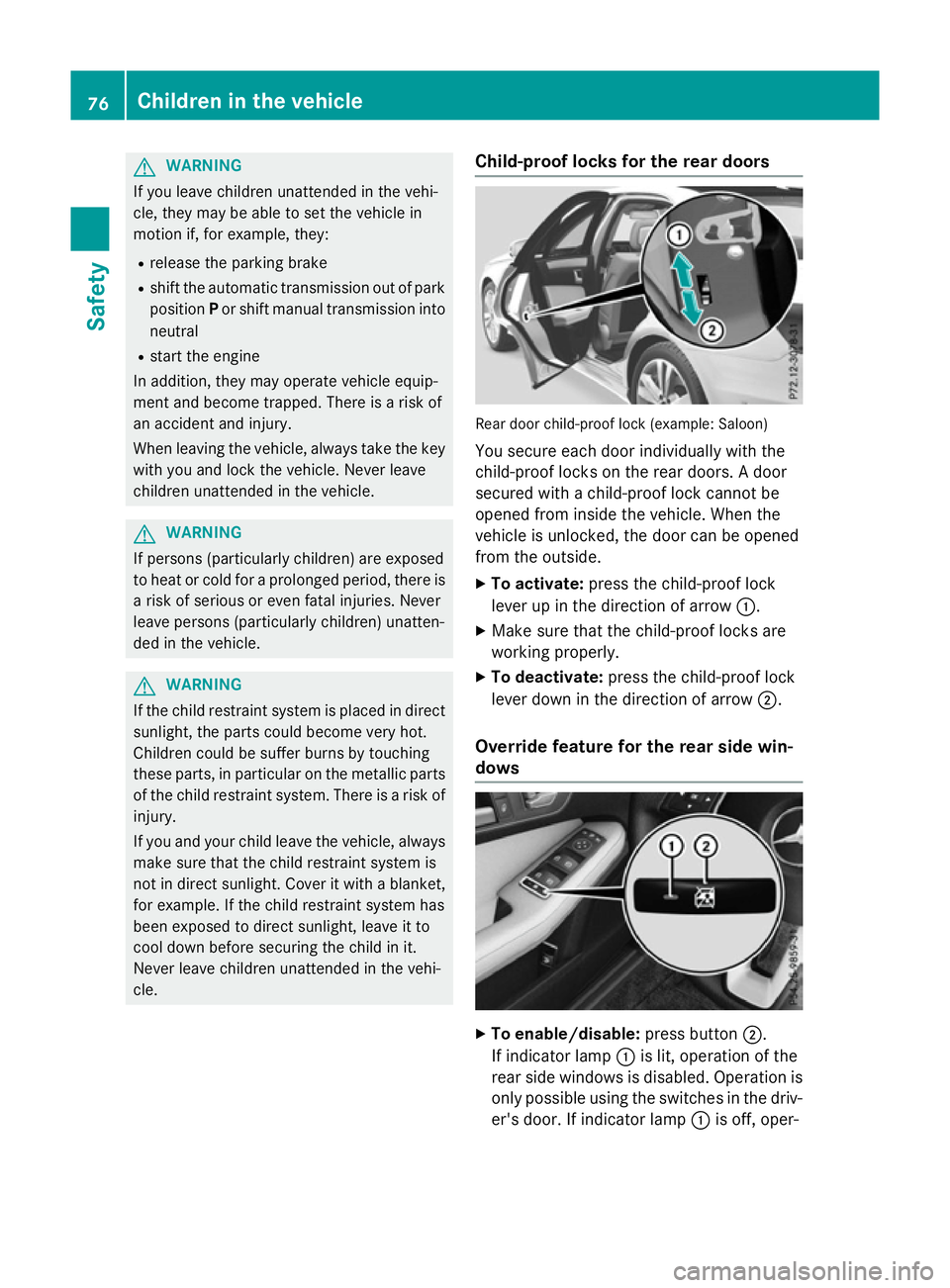
cle. Child-proof locks for the rear doors Rea
rdoor child-proof lock (example: Saloon)
You secure each door individually with the
child-proof locks on the rear doors. Adoor
secure dwithachild-proof lock cannot be
opened from insid ethe vehicle. When the
vehicl eisunlocked ,the door can be opened
from the outside.
X To activate: press the child-proof lock
leve rupint he direction of arrow :.
X Make sure that the child-proof locks are
working properly.
X To deactivate: press the child-proof lock
leve rdow nint he direction of arrow ;.
Override feature for the rear side win-
dows X
To enable/disable: press button;.
If indicator lamp :is lit, operation of the
rear side windows is disabled. Operation is
only possible using the switches in the driv- er's door. If indicator lamp :is off, oper- 76
Children in the vehicleSafety
Page 80 of 497
atio
nisp ossible usin gthe switches in the
rear compartment. Pet
sint hevehicle G
WARNING
If you leave animals unsupervised or unse-
cured in th evehicle ,the ym ay push abutton
or as witch ,for example.
They could:
R activat evehicle equipmen tand become
trapped, for example
R switch vehicle systems on or off ,thus
endangering other road users
In th eevent of an accident, sudde nbraking or
abrupt changes of direction ,unsecured ani-
mals could be flun garoun dthe vehicle ,injur-
ing th evehicle occupants .Ther eisar iskofan
acciden tand injury.
Never leave animals unattende dinthevehi-
cle .Always secure animals correctly durin ga
journey, e.g .inananimal transpor tbox. Driving safety systems
Driving safety systems overview
In this section, you will fin dinformatio nabout
th ef ollowin gdriving safety systems:
R AB S(Anti-lock Braking System)
(Y page 77)
R BA S(Brake AssistSystem) (Y page 78)
R BA SP LUS(Brake AssistSystem PLUS) with
Cross-Traffic Assist (Y page 78)
R COLLISION PREVENTION ASSIST PLUS
(distanc ewarning function and Adaptive
Brake Assist )(Y page 80)
R Adaptive brak elamps (Y page 83)
R ESP ®
(E lectronic Stability Program)
(Y page 83)
R EB D( electronic brakeforce distribution)
(Y page 86)
R ADAPTIV EBRAKE (Y page 86) R
PRE-SAFE ®
Brake (Y page 87)
R STEE RCONTROL (Y page 89) Important safety notes
If you fail to adapt your driving style or if you
are inattentive, th edriving safety systems can
neither reduc ethe riskofana ccidentnor
override th elaws of physics. Drivin gsafety
systems are merely aids designe dtoassist
driving .You are responsible for maintaining
th ed istanc etothevehicle in front, for vehicle
speed, for braking in good time, and for stay- ing in lane .Always adapt your driving style to
suit th eprevailin groad and weather condi-
tions and maintain asafe distanc efromt he
vehicle in front. Drive carefully.
The driving safety systems describe donly
work as effectivel yaspossible when there is
adequat econtac tbetween th etyres and the
road surface. Pleas epay special attentio nto
th en otes on tyres, recommended minimum
tyr etread depths etc. (Y page 416).
In wintry driving conditions, always use winter
tyres (M+ Styres) and ,ifnecessary, snow
chains .Onlyint hisw ay will th edriving safety
systems describe dinthiss ectio nwork as
effectivel yaspossible. ABS (Anti-lock Braking System)
General notes AB
Sr egulate sbrak epressure in suc haway
that th ewheels do no tloc kw hen you brake.
This allows you to continue steering th evehi-
cle when braking.
The yellow !ABSw arning lamp in the
instrumen tcluste rlight supw hen th eignition
is switched on .Itgoes out when th eengineis
running.
Important safety notes i
Observ
ethe "Important safety notes" sec-
tio n(Ypage 77). Driving safety systems
77Safety Z
Page 81 of 497
G
WARNING
If ABS is faulty, the wheels coul dlock when
braking. The steerability and braking charac-
teristics may be severely impaired .Addition-
ally, further driving safety systems are deac-
tivated. There is an increased dange rofskid-
ding and accidents.
Drive on carefully.H ave ABS checked imme-
diately at aqualified specialist workshop.
If ABS is malfunctioning, other systems,
including driving safety systems ,willa lso
become inoperative. Observe the information on the ABS warning lamp (Y page332) and
display messages which may be show ninthe
instrument cluster (Y page300).
ABS works from aspee dofa bout8km/h,
regardless of road-surface conditions. ABS
works on slippery surfaces, even when you
only brake gently.
Brakes X
If ABS intervenes: continue to depress the
brake peda lwith force until the braking sit-
uation is over.
X To make afull brake application:
depress the brake peda lwith full force.
If ABS intervenes when braking, you willf eel a
pulsing in the brake pedal.
The pulsating brake peda lcan be an indica-
tion of hazardous road conditions; this serves
as areminde rtotake extra care while driving. BAS (Brake Assist System)
General notes BAS operates in emergency braking situa-
tions. If you depress the brake peda lquickly,
BAS automatically boosts the braking force,
thus shortening the stopping distance. Important safety notes i
Observe the "Important safety notes" sec-
tion (Y page77). G
WARNING
If BAS is malfunctioning, the braking distance
in an emergency braking situation is
increased. There is arisk of accident.
In an emergency braking situation, depress
the brake peda lwith full force. ABS prevents
the wheels from locking.
Brakes X
Keep the brake peda ldepressed firmly until
the emergency braking situation is over.
ABS prevents the wheels from locking.
The brakes willf unction as usual once you
release the brake pedal. BAS is deactivated. BAS PLUS(
Brake Assist System
PLUS) with Cross-Traffic Assist
General notes i
Observe the "Important safety notes" sec-
tion (Y page77).
BAS PLUS is only available on vehicles with
the Driving Assistance package.
For BAS PLUS to assist you when driving, the
rada rsensor system and the camera system
must be operational.
With the help of asensor system and acam-
era system, BAS PLUS can detect obstacles:
R that are in the path of yourv ehiclefor an
extended period of time
R that cross the path of yourv ehicle
In addition, pedestrians in the path of your
vehicl ecan be detected.
BAS PLUS detects pedestrians using typical
characteristics such as the body contours
and posture of aperso nstanding upright.
If the rada rsensor system or the camera sys-
tem is malfunctioning, BAS PLUS functions
are restricted or no longer available.T he78
Driving safety systemsSafety
Page 82 of 497
brake system is still available with complete
brake boostin geffec tand BAS.
i Observ
ethe restrictions described in the
"Important safety notes" section
(Y page 79).
BASP LUS can help you to minimis ethe risk of
ac ollision with avehicle or apedestrian and
reduce the effects of such acollision .IfBAS
PLUS detects adanger of collision, you are
assisted when braking.
Importan tsafet ynotes G
WARNING
BASP LUS cannot always clearly identify
objects and complex traffic situations.
In such cases, BASP LUS may:
R interven eunnecessarily
R not intervene
There is arisk of an accident.
Always pay careful attention to the traffic sit- uation and be ready to brake. Terminate the
intervention in anon-critical drivin gsituation. G
WARNING
BASP LUS does not react:
R to small people, e.g. children
R to animals
R to oncoming vehicles
R when cornering
As aresult, BASP LUS may not interven einall
critical situations. There is arisk of an acci-
dent.
Always pay careful attention to the traffic sit- uation and be ready to brake.
In the event of snowfall or heavy rain, detec-
tion can be impaired.
Detection by the radar senso rsystem is also
impaired in the event of:
R dirt on the sensors or obscured sensors
R interferenc ebyother radar sources
R strong radar reflections, for example, in
multi-storey car parks R
an arro wvehicle travelling in front, e.g. a
motorcycle
R av ehicle travelling in fron tonadifferent
line
R vehicles quickly movin gintot he radar sen-
sor system detection range
Detection by the camera system is also
impaired in the event of:
R dirt on the camera or if the camera is cov-
ered
R glare on the camera system, e.g. from the
sun being low in the sky
R darkness
R if:
- pedestrians move quickly, e.g. int othe
path of the vehicle
- the camera system no longer detects a
pedestrian as aperson due to special
clothing or other objects
- ap edestrian is concealed by other
objects
- the typical outline of aperson is not dis-
tinguishable from the background
Following damage to the fron tend of the vehi-
cle, have the radar senso rsettings and oper-
ation checked at aqualified specialist work-
shop. This also applies to collisions at slow
speeds where ther eisnovisible damage to
the fron tofthe vehicle.
Following damage to the windscreen, have
the configuration and operation of the cam-
era system checked at aqualified specialist
workshop.
Function To avoid
acollision, BASP LUS calculates the
brake forc enecessary if:
R you approach an obstacle and
R BASP LUS has detected arisk of collision
When driving at aspeed under 30 km/h :if
you depress the brake pedal, BASP LUS is
activated. Braking assistance from BASP LUS
is carried out at the last possible moment. Driving safet
ysystems
79Safety Z