brake MERCEDES-BENZ E-CLASS SALOON 2015 Owner's Manual
[x] Cancel search | Manufacturer: MERCEDES-BENZ, Model Year: 2015, Model line: E-CLASS SALOON, Model: MERCEDES-BENZ E-CLASS SALOON 2015Pages: 497, PDF Size: 16.23 MB
Page 83 of 497
When driving at
aspee dabove 30 km/h :if
you depress the brake peda lsharply,B AS
PLUS automatically increases the brake pres- sure to adegre esuited to the traffic situation.
BAS PLUS provides braking assistance in haz- ardous situations with vehicles in front within
as pee drange between 7km/h and
250 km/h.
Up to aspee dofa pproximately 70 km/h, BAS
PLUS may react to:
R stationary objects in the path of yourv ehi-
cle, e.g. stoppe dorparked vehicles
R pedestrians in the path of yourv ehicle
R obstacles crossing yourp ath, which move
in the detection range of the sensors and
are recognised by them
i If BAS PLUS demands particularly high
braking force, preventative passenger pro-
tection measures (PRE-SAFE ®
)a re activa-
ted simultaneously.
X Keep the brake peda ldepressed until the
emergency braking situation is over.
ABS prevents the wheels from locking.
BAS PLUS is deactivated and the brakes func-
tion as usual, if:
R you release the brake pedal
R there is no longer arisk of collision
R no obstacl eisdetected in front of your
vehicle
R you depress the accelerator pedal
R you activate kickdown COLLISIONP
REVENTIONASSIST
PLUS
General notes COLLISION PREVENTIO
NASSIST PLUS con-
sists of adistance warning function with an
autonomous braking function and Adaptive
Brake Assist.
COLLISION PREVENTIO NASSIST PLUS can
help you to minimise the risk of acollision with the vehicl
einfront or reduce the effects
of such acollision.
If COLLISION PREVENTIO NASSIST PLUS
detects that there is arisk of acollision, you
willbew arned visuallya nd acoustically.Ify ou
do not react to the visual and audible collision warning, autonomous braking can be initiated
in critical situations. If you apply the brake
yourself in acritical situation, the COLLISION
PREVENTIO NASSIST PLUS Adaptive Brake
Assist assists you.
Switchin gthe soun don/off COLLISION PREVENTIO
NASSIST PLUS is
activated after every ignition cycle .You can
activate or deactivate COLLISION PREVEN-
TION ASSIST PLUS in the on-board computer
(Y page2 87). When deactivated, the dis-
tance warning function and the autonomous
braking function are alsod eactivated.
If COLLISION PREVENTIO NASSIST PLUS is
deactivated, the æsymbol appears in the
assistance graphics display.
Important safety notes In particular, the detection of obstacles can
be impaired in the case of:
R dirt on the sensors or obscured sensors
R snow or heavy rain
R interference by other rada rsources
R strong rada rreflections, for example, in
multi-storey car parks
R an arrow vehicl etravelling in front, e.g. a
motorcycle
R av ehicl etravelling in front on adifferent
line
R new vehicles or after aservice on the COL-
LISION PREVENTIO NASSIST PLUS system
Please observe the information in the sec-
tion on running-in the vehicle
(Y page1 78).
Following damage to the front end of the vehi-
cle, have the configuration and operation of
the rada rsensor checked at aqualified spe- 80
Driving safety systemsSafety
Page 84 of 497
cialist workshop. Thi
salsoa pplies to colli-
sions at slo wspeeds where there is no visible
damag etothe front of the vehicle.
Distanc ewarnin gfunction General notes
The distance warning function can hel
pyou to
minimis ethe ris kofa collisio nwitht he vehi-
cle in front or reduce the effects of such a
collision. If the distance warning function
detects that there is ariskofa collision, you
will be warned visuall yand acoustically.
Important safety notes
i Observe the "Important safety notes" sec-
tion for driving safety systems (Y page 77).G
WARNING
The distance warning function doe snot react:
R to peopl eoranimals
R to oncoming vehicles
R to crossing traffic
R whe ncornering
Thus, the distance warning function cannot
provid eawarning in al lcritical situations.
There is ariskofana ccident.
Alway spaycareful attention to the traffic sit-
uation and be ready to brake. G
WARNING
The distance warning function cannot always
clearl yide ntif yobjects and comple xtraffic
situations.
In such cases, the distance warning function
may:
R giv eanu nnecessary warning
R not giv eawarning
There is ariskofana ccident.
Alway spaycareful attention to the traffic sit-
uation; do not rel yonthe distance warning
function alone. Function
The distance warning function issue
sawarn-
ing at speeds:
R of approximately 30 km/h or more ,if, over
several seconds, the distance maintained
to the vehicle travelling in front is insuffi-
cient. The ·distance warning lamp
then lights up in the instrument cluster.
R of approximately 7km/h or more ,ifyou
rapidly approach avehicle in front. An inter-
mittent warning tone will then sound and
the · distance warning lamp will light
up in the instrument cluster.
X Brake immediately in order to increas ethe
distance from the vehicle in front.
or
X Take evasiv eaction provided it is safe to do
so.
Due to the nature of the system, particularly
complicate dbutnon-critical driving condi-
tions may also cause the system to display a
warning.
With the hel pofthe radar sensor system, the
distance warning function can detect obsta-
cle sthat are in the path of your vehicle for an
extended period of time.
Up to aspeed of approximately 70 km/h ,the
distance warning function can also react to
stationary obstacles, such as stopped or
parked vehicles.
Autonomous braking function If the driver doe
snot react to the distance
warning signal in acritical situation, COLLI-
SION PREVENTIO NASSIST PLUS can assist
with the autonomous braking function.
The autonomous braking function:
R gives the driver more time to react to criti-
cal driving situations
R can hel pthe driver to avoid an accident or
R reduce sthe effects of an accident Drivin
gsafety systems
81Safety Z
Page 85 of 497
The autonomous braking function is available
in the following speed ranges:
R from 7km/ htoa pprox. 105 km/hf or mov-
ing objects
R from 7km/ htoa pprox. 50 km/h for sta-
tionar yobjects
If the autonomou sbraking functio ndeman ds
particularl yhighb raking force, preventative
passenge rprotection measures (PRE-SAFE ®
)
ar ea ctivated simultaneously.
Adaptive Brake Assist i
Observe the "Important safety notes" sec-
tio n(Ypage 77).
Adaptive Brake Assist provide sbraking assis-
tanc einh azardous situations at speeds
above 7km/h .Itusesr adar senso rtechnol-
og ytoa ssessthe traffi csituation. G
WARNING
Adaptive Brake Assist cannot always clearly
identify objects and complex traffi csitua-
tions.
In such cases ,Adaptive Brake Assist can:
R intervene unnecessarily
R not intervene
There is ariskofana ccident.
Alway spaycarefu lattentio ntothe traffi csit-
uatio nand be ready to brake. Terminate the
interventio ninanon-critical driving situation. G
WARNING
Adaptive Brake Assist does not react:
R to people or animals
R to oncoming vehicles
R to crossing traffic
R when cornering
As aresult, the Adaptive Brake Assist ma ynot
intervene in al lcritica lconditions .The re is a
risk of an accident.
Alway spaycarefu lattentio ntothe traffi csit-
uatio nand be ready to brake. Due to the nature of the system, particularly
complicated bu
tnon-critical driving condi-
tions ma yalsoc ause Brake Assist to inter-
vene.
If Adaptive Brake Assist is not availabl edueto
am alfu nctio ninthe rada rsen sors ystem, the
brake syste mremains availabl ewithf ull
brake boosting effect and BAS.
With the help of Adaptive Brake Assist, the
distance warning signa lcan detect obstacles
tha tare in the path of your vehicl efor an
extende dperio doft ime.
If Adaptive Brake Assist detects ariskofc ol-
lision with the vehicl einfront, it calculates
the braking force necessary to avoi dacolli-
sion. If yo uapply the brakes forcefully ,Adap-
tiv eB rake Assist will automaticall yincrease
the braking force to alevel suitabl efor the
traffi cconditions.
X Kee pthe brake peda ldep resse duntilthe
emergency braking situatio niso ver.
ABS prevents the wheels fro mlocking.
Th eb rakes will work normally agai nif:
R yo ur elease the brake pedal
R there is no longe rany dange rofacollision
R no obstacle is detecte dinfront of your
vehicle
Adaptive Brake Assist is the ndeactivated.
If Adaptive Brake Assist demands particularly high braking force, preventativ epassenger
protection measures (PRE-SAFE ®
)a re activa-
ted simultaneously.
Up to aspeed of approximately 250 km/h,
Adaptive Brake Assist is capable of reacting
to moving objects tha thavea lready been
detecte dassuchatl east once ove rthe period
of observation.
Up to aspeed of approximately 70 km/h,
Adaptive Brake Assist reacts to stationary
obstacles. 82
Driving safet
ysystemsSafety
Page 86 of 497
Adaptive brak
elamps
i Observ
ethe "Importan tsafet ynotes "sec-
tion (Y page 77).
The adaptive brak elights warn followin gtraf-
fic in an emergenc ybraking situation:
R by flashin gbrak elamps
R theh azard warning lamp sare activated
If you brak esharply from aspee dofm ore
than 50 km/h or if braking is assisted by BAS or BA SPLUS, th ebrak elamp sflas hrapidly. In
this way, traffic travellin gbehind you is
warned in an eve nmoren oticea ble manner.
If you brak esharply from aspee dofm ore
than 70 km/h to astandstill, th ehazard warn-
ing lamp sare activated automatically. If the
brakes are applie dagain ,the brak elamps
ligh tupc ontinuo usly. The hazard warning
lamp sswitch off automatically if you travel
faste rtha n1 0k m/ h.You can also switch off
th eh azard warning lamp susingthe hazard
warning butto n(Ypage 145). ESP
®
(Electronic Stabilit yProgram)
Genera lnotes i
Observ
ethe "Importan tsafet ynotes "sec-
tion (Y page 77).
ESP ®
monitors driving stabilit yand traction,
i.e .p ower transmission between th etyres
and th eroad surface.
If ESP ®
detects that th evehicl eisd eviating
from th edirection desired by th edriver, one
or mor ewheels are braked to stabilis ethe
vehicle. The engin eoutput is also modifie dto
keep th evehicl eont hedesired cours ewithin
physical limits .ESP ®
assist sthe driver when
pullin gaway on wet or slippery roads. ESP ®
can also stabilis ethe vehicl eduring braking.
ETS/4ET S(Electronic Traction System) ET
St raction control is part of ESP ®
.Onv ehi-
cle sw ith4 MATIC ,4ETSisa component of
ESP ®
. Traction control brakes th
edrivew heels indi-
vidually if they spin .This enables you to pull
away and accelerate on slippery surfaces, for exampl eiftheroad surfac eisslippery on one
side .Ina ddition ,mored rivet orque is trans-
ferred to th ewhee lorw heels wit htraction.
Traction control remain sactive if you deacti-
vat eE SP®
.
Important safety notes i
Observ
ethe "Importan tsafet ynotes "sec-
tion (Y page 77). G
WARNING
If ESP ®
is malfunctioning ,ESP ®
is unable to
stabilis ethe vehicle. In addition ,other driving
safet ysystems are switched off .This increa-
ses th eriskofs kiddin gand an accident.
Drive on carefully. Hav eESP®
checke data
qualified specialist workshop.
! Vehicles wit
h4MATIC :function or per-
formance test smay only be carrie dout on
a2 -axled ynamometer. Befor eoperating
th ev ehicl eons uchad ynamometer, please
consult aqualified specialist workshop.
You could otherwise damag ethe driv etrain
or th ebrak esystem.
Vehicles without 4MATIC: when towin gyour
vehicl ewitht he rear axl eraised, observ ethe
note sonE SP®
(Y page 410).
When ESP ®
is deactivated, the åESP®
OF Fw arning lamp lights up continuously.
If the ÷ warning lamp and the åwarn-
ing lamp are lit continuously, ESP ®
is not
available due to amalfunction.
Observ ethe information on warning lamps
(Y page 333) and display message swhich
may be shown in th einstrumen tcluster
(Y page 300).
i Only use wheels wit
hthe recommended
tyr es izes. Only then will ESP ®
function
properly. Driving safety systems
83Safety Z
Page 87 of 497
Characteristics of ESP
®General notes
If the
÷ ESPw arning lamp goes out before
beginnin gthe journey, ESP ®
is automatically
active.
If ESP ®
intervenes, the ÷ESP®
warning
lamp flashes in th einstrumen tcluster.
If ESP ®
intervenes:
X Do no tdeactivate ESP ®
unde rany circum-
stances.
X When pullin gaway, only depress th eaccel-
erator pedal as far as is necessary.
X Adapt your driving style to suit th eprevail-
ing road and weather conditions.
ECO start/stop function
The ECO start/sto pfunction switches the
engin eoff automaticall yifthevehicle stops
moving .When pullin gaway again ,the engine
start sautomatically. ESP ®
remains in its pre-
viously selecte dstatus. Example: if ESP®
was deactivate dbefore th eenginew as
switched off ,ESP ®
remains deactivate dwhen
th ee ngineiss witched on again.
Deactivating/activatin gESP®
(except
AMG vehicles) Important safety notes
You can selec
tbetween th efollowin gsta-
tuses of ESP ®
:
R ESP ®
is activated.
R ESP ®
is deactivated. G
WARNING
If you deactivate ESP ®
,E SP ®
no longer sta-
bilise sthe vehicle .Ther eisani ncreased risk
of skiddin gand an accident.
Only deactivate ESP ®
in th esituations descri-
bed in th efollowing. It may be best to deactivate ESP
®
in th efol-
lowin gsituations:
R when usin gsnowc hains
R in deep snow
R on san dorgravel
i Activate ESP ®
as soon as th esituations
describe dabov enol onger apply. ESP ®
will
otherwise no tbeable to stabilise th evehi-
cle if th evehicle start stoskidoraw heel
start stos pin.
Deactivating/activatin gESP®
You can deactivate or activat eESP®
via the
on-board computer (Y page 287).
ESP ®
deactivated:
The å ESP®
OF Fw arning lamp in the
instrumen tcluste rlight sup.
ESP ®
activated:
The å ESP®
OF Fw arning lamp in the
instrumen tcluste rgoes out.
Characteristics when ESP ®
is deactivated
If ESP ®
is deactivate dand on eorm orew heels
start to spin ,the ÷ ESP®
warning lamp in
th ei nstrumen tcluste rflashes. In suc hsitua-
tions ,ESP ®
will no tstabilise th evehicle.
If you deactivate ESP ®
:
R ESP ®
no longer improve sdriving stability
R engin etorque is no longer limited and the
driv ewheels are able to spin
The spinnin gofthewheels results in acut-
tin ga ction for bette rtraction on loos esur-
faces.
R traction control is still activated
R ESP ®
still provide ssupport when you brake 84
Driving safety systemsSafety
Page 89 of 497
R
engin etorque is restricted to alimited
degree and the drive wheels are able to spin
The spinning of the wheels results in acut-
tinga ction for better traction on loose sur-
faces.
R ESP ®
still provides support when you brake
firmly
Characteristics when ESP ®
is deactivated
If ESP ®
is deactivated and one or more wheels
start to spin, the ÷ESP®
warning lamp in
the instrument cluster does not flash. In such
situations, ESP ®
will not stabilise the vehicle.
If you deactivat eESP®
:
R ESP ®
no longer improves driving stability
R engin etorque is restricted to alimited
degree and the drive wheels are able to spin
The spinning of the wheels results in acut-
tinga ction for better traction on loose sur-
faces.
R traction control is still activated
R PRE-SAFE ®
is no longer available; it is also
not activated if you brake firmly with assis-
tanc efrom ESP ®
R PRE-SAFE ®
Brak eisnol onger available; it
is also not activated if you brake firmly with
assistanc efrom ESP ®
R ESP ®
still provides support when you brake
firmly
ESP ®
trailer stabilisation General notes
If your vehicle/trailer combination begins to
lurch, ESP
®
assists you in this situation .ESP ®
slows the vehicle down by brakin gand limit-
ing the engin eoutput until the vehicle/trailer
combination has stabilised.
Important safet ynotes G
WARNING
If road and weather conditions are poor,
trailer stabilisation will not be able to prevent the vehicle/trailer combination from swerv- ing. Trailers with
ahigh centre of gravity can
tip over before ESP ®
can detec tthis. There is
ar isk of an accident.
Always adapt your driving style to the prevail- ing road and weather conditions.
If your vehicle/trailer combination begins to
lurch, you can only stabilise the vehicle/
trailer combination by depressing the brake
firmly.
ESP ®
trailer stabilisation is activ eabove
speeds of about 65 km/h.
ESP ®
trailer stabilisation does not work if
ESP ®
is deactivated or disabled because of a
malfunction. EBD (electronic brak
eforce distribu-
tion)
General notes EBDm
onitors and controls the brake pres-
sure on the rear wheels to improve driving
stability while braking.
Important safet ynotes i
Observe the "Important safety notes" sec-
tion for driving safety systems (Y page 77). G
WARNING
If EBDism alfunctioning, the rear wheels can
lock, e.g. under full braking. This increases the risk of skidding and an accident.
You should therefore adapt your driving style
to the differen thandling characteristics. Have
the brake system checked at aqualified spe-
cialist workshop.
Observe information regarding indicator and
warning lamps (Y page 332) as well as dis-
play messages (Y page 302). ADAPTIVE BRAKE
i Observe the "Important safety notes" sec-
tion (Y page 77). 86
Driving safet
ysystemsSafety
Page 90 of 497
ADAPTIVE BRAK
Eenhance sbraking safety
and offers increased braking comfort. In addi-
tio ntot he braking function, ADAPTIVE BRAKE
also ha sthe HOLD functio n(Ypage 228 )and
hill start assist (Y page 183). PRE-SAFE
®
Brake
General notes i
Observ
ethe "Important safety notes "sec-
tio n(Ypage 77).
PRE‑SAFE ®
Brake is onl yavailable for vehi-
cle sw itht he Driving Assistance package.
For PRE-SAFE ®
Brake to assist yo uwhend riv-
ing ,the rada rsensor system and the camera
system must be switched on and operational.
With the hel pofthe rada rsensor system and
the camera system ,PRE -SAFE ®
Brake can
detect obstacle stha tare in front of your vehi-
cle for an extende dperiodoft ime.
In addition, pedestrians in the path of your
vehicl ecan be detected.
PRE-SAFE ®
Brake detects pedestrians using
typica lcharacteristics such as the body con-
tours and posture of aperso ns tanding
upright.
Observ ethe restrictions describe dinthe
"Important safety notes "section
(Y page 87).
PRE-SAFE ®
Brake can hel pyou to minimise
the ris kofacollision with avehicl eahead or a
pedestrian, and reduce the effects of such a
collision. If PRE-SAFE ®
Brake ha sdetecte da
ris kofc ollision, yo uwillbew arned visually
and acousticall yaswellasbya utomatic brak-
ing.
Important safety notes G
WARNING
PRE-SAFE ®
Brake will initiall ybrake your vehi-
cle by apartia lappli catio noft he brakes if a
dange rofcollision is detected. There ma ybe
ac ollision unless yo ubrake yourself. Even after subsequent full applicatio
nofthe brakes
ac ollision canno talway sbea voided ,partic-
ularly when approaching at too high aspeed.
There is ariskofana ccident.
Alway sapply the brakes yoursel fand try to
take evasive action, provided it is safe to do
so. G
WARNING
PRE-SAFE ®
Brake canno talway sclearly iden-
tify objects and comple xtraffic conditions.
In thes ecases, PRE-SAFE ®
Brake may:
R give an unnecessary warning and then
brake the vehicle
R neither give awarning nor intervene
There is ariskofana ccident.
Alway spayparticula rattentio ntothe traffic
situatio nand be ready to brake, especially if
PRE-SAFE ®
Brake warns you. Terminate the
interventio ninanon-critica ldriving situation.
In order to maintain the appropriate distance
to the vehicl einfront and thu sprevent acol-
lision, yo umusta pply the brakes yourself.
The PRE-SAFE ®
Brake functio ncan also brake
the vehicl eautomaticall yunder the following
conditions:
R the driver and front passenge rhavet heir
sea tbelts fastened
and
R the vehicl espeed is between approx-
imatel y7km/h and 200 km/h
At as peed of up to approximatel y70k m/h,
PRE-SAFE ®
Brake can also detect:
R stationar yobjects in the path of your vehi-
cle ,e.g.s toppe dorp arked vehicles
R pedestrians in the path of your vehicle G
WARNING
PRE-SAFE ®
Brake does not react:
R to small people ,e.g.c hildren
R to animals
R to oncoming vehicles Driving safety systems
87Safety
Z
Page 91 of 497
R
to crossing traffic
R when cornering
As aresult, PRE-SAFE ®
Brake ma yneither
give warnings nor intervene in al lcritica lsit-
uations. There is ariskofana ccident.
Alway spaycarefu lattentio ntothe traffi csit-
uatio nand be ready to brake.
In the event of snowfall or heav yrain, detec-
tio nc an be impaired.
Detectio nbythe rada rsensor system is also
impaire dinthe event of:
R dirt on the sensor sorobscured sensors
R interferenc ebyotherradar sources
R strong rada rreflections, for example, in
multi-storey car parks
R an arrow vehicl etravelling in front, e.g .a
motorcycle
R av ehicl etravelling in front on adifferent
line
Detectio nbythe camera system is also
impaire dinthe event of:
R dirt on the camera or if the camera is cov-
ered
R glar eont he camera system ,e.g.f ro mt he
su nb eing lo wint he sky
R darkness
R if:
- pedestrians mov equickly, e.g .into the
path of the vehicle
- the camera system no longe rdetects a
pedestrian as aperso nd ueto special
clothing or othe robjects
- ap edes trian is concealed by other
objects
- the typica loutline of aperso ni sn ot dis-
tinguishabl efromt he background
Following damage to the front end of the vehi- cle ,havet he rada rsensor setting sand oper-
ation checked at aquali fied specialis twork-
shop. This also applie stocollisions at slow
speeds where there is no visible damage to
the front of the vehicle. Following damage to the windscreen, have
the configuratio nand operatio nofthe cam-
era syste mchecked at aquali fied specialist
workshop.
Function X
To activate/deactivate: activate or deac-
tivate PRE-SAFE ®
Brake in the on-board
compute r(Ypage 287).
If the PRE-SAFE ®
Brake is not activated ,the
æ symbo lappears in the multifunction
display.
This functio nwilli ssue awarning if:
R at as peed of approximately 30 km/h or
mor ethe distance maintaine dtothe vehi-
cle travelling in front is insufficient for sev-
era lsec onds
The · distance warning lamp the nlights
up in the instrument cluster.
R at as peed of approximately 7km/h or
more, yo urapidly approach avehicl ein
front
An intermittent warning tone will then
sound and the ·distance warning lamp
will light up in the instrument cluster.
X Brake immediatel ytodefusethe situation.
or
X Take evasive action provided it is safe to do
so.
If there is an increase driskofc ollision, pre-
ventive passenge rprotection measures (PRE-
SAFE ®
)a re activated.
If the risk of collision with the vehicl einfront
remains and yo udonot brake, take evasive
action or accelerate significantly, the vehicle
ma yperform automatic emergency braking,
up to the point of full brake application. Auto- matic emergency braking is not performed
unti limm ediatel yprior to an imminent acci-
dent. 88
Driving safet
ysystemsSafety
Page 92 of 497
You can prevent the intervention of PRE-
SAFE ®
Brak eata ny tim eby:
R depressing the accelerator pedal further
R activatin gkickdown
R releasin gthe brak epedal
The braking action of PRE-SAFE ®
Brak eis
ended automatically if:
R you manoeuvre to avoid the obstacle
R there is no longer arisk of collision
R there is no longer an obstacle detected in
front of your vehicle STEER CONTROL
General notes STEER CONTROL helps you by transmitting a
noticeable steerin gforce to the steering
wheel in the direction required for vehicle
stabilisation.
This steerin gsupport is provided in particular
if:
R both right wheels or both left wheels are on
as lippery road surfac ewhen you brake
heavily
R the vehicle starts to skid
Important safet ynotes i
Observe the "Importan
tsafet ynotes" sec-
tion (Y page 77).
No steerin gsupport is provided by STEER
CONTROL ,if:
R ESP ®
is malfunctioning
R the steerin gisfaulty
Power steerin gwill, however ,continue to
function. Protection against theft
Immobiliser
The immobiliser prevent syour vehicle from
being started without the correc tkey. X
To activat ewith th ekey: remove the key
fro mt he ignition lock.
X To activat ewith KEYLESS-GO: switchthe
ignition off and open the driver's door.
X To deactivate: switchont he ignition.
When leavin gthe vehicle, always tak ethe key
with you and lock the vehicle. Anyone can
star tthe engin eifavalid key has been left
inside the vehicle.
i The immobiliser is always deactivated
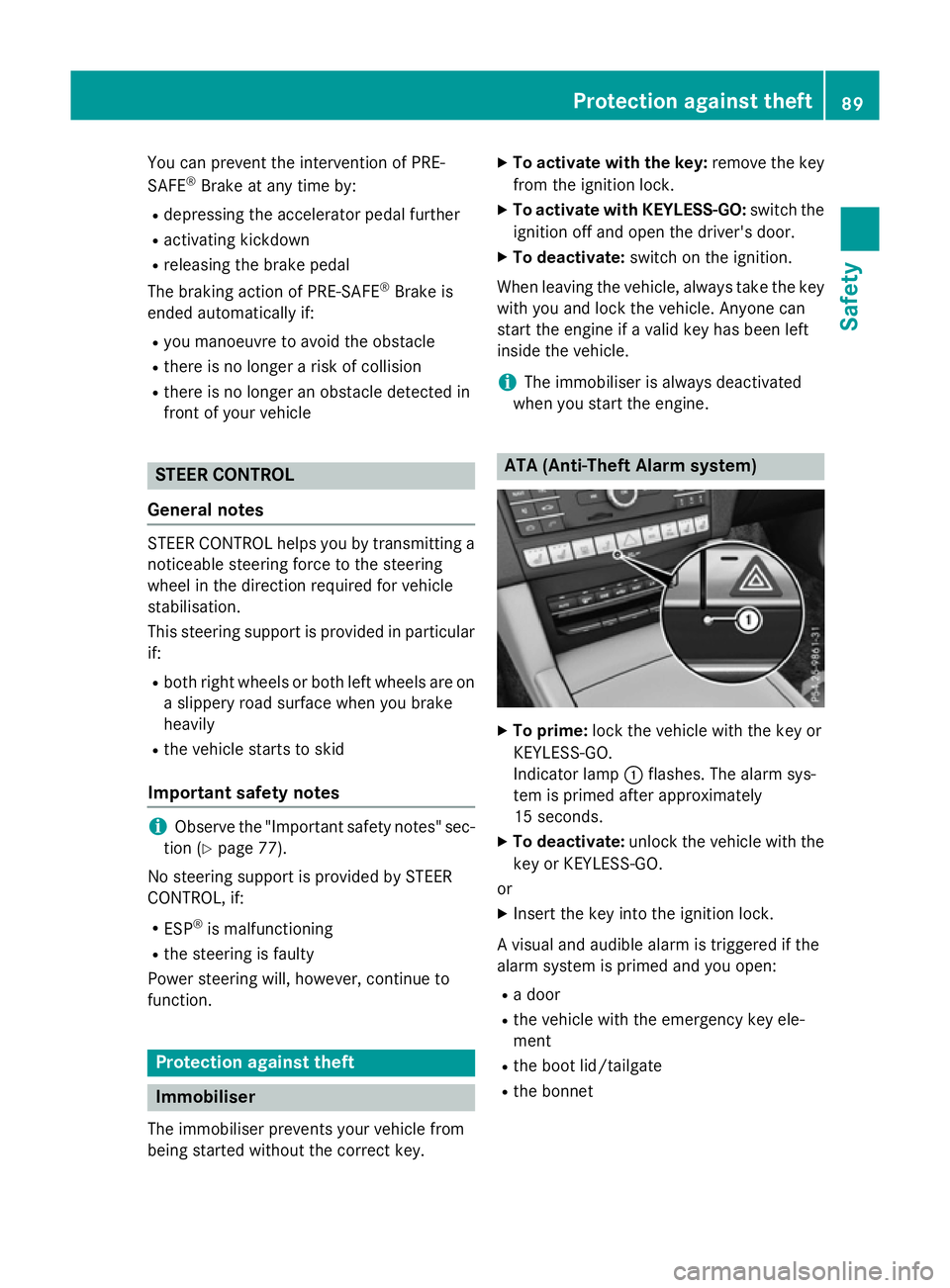
when you star tthe engine. ATA (Anti-Theft Alar
msystem) X
To prime: lock the vehicle with the key or
KEYLESS-GO.
Indicator lamp :flashes .The alarm sys-
tem is prime dafter approximately
15 seconds.
X To deactivate: unlockthe vehicle with the
key or KEYLESS-GO.
or X Insert the key int othe ignition lock.
Av isual and audible alarm is triggered if the
alarm system is primed and you open:
R ad oor
R the vehicle with the emergenc ykey ele-
ment
R the boot lid/tailgate
R the bonnet Protection against theft
89Safety Z
Page 97 of 497
Useful information
i This Owner's Manual describes all mod-
els, series and optional equipment for your
vehicle that were available at the time of
going to press. National variation sare pos-
sible. Not ethat your vehicle may not be
equipped with all of the function sdescri-
bed. This is also the case for system sand
function srelevan ttosafety.
i Read the information on qualified special-
ist workshops: (Y page 27). Key
Important safet
ynotes
United Kingdom only: G
WARNING
When the double lock sare activated, the
doors can no longer be opened from the
inside. People in the vehicle can no longer get out, e.g. in hazardous situations. There is a
risk of injury.
Therefore, do not leave any people unsuper-
vised in the vehicle, particularly children ,eld-
erly people or people in need of special assis-
tance. Do not activate the double lock when
people are in the vehicle.
If the vehicle has been locked from the out-
side, the double lock function is activated as
standard. It is then not possible to open the
doors from inside the vehicle. You can deac-
tivat ethe double lock function by deactivat-
ing the interior motion sensor (Y page 91).
The doors can then be opened from the inside after the vehicle has been locked from the
outside.
The anti-theft alarm system is triggered if thedoor is opened from the inside. Switc hoff the
alarm (Y page 89).
All countries: G
WARNING
If children are left unsupervised in the vehicle, they could:
R open doors, thereby endangering other per-
sons or road users
R get out and be struck by oncoming traffic
R operate vehicle equipment and become
trapped, for example
In addition ,the children could also set the
vehicle in motion, for example, if they:
R release the parkin gbrake
R shift the automatic transmission out of park
position Porshift manual transmission into
neutral
R start the engine
There is arisk of an acciden tand injury.
When leaving the vehicle, always tak ethe key
with you and lock the vehicle. Never leave
children and animals unattended in the vehi-
cle. Keep the keys out of the reach of children. G
WARNING
If you attach heavy or large objects to the key, the key could be unintentionally turned in the
ignition lock .This could cause the engin eto
be switched off. There is arisk of an accident.
Do not attach any heavy or large objects to the
key. Remove any bulky keyrings before insert-
ing the key int othe ignition lock.
! Keep the key away from strong magnetic
fields. Otherwise, the remot econtro lfunc-
tion could be affected.
Stron gmagnetic fields can occur in the
vicinity of powerful electrical installations.
Do not keep the key: R with electronic devices ,e.g. am obile
phone or another key
R with metallic objects, e.g. coin sormetal
film
R inside metallic objects, e.g. ametal case
This can affec tthe key's functionality. 94
KeyOpening and closing