fuel MERCEDES-BENZ E-CLASS SALOON 2015 Service Manual
[x] Cancel search | Manufacturer: MERCEDES-BENZ, Model Year: 2015, Model line: E-CLASS SALOON, Model: MERCEDES-BENZ E-CLASS SALOON 2015Pages: 497, PDF Size: 16.23 MB
Page 404 of 497
ment cluster where it willbee
asily seen by
the driver.
! After use, excess tyre sealant may run out
of the filler hose. This could caus estains.
Therefore, place the filler hose in the plastic
bag which contained the TIREFIT kit. H
Environmental note
Have the used tyre sealant bottle disposed of
professionally, e.g. at aqualified specialist
workshop.
If at yre pressure of 180 kPa (1.8 bar/26 psi)
has been attained after five minutes:
X Switch off the tyre inflation compressor.
X Unscrew the filler hose from the valve of
the faulty tyre.
X Stow the tyre sealant bottle, the tyre infla-
tion compresso rand the warning triangle.
X Pull away immediately.
X Stop after driving for approximatel yten
minutes and check the tyre pressure with
the tyre inflation compressor.
The tyre pressure must now be at least
130 kPa (1.3 bar/19 psi). G
WARNING
If the required tyre pressure is not reached
after driving for ashort period, the tyre is too
badly damaged. The tyre sealant cannot
repair the tyre in this instance. Damage dtyres
and atyre pressure that is too low can signif-
icantly impair the vehicle's braking and driv-
ing characteristics. There is arisk of accident.
Do not continue driving. Contact aqualified
specialist workshop.
i In yourv
ehicle, you willf indasticker with
the Mercedes-Benz Service24h telephone
number, e.g. on the B-pillar on the driver's
side.
X Correct the tyre pressure if it is still at least
130 kPa (1.3 bar/19 psi). See the fuel filler
flap for values.
X To increase the tyre pressure: switch on
the tyre inflation compressor. X
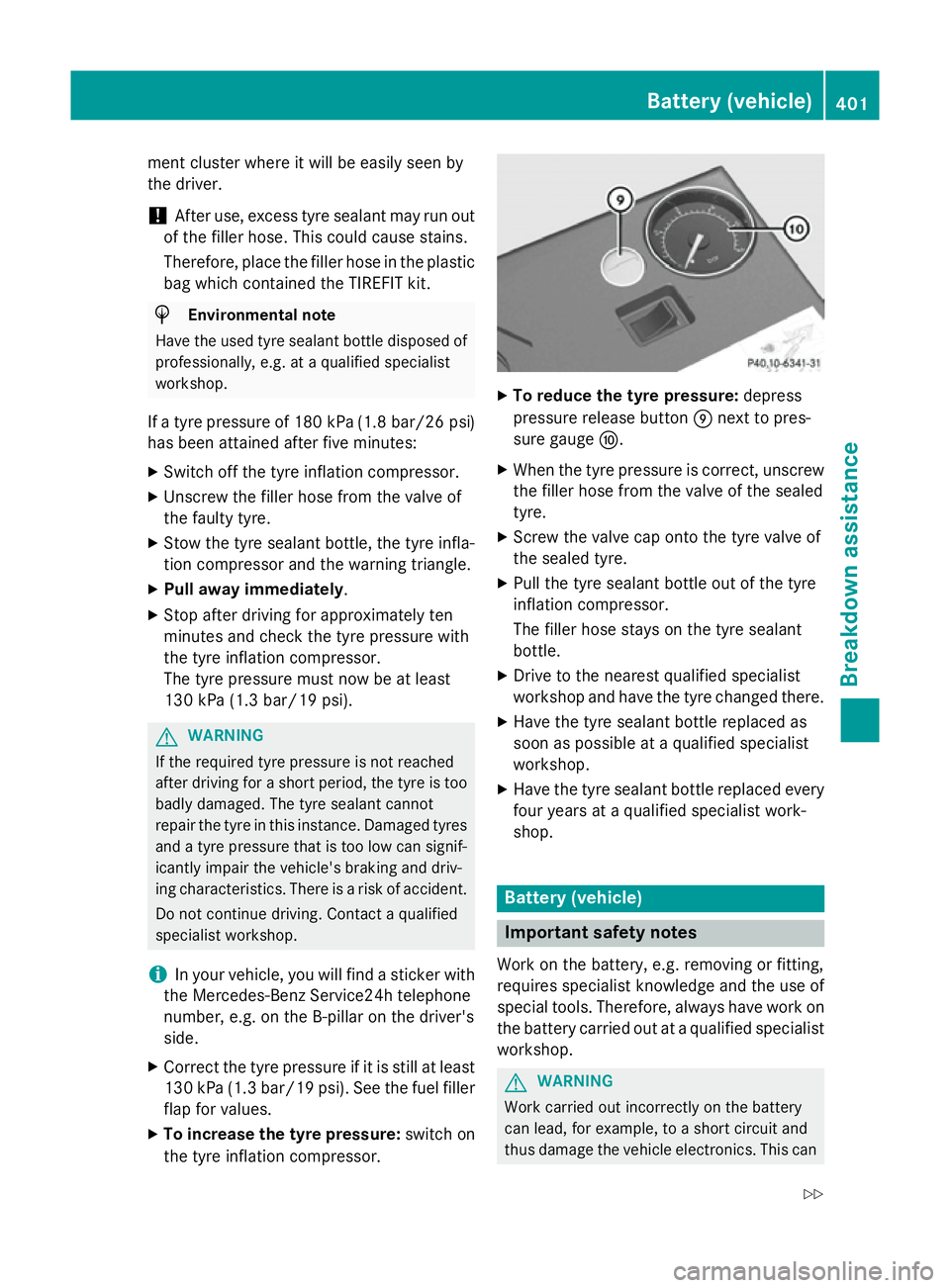
To reduce the tyre pressure: depress
pressure release button Enext to pres-
sure gauge F.
X When the tyre pressure is correct, unscrew
the filler hose from the valve of the sealed
tyre.
X Screw the valve cap onto the tyre valve of
the sealed tyre.
X Pullt he tyre sealant bottle out of the tyre
inflation compressor.
The filler hose stays on the tyre sealant
bottle.
X Drive to the nearest qualified specialist
workshop and have the tyre changed there.
X Have the tyre sealant bottle replaced as
soon as possible at aqualified specialist
workshop.
X Have the tyre sealant bottle replaced every
four years at aqualified specialist work-
shop. Battery (vehicle)
Important safety notes
Work on the battery ,e.g. removing or fitting,
requires specialist knowledge and the use of
specia ltools. Therefore, alwaysh ave work on
the battery carrie dout at aqualified specialist
workshop. G
WARNING
Work carried out incorrectly on the battery
can lead, for example, to ashort circuit and
thus damage the vehicl eelectronics. This can Battery (vehicle)
401Breakdown assistance
Z
Page 408 of 497
Jump-starting
For the jump-starting procedure, use only the jump-starting connection point, consisting of a positive terminal and an earth point, in the engine compartment. G
WARNING
Battery acid is caustic. There is arisk of injury.
Avoid contact with the skin, eyes or clothing. Do not breathe in any battery gases. Do not lean over the battery. Keep the batteries out of the reach of children. Immediately rinse off battery acid
thoroughly with plenty of clean water and seek medical attention at once. G
WARNING
During charging and jump-starting, explosive gases can escape from the battery. There is arisk
of an explosion.
Particularly avoid fire, naked flames, creating sparks and smoking. Ensure there is sufficient
ventilation while charging and jump-starting. Do not lean over abattery. G
WARNING
During the charging process, abattery produces hydrogen gas. If ashort circuit occurs or sparks
are created, the hydrogen gas can ignite. There is arisk of an explosion.
R Make sure that the positive terminal of aconnected battery does not come into contact with
vehicle parts.
R Never place metal objects or tools on abattery.
R It is important that you observe the described order of the battery terminals when connecting
and disconnecting abattery.
R When jump-starting, make sure that the battery poles with identical polarity are connected.
R It is particularly important to observe the described order when connecting and disconnecting
the jump leads.
R Never connect or disconnectt he battery terminals while the engine is running.G
WARNING
Ad ischarged battery can freeze at temperatures below freezing point. When jump-starting the
vehicle or charging the battery, gases can escape from the battery. There is arisk of an explosion.
Allow the frozen battery to thaw out before charging it or jump-starting.
! Vehicles with
apetrol engine: avoid repeated and lengthy startinga ttempts. Otherwise,
the non-combusted fuel may damage the catalytic converter.
HYBRID vehicles: make sure that you read the "HYBRID" Supplement included in the vehicle
literature. You could otherwise fail to recognise dangers, e.g. due to high voltage. Jump-starting
405Breakdown assistance Z
Page 419 of 497
Useful information
i This Owner's Manual describes all mod-
els, series and optional equipment for your
vehicle that were available at the time of
going to press. National variation sare pos-
sible. Not ethat your vehicle may not be
equipped with all of the function sdescri-
bed. This is also the case for system sand
function srelevan ttosafety.
i Read the information on qualified special-
ist workshops: (Y page 27). Important safet
ynotes G
WARNING
If wheels and tyres of the wrong size are used, the wheel brakes or suspensio ncomponents
may be damaged. There is arisk of an acci-
dent.
Always replace wheels and tyres with those
that fulfil the specification softhe original
part.
When replacin gwheels, make sure to fit the
correct:
R designation
R type
When replacin gtyres, make sure to fit the
correct:
R designation
R manufacturer
R type G
WARNING
Af lat tyre severely impairs the driving, steer-
ing and brakin gcharacteristic softhe vehicle.
There is arisk of accident.
Tyres without run-flat characteristics:
R do not drive with aflat tyre.
R immediately replace the flat tyre with your
emergency spare wheel or spare wheel, or
consult aqualified specialist workshop. Tyres with run-flat characteristics:
R pay attention to the information and warn-
ing notices on MOExtended tyres (tyres
with run-flat characteristics).
Accessories that are not approved for your
vehicle by Mercedes-Benz or are not being
used correctly can impair the operating
safety.
Before purchasin gand using non-approved
accessories, visit aqualified specialist work-
shop and enquire about:
R suitability
R legal stipulations
R factory recommendations
Information on the sizes and types of wheels
and tyres for your vehicle can be found under
"Wheel/tyre combinations" (Y page 431).
Information on tyre pressures can be found:
R on the tyre pressure label on the fuel filler
flap (Y page 202)
R under "Tyre pressure" (Y page 420)
Modification work on the brake system and
wheels is not permitted. The use of wheel
spacers or brake dust shields is not permit-
ted. This invalidates the general operating
permit for the vehicle.
i Further information on wheels and tyres
can be obtained at any qualified specialist
workshop. Operation
Information on driving
Check the tyre pressures when the vehicle is
heavily laden and adjust prior to atrip.
While driving, pay attention to vibrations,
noises and unusual handling characteristics,
e.g. pulling to one side. This may indicat ethat
the wheels or tyres are damaged. If you sus-
pect that atyre is defective, reduce your
speed immediately. Stop the vehicle as soon
as possible to chec kthe wheels and tyres for
damage. Hidden tyre damage could also be 416
OperationWheels and tyres
Page 423 of 497
This way you can allow the wheels to spin in
ac ontrolled manner ,achieving increased
driving force (cutting action).
Further information on driving with the emer-
gency spare wheel (Y page 465).Tyrep
ressure Tyrep
ressure specifications G
WARNING
Tyres with insufficien torexcessiv etyre pres-
sure harbour the following hazards:
R the tyres may burst, especially as the load
and vehicle speed increase.
R the tyres may wear excessively or unevenly
which can severely impair tyre traction.
R the handling as well as steerin gand braking
characteristics may be severely affected.
There is arisk of an accident.
Observe the recommended tyre pressures
and check the tyre pressure of all the tyres
including the spare wheel:
R every day before starting ajourney
R when the load changes
R prior to long journey
R for changed operating conditions, e.g. off-
road driving
If necessary, correc tthe tyre pressure. G
WARNING
If you fit unsuitable accessories ontot yre
valves, the tyre valves may be overloaded and malfunction, which can cause tyre pressure
loss. Due to their design, retrofitted tyre pres-
sure monitors keep the tyre valve open. This
can also result in tyre pressure loss. There is a risk of accident.
Only screw standard valve caps or valve caps
specifically provided by Mercedes-Benz for
your vehicle ontot he tyre valve. G
WARNING
If the tyre pressure drops repeatedly, the
wheel, valve or tyre may be damaged. Tyre
pressure that is too low may result in atyre
blow-out. There is arisk of accident.
R Check the tyre for foreign objects.
R Check whether the wheel is losing air or the
valve is leaking.
If you are unable to rectify the damage, con-
tact aqualified specialist workshop. H
Environmenta
lnote
Check the tyre pressure regularly, at least
every 14 days.
You will find atable of tyre pressures for var-
ious operating conditions on the tyre pres-
sure label on the inside of your vehicle's fuel
filler flap (Y page 202).
Operation with an emergency spare
wheel: information on operation with an
emergenc yspare wheel can be found in the
general notes in the "Emergency spare wheel" section (Y page 465).
Operation with atrailer: the applicable
value for the rear tyres is the maximum tyre
pressure value stated in the table inside the
fuel filler flap.
The table of tyre pressures may also state tyre
pressures for different load conditions. These are defined in the table as different numbers
of passengers and amounts of luggage. The
actual number of seats may vary; for more
information, please refer to the vehicle's reg- istration documents.
If tyre sizes are not specified, the tyre pres-
sures stated on the tyre pressure information
label apply for all tyres approved for this vehi- cle. 420
Tyrep
ressureWheels and tyres
Page 424 of 497
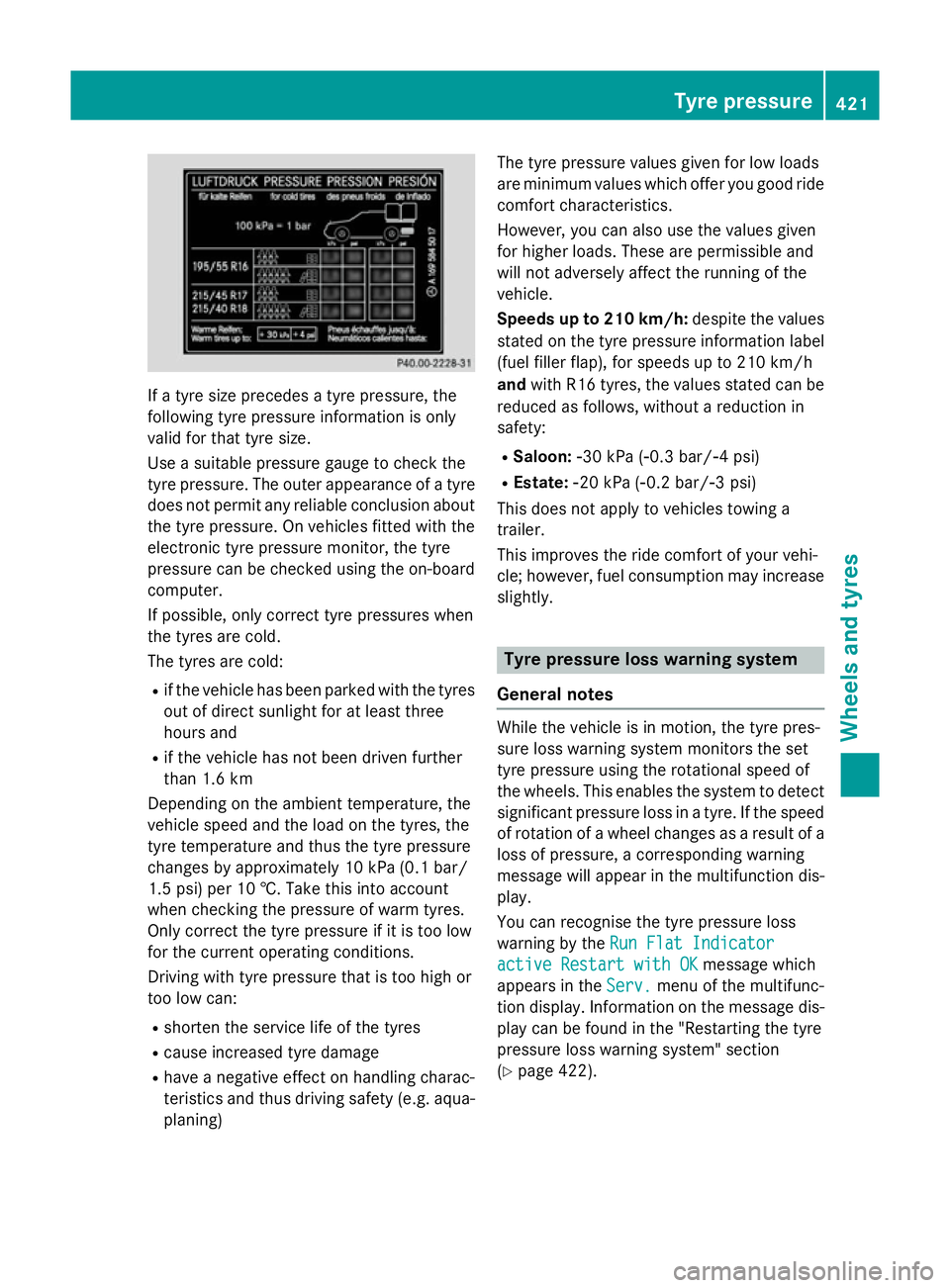
If
at yre size precedes atyre pressure, the
following tyre pressure information is only
validf or that tyre size.
Use asuitable pressure gauge to check the
tyre pressure. The outer appearance of atyre
does not permit any reliable conclusion about the tyre pressure. On vehicle sfitted with the
electronic tyre pressure monitor, the tyre
pressure can be checked using the on-board
computer.
If possible, only correct tyre pressures when
the tyres are cold.
The tyres are cold:
R if the vehicle has been parked with the tyres
out of direct sunlight for at least three
hours and
R if the vehicle has not been driven further
than 1.6 km
Depending on the ambient temperature ,the
vehicle speed and the loadont he tyres, the
tyre temperature and thus the tyre pressure
changes by approximately 10 kPa (0. 1bar/
1.5 psi )per 10 †. Take this into account
when checking the pressure of warm tyres.
Only correct the tyre pressure if it is too low
for the current operating conditions.
Driving with tyre pressure that is too high or
too low can:
R shorten the service life of the tyres
R cause increased tyre damage
R have anegative effect on handling charac-
teristics and thus driving safety (e.g. aqua-
planing) The tyre pressure values given for low loads
are minimum values which offer you good ride
comfort characteristics.
However, you can also use the values given
for higherl oads. These are permissible and
willn ot adversely affect the running of the
vehicle.
Speeds up to 210 km/h: despite the values
stated on the tyre pressure information label (fuel filler flap), for speedsupt o210 km/h
and with R16 tyres, the values stated can be
reduced as follows, withou tareduction in
safety:
R Saloon: Ò30 kPa (Ò0.3 bar/Ò4p si)
R Estate: Ò20 kPa (Ò0.2 bar/Ò3p si)
This does not apply to vehicle stowing a
trailer.
This improves the ride comfort of yourv ehi-
cle; however, fuel consumption may increase slightly. Tyre pressure lossw
arning system
General notes Whilet
he vehicle is in motion, the tyre pres-
sure loss warning system monitors the set
tyre pressure using the rotational speed of
the wheels. This enables the system to detect significant pressure loss in atyre. If the speed
of rotation of awhee lchanges as aresultofa
loss of pressure, acorresponding warning
messag ewilla ppear in the multifunction dis-
play.
You can recognise the tyre pressure loss
warning by the Run Flat Indicator Run Flat Indicator
active Restart with OK
active Restart with OK messagewhich
appears in the Serv.
Serv.menu of the multifunc-
tion display.I nformation on the messag edis-
playc an be found in the "Restarting the tyre
pressure loss warning system" section
(Y page 422). Tyre pressure
421Wheelsand tyres Z
Page 425 of 497
Important safety notes
The tyr
epressur ewarning system does not
warn you of an incorrectl yset tyr epressure.
Observ ethe note sont herecommended tyre
pressur e(Ypage 420).
The tyr epressur eloss warning does not
replace th eneedtor egularly chec kthe tyre
pressures. An eve nloss of pressur eonsev-
eral tyres at th esame time canno tbedetec-
te dbyt hetyrep ressur eloss warning system.
The tyr epressur emonitor is no table to warn
you of asudde nloss of pressure, e.g. if the
tyr eisp enetrated by aforeign object. In the
event of asudde nloss of pressure, brin gthe
vehicl etoah alt by braking carefully. Avoid
abrup tsteering manoeuvres.
The function of th etyrep ressur eloss warning
system is limited or delayed if:
R snow chains are fitte dtoyour vehicle's
tyres.
R road condition sare wintry.
R you are driving on san dorgravel.
R you adopt averys port ydriving style (cor-
nerin gath igh speeds or driving wit hhigh
rates of acceleration).
R you are towin gaveryh eav yorl argetrailer.
R you are driving wit haheavyload (in the
vehicl eoront heroof).
Restarting th etyrep ressure loss warn-
ing system Restart th
etyrep ressur eloss warning system
if you have:
R changed th etyrep ressure
R changed th ewheels or tyres
R fitte dnew wheels or tyres
X Befor erestarting ,makes ure that th etyre
pressures are set properly on all four tyres
for th erespective operating conditions.
The recommended tyr epressures can be
foun dint hetyrep ressur etable on th efuel
filler flap.
The tyr epressur eloss warning system can
only giv ereliable warning sifyou have set th
ec orrect tyrep ressure. If an incorrect
tyr ep ressur eisset,the se incorrec tvalues
will be monitored.
X Observ ethe note sint hesection on tyre
pressures (Y page 420).
X Mak esure that th ekeyis in position 2in the
ignition loc k(Ypage 179).
X Press the =or; buttononthesteer-
ing whee ltos elect the Serv.
Serv. menu.
X Press the 9or: buttononthesteer-
ing whee ltos elect the Tyrep ressure
Tyr ep ressure
menu.
X Press the abutton.
The Run Fla tIndicator active
Run Fla tIndicator active
Restart Restart with
withOK
OKmessage appear sinthe
multifunction display.
If you wish to confirm th erestart:
X Press the abutton.
The Tyrep ress. now OK?
Tyr ep ress. now OK? message
appear sinthemultifunction display.
X Press the 9or: buttontos elect
Yes
Yes .
X Press the abutton.
The Run Fla tIndicator restarted
Run Fla tIndicator restarted
message appear sinthemultifunction dis-
play.
Afte rateach-in period, th etyrep ressure
loss warning system will monitor th eset
tyr ep ressures of all four tyres.
If you wish to cance lthe restart:
X Press the %button.
or
X When the Tyre
Tyre press. press. now
now OK?
OK?message
appears, press the 9or: buttonto
select Cancel
Cancel .
X Press the abutton.
The tyr epressur evalue sstoredatt helast
restar twill continue to be monitored. 422
Tyre pressureWheels and ty
res
Page 427 of 497
phones, two-way radios) that may be being
operated in or near the vehicle.
Checking the tyr epressure electroni-
cally X
Make sure that the key is in position 2
(Y page 179) in the ignition lock.
X Press the =or; button on the steer-
ing wheel to select the Service
Servicemenu.
X Press the 9or: button to select
Tyre pressure
Tyre pressure.
X Press the abutton.
The curren ttyre pressure for each wheel
will be displayed in the multifunction dis-
play.
If the vehicle has been parked for over
20 minutes, the Tyre Tyrepressures
pressures will
willbe
be
displayed after afew minute sof
displayed after afew minute sof
driving
driving message appears.
After ateach-in period, the tyre pressure
monitor automatically detects new wheels or new sensors. As long as aclear allocation of
the tyre pressure values to the individual
wheels is not possible, the Tyre pressure Tyre pressure
monito ractive
monito ractive display message is shown
instead of the tyre pressure display. The tyre
pressures are already being monitored.
If an emergency spare wheel is fitted, for a
few minutes the system may continue to
show the tyre pressure of the wheel that has
been removed. If this occurs, not ethat the
value displayed for the position where the
spare wheel is fitted is not the same as the
curren ttyre pressure of the emergency spare
wheel.
Warning messages of the tyr epressure
monitor If the tyre pressure monitor detects
apres-
sure loss in one or more tyres, awarning mes-
sage is shown in the multifunction display and
the yellow tyre pressure monitor warning
lamp comes on.
R If the Please correc ttyre pressure
Please correc ttyre pressure
message appears in the multifunction dis- play, the tyre pressure in at least one tyre is
too low and must be corrected at the next
opportunity.
R If the Check tyre(s) Check tyre(s) message appears in
the multifunction display, the tyre pressure in one or more tyres has dropped signifi-
cantly and the tyres must be checked.
R If the Warnin gtyre defect
Warnin gtyre defect message
appears in the multifunction display, the
tyre pressure in one or more tyres has drop-
ped suddenly and the tyres must be
checked.
Observ ethe instructions and safety notes in
the display messages in the "Tyres" section
(Y page 322).
If the wheel position sonthe vehicle are inter-
changed, the tyre pressures may be displayed for the wrong position sfor as hort time. After
af ew minutes of driving, this is rectified and
the tyre pressures are displayed for the cor-
rect positions.
Restarting the tyr epressure monitor When you restart the tyre pressure monitor,
all existing warning messages are deleted and
the warning lamps go out. The monitor uses
the currently set tyre pressures as the refer-
enc evalues for monitoring. In most cases, the
tyre pressure monitor will automatically
detec tthe new referenc evalues after you
have changed the tyre pressure. However,
you can also define referenc evalues man-
ually as described here. The tyre pressure
monitor then monitors the new tyre pressure values.
X Use the table on the inside of the fuel filler
flap to ensure that the tyre pressure is set
correctly in all four tyres for the current
operatin gconditions.
Also observe the notes in the section on
tyre pressures (Y page 420).
X Make sure that the key is in position 2in the
ignition lock.
X Press the =or; button on the steer-
ing wheel to select the Service Servicemenu. 424
Tyrep
ressureWheels and tyres
Page 434 of 497
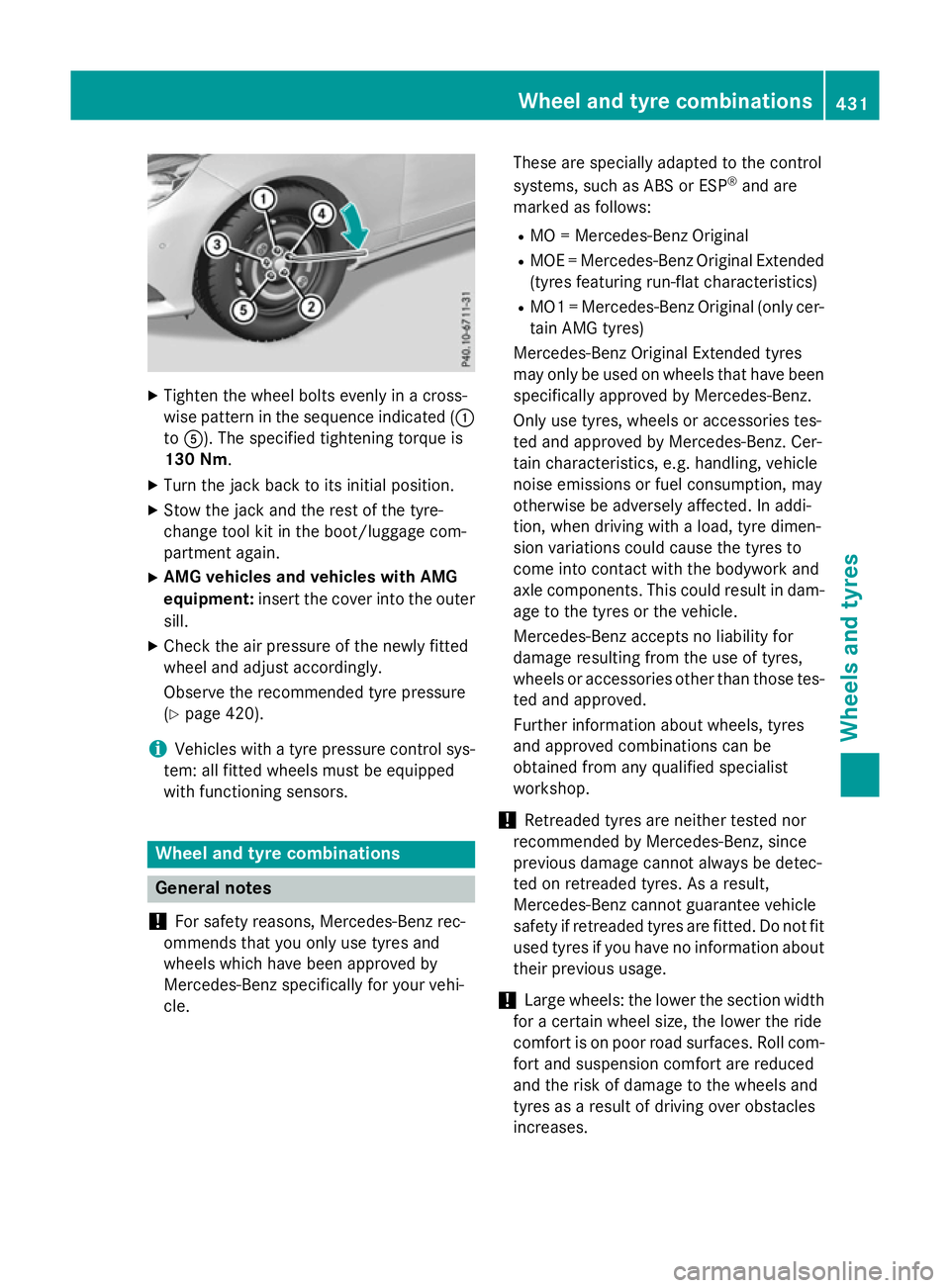
X
Tighten the wheel bolts evenly in across-
wise pattern in the sequence indicated ( :
to A). The specified tightening torque is
130 Nm.
X Turn the jack back to its initial position.
X Stow the jack and the rest of the tyre-
change tool kit in the boot/luggage com-
partmen tagain.
X AMG vehicles and vehicles with AMG
equipment: insert the cover into the outer
sill.
X Check the air pressure of the newly fitted
wheel and adjust accordingly.
Observe the recommended tyre pressure
(Y page 420).
i Vehicles with
atyre pressure control sys-
tem: all fitted wheels must be equipped
with functioning sensors. Wheel and tyrec
ombinations General notes
! For safety reasons, Mercedes-Benz rec-
ommends that you only use tyres and
wheels which have been approved by
Mercedes-Benz specifically for your vehi-
cle. These are specially adapted to the control
systems, such as ABS or ESP
®
and are
marked as follows:
R MO =Mercedes-Benz Original
R MOE =Mercedes-Benz Original Extended
(tyres featuring run-flat characteristics)
R MO1 =Mercedes-Benz Original (only cer-
tain AMG tyres)
Mercedes-Benz Original Extended tyres
may only be used on wheels that have been
specifically approved by Mercedes-Benz.
Only use tyres, wheels or accessories tes-
ted and approved by Mercedes-Benz.C er-
tain characteristics, e.g. handling, vehicle
noise emissions or fuel consumption, may
otherwise be adversely affected. In addi-
tion, when driving with aload, tyre dimen-
sion variations could cause the tyres to
come into contact with the bodywork and
axle components. This could result in dam- age to the tyres or the vehicle.
Mercedes-Benz accepts no liability for
damage resulting from the use of tyres,
wheels or accessories other than those tes-
ted and approved.
Further information about wheels, tyres
and approved combinations can be
obtained from any qualified specialist
workshop.
! Retreaded tyres are neither tested nor
recommended by Mercedes-Benz,s ince
previous damage cannot alway sbedetec-
ted on retreaded tyres. As aresult,
Mercedes-Benz cannot guarantee vehicle
safety if retreaded tyres are fitted. Do not fit
used tyres if you have no information about their previous usage.
! Large wheels: the lower the section width
for acertain wheel size, the lower the ride
comfor tisonp oor road surfaces. Roll com-
fort and suspension comfor tare reduced
and the risk of damage to the wheels and
tyres as aresult of driving over obstacles
increases. Wheel and tyrec
ombinations
431Wheels and tyres Z
Page 435 of 497
Overview of abbreviations used in the follow-
ing tyre tables:
R BA: both axles
R FA: front axle
R RA: rear axle
You will find atable with recommended tyre
pressures for various operating conditions on
the inside of your vehicle's fuel filler flap. For
further information on tyre pressure, see
(Y page 420). Check tyre pressures regularly
and only when the tyres are cold.
Notes on the vehicle equipment –always fit
the vehicle:
R with tyres of the same size on agiven axle
(left/right)
R with the same type of tyres at agiven time
(summer tyres, winter tyres, MOExtended
tyres)
Exception: it is permissibletof itad ifferent
type or make in the event of aflat tyre.
Observe the "MOExtended tyres (tyres with
run-flat characteristics)" section
(Y page 398).
Vehicles with MOExtended tyres are not
equipped with aTIREFIT kit at the factory. It is
therefore recommended that you additionally equipy our vehicle with aTIREFIT kit if you fit
tyres that do not feature run-flat characteris-
tics, e.g. winter tyres. ATIREFIT kit can be
obtained from aqualified specialist work-
shop.
i Not all wheel/tyre combinations can be
fitted at the factory in all countries. 432
Wheel and tyrec
ombinationsWheels and tyres
Page 476 of 497
X
Slide the right-hand front sea ttoits rear-
mos tposition.
X Fol dfloor covering :upwards.
VIN ;can be seen. Engine number
The engine number is stampe dinto the crank-
case. Yo ucan obtain further information from
any qualified specialist workshop. Servic
eproducts and capacities Important safety notes
G
WARNING
Service product can be poisonous and haz-
ardou stohealth. There is ariskofi njury.
Observe the instructions on the respective
original containe rwhenu sing ,storing and dis-
posing off service products. Alway sstore ser-
vice products in the seale doriginal container.
Alway skeep service products ou tofthe reach
of children. H
Environmental note
Dispose of service products in an environ-
mentally-responsible manner.
Service products includ ethe following:
R fuels
R exhaus tgas aftertreatment additives, e.g.
AdBlue ®
R lubricants (e.g. engine oil, transmissio noil)
R coolant
R brake fluid
R windscreen washe rfluid
R climate control system refrigerant
Components and service products mus tbe
matched .Only us eproducts recommended
by Mercedes-Benz. Damage which is caused
by the us eofproducts which have not been
recommended is not covered by the
Mercedes-Benz warranty or goodwil lges- tures. The
yare listed in this Mercedes-Benz
Owner's Manua linthe appropriate section.
Yo uc an identif yservice products approved
by Mercedes-Benz by the following inscrip-
tions on the container:
R MB-Freigab e(e.g. MB-Freigab e229.51)
R MB Approva l(e.g. MB Approva l229.51)
Othe rdesignations or recommendations indi-
cate alevel of quality or aspecification in
accordance with an MB Shee tNum ber(e.g.
MB 229.5) .The yh aven ot necessaril ybeen
approved by Mercedes-Benz.
Othe ride ntifications ,for example:
R 0W -30
R 5W -30
R 5W -40
Further information can be obtaine dfrom any
Mercedes-Benz Service Centre or on the
Interne tath ttp://bevo.mercedes-benz.com. Fuel
Important safety notes G
WARNING
Fue lish ighl yf lammable. If yo uhandlef uel
incorrectly, ther eisariskoff irea nd explo-
sion.
Yo um usta void fire, nake dflames ,creating
sparks and smoking. Switch off the engine
and ,ifa pplicable, the auxiliary heating before
refuelling. G
WARNING
Fuels are poisonous and hazardou stohealth.
There is adanger of injury.
Do not swallo wfuelorl etit come into contact
with skin, eyes or clothing .Donot inhale fuel
vapours. Kee pfuels ou tofthe reach of chil-
dren. Servic
eproducts and capacities
473Technical data
Z