ESP MERCEDES-BENZ E-CLASS WAGON 2001 W210 Owner's Manual
[x] Cancel search | Manufacturer: MERCEDES-BENZ, Model Year: 2001, Model line: E-Class WAGON, Model: MERCEDES-BENZ E-Class WAGON 2001 W210Pages: 345, PDF Size: 16.08 MB
Page 6 of 345

3 Contents
DrivingControl and operation of radio
transmitters ............................... 184
The first 1 000 miles
(1 500 km) ................................. 185
Maintenance ................................... 185
Tele Aid............................................ 186
Catalytic converter......................... 196
Emission control ............................ 197
Steering lock ................................... 198
Starting and turning off
the engine .................................. 200
Automatic transmission................ 201
Parking brake ................................. 210
Driving instructions ...................... 211
Drive sensibly -
Save Fuel ..................................... 211
Drinking and Driving ................ 211
Pedals ........................................... 211
Power assistance ........................ 212
Brakes .......................................... 212
Driving off ................................... 213
Parking ........................................ 213Tires ..............................................214
Snow chains ................................ 216
Winter driving instructions ......217
Block heater .................................218
Deep water ...................................219
Passenger compartment ............219
Traveling abroad ......................... 219
Cruise control ................................ 220
Brake assist system
(BAS)........................................... 223
Antilock brake system
(ABS) .......................................... 225
Four wheel electronic
traction system (4MATIC) ....... 227
Electronic stability program
(ESP) ........................................... 228
Parking assist (Parktronic) .......... 232
What you should know
at the gas station ...................... 237
Check regularly and before
a long trip .................................. 239
Instrument cluster displayMalfunction and indicator
lamps in the
instrument cluster .................... 242
On-board
diagnostic system .......................242
Check engine malfunction
indicator lamp .............................242
Brake warning lamp ..................243
Supplemental restraint
system (SRS)
indicator lamp .............................244
Fuel reserve and fuel cap
placement warning ....................244
Electronic stability program
(ESP) — warning lamp ...............245
BAS / ESP malfunction
indicator lamp .............................245
ABS malfunction
indicator lamp .............................245
Seat belt warning lamp .............246
Malfunction and indicator
lamp in the center console ...... 246
Page 10 of 345

7 IntroductionProduct information
Kindly observe the following in your own best interest:
We recommend using Mercedes-Benz original parts as well as conversion parts and accessories
explicitly approved by us for your vehicle model.
We have tested these parts to determine their reliability, safety and their special
suitability for Mercedes-Benz vehicles.
We are unable to make an assessment for other products and therefore cannot be held responsible
for them, even if in individual cases an official approval or authorization by governmental or other
agencies should exist. Use of such parts and accessories could adversely affect the safety, performance
or reliability of your vehicle. Please do not use them.
Mercedes-Benz original parts as well as conversion parts and accessories approved by us are available
at your authorized Mercedes-Benz Center where you will receive comprehensive information, also on
permissible technical modifications, and where proper installation will be performed.
Page 23 of 345
20 Instruments and controls
Te ch n ica l
data Instruments
and controlsOperation DrivingInstrument
cluster displayPractical hints Car care Index
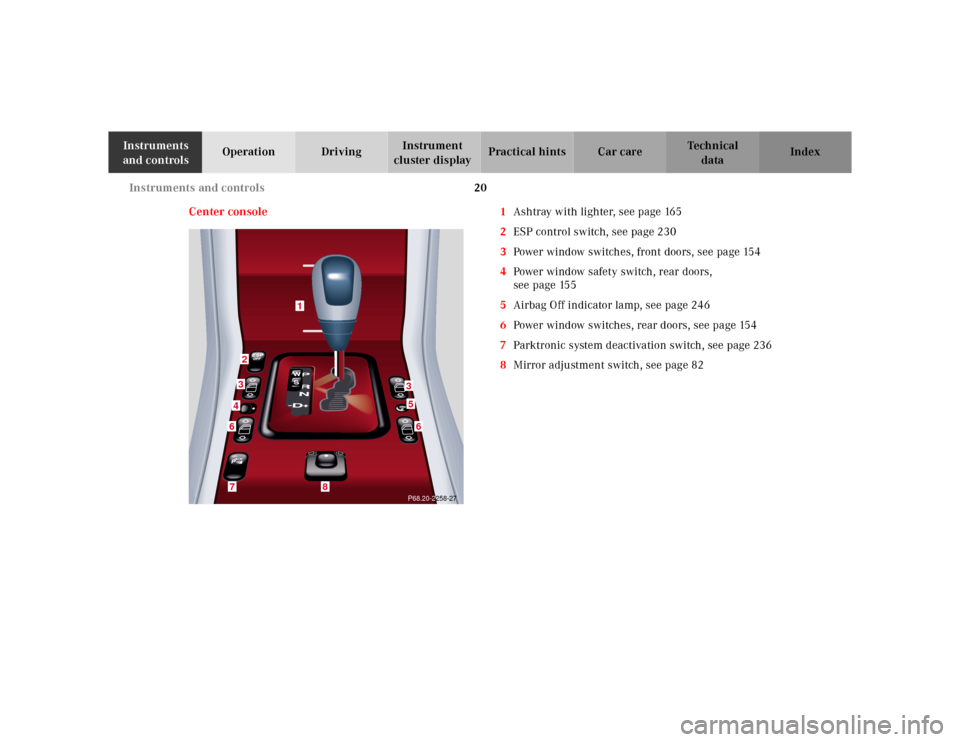
Center console 1Ashtray with lighter, see page 165
2ESP control switch, see page 230
3Power window switches, front doors, see page 154
4Power window safety switch, rear doors,
seepage155
5Airbag Off indicator lamp, see page 246
6Power window switches, rear doors, see page 154
7Parktronic system deactivation switch, see page 236
8Mirror adjustment switch, see page 82
356
6432
1
7
8
P68.20-2258-27
Page 36 of 345
33 Central locking system
Te ch n ica l
data Instruments
and controlsOperationDrivingInstrument
cluster displayPractical hints Car care Index Panic button
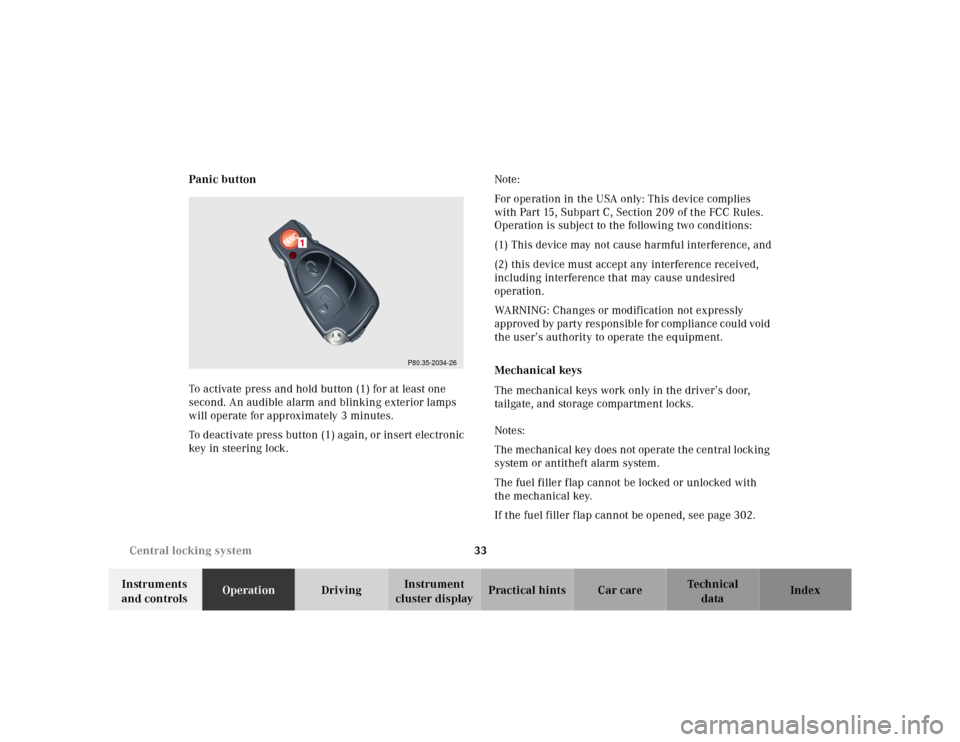
To activate press and hold button (1) for at least one
second. An audible alarm and blinking exterior lamps
will operate for approximately 3 minutes.
To deactivate press button (1) again, or insert electronic
key in steering lock.Note:
For operation in the USA only: This device complies
with Part 15, Subpart C, Section 209 of the FCC Rules.
Operation is subject to the following two conditions:
(1) This device may not cause harmful interference, and
(2) this device must accept any interference received,
including interference that may cause undesired
operation.
WARNING: Changes or modification not expressly
approved by party responsible for compliance could void
the user’s authority to operate the equipment.
Mechanical keys
The mechanical keys work only in the driver’s door,
tailgate, and storage compartment locks.
Notes:
The mechanical key does not operate the central locking
system or antitheft alarm system.
The fuel filler flap cannot be locked or unlocked with
the mechanical key.
If the fuel filler flap cannot be opened, see page 302.
P80.35-2034-26
Page 37 of 345
34 Central locking system
Te ch n ica l
data Instruments
and controlsOperationDrivingInstrument
cluster displayPractical hints Car care Index
Doors
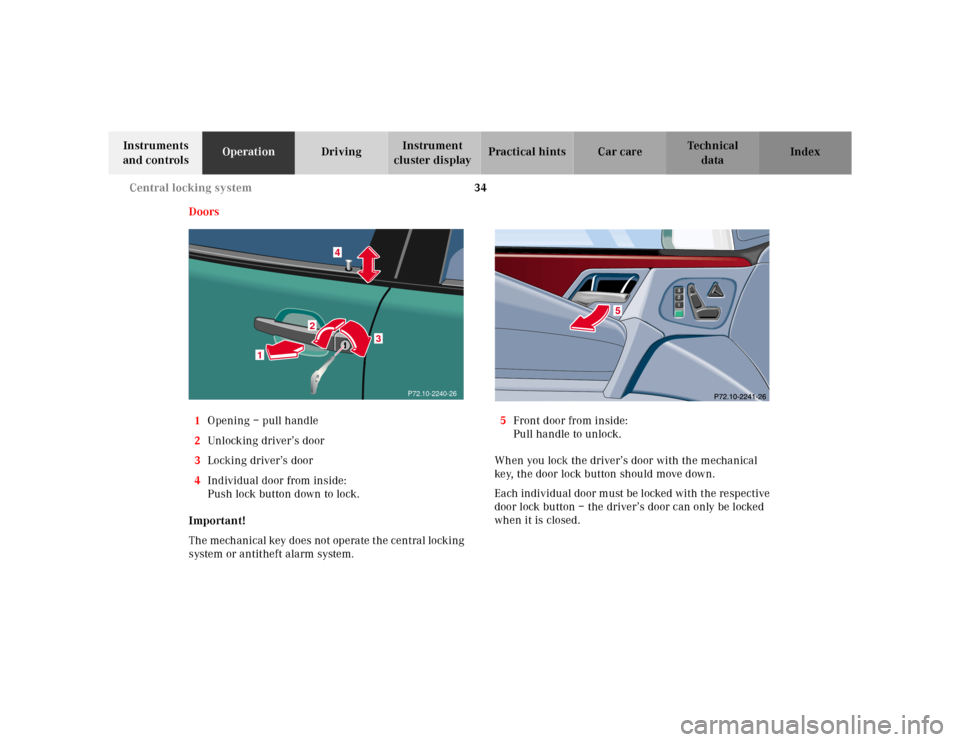
1Opening – pull handle
2Unlocking driver’s door
3Locking driver’s door
4Individual door from inside:
Push lock button down to lock.
Important!
The mechanical key does not operate the central locking
system or antitheft alarm system.5Front door from inside:
Pull handle to unlock.
When you lock the driver’s door with the mechanical
key, the door lock button should move down.
Each individual door must be locked with the respective
door lock button – the driver’s door can only be locked
when it is closed.
1
2
3
4
P72.10-2240-26
Page 43 of 345
40 Central locking system
Te ch n ica l
data Instruments
and controlsOperationDrivingInstrument
cluster displayPractical hints Car care Index
Important!
In case of danger, the closed tailgate can be opened with
the inside or outside handle.
Only drive with the tailgate closed as otherwise exhaust
fumes may enter the vehicle interior.Notes:
In case of a malfunction in the central locking system
the tailgate can be locked and unlocked individually.
To unlock, turn mechanical key in lock to position 1, or
push lock button to position 1.
To lock, turn mechanical key in lock to position 2, or
push lock button to position 2.
The rear compartment lamp will be switched off by the
contact switch only if the tailgate is fully closed.
When opening the tailgate completely, always make sure
that there is sufficient overhead clearance.
When unlocking the tailgate with the mechanical key,
the exterior lamps will flash and the alarm will sound.
To cancel the alarm, insert the electronic key in the
steering lock or press buttonŒ or‹ on the
electronic main key.
If the fuel filler flap cannot be opened, see page 302.
Wa r n i n g !
To prevent possible personal injury, always keep
hands and fingers away from the tailgate opening
when closing the tailgate. Be especially careful
when small children are around.To prevent personal injury, never activate the
closing assist mechanism by tampering with the
tailgate latch.In case the closing procedure causes potential
danger, the closing procedure can be immediately
halted by pulling the outside recessed handle.
Page 49 of 345
46 Seats
Te ch n ica l
data Instruments
and controlsOperationDrivingInstrument
cluster displayPractical hints Car care Index
Synchronizing head restraints
If the power supply was interrupted (battery
disconnected or empty), the head restraints are no
longer adjusted automatically.
To resynchronize the adjustment feature, turn
electronic key in steering lock to position 2, move the
seat completely forward and the head restraint fully
down, and hold respective buttons for approximately
two seconds.Caution!
Do not remove head restraints except when mounting
seat covers. For removal refer to Head Restraints, Front,
see page 50. Whenever restraints have been removed be
sure to reinstall them before driving.
Page 50 of 345
47 Seats
Te ch n ica l
data Instruments
and controlsOperationDrivingInstrument
cluster displayPractical hints Car care Index Memory function
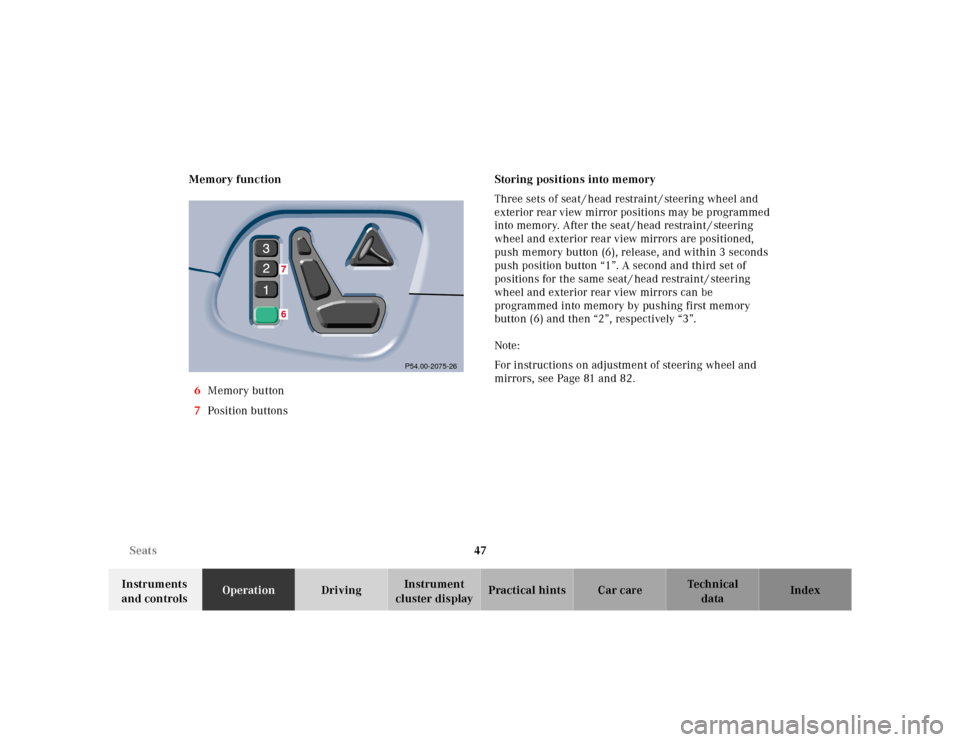
6Memory button
7Position buttonsStoring positions into memory
Three sets of seat / head restraint / steering wheel and
exterior rear view mirror positions may be programmed
into memory. After the seat / head restraint / steering
wheel and exterior rear view mirrors are positioned,
push memory button (6), release, and within 3 seconds
push position button “1”. A second and third set of
positions for the same seat / head restraint / steering
wheel and exterior rear view mirrors can be
programmed into memory by pushing first memory
button (6) and then “2”, respectively “3”.
Note:
For instructions on adjustment of steering wheel and
mirrors, see Page 81 and 82.
76
P54.00-2075-26
Page 78 of 345
75 Restraint systems
Te ch n ica l
data Instruments
and controlsOperationDrivingInstrument
cluster displayPractical hints Car care Index
• Sit properly belted in an upright position with
your back against the backrest.• Adjust the driver’s seat as far as possible
rearward, still permitting proper operation of
vehicle controls. distance from the center of
the driver’s breastbone to the center of the
airbag cover on the steering wheel must be at
least ten inches (25 cm) or more. You should be
able to accomplish this by a combination of
adjustments to the seat and steering wheel. If
you have any problems, please see your
authorized Mercedes-Benz Center.• Do not lean with your head or chest close to the
steering wheel or dashboard.• Keep hands on the outside of steering wheel
rim. Placing hands and arms inside the rim
can increase the risk and potential severity of
hand / arm injury when driver front airbag
inflates.• Adjust the front passenger seat as far as
possible rearward from the dashboard when
the seat is occupied.
• Occupants, especially children, should never
lean their heads in the area of the door where
the side airbag inflates. This could result in
serious injuries or death should the airbag be
triggered. Always sit upright, properly use the
seatbelts and appropriate size infant or child
restraint system• Children 12 years old and under must never
ride in the front seat, except in a Mercedes-
Benz authorized Baby Smart
TM compatible
child seat, which operates with the
BabySmart
TM system installed in the vehicle to
deactivate the passenger front airbag when it
is properly installed. Otherwise they will be
struck by the airbag when it inflates in a crash.
If this happens, serious or fatal injury can
result.
Failure to follow these instructions can result in
severe injuries to you or other occupants.
Page 79 of 345
76 Restraint systems
Te ch n ica l
data Instruments
and controlsOperationDrivingInstrument
cluster displayPractical hints Car care Index
Safety guidelines for the seat belt, emergency
tensioning retractor and airbag
Wa r n i n g !
Accident research shows that the safest place for
children in an automobile is in the rear seat.
Should you choose to place a child 12 years old or
under in the front passenger seat of your vehicle,
you must properly use a BabySmart
TM child
restraint which will turn off the passenger side
front airbag. BabySmart
TM will not, however, turn
off the vehicle’s side impact airbag.
It should be noted that with respect to both front
and rear side impact airbags there is a possibility
for a side airbag related injury if occupants,
especially children, are not properly seated or
restrained when next to a side airbag which needs
to deploy rapidly in a side impact in order to do its
job.To help avoid the possibility of injury, please follow
these guidelines: (1) occupants, especially
children, should never place their bodies or lean
their heads in the area of the door where the side
airbag inflates. This could result in serious
injuries or death should the side airbag be
activated; (2) always sit upright, properly use the
seat belts and use an appropriately sized infant or
child restraint system for all children 12 years old
or under; and (3) always wear seat belts properly.
If you believe that, even with the use of these
guidelines, it would be safer for your rear seat
occupants to have both rear door mounted side
airbags deactivated, then deactivation can be
accomplished upon your written election to do so at
your authorized Mercedes-Benz Center at an
additional cost. Please contact your local
authorized Mercedes-Benz Center or call our Client
Assistance Center at 1-800-FOR-MERCedes
(1-800-367-6372) for details.Wa r n i n g !
• Damaged seat belts or belts that were highly
stressed in an accident must be replaced and
their anchoring points must also be checked.
Use only belts installed or supplied by an
authorized Mercedes-Benz Center.• Do not pass belts over sharp edges.• Do not make any modification that could
change the effectiveness of the belts.