child seat MERCEDES-BENZ E-CLASS WAGON 2018 User Guide
[x] Cancel search | Manufacturer: MERCEDES-BENZ, Model Year: 2018, Model line: E-CLASS WAGON, Model: MERCEDES-BENZ E-CLASS WAGON 2018Pages: 506, PDF Size: 6.73 MB
Page 50 of 506
&WARNING Risk of accident caused by
incor rectly ins talled child restra int sys‐
te ms
If th ech ild restra int sy stem is not cor rectly
ins talled or secured, it could release in the
ev ent of an accident, sudden braking or a
sudden change in direction.
The child restra int sy stem could be flung
around and hit vehicle occupants. This poses
an increased risk of injury or even fata l
injur y.
#Always ins tallch ild restra int sy stems
cor rectl y,eve n when not in use.
#Alw ays comply with thech ild restra int
sy stem manufacturer's ins tallation
instructions.
& WARNING Risk of injury or death caused
by the use of damaged child restra int
sy stems
Child restra int sy stems or their retaining sys‐
te ms that ha vebeen subjec tedto a load in
an accident may then not be able toper form
th eir intended pr otective function.
The child cannot be restra ined in theeve nt of
an accident, heavy braking or a sudden
ch ange of direction.
#Alw aysre place child restra int sy stems
immediately that ha vebeen damaged or
in vo lved in an accident.
#Ha ve the securing sy stems forth ech ild
re stra int sy stems checked at a qualified
specialist workshop before ins talling a
ch ild restra int sy stem again.
A boos ter seat may be necessary toachie ve
proper seat belt positioning forch ildren over
40 lbs (18 kg) in weight until they reach a height
where a thre e-point seat belt can be fitted prop‐
erly wi thout a boos ter seat.
The following no tes must be obser ved:
RWhen ins talling a child restra int sy stem on
th e front passenger seat, the information on
ins talling a child restra int sy stem on the front
passenger seat (
→page 52).
RInstructions and saf etyno tes on the auto‐
matic front passenger airbag shutoff .
RSaf etyno tes on the seat belt (→page 33).
RInformation on the cor rect use of the seat
belt (→page 37).
Ac tivating/deactivating the child seat saf ety
fe ature of the seat belt
&
WARNING Risk of injury or death if a
seat belt is unfas tened while theve hicle
is in motion
If th e seat belt is released while theve hicle is
in motion, thech ild restra int sy stem is no
longer cor rectly secure d. Thechild seat
saf etyfe ature is deactivated and the seat
belt is dr awn in a bit bythe inertia reel.
It is therefore not possible toengage the seat
belt again.
#Pull over and stop theve hicle safely as
soon as possible, paying attention to
ro ad and traf fic conditions.
48
Occupant saf ety
Page 51 of 506
#Activate thech ild seat saf etyfe ature
again and cor rectly secure thech ild
re stra int sy stem.
When enabled, thech ild seat saf etyfe ature
ensures that the seat belts of the front
passenger seat and rear seats do not slac ken
once thech ild restra int sy stem is secured.
Installing a child restra int sy stem:
#Alw ays comply with the manufacturer's
ins tallation instructions when ins talling and
re moving thech ild restra int sy stem.
#Pull the seat belt smoo thly from the seat belt
outlet.
#En gage the seat belt tongue in the seat belt
buckle.
Ac tivating the child seat saf etyfe ature:
#Pull the seat belt out fully and let the inertia
re el retract it again.
When thech ild seat saf etyfe ature is activa‐
te d,you should hear a ratcheting sound.
#Push thech ild restra int sy stem down until
th e seat belt sits tightly. Deactivating the
child seat saf etyfe ature:
#Press there lease button of the seat belt
buckle.
#Hold the seat belt tongue and guide it ba ck
to the seat belt outlet.
LA TC H-type (ISOFIX) child seat attachment
Note s onLATC H-type (ISOFIX) child seat
securing sy stems
&
WARNING Risk of injury or death when
using theLA TC H-type (ISOFIX) child
re stra int sy stems and exceeding the per‐
missible weight limit
LA TC H-type (ISOFIX) child restra int sy stems
do not of fer suf ficient pr otection forch ildren
we ighing more than 65 lbs (29 kg)to ge ther
with thech ild restra int sy stem, who are
secured using the seat belt integrated in the
ch ild restra int sy stem. Forex ample, thech ild
may not be restra ined cor rectly in theeve nt
of an accident.
#If th ech ild and thech ild restra int sys‐
te m toget her weigh more than 65 lbs
(29 kg),only use LATC H-type (ISOFIX)
ch ild restra int sy stems with which the
ch ild is secured with theve hicle seat
belt.
#Also secure thech ild restra int sy stem
with theTo pTe ther belt, if available.
When ins talling a child restra int sy stem, be sure
to obser vethe manufacturer's ins tallation
instructions and the instructions for cor rect use
of thech ild restra int sy stem.
LA TC H-type (ISOFIX) is a standardized securing
sy stem for specially designed restra int sy stems.
LA TC H-type (ISOFIX) child restra int sy stems are
appr oved in accordance with ECE R44.
Only child restra int sy stems that ha vebeen
appr oved in accordance with ECE R44 may be
attached toLATC H-type (ISOFIX) mounting
brac kets.
Occupant safe ty49
Page 52 of 506
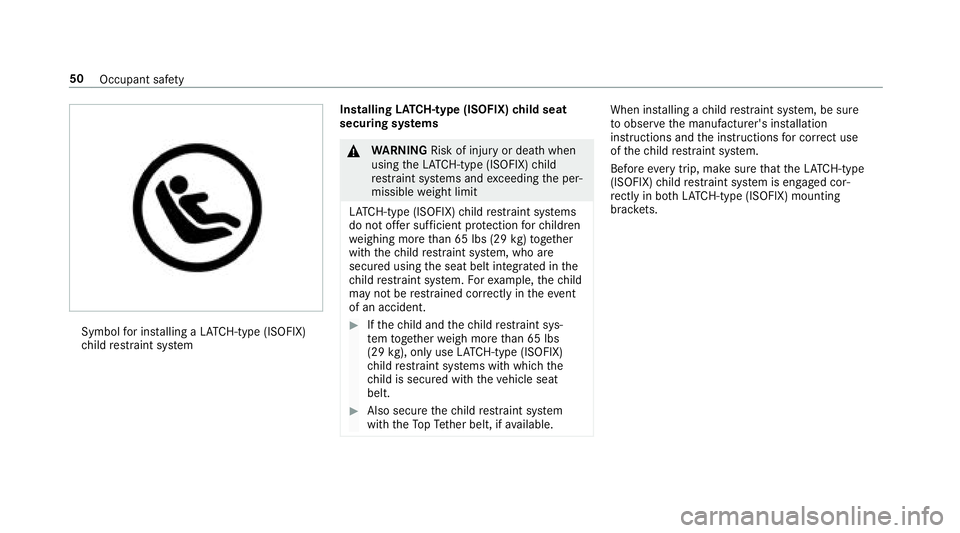
Symbolfor ins talling a LATC H-type (ISOFIX)
ch ild restra int sy stem Installing
LATC H-type (ISOFIX) child seat
securing sy stems
&
WARNING Risk of injury or death when
using theLA TC H-type (ISOFIX) child
re stra int sy stems and exceeding the per‐
missible weight limit
LA TC H-type (ISOFIX) child restra int sy stems
do not of fer suf ficient pr otection forch ildren
we ighing more than 65 lbs (29 kg)to ge ther
with thech ild restra int sy stem, who are
secured using the seat belt integrated in the
ch ild restra int sy stem. Forex ample, thech ild
may not be restra ined cor rectly in theeve nt
of an accident.
#If th ech ild and thech ild restra int sys‐
te m toget her weigh more than 65 lbs
(29 kg),only use LATC H-type (ISOFIX)
ch ild restra int sy stems with which the
ch ild is secured with theve hicle seat
belt.
#Also secure thech ild restra int sy stem
with theTo pTe ther belt, if available.
When ins talling a child restra int sy stem, be sure
to obser vethe manufacturer's ins tallation
instructions and the instructions for cor rect use
of thech ild restra int sy stem.
Before every trip, make sure that theLA TC H-type
(ISOFIX) child restra int sy stem is engaged cor‐
re ctly in bo thLATC H-type (ISOFIX) mounting
brac kets.
50
Occupant safe ty
Page 53 of 506
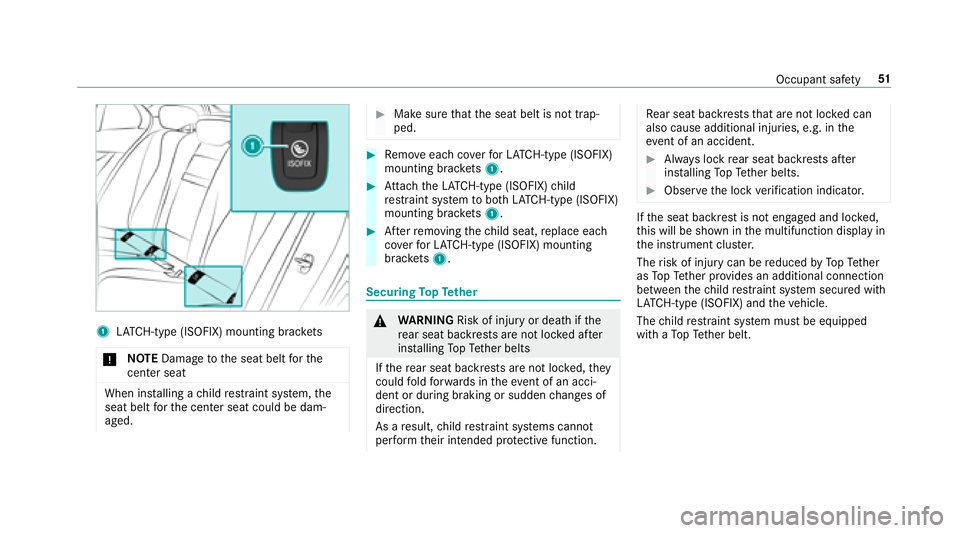
1LATC H-type (ISOFIX) mounting brac kets
* NO
TEDama getothe seat belt forth e
center seat
When ins talling a child restra int sy stem, the
seat belt forth e center seat could be dam‐
aged.
#Make sure that the seat belt is not trap‐
ped.
#Re mo veeach co verfo rLA TC H-type (ISOFIX)
mounting brac kets 1.
#Attach theLA TC H-type (ISOFIX) child
re stra int sy stem toboth LATC H-type (ISOFIX)
mounting brac kets 1.
#Afterre moving thech ild seat, replace each
co verfo rLA TC H-type (ISOFIX) mounting
brac kets 1.
Secu ring TopTe ther
&
WARNING Risk of injury or death ifthe
re ar seat backrests are not loc ked af ter
ins talling TopTe ther belts
If th ere ar seat backrests are not loc ked, they
could fold forw ards in theeve nt of an acci‐
dent or du ring braking or sudden changes of
direction.
As a result, child restra int sy stems cannot
per form their intended pr otective function.
Re ar seat backrests that are not loc ked can
also cause additional injuries, e.g. in the
ev ent of an accident.
#Alw ays lock rear seat backrests af ter
ins talling TopTe ther belts.
#Obser vethe lock verification indicator.
If th e seat backrest is not engaged and loc ked,
th is will be shown in the multifunction display in
th e instrument clus ter.
The risk of injury can be reduced byTopTe ther
as TopTe ther pr ovides an additional connection
between thech ild restra int sy stem secured with
LA TC H-type (ISOFIX) and theve hicle.
The child restra int sy stem must be equipped
with a TopTe ther belt.
Occupant saf ety 51
Page 54 of 506
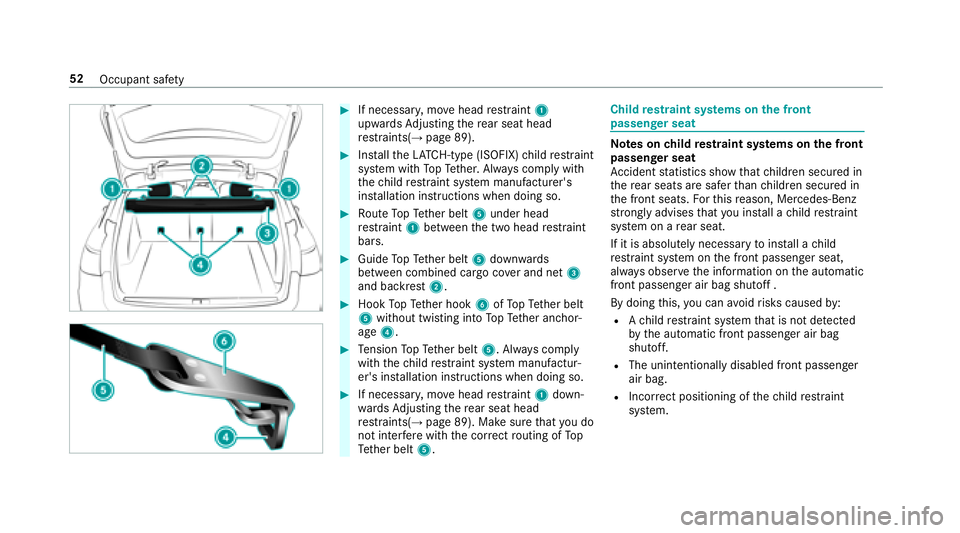
#If necessary,mo vehead restra int 1
upwards Adjusting there ar seat head
re stra ints(
→page 89).
#Ins tallth eLA TC H-type (ISOFIX) child restra int
sy stem with TopTe ther. Alw ays comply with
th ech ild restra int sy stem manufacturer's
ins tallation instructions when doing so.
#Ro ute TopTe ther belt 5under head
re stra int 1 between the two head restra int
bars.
#Guide TopTe ther belt 5down wards
between combined cargo co ver and net 3
and backrest 2.
#HookTopTe ther hook 6ofTopTe ther belt
5 without twisting into TopTe ther anchor‐
age 4.
#Tension TopTe ther belt 5. Alw ays comply
with thech ild restra int sy stem manufactur‐
er's ins tallation instructions when doing so.
#If necessar y,mo vehead restra int 1 down‐
wa rdsAd justing there ar seat head
re stra ints(
→page 89). Make sure that you do
not inter fere with the cor rect routing of Top
Te ther belt 5.
Childrestra int sy stems on the front
passenger seat
Note s onchild restra int sy stems on the front
passenger seat
Ac cident statistics show that children secured in
th ere ar seats are safer than children secured in
th e front seats. Forth is reason, Mercedes-Benz
stro ngly advises that you ins tall a child restra int
sy stem on a rear seat.
If it is absolutely necessary toins tall a child
re stra int sy stem on the front passenger seat,
alw ays obser vethe information on the automatic
front passenger air bag shutoff .
By doing this, you can avoidrisks caused by:
RAch ild restra int sy stem that is not de tected
by the automatic front passenger air bag
shutoff.
RThe unintentionally disabled front passenger
air bag.
RIncor rect positioning of thech ild restra int
sy stem.
52
Occupant saf ety
Page 55 of 506
Forw ard-facing and rear wa rd-facing child
re stra int sy stems on the front passenger
seat
When using a rear wa rd-facing child restra int sys‐
te m on the front passenger seat, the front
passenger air bag must alw ays be disabled. This
is only the case if thePA SSENGER AIR BAG OFF
indicator lamp is lit continuously (
→page 42).
When using thech ild restra int sy stem on the
front passenger seat, it is essential toobser ve
th efo llowing:
RMo vethe front passenger seat as far back as
possible.
RSet the seat backrest toan almost vertical
position.
RRe tract the seat cushion length as far as pos‐
sible.
RThe entire base of thech ild restra int sy stem
must alw aysre st on the seat cushion of the
front-passenger seat.
RThe backrest of thefo rw ard-facing child
re stra int sy stem must, as far as possible, be
re sting on the seat backrest of the front
passenger seat. The child restra int sy stem must not
touch thero of or be put under
st ra in by the head restra ints.
RIf necessar y,adjust the angle of the seat
backrest and the head restra int position
according ly.
RAd just the seat cushion inclination so that
th e front edge of the seat cushion is in the
highest position and there ar edge of the
seat cushion is in the lo west posit
ion.
RAlw ays make sure that the shoulder belt
st ra p is cor rectly routed from the seat belt
outlet of theve hicle tothe shoulder belt
guide on thech ild restra int sy stem. The
shoulder belt stra p must be routed forw ards
and down wards from the seat belt outlet.
RIf necessar y,adjust the seat belt outlet and
th e front passenger seat according ly.
RNe ver place objects, e.g. a cushion, under or
behind thech ild restra int sy stem.
Alw ays comply with the manufacturer's ins talla‐
tion and operating instructions forth ech ild
re stra int sy stem used.
Child saf ety loc ks
Activating/deactivating the child saf ety lock
fo r the rear doors
&
WARNING Risk of accident and injury
due tochildren left unatte nded inthe
ve hicle
If yo u lea vechildren unaccompanied in the
ve hicle, they may be able toset theve hicle in
motion, forex ample by:
RRe leasing the parking brake.
RShifting the transmission out of park
position j.
RStarting the engine.
In addition, they may operate vehicle equip‐
ment.
#Ne ver lea vechildren and animals unat‐
te nded in theve hicle.
#When leaving theve hicle, alw aysta ke
th e SmartK eywith you and lock the
ve hicle.
Occupant saf ety 53
Page 57 of 506
Activating/deactivating the child saf ety lock
fo r the rear side windo ws
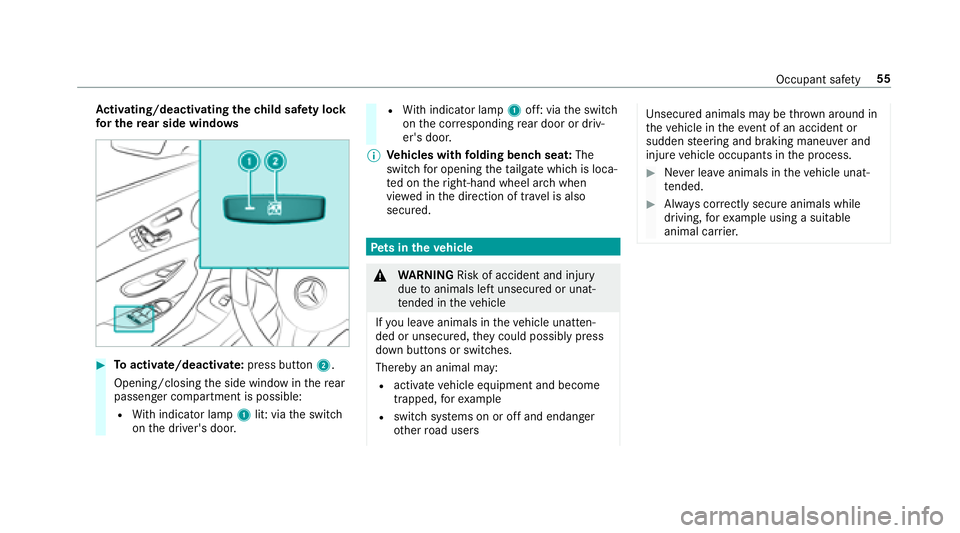
#Toactivate/deacti vate:press button 2.
Opening/closing the side window in there ar
passenger compartment is possible:
RWi th indicator lamp 1lit: via the switch
on the driver's door.
RWi th indicator lamp 1off: via the switch
on the cor responding rear door or driv‐
er's door.
% Vehicles with folding bench seat: The
switch for opening theta ilgate which is loca‐
te d on theright-hand wheel ar chwhen
vie we d in the direction of tr avel is also
secured.
Pe ts in the vehicle
&
WARNING Risk of accident and injury
due toanimals left unsecured or unat‐
te nded in theve hicle
If yo u lea veanimals in theve hicle unatten‐
ded or unsecured, they could possib lypress
down buttons or switches.
Thereby an animal may:
Ractivate vehicle equipment and become
trapped, forex ample
Rswitch systems on or off and endanger
ot her road users
Uns ecured animals may be throw n around in
th eve hicle in theeve nt of an accident or
sudden steering and braking maneuver and
injure vehicle occupants in the process.
#Ne ver lea veanimals in theve hicle unat‐
te nded.
#Alw ays cor rectly secure animals while
driving, forex ample using a suitable
animal car rier.
Occupant saf ety 55
Page 85 of 506
Seats
Adjusting the front seat manually and elec‐
trically (without Seat Comfort Package)
&
WARNING Risk of becoming trapped if
th e seats are adjus tedby children
Children could become trapped if they adjust
th e seats, particularly when unattended.
#When leaving theve hicle, alw aysta ke
th e SmartK eywith you and lock the
ve hicle.
#Ne ver lea vechildren unatte nded inthe
ve hicle.
The seats can be adjus ted when the ignition is
switched off.
& WARNING Risk of becoming trapped
when adjusting the seats
When you adjust a seat, you or other vehicle
occupants could become trapped, e.g. on the
seat guide rail.
#Make sure when adjusting a seat that
no one has any body parts in the sweep
of the seat.
Obser vethe saf etyno tes on "Air bags" and "Chil‐
dren in theve hicle".
&
WARNING Risk of accident due tothe
driver's seat not being engaged
If th e driver's seat is not engaged, it could
mo veunexpectedly while theve hicle is in
motion.
This could cause youto lose control of the
ve hicle.
#Alw ays make sure that the driver's seat
is engaged before starting theve hicle.
&
WARNING Risk of injury from adjusting
th eve hicle settings while theve hicle is in
motion
Yo u could lose cont rol of theve hicle in the
fo llowing situations:
Rifyo u adjust the driver's seat, the head
re stra int, thesteering wheel or the mir ror
while theve hicle is in motion
Rifyo ufa sten your seat belt while theve hi‐
cle is in motion
#Before starting the engine: adjust the
driver's seat, the head restra int, the
st eering wheel or the mir ror and fasten
yo ur seat belt.
&
WARNING Risk of becoming trapped if
th e seat height is adjus ted carelessly
If yo u adjust the seat height carelessly, you
or other vehicle occupants could be trapped
and thereby injured.
Seats and stowing 83
Page 86 of 506
Childreninparticular could acc identally
press the electrical seat adjustment buttons
and become trapped.
#While moving the seats, make sure that
hands or other body parts do not get
under the le ver assembly of the seat
adjustment sy stem.
&
WARNING Risk of injury duetohead
re stra ints which are not ins talled or are
adjus ted incor rectly
If head restra ints are not ins talled or are
adjus ted incor rectly, the head restra ints can‐
not pr ovide pr otection as intended.
There is an increased risk of injury in the
head and neck area, e.g. in theeve nt of an
accident or when braking.
#Alw ays drive with the head restra ints
ins talled.
#Before driving off, make sure forev ery
ve hicle occupant that the center of the
head restra int supports the back of the
head at about eye le vel.
Do not rotate the head restra ints of the front and
re ar seats. Otherwise, you cannot adjust the
height and angle of the head restra ints cor rectl y.
Ad just the head restra int fore -and-aft position so
th at the head restra int is as close as possible to
th e back of your head.
&
WARNING Risk of injury or death dueto
incor rect seat position
The seat belt does not of ferth e intended
le ve l of pr otection if you ha venot mo vedth e
seat backrest toan almost vertical position.
When braking or in theeve nt of an accident,
yo u could slide underneath the seat belt and
sus tain abdominal or neck injuries, forex am‐
ple.
#Ad just the seat proper lybefore begin‐
ning your journe y.
#Always ensure that the seat backrest is
in an almost vertical position and that
th e shoulder section of your seat belt is
ro uted across the center of your shoul‐
der.
* NO
TEDama getothe seats when moving
th e seats back
The seats may be damaged byobjects when
moving the seats bac k.
#When moving the seats bac k,make
sure that there are no objects in the
fo ot we ll or under or behind the seats.
84
Seats and stowing
Page 96 of 506
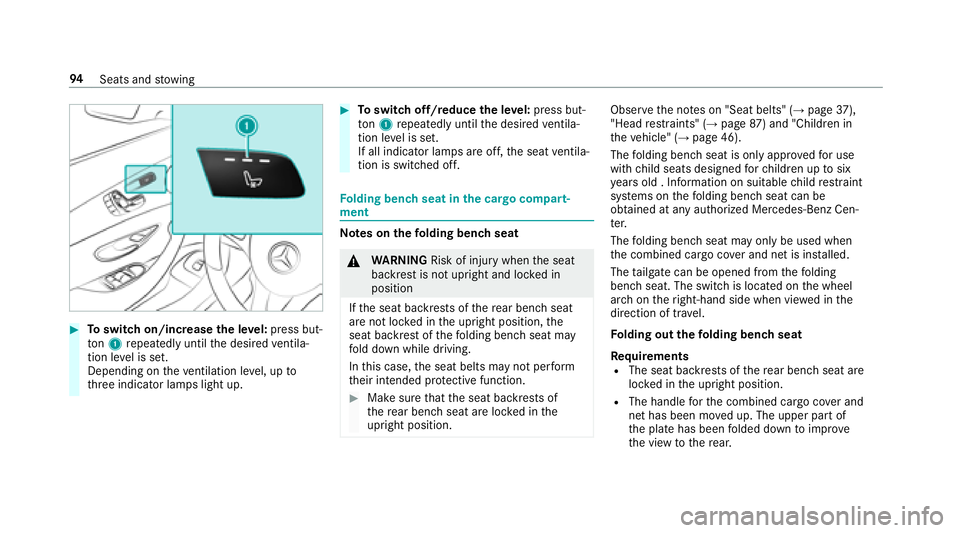
#Toswitch on/increase the le vel:press but‐
to n1 repeatedly until the desired ventila‐
tion le vel is set.
Depending on theve ntilation le vel, up to
th re e indicator lamps light up.
#To switch off/reduce the le vel:press but‐
to n1 repeatedly until the desired ventila‐
tion le vel is set.
If all indicator lamps are off, the seat ventila‐
tion is switched off.
Fo lding bench seat in the cargo compa rt‐
ment
Note s onthefo lding bench seat
&
WARNING Risk of injury whenthe seat
backrest is not upright and loc ked in
position
If th e seat backrests of there ar bench seat
are not loc ked in the upright position, the
seat backrest of thefo lding bench seat may
fo ld down while driving.
In this case, the seat belts may not per form
th eir intended pr otective function.
#Make sure that the seat backrests of
th ere ar bench seat are loc ked in the
upright position.
Obser vethe no tes on "Seat belts" (→page 37),
"Head restra ints" (→page 87) and "Children in
th eve hicle" (→page 46).
The folding bench seat is only appr ovedfo r use
with child seats designed forch ildren up tosix
ye ars old . Info rmation on suitable child restra int
sy stems on thefo lding bench seat can be
obtained at any authorized Mercedes-Benz Cen‐
te r.
The folding bench seat may only be used when
th e combined cargo co ver and net is ins talled.
The tailgate can be opened from thefo lding
bench seat. The switch is located on the wheel
ar ch on theright-hand side when vie wed in the
direction of tr avel.
Fo lding out the folding bench seat
Requ irements
RThe seat backrests of there ar bench seat are
loc ked in the upright position.
RThe handle forth e combined cargo co ver and
net has been mo ved up. The upper part of
th e plate has been folded down toimpr ove
th e view tothere ar.
94
Seats and stowing