tires MERCEDES-BENZ E-CLASS WAGON 2018 User Guide
[x] Cancel search | Manufacturer: MERCEDES-BENZ, Model Year: 2018, Model line: E-CLASS WAGON, Model: MERCEDES-BENZ E-CLASS WAGON 2018Pages: 506, PDF Size: 6.73 MB
Page 336 of 506
RThe blowerfo rth eve ntilation/heating is
switched off.
RThe windshield wiper switch is in position
g.
RIn car washes with a towing mechanism: neu‐
tral iis engaged.
RThe SmartK eyis at a dis tance of at least
10 ft(3 m) away from theve hicle, otherwise
th eta ilgate could open unin tentionally.
% If, af terth e car wash, youre mo vethewa x
from the windshield and wiper rubber, this
will pr event smearing and reduce wiper
noise.
Information on using a po werwa sher
&
WARNING Risk of accident when using
high-pressure cleaning equipment wi th
ro und-s pray nozzles
The wate r jet from a round-s pray nozzle (dirt
grinder) may cause damage totires and sus‐
pension components that is not visible.
Components damaged in this wa yma yfa il
unexpec tedly.
#Do not use high-pressure cleaning
equipment wi thround-spr aynozzles to
clean your vehicle.
#Damaged tires or suspension compo‐
nents must be replaced immediatel y.
Toavo id damage to yourvehicle, obser vethefo l‐
lowing when using a po werwa sher:
RKeep the SmartK eyat least 10ft(3 m) away
from theve hicle. Otherwise theta ilgate
could open unin tentional ly.
RMaintain a dis tance of at least 11.8 in
(30 cm) totheve hicle.
RVe hicles with deco rative foil: parts of your
ve hicle are co vered with a decorative foil.
Maintain a dis tance of at least 27.6 in
(70 cm) between thefo il-c ove red parts of the
ve hicle and the nozzle of the po werwa sher.
Mo vethe po werwa sher cleaner nozzle
around whilst cleaning.
RObser vethe information on the cor rect dis‐
ta nce in the equipment manufacturer's oper‐
ating instructions.
RDo not point the nozzle of the po werwa sher
directly at sensitive parts such as tires, slits,
electrical component parts, batteries, light
sources and ventilation slot s.
Washing the vehicle byhand
Obser vethe legal requirements, e.g. in a number
of countries, washing byhand is only permitted
in specially designated washing areas.
#Use a mild cleaning agent, e.g. car shampoo.
#Wa shtheve hicle with luk ewarmwate r using
a soft car sponge. When doing so, do not
ex pose theve hicle todirect sunlight.
#Carefully hose theve hicle off with water and
dry using a chamois. Take care not topoint
th ewate r jet directly towa rdsth e air inlet
grille.
334 Maintenance and care
Page 342 of 506
Emergency
Re moving the saf etyve st
The saf etyve sts are located in the saf etyve st
compart ments in the driver's and front
passenger door stowage compartments.
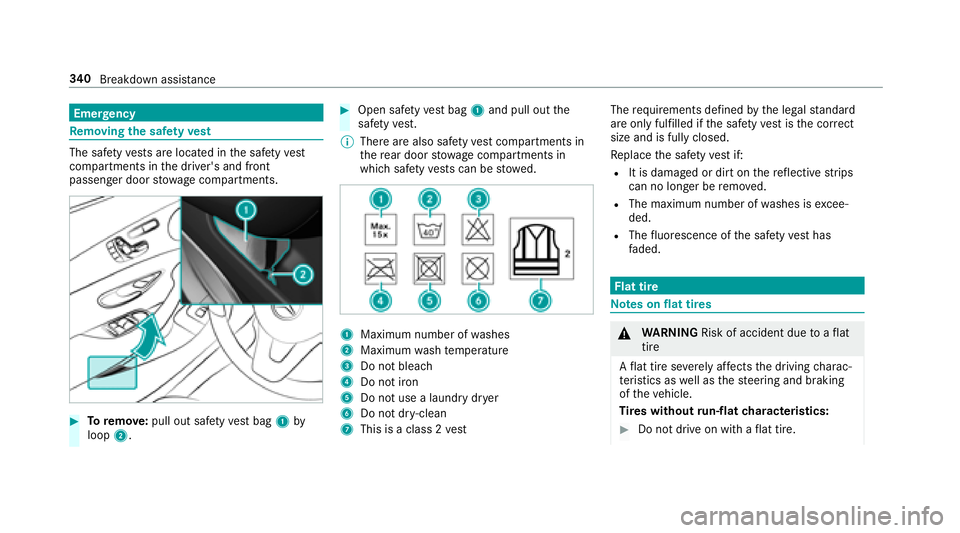
#Toremo ve:pull out safe tyvest bag 1by
loop 2.
#Open saf etyve st bag 1and pull out the
saf etyve st.
% There are also saf etyve st compart ments in
th ere ar door stowage compartments in
which saf etyve sts can be stowed.
1Maximum number of washes
2Maximum wash temp erature
3Do not bleach
4Do not iron
5Do not use a laundry dr yer
6Do not dr y-clean
7This is a class 2 vest The
requ irements defined bythe legal standard
are only fulfille difth e saf etyve st isthe cor rect
size and is fully closed.
Re place the saf etyve st if:
RIt is damaged or dirt on there flective strips
can no longer be remo ved.
RThe maximum number of washes is excee‐
ded.
RThe fluorescence of the saf etyve st has
fa ded.
Flat tire
Note s on flat tires
&
WARNING Risk of accident due toaflat
tire
A flat tire se verely affects the driving charac‐
te rist ics as well as thesteering and braking
of theve hicle.
Ti re s without run-flat characteristics:
#Do not drive on with a flat tire.
34 0
Breakdown assis tance
Page 343 of 506
#Changetheflat tire immediately with
th e emer gency spa rewheel or spare
wheel. Alternativel y,consult a qualified
specialist workshop.
Ti re s with run-flat characteristics:
#Observ eth e information and warning
no tes on MOExtended tires (run-flat
tires).
In theeve nt of a flat tire, thefo llowing options
are available depending on your vehicle's equip‐
ment:
RVe hicles with MOExtended tires: it is pos‐
sible tocontinue the journey for a short
period of time. Make sure you observ eth e
no tes on MOExtended tires (run-flat tires)
(
→page 341).
RVe hicles with a TIREFIT kit: you can repair
th e tire so that it is possible tocontinue the
jou rney for a short period of time. Todo this,
use the TIREFIT kit (
→page 342).
RVe hicles with Mercedes-Benz
mbrace®(USA only): you can make a call for Ro
adside Assis tance via theove rhead control
panel in the case of a breakdown
(
→page 294).
RAll vehicles: change the wheel
(→page 384).
MOExtended tires (tires with run-flat proper‐
ties)
& WARNING Risk of accident when driving
in li mp-home mode
When driving in emergency mode the han‐
dling characteristics are impaired, e.g. when
cornering, when accelerating stronglyand
when braking.
#Do not exceed the specified maximum
speed.
#Av oid any abrupt steering and driving
maneuvers as well as driving over
obs tacles (curbs, pot holes, off-road).
This applies, in part icular,toa loaded
ve hicle.
#Stop driving in the emer gency mode if
yo u notice:
Rbanging noise
Rvehicle vibration
Rsmoke which smells like rubber
Rcontinuous ESP®inter vention
Rcrac ksin tire side walls
#After driving in emergency mode ha ve
th erims checkedby aqu alified special‐
ist workshop with rega rd totheir fur ther
use.
#The defective tire must be replaced in
eve rycase.
With MOExtended tires (run-flat tires), you can
continue todrive your vehicle even if there is a
tot al loss of pressure in one or more tires. How‐
eve r,th e tire af fected must not show any clearly
visible damage.
Yo u can recognize MOExtended tires bythe
MOExtended marking which appears onthe side
wa ll of the tire.
Breakdown assis tance 34
1
Page 344 of 506
Vehicles with tire pressure monitoring sys‐
te m: MOExtended tires may only be used in con‐
junction wi than activated tire pressure monitor‐
ing sy stem.
If a pressure loss warning message appears in
th e multifunction display:
RCheck the tire for dama ge.
RIf driving on, obser vethefo llowing no tes.
Driving distance possible in limp-home mode
af te r the pressure loss warning:
Load condition Driving distance pos‐
sible in limp-homemode
Pa rtially laden 50 miles (80 km)
Fu lly laden 19miles (30 km)
RThe driving dis tance possible in li mp-home
mode may vary depending on the driving
st yle.
RMaximum permissible speed 50 mph
(80 km/h). If a tire has gone
flat and cannot be replaced
with an MOEx tended tire, you can use a stand‐
ard tire as a temp orary measure.
Using the TIREFIT kit
Ha ve thefo llowing readily available:
RTire sealant bottle
REnclosed TIREFIT sticke r
RTire inflation compressor
Yo u can use TIREFIT tire sealant toseal punctu‐
re s of up to0.16 in (4 mm), particular lythose in
th e tire conta ct surface.You can use TIREFIT in
outside temp eratures down to-4 °F (-20 °C).
&
WARNING Risk of accident when using
tire sealant.
In thefo llowing situations, the tire sealant is
unable toprov ide suf ficient breakdown assis‐
ta nce, as it is unable toseal the tire proper ly:
RThere are cuts or punctures in the tire
lar gerth an those pr eviously mentioned.
RThe wheel rim is dama ged.
RYo u ha vedriven at a very low tire pres‐
sure or on a flat tire.
#Do not continue driving.
#Consult a qualified specialist workshop.
&
WARNING Risk of injury and poisoning
from tire sealant
The tire sealant is harmful and causes ir rita ‐
tion. Do not allow it tocome into contact
wi th th e skin, eyes or clo thing, and do not
swallow it. Do not inhale tire sealant fumes.
Ke ep the tire sealant away from children.
If yo u come into contact withth e tire sealant,
obser vethefo llowing:
#Rinse off the tire sealant from your skin
immediately using water.
#If tire sealant gets into your eyes, thor‐
oughly rinse out theey es using clean
wate r.
342
Breakdown assis tance
Page 346 of 506
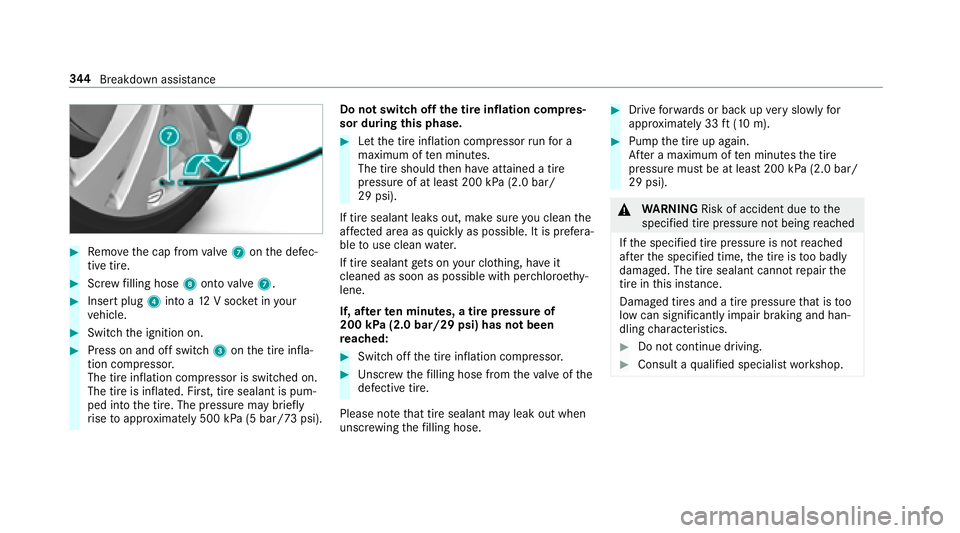
#Remo vethe cap from valve 7 onthe defec‐
tive tire.
#Scr ew filling hose 8onto valve 7.
#Insert plug 4into a 12V soc ket in your
ve hicle.
#Switch the ignition on.
#Press on and off switch 3onthe tire infla‐
tion compressor.
The tire inflation compressor is switched on.
The tire is inflated. Fir st, tire sealant is pum‐
ped into the tire. The pressure may brief ly
ri se toappr oximately 500 kPa (5 bar/73 psi). Do not switch off
the tire inflation compres‐
sor du ring this phase.
#Let the tire inflation compressor runfo r a
maximum of ten minu tes.
The tire should then ha veattained a tire
pressure of at least 200 kPa (2.0 bar/
29 psi).
If tire sealant leaks out, make sure you clean the
af fected area as quickly as possible. It is prefera‐
ble touse clean water.
If tire sealant gets on your clo thing, ha veit
cleaned as soon as possible with per chloroe thy‐
lene.
If, af terte n minutes, a tire pressure of
200 kPa (2.0 bar/29 psi) has not been
re ached:
#Switch off the tire inflation compressor.
#Un scr ew thefilling hose from theva lve of the
defective tire.
Please no tethat tire sealant may leak out when
unscr ewing thefilling hose.
#Drive forw ards or back up very slowly for
appr oximately 33 ft(10 m).
#Pump the tire up again.
Af ter a maximum of ten minu testh e tire
pressure must be at least 200 kPa (2.0 bar/
29 psi).
& WARNING Risk of accident due tothe
specified tire pressure not being reached
If th e specified tire pressure is not reached
af te rth e specified time, the tire is too badly
damaged. The tire sealant cannot repair the
tire in this ins tance.
Dama ged tires and a tire pressure that is too
low can significantly impair braking and han‐
dling characteristics.
#Do not continue driving.
#Consult a qualified specialist workshop.
34 4
Breakdown assis tance
Page 347 of 506
If, afterte n minutes, a tire pressure of
200 kPa (2.0 bar/29 psi) has been reached:
&
WARNING Risk of accident from driving
wi th sealed tires
A tire temp orarily sealed with tire sealant
impairs the handling characteristics and is
not suitable for higher speeds.
#Ad apt your dr ivingst yle according lyand
drive carefull y.
#Do notexceed the specified maximum
speed with a tire that has been repaired
using tire sealant.
#Obser vethe maximum permissible speed for
a tire sealed with tire sealant 50 mph
(80 km/h).
#Af fix th e upper section of the TIREFIT sticke r
to the instrument clus ter where it will easily
be seen bythe driver. *
NO
TEStaining caused byleaking tire
sealant
Af ter use, excess tire sealant may leak out
from thefilling hose.
#Therefore, place thefilling hose in the
plastic bag that con tained the TIREFIT
kit.
+ENVIRONMEN TALNO TEEnvironmental
pollution caused byenvironmen tally ir re‐
sponsible disposal
Ti re sealant contains polluta nts.
#Have the tire sealant bottle disposed of
professionall y,e.g. at an authorized
Mercedes-Benz Center.
#Switch off the tire inflation compressor.
#Un scr ew thefilling hose from theva lve of the
defective tire.
#St ow th e tire sealant bottle and the tire infla‐
tion compressor.
#Pull away immediatel y.
#Stop af ter driving for app roxima tely ten
minutes and check the tire pressure using
th e tire inflation compressor.
The tire pressure must now be at least
13 0 kPa (1.3 bar/19 psi).
&
WARNING Risk of accident due tothe
specified tire pressure not being reached
If th e specified tire pressure is not reached
af te r a brief drive, the tire is too badly dam‐
aged. The tire sealant cannot repair the tire
in this ins tance.
Dama ged tires and tire pressure that is too
low can significantly impair the braking prop‐
erties and the handling characteristics.
#Do not continue driving.
#Consult a qualified specialist workshop.
In cases such as the one mentioned abo ve, con‐
ta ct an au thorized Mercedes-Benz Center. Or
call 1-800-FOR-MERC edes (inthe USA) or
1-800-387-0 100 (in Canada).
Breakdown assis tance 34
5
Page 362 of 506
Noise or unusual handling characteristics
While driving, pay attention tovibrations, noises
and unusual handling characteristics, e.g. pulling
to one side. This may indicate that the wheels or
tires are damaged. If you suspect that a tire is
defective, reduce your speed immediatel y.Stop
th eve hicle as soon as possible tocheck the
wheels and tires for dama ge. Hidden tire dam‐
age could also be causing the unusual handling
ch aracteristics. If youfind no signs of damage,
ha ve the tires and wheels checked at a qualified
specialist workshop.
Checking wheels and tires regular ly
&
WARNING Risk of accident from dam‐
aged tires
Dama ged tires can cause tire pressure loss.
As a result, you could lose cont rol of your
ve hicle.
#Check the tires regularly for signs of
dama geand replace any damaged tires
immediatel y.
&
WARNING Risk of aquaplaning due to
insuf ficient tire tread
Insuff icient tire tread will result in reduced
tire grip. The tire tread is no longer able to
dissipate water.
This means that in heavy rain or slush the
ri sk of hydroplaning is increased, in particu‐
lar if vehicle speed is not adap tedto suit the
conditions.
If th e tire pressure is too high or too lo w,
tires may exhibit dif fere nt le vels of wear at
dif fere nt locations on the tire conta ct sur‐
fa ce.
#Thus, you should regularly check the
tread de pth and the condition of the tire
conta ct surf ace across the entire width
of all tires.
Minimum tread dep thfor:
RSummer tires: âin (3 mm)
RM+S tires: ãin (4 mm)
#For saf etyre asons, replace the tires
before the legally prescribed limit for
th e minimum tread dep thisreached.
Car ryout thefo llowing checks on all wheels reg‐
ularly, at least once a month or as requ ired, e.g.
prior toa long journey or driving off- road:
RCheck the tire pressure (→page 361).
RVisual inspection of wheels and tires for
damage.
RCheck theva lve caps.
The valves must be pr otected against mois‐
ture and dirt bytheva lve caps appr oved
especially foryo ur vehicle byMercedes-Benz.
RVisual check of the tread dep thand the tire
conta ct surf ace across the entire width.
The minimum tread dep thfor summer tires is
â in (3 mm) and for winter tires ãin
(4 mm).
360 Wheels and tires
Page 363 of 506
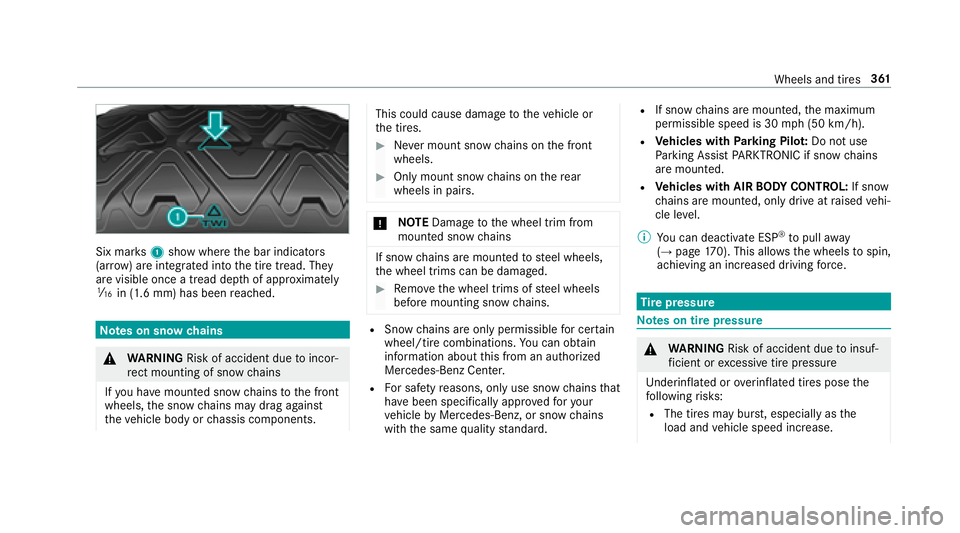
Six marks1 show where the bar indicators
(ar row ) are integrated into the tire tread. They
are visible once a tread dep thof appr oximately
á in (1.6 mm) has been reached.
Note s on snow chains
&
WARNING Risk of accident due toincor‐
re ct mounting of snow chains
If yo u ha vemounted snow chains tothe front
wheels, the snow chains may drag against
th eve hicle body or chassis components.
This could cause damage totheve hicle or
th e tires.
#Ne ver mount snow chains on the front
wheels.
#Only mount snow chains on there ar
wheels in pairs.
* NO
TEDama getothe wheel trim from
mounted snow chains
If snow ch ains are mounte dto steel wheels,
th e wheel trims can be damaged.
#Re mo vethe wheel trims of steel wheels
before mounting snow chains.
RSn ow chains are only pe rmissible for cer tain
wheel/tire combinations. You can obtain
information about this from an authorized
Mercedes-Benz Center.
RFo r saf etyre asons, only use snow ch ainsthat
ha ve been specifically appr oved foryo ur
ve hicle byMercedes-Benz, or snow chains
with the same quality standard.
RIf snow ch ains are moun ted, the maximum
permissible speed is 30 mph (50 km/h).
RVehicles with Parking Pilo t:Do no t use
Pa rking Assist PARKTRONI Cif sn ow ch ains
are mounte d.
RVehicles with AIR BODY CONT ROL:If snow
ch ains are mounte d, only drive atraised vehi‐
cle le vel.
% You can deactivate ESP
®to pull away
(→page 170). This allo wsthe wheels tospin,
achieving an increased driving forc e.
Tire pressure
Note s on tire pressure
&
WARNING Risk of accident due toinsuf‐
fi cient or excessive tire pressure
Underinfla ted or overinfla ted tires pose the
fo llowing risks:
RThe tires may bur st, especially as the
load and vehicle speed increase.
Wheels and tires 361
Page 364 of 506
RThe tires maywearexc essively and/or
une venly, which may greatlyimpair tire
traction.
RThe driving characteristics, as well as
st eering and braking, may be greatly
impaired.
#Comply with there commended tire
pressure and check the tire pressure of
all tires including the spare wheel regu‐
larly:
Rat least once a month
Rwhen the load changes
Rbefore embarking on a longe r journey
Rif operating conditionschange, e.g. off-
ro ad driving
#Ad just the tire pressure as necessar y.
Driving withtire pressure that is too high or too
low can:
RSho rten the service life of the tires.
RCause increased tire damage.
RAd versely af fect handling characteristics and
th us dr iving saf ety, e.g. due to hydroplaning.
&
WARNING Risk of an accident due to
insuf ficient tire pressure
Ti re s with pressure that is too low can over‐
heat and bur stas a result.
In addition, they also suf fer from excessive
and/or ir regular wear, which can significantly
impair the braking properties and the han‐
dling characteristics.
#Av oid excessively low tire pressures in
all the tires, including the spare wheel.
Tire pressure which is too low can cause:
RTire defects as a result of overheating
RImpaired handling characteristics
RIrre gular wear
RIncreased fuel consum ption
&
WARNING Risk of accident from exces‐
sive tire pressure
Ti re s with excessively high pressure can
burs t because they are damaged more easily
by highw ayfill, pot holes etc.
In addition, they also suf fer from ir regular
we ar, which can significantly impair the brak‐
ing properties and the handling characteris‐
tics.
#Av oid excessively high tire pressures in
all the tires, including the spare wheel.
Excessively high tire pressure can result in:
RIncreased braking dis tance
RImpaired handling characteristics
RIrre gular wear
RImpaired driving com fort
RSusceptibility todamage
362
Wheels and tires
Page 365 of 506
&WARNING Risk of accident caused by
re peated drop in tire pressure
If th e tire pressure drops repeatedl y,the
wheel, valve or tire may be damaged.
Insuf ficient tire pressure can cause the tires
to bur st.
#Inspect the tire for signs of fore ign
objects.
#Check whe ther the wheel or valve has a
leak.
#If yo u are unab leto rectify the damage,
conta ct aqualified specialist workshop.
Yo u can find information on tire pressure forth e
ve hicle's factor y-mounted tires on thefo llowing
labels:
RTi re and Loading Info rmation placard on the
B‑pillar of your vehicle (→page 367).
RTire pressure table on the inside of the fuel
fi ller flap (→page 363).
Observ eth e maximum tire pressure
(
→page 374). Use a sui
table pressure gauge tocheck the tire
pressure. The outer appearance of a tire does
not permit any reliable conclusion about the tire
pressure.
Ve hicles with a tire pressure monitoring sys‐
te m: You can also check the tire pressure using
th e on-board computer.
Only cor rect tire pressure when the tires are
cold. Conditions for cold tires:
RThe vehicle has been par ked with the tires
out of direct sunlight for at least th ree hours.
RThe vehicle has tr aveled less than 1 mile
(1.6 km).
A rise in the tire temp erature of 18°F (10 °C)
increases the tire pressure byappr ox.10 kPa
(0.1 bar/1.5 psi). Take this into account when
ch ecking the tire pressure of warm tires.
The tire pressure re commendedfor increased
load/speed in the tire pressure table can af fect
th eride comfort.
&
WARNING Risk of accident from unsuita‐
ble accessori es onthe tire valves
If yo u mount unsuitable accessories onto tire
va lves, the tire valves may be overloaded and
malfunction, which can cause tire pressure
loss. Tire pressure monitoring sy stems for
re trofitting will cause the tire valve toremain
open. This can also result in tire pressure
loss.
#Only scr ewstandard valve caps or valve
caps specifically appr ovedby
Mercedes-Benz foryo ur vehicle onto
th e tire valve.
Ti re pressure table
The tire pressure table is on the inside of the
fuel filler flap.
% The data shown in the images is example
data.
Wheels and tires 363