tow MERCEDES-BENZ E-CLASS WAGON 2018 User Guide
[x] Cancel search | Manufacturer: MERCEDES-BENZ, Model Year: 2018, Model line: E-CLASS WAGON, Model: MERCEDES-BENZ E-CLASS WAGON 2018Pages: 506, PDF Size: 6.73 MB
Page 41 of 506
&WARNING Risk of injury or death dueto
incor rect seat position
If yo ude viate from the cor rect seat position,
th e air bag cannot perform its intended pro‐
te ctive function and deployment may even
cause fur ther injuries.
To avo id hazardous situations, alw ays make
sure that all vehicle occupants:
RHa ve their seat belt fastened cor rectly,
including pregnant women.
RAre seated properly and that dis tance to
th e air bags is as large as possible.
RObser vethefo llowing information.
#Alw ays make sure that there are no
objects between the air bag and the
ve hicle occupant.
To avo idrisks resulting from the deployment of
th e air bag:
RBefore starting your journe y,adjust your seat
co rrectly ;th e driver's seat and front
passenger seat should be mo ved as far back
as possible. When doing so, alw
ays obser vethe informa‐
tion on the cor rect driver's seat position
(
→page 82).
ROnly hold thesteering wheel bythesteering
wheel rim. This all owsth e air bag tobe fully
deplo yed.
RAlw ays lean against the seat backrest when
th eve hicle is in motion. Do not lean forw ards
or against the door or side windo w.You may
ot herwise be in the deployment area of the
air bags.
RAlw ayske ep your feet on thefloor. Do not
put your feet on the dashboard, forex ample.
Yo ur feet may otherwise be in the deploy‐
ment area of the air bag.
RIfch ildren are tra veling in theve hicle,
obser vethe additional no tes (→page 46).
RAlw aysstow and secure objects cor rectly. Objects in
theve hicle interior may pr event an air
bag from functioning cor rectly. There fore alw ays
ensure that:
RThere are no people, animals or objects
between theve hicle occupants and an air
bag.
RThere are no objects between the seat, door
and door pillar (B-pillar).
RThere are no hard objects, e.g. coat hangers,
hanging on the grab handles or coat hooks.
RThere are no accessory parts, such as cup
holders, attached totheve hicle within the
deployment area of an air bag, e.g. on doors,
side windo wsor side paneling.
RThere are no heavy, sharp-edged or fragile
objects in the poc kets of your clo thing. Store
such objects in a suitable place.
Occupant saf ety 39
Page 42 of 506
Reduced air bag pr otection
&
WARNING Risk of injury from modifica‐
tions tothe airbag co ver
If yo u modify an airbag co ver or af fix objects
such assticke rs to it,the airbag can no lon‐
ge r function cor rectl y.
#Ne ver modify an airbag co ver and do
not af fix objects toit.
The ins tallation location of an air bag is identi‐
fi ed bythe AIRB AGsymbol .
&
WARNING Risk of injury or death dueto
th e use of unsuitable seat co vers
Uns uitable seat co vers can obstruct or pre‐
ve nt the deployment of air bags integrated
into the seats.
Consequentl y,the air bags cannot protect
ve hicle occupants as they are designed to
do. In addition, operation of the automatic
front passenger air bag shutoff may be
re stricted.
#Yo u should only use seat covers that
ha ve been appr oved forth e cor respond‐
ing seats byMercedes-Benz.
&
WARNING Risk of injury duetomalfunc‐
tions of the sensors in the door paneling
Sensors tocontrol the airbags are located in
th e doors. Modifications or worknot per‐
fo rm ed cor rectly tothe doors or door panel‐
ing, as well as damaged doors, can lead to
th e function of the sensors being impaired.
The airbags might therefore not function
proper lyany more.
Consequent ly,th e airbags cannot protect
ve hicle occupants as they are designed to
do.
#Ne ver modify the doors or parts of the
doors.
#Alw ays ha vewo rkon the doors or door
paneling car ried out at a qualified spe‐
cialist workshop.
&
WARNING Risk of injury duetodeplo yed
airbag
A deplo yed airbag no longer has a pr otective
function and cann otprotect as intended in
th eev ent of an accident.
#Ha ve theve hicle towe dto aqu alified
specialist workshop in order tohave the
deplo yed airbag replaced.
Ha ve deplo yed air bags replaced immediately.
St atus of the front passenger airbag
Po ints toremember when the front
passen ger seat is occupied
The au tomatic front passenger air bag shutoff is
able todetect whe ther the front passenger seat
is occupied bya person or a child restra int sys‐
te m. The front passenger air bag is enabled or
disabled accordingly.
When ins talling a child restra int sy stem on the
front passenger seat:
REnsure that thech ild restra int sy stem is posi‐
tioned cor rectly (→page 46).
40
Occupant saf ety
Page 60 of 506
Deactivatethe KEYLESS-GO function of the
SmartK ey.
#To deactivate: pressthe& button on the
SmartK eytwice in rapid succession.
The battery check lamp of the SmartK ey
fl ashes twice brief lyand lights up once.
#To activate: press any button on the Smart‐
Ke y.
% When theve hicle is star ted with the Smart‐
Ke yin thestow age compartment of the cen‐
te r console (
→page 145),th e SmartK ey
functions are au tomatically activated.
Inserting/re moving the mechanical key
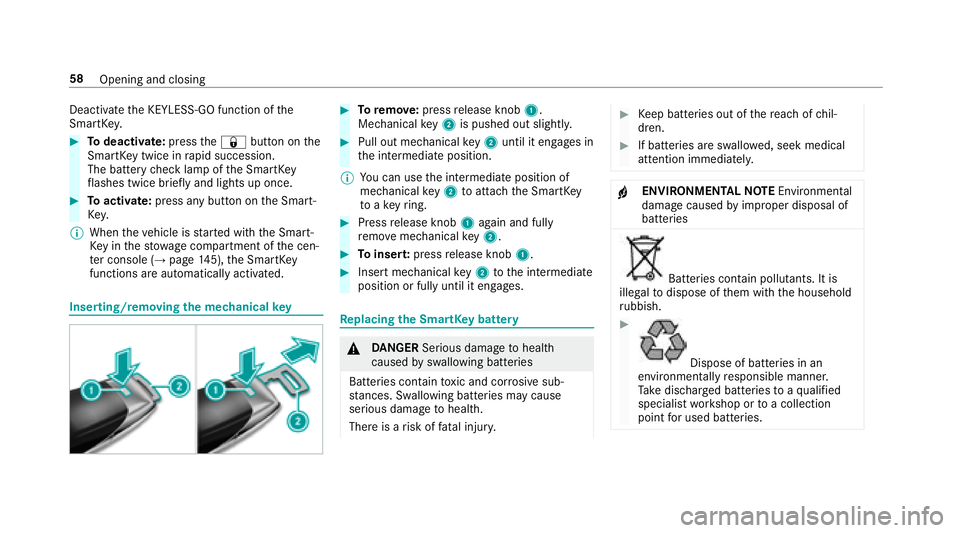
#To remo ve:press release knob 1.
Mechanical key2 is pushed out slight ly.
#Pull ou tme chanical key2 until it en gage s in
th e intermediate position.
% You can use the intermediate position of
mechanical key2 toattach the SmartK ey
to ake yring.
#Press release knob 1again and fully
re mo vemechanical key2.
#To inser t:press release knob 1.
#Insert mechanical key2 tothe intermediate
position or fully until it engages.
Re placing the SmartK eybattery
&
DANG ER Serious damage tohealth
caused byswallowing batteries
Batteries contain toxic and cor rosive sub‐
st ances. Swallowing batte ries may cause
serious damage tohealth.
There is a risk of fata l injur y.
#Keep batteries out of there ach of chil‐
dren.
#If batteries are swallo wed, seek medical
attention immediately.
+ENVIRONMEN TALNO TEEnvironmental
damage causedbyimproper disposal of
batteries
Bat teries conta in pollutants. It is
illegal todispose of them with the household
ru bbish.
#
Dispose of batteries in an
environmen tally responsible manner.
Ta ke dischar ged batteries toaqu alified
specialist workshop or toa collection
point for used batteries.
58
Opening and closing
Page 65 of 506
ProblemPossible causes/consequences and MSolutions
RThe SmartKeyis malfunctioning.
#Activate KEYLESS-GO .
#Check the battery using the battery check lamp and replace if necessary .
#Use the mechanical keyto lock or unlock theve hicle .
#Ha ve theve hicle and SmartK eychecked at a qualified specialist workshop.
Switching the automatic locking feature
on/off
The vehicle is loc ked automatically when the
ignition is switched on and the wheels are turn‐
ing fast erthan walking pace.
#To deactivate: press and hold button 1for
appr oximately five seconds until an acoustic
signal sounds.
#To activate: press and hold button 2for
appr oximately five seconds until an acoustic
signal sounds.
Danger of being loc ked out when the function is
activated:
RIf th eve hicle is being tow star ted/pushed.
ROn a roller dynamome ter.
Opening and closing 63
Page 68 of 506
cally opening,this process is stopped. The auto‐
matic obs tacle de tection function is only an aid.
It is not a substitute foryo ur attentiveness when
opening theta ilgate.
Closing the tailgate
&
WARNING Risk of injury from unsecured
items in theve hicle
If objects, luggage or loads are not secured
or not secured suf ficientl y,they could slip,
tip ove r or be throw n around and thereby hit
ve hicle occupants.
There is a risk of injur y,particularly in the
ev ent of sudden braking or a sudden change
in direction.
#Alw aysstow objects in such a wayth at
th ey cannot be thro wn around.
#Before the journe y,secure objects, lug‐
ga ge or loads against slipping or tipping
ove r.
&
WARNING Risk of becoming trapped
duri ng au tomatic closing of theta ilgate
Pa rts of the body could become trapped dur‐
ing automatic closing of theta ilgate. More‐
ove r,people, e.g. children, may be standing
in the closing area or may enter the closing
area during the closing process.
#Make sure that nobody is in the vicinity
of the closing area during the closing
process.
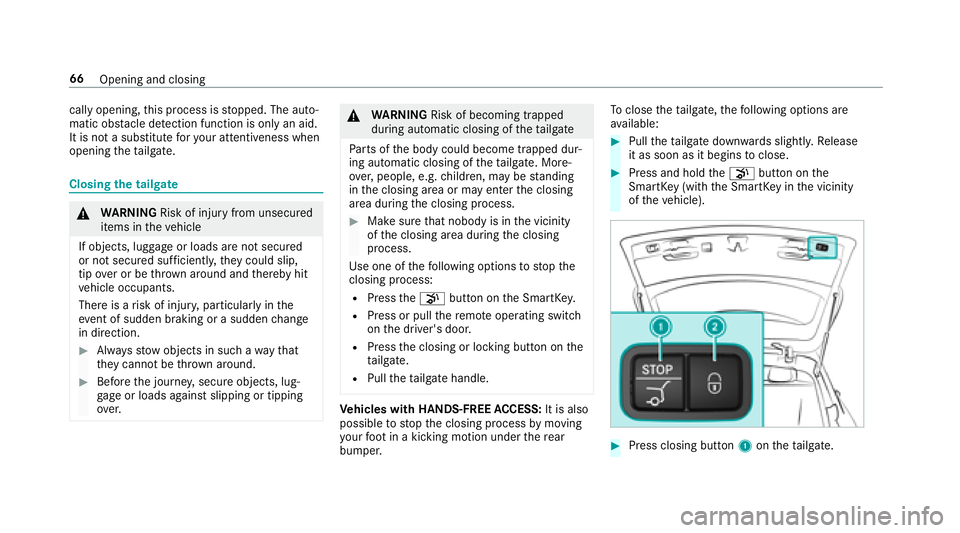
Use one of thefo llowing options tostop the
closing process:
RPress thep button on the SmartK ey.
RPress or pull there mo teoperating switch
on the driver's door.
RPress the closing or locking button on the
ta ilgate.
RPull theta ilgate handle.
Ve hicles with HANDS-FREE ACCESS: It is also
possible tostop the closing process bymoving
yo ur foot in a kicking motion under there ar
bumper. To
close theta ilgate, thefo llowing options are
av ailable:
#Pull theta ilgate down wards slightly. Release
it as soon as it begins toclose.
#Press and hold thep button on the
SmartK ey(with the SmartK eyinthe vicinity
of theve hicle).
#Press closing button 1ontheta ilgate.
66
Opening and closing
Page 70 of 506
HANDS-FREEACCESS function
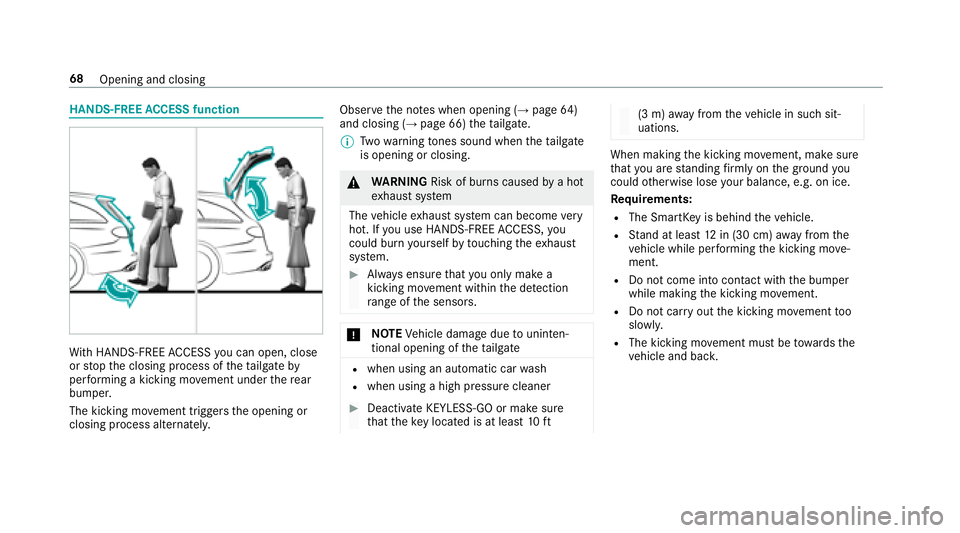
With HANDS-FREE ACCESS you can open, close
or stop the closing process of theta ilgate by
per form ing a kicking mo vement under there ar
bumper.
The kicking mo vement triggers the opening or
closing process alternately. Obser
vethe no tes when opening (
→page 64)
and closing (→page 66) theta ilgate.
% Twowa rning tones sound when thetai lgate
is opening or closing.
& WARNING Risk of burn s causedbya hot
ex haust sy stem
The vehicle exhaust sy stem can become very
hot. If you use HANDS- FREEACCESS, you
could burn yourself by touching theex haust
sy stem.
#Alw ays ensure that you only ma kea
kicking mo vement within the de tection
ra nge of the sensors.
* NO
TEVehicle damage due tounin ten‐
tional opening of theta ilgate
Rwhen using an automatic car wash
Rwhen using a high pressure cleaner
#Deactivate KEYLESS-GO or make sure
that theke ylocated is at leas t10 ft
(3 m) away from theve hicle in such sit‐
uations.
When making the kicking mo vement, make sure
th at you are standing firm ly on the ground you
could otherwise lose your balance, e.g. on ice.
Re quirements:
RThe SmartK eyis behind theve hicle.
RStand at least 12in (30 cm) away from the
ve hicle while per form ing the kicking mo ve‐
ment.
RDo not come into contact with the bumper
while making the kicking mo vement.
RDo not car ryout the kicking mo vement too
slowl y.
RThe kicking mo vement must be towa rdsth e
ve hicle and bac k.
68
Opening and closing
Page 84 of 506
Notes onthe cor rect driver's seat position
&
WARNING Risk of injury from adjusting
th eve hicle settings while theve hicle is in
motion
Yo u could lose cont rol of theve hicle in the
fo llowing situations:
Rifyo u adjust the driver's seat, the head
re stra int, thesteering wheel or the mir ror
while theve hicle is in motion
Rifyo ufa sten your seat belt while theve hi‐
cle is in motion
#Before starting the engine: adjust the
driver's seat, the head restra int, the
st eering wheel or the mir ror and fasten
yo ur seat belt.
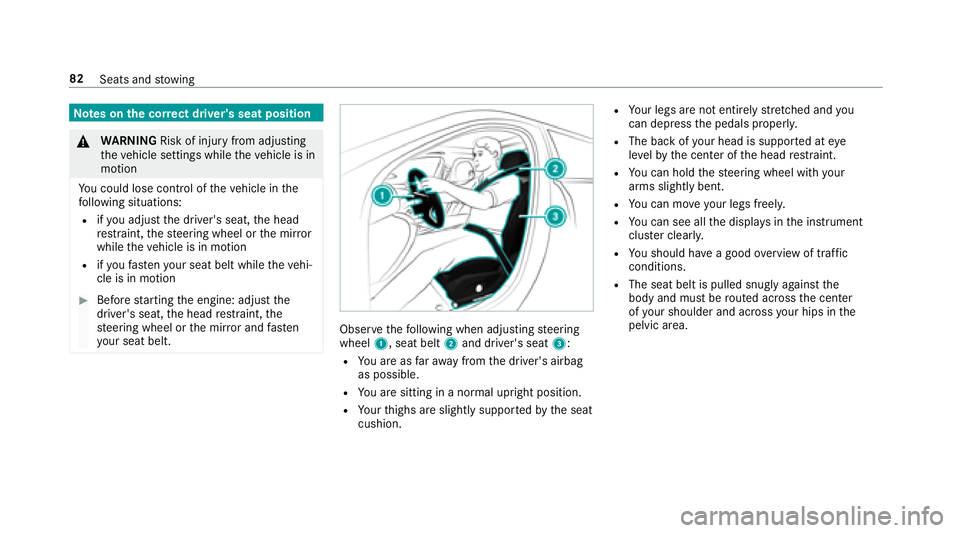
Obser vethefo llowing when adjusting steering
wheel 1, seat belt 2and driver's seat 3:
RYou are as faraw ay from the driver's airbag
as possible.
RYo u are sitting in a no rmal upright position.
RYour thighs are slightly suppor tedby the seat
cushion.
RYo ur legs are not entirely stre tched and you
can dep ress the pedals proper ly.
RThe back of your head is support ed ateye
le ve lby the center of the head restra int.
RYo u can hold thesteering wheel with your
arms slightly bent.
RYo u can mo veyour legs freel y.
RYou can see all the displa ysinthe instrument
clus ter clearl y.
RYou should ha vea good overview of traf fic
conditions.
RThe seat belt is pulled snug lyagainst the
body and must be routed across the center
of your shoulder and across your hips in the
pelvic area.
82 Seats and stowing
Page 85 of 506
Seats
Adjusting the front seat manually and elec‐
trically (without Seat Comfort Package)
&
WARNING Risk of becoming trapped if
th e seats are adjus tedby children
Children could become trapped if they adjust
th e seats, particularly when unattended.
#When leaving theve hicle, alw aysta ke
th e SmartK eywith you and lock the
ve hicle.
#Ne ver lea vechildren unatte nded inthe
ve hicle.
The seats can be adjus ted when the ignition is
switched off.
& WARNING Risk of becoming trapped
when adjusting the seats
When you adjust a seat, you or other vehicle
occupants could become trapped, e.g. on the
seat guide rail.
#Make sure when adjusting a seat that
no one has any body parts in the sweep
of the seat.
Obser vethe saf etyno tes on "Air bags" and "Chil‐
dren in theve hicle".
&
WARNING Risk of accident due tothe
driver's seat not being engaged
If th e driver's seat is not engaged, it could
mo veunexpectedly while theve hicle is in
motion.
This could cause youto lose control of the
ve hicle.
#Alw ays make sure that the driver's seat
is engaged before starting theve hicle.
&
WARNING Risk of injury from adjusting
th eve hicle settings while theve hicle is in
motion
Yo u could lose cont rol of theve hicle in the
fo llowing situations:
Rifyo u adjust the driver's seat, the head
re stra int, thesteering wheel or the mir ror
while theve hicle is in motion
Rifyo ufa sten your seat belt while theve hi‐
cle is in motion
#Before starting the engine: adjust the
driver's seat, the head restra int, the
st eering wheel or the mir ror and fasten
yo ur seat belt.
&
WARNING Risk of becoming trapped if
th e seat height is adjus ted carelessly
If yo u adjust the seat height carelessly, you
or other vehicle occupants could be trapped
and thereby injured.
Seats and stowing 83
Page 86 of 506
Childreninparticular could acc identally
press the electrical seat adjustment buttons
and become trapped.
#While moving the seats, make sure that
hands or other body parts do not get
under the le ver assembly of the seat
adjustment sy stem.
&
WARNING Risk of injury duetohead
re stra ints which are not ins talled or are
adjus ted incor rectly
If head restra ints are not ins talled or are
adjus ted incor rectly, the head restra ints can‐
not pr ovide pr otection as intended.
There is an increased risk of injury in the
head and neck area, e.g. in theeve nt of an
accident or when braking.
#Alw ays drive with the head restra ints
ins talled.
#Before driving off, make sure forev ery
ve hicle occupant that the center of the
head restra int supports the back of the
head at about eye le vel.
Do not rotate the head restra ints of the front and
re ar seats. Otherwise, you cannot adjust the
height and angle of the head restra ints cor rectl y.
Ad just the head restra int fore -and-aft position so
th at the head restra int is as close as possible to
th e back of your head.
&
WARNING Risk of injury or death dueto
incor rect seat position
The seat belt does not of ferth e intended
le ve l of pr otection if you ha venot mo vedth e
seat backrest toan almost vertical position.
When braking or in theeve nt of an accident,
yo u could slide underneath the seat belt and
sus tain abdominal or neck injuries, forex am‐
ple.
#Ad just the seat proper lybefore begin‐
ning your journe y.
#Always ensure that the seat backrest is
in an almost vertical position and that
th e shoulder section of your seat belt is
ro uted across the center of your shoul‐
der.
* NO
TEDama getothe seats when moving
th e seats back
The seats may be damaged byobjects when
moving the seats bac k.
#When moving the seats bac k,make
sure that there are no objects in the
fo ot we ll or under or behind the seats.
84
Seats and stowing
Page 87 of 506
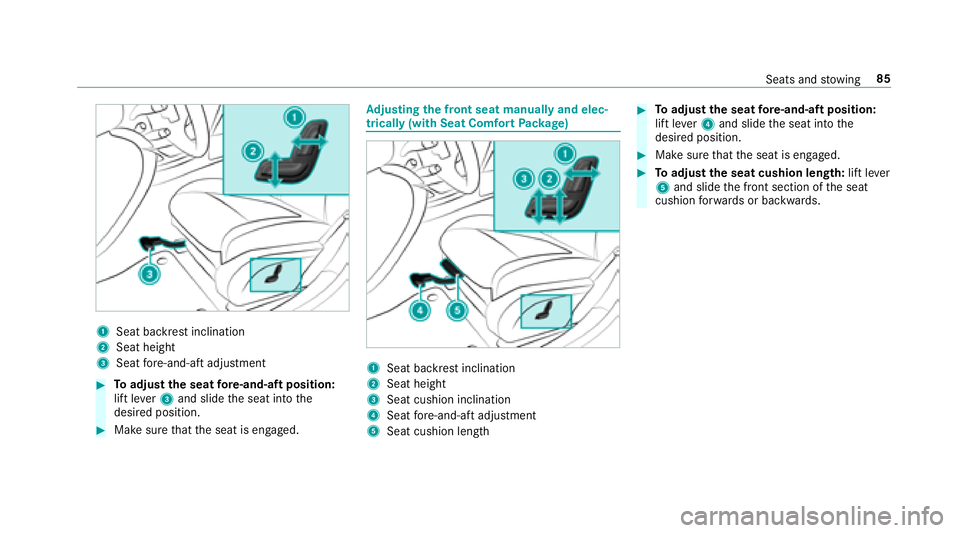
1Seat backrest inclination
2Seat height
3Seat fore -and-aft adjustment
#To adjust the seat fore -and-aft position:
lift le ver3 and slide the seat into the
desired position.
#Make sure that the seat is engaged.
Ad justing the front seat manually and elec‐
trically (with Seat Comfort Package)
1Seat backrest inclination
2Seat height
3Seat cushion inclination
4Seat fore -and-aft adjustment
5Seat cushion length
#To adjust the seat fore -and-aft position:
lift le ver4 and slide the seat into the
desired position.
#Make sure that the seat is engaged.
#To adjust the seat cushion length: lift lever
5 and slide the front section of the seat
cushion forw ards or backwards.
Seats and stowing 85