warning MERCEDES-BENZ E-CLASS WAGON 2018 User Guide
[x] Cancel search | Manufacturer: MERCEDES-BENZ, Model Year: 2018, Model line: E-CLASS WAGON, Model: MERCEDES-BENZ E-CLASS WAGON 2018Pages: 506, PDF Size: 6.73 MB
Page 26 of 506
must accept any interfere nce, including inter fer‐
ence that may cause undesired operation of the
device."
USA: "Wireless charging sy stem for mobile devi‐
ces (Model: D-WMI20 15A): this device complies
with Part18 ofthe FCC Rules."
The name and address of there sponsible party
is:
Continental Automotive Sy stems US Inc.
24 00 Executive Hills Drive
Au burn Hills, MI 48326-2980
Uni tedSt ates of America
Diagnostics connection
The diagnostics connection is only in tended for
th e connection of diagnostic devices at a quali‐
fi ed specialist workshop.
&
WARNING Risk of accident due tocon‐
necting devices tothe diagnostics con‐
nection
If yo u connect equipment toa diagnostics
connection in theve hicle, it may af fect the
operation of vehicle sy stems.
As a result, the operating saf etyof theve hi‐
cle could be af fected.
#Only connect equipment toa diagnos‐
tics connection in theve hicle which is
appr ovedfo ryo ur vehicle byMercedes-
Benz.
& WARNING Risk of accident due to
objects in the driver's foot we ll
Objects in the driver's foot we ll may impede
pedal tr avel or block a depressed pedal.
This jeopardizes the operating and road
saf etyof theve hicle.
#Stow all objects in theve hicle securely
so that they cannot getinto the driver's
fo ot we ll.
#Alw ays ins tallth efloor mats securely
and as prescribed in order toensure
th at there is alw ays suf ficient room for
th e pedals.
#Do not use loose floor mats and do not
place floor mats on top of one ano ther.
* NO
TEBattery discharging from using
devices connected tothe diagnostics
connection
Using devices at the diagnostics connection
drains the batter y.
#Checkthech arge leve l of the batter y.
#Ifth ech arge leve l is lo w,charge the
batter y,e.g. bydriving a considerable
dis tance.
Connecting equipment tothe diagnostics con‐
nection can lead toemissions monitoring infor‐
mation being reset, forex ample. This may lead
to theve hicle failing tomeet therequ irements of
th e next emissions inspection during the main
inspection.
24 General no tes
Page 27 of 506
Qualified specialistworkshop
An authorized Mercedes-Benz Center is a quali‐
fi ed specialist workshop. It has the necessary
specialist kn owledge, tools and qualifications to
cor rectly car ryout thewo rkrequ ired on your
ve hicle. This particularly applies towo rkreleva nt
to saf ety.
Alw ays ha vethefo llowing workcar ried out on
yo ur vehicle at an authorized Mercedes-Benz
Center:
RWo rkreleva nt tosaf ety
RService and maintenance work
RRepair work
RModifications, ins tallations and con versions
RWo rkon electronic component parts
Mercedes‑Benz recommends an au thorized
Mercedes‑Benz Center.
Cor rect use of theve hicle
If yo ure mo veany warning sticke rs,yo u or others
could failto recognize cer tain dangers. Lea ve
wa rning sticke rs in position. When using
theve hicle, obser vethefo llowing
information:
RThe saf etyno tes in this manual
RThe vehicle tech nical da ta
RTraf fic ru les and regulations
RLa ws and saf etyst andards per taining to
mo torve hicles
Problems with your vehicle
If yo u should experience a problem with your
ve hicle, particularly one that you belie vemay
af fect its safe ope ration, weurge youto contact
an au thorized Mercedes-Benz service center
immediately tohave the problem diagnosed and
re ctified. If the problem is not resolved toyour
satisfaction, please discuss the problem again
with the authorized Mercedes-Benz service cen‐
te r or, if necessar y,contact us at one of thefo l‐
lowing addresses.
In the USA:
Cus tomer Assis tance Center
Mercedes-Benz US A,LLC 3 Mercedes Drive
Montvale, NJ
0764 5-0350
In Canada:
Cu stomer Relations Department
Mercedes-Benz Canada, Inc.
98 Vande rhoof Avenue
To ronto, Ontario M4G 4C9Re porting saf ety defects
USA onl y:
The following text is published as requ ired of
manufacturers under Title 49, Code of U.S. Fed‐
eral Regulations, Part57 5 pursuant tothe
"N ational Traf fic and Mo torVe hicle Saf etyAc t of
19 66".
If yo u belie vethat your vehicle has a defect
which could cause a crash or could cause injury
or death, you should immediately inform the
Na tional Highw ayTraf fic Saf etyAd ministration
(NHT SA) in addition tonotifying Mercedes-Benz
US A,LLC.
General no tes 25
Page 33 of 506
Restra int sy stem
Pr otection bythere stra int sy stem
The restra int sy stem includes thefo llowing:
RSeat belt sy stem
RAir bags
RChild restra int sy stem
RChild seat securing sy stem
In theev ent of an accident, there stra int sy stem
can:
RRe duce therisk of vehicle occupants coming
into contact with parts of theve hicle interior.
RRe duce thefo rc es towhich theve hicle occu‐
pants are subjected.
A seat belt can only pr ovide the best le vel of pro‐
te ction if it is worncor rectl y.Depending on the
de tected accident situation, Emergency Tension‐
ing Devices and/or air bags supplement the pro‐
te ction of fere dby a cor rectly wornseat belt.
Emer gency Tensioning Devices and/or air bags
are not depl oyed in everyaccident. So
that there stra int sy stem can pr ovide pr otec‐
tion, each vehicle occupant mus t:
RFasten their seat belt cor rectly.
RSit in an almost up right position with their
back against the seat backrest.
RSit with their feet resting on thefloor, if pos‐
sible.
RAlw ays be secured in an additional restra int
sy stem suitable for Mercedes-Benz vehicles
if th ey are under 5 ft(1.50 m) tall.
Ho wever,no sy stem available today can com‐
ple tely eliminate injuries and fata lities in every
accident situation. In particular, the seat belt
and air bag generally do no t p
r
otect against
objects penetrating theve hicle from the outside.
It is also not possible tocomplet elyrule out the
ri sk of injury caused bythe air bag deploying.
Re duced restra int sy stem pr otection
&
WARNING Risk of injury or death from
modifications tothere stra int sy stem
The restra int sy stem can no longer function
cor rectly af ter alterations ha vebeen made.
The restra int sy stem may then not pr otect
th eve hicle occupants as intended byfailing
in an accident or triggering unexpec tedly, for
ex ample
#Ne ver alter the parts of there stra int
sy stem.
#Ne verta mp er with the wiring or any
electronic component parts or their
software.
RIf it is necessary tomodify theve hicle to
accommodate a person with disabilities, con‐
ta ct an au thorized Mercedes-Benz Center for
de tails.
RUSA only: for de tails, con tact our Cu stomer
Assis tance Center on 1-800-FOR-MERCedes
(1‑800‑367‑63 72).
Occupant saf ety 31
Page 34 of 506
Restra int sy stem functionality
When the ignition is switched on, a sy stem self-
te st is per form ed, during which the6
re stra int sy stem warning lamp lights up. It goes
out no later than a few seconds af terth eve hicle
is star ted. The components of there stra int sys‐
te m are then functional.
Re stra int sy stem malfunction
RThe 6 restra int sy stem warning lamp
does not light up when the ignition is
switched on.
RThe 6 restra int sy stem warning lamp
lights up continuously or repeatedly during a
journe y.
&
WARNING Risk of injury orfata l injury
due toa malfunction in there stra int sys‐
te m
If th ere stra int sy stem is malfunctioning,
re stra int sy stem components may be trig‐
ge red unintentionally or might not be trig‐
ge red at all in theev ent of an accident. This
may af fect the Emer gency Tensioning Device
or airbag, forex ample.
#Ha ve there stra int sy stem checked and
re paired immediately at a qualified spe‐
cialist workshop.
Fu nction of there stra int sy stem in an acci‐
dent
How there stra int sy stem works is de term ined by
th e se verity of the impact de tected and the type
of accident anticipated:
RFr ontal impact
RRe ar impact
RSide impact
RRo llover
The activation thre sholds forth e components of
th ere stra int sy stem are de term ined based on
th eev aluation of the sensor values measured at
va rious points in theve hicle. This process is pre-
em ptive in nature. The triggering/deployment of
th e components of there stra int sy stem should ta
ke place in good time at thest art of the colli‐
sion.
Fa ctors whi chcan only be seen and measure d
af te r a collision has occur red cann otplay a deci‐
sive role in air bag deployment, nor do they pro‐
vide an indication of air bag deployment.
The vehicle may be deformed significantly with‐
out an air bag being deplo yed. This is the case if
only parts which are relatively easily deformed
are af fected and thera te ofvehicle deceleration
is not high. Con versely, an air bag may be
deplo yedev en though theve hicle suf fers only
minor deformation. If very rigid vehicle parts
such as longitudinal members are hit, forex am‐
ple, theve hicle deceleration may be high enough
fo rth is to happen.
32
Occupant saf ety
Page 35 of 506
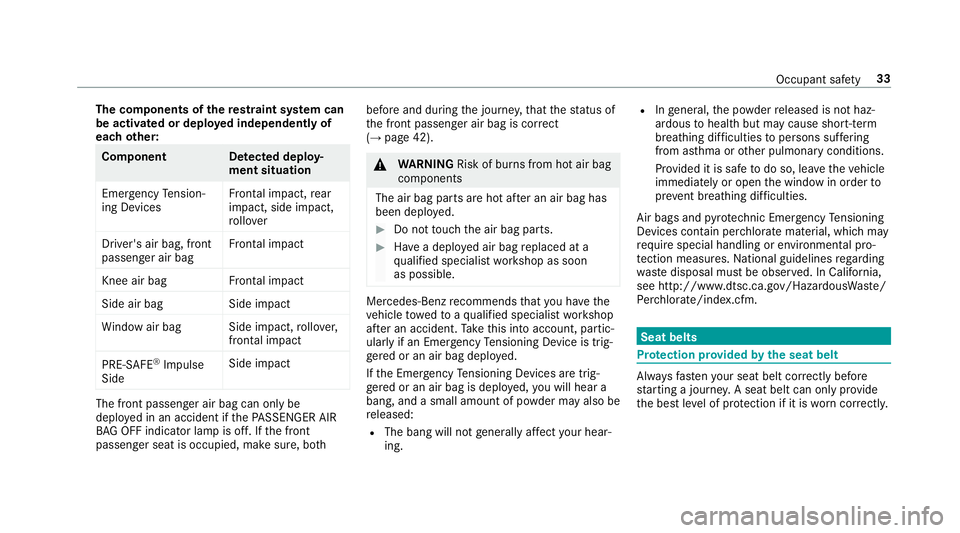
The components of there stra int sy stem can
be activated or deplo yed independently of
each other:
Component De tected deploy‐
ment situation
Emer gency Tension‐
ing Devices Fr
ontal impact, rear
impact, side impact,
ro llo ver
Driver's air bag, front
passenger air bag Fr
ontal impact
Knee air bag Frontal impact
Side air bag Side impact
Wi ndow air ba gS ide impact,rollo ver,
frontal impact
PRE-SAFE®Impulse
Side Side impact
The front passenger air bag can only be
deploy
ed in an accident if thePA SSENGER AIR
BA G OFF indicator lamp is off. If the front
passenger seat is occupied, make sure, bo thbefore and during
the journe y,that thest atus of
th e front passenger air bag is cor rect
(
→page 42).
&
WARNING Risk of burn s from hot air bag
components
The air bag parts are hot af ter an air bag has
been deploy ed.
#Do nottouch the air bag parts.
#Ha ve a deplo yed air bag replaced at a
qu alified specialist workshop as soon
as possible.
Mercedes-Benz recommends that you ha vethe
ve hicle towe dto aqu alified specialist workshop
af te r an accident. Take this into account, partic‐
ularly if an Emer gency Tensioning Device is trig‐
ge red or an air bag deplo yed.
If th e Emer gency Tensioning Devices are trig‐
ge red or an air bag is deplo yed, youwill hear a
bang, and a small amount of powder may also be
re leased:
RThe bang will not generally af fect your hear‐
ing.
RIn general, the powder released is not haz‐
ardous tohealth but may cause short-term
breathing dif ficulties topersons suf fering
from as thma or other pulmonary conditions.
Pr ov ided it is safe todo so, lea vetheve hicle
immediately or open the window in order to
pr eve nt brea thing dif ficulties.
Air bags and pyrotech nic Emergency Tensioning
Devices contain pe rchlorate material, which may
re qu ire special handling or environmental pro‐
te ction measure s.Na tional guidelines rega rding
wa ste disposal must be obser ved. In California,
see http://www.dtsc.ca.gov/HazardousWas te/
Pe rchlorate/index.cfm.
Seat belts
Pr otection pr ovided bythe seat belt
Alw aysfast enyour seat belt co rrectly before
st arting a journe y.A seat belt can only pr ovide
th e best le vel of pr otection if it is worncor rectl y.
Occupant saf ety 33
Page 36 of 506
&WARNING Risk of injury or death dueto
incor rectly fastened seat belt
If th e seat belt is not worncor rectly, it can‐
not per form its intended pr otective function.
In addition, an incor rectly fastened seat belt
can also cause injuries, forex ample, in the
ev ent of an accident or when braking or
ch anging direction suddenly .
#Always ensure that all vehicle occu‐
pants ha vetheir seat belts fastened
cor rectly and are sitting prope rly.
RThe seat belt mus t:
-Not be twisted and must fit tightly and
snugl yacross your body .
-Berouted across the center of the
shoulders and as low down towa rdsth e
hips as possible.
RThe shoulder section of the seat belt should
not touch your ne cknor be routed under
yo ur arm or behind your bac k.
RAvoid wearing bulky clo thing, e.g. a winter
coat.
RPush the lap belt down as far as possible
across your hips and pull tight withth e shoul‐
der section of the belt. Ne verro ute the lap
belt across your abdomen.
RNe verro ute the seat belt across sharp, poin‐
te d, abrasive or fragile objects.
ROnly one person should use each seat belt at
any one time. Ne ver all owbabies and chil‐
dren totrave l sitting on the lap of ano ther
ve hicle occupant.
RNe ver secure objects with a seat belt if the
seat belt is also being used byone of the
ve hicle's occupants. Alw ays obser vethe
instructions for loading theve hicle when
securing objects, luggage or loads
(
→page 101).
Th eseat belt son thefo llowing seats are equip‐
ped with a child seat saf etyfe ature:
RFr ont passenger seat
RRe ar seats
The seat belts forth efo lding bench seat in the
cargo compart ment are not equipped with a
ch ild seat saf etyfe ature. Ac
tivate or deacti vate thech ild seat saf etyfe a‐
t
ure of the seat belt (→page 48).
If ch ildren are tra veling in theve hicle, be sure to
obser vethe instructions and saf etyno tes on
"Children in theve hicle" (
→page 46).
Re duced pr otection
&
WARNING Risk of injury or death dueto
incor rect seat position
The seat belt does not of ferth e intended
le ve l of pr otection if you ha venot mo vedth e
seat backrest toan almost vertical position.
When braking or in theeve nt of an accident,
yo u could slide underneath the seat belt and
sus tain abdominal or neck injuries, forex am‐
ple.
#Ad just the seat proper lybefore begin‐
ning your journe y.
#Always ensure that the seat backrest is
in an almost vertical position and that
th e shoulder section of your seat belt is
34
Occupant saf ety
Page 37 of 506
routed across the center of your shoul‐
der.
& WARNING Risk of injury or death when
additional restra int sy stems are not used
fo r persons with a smaller build
Pe rsons under 5 ft(1.50 m) tall cannot wear
th e seat belt cor rectly wi thout a suitable
additional restra int sy stem.
If th e seat belt is not worncor rectly, it can‐
not per form its intended pr otective function.
In addition, an incor rectly fastened seat belt
can also cause injuries, forex ample, in the
ev ent of an accident or when braking or
ch anging direction suddenly .
#Always secure persons under 5 ft
(1.50 m) tall in a suitable restra int sys‐
te m.
&
WARNING Risk of injury or death dueto
bloc ked seat belt buckle or seat belt
anchorage
Objects next tothe front seat that block the
seat belt buckle or the moving seat belt
anchorage on the front seat impair the func‐
tion of the Emer gency Tensioning Devices.
The Emergency Tensioning Devices can,
th en, not function as intended and the seat
belt can no longer pr ovide the intended pro‐
te ction.
#Before starting the journe y,make sure
th at there are no objects around the
seat belt buckle or between the front
seat and door.
& WARNING Risk of injury or death dueto
damaged or modified seat belts
Seat belts cann otprov ide pr otection in the
fo llowing situations:
RIf th e seat belts are damaged, modified,
ex treme lydirty, bleached or dyed
RIfth e seat belt buckle is damaged or
ex treme lydirty
RIfth e Emer gency Tensioning Devices,
seat belt anchorages or seat belt retrac‐
to rs have been modified
Seat belts may be damaged in an accident,
although the damage may not be visible, e.g.
due tosplinters of glass.
Modified or damaged seat belts may tear or
fa il, e.g. in an accident.
Modified Emer gency Tensioning Devices can
accidental lytrig ger or failto function as
intended.
#Ne ver modify the seat belts, Emer gency
Te nsioning Devices, seat belt ancho‐
ra ge s or seat belt retractors.
#Make surethat the seat belts are
undamaged, not wornand clean.
#Alw ays ha vethe seat belts checked
immediately af ter an accident at a
qu alified specialist workshop.
Occupant saf ety 35
Page 38 of 506
Only use seat beltsthat ha vebeen appr ovedfo r
yo ur vehicle byMercedes-Benz.
&
WARNING Risk of injury or death from
deplo yedpy rotech nic Emergency Ten‐
sioning Devices
Pyro tech nic Emergency Tensioning Devices
th at ha vebeen deplo yed are no longer opera‐
tional and are unable toper form their inten‐
ded pr otective function.
#Therefore, ha vedeplo yedpy rotech nic
Emergency Tensioning Devices immedi‐
ately replaced at a qualified specialist
wo rkshop.
Mercedes-Benz recommends that you ha vethe
ve hicle towe dto aqu alified specialist workshop
af te r an accident.
* NO
TEDama gecaused bytrapping the
seat belt
If an unused seat belt is not fully retracted, it
may become trapped in the door or in the
seat mechanism.
#Alw ays ensure that an unused seat belt
is fully retracted.
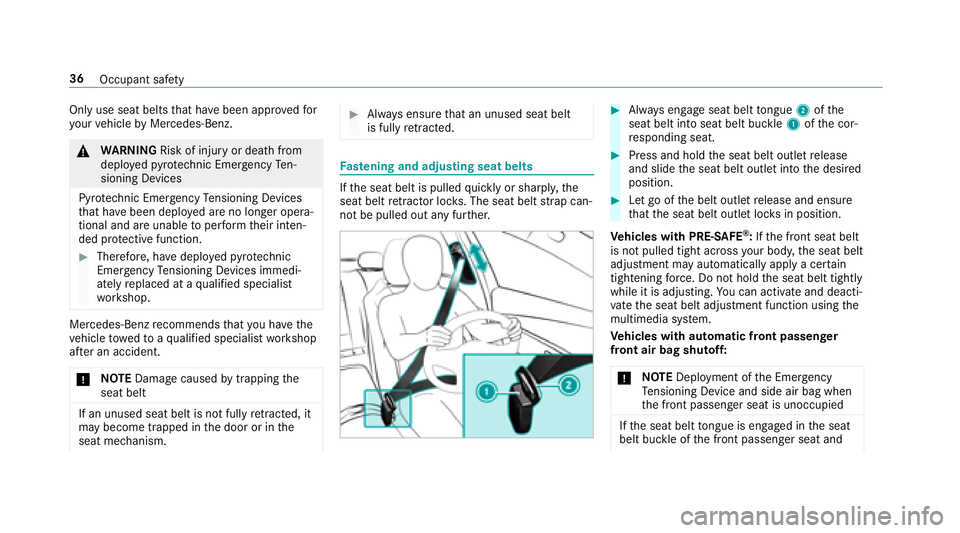
Fa stening and adju sting seat belts
Ifth e seat belt is pulled quickly or sharpl y,the
seat belt retractor lo cks. The seat belt stra p can‐
not be pulled out any fur ther.
#Alw ays engage seat belt tongue 2ofthe
seat belt into seat belt buckle 1ofthe cor‐
re sponding seat.
#Press and hold the seat belt outlet release
and slide the seat belt outlet into the desired
position.
#Let go of the belt outlet release and ensure
th at the seat belt outlet loc ksin position.
Ve hicles with PRE-SAFE
®:If th e front seat belt
is not pulled tight across your body, the seat belt
adjustment may automatically apply a cer tain
tigh tening forc e. Do not hold the seat belt tightly
while it is adjusting. You can activate and deacti‐
va te the seat belt adjustment function using the
multimedia sy stem.
Ve hicles with automatic front passenge r
front air bag shu toff:
* NO
TEDeployment of the Emer gency
Te nsioning Device and side air bag when
th e front passenger seat is unoccupied
Ifth e seat belt tongue is engaged in the seat
belt buckle of the front passenger seat and
36
Occupant saf ety
Page 39 of 506
the front passenger seat is unoccupied, the
Emergency Tensioning Device and the side
air bag may deploy in theeve nt of an acci‐
dent.
#Only one pe rson should use each seat
belt at any one time.
Ve hicles without automatic front passenge r
front air bag shu toff:
* NO
TEDeployment of the Emer gency
Te nsioning Device when the front
passenger seat is unoccupied
If th e seat belt tongue is engaged in the seat
belt buckle of the front passenger seat and
th e front passenger seat is unoccupied, the
Emergency Tensioning Device may depl oyin
th eev ent of an accident.
#Only one person should use each seat
belt at any one time.
Re leasing seat belts
#Press there lease button in the seat belt
buckle and guide the seat belt back with the
seat belt tongue.
Ac tivating or deactivating seat belt adjust‐
ment via the multimedia sy stem
Multimedia sy stem:
,9HKLFOH.î 9HKLFOH 6HWWLQJV.%HOW
$GMXVWPHQW
#Ac tivate Oor deacti vate ª the function.
Seat belt warning for the driver and front
passen ger
The ü seat belt warning lamp in the Instru‐
ment Display is a reminder that all vehicle occu‐
pants must weartheir seat belts cor rectly.
The ü seat belt warning lamp lights up for six
seconds af tereve ryengine start.
In addition, an acoustic warning tone may sound. When
the driver's and front passenger's doors
are closed and the driver and front passenger
ha ve fast ened their seat belts, the seat belt
wa rning goes out.
During a journe y,the seat belt warning lights up
if:
RThe vehicle speed exceeds 15mp h
(25 km/h) and the driver's or front
passenger seat belt is not fastened.
RThe driver or front passenger unfas tens their
seat belt while theve hicle is in motion.
Occupant saf ety 37
Page 41 of 506
&WARNING Risk of injury or death dueto
incor rect seat position
If yo ude viate from the cor rect seat position,
th e air bag cannot perform its intended pro‐
te ctive function and deployment may even
cause fur ther injuries.
To avo id hazardous situations, alw ays make
sure that all vehicle occupants:
RHa ve their seat belt fastened cor rectly,
including pregnant women.
RAre seated properly and that dis tance to
th e air bags is as large as possible.
RObser vethefo llowing information.
#Alw ays make sure that there are no
objects between the air bag and the
ve hicle occupant.
To avo idrisks resulting from the deployment of
th e air bag:
RBefore starting your journe y,adjust your seat
co rrectly ;th e driver's seat and front
passenger seat should be mo ved as far back
as possible. When doing so, alw
ays obser vethe informa‐
tion on the cor rect driver's seat position
(
→page 82).
ROnly hold thesteering wheel bythesteering
wheel rim. This all owsth e air bag tobe fully
deplo yed.
RAlw ays lean against the seat backrest when
th eve hicle is in motion. Do not lean forw ards
or against the door or side windo w.You may
ot herwise be in the deployment area of the
air bags.
RAlw ayske ep your feet on thefloor. Do not
put your feet on the dashboard, forex ample.
Yo ur feet may otherwise be in the deploy‐
ment area of the air bag.
RIfch ildren are tra veling in theve hicle,
obser vethe additional no tes (→page 46).
RAlw aysstow and secure objects cor rectly. Objects in
theve hicle interior may pr event an air
bag from functioning cor rectly. There fore alw ays
ensure that:
RThere are no people, animals or objects
between theve hicle occupants and an air
bag.
RThere are no objects between the seat, door
and door pillar (B-pillar).
RThere are no hard objects, e.g. coat hangers,
hanging on the grab handles or coat hooks.
RThere are no accessory parts, such as cup
holders, attached totheve hicle within the
deployment area of an air bag, e.g. on doors,
side windo wsor side paneling.
RThere are no heavy, sharp-edged or fragile
objects in the poc kets of your clo thing. Store
such objects in a suitable place.
Occupant saf ety 39