wheel MERCEDES-BENZ E-CLASS WAGON 2018 Owner's Guide
[x] Cancel search | Manufacturer: MERCEDES-BENZ, Model Year: 2018, Model line: E-CLASS WAGON, Model: MERCEDES-BENZ E-CLASS WAGON 2018Pages: 506, PDF Size: 6.73 MB
Page 134 of 506
%The duration of the color change varies
depending on the usage conditions.
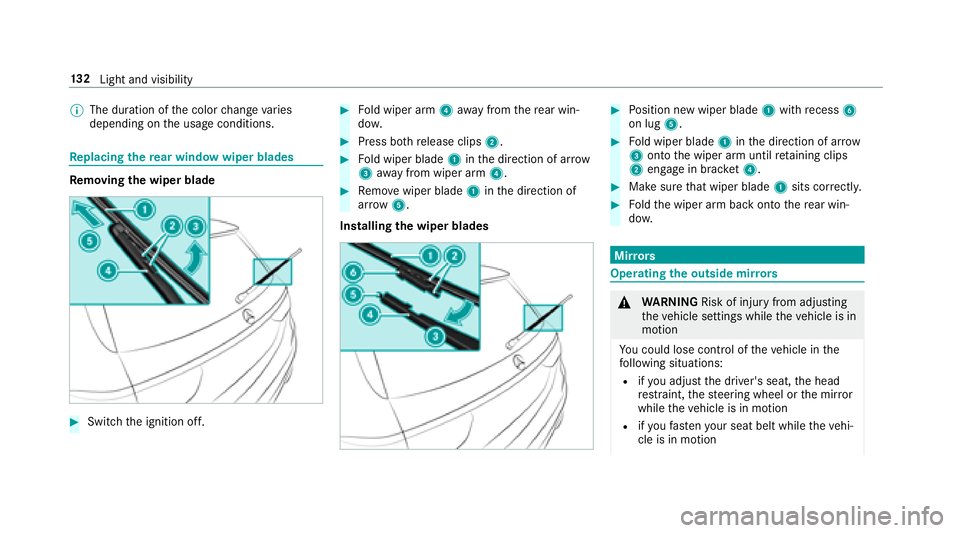
Re placing the rear window wiper blades
Re moving the wiper blade
#Switch the ignition off.
#Fo ld wiper arm 4away from there ar win‐
do w.
#Press bo threlease clips 2.
#Fold wiper blade 1inthe direction of ar row
3 away from wiper arm 4.
#Remo vewiper blade 1inthe direction of
ar row 5.
Installing the wiper blades
#Po sition new wiper blade 1with recess 6
on lug 5.
#Fold wiper blade 1inthe direction of ar row
3 onto the wiper arm until retaining clips
2 engage in brac ket4.
#Make surethat wiper blade 1sits cor rectl y.
#Foldthe wiper arm back onto there ar win‐
do w.
Mir rors
Operating the outside mir rors
&
WARNING Risk of injury from adjusting
th eve hicle settings while theve hicle is in
motion
Yo u could lose cont rol of theve hicle in the
fo llowing situations:
Rifyo u adjust the driver's seat, the head
re stra int, thesteering wheel or the mir ror
while theve hicle is in motion
Rifyo ufa sten your seat belt while theve hi‐
cle is in motion
13 2
Light and visibility
Page 135 of 506
#Beforestarting the engine: adjust the
driver's seat, the head restra int, the
st eering wheel or the mir ror and fasten
yo ur seat belt.
&
WARNING Risk of accident due tomis‐
judgment of dis tances when using the
passenger mir ror
The outside mir ror on the front passenger
side reflects objects on a smaller scale. The
objects in view are in fact closer than they
appear.
As a result, you may misjud gethe dis tance
between you and thero ad user driving
behind you, forex ample, when changing
lanes.
#Therefore, alw ays look over your shoul‐
der inorder toensure that you are
aw are of the actual dis tance between
yo u and thero ad users driving behind
yo u.
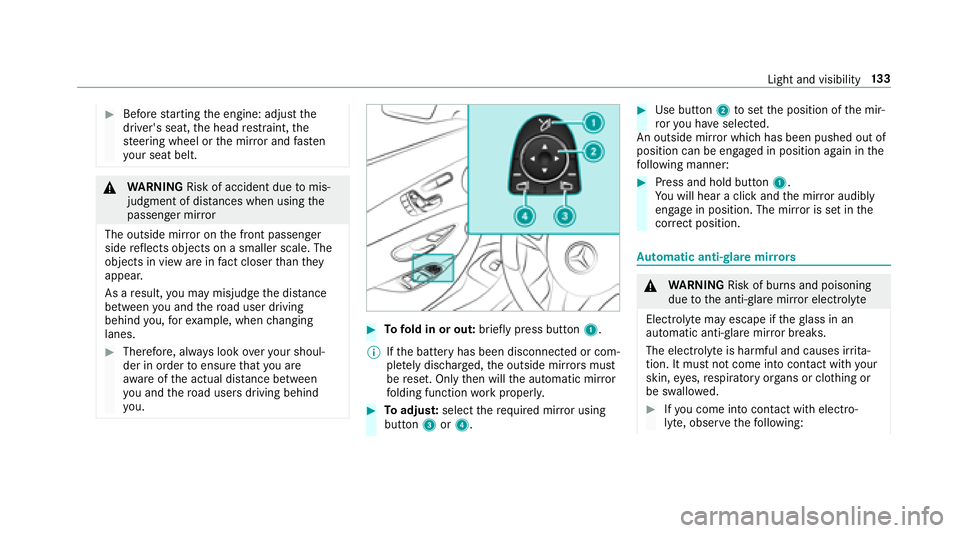
#To fold in or out: brieflypress button 1.
% Ifth e battery has been disconnected or com‐
ple tely discharged ,th e outside mir rors must
be reset. Only then will the automatic mir ror
fo lding function workproperly.
#To adjus t:select therequ ired mir ror using
button 3or4.
#Use button 2toset the position of the mir‐
ro ryo u ha veselected.
An outside mir ror which has been pushed out of
position can be engaged in position again in the
fo llowing manner:
#Press and hold button 1.
Yo u will hear a click and the mir ror audibly
engage in position. The mir ror is set in the
cor rect position.
Au tomatic anti-glare mir rors
&
WARNING Risk of burn s and poisoning
due tothe anti- glare mir ror electrolyte
Electrolyte may escape if theglass in an
automatic anti-glare mir ror breaks.
The electrolyte is harmful and causes ir rita ‐
tion. It must not come into contact wi thyour
skin, eyes,respiratory organs or clo thing or
be swallo wed.
#Ifyo u come into contact with electro‐
ly te , obser vethefo llowing:
Light and visibility 13
3
Page 136 of 506
RRinseth e electrolyte from your skin
and seek medical attention immedi‐
atel y.
RIf electrolyte comes into contact
with your eyes, rinse them thor‐
oughly with clean water and seek
medical attention immediately.
RIf th e electrolyte is swallo wed,
immediately rinse your mouth out
th oroughl y.Do not induce vomiting.
Seek medical attention immediately.
RImmediate lych ange out of clo thing
which has come into con tact wi th
electrolyte.
RIf an allergic reaction occurs, seek
medical attention immediatel y.
The insiderearview mir ror and the outside mir‐
ro rs and on the driver's side automatically go
into anti- glare mode if light from a headlamp hits
th e inside rearview mir ror.
Sy stem limitations
The mir rors do not go into anti- glare mode in the
fo llowing situations:
RThe engine is switched off.
RRe versege ar is engaged.
RInte rior lighting is switched on.
Park ing position of the passenger outside
mir ror
The parking position makes parking easier.
The passenger outside mir ror tilts down wards
and sho wsthere ar wheel on the front passenger
side if:
RThe parking position is stored.
RThe passenger mir ror is selected.
RRe versege ar is engaged.
The passenger outside mir ror mo ves back toits
original position in thefo llowing situations:
RIf yo u shift the transmission toano ther trans‐
mission position.
RWhen driving fasterthan 9 mph (15 km/h).
RIfyo u press the button forth e outside mir ror
on the driver's side.
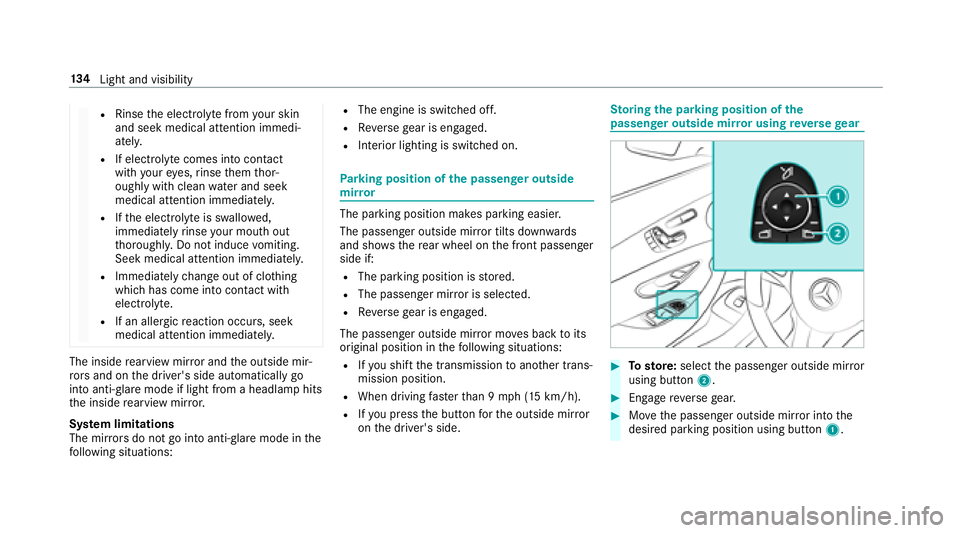
St oring the pa rking position of the
pa ssenger outside mir ror using reve rsege ar
#To sto re:select the passenger outside mir ror
using butto n2.
#Engage reve rsege ar.
#Mo vethe passenger outside mir ror into the
desired parking position using button 1.
134
Light and visibility
Page 149 of 506
&WARNING Risk of accident due to
unsuit ablefoot we ar
Operation of the pedals may be restricted
due tounsuitable foot we ar such as:
RShoes with platfo rmsoles
RShoes with high heels
RSlippers
#When driving alw ayswe ar suitable
shoes in order tobe able tooperate the
pedals safel y.
&
WARNING Risk of accident due tothe
ignition being switched off whilst the
ve hicle is in motion
If yo uswit choff the ignition whilst theve hi‐
cle is in motion saf ety-re leva nt functions will
be restricted or no longer available. This may
ef fect the po werst eering sy stem and brake
fo rc e boosting, forex ample.
Yo uwill need touse cons iderablymoreforc e
to steer and brake.
#Do not switch off the ignition whilst the
ve hicle is in motion.
&
WARNING Risk ofexhaust gas poisoning
Combustion engines emit poisonous exhaust
ga ses such as carbon monoxide. Inhaling
th ese exhaust gases causes poisoning.
#Ne ver lea vethe engine running in an
enclosed space wi thout suf ficient venti‐
lation.
& WARNING Risk of skidding and of an
accident due toshifting down on slippery
ro ad sur faces
If yo u shift do wnon slippery road sur faces to
inc rease the engine braking ef fect, the drive
wheels may lose traction.
#Do not shift down on slippery road sur‐
fa ces toinc rease the engine braking
ef fect.
&
DANG ER Risk of fata l injury due topoi‐
sonous exhaust gases
If th eta ilpipe is bloc ked or suf ficient ventila‐
tion is not possible, poisonous exhaust gases
such as carbon monoxide may enter theve hi‐
cle. This is the case if theve hicle getsst uck
in snow ,fo rex ample.
#Ke ep theta ilpipe and the area around
th eve hicle free from snow when the
engine or thest ationary heater are run‐
ning.
#Open a window on the windward side of
th eve hicle toensure an adequate sup‐
ply of fresh air.
& WARNING Risk of accident and injury
due tobeing under the influence of alco‐
hol and drugs while driving
Driving when under the influence of alcohol
and/or drugs is an extreme lydangerous
combination. Even small quantities of alcohol
or drugs may af fect your reflexe s, perception
and judgment.
Driving and parking 14
7
Page 150 of 506
The probability of a serious oreven fata l acci‐
dent greatly inc reases if youdriv e when
under the influence of alcohol or drugs.
#Do not drink alcohol or take drugs while
driving, and do not allow an yone to
drive who has been drinking alcohol or
ta king drugs.
&
WARNING Risk of accident due tothe
brake sy stem overheating
If yo u lea veyour foot on the brake pedal
when driving, the brake sy stem may over‐
heat.
This increases the braking dis tance and the
brake sy stem may evenfa il.
#Ne ver use the brake pedal as a foot re st.
#Do not depress the brake pedal and the
accelerator pedal at the same time
while driving.
* NO
TEWearing out the brake linings by
continuously dep ressing the brake pedal
#Do not depress the brake pedal contin‐
uously whilst driving.
#To use the braking ef fect of the engine,
shift toa lo werge ar in good time.
* NO
TEDama getothe driv etra in and the
engine when pulling away
#Do not warm upthe engine when the
ve hicle is stationar y.Pull away immedi‐
atel y.
#Avoid high engine speeds and driving at
full thro ttle until the engine has reached
operating temp erature.
#Do not allow the wheels tospin.
* NO
TEDama getothe catalytic con verter
due tonon-combu sted fuel
The engine is not running smoot hly and is
misfiring.
Non-combus ted fuel may get into the cata‐
lytic con verter.
#Only depress the accelera tor pedal
slightl y.
#Have the cause rectified immediately at
a qu alified specialist workshop.
Limited braking ef fect on salt-treate dro ads:
Rdue tosalt build-up on the brake discs and
brake lining, the braking dis tance can
increase conside rably or result in braking
only on one side.
Rmaintain a much greater dis tance totheve hi‐
cle in front.
To preve nt salt build-up:
Rbrake occasionally while paying attention to
th e tra ffic conditions.
Rcarefully depress the brake pedal at the end
of the journey and when starting the next
journe y.
148
Driving and pa rking
Page 155 of 506
#Depress the brake pedal and shift toneutral
i.
#Re lease the brake pedal.
#Switch the ignition off.
% Ifyo uth en exitth eve hicle leaving the
SmartK eyintheve hicle, the automatic trans‐
mission remains in neutral i
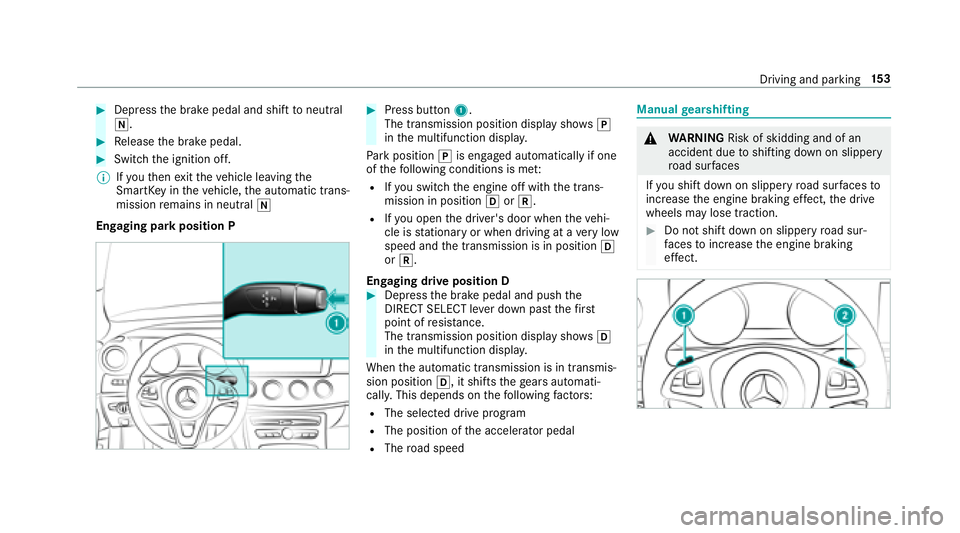
Engaging park position P
#Press button 1.
The transmission position display sho wsj
in the multifunction displa y.
Pa rk position jis engaged automatically if one
of thefo llowing conditions is me t:
RIfyo uswit chthe engine off with the trans‐
mission in position hork.
RIfyo u open the driver's door when theve hi‐
cle is stationary or when driving at a very low
speed and the transmission is in position h
or k.
Engaging drive position D
#Depress the brake pedal and push the
DIRECT SELECT le ver down past thefirs t
point of resis tance.
The transmission position displ aysho wsh
in the multifunction displa y.
When the automatic transmission is in transmis‐
sion position h, it shiftsthege ars automati‐
call y.This depends on thefo llowing factors:
RThe selected drive program
RThe position of the accelera tor pedal
RThe road speed
Manual gearshifting
&
WARNING Risk of skidding and of an
accident due toshifting down on slippery
ro ad sur faces
If yo u shift do wnon slippery road sur faces to
inc rease the engine braking ef fect, the drive
wheels may lose traction.
#Do not shift down on slippery road sur‐
fa ces toinc rease the engine braking
ef fect.
Driving and park ing15
3
Page 156 of 506
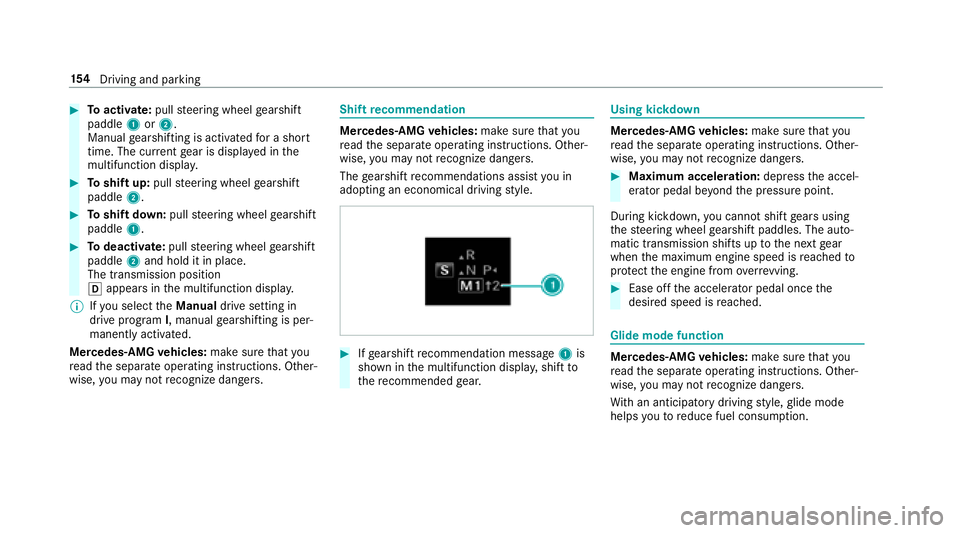
#Toactivate: pullsteering wheel gearshift
paddle 1or2.
Manual gearshifting is activated for a short
time. The cur rent gear is displa yed in the
multifunction displa y.
#Toshift up: pullsteering wheel gearshift
paddle 2.
#Toshift down: pullsteering wheel gearshift
paddle 1.
#Todeactivate: pullsteering wheel gearshift
paddle 2and hold it in place.
The transmission position
h appears in the multifunction displa y.
% Ifyo u select theManual drive setting in
drive prog ram I, manual gearshifting is per‐
manent lyactivated.
Mercedes -AMG vehicles: make sure that you
re ad the separate operating instructions. Other‐
wise, you may not recognize dangers.
Shift recommendation
Mercedes -AMG vehicles: make sure that you
re ad the separate operating instructions. Other‐
wise, you may not recognize dangers.
The gearshift recommendations assist you in
adopting an economical driving style.
#If ge arshift recommendation message 1is
shown in the multifunction displa y,shift to
th ere commended gear.
Using kickdow n
Mercedes-AMG vehicles: make sure that you
re ad the separate operating instructions. Other‐
wise, you may not recognize dangers.
#Maximum acceleration: depress the accel‐
erator pedal be yond the pressure point.
During kickdown, you cannot shift gears using
th esteering wheel gearshift paddles. The auto‐
matic transmission shifts up tothe next gear
when the maximum engine speed is reached to
pr otect the engine from overrev ving.
#Ease off the accelera tor pedal once the
desired speed is reached.
Glide mode function
Mercedes -AMG vehicles: make sure that you
re ad the separate operating instructions. Other‐
wise, you may not recognize dangers.
Wi th an anticipatory driving style, glide mode
helps youto reduce fuel consum ption.
15 4
Driving and pa rking
Page 160 of 506
&WARNING Risk of accident and injury
due tochildren left unatte nded inthe
ve hicle
If yo u lea vechildren unaccompanied in the
ve hicle, they may be able toset theve hicle in
motion, forex ample by:
RRe leasing the parking brake.
RShifting the transmission out of park
position j.
RStarting the engine.
In addition, they may operate vehicle equip‐
ment.
#Ne ver lea vechildren and animals unat‐
te nded in theve hicle.
#When leaving theve hicle, alw aysta ke
th e SmartK eywith you and lock the
ve hicle.
* NO
TEDama getotheve hicle or the driv‐
et ra in caused bytheve hicle rolling away
#Alw ays proper lysecure theve hicle
against rolling away.
#On uphill or downhill inclines, turn the front
wheels towa rdsth e curb.
#Select transmission position j.
#Applythe electric parking brake.
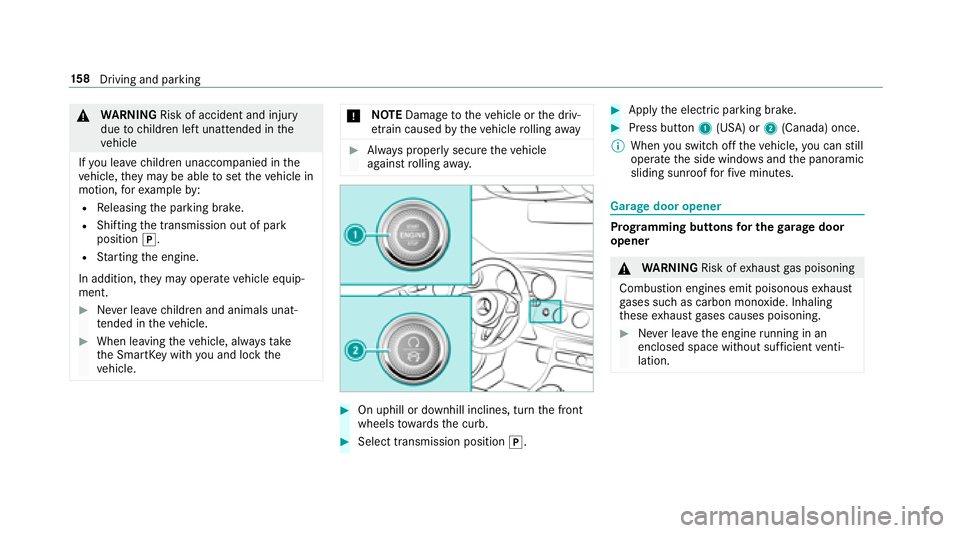
#Press button 1(USA) or 2(Canada) once.
% When you switch offtheve hicle, you can still
opera tethe side windo wsand the panoramic
sliding sunroof forfive minutes.
Garage door opener
Prog ramming buttons for the garage door
opener
& WARNING Risk ofexhaust gas poisoning
Combustion engines emit poisonous exhaust
ga ses such as carbon monoxide. Inhaling
th ese exhaust gases causes poisoning.
#Ne ver lea vethe engine running in an
enclosed space wi thout suf ficient venti‐
lation.
15 8
Driving and pa rking
Page 168 of 506
Drivingand drivin gsaf ety sy stems
Driving sy stems and your responsibility
Yo ur vehicle is equipped with driving sy stems
which assist youin drivin g, parking and maneu‐
ve ring theve hicle. The driving sy stems are aids
and do not relie ve you of your responsibility. Pay
attention tothe tra ffic conditions at all times
and inter vene when necessary . Beaware of the
limitations rega rding the safe use of these sys‐
te ms.
Fu nction of thera dar senso rs
Some driving and driving safe ty systems use
ra dar sensors tomonitor the area in front of,
behind or next totheve hicle (depending on the
ve hicle's equipment).
Depending on theve hicle's equipment, thera dar
sensors are integrated behind the bumpers
and/or behind thera diator grill. Keep these
parts free of dirt, ice and slush (
→page 336).
The sensors must not be co vered, forex ample
by bicycle rack s, overhanging loads or radar-
re flecting sticke rs.Fo llowing an impact and in th
eeve nt of associated damage , which may not
be visible, tothe bumpers or radiator grille, ha ve
th e function of thera dar sensors checked at a
qu alified specialist workshop. The driver assis‐
ta nce sy stem may no longer workproperly.
Overview of driving sy stems and driving
saf ety sy stems
In this section, you will find information about
th efo llowing driving sy stems and driving saf ety
sy stems:
R360° Camera (→page 196)
RABS ( Anti-lock BrakingSystem)
(→page 166)
RAc tive Dis tance Assist DISTRONIC
(→pa ge 177)
RAIR BODY CONTROL(→page 187)
RAc tive Brake Assi st(→page 170)
RAc tive Lane Keeping Assist (→page 211)
RAT TENTION ASSIST (→page 205)
RBA S (Bra keAssist System) (→page 167)
RDY NA MIC BODY CONTROL (→page 187)
REBD ( Electronic Brakeforc eDistribution)
(→page 170)
RESP®(E lectronic Sta bility Program)
(→page 167)
RHOLD function (→page 186)
RSTEER CONTROL (→page 170)
RAc tive Steering Assist (→page 183)
RAc tive Parking Assist (→page 199)
RParking Assist PARKTRONI C (→page19 0)
RRe ar view camera (→page 194)
RCruise control (→page 175)
RBlind Spot Assist andActive Blind Spot Assi st
(→page 208)
RTr af fic Sign Assist (→page 206)
Functions of ABS (anti-lock braking sy stem)
ABS regulates the brake pressure in critical driv‐
ing situations:
RDuring braking, e.g. at maximum full-s top
braking or insuf ficient traction of the tires,
th e wheels are pr evented from blocking.
16 6
Driving and pa rking
Page 169 of 506
RVehicle steerability while braking is ensured.
If ABS inter venes when braking, youwill feel a
pulsing in the brake pedal. The pulsating brake
pedal can be an indication of hazardous road
conditions and can ser veas a reminder totake
ex tra care while driving.
Sy stem limitations
RABS is active from speeds of appr ox. 5 mph
(8 km/h).
RABS may be impaired or may not function if a
malfunction has occur red and theye l‐
low ! ABSwarning lamp lights up contin‐
uously in the instrument clus ter af terth e
engine is star ted.
Fu nction of BAS (Brake Assist Sy stem)
&
WARNING Risk of an accident caused by
a malfunction in BAS (Brake Assist Sys‐
te m)
If BA S is malfunctioning, the braking dis tance
in an emergency braking situation is
increased.
#Depre ssthe brake pedal with full forc e
in emer gency braking situations. ABS
pr eve nts the wheels from locking.
BA S suppo rts yo ur eme rgency braking situation
with additional brake forc e.
If yo u depress the brake pedal quickl y,BA S is
acti vated:
RBA S au tomatical lyboosts the brake pres‐
sure.
RBA S can short enthe braking dis tance.
RABS pr events the wheels from locking.
The brakes will function as usual once you
re lease the brake pedal. BAS is deactivated.
Functions of ESP®(Electronic Stability Pro‐
gr am)
&
WARNING Risk of skidding if ESP®is
malfunctioning
If ESP
®is malfunctioning, ESP®cannot car ry
out vehicle stabilization. In addition, other
driving saf etysy stems are switched off.
#Drive on carefull y.
#Have ESP®checked at a qualified spe‐
cialist workshop.
&
WARNING Risk of skidding if ESP®is
deactivated
If yo u deactivate ESP
®, ESP®cannot car ry
out vehicle stabilization.
#ESP®should only be deactivated in the
fo llowing situations.
ESP®monitors and impr oves driving stability and
traction, particular ly inthefo llowing situations:
RWhen pulling away on wet or slippe ryroads.
Driving and parking 16
7