flat tire MERCEDES-BENZ E-CLASS WAGON 2018 Owner's Manual
[x] Cancel search | Manufacturer: MERCEDES-BENZ, Model Year: 2018, Model line: E-CLASS WAGON, Model: MERCEDES-BENZ E-CLASS WAGON 2018Pages: 506, PDF Size: 6.73 MB
Page 5 of 506
Drivingand pa rking ................................. 143
Driving ........................................................ 143
DY NA MIC SELECT switch ........................... 150
Au tomatic transmission .............................. 151
Re fueling .................................................... 155
Pa rking ...................................................... .157
Driving and driving safe ty systems ............ .166
Instrument Display and on-board
comp uter ................................................... 215
Instrument display overview ...................... .215
Overview of the buttons on thesteering
wheel ......................................................... .216
Operating the on-board computer ............... 216
Displ ays in the multifunction display ........... 218
Ad justing the instrument lighting ............... .218
Menus and submenus ................................. 219
Head-up Display ......................................... 225
Vo ice Control Sy stem .............................. 227
Operating saf ety........................................ .227
Operation ................................................... 227
Using Voice Cont rol Sy stem ef fectively ...... 229
Essential voice commands ........................ .229
Multimedia sy stem .................................. 239
Overview and operation .............................. 239
Sy stem settings .......................................... 247
Na vigation .................................................. 258
Te lephone .................................................. .281
Online and Internet functions ..................... 297
Media ......................................................... 304
Ra dio .......................................................... .316
Sound ......................................................... 323
Main tenance and care ............................. 326
ASS YST PLUS service inter val display ........ 326
Engine compartment .................................. 327
Cleaning and care ...................................... .333
Breakdown assist ance............................ 340
Emergency .................................................. 340
Flat tire ....................................................... 340
Battery (vehicle) ......................................... 346
To w starting or towing away ........................ 351
Electrical fuses ........................................... 356
Wheels and tires ...................................... 360
Noise or unusual handling characteris‐
tics ............................................................ .360
Che cking wheels and tires regularly ........... 360
No tes on snow chains ................................ .361
Ti re pressure .............................................. .361
Loading theve hicle .....................................3 67
Ti re labeling ................................................ 372
Definition of term sfo r tires and loading ..... 377
Changing a wheel ...................................... .380
Tech nical data .......................................... 390
No tes on tech nical da ta.............................. 390
Ve hicle electronics .....................................3 90
Ve hicle identification plate, VIN and
engine number ...........................................3 92
Operating fluids .......................................... 394
Ve hicle data ................................................ 400
Display messages and warning/indi‐
cator lamps .............................................. 402
Display messages ...................................... .402
Wa rning and indicator lamps ...................... 449
Conte nts 3
Page 19 of 506
Whattodo in theeve nt of an accident
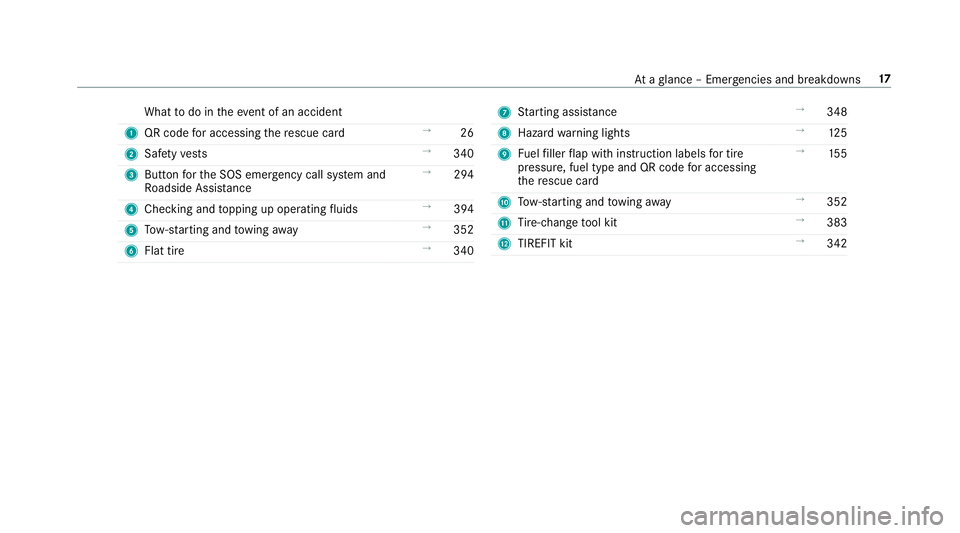
1 QR code for accessing there scue card →
26
2 Safetyve sts →
340
3 Button forth e SOS emer gency call sy stem and
Ro adside Assis tance →
294
4 Checking and topping up operating fluids →
394
5 Tow- starting and towing away →
352
6 Flat tire →
3407Starting assis tance →
348
8 Haza rdwa rning lights →
125
9 Fuelfiller flap with instruction labels for tire
pressure , fuel type and QR code for accessing
th ere scue card →
155
A Tow- starting and towing away →
352
B Tire -change tool kit →
383
C TIREFIT kit →
342
Ataglance – Emer gencies and breakdowns 17
Page 43 of 506
RAlways obser vethech ild restra int sy stem
manufacturer's ins tallation instructions.
RNe ver place objects under or behind the
ch ild restra int sy stem, e.g. cushions.
RFu lly retract the seat cushion length adjust‐
ment.
RThe entire base of thech ild restra int sy stem
must alw aysre st on the seat cushion of the
front-passenger seat.
RThe backrest of thefo rw ard-facing child
re stra int sy stem must, as far as possible, be
re sting on the seat backrest of the front
passenger seat.
RThe child restra int sy stem must not touch the
ro of or be put under stra in by the head
re stra ints. Adjust the seat backrest inclina‐
tion and the head restra int setting accord‐
ing ly.
&
WARNING Risk of injury or death dueto
objects between the sitting sur face and
th ech ild restra int sy stem
Objects between the sitting sur face and the
ch ild restra int sy stem could af fect the func‐
tion of the automatic front passenger airbag
shutoff.
This could result in the front passenger air‐
bag not functioning as intended during an
accident.
#Do not place any objects between the
sitting sur face and thech ild restra int
sy stem.
#The entire base of thech ild restra int
sy stem must alw aysre st on the sitting
sur face of the front passenger seat.
#The backrest of thefo rw ard-facing child
re stra int sy stem must lie as flat as pos‐
sible against the backrest of the front
passenger seat.
#Alw ays comply with thech ild restra int
sy stem manufacturer's ins tallation
instructions.
A person in the front passenger seat mus t:
RFasten their seat belt cor rectly.
RSit in an almost up right position with their
back against the seat backrest.
RSit with their feet resting on thefloor, if pos‐
sible.
Otherwise, the front passenger air bag may be
deactivated bymis take ,fo rex ample because the
front passenger:
RTr ans fers their weight bysupporting them‐
selves on a vehicle armrest.
RSits in such a wayth at their weight is raised
from the sitting sur face.
&
WARNING Risk of injury or death dueto
deactivated front passenger airbag
If th ePA SSENGER AIR BAG OFF indicator
lamp is lit, the front passenger airbag is disa‐
bled. It will not be deplo yed in theeve nt of
an accident and cannot pe rform its intended
pr otective function.
Occupant saf ety 41
Page 97 of 506
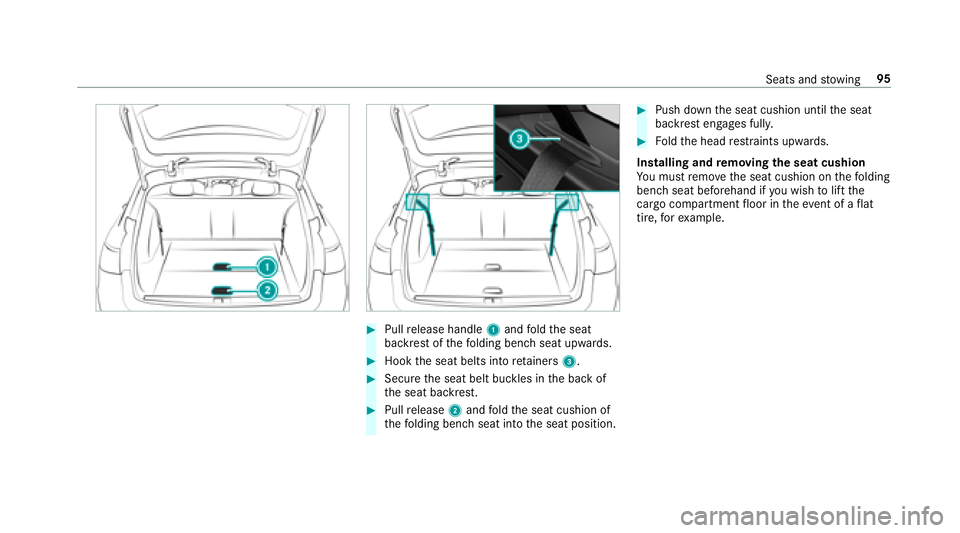
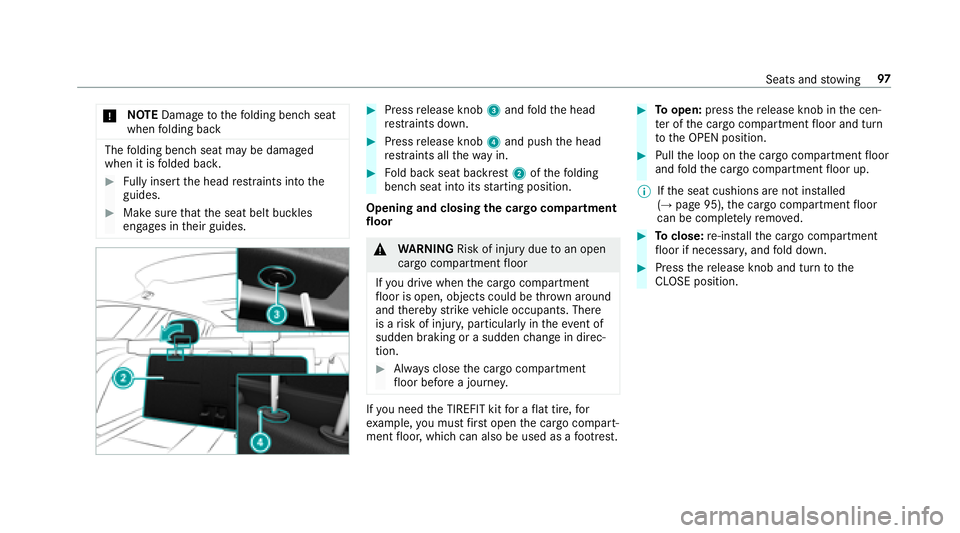
#Pullrelease handle 1and fold the seat
backrest of thefo lding bench seat upwards.
#Hook the seat belts into retainers 3.
#Secure the seat belt buckles in the back of
th e seat backrest.
#Pull release 2and fold the seat cushion of
th efo lding bench seat into the seat position.
#Push down the seat cushion until the seat
backrest engages full y.
#Foldthe head restra ints upwards.
Installing and removing the seat cushion
Yo u must remo vethe seat cushion on thefo lding
bench seat beforehand if youwish tolift the
cargo compart mentfloor in theev ent of a flat
tire, forex ample.
Seats and stowing 95
Page 99 of 506
*NO
TEDama getothefo lding bench seat
when folding back
The folding bench seat may be damaged
when it is folded bac k.
#Fully inse rtthe head restra ints into the
guides.
#Make sure that the seat belt buckles
engages in their guides.
#Press release knob 3and fold the head
re stra ints down.
#Press release knob 4and push the head
re stra ints all thewa yin .
#Fo ld back seat backrest 2ofthefo lding
bench seat into its starting position.
Opening and closing the cargo compa rtment
floor
& WARNING Risk of injury duetoan open
cargo compartment floor
If yo u dr ive when the cargo compartment
fl oor is open, objects could be throw n around
and thereby strike vehicle occupants. There
is a risk of injur y,particular lyin theeve nt of
sudden braking or a sudden change in direc‐
tion.
#Alw ays close the cargo compartment
fl oor before a journe y.
Ifyo u need the TIREFIT kit for a flat tire, for
ex ample, you must firs t open the cargo compart‐
ment floor, which can also be used as a foot re st.
#To open: pressthere lease knob in the cen‐
te r of the cargo compartment floor and turn
to the OPEN position.
#Pull the loop on the cargo compartment floor
and fold the cargo compartment floor up.
% Ifth e seat cushions are not ins talled
(
→page 95), the cargo compartment floor
can be comple tely remo ved.
#To close: re-ins tallth e cargo compartment
fl oor if necessar y,and fold down.
#Press there lease knob and turn tothe
CL OSE position.
Seats and stowing 97
Page 342 of 506
Emergency
Re moving the saf etyve st
The saf etyve sts are located in the saf etyve st
compart ments in the driver's and front
passenger door stowage compartments.
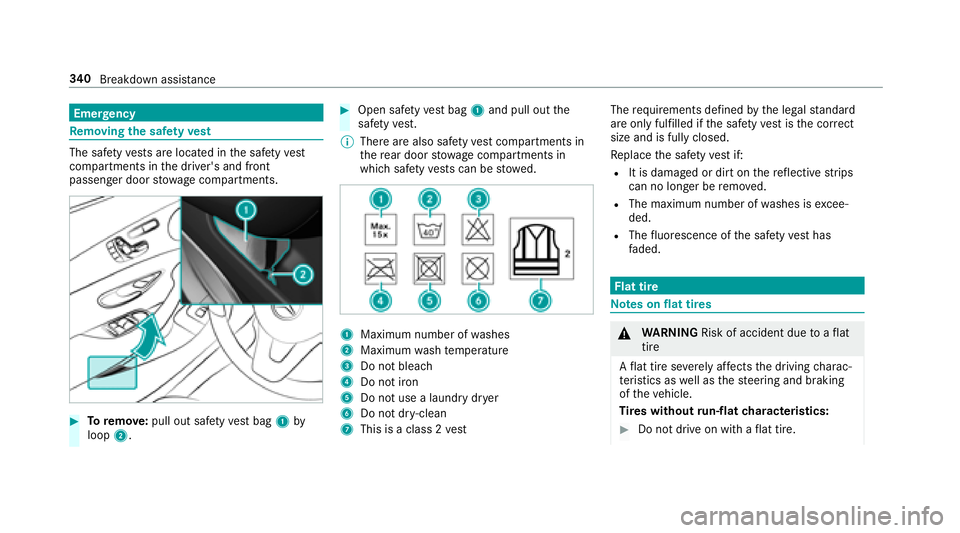
#Toremo ve:pull out safe tyvest bag 1by
loop 2.
#Open saf etyve st bag 1and pull out the
saf etyve st.
% There are also saf etyve st compart ments in
th ere ar door stowage compartments in
which saf etyve sts can be stowed.
1Maximum number of washes
2Maximum wash temp erature
3Do not bleach
4Do not iron
5Do not use a laundry dr yer
6Do not dr y-clean
7This is a class 2 vest The
requ irements defined bythe legal standard
are only fulfille difth e saf etyve st isthe cor rect
size and is fully closed.
Re place the saf etyve st if:
RIt is damaged or dirt on there flective strips
can no longer be remo ved.
RThe maximum number of washes is excee‐
ded.
RThe fluorescence of the saf etyve st has
fa ded.
Flat tire
Note s on flat tires
&
WARNING Risk of accident due toaflat
tire
A flat tire se verely affects the driving charac‐
te rist ics as well as thesteering and braking
of theve hicle.
Ti re s without run-flat characteristics:
#Do not drive on with a flat tire.
34 0
Breakdown assis tance
Page 343 of 506
#Changetheflat tire immediately with
th e emer gency spa rewheel or spare
wheel. Alternativel y,consult a qualified
specialist workshop.
Ti re s with run-flat characteristics:
#Observ eth e information and warning
no tes on MOExtended tires (run-flat
tires).
In theeve nt of a flat tire, thefo llowing options
are available depending on your vehicle's equip‐
ment:
RVe hicles with MOExtended tires: it is pos‐
sible tocontinue the journey for a short
period of time. Make sure you observ eth e
no tes on MOExtended tires (run-flat tires)
(
→page 341).
RVe hicles with a TIREFIT kit: you can repair
th e tire so that it is possible tocontinue the
jou rney for a short period of time. Todo this,
use the TIREFIT kit (
→page 342).
RVe hicles with Mercedes-Benz
mbrace®(USA only): you can make a call for Ro
adside Assis tance via theove rhead control
panel in the case of a breakdown
(
→page 294).
RAll vehicles: change the wheel
(→page 384).
MOExtended tires (tires with run-flat proper‐
ties)
& WARNING Risk of accident when driving
in li mp-home mode
When driving in emergency mode the han‐
dling characteristics are impaired, e.g. when
cornering, when accelerating stronglyand
when braking.
#Do not exceed the specified maximum
speed.
#Av oid any abrupt steering and driving
maneuvers as well as driving over
obs tacles (curbs, pot holes, off-road).
This applies, in part icular,toa loaded
ve hicle.
#Stop driving in the emer gency mode if
yo u notice:
Rbanging noise
Rvehicle vibration
Rsmoke which smells like rubber
Rcontinuous ESP®inter vention
Rcrac ksin tire side walls
#After driving in emergency mode ha ve
th erims checkedby aqu alified special‐
ist workshop with rega rd totheir fur ther
use.
#The defective tire must be replaced in
eve rycase.
With MOExtended tires (run-flat tires), you can
continue todrive your vehicle even if there is a
tot al loss of pressure in one or more tires. How‐
eve r,th e tire af fected must not show any clearly
visible damage.
Yo u can recognize MOExtended tires bythe
MOExtended marking which appears onthe side
wa ll of the tire.
Breakdown assis tance 34
1
Page 344 of 506
Vehicles with tire pressure monitoring sys‐
te m: MOExtended tires may only be used in con‐
junction wi than activated tire pressure monitor‐
ing sy stem.
If a pressure loss warning message appears in
th e multifunction display:
RCheck the tire for dama ge.
RIf driving on, obser vethefo llowing no tes.
Driving distance possible in limp-home mode
af te r the pressure loss warning:
Load condition Driving distance pos‐
sible in limp-homemode
Pa rtially laden 50 miles (80 km)
Fu lly laden 19miles (30 km)
RThe driving dis tance possible in li mp-home
mode may vary depending on the driving
st yle.
RMaximum permissible speed 50 mph
(80 km/h). If a tire has gone
flat and cannot be replaced
with an MOEx tended tire, you can use a stand‐
ard tire as a temp orary measure.
Using the TIREFIT kit
Ha ve thefo llowing readily available:
RTire sealant bottle
REnclosed TIREFIT sticke r
RTire inflation compressor
Yo u can use TIREFIT tire sealant toseal punctu‐
re s of up to0.16 in (4 mm), particular lythose in
th e tire conta ct surface.You can use TIREFIT in
outside temp eratures down to-4 °F (-20 °C).
&
WARNING Risk of accident when using
tire sealant.
In thefo llowing situations, the tire sealant is
unable toprov ide suf ficient breakdown assis‐
ta nce, as it is unable toseal the tire proper ly:
RThere are cuts or punctures in the tire
lar gerth an those pr eviously mentioned.
RThe wheel rim is dama ged.
RYo u ha vedriven at a very low tire pres‐
sure or on a flat tire.
#Do not continue driving.
#Consult a qualified specialist workshop.
&
WARNING Risk of injury and poisoning
from tire sealant
The tire sealant is harmful and causes ir rita ‐
tion. Do not allow it tocome into contact
wi th th e skin, eyes or clo thing, and do not
swallow it. Do not inhale tire sealant fumes.
Ke ep the tire sealant away from children.
If yo u come into contact withth e tire sealant,
obser vethefo llowing:
#Rinse off the tire sealant from your skin
immediately using water.
#If tire sealant gets into your eyes, thor‐
oughly rinse out theey es using clean
wate r.
342
Breakdown assis tance
Page 345 of 506
#If tire sealant has been swallowed,
immediately rinse out the mouth thor‐
oughly and drink plenty of water.Do not
induce vomiting and seek medical
attention immediately.
#Change out of any clo thes conta mina‐
te d with tire sealant immediatel y.
#If allergicreactions occur, seek medical
attention immediatel y.
*NO
TEOverheating due tothe tire infla‐
tion compressor running too long
#Do not runth e tire inflation compressor
fo r longer than ten minu tes without
inter ruption.
Comply with the manufacturer's saf etyno tes in
th est icke r on the tire inflation compressor.
Ha ve the tire sealant bottle replaced everyfour
ye ars at a qualified specialist workshop.
#Do not remo veany fore ign objects which
ha ve penetra tedth e tire.
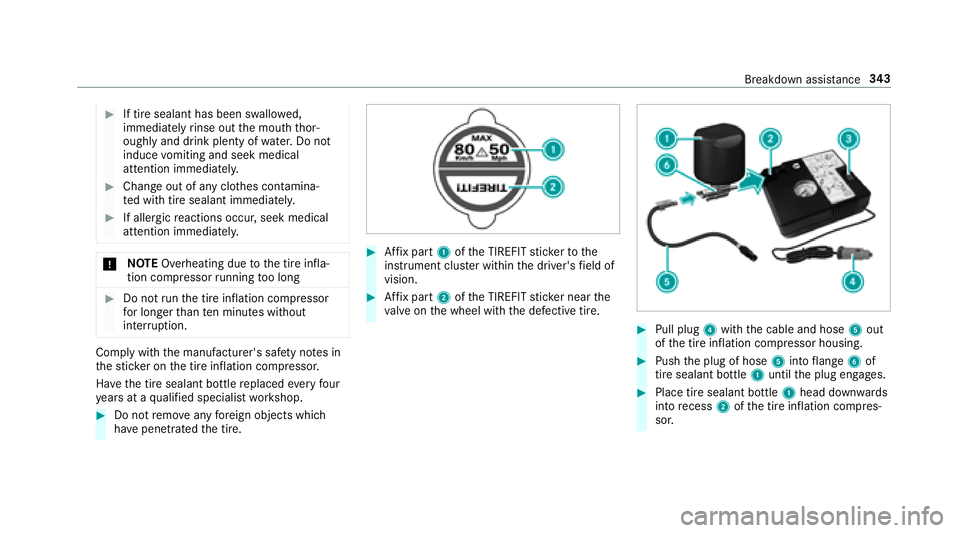
#Af fix pa rt1 ofthe TIREFIT sticke rto the
instrument clus ter within the driver's field of
vision.
#Af fix pa rt2 ofthe TIREFIT sticke r near the
va lve on the wheel with the defective tire.
#Pull plug 4with the cable and hose 5out
of the tire inflation compressor housing.
#Push the plug of hose 5into flange 6of
tire sealant bottle 1until the plug engages.
#Place tire sealant bottle 1head down wards
into recess 2ofthe tire inflation compres‐
sor.
Breakdown assis tance 34
3
Page 346 of 506
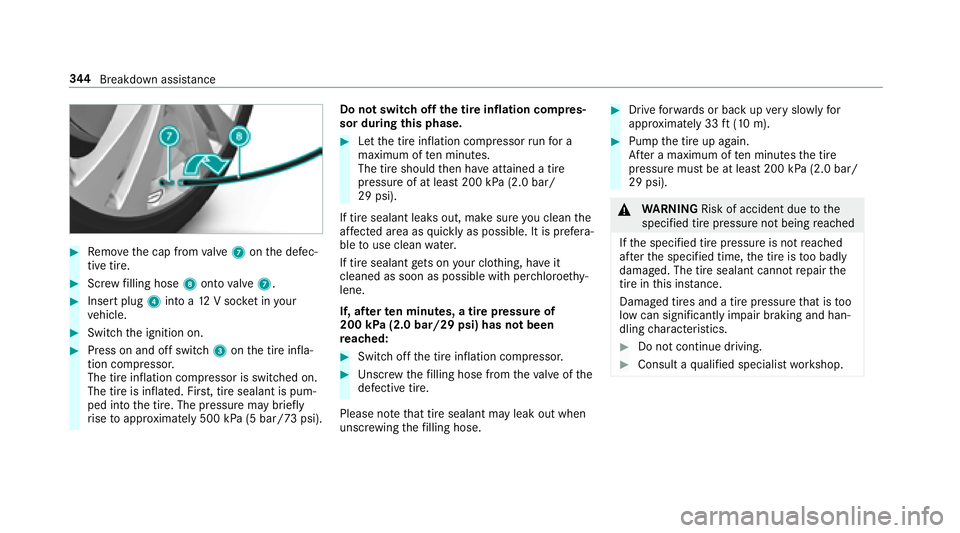
#Remo vethe cap from valve 7 onthe defec‐
tive tire.
#Scr ew filling hose 8onto valve 7.
#Insert plug 4into a 12V soc ket in your
ve hicle.
#Switch the ignition on.
#Press on and off switch 3onthe tire infla‐
tion compressor.
The tire inflation compressor is switched on.
The tire is inflated. Fir st, tire sealant is pum‐
ped into the tire. The pressure may brief ly
ri se toappr oximately 500 kPa (5 bar/73 psi). Do not switch off
the tire inflation compres‐
sor du ring this phase.
#Let the tire inflation compressor runfo r a
maximum of ten minu tes.
The tire should then ha veattained a tire
pressure of at least 200 kPa (2.0 bar/
29 psi).
If tire sealant leaks out, make sure you clean the
af fected area as quickly as possible. It is prefera‐
ble touse clean water.
If tire sealant gets on your clo thing, ha veit
cleaned as soon as possible with per chloroe thy‐
lene.
If, af terte n minutes, a tire pressure of
200 kPa (2.0 bar/29 psi) has not been
re ached:
#Switch off the tire inflation compressor.
#Un scr ew thefilling hose from theva lve of the
defective tire.
Please no tethat tire sealant may leak out when
unscr ewing thefilling hose.
#Drive forw ards or back up very slowly for
appr oximately 33 ft(10 m).
#Pump the tire up again.
Af ter a maximum of ten minu testh e tire
pressure must be at least 200 kPa (2.0 bar/
29 psi).
& WARNING Risk of accident due tothe
specified tire pressure not being reached
If th e specified tire pressure is not reached
af te rth e specified time, the tire is too badly
damaged. The tire sealant cannot repair the
tire in this ins tance.
Dama ged tires and a tire pressure that is too
low can significantly impair braking and han‐
dling characteristics.
#Do not continue driving.
#Consult a qualified specialist workshop.
34 4
Breakdown assis tance