airbag MERCEDES-BENZ E320 WAGON 2003 S210 Owner's Guide
[x] Cancel search | Manufacturer: MERCEDES-BENZ, Model Year: 2003, Model line: E320 WAGON, Model: MERCEDES-BENZ E320 WAGON 2003 S210Pages: 354, PDF Size: 13.99 MB
Page 78 of 354
75 Restraint systems
Te ch n i c a l
data Instruments
and controlsOperationDrivingInstrument
cluster displayPractical hints Car care Index Safety guidelines for the seat belt, emergency
tensioning device and airbag
If you believe that, even with the use of these
guidelines, it would be safer for your rear seat
occupants to have both rear door mounted side
airbags deactivated, then deactivation can be
accomplished upon your written election to do so at
your authorized Mercedes-Benz Center at an
additional cost. Please contact your local
authorized Mercedes-Benz Center or call our
Customer Assistance Center at 1-800-FOR-
MERCedes (1-800-367-6372) for details.Wa r n i n g !
• Damaged seat belts or belts that were highly
stressed in an accident must be replaced and
their anchoring points must also be checked.
Use only belts installed or supplied by an
authorized Mercedes-Benz Center.• Do not pass belts over sharp edges.• Do not make any modification that could
change the effectiveness of the belts.
• Ai rba gs an d E T Ds are d esi gned to fun c tion on a
one-time-only basis. An airbag or emergency
tensioning device (ETD) that was activated
must be replaced.• No modifications of any kind may be made to
any components or wiring of the SRS. This
includes changing or removing any component
or part of the SRS, the installation of additional
trim material, badges etc. over the steering
wheel hub, front passenger airbag cover, door
trim panels, or door frame trims, and
installation of additional electrical /electronic
equipment on or near SRS components and
wiring. Keep area between airbags and
occupants free of objects (e.g. packages,
purses, umbrellas, etc.).• Do not hang items such as coat hangers from
the coat hooks or handles over the door. These
items may turn into projectiles and cause head
and other injuries when curtain airbag is
deployed.• An airbag system component within the
steering wheel gets hot after the airbag has
inflated. Do not touch.
Page 79 of 354
76 Restraint systems
Te ch n i c a l
data Instruments
and controlsOperationDrivingInstrument
cluster displayPractical hints Car care Index
When you sell the vehicle we strongly urge you to give
notice to the subsequent owner that it is equipped with
an SRS by alerting him to the applicable section in the
Operator’s Manual.
• Improper work on the system, including
incorrect installation and removal, can lead to
possible injury through an unintended
activation of the SRS.• In addition, through improper work there is
the risk of rendering the SRS inoperative or
causing unintended airbag deployment. Work
on the SRS must therefore only be performed
by an authorized Mercedes-Benz Center.• For your protection and the protection of
others, when scrapping the airbag unit or
emergency tensioning device, our safety
instructions must be followed. These
instructions are available at your authorized
Mercedes-Benz Center.• Given the considerable deployment speed and
the textile structure of the airbags, there is the
possibility of abrasions or other injuries
resulting from airbag deployment.
Page 81 of 354
78 Restraint systems
Te ch n i c a l
data Instruments
and controlsOperationDrivingInstrument
cluster displayPractical hints Car care Index
Important!
The use of infant or child restraints is required by law in
all 50 states, the District of Columbia, the U.S. territories
and all Canadian provinces.
Infants and small children should be seated in an
appropriate infant or child restraint system properly
secured by a lap-shoulder belt that complies with U.S.
Federal Motor Vehicle Safety Standard 213 and
Canadian Motor Vehicle Safety Standard 213.
A statement by the child restraint manufacturer of
compliance with this standard can be found on the
instruction label on the restraint and in the instruction
manual provided with the restraint.
When using any infant or child restraint system, be sure
to carefully read and follow all manufacturer’s
instructions for installation and use.
Please read and observe warning labels affixed to inside
of vehicle and to infant or child restraints.
Wa r n i n g !
Children 12 years old and under must never ride in
the front seat, except in a Mercedes-Benz
authorized BabySmart
TM compatible child seat,
which operates with the BabySmart
TM system
installed in the vehicle to deactivate the passenger
front airbag when it is properly installed.
Otherwise they will be struck by the airbag when it
inflates in a crash. If this happens, serious or fatal
injury can result.
According to accident statistics, children are safer
when properly restrained in the rear seating
positions than in the front seating positions.
Infants and small children must ride in back seats
and be seated in an appropriate infant or child
restraint system, which is properly secured with
the vehicle’s seat belt and top tether strap, fully in
accordance with the child seat manufacturer’s
instructions.
Page 91 of 354
88 Instrument cluster
Te ch n i c a l
data Instruments
and controlsOperationDrivingInstrument
cluster displayPractical hints Car care Index
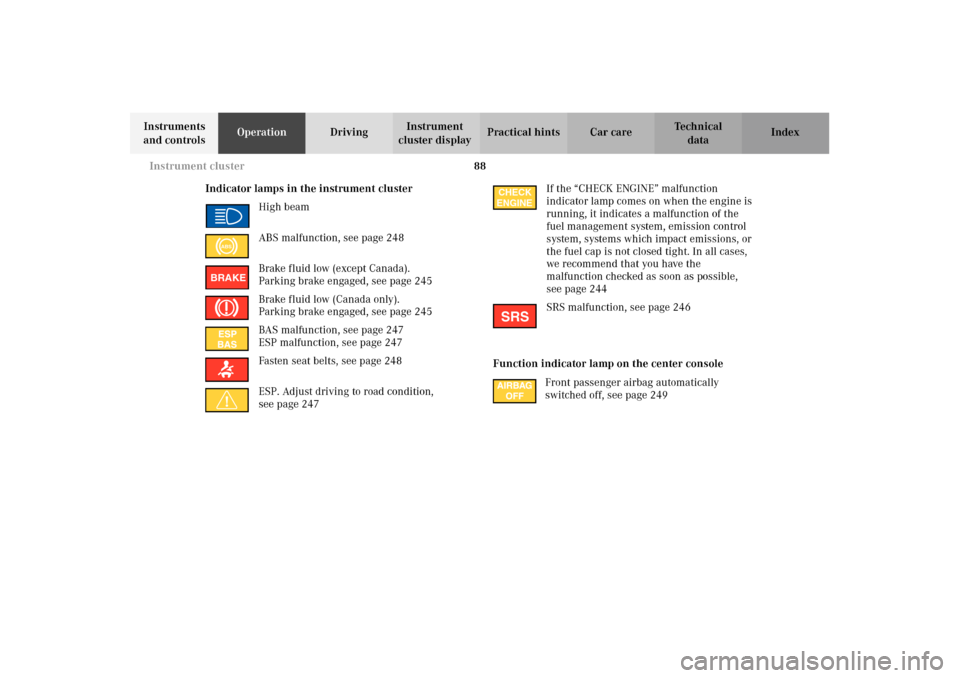
Indicator lamps in the instrument cluster
High beam
ABS malfunction, see page 248
Brake fluid low (except Canada).
Parking brake engaged, see page 245
Brake fluid low (Canada only).
Parking brake engaged, see page 245
BAS malfunction, see page 247
ESP malfunction, see page 247
Fasten seat belts, see page 248
ESP. Adjust driving to road condition,
seepage247If the “CHECK ENGINE” malfunction
indicator lamp comes on when the engine is
running, it indicates a malfunction of the
fuel management system, emission control
system, systems which impact emissions, or
the fuel cap is not closed tight. In all cases,
we recommend that you have the
malfunction checked as soon as possible,
seepage244
SRS malfunction, see page 246
Function indicator lamp on the center console
Front passenger airbag automatically
switched off, see page 249
ABSBRAKE
CHECK
ENGINESRS
Page 128 of 354
125 Hazard warning flasher
Te ch n i c a l
data Instruments
and controlsOperationDrivingInstrument
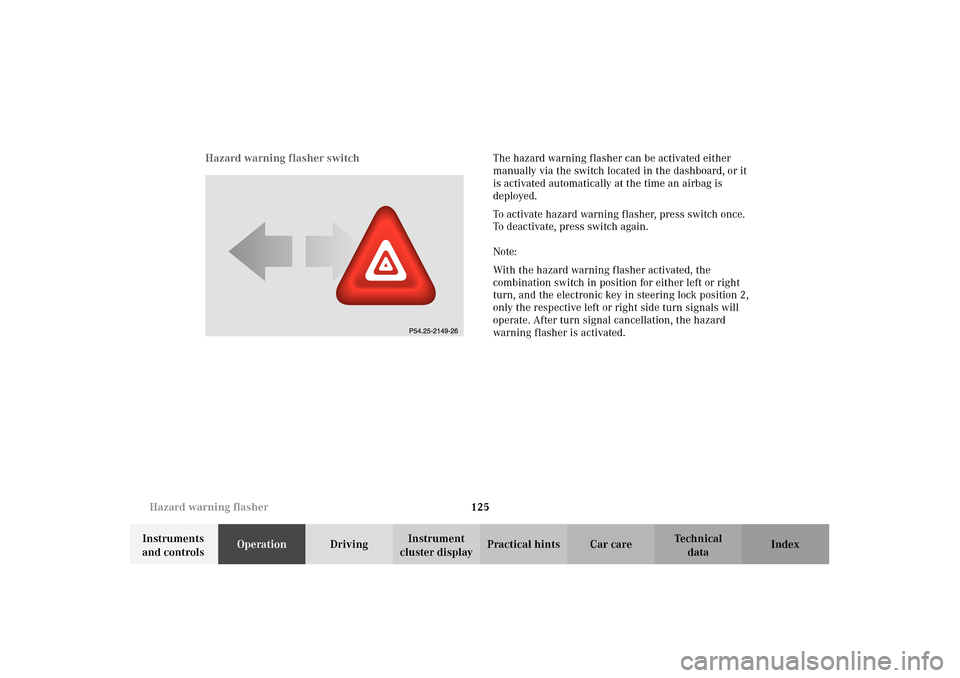
cluster displayPractical hints Car care Index Hazard warning flasher switchThe hazard warning flasher can be activated either
manually via the switch located in the dashboard, or it
is activated automatically at the time an airbag is
deployed.
To activate hazard warning flasher, press switch once.
To deactivate, press switch again.
Note:
With the hazard warning flasher activated, the
combination switch in position for either left or right
turn, and the electronic key in steering lock position 2,
only the respective left or right side turn signals will
operate. After turn signal cancellation, the hazard
warning f lasher is activated.
Page 192 of 354
189 Tele Aid
Te ch n i c a l
data Instruments
and controlsOperationDrivingInstrument
cluster displayPractical hints Car care Index System self-check
Initially, after turning the electronic key in steering lock
to position 2, malfunctions are detected and indicated
(the indicator lamps in the SOS button, the Roadside
Assistance button• and the Information
button¡ stay on longer than 10 seconds or do not
come on). The message “TELE AID – VISIT
WORKSHOP” appears for approx. 10 seconds in the
multifunction display. Emergency calls
An emergency call is initiated automatically:
•following an accident in which the Emergency
Tensioning Devices (ETDs) or airbags deploy,
•if the antitheft alarm or the tow away alarm stays on
for more than 20 seconds, see pages 39 and 41.
An emergency call can also be initiated manually by
opening the cover next to the inside rear view mirror
labeled SOS, then briefly pressing the button located
under the cover. See below for instructions on initiating
an emergency call manually.
Once the emergency call is in progress, the indicator
lamp in the SOS button will begin to flash. The message
“EMERGENCY CALL – CONNECTING CALL” appears in
the multifunction display. When the connection is
established, the message “EMERGENCY CALL – CALL
CONNECTED” appears in the multifunction display. All
information relevant to the emergency, such as the
location of the vehicle (determined by the GPS satellite
location system), vehicle model, identification number
and color are generated.
A voice connection between the Response Center and
the occupants of the vehicle will be established
automatically soon after the emergency call has been
Wa r n i n g !
If the indicator lamps in the SOS button, in the
Roadside Assistance button and/or in the
Information button do not come on during the
system self-check or if any of these indicators
remain illuminated constantly in red and/or the
message "TELE AID - VISIT WORKSHOP!" is
displayed in the multifunction display after the
system self-check, a malfunction in the system has
been detected.If a malfunction is indicated as outlined above, the
system may not operate as expected. Have the
system checked at the nearest Mercedes-Benz
Center as soon as possible.
Page 246 of 354
243 Contents – Instrument cluster display
Te ch n i c a l
data Instruments
and controlsOperation DrivingInstrument
cluster displayPractical hints Car care Index
Instrument cluster displayMalfunction and indicator lamps in
the instrument cluster .............244
On-board diagnostic system .....244
Check engine malfunction
indicator lamp .............................244
Brake warning lamp ..................245
Supplemental restraint system
(SRS) indicator lamp ..................246
Fuel reserve and fuel cap
placement warning ....................246
Electronic stability program (ESP)
— warning lamp ..........................247
BAS / ESP malfunction indicator
lamp ..............................................247ABS malfunction
indicator lamp ............................ 248
Seat belt warning lamp ............. 248
Malfunction and indicator lamp in
the center console .................... 249
AIRBAG OFF indicator lamp .... 249
Malfunction and warning
messages in the multifunction
display ........................................ 250
DISPLAY DEFECTIVE................ 251
BATTERY / ALTERNATOR ........ 252
ABS-SYSTEM .............................. 253
BRAKE ASSIST........................... 253
BRAKE LINING WEAR .............. 254
BRAKE FLUID ............................ 254PARKING BRAKE .......................255
ENGINE FAN ...............................255
COOLANT (coolant level) ..........256
COOLANT TEMP. ........................257
LIGHTING SYSTEM ....................258
LIGHT SENSOR ...........................259
REMOVE KEY .............................259
STEERING GEAR OIL................. 260
ENGINE OIL LEVEL ................... 261
WASHER FLUID .........................262
ELEC. STABIL. PROG. (Electronic
stability program) ......................263
TELE AID ..................................... 263
Page 249 of 354
246 Malfunction and indicator lamps
Te ch n i c a l
data Instruments
and controlsOperation DrivingInstrument
cluster displayPractical hints Car care Index
Supplemental restraint system (SRS) indicator lamp
The operational readiness of the airbag
system is verified by the indicator lamp SRS
in the instrument cluster when turning the
electronic key in steering lock to position 1 or 2. If no
malfunction is detected, the lamp will go out after
approximately 4 seconds; after the lamp goes out, the
system continues to monitor the components and
circuitry of the airbag system and will indicate a
malfunction by coming on again.
See page 68 for notes on airbags, see page 67 for belt
tensioners and page 57 for infant and child seat
restraint.Fuel reserve and fuel cap placement warning
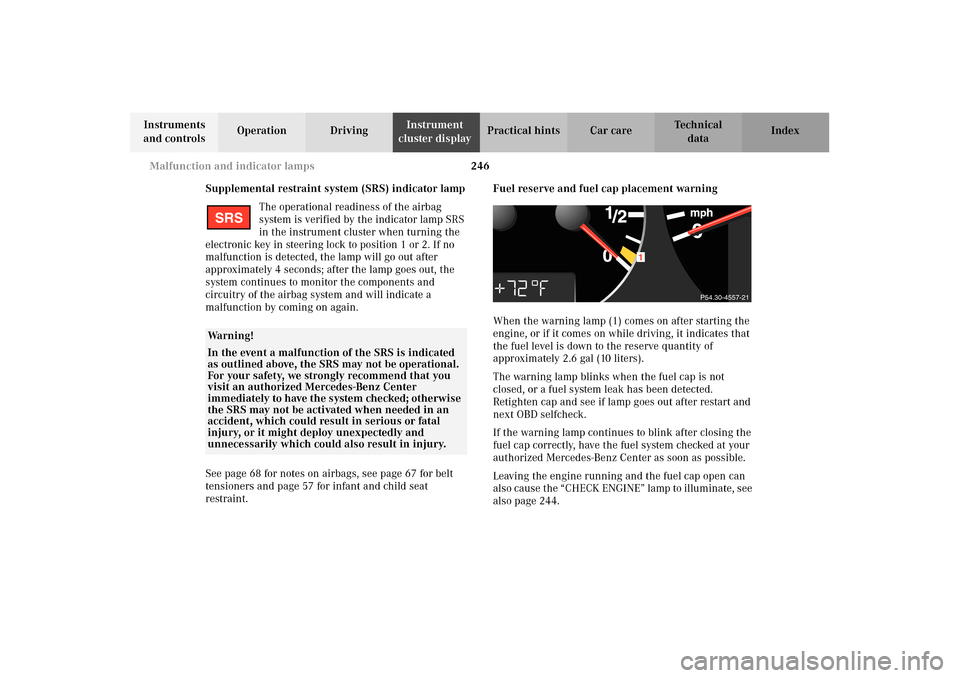
When the warning lamp (1) comes on after starting the
engine, or if it comes on while driving, it indicates that
the fuel level is down to the reserve quantity of
approximately 2.6 gal (10 liters).
The warning lamp blinks when the fuel cap is not
closed, or a fuel system leak has been detected.
Retighten cap and see if lamp goes out after restart and
next OBD selfcheck.
If the warning lamp continues to blink after closing the
fuel cap correctly, have the fuel system checked at your
authorized Mercedes-Benz Center as soon as possible.
Leaving the engine running and the fuel cap open can
also cause the “CHECK ENGINE” lamp to illuminate, see
also page 244.
Wa r n i n g !
In the event a malfunction of the SRS is indicated
as outlined above, the SRS may not be operational.
For your safety, we strongly recommend that you
visit an authorized Mercedes-Benz Center
immediately to have the system checked; otherwise
the SRS may not be activated when needed in an
accident, which could result in serious or fatal
injury, or it might deploy unexpectedly and
unnecessarily which could also result in injury.SRS
1
P54.30-4557-21
Page 252 of 354
249 Malfunction and indicator lamps
Te ch n i c a l
data Instruments
and controlsOperation DrivingInstrument
cluster displayPractical hints Car care Index Malfunction and indicator lamp in the center
console
AIRBAG OFF indicator lamp
The 7 indicator lamp will light up for approximately
6 seconds when you turn the electronic key in steering
lock to position 1 or 2.
The 7 indicator lamp stays lit as long as a
BabySmart
TM compatible child seat is properly installed
on the front passenger seat. It indicates that the front
passenger airbag is switched off.
See page 65 for BabySmart
TM deactivation system.
BabySmart
TM is a trademark of Siemens Automotive Corp.
Wa r n i n g !
The BabySmart
TM airbag deactivation system will
ONLY work with a special child seat designed to
operate with it. It will not work with child seats
which are not BabySmart
TMcompatible.
Never place anything between seat cushion and
child seat (e.g. pillow), since it reduces the
effectiveness of the deactivation systems.Follow the manufacturer’s instructions for
installation of special child seats.When using a BabySmart
TM compatible child seat
on the front passenger seat, the front passenger
airbag will not deploy only if the 7 indicator
lamp remains illuminated.
Please be sure to check the indicator every time
you use the special system child seat. Should the
light go out while the restraint is installed, please
check installation. If the light remains out, do not
use the BabySmart
TM restraint to transport children
on the front passenger seat until the systems has
been repaired.
Page 339 of 354
336 Index
Te ch n i c a l
data Instruments
and controlsOperation DrivingInstrument
cluster displayPractical hints Car careIndex
Index
AABS (Antilock brake system) .......................................227
Malfunction indicator lamp ..................................... 248
ABS-SYSTEM - malfunction and warning
messages .................................................................... 253
Adjusting steering wheel ................................................ 81
Air conditioner refrigerant ........................................... 330
Air distribution .............................................................. 130
Air volume ...................................................................... 130
Airbag deactivation system ............................................ 65
AIRBAG OFF indicator lamp ........................................249
Airbags .............................................................................. 68
Alarm system ..............................................................39, 41
Anticorrosion/antifreeze ................... 220, 275, 328, 332
Antilock brake system (ABS) .......................................227
Malfunction indicator lamp ..................................... 248
Antitheft alarm system ................................................... 39
Aquaplaning ................................................................... 217
Armrest, rear bench ...................................................... 162
Ashtrays .......................................................................... 166
Center console, front ................................................ 166
Rear doors .................................................................. 167Audio system .................................................................. 135
Anti-theft system ....................................................... 137
Button and soft key operation ................................. 138
Cassette mode ............................................................ 143
CD changer ................................................................. 148
CD mode ..................................................................... 147
Operating and display elements ............................. 136
Operating safety ........................................................ 135
Operation – audio and telephone ........................... 135
Radio mode ................................................................ 141
Telephone operation ................................................. 151
Audio systems ................................................................... 97
Cassette player ............................................................ 99
CD player ......................................................................98
Radio .............................................................................97
Automatic central locking .............................................. 35
Automatic climate control ............................................ 126
Activated charcoal filter ........................................... 132
Air distribution .......................................................... 130
Air recirculation ........................................................ 131
Air volume .................................................................. 130
Basic setting ............................................................... 129
Defogging windows ................................................... 129
Defrosting ...................................................................129
Display and controls .................................................128
Dust filter ................................................................... 131