ABS MERCEDES-BENZ EQC SUV 2021 Owners Manual
[x] Cancel search | Manufacturer: MERCEDES-BENZ, Model Year: 2021, Model line: EQC SUV, Model: MERCEDES-BENZ EQC SUV 2021Pages: 453, PDF Size: 8.68 MB
Page 12 of 453
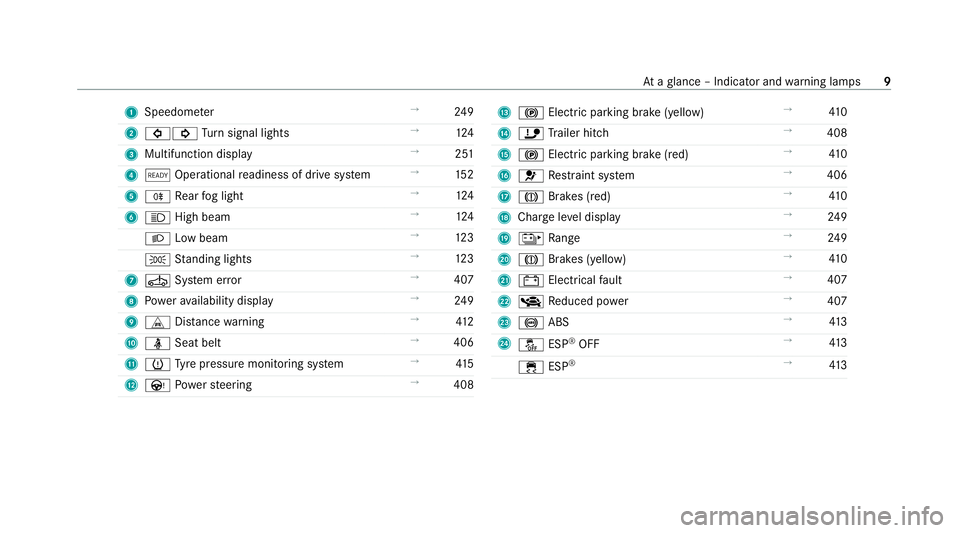
1
Speedom eter →
24 9
2 #! Turn signal lights →
124
3 Multifunction display →
251
4 õ Operational readiness of drive sy stem →
15 2
5 R Rear fog light →
124
6 K High beam →
124
L Low beam →
12 3
T Standing lights →
12 3
7 Ú System er ror →
407
8 Powe rav ailability display →
24 9
9 L Distance warning →
412
A ü Seat belt →
406
B h Tyre pressure monitoring sy stem →
41 5
C Ù Powe rst eering →
408 D
! Electric pa rking brake (yellow) →
41 0
E ï Trailer hit ch →
408
F ! Electric parking brake (red) →
41 0
G 6 Restra int sy stem →
406
H J Brakes (red) →
41 0
I Char geleve l display →
24 9
J R Range →
24 9
K J Brakes (yell ow) →
41 0
L # Electrical fault →
407
M _ Reduced po wer →
407
N ! ABS →
413
O å ESP®
OFF →
413
÷ ESP®
→
413 At
aglance – Indicator and warning lamps 9
Page 23 of 453
case
for sy stems and functions releva nt to
saf ety. Therefore, the equipment on your vehicle
may dif fer from that in the descriptions and illus‐
trations.
The original pur chase agreement foryo ur vehicle
contains a list of all of the sy stems in your vehi‐
cle.
Should you ha veany questions concerning
equipment and operation, please consult a
Mercedes-Benz Service Centre.
The Owner's Manual and Service Booklet are
impor tant documents and should be kept inthe
ve hicle. Operating saf
ety&
WARNING Risk of inju rydue tomalfunc‐
tions or sy stem failure
In order toavo id malfunctions or sy stem fail‐
ures: #
Alw ays ha vethe specified service/
maintenance workas well as any nec‐ essary
repairs car ried out at a qualified
specialist workshop. &
WARNING Risk of accident or inju rydue
to improper modifications toelectronic
components
Modifications toelectronic components,
th eir software or wiring can impair their func‐
tionality and/or the functionality of other
networ ked components or saf ety-re leva nt
sy stems.
This can endanger theve hicle's operating
saf ety. #
You must not tamp er with wiring, elec‐
tronic components, or their software. #
Alw ays ha vewo rkon electrical and
electronic devices car ried out at a quali‐
fi ed specialist workshop. If
yo u modify the on-board electronics, thege n‐
eral operating pe rmit is rende red in valid.
Obser vethe "On-board electronics" section in
"Technical data". *
NO
TEDama getotheve hicle due todriv‐
ing toofast and due toimpacts tothe
ve hicle underbody and suspension com‐
ponents In
thefo llowing situations, in particular, there
is a risk of damage totheve hicle:
R theve hicle becomes grounded, e.g. on a
high kerb or an unpa vedro ad
R theve hicle is driven toofast over an
obs tacle, e.g. a kerb, speed bump or pot‐
hole
R a heavy object strike sth e underbody or
suspension components
In situations such as these, damage tothe
body, underbody, suspension components,
wheels or tyres and high-voltage battery
components may not be visible. Components
damaged in this wa y can unexpec tedly fail or,
in the case of an accident, may no longer
absorb there sulting forc e as intended. 20
General no tes
Page 27 of 453
Te
ch nology Frequency rang eT ransmission output/magnetic field
st re ngth
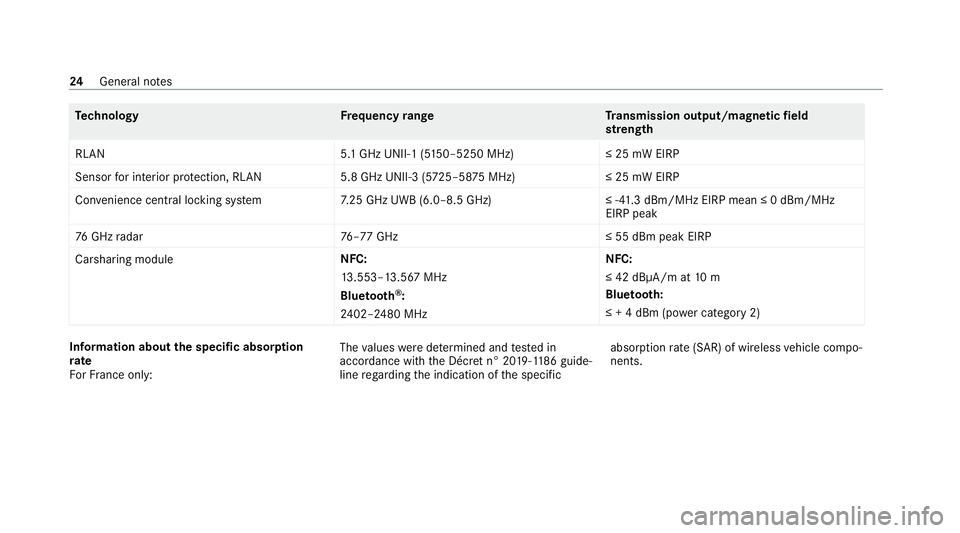
RLAN 5.1 GHz UNII-1 (5150–5250 MHz) ≤ 25 mW EIRP
Sensor for interior pr otection, RLAN 5.8 GHz UNII-3 (5725–58 75MHz) ≤ 25 mW EIRP
Con venience central lo cking sy stem 7.25 GHz UWB (6.0–8.5 GHz) ≤ -41.3 dBm/MHz EIRP mean ≤ 0 dBm/MHz
EIRP peak
76 GHz radar 76–77 GHz ≤ 55 dBm peak EIRP
Carsharing module NFC:
13
.553–13.567 MHz
Blue tooth ®
:
24 02–2480 MHz NFC:
≤ 42 dBμA/m at
10 m
Blue tooth:
≤ + 4 dBm (po wer category 2) Information about
the specific absor ption
rate
Fo rFr ance on ly: The
values weredeterm ined and tested in
accordance with the Décre t n° 2019-118 6guide‐
line rega rding the indication of the specific absor
ption rate (SAR) of wireless vehicle compo‐
nents. 24
General no tes
Page 65 of 453
Centre
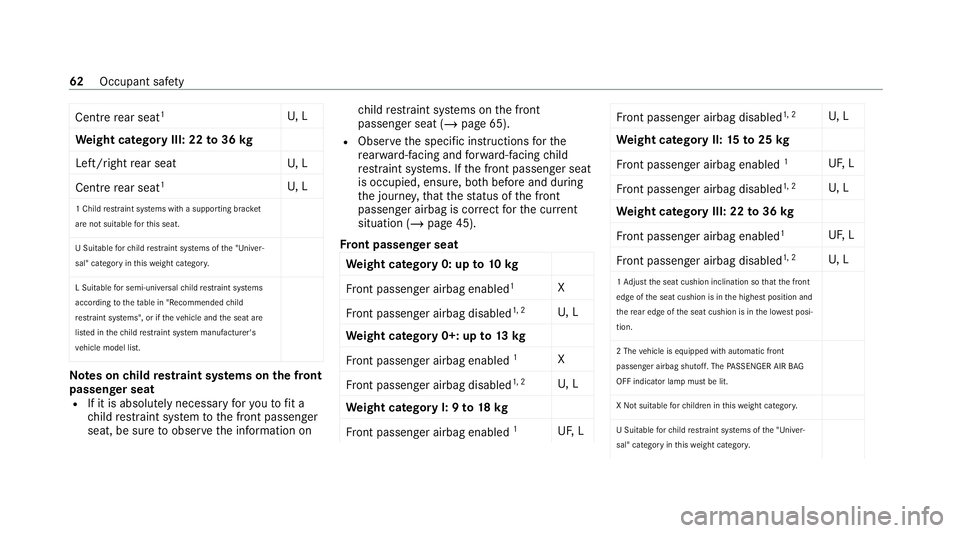
rear seat 1
U, L
We ight category III: 22 to36 kg
Left/right rear seat U, L
Centre rear seat 1
U, L
1 Child restra int sy stems with a supporting brac ket
are not sui table forth is seat.
U Suitable forch ild restra int sy stems of the "Univer‐
sal" category in this we ight categor y.
L Suitable for semi-universal child restra int sy stems
according totheta ble in "Recommended child
re stra int sy stems", or if theve hicle and the seat are
lis ted in thech ild restrai nt sy stem manufacturer's
ve hicle model list. Note
s onchild restra int sy stems on the front
passenger seat
R If it is absolutely necessary foryo uto fit a
ch ild restra int sy stem tothe front passenger
seat, be sure toobser vethe information on ch
ild restra int sy stems on the front
passenger seat (/ page 65).
R Obser vethe specific instructions forthe
re ar wa rd-facing and forw ard-facing child
re stra int sy stems. If the front passenger seat
is occupied, ensure, bo thbefore and during
th e journe y,that thest atus of the front
passenger airbag is cor rect forth e cur rent
situation (/ page 45).
Fr ont passenger seat
We ight category 0: up to10 kg
Fr ont passenger airbag enabled 1
X
Fr ont passenger airbag disabled 1, 2
U, L
We ight category 0+: up to13 kg
Fr ont passenger airbag enabled 1
X
Fr ont passenger airbag disabled 1, 2
U, L
We ight category I: 9 to18 kg
Fr ont passenger airbag enabled 1
UF, L Fr
ont passenger airbag disabled 1, 2
U, L
We ight category II: 15to25 kg
Fr ont passenger airbag enabled 1
UF, L
Fr ont passenger airbag disabled 1, 2
U, L
We ight category III: 22 to36 kg
Fr ont passenger airbag enabled 1
UF, L
Fr ont passenger airbag disabled 1, 2
U, L
1 Ad just the seat cushion inclination so that the front
edge of the seat cushion is in the highest position and
th ere ar edge of the seat cushion is in the lo west posi‐
tion.
2 The vehicle is equipped with automatic front
passenger airbag shutoff. The PASSENGER AIR BAG
OFF indicator lamp must be lit.
X Not suitable forch ildren in this we ight categor y.
U Suitable forch ild restrai nt sy stems of the "Univer‐
sal" category in this we ight categor y. 62
Occupant saf ety
Page 68 of 453
Note
s onrear wa rd-facing and forw ard-facing
ch ild restra int sy stems on the front
passenger seat &
WARNING Risk of inju ryor death when
using a rear wa rd-facing child restra int
sy stem while the front passenger airbag
is enabled
If yo u secure a child in a rear wa rd-facing
ch ild restra int sy stem on the front passenger
seat and thePA SSENGER AIR BAG OFF indi‐
cator lamp is off, the front passenger airbag
can deploy in theev ent of an accident.
The child could be stru ck bythe airbag.
Alw ays ensure that the front passenger air‐
bag is disabled. The PASSENGER AIR BAG
OFF indicator lamp must be lit.
NEVER use a rear wa rd-facing child restra int
sy stem on a seat with an ENABLED FRONT
AIRB AG. This can result in the DEAT H of or
SERIOUS INJU RYtotheCH ILD. Obser
vethe specific instructions forth ere ar‐
wa rd-facing and forw ard-facing child restra int
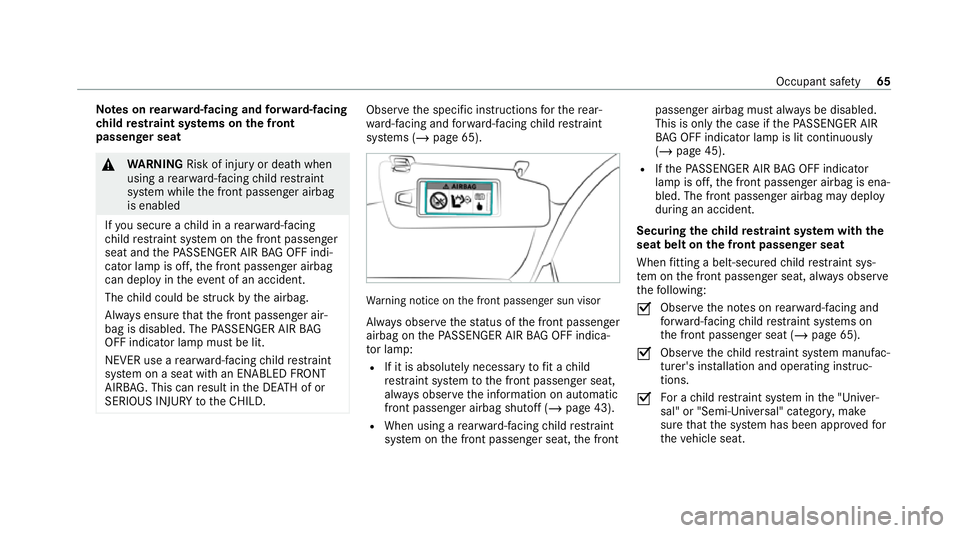
sy stems (/ page 65). Wa
rning notice on the front passenger sun visor
Alw ays obser vethest atus of the front passenger
airbag on thePA SSENGER AIR BAG OFF indica‐
to r lamp:
R If it is absolutely necessary tofit a child
re stra int sy stem tothe front passenger seat,
alw ays obser vethe information on automatic
front passenger airbag shutoff (/ page 43).
R When using a rear wa rd-facing child restra int
sy stem on the front passenger seat, the front passenger airbag must alw
ays be disabled.
This is only the case if thePA SSENGER AIR
BA G OFF indicator lamp is lit continuously
(/ page 45).
R Ifth ePA SSENGER AIR BAG OFF indicator
lamp is off, the front passenger airbag is ena‐
bled. The front passenger airbag may deploy
during an accident.
Securing thech ild restra int sy stem with the
seat belt on the front passenger seat
When fitting a belt-secu redch ild restra int sys‐
te m on the front passenger seat, alw ays obser ve
th efo llowing:
O Obser
vethe no tes on rear wa rd-facing and
fo rw ard-facing child restra int sy stems on
th e front passenger seat (/ page 65).
O Obser
vethech ild restra int sy stem manufac‐
turer's ins tallation and operating instruc‐
tions.
O Fo
r a child restra int sy stem in the "Univer‐
sal" or "Semi-Universal" categor y,make
sure that the sy stem has been appr ovedfor
th eve hicle seat. Occupant saf
ety65
Page 171 of 453
absorbed
bythe high-voltage batter y.This is the
re sult of dif fere nt le vels of charging losses and is
desc ribed as rech arge efficiency. Charging los‐
ses occu r,fo rex ample, due toheat that builds
up when charging or from auxiliary consume rs
th at are swit ched on. Further information on
re ch arge efficiency can be obtained at a quali‐
fi ed specialist workshop. Note
s oncharging the high-voltage bat tery
at a fast charging station (mode 4) &
DANG ER Risk of death due todamaged
component parts
Connecting thech arging cable toach arging
st ation using a damaged component part
could cause a fire or an electric shoc k,for
ex ample. #
Atcharging stations with a pre-ins talled
ch arging cable:
R Visually check thech arging station
fo r obvious faults, such as damage
to the housing or charging cable. #
Atcharging stations without a pre-
ins talled charging cable:
R For saf etyre asons, on lyuse charg‐
ing cables that ha vebeen tested
and appr oved bythe manufacturer
fo rch arging the high-voltage battery
in an electric vehicle.
R Never use dama gedch arging
cables.
R Do not extend thech arging cable.
R Do not use adap ters. #
Alw ays obser vethe saf ety no tes on the
ch arging station. Most
charging stations must be activated before
th ech arging process, e.g. using an RFID card.
Obse rveth e on-site operator's instructions for
th ech arging station.
The charging cable forth eve hicle must not be
longer than 30 m due tothe legal requ irements
in some countries. This is topreve ntthe inter fer‐
ence of signals being recei vedby radio commu‐
nication devices in theve hicle or in close pr ox‐
imity tothech arging station. Be aware that parts of
thech arging cable may be routed under‐
ground. If in doubt, ask thech arging station
operator if this is the case before charging the
high-voltage batter y.
The amount of energy dispensed forth ech arg‐
ing process, shown bythech arging station, may
be higher than the amount of energy actually
absorbed bythe high-voltage batter y.This is the
re sult of dif fere nt le vels of charging losses and is
desc ribed as rech arge efficiency. Charging los‐
ses occu r,fo rex ample, due toheat that builds
up when charging or from auxiliary consume rs
th at are swit ched on. Further information on
re ch arge efficiency can be obtained at a quali‐
fi ed specialist workshop. Setting
the maximum permissible charging
cur rent forch arging at a mains soc ket *
NO
TEDanger due toexcessive charging
cur rent If
th ech arging cur rent is too high, the fuse
could be tripped or theex tern al mains supply
could overheat. 16 8
Driving and pa rking
Page 191 of 453
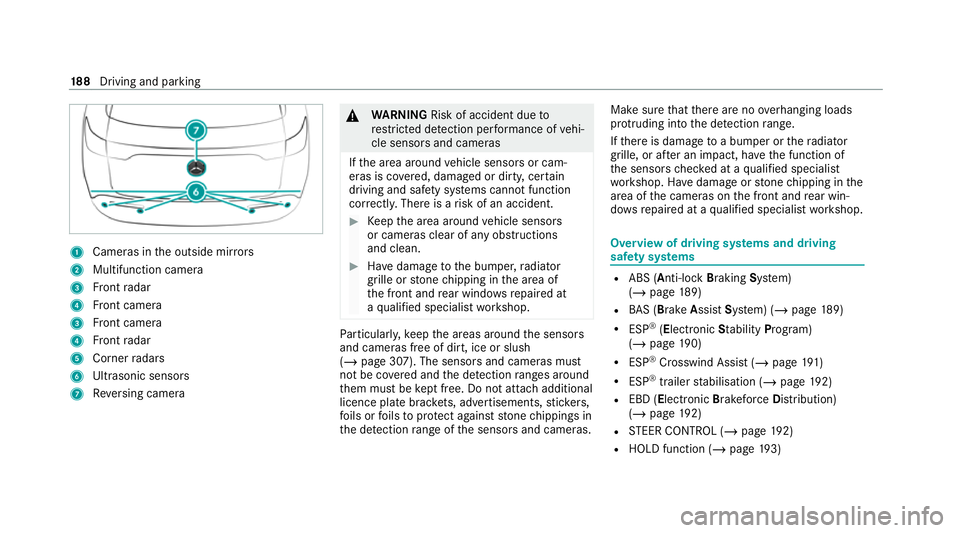
1
Cameras in the outside mir rors
2 Multifunction camera
3 Front radar
4 Front camera
3 Front camera
4 Front radar
5 Corner radars
6 Ultrasonic sensors
7 Reversing camera &
WARNING Risk of accident due to
re stricted de tection per form ance of vehi‐
cle sensors and cameras
If th e area around vehicle sensors or cam‐
eras is co vered, damaged or dirty, cer tain
driving and saf ety sy stems cann otfunction
cor rectly. The reis a risk of an accident. #
Keep the area around vehicle sensors
or cameras clear of any obstructions
and clean. #
Have damage tothe bumper, radiator
grille or stone chipping in the area of
th e front and rear wind owsrepaired at
a qu alified specialist workshop. Pa
rticular ly,ke ep the areas around the sensors
and cameras free of dirt, ice or slush
(/ page 307). The sensors and cameras must
not be co vered and the de tection ranges around
th em must be kept free. Do not attach additional
licence pla tebrac kets, ad vertisements, sticke rs,
fo ils or foils toprotect against stone chippings in
th e de tection range of the sensors and cameras. Make sure
that there are no overhanging loads
pr otru ding into the de tection range.
If th ere is damage toa bumper or thera diator
grille, or af ter an impact, ha vethe function of
th e sensors checked at a qualified specialist
wo rkshop. Ha vedamage or stone chipping in the
area of the cameras on the front and rear win‐
do ws repaired at a qualified specialist workshop. Overview of driving sy
stems and driving
saf ety sy stems R
ABS (Anti-lo ckBra king System)
(/ page 189)
R BAS (B rake Assist System) (/ page189)
R ESP ®
(Electronic Stability Program)
(/ page 190)
R ESP ®
Crosswind Assist (/ page191)
R ESP ®
trailer stabilisation (/ page192)
R EBD ( Electronic Brakeforce Distribution)
(/ page 192)
R STEER CONTROL (/ page 192)
R HOLD function (/ page193) 18 8
Driving and pa rking
Page 192 of 453
R
Hill Start Assist (/ page194)
R Adaptive Brake Lights (/ page194)
R ATTENTION ASSIST (/ page195)
R Cruise control (/ page 196)
R Limi ter (/ page197)
R Traf fic Sign Assi st (/ page 215)
R Speed Limit Assist (countr y-dependent)
(/ page 214)
Driving Assistance package
The following functions are part of the Driving
Assis tance Package. Cer tain functions are only
av ailable in some countries. Some functions are
also available without the Driving Assis tance
Pa ckage, albeit with restricted functionality.
R Active Dis tance Assi stDISTRONIC
(/ page 199)
R Active Speed Limit Assi st(countr y-depend‐
ent) (/ page 204)
R Route-based speed adap tation (countr y-
dependent) (/ page 204)
R Active Brake Assi st (/ page 209) R
Active Steering Assist (count ry-dependent)
(/ page 206)
R Active Emergency Stop Assist (countr y-
dependent) (/ page 208)
R Blind Spot Assist and Active Blind Spot Assi st
with exitwa rning (/ page218)
R Active Lane Keeping Assist (/ page 220)
Park ingPackage
R Reversing camera (/ page 223)
R 360° Camera (/ page 226)
R Parking Assist PARKTRONIC (/ page 229)
R Active Parking Assist (/ page 233) Fu
nction of ABS (Anti-lock Braking Sy stem) ABS
regulates the brake pressure in critical driv‐
ing situations:
R During braking, e.g. at full brake application
or insuf ficient tyre traction, the wheels are
pr ev ented from locking.
R Vehicle steerability while braking is ensured. If ABS inter
venes when braking, you will feel a
pulsing in the brake pedal. The pulsating brake
pedal can be an indication of hazardous road
conditions and can ser veas a reminder totake
ex tra care while driving.
Sy stem limits
R ABS is active from speeds of appr ox.
8 km/h.
R ABS may be impai red or may not function if a
malfunction has occur red and theye l‐
low ! ABSwarning lamp lights up contin‐
uously in the instrument clus ter af terthe
drive sy stem is star ted. Fu
nction of BAS &
WARNING Risk of an accident caused by
a malfunction in BAS (Brake Assi stSys‐
te m)
If BA S is malfunctioning, the braking dis tance
in an eme rgency braking situation is
increased. Driving and parking
18 9
Page 193 of 453
#
Dep ress the brake pedal with full force
in emer gency braking situations. ABS
pr eve nts the wheels from locking. The Brake Assist Sy
stem (BAS) supports your
eme rgency braking situation with additional
brake forc e.
If yo u depress the brake pedal quickl y,BA S is
acti vated:
R BAS au tomatical lyboosts the brake pres‐
sure.
R BAS can sho rten the braking dis tance.
R ABS pr events the wheels from locking.
The brakes will function as usual once you
re lease the brake pedal. BAS is deactivated. Fu
nction of ESP ® &
WARNING Risk of skidding if ESP ®
is
malfunctioning
If ESP ®
is malfunctioning, ESP ®
cannot car ry
out vehicle stabilisation. In addition, other
driving saf ety sy stems are switched off. #
Drive on carefull y. #
Have ESP ®
ch ecked at a qualified spe‐
cialist workshop. &
WARNING Risk of skidding if ESP ®
is
deactivated
If yo u deactivate ESP ®
, ESP ®
cannot car ry
out vehicle stabilisation. #
ESP ®
should on lybe deactivated in the
fo llowing situations. The Electronic
Stability Program (ESP ®
) can
monitor and impr ovedriving stability and trac‐
tion in thefo llowing situations within ph ysical
limits:
R When pulling away on wet or slippe rycar ria‐
ge wa ys.
R When braking.
R Vehicles with trailer hitch: in trailer opera‐
tion from speeds of 65 km/h, if theve hicle/
trailer combination begins tosw ay from side
to side.
R Instro ng side winds when you are driving
fast erthan 80 km/h.
If th eve hicle deviates from the direction desired
by the driver, ESP ®
can stabilise theve hicle by
inter vening in thefo llowing ways:
R One or more wheels are braked.
R The drive sy stem output is adap ted according
to the situation. 19 0
Driving and pa rking
Page 309 of 453
Pa
int
R Insect remains: soak with insect remo ver and
ri nse off the treated areas af terw ards.
R Bird droppings: soak with water and rinse off
af te rw ards.
R Tree resin, oils, fuels and greases: remo veby
ru bbing gently wi tha clo thsoaked in petro‐
leum ether or lighter fluid.
R Coolant and brake fluid: remo vewith a damp
clo thand clean water.
R Tarst ains: use tar remo ver.
R Wax: use silicone remo ver.
R Do not attach sticke rs,fi lms or similar mate‐
ri als.
R Remo vedirt immediately, where possible.
Matt finish
R Only use care products appr ovedfor
Mercedes-Benz.
R Do not polish theve hicle and light-alloy
wheels.
R Only use car washes that cor respond tothe
latest engineering standards. R
Do not use car wash programmes with a final
hot wax treatment.
R Do not use paint cleane rs, buf fing or polish‐
ing products, gloss preser vers, e.g. wax.
R Alw ays ha vepaintwork repairs car ried out at
a qu alified specialist workshop. Note
s on cleaning decorative foils Obser
vethe no tes on matt finish care in the
ch ap ter "No tes on paintwork/matt finish paint‐
wo rkcare" (/ page 305). They also apply to
matt decorative foils.
Obser vethe no tes on cleaning decorative foils to
av oid vehicle damage.
Cleaning
R For cleaning, use plenty of water and a mild
cleaning agent without additives or abrasive
subs tances, e.g. a car sha mpoo appr ovedfor
Mercedes-Benz.
R Remo vedirt immediatel y,where possible,
whilst avoiding rubbing too hard. There is
ot herwise a risk of damaging the decorative
fo il ir reparabl y. R
Ifth ere is dirt on thefinish or if the decora‐
tive foil is dull: use thePa int Cleaner recom‐
mended and appr oved for Mercedes-Benz.
R Insect remains: soak with insect remo ver and
ri nse off the treated areas af terw ards.
R Bird droppings: soak with water and rinse off
af te rw ards.
R Topreve ntwate rst ains, dry a foil-wrapped
ve hicle with a soft, absorbent clo thafter
eve rycar wash.
Av oiding dama getothe decorative foil
R The service life and colouring of decorative
foils are impaired by:
- sunlight
- temp erature, e.g. hot air blo wer
- weather conditions
- stone chippings and dirt
- chemical cleaning agents
- oily products
R Do not use polish on matt decorative foil.
Po lishing will ha vethe ef fect of shining the
fo il-wrapped sur face. 306
Maintenance and care