check oil MERCEDES-BENZ G-CLASS 2011 User Guide
[x] Cancel search | Manufacturer: MERCEDES-BENZ, Model Year: 2011, Model line: G-CLASS, Model: MERCEDES-BENZ G-CLASS 2011Pages: 288, PDF Size: 11.6 MB
Page 219 of 288
! Only use engine oils and oil filters which
have been approved for vehicles with a
service system. A list of the engine oils and
oil filters that have been tested and
approved according to the Mercedes-Benz
specifications for service products can be
found on the Internet at http://
www.mbusa.com (USA only). Further
information on tested and approved engine
oils and oil filters can be obtained from any
authorized Mercedes-Benz Center.
The following causes engine failure or
damage to the exhaust system:
Rusing engine oils and oil filters that are
not specifically approved for the service
system
Rreplacing the engine oil and oil filter after
having exceeded the interval for
replacement prescribed by the
maintenance system
Rusing engine oil additives
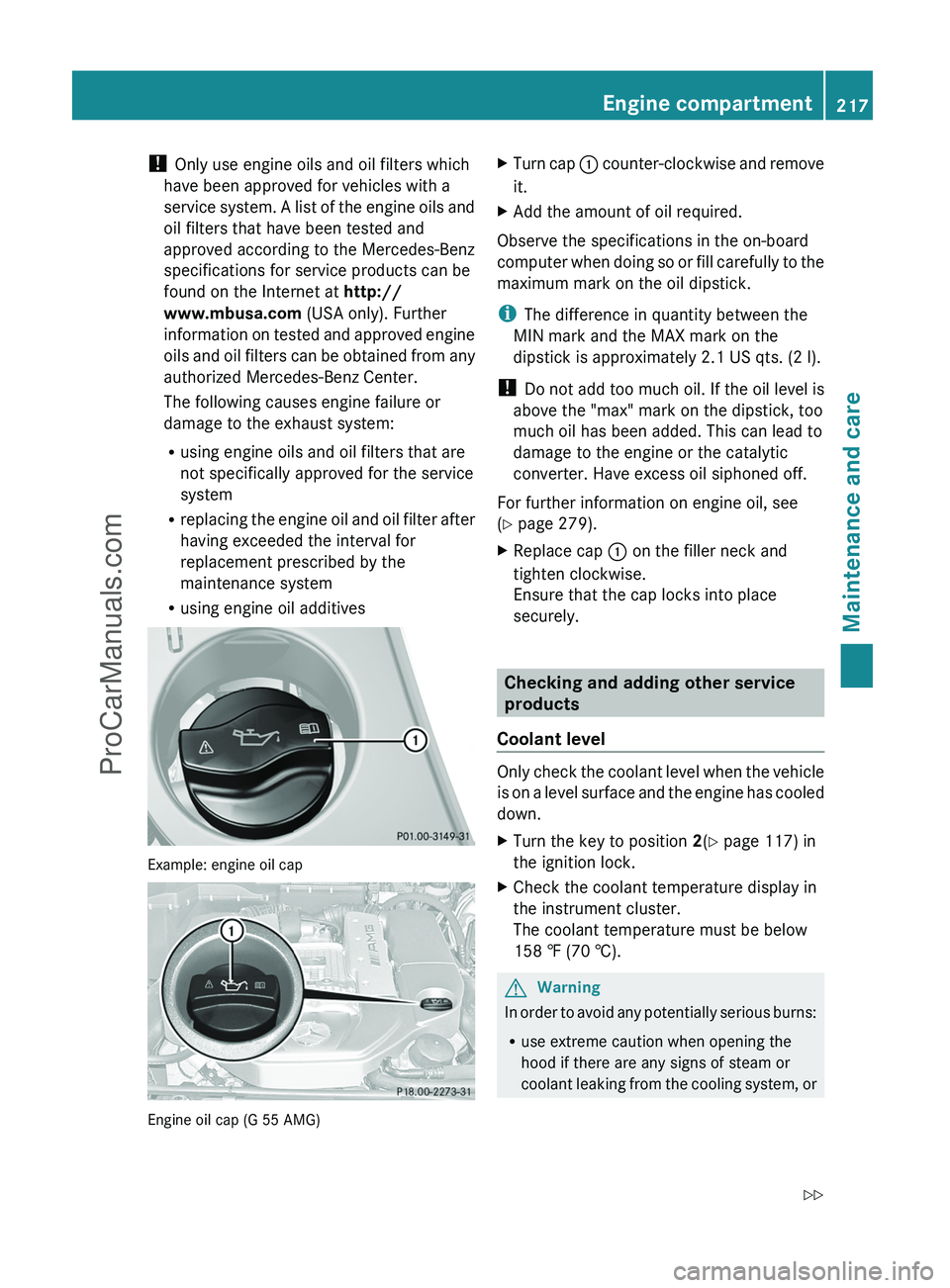
Example: engine oil cap
Engine oil cap (G 55 AMG)
XTurn cap : counter-clockwise and remove
it.
XAdd the amount of oil required.
Observe the specifications in the on-board
computer when doing so or fill carefully to the
maximum mark on the oil dipstick.
iThe difference in quantity between the
MIN mark and the MAX mark on the
dipstick is approximately 2.1 US qts. (2 l).
! Do not add too much oil. If the oil level is
above the "max" mark on the dipstick, too
much oil has been added. This can lead to
damage to the engine or the catalytic
converter. Have excess oil siphoned off.
For further information on engine oil, see
(Y page 279).
XReplace cap : on the filler neck and
tighten clockwise.
Ensure that the cap locks into place
securely.
Checking and adding other service
products
Coolant level
Only check the coolant level when the vehicle
is on a level surface and the engine has cooled
down.
XTurn the key to position 2(Y page 117) in
the ignition lock.
XCheck the coolant temperature display in
the instrument cluster.
The coolant temperature must be below
158 ‡ (70 †).
GWarning
In order to avoid any potentially serious burns:
Ruse extreme caution when opening the
hood if there are any signs of steam or
coolant leaking from the cooling system, or
Engine compartment217Maintenance and careZProCarManuals.com
Page 272 of 288
requires. Do not change the direction of
wheel rotation.
Clean the contact surfaces of the wheel and
the brake disc thoroughly every time a wheel
is interchanged. Check the tire pressure and
reactivate the tire pressure monitor
( Y page 253) if necessary.
Information on changing a wheel and
mounting the spare wheel ( Y page 232).
! On vehicles installed with a tire pressure
monitor, electronic components are
located in the wheel.
Tire-mounting tools should not be applied
in the area of the valve, as this could
damage the electronic components.
Always have the tires changed at a qualified
specialist workshop, e.g. an authorized
Mercedes-Benz Center.
Direction of rotation
Tires with a specified direction of rotation
have additional benefits, e.g. if there is a risk
of hydroplaning. You will only gain these
benefits if the correct direction of rotation is
maintained.
An arrow on the sidewall of the tire indicates
its correct direction of rotation.
You may install the spare wheel against the
direction of rotation. Adhere to the time
restriction on use as well as the speed
limitation specified on the spare wheel.
Storing wheels
Store tires that are not being used in a cool,
dry and preferably dark place. Protect the
tires from oil, grease, gasoline and diesel.
Cleaning the wheels
GWarning
Do not use power washers with circular jet
nozzles (concentrated-power jets) to clean
your vehicle, especially for cleaning tires. You
could otherwise damage the tires and cause
an accident.
Wheel and tire combinations
Please bear the following in mind
GWarning
Replace rims or tires with the same
designation, manufacturer and type as shown
on the original part. For further information
contact an authorized Mercedes-Benz Center.
If incorrectly sized rims and tires are
mounted, the wheel brakes or suspension
components can be damaged. Also, the
operating clearance of the wheels and the
tires may no longer be correct.
GWarning
Worn, old tires can cause accidents. If the tire
tread is worn to minimum tread depth, or if
the tires have sustained damage, replace
them.
When replacing rims, only use genuine
Mercedes-Benz wheel bolts specified for the
particular rim type. Failure to do so can result
in the bolts loosening and possibly an
accident.
Retreaded tires are not tested or
recommended by Mercedes-Benz, since
previous damage cannot always be
recognized on retreads. The operating safety
of the vehicle cannot be assured when such
tires are used.
GWarning
If you feel a sudden significant vibration or
ride disturbance, or you suspect that possible
damage to your vehicle has occurred, you
should turn on the hazard warning flashers,
carefully slow down, and drive with caution to
an area which is a safe distance from the road.
Inspect the tires and the vehicle underbody
for possible damage. If the vehicle appears
unsafe, have the vehicle towed to the nearest
270Wheel and tire combinationsWheels and tires
ProCarManuals.com
Page 282 of 288
Brake fluidGWarning
The brake fluid constantly absorbs moisture
from the air; this lowers its boiling point.
If the boiling point of the brake fluid is too low,
vapor pockets may form in the brake system
when the brakes are applied hard (e.g. when
driving downhill). This would impair braking
efficiency.
You should have the brake fluid renewed at
regular intervals. The brake fluid change
intervals can be found in the Service Booklet.
Only use brake fluid approved by Mercedes-
Benz. Information about approved brake
fluids can be obtained from any authorized
Mercedes-Benz Center.
Coolant
Important safety notes
The coolant is a mixture of water and
antifreeze/corrosion inhibitor. It performs
the following tasks:
R anti-corrosion protection
R antifreeze protection
R raising the boiling point
The engine cooling system is filled at the
factory with coolant which contains an
antifreeze/corrosion inhibitor that ensures
protection down to approximately -35 ‡
(-37 †).
! Only add coolant that has been premixed
with the desired antifreeze protection. You
could otherwise damage the engine.
Further information on coolants and on
filling can be found in the Mercedes-Benz
Specifications for Service Products, MB
Approval 310.1, e.g. on the Internet at
http://bevo.mercedes-benz.com . You
can also consult an authorized Mercedes-
Benz Center.
! Always use a suitable coolant mixture,
even in countries where high temperatures
prevail.
Otherwise, the engine cooling system is not
sufficiently protected from corrosion and
the boiling point will be too low.
If the coolant has antifreeze protection down
to -35 ‡ (-37 †), the boiling point of the
coolant in the pressurized system is
approximately 266 ‡ (130 †).
Your vehicle has a range of aluminum
components. Use of aluminum components
in the engine make it necessary to specifically
match the antifreeze/corrosion inhibitor in
these systems in order to protect the
aluminum parts. Using other antifreeze/
corrosion inhibitors without these
characteristics affects the service life.
The coolant must be used throughout the year
in order to maintain the necessary corrosion
protection and provide protection from
overheating. In the Service Booklet, you can
find information on the intervals for renewal.
The renewal interval is determined by the
coolant type and the engine cooling system
design. The renewal interval in the Service
Booklet is only valid if the coolant is renewed
or replenished with Mercedes-Benz approved
products. Therefore, only use MB 326.0
antifreeze/corrosion inhibitor or another
Mercedes-Benz approved product of the
same specification.
Information on other Mercedes-Benz
approved products of the same specification
can be obtained at any authorized Mercedes-
Benz Center or on the Internet at
http://bevo.mercedes-benz.com .
The coolant is checked at every service date
at an authorized Mercedes-Benz Center.280Service products and capacitiesTechnical data
ProCarManuals.com