reset MERCEDES-BENZ G-Class 2014 W463 Owner's Manual
[x] Cancel search | Manufacturer: MERCEDES-BENZ, Model Year: 2014, Model line: G-Class, Model: MERCEDES-BENZ G-Class 2014 W463Pages: 354, PDF Size: 7.63 MB
Page 12 of 354
Fuse box in the transmission
tunnel
............................................ 310
Important safety notes ..................308
In the battery case .........................310 G
Garage door opener Clearing the memory .....................278
Important safety notes ..................274
Opening/closing the garage door ..278
Programming the remote control ...275
Gasoline ............................................. 344
Gear indicator (on-board computer) 217
Gear or selector lever (cleaning
guidelines) ......................................... 292
Genuine parts ...................................... 20
Genuine wood trim and trim strips
(cleaning instructions) ......................293
Glove box ........................................... 257
Gradient-climbing capability
(maximum) ........................................ .168
GTW (Gross Trailer Weight)
(definition) ......................................... 332H
Hazard warning lamps ......................104
Headlamps Adding fluid to cleaning system .....286
Cleaning ......................................... 291
Cleaning system (capacity )............ 349
Cleaning system (function) ............103
Cleaning system (notes) ................349
Fogging up ..................................... 105
Protective grille .............................. 112
see Automatic headlamp mode
Head restraints
Adjusting ......................................... 86
Adjusting (rear) ................................ 87
Installing/removing (rear) ................88
Luxury .............................................. 87
Resetting (front) ............................... 87
Heating
see Climate control
High-beam headlamps
Display message ............................ 227
Switching on/off ........................... 103Hill start assist
.................................. 141
HOLD function Function/notes ............................. 188
Hood
Closing .......................................... .283
Display message ............................ 241
Important safety notes ..................282
Opening ......................................... 283
Hydroplaning ..................................... 162 I
Immobilizer .......................................... 64
Instrument cluster Overview ........................................ 205
Warning and indicator lamps .........242
Instrument cluster lighting ..............205
Interior lighting ................................. 105
Automatic control ..........................106
Cargo compartment lamp ..............107
Delayed switch-off (on-board
computer) ...................................... 216
Manual control ............................... 106
Overview ........................................ 105
Reading lamp ................................. 107
Rear interior lighting ......................108 J
Jack Pump lever ..................................... 337
Storage location ............................ 296
Using ............................................. 336
Jump starting (engine) ......................303 K
Key positions SmartKey ....................................... 139
Kickdown
Manual drive program ....................152 L
Lap time (RACETIMER) ......................218
LATCH-type (ISOFIX) child seat
anchors ................................................ 57
License plate lamp (display
message) ............................................ 228 10
Index
Page 14 of 354
Messages
see Display messages
Mirrors
Sun visor ........................................ 263
see Exterior mirrors
see Rear-view mirror
Mobile phone
Menu (on-board computer) ............212
Mounting wheels
Mounting a new wheel ...................337
Raising the vehicle .........................336
Removing a wheel ..........................337
Securing the vehicle against
rolling away ................................... 336
MP3
Operation ....................................... 211
see separate operating instructions
Multifunction display
Function/notes ............................. 207
Permanent displa y......................... 215
Multifunction steering wheel
Back button ................................... 207
Operating the on-board computer .206
Overview .......................................... 31N
Navigation Menu (on-board computer) ............209
see separate operating instructions
NECK-PRO head restraints
Operation ........................................ .47
Resetting after being triggered ........48
Notes on breaking-in a new vehicle 138O
Occupant safety Children in the vehicle .....................54
Important safety notes ....................38
Off-road
Differential locks ............................ 195
Off-road ABS .................................... 61
Off-road driving
Checklist ........................................ 165
Driving on sand .............................. 166
Important safety notes ..................164
Traveling uphill ............................... 167 Off-road fording
................................. 162
Off-road system 4MATIC .......................................... 189
Oil
see Engine oil
On-board computer
AMG menu ..................................... 217
Assistance menu ........................... 213
Audio menu ................................... 211
Convenience submenu ..................216
Display messages ..........................220
DISTRONIC PLUS ........................... 182
Factory settings submenu .............217
Important safety notes ..................204
Instrument cluster submenu ..........214
Lighting submenu .......................... 215
Menu overview .............................. 208
Message memory .......................... 220
Navigation menu ............................ 209
Operation ....................................... 206
RACETIMER ................................... 218
Service menu ................................. 214
Settings menu ............................... 214
Standard displa y............................ 208
Telephone menu ............................ 212
Trip menu ...................................... 208
Vehicle submenu ........................... 216
Video DVD operation .....................212
Operating safety
Declaration of conformity ................24
Operating system
see On-board computer
Outside temperature display ...........206
Overhead control panel ......................34
Override feature Rear side windows ...........................60 P
Paint code number ............................342
Paintwork (cleaning instructions) ...289
Panic alarm .......................................... 38
Parcel net ........................................... 258
Parking ............................................... 156
Engaging park position ..................14612
Index
Page 15 of 354
Important safety notes
..................156
Position of exterior mirror, front-
passenger side ................................. 94
see PARKTRONIC
Parking aid
see Exterior mirrors
see PARKTRONIC
Parking brake
Applying ........................................ .157
Display message ............................ 223
Warning lamp ................................. 250
Parking lamps
Switching on/off ........................... 102
PARKTRONIC
Deactivating/activating .................191
Driving system ............................... 189
Function/notes ............................. 189
Important safety notes ..................189
Problem (malfunction) ...................192
Range of the sensors .....................190
Trailer towing ................................. 191
Warning displa y............................. 191
Pedals ................................................ .159
Plastic trim (cleaning instructions) .292
Power supply (trailer) .......................200
Power washers .................................. 289
Programming SmartKey ......................................... 69
Program selector button ..................149
Pulling away Automatic transmission .................140 Q
Qualified specialist workshop ...........24 R
RACETIMER Deleting all laps ............................. 219
Displaying and starting ..................218
Displaying the intermediate time ...218
Resetting the current lap ...............219
Starting a new lap ..........................218
Stopping ........................................ 219
RACETIMER (on-board computer) ....218 Radio
Selecting a station .........................211
see separate operating instructions
Radio-wave reception/
transmission in the vehicle
Declaration of conformity ................24
Reading lamp ..................................... 105
Rear bench seat Folding forward .............................. 260
Rear compartment
Setting the air vents ......................136
Rear door
Closing ............................................ .77
Display message ............................ 241
Important safety notes ....................76
Opening ........................................... 77
Opening/closing .............................. 76
Rear fog lamp
Display message ............................ 228
Switching on/off ........................... 101
Rear lamps
see Lights
Rear seat bench
Folding into an upright position .....260
Rear view camera
Function/notes ............................. 192
Rear view camera (cleaning
instructions) ...................................... 291
Rear-view mirror Dipping (automatic) .........................94
Rear window defroster
Problem (malfunction) ...................133
Switching on/off ........................... 133
Rear window wiper
Switching on/off ........................... 115
Refueling
Fuel gauge ..................................... 205
Important safety notes ..................153
Refueling proces s.......................... 154
see Fuel
Remote control
Programming (garage door opener) 275
Replacing bulbs
Important safety notes ..................108
Overview of bulb type s.................. 109
Reporting safety defects ....................25 Index
13
Page 20 of 354
Switching off the off-road gear
ratio
............................................... 194
Switching on the off-road gear
ratio ............................................... 194
Transmission
see Automatic transmission
Transmission positions ....................148
Transporting the vehicle ..................307
Traveling uphill Brow of hill ..................................... 168
Trip computer (on-board computer) 208
Trip odometer Calling up ....................................... 208
Resetting (on-board computer) ......209
Turn signals
Changing bulbs (front) ...................111
Display message ............................ 227
Switching on/off ........................... 103
TWR (Tongue Weight Rating)
(definition) ......................................... 334
Type identification plate see Vehicle identification plate U
Unlocking Emergency unlocking .......................75
From inside the vehicle (central
unlocking button) ............................. 74V
Vanity mirror Sun visor ........................................ 263
Variable SPEEDTRONIC
Function/notes ............................. 174
Vehicle
Correct use ...................................... 24
Data acquisition ............................... 25
Display message ............................ 240
Emergency locking ........................... 75
Emergency unlocking .......................75
Equipment ....................................... 21
Individual settings ..........................214
Limited Warranty ............................. 25
Loading .......................................... 322
Locking (SmartKey) .......................... 68
Lowering ........................................ 338Maintenance
.................................... 22
Parking for a long period ................ 158
Pulling away ................................... 140
Raising ........................................... 336
Reporting problems .........................24
Securing from rolling away ............336
Towing away .................................. 305
Tow-starting ................................... 305
Transporting .................................. 307
Unlocking (SmartKey) ......................68
Vehicle data ................................... 350
Vehicle data ....................................... 350
Vehicle data (off-road driving) Approach/departure angl e............ 351
Fording depth ................................ 350
Maximum gradient climbing ability 351
Vehicle dimensions ...........................350
Vehicle identification number see VIN
Vehicle identification plate ..............342
Vehicle tool kit .................................. 296
Ventilation Setting the airflow .........................131
Video
Operating the DVD ......................... 212
VIN ...................................................... 342 W
Warning and indicator lamps ABS ................................................ 245
Brakes ........................................... 244
Check Engine ................................. 251
Coolant .......................................... 251
Cruise control ................................ 169
Distance warning ........................... 253
DISTRONIC PLUS ........................... 253
ESP ®
.............................................. 247
ESP ®
OFF ....................................... 248
Fuel tank ........................................ 251
LIM (DISTRONIC PLUS) ..................178
LIM (variable SPEEDTRONIC )......... 175
Overview .................................. 30, 242
Parking brake ................................ 250
PASSENGER AIR BAG OFF ...............44
Reserve fuel ................................... 251
Seat belt ........................................ 24318
Index
Page 45 of 354
vehicle deceleration. In the first deployment
stage, the driver's air bag is filled with enough
propellant gas to reduce the risk of injuries.
The front-passenger front air bag, however, is
immediately filled with the maximum amount
of propellant gas. The driver's air bag is fully
deployed if a second deployment threshold is
exceeded within a few milliseconds.
The lighter the front passenger, the higher the
vehicle deceleration rate required (predicted
at the start of the impact) for triggering the
front-passenger front air bag.
The front air bags will not deploy in impacts
with vehicle deceleration or acceleration
rates which do not exceed the system’s
preset deployment thresholds for vehicle
deceleration or acceleration. You will then be
protected by the fastened seat belt.
Front-passenger front air bag 0044will only
deploy if:
R the front-passenger seat is occupied
R the 00730074 indicator lamp on the center
console is not lit (Y page 44)
R the impact exceeds a preset deployment
threshold
The front-passenger air bag is automatically
activated and deactivated. Both driver and
passenger should always check whether the
front-passenger air bag is activated or
deactivated.
The deployment of the driver's air bag does
not mean that the front-passenger air bag will
also deploy. If the system recognizes that the
front-passenger seat is empty, the front-
passenger air bag does not deploy even if the
impact fulfills the criteria and the driver's air
bag has deployed.
If the system detects that the front-passenger
seat is occupied, the 00730074indicator
lamp lights up for approximately six seconds
if:
R you turn the SmartKey to position 1or 2in
the ignition lock.
R the engine is running and then you switch
it off. This indicates the operational readiness of
the front-passenger air bag.
Note that objects placed on the front-
passenger seat may cause the system to
recognize the seat as occupied. This can
result in the deployment of the front-
passenger air bag if the impact fulfills the
specified criteria. If the
00730074indicator
lamp lights up, the front-passenger front air
bag is disabled and will not be deployed in
certain situations. If the 00730074indicator
lamp does not light up, the front-passenger
front air bag is enabled and can be deployed.
Window curtain air bags G
WARNING
Observe "Important safety notes"
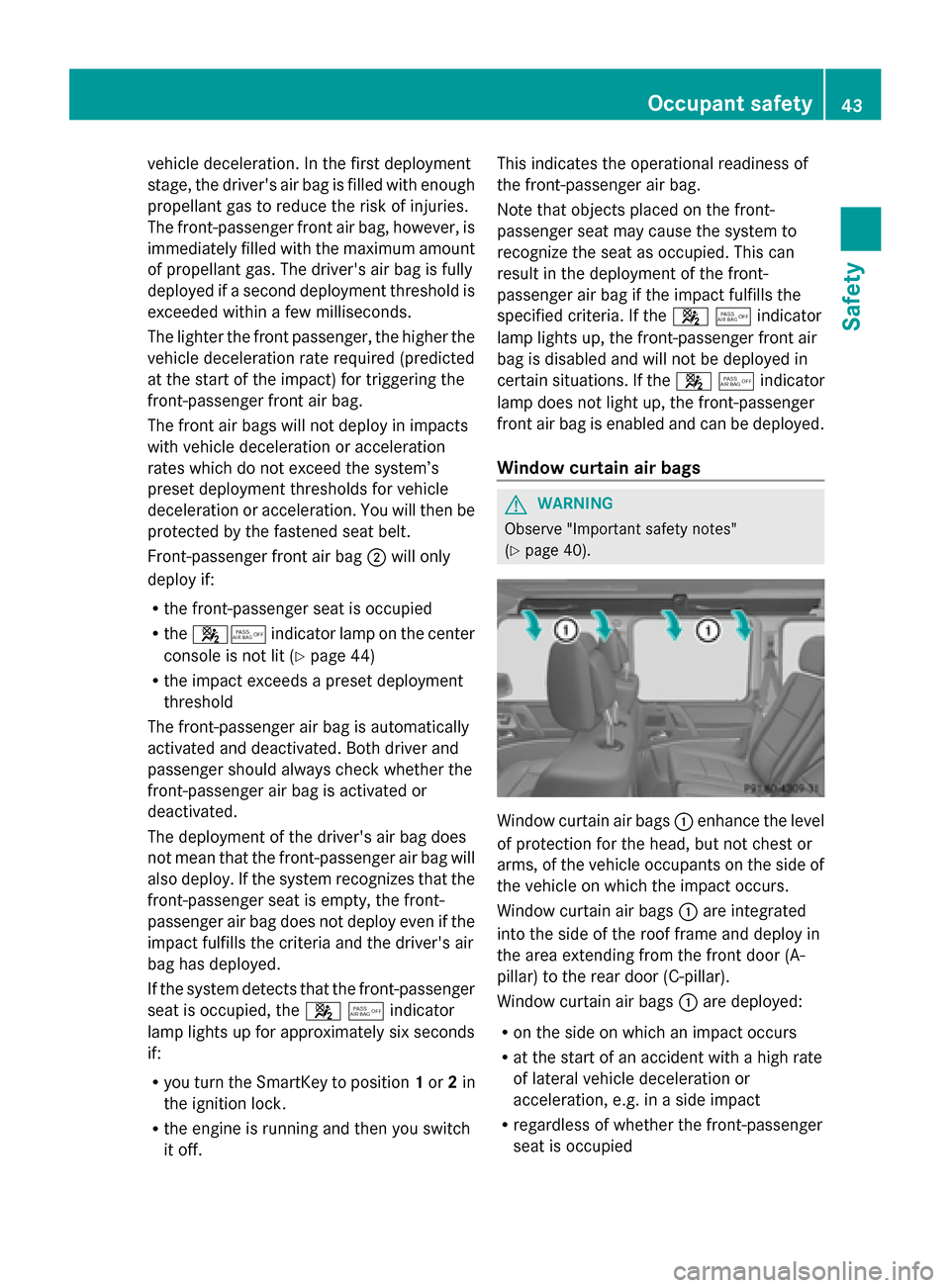
(Y page 40). Window curtain air bags
0043enhance the level
of protection for the head, but not chest or
arms, of the vehicle occupants on the side of
the vehicle on which the impact occurs.
Window curtain air bags 0043are integrated
into the side of the roof frame and deploy in
the area extending from the front door (A-
pillar) to the rear door (C-pillar).
Window curtain air bags 0043are deployed:
R on the side on which an impact occurs
R at the start of an accident with a high rate
of lateral vehicle deceleration or
acceleration, e.g. in a side impact
R regardless of whether the front-passenger
seat is occupied Occupant safety
43Safety Z
Page 46 of 354
R
independently of seat belt use
R if the vehicle rolls over and the system
determines that window curtain air bag
deployment can offer additional protection
to that provided by the seat belt
R independently of the front air bags
Window curtain air bags will not deploy in
impacts which do not exceed the system's
preset deployment thresholds for lateral
acceleration/deceleration. You will then be
protected by the fastened seat belt. BabySmart™ air bag deactivation
system
How the air bag deactivation system
works G
WARNING
According to accident statistics, children are
safer when properly restrained in the rear
seating positions than in the front seating
position. Thus, we strongly recommend that
children be placed in the rear seats whenever
possible. Regardless of seating position,
children 12 years old and under must be
seated and properly secured in an appropriate
infant restraint, toddler restraint, or booster
seat recommended for the size and weight of
the child.
The infant or child restraint must be properly
secured with the vehicle's seat belt, the seat
belt and top tether strap, or lower anchors and
top tether strap, fully in accordance with the
child seat manufacturer's instructions.
Occupants, especially children, should always
sit as upright as possible, wear the seat belt
properly and use an appropriately sized infant
restraint, toddler restraint, or booster seat
recommended for the size and weight of the
child. Children can be killed or seriously injured by
an inflating air bag. Note the following
important information when circumstances
require you to place a child in the front
passenger seat:
R Children 12 years old and under must never
ride in the front seat, except in a Mercedes-
Benz authorized BabySmart™ compatible
child seat, which operates with the
BabySmart™ system installed in the vehicle
to deactivate the front passenger front air
bag when it is installed properly. Otherwise
they will be struck by the air bag when it
inflates in a crash. If this happens, serious
or fatal injury will result.
R A child in a rear-facing child restraint on the
front passenger seat will be seriously
injured or even killed if the front passenger
front air bag inflates in a collision which
could occur under some circumstances,
even with the air bag technology installed
in your vehicle. The only means to
completely eliminate this risk is to never
place a child in a rear-facing child restraint
in the front seat. We therefore strongly
recommend that you always place a child
in a rear-facing child restraint in a backseat.
R If you must install a BabySmart™
compatible rear-facing child restraint on
the front passenger seat because
circumstances require you to do so, make
sure the 0073007Cindicator lamp is
illuminated, indicating that the front
passenger front air bag is deactivated.
Should the 0073007Cindicator lamp not
illuminate or go out while the restraint is
installed, please check installation.
Periodically check the 0073007Cindicator
lamp while driving to make sure the
0073007Cindicator lamp is illuminated. If
the 0073007Cindicator lamp goes out or
remains out, do not transport a child on the
front passenger seat until the system has
been repaired.
A child in a rear-facing child restraint on the
front passenger seat will be seriously 44
Occupant safetySafety
Page 50 of 354
passenger seats are moved forwards and
upwards in the event of a rear-end collision of
a certain severity. This provides better head
support.
If the NECK-PRO head restraints have been
triggered in an accident, reset the NECK-PRO
head restraints on the driver’s and front-
passenger seat (Y page 48). Otherwise, the
additional protection will not be available in
the event of another rear-end collision. You
can recognize if NECK-PRO head restraints
have been triggered by the fact that they have
moved forwards and can no longer be
adjusted.
Resetting triggered NECK-PRO head
restraints G
WARNING
For safety reasons, have the NECK-PRO head
restraints checked at a qualified specialist
workshop after a rear-end collision. G
WARNING
When pushing back the NECK-PRO head
restraint cushion, make sure your fingers do
not become caught between the head
restraint cushion and the cover. Failure to
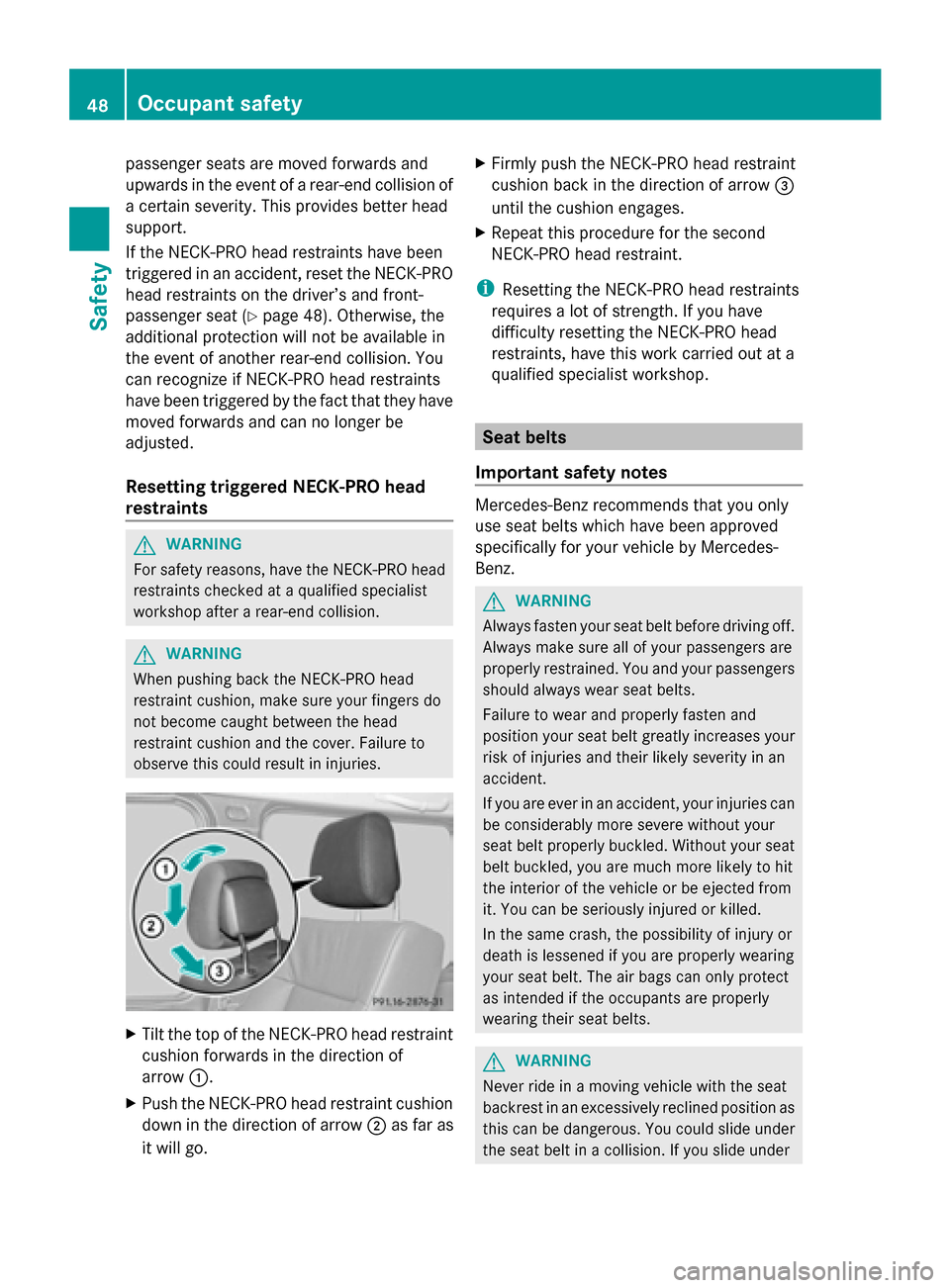
observe this could result in injuries. X
Tilt the top of the NECK-PRO head restraint
cushion forwards in the direction of
arrow 0043.
X Push the NECK-PRO head restraint cushion
down in the direction of arrow 0044as far as
it will go. X
Firmly push the NECK-PRO head restraint
cushion back in the direction of arrow 0087
until the cushion engages.
X Repeat this procedure for the second
NECK-PRO head restraint.
i Resetting the NECK-PRO head restraints
requires a lot of strength. If you have
difficulty resetting the NECK-PRO head
restraints, have this work carried out at a
qualified specialist workshop. Seat belts
Important safety notes Mercedes-Benz recommends that you only
use seat belts which have been approved
specifically for your vehicle by Mercedes-
Benz.
G
WARNING
Always fasten your seat belt before driving off.
Always make sure all of your passengers are
properly restrained. You and your passengers
should always wear seat belts.
Failure to wear and properly fasten and
position your seat belt greatly increases your
risk of injuries and their likely severity in an
accident.
If you are ever in an accident, your injuries can
be considerably more severe without your
seat belt properly buckled. Without your seat
belt buckled, you are much more likely to hit
the interior of the vehicle or be ejected from
it. You can be seriously injured or killed.
In the same crash, the possibility of injury or
death is lessened if you are properly wearing
your seat belt. The air bags can only protect
as intended if the occupants are properly
wearing their seat belts. G
WARNING
Never ride in a moving vehicle with the seat
backrest in an excessively reclined position as
this can be dangerous. You could slide under
the seat belt in a collision. If you slide under 48
Occupant safetySafety
Page 51 of 354
it, the seat belt would apply force at the
abdomen or neck. That could cause serious
or even fatal injuries. The seat backrest and
seat belt provide the best restraint when the
wearer is in a position that is as upright as
possible and the seat belt is properly
positioned on the body. G
WARNING
Never let more people ride in the vehicle than
there are seat belts available. Make sure
everyone riding in the vehicle is correctly
restrained with a separate seat belt. Never
use a seat belt for more than one person at a
time. G
WARNING
Always have damaged seat belts or seat belts
that have been subjected to a load in an
accident replaced and the anchorages
checked.
Only use seat belts that have been approved
by Mercedes-Benz.
Never tamper with seat belts. This can result
in the unintended deployment of the
Emergency Tensioning Devices or the failure
to deploy when necessary.
Do not bleach or dye seat belts, as this may
severely weaken them. In the event of a
collision, they may be unable to provide
adequate protection.
Have all work carried out only by qualified
technicians. Consult a qualified specialist
workshop.
The use of infant or child restraints is required
by law in all 50 states, the District of
Columbia, all U.S. territories and all Canadian
provinces.
Even where this is not the case, all vehicle
occupants should have their seat belts
fastened when the vehicle is in motion.
i See "Children in the vehicle"
(Y page 54) for further information on
infants and children traveling in the vehicle,
as well as on child restraint systems. Correct use of the seat belts G
WARNING
CORRECT USE OF SEAT BELTS
R Seat belts only work properly if they are
fastened correctly. Never wear seat belts in
any other way than as described in this
section, as that could result in serious
injuries in the event of an accident.
R All occupants should wear their seat belt at
all times, because seat belts help reduce
the likelihood of and potential severity of
injuries in accidents, even if the vehicle
overturns. The restraint system installed is
equipped with SRS (driver's air bag, front-
passenger air bag, window curtain air
bags), belt tensioners and belt force
limiters.
The system is designed to enhance the
protection offered to occupants who are
wearing their seat belts correctly, in certain
frontal impacts (front air bags and belt
tensioners) and side impacts (window
curtain air bags and belt tensioners) which
exceed preset deployment thresholds.
R Never route the shoulder section of the
seat belt under your arm, across your neck
or anywhere other than across your
shoulder. In the event of a frontal impact,
your body would be moved too far forward.
This would increase the risk of head and
neck injuries. The seat belt would then
apply excessive force to the ribs or
abdomen which could cause severe
internal injuries to organs such as the liver
or spleen.
Adjust the seat belt so that the upper part
of the belt is as close as possible to the
center of the shoulder. It should not touch
the neck. Never route the belt under the
shoulder. The height of the belt outlet can
be altered to ensure correct usage.
R The lap belt should be routed as low as
possible across the hips, not across the
abdomen. If the lap belt is routed across the Occupant safety
49Safety
Z
Page 88 of 354
!
To avoid damage to the seats and the seat
heating, observe the following information:
R keep liquids from spilling on the seats. If
liquid is spilled on the seats, dry them as
soon as possible.
R if the seat covers are damp or wet, do not
switch on the seat heating. The seat
heating should also not be used to dry
the seats.
R clean the seat covers as recommended;
see the "Interior care" section.
R do not transport heavy loads on the
seats. Do not place sharp objects on the
seat cushions, e.g. knives, nails or tools.
The seats should only be occupied by
passengers, if possible.
R when the seat heating is in operation, do
not cover the seats with insulating
materials, e.g. blankets, coats, bags,
seat covers, child seats or booster seats.
! Make sure that there are no objects in the
footwell or behind the seats when resetting
the seats. There is a risk that the seats
and/or the objects could be damaged.
! When the rear bench seat is folded
forwards, the front seats cannot be moved
to their rearmost position. You could
otherwise damage the seats and the rear
bench seat.
! Make sure that the sun visor is folded up
before adjusting the backrest and head
restraint height. The head restraint and sun
visor could otherwise collide when the head
restraint is fully extended.
i If the front door is open, the seats can be
adjusted for up to 30 minutes after the
ignition has been switched off.
i The rear-compartment head restraints
can be removed (Y page 88).
For more information, contact a qualified
specialist workshop.
i You can find further information about
enlarging the cargo compartment (folding the rear bench seat forwards) on
(Y
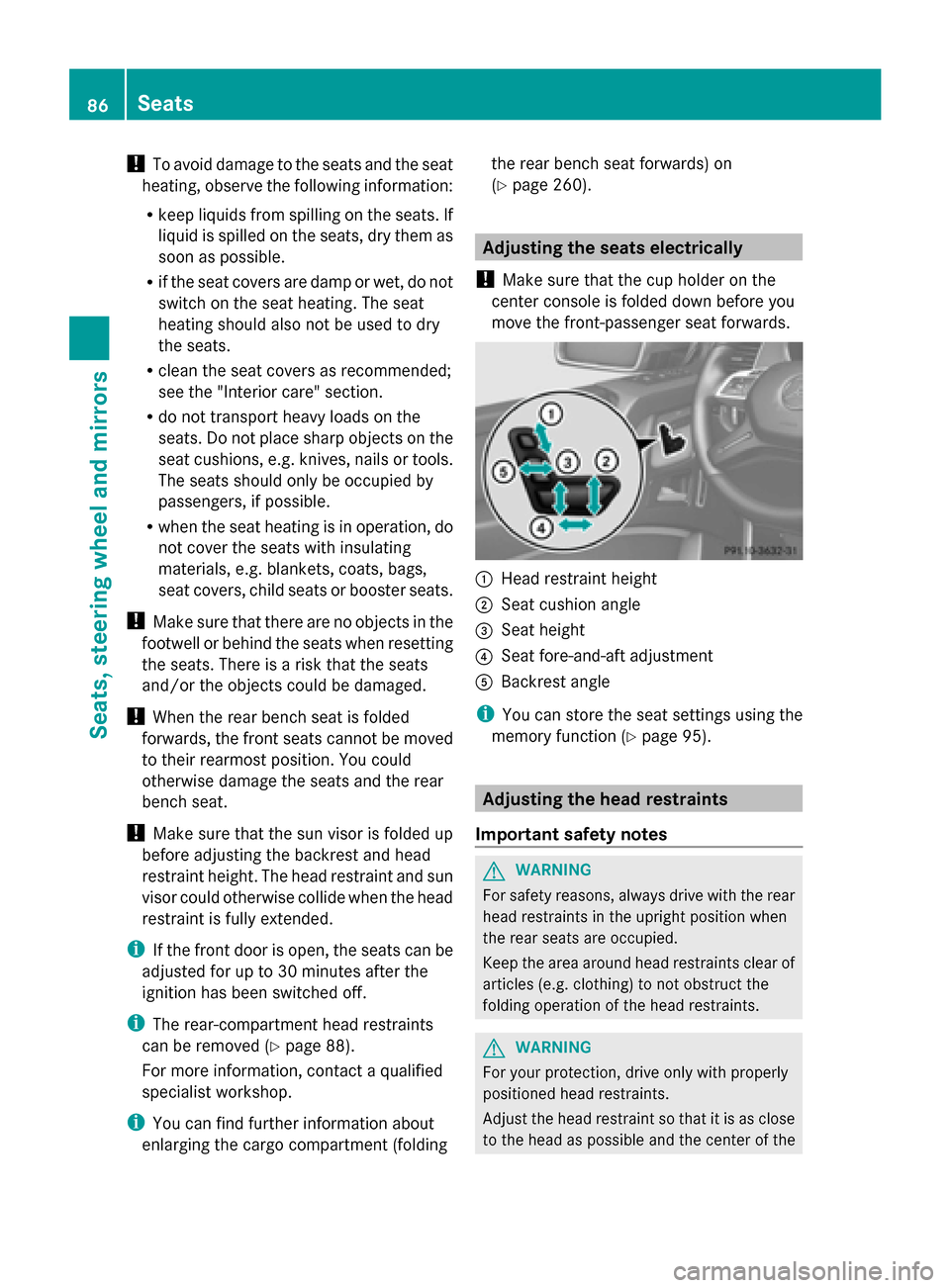
page 260). Adjusting the seats electrically
! Make sure that the cup holder on the
center console is folded down before you
move the front-passenger seat forwards. 0043
Head restraint height
0044 Seat cushion angle
0087 Seat height
0085 Seat fore-and-aft adjustment
0083 Backrest angle
i You can store the seat settings using the
memory function (Y page 95). Adjusting the head restraints
Important safety notes G
WARNING
For safety reasons, always drive with the rear
head restraints in the upright position when
the rear seats are occupied.
Keep the area around head restraints clear of
articles (e.g. clothing) to not obstruct the
folding operation of the head restraints. G
WARNING
For your protection, drive only with properly
positioned head restraints.
Adjust the head restraint so that it is as close
to the head as possible and the center of the 86
SeatsSeats, steering wheel and mirrors
Page 89 of 354
head restraint supports the back of the head
at eye level. This will reduce the potential for
injury to the head and neck in the event of an
accident or similar situation.
Do not drive the vehicle without the seat head
restraints. Head restraints are intended to
help reduce injuries during an accident.
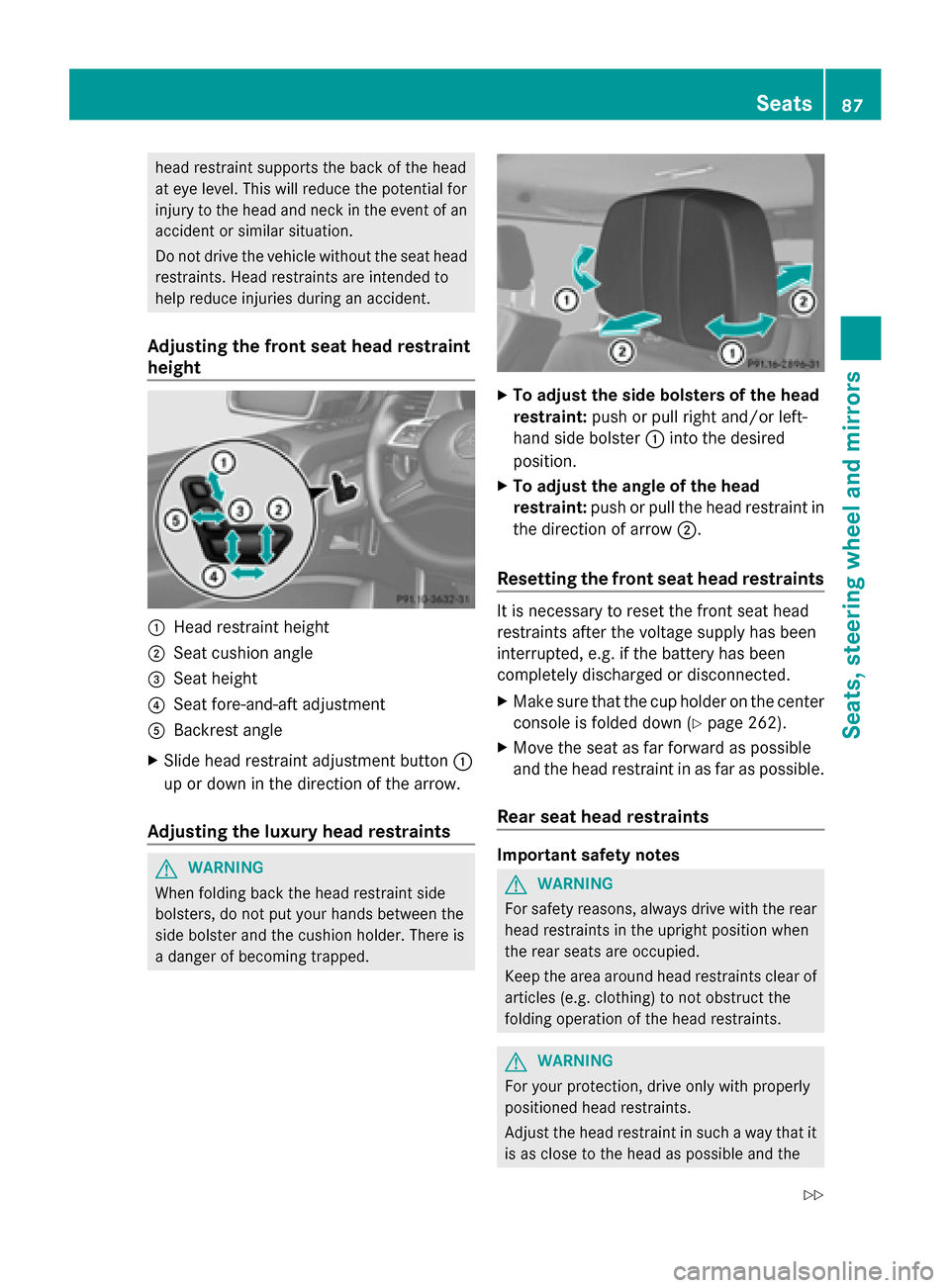
Adjusting the front seat head restraint
height 0043
Head restraint height
0044 Seat cushion angle
0087 Seat height
0085 Seat fore-and-aft adjustment
0083 Backrest angle
X Slide head restraint adjustment button 0043
up or down in the direction of the arrow.
Adjusting the luxury head restraints G
WARNING
When folding back the head restraint side
bolsters, do not put your hands between the
side bolster and the cushion holder. There is
a danger of becoming trapped. X
To adjust the side bolsters of the head
restraint: push or pull right and/or left-
hand side bolster 0043into the desired
position.
X To adjust the angle of the head
restraint: push or pull the head restraint in
the direction of arrow 0044.
Resetting the front seat head restraints It is necessary to reset the front seat head
restraints after the voltage supply has been
interrupted, e.g. if the battery has been
completely discharged or disconnected.
X
Make sure that the cup holder on the center
console is folded down (Y page 262).
X Move the seat as far forward as possible
and the head restraint in as far as possible.
Rear seat head restraints Important safety notes
G
WARNING
For safety reasons, always drive with the rear
head restraints in the upright position when
the rear seats are occupied.
Keep the area around head restraints clear of
articles (e.g. clothing) to not obstruct the
folding operation of the head restraints. G
WARNING
For your protection, drive only with properly
positioned head restraints.
Adjust the head restraint in such a way that it
is as close to the head as possible and the Seats
87Seats, steering wheel and mirrors
Z