ECU MERCEDES-BENZ G-Class 2015 W463 Owner's Manual
[x] Cancel search | Manufacturer: MERCEDES-BENZ, Model Year: 2015, Model line: G-Class, Model: MERCEDES-BENZ G-Class 2015 W463Pages: 350, PDF Size: 6.44 MB
Page 14 of 350
Roadside Assistance butto
n ..........261
Self-test ......................................... 259
Speed alert ................................... .265
System .......................................... 259
Triggering the vehicle alarm ........... 266
Vehicle remote malfunction diag-
nosis .............................................. 264
Vehicle remote unlocking .............. 263
Mechanical key
Function/notes ................................ 69
General notes .................................. 69
Removing ......................................... 70
Memory card (audio) ......................... 203
Memory function ................................. 95
Message memory (on-board com-
puter) ................................................. .212
Messages
see Display messages
Mirrors
Sun visor ........................................ 255
see Exterior mirrors
see Rear-view mirror
Mobile phone
Menu (on-board computer) ............ 204
Mounting wheels
Mounting a new wheel ................... 330
Raising the vehicle ......................... 328
Removing a wheel .......................... 330
Securing the vehicle against roll-
ing away ........................................ 328
MP3
Operation ....................................... 203
see separate operating instructions
Multifunction display
Function/notes ............................ .199
Permanent display ......................... 207
Multifunction steering wheel
Back button ................................... 199
Operating the on-board computer .. 198
Overview .......................................... 33 N
Navigation Menu (on-board computer) ............ 201
see separate operating instructions
NECK-PRO head restraints
Operation ......................................... 51 Resetting triggered .......................... 51
NECK-PRO luxury head restraints
Important safety notes .................... 51
Operation ......................................... 51
Resetting when triggered ................. 52
Notes on breaking-in a new vehi-
cle ....................................................... 132 O
Occupant safety Automatic measures after an acci-
dent ................................................. 52
BabySmart™ air bag deactivation
system ............................................. 56
Children in the vehicle ..................... 52
Important safety notes .................... 41
Pets in the vehicle ........................... 61
Off-road
Differential locks ............................ 188
Off-road ABS ................................... .62
Off-road driving
Checklist ........................................1 59
Driving on sand .............................. 160
Important safety notes .................. 158
Traveling uphill ............................... 161
Off-road fording ................................. 156
Off-road system
Permanent all-wheel drive ............. 181
Oil
see Engine oil
On-board computer
AMG menu ..................................... 209
Assistance menu ........................... 205
Audio menu ................................... 203
Convenience submenu .................. 208
Display messages .......................... 211
DISTRONIC PLUS ........................... 174
Factory settings submenu ............. 209
Important safety notes .................. 196
Instrument cluster submenu .......... 206
Lighting submenu .......................... 207
Menu overview .............................. 200
Message memory .......................... 212
Navigation menu ............................ 201
Operation ....................................... 198
RACETIMER ................................... 210
Service menu ................................. 206 12
Index
Page 20 of 350
Trailer
7-pin connector ............................. 193
Power supply ................................. 193
Trailer coupling (cleaning instruc-
tions) .................................................. 285
Trailer loads
Technical data ............................... 347
Trailer tow hitch
Ball position ................................... 347
Trailer towing
ESP® .............................................. .65
PARKTRONIC ................................. 184
Transfer case
General notes ................................ 186
Shift range .....................................1 86
Shifting .......................................... 186
Shifting (general notes) .................. 187
Shifting (important safety notes) ... 186
Shifting to neutra l.......................... 188
Switching off the off-road gear
ratio ............................................... 187
Switching on the off-road gear
ratio ............................................... 187
Transmission
see Automatic transmission
Transmission positions .................... 142
Transporting the vehicle .................. 300
Traveling uphill
Brow of hill ..................................... 162
Trip computer (on-board com-
puter) .................................................. 200
Trip odometer
Calling up ....................................... 200
Resetting (on-board computer) ...... 201
Turn signals
Changing bulbs (front) ................... 111
Display message ............................ 219
Switching on/of f........................... 103
TWR (Tongue Weight Rating) (defi-
nition) ................................................. 327
Type identification plate
see Vehicle identification plate U
Unlocking Emergency unlocking ....................... 75 From inside the vehicle (central
unlocking button) ............................. 74 V
Vanity mirror Sun visor ........................................ 255
Variable SPEEDTRONIC
Function/note s............................. 166
Vehicle
Correct use ...................................... 25
Data acquisition ............................... 26
Display message ............................ 232
Emergency locking ........................... 75
Emergency unlocking ....................... 75
Equipment ....................................... 21
Individual settings .......................... 206
Limited Warranty ............................. 25
Loading .......................................... 316
Locking (SmartKey ).......................... 68
Lowering ........................................ 330
Maintenance .................................... 22
Parking for a long period ................ 152
Pulling away ................................... 134
Raising ........................................... 328
Reporting problems ......................... 25
Securing from rolling away ............ 328
Tow-starting ................................... 298
Towing away .................................. 298
Transporting .................................. 300
Unlocking (SmartKey )...................... 68
Vehicle data ................................... 344
Vehicle data ....................................... 344
Vehicle data (off-road driving)
Approach/departure angle ............ 346
Fording depth ................................ 345
Maximum gradient climbing abil-
ity .................................................. 346
Vehicle dimensions ........................... 344
Vehicle identification number
see VIN
Vehicle identification plate .............. 336
Vehicle tool kit .................................. 290
Ventilation
Setting the airflow ......................... 124
Video
Operating the DVD ......................... 203
VIN ...................................................... 336 18
Index
Page 27 of 350
Correct use
If you remove any warning stickers, you or
others could fail to recognize certain dangers.
Leave warning stickers in position.
Observe the following information when driv- ing your vehicle:
R the safety notes in this manual
R the technical data section in this manual
R traffic rules and regulations
R laws and safety standards pertaining to
motor vehicles Problems with your vehicle
If you should experience a problem with your
vehicle, particularly one that you believe may affect its safe operation, we urge you to con-
tact an authorized Mercedes-Benz Center
immediately to have the problem diagnosed
and rectified. If the problem is not resolved to
your satisfaction, please discuss the problem
again with a Mercedes-Benz Center or con-
tact us at one of the following addresses.
In the USA
Customer Assistance Center
Mercedes-Benz USA, LLC
One Mercedes Drive
Montvale, NJ 07645-0350
In Canada
Customer Relations Department
Mercedes-Benz Canada, Inc.
98 Vanderhoof Avenue
Toronto, Ontario M4G 4C9 Reporting safety defects
USA only:
The following text is reproduced as required
of all manufacturers according to Title 49,
Code of U.S. Federal Regulations, Part 575
pursuant to the National Traffic and Motor
Vehicle Safety Act of 1966. If you believe that your vehicle has a defect
which could cause a crash or could cause
injury or death, you should immediately
inform the National Highway Traffic Safety
Administration (NHTSA) in addition to notify-
ing Mercedes-Benz USA, LLC.
If NHTSA receives similar complaints, it may
open an investigation, and if it finds that a
safety defect exists in a group of vehicles, it
may order a recall and remedy campaign.
However, NHTSA cannot become involved in
individual problems between you, your
dealer, or Mercedes-Benz USA, LLC.
To contact NHTSA, you may call the Vehicle
Safety Hotline toll-free at
1-888-327-4236(TTY: 1-800-424-9153 );go
to http://www.safercar.gov; or write to:
Administrator, NHTSA Headquarters,
1200 New Jersey Avenue, SE, West Building,
Washington, DC 20590.
You can obtain additional information about
vehicle safety from:
http://www.safercar.gov Limited Warranty
! Follow the instructions in this manual
about the proper operation of your vehicle
as well as about possible vehicle damage.
Damage to your vehicle that arises from
culpable contraventions against these
instructions is not covered either by the
Mercedes-Benz Limited Warranty or by the
New or Used-Vehicle Warranty. QR codes for rescue cards
The QR codes are secured in the fuel filler flap and on the opposite side on the B-pillar. In the
case of an accident, the rescue services can
find the QR codes quickly on the appropriate rescue cards for your vehicle. The current
rescue card contains the most important
information about your vehicle in a compact
form, e.g. the routing of the electric cables. Introduction
25 Z
Page 42 of 350
Useful information
i This Operator's Manual describes all
models and all standard and optional equip- ment of your vehicle available at the time of
publication of the Operator's Manual.
Country-specific differences are possible.
Please note that your vehicle may not be
equipped with all features described. This
also applies to safety-related systems and
functions.
i Read the information on qualified special-
ist workshops: (Y page 24). Panic alarm
X
To activate: press!button :for at
least one second.
An alarm sounds and the indicator lamp
flashes.
X To deactivate: press!button :
again.
or
X Insert the SmartKey into the ignition lock.
i USA only:
This device complies with part 15 of the
FCC Rules. Operation is subject to the fol-
lowing two conditions:
1. This device may not cause interference,
and
2. this device must accept any interference received, including interference that may
cause undesired operation of the device. Any unauthorized modification to this
device could void the user's authority to
operate the equipment.
The Product label with FCC ID and IC cer-
tification number can be found in the bat-
tery case of the SmartKey.
i Canada only:
This device complies with the RSS-210
Rules of Industry Canada. Operation is sub-
ject to the following two conditions:
1. This device may not cause interference,
and
2. this device must accept any interference received, including interference that may
cause undesired operation.
Any unauthorized modification to this
device could void the user's authority to
operate the equipment.
The Product label with FCC ID and IC cer-
tification number can be found in the bat-
tery case of the SmartKey. Occupant safety
Restraint system: introduction
The restraint system reduces the risk of vehi- cle occupants coming into contact with parts
of the vehicle's interior in the event of an
accident. The restraint system can also
reduce the forces to which vehicle occupants
are subjected during an accident.
The restraint system comprises:
R Seat belt system
R Air bags
R Child restraint system
R Child seat securing systems 40
Occupant safetySafety
Page 45 of 350
Important safety notes
The use of seat belts and child restraint sys-
tems is required by law in:
R all 50 states
R the U.S. territories
R the District of Columbia
R all Canadian provinces
Even where this is not required by law, all
vehicle occupants should correctly fasten
their seat belts before starting the journey. G
WARNING
If the seat belt is incorrectly fastened, it can-
not protect as intended. Furthermore, an
incorrectly fastened seat belt can cause addi- tional injury, for example, in an accident, dur-
ing braking or when abruptly changing direc-
tion. This poses an increased risk of injury or
even fatal injury.
Make sure that all vehicle occupants are
seated properly with a correctly fastened seat belt. G
WARNING
The seat belt does not offer the intended level of protection if you have not moved the back-
rest to an almost vertical position. When brak-
ing or in the event of an accident, you could
slide underneath the seat belt and sustain
abdomen or neck injuries, for example. This
poses an increased risk of injury or even fatal injury.
Adjust the seat properly before beginning
your journey. Always ensure that the backrest
is in an almost vertical position and that the
shoulder section of your seat belt is routed
across the center of your shoulder. G
WARNING
Persons under 5 ft (1.50 m) in height cannot
fasten the seat belt correctly without an addi- tional suitable restraint system. If the seat
belt is incorrectly fastened, it cannot protect
as intended. Furthermore, an incorrectly fas-
tened seat belt can cause additional injury, for example, in an accident, during braking or an
abrupt change of direction. This poses an
increased risk of injury or even fatal injury.
For this reason, always secure persons under
5 ft (1.50 m)in height in suitable restraint
systems.
If a child younger than 12 years and under 5 ft
(1.50 m)in height is traveling in the vehicle:
R always secure the child in a child restraint
system suitable for this Mercedes-Benz
vehicle. The child restraint system must be
appropriate to the age, weight and size of
the child
R always observe the instructions and safety
notes in the "Children in the vehicle" sec-
tion of this Operator's Manual
(Y page 52) in addition to the child
restraint system manufacturer's installa-
tion instructions G
WARNING
The seat belts may not perform their intended protective function if:
R they are damaged, modified, extremely
dirty, bleach or dyed
R the seat belt buckle is damaged or
extremely dirty
R the Emergency Tensioning Devices, belt
anchorages or inertia reels have been modi-
fied
Seat belts may sustain non-visible damage in an accident, e.g. due to glass splinters. Modi-
fied or damaged seat belts may tear or fail,
e.g. in an accident. Modified Emergency Ten-
sioning Devices could accidentally trigger or
fail to deploy when necessary. This poses an
increased risk of injury or even fatal injury.
Never modify the seat belts, Emergency Ten-
sioning Devices, belt anchorages or inertia
reels. Make sure that the seat belts are
undamaged, not worn out and clean. Follow-
ing an accident, have the seat belts checked
immediately at a qualified specialist work-
shop. Occupant safety
43Safety Z
Page 46 of 350
Only use seat belts that have been approved
for your vehicle by Mercedes-Benz. Any such modifications could invalidate the vehicle's
general operating permit.
Proper use of the seat belts Observe the safety notes on the seat belt
(Y
page 43).
All vehicle occupants must be wearing the
seat belt correctly before beginning the jour- ney. Also make sure that all vehicle occu-
pants are always wearing the seat belt cor-
rectly while the vehicle is in motion.
When fastening the seat belt, always make
sure that:
R the seat belt tongue is only inserted to the
belt buckle belonging to that seat.
R the seat belt is tight across your body.
Avoid wearing bulky clothing, e.g. a winter
coat.
R the seat belt is not twisted.
Only then can the forces which occur be
distributed over the area of the belt.
R the shoulder section of the belt is always
routed across the center of your shoulder.
The shoulder section of the belt must not
come into contact with your neck or be
routed under your arm. Where possible,
adjust the seat belt to the appropriate
height.
R the lap belt passes tightly and as low down
as possible across your lap.
The lap belt must always be routed across
your hip joints and not across your abdo-
men. This applies particularly to pregnant
women. If necessary, push the lap belt
down to your hip joint and pull it tight using the shoulder section of the belt.
R the seat belt is not routed across sharp,
pointed or fragile objects.
If you have such items located on or in your
clothing, e.g. pens, keys or eyeglasses,
store these in a suitable place. R
only one person is using a seat belt at a
time.
Infants and children must never travel sit-
ting on the lap of a vehicle occupant. In the
event of an accident, they could be crushed between the vehicle occupant and seat
belt.
R objects are never secured with a seat belt if
the seat belt is also being used by one of the
vehicle's occupants.
Seat belts are only intended to secure and
restrain vehicle occupants. Always observe
the "Loading guidelines" for securing objects,
luggage or loads (Y page 248).
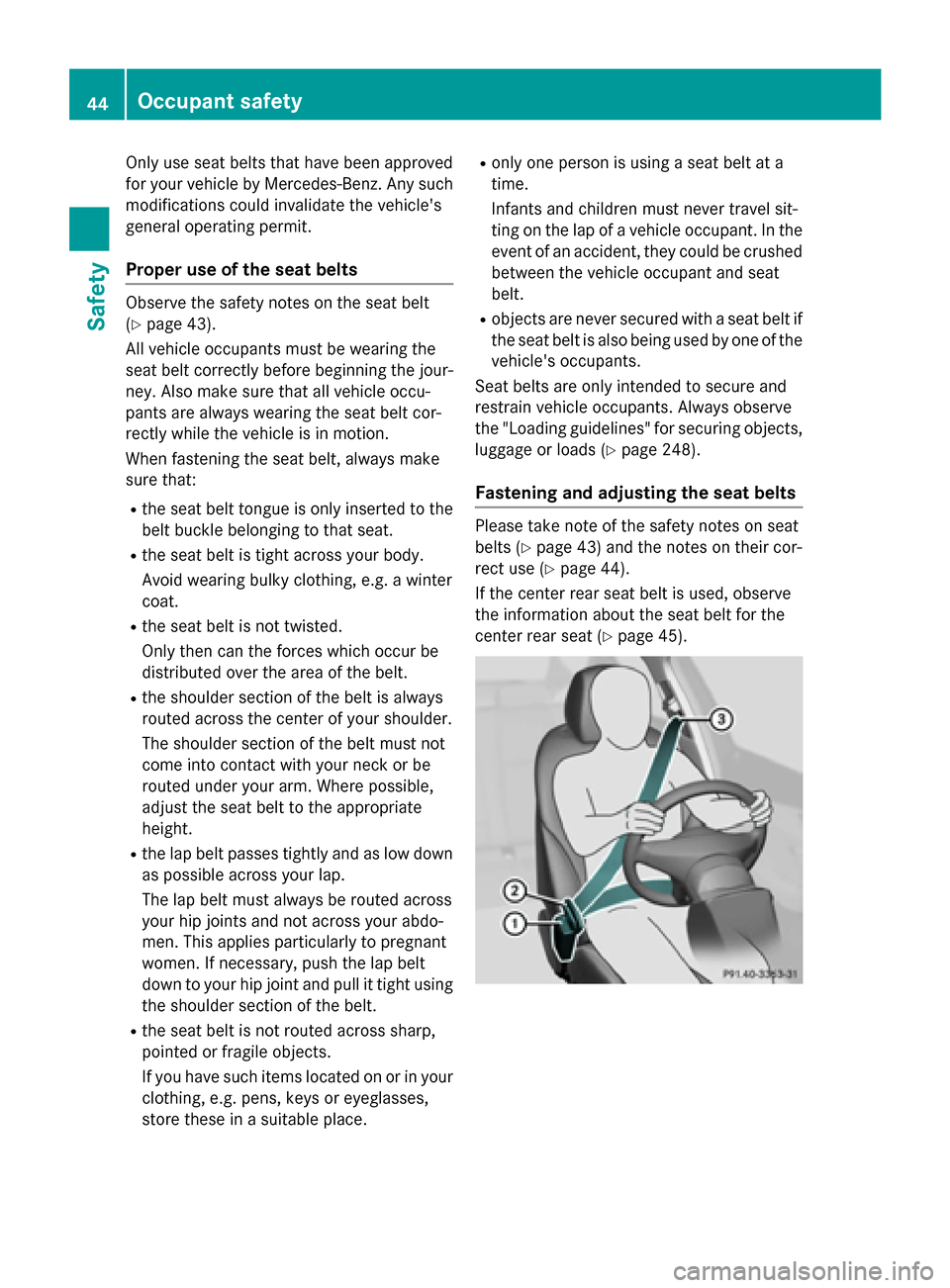
Fastening and adjusting the seat belts Please take note of the safety notes on seat
belts (Y
page 43) and the notes on their cor-
rect use (Y page 44).
If the center rear seat belt is used, observe
the information about the seat belt for the
center rear seat (Y page 45).44
Occupant safetySafety
Page 47 of 350
X
Adjust the seat (Y page 84).
The seat backrest must be in an almost
upright position.
X Pull the seat belt smoothly out of belt sash
guide =and engage belt tongue ;into
belt buckle :.
X If necessary, pull upwards on the shoulder
section of the seat belt to tighten the belt
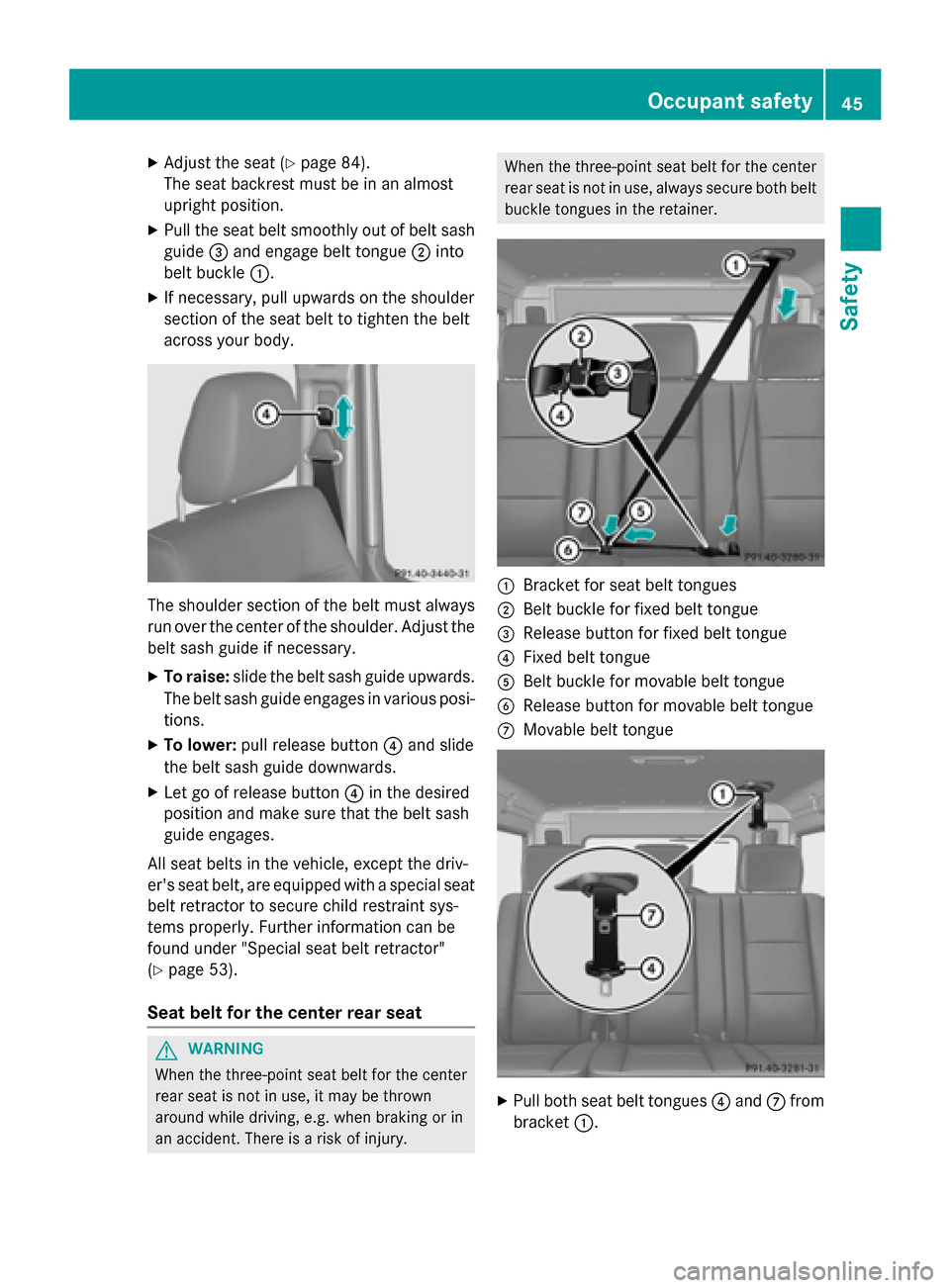
across your body. The shoulder section of the belt must always
run over the center of the shoulder. Adjust the
belt sash guide if necessary.
X To raise: slide the belt sash guide upwards.
The belt sash guide engages in various posi- tions.
X To lower: pull release button ?and slide
the belt sash guide downwards.
X Let go of release button ?in the desired
position and make sure that the belt sash
guide engages.
All seat belts in the vehicle, except the driv-
er's seat belt, are equipped with a special seat belt retractor to secure child restraint sys-
tems properly. Further information can be
found under "Special seat belt retractor"
(Y page 53).
Seat belt for the center rear seat G
WARNING
When the three-point seat belt for the center
rear seat is not in use, it may be thrown
around while driving, e.g. when braking or in
an accident. There is a risk of injury. When the three-point seat belt for the center
rear seat is not in use, always secure both belt
buckle tongues in the retainer. :
Bracket for seat belt tongues
; Belt buckle for fixed belt tongue
= Release button for fixed belt tongue
? Fixed belt tongue
A Belt buckle for movable belt tongue
B Release button for movable belt tongue
C Movable belt tongue X
Pull both seat belt tongues ?and Cfrom
bracket :. Occupant safety
45Safety Z
Page 49 of 350
six seconds or when the driver's seat belt is
fastened.
If the vehicle's speed exceeds 15 mph
(25 km/h) once and the driver's and front-
passenger seat belts are not fastened, a
warning tone sounds. The warning tone
sounds with increasing intensity for
60 seconds or until the driver or front
passenger have fastened their seat belts.
If the driver or front passenger unfasten their seat belts during the journey, the seat belt
warning is activated again.
i For more information on the
7seat
belt warning lamp, see "Warning and indi-
cator lamps in the instrument cluster, seat
belts" (Y page 235). Air bags
Introduction The installation point of an air bag can be rec-
ognized by the AIR BAG symbol.
An air bag complements the correctly fas-
tened seat belt. It is no substitute for the seat
belt. The air bag provides additional protec-
tion in applicable accident situations.
Not all air bags are deployed in an accident.
The different air bag systems function inde-
pendently from one another (Y page 49).
However, no system available today can com- pletely eliminate injuries and fatalities.
It is also not possible to rule out a risk of injury
caused by an air bag due to the high speed at which the air bag must be deployed.
Important safety notes G
WARNING
If you do not sit in the correct seat position,
the air bag cannot protect as intended and
could even cause additional injury when
deployed. This poses an increased risk of
injury or even fatal injury. To avoid hazardous situations, always make
sure that all of the vehicle's occupants:
R have fastened their seat belts correctly,
including pregnant women
R are sitting correctly and maintain the great-
est possible distance to the air bags
R follow the following instructions
Always make sure that there are no objects
between the air bag and the vehicle's occu-
pants.
R Adjust the seats properly before beginning
your journey. Always make sure that the
seat is in an almost upright position. The
center of the head restraint must support
the head at about eye level.
R Move the driver's and front-passenger
seats as far back as possible. The driver's
seat position must allow the vehicle to be
driven safely.
R Only hold the steering wheel on the out-
side. This allows the air bag to be fully
deployed.
R Always lean against the backrest while driv-
ing. Do not lean forwards or lean against
the door or side window. You may other-
wise be in the deployment area of the air
bags.
R Always keep your feet in the footwell in
front of the seat. Do not put your feet on the
dashboard, for example. Your feet may oth- erwise be in the deployment area of the air
bag.
R For this reason, always secure persons less
than 5 ft (1.50 m) tall in suitable restraint
systems. Up to this height, the seat belt
cannot be worn correctly.
If a child is traveling in your vehicle, also
observe the following notes:
R Always secure children under 12 years of
age and less than 5 ft (1.50 m)in height in
suitable child restraint systems.
R Child restraint systems should be installed
on the rear seats. Occupant safety
47Safety Z
Page 50 of 350
R
Only secure a child in a rearward-facing
child restraint system on the front-
passenger seat when the front-passenger
front air bag is deactivated. If the
PASSENGER AIR BAG OFF indicator lamp is permanently lit, the front-passenger front
air bag is deactivated (Y page 42).
R Always observe the instructions and safety
notes on "Children in the vehicle"
(Y page 52) and on the "Child restraint
system on the front-passenger seat"
(Y page 58) in addition to the child
restraint system manufacturer's installa-
tion instructions.
Objects in the vehicle interior may pre-
vent an air bag from functioning correctly.
Before starting your journey and to avoid risks resulting from the speed of the air bag as it
deploys, make sure that:
R there are no people, animals or objects
between the vehicle occupants and an air
bag.
R there are no objects between the seat, door
and B-pillar.
R no hard objects, e.g. coat hangers, hang on
the grab handles or coat hooks.
R no accessories, such as cup holders, are
attached to the vehicle within the deploy-
ment area of an air bag, e.g. to doors, side windows, rear side trim or side walls.
R no heavy, sharp-edged or fragile objects
are in the pockets of your clothing. Store
such objects in a suitable place. G
WARNING
If you modify the air bag cover or affix objects
such as stickers to it, the air bag can no longer function correctly. There is an increased risk
of injury.
Never modify an air bag cover or affix objectsto it. G
WARNING
Sensors to control the air bags are located in the doors. Modifications or work not per-
formed correctly to the doors or door panel- ing, as well as damaged doors, can lead to the
function of the sensors being impaired. The air
bags might therefore not function properly
any more. Consequently, the air bags cannot
protect vehicle occupants as they are
designed to do. There is an increased risk of
injury.
Never modify the doors or parts of the doors. Always have work on the doors or door pan-
eling carried out at a qualified specialist work-
shop.
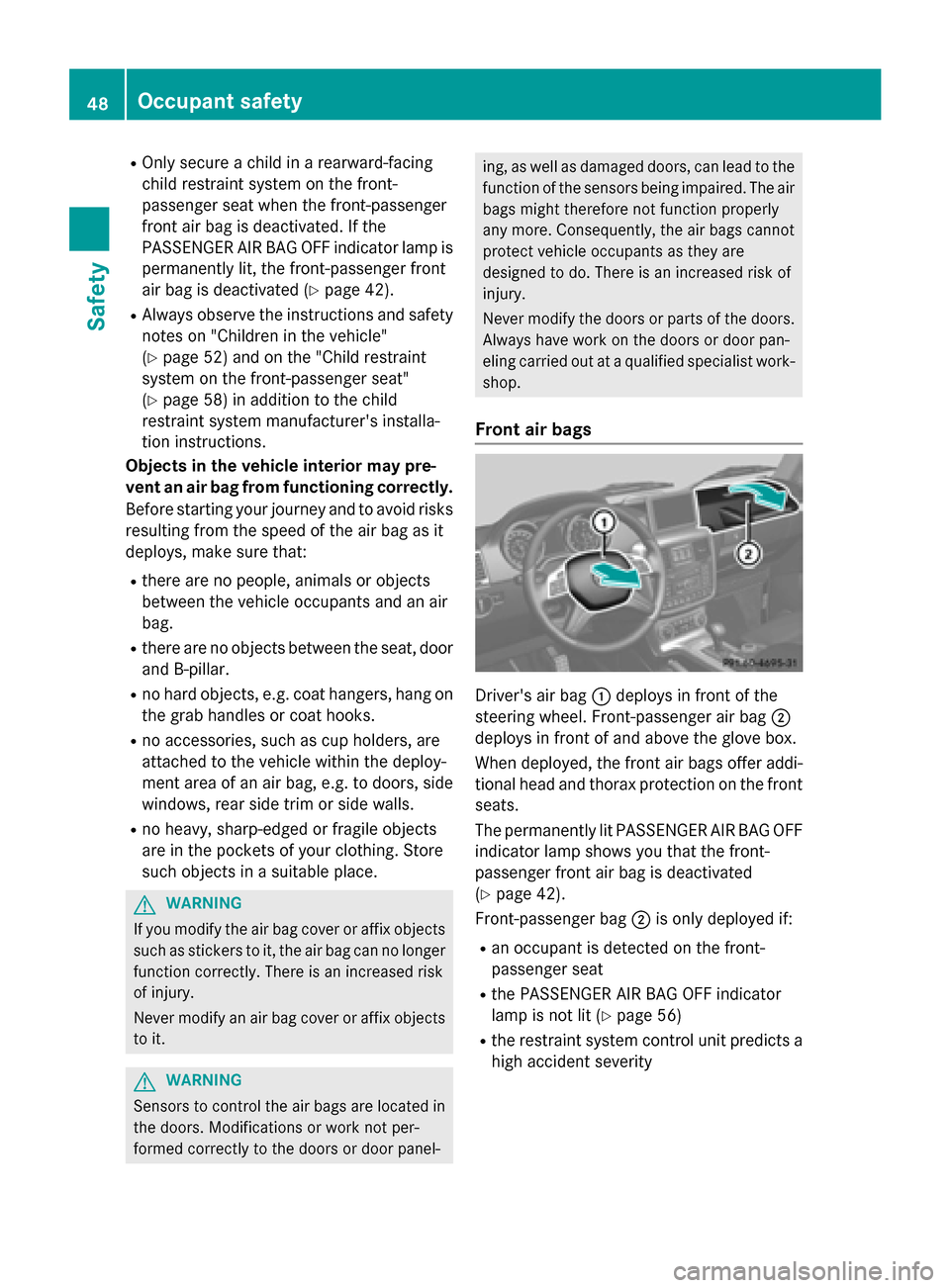
Front air bags Driver's air bag
:deploys in front of the
steering wheel. Front-passenger air bag ;
deploys in front of and above the glove box.
When deployed, the front air bags offer addi- tional head and thorax protection on the front
seats.
The permanently lit PASSENGER AIR BAG OFF
indicator lamp shows you that the front-
passenger front air bag is deactivated
(Y page 42).
Front-passenger bag ;is only deployed if:
R an occupant is detected on the front-
passenger seat
R the PASSENGER AIR BAG OFF indicator
lamp is not lit (Y page 56)
R the restraint system control unit predicts a
high accident severity 48
Occupant safetySafety
Page 54 of 350
X
Tilt the top of the NECK-PRO head restraint
cushion forwards in the direction of
arrow :.
X Push the NECK-PRO head restraint cushion
down as far as it will go in the direction of
arrow ;.
X With your hand flat, firmly push the NECK-
PRO head restraint cushion backwards in
the direction of arrow =until it engages.
X Repeat this procedure for the second
NECK-PRO head restraint.
i Resetting the NECK-PRO head restraints
requires a lot of strength. If you have diffi-
culty resetting the NECK-PRO head
restraints, have this work carried out at a
qualified specialist workshop.
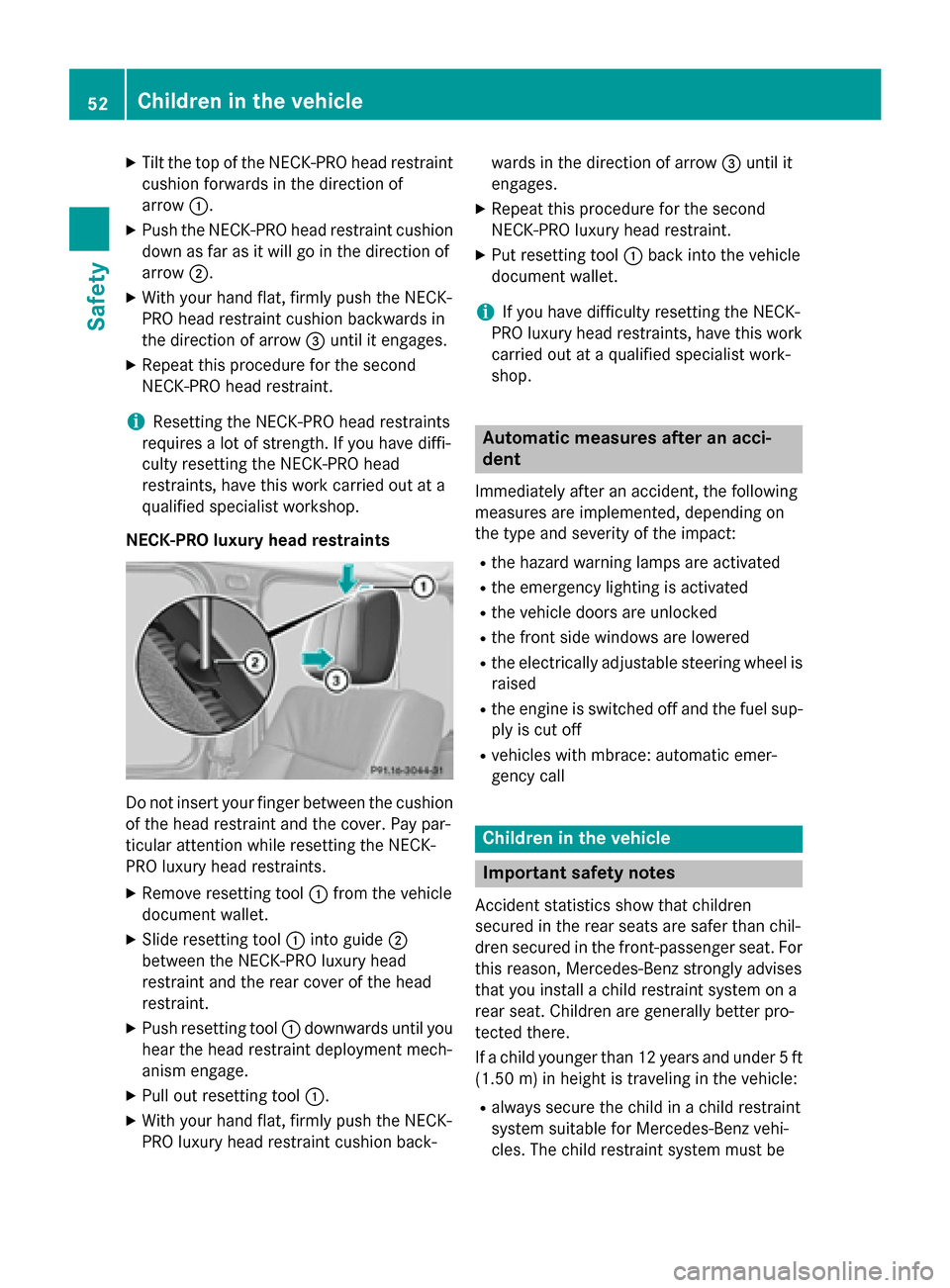
NECK-PRO luxury head restraints Do not insert your finger between the cushion
of the head restraint and the cover. Pay par-
ticular attention while resetting the NECK-
PRO luxury head restraints.
X Remove resetting tool :from the vehicle
document wallet.
X Slide resetting tool :into guide ;
between the NECK-PRO luxury head
restraint and the rear cover of the head
restraint.
X Push resetting tool :downwards until you
hear the head restraint deployment mech-
anism engage.
X Pull out resetting tool :.
X With your hand flat, firmly push the NECK-
PRO luxury head restraint cushion back- wards in the direction of arrow
=until it
engages.
X Repeat this procedure for the second
NECK-PRO luxury head restraint.
X Put resetting tool :back into the vehicle
document wallet.
i If you have difficulty resetting the NECK-
PRO luxury head restraints, have this work carried out at a qualified specialist work-
shop. Automatic measures after an acci-
dent
Immediately after an accident, the following
measures are implemented, depending on
the type and severity of the impact:
R the hazard warning lamps are activated
R the emergency lighting is activated
R the vehicle doors are unlocked
R the front side windows are lowered
R the electrically adjustable steering wheel is
raised
R the engine is switched off and the fuel sup-
ply is cut off
R vehicles with mbrace: automatic emer-
gency call Children in the vehicle
Important safety notes
Accident statistics show that children
secured in the rear seats are safer than chil-
dren secured in the front-passenger seat. For this reason, Mercedes-Benz strongly advises
that you install a child restraint system on a
rear seat. Children are generally better pro-
tected there.
If a child younger than 12 years and under 5 ft
(1.50 m)in height is traveling in the vehicle:
R always secure the child in a child restraint
system suitable for Mercedes-Benz vehi-
cles. The child restraint system must be 52
Children in the vehicleSafety