tow MERCEDES-BENZ G-Class 2017 W463 User Guide
[x] Cancel search | Manufacturer: MERCEDES-BENZ, Model Year: 2017, Model line: G-Class, Model: MERCEDES-BENZ G-Class 2017 W463Pages: 286, PDF Size: 4.91 MB
Page 37 of 286
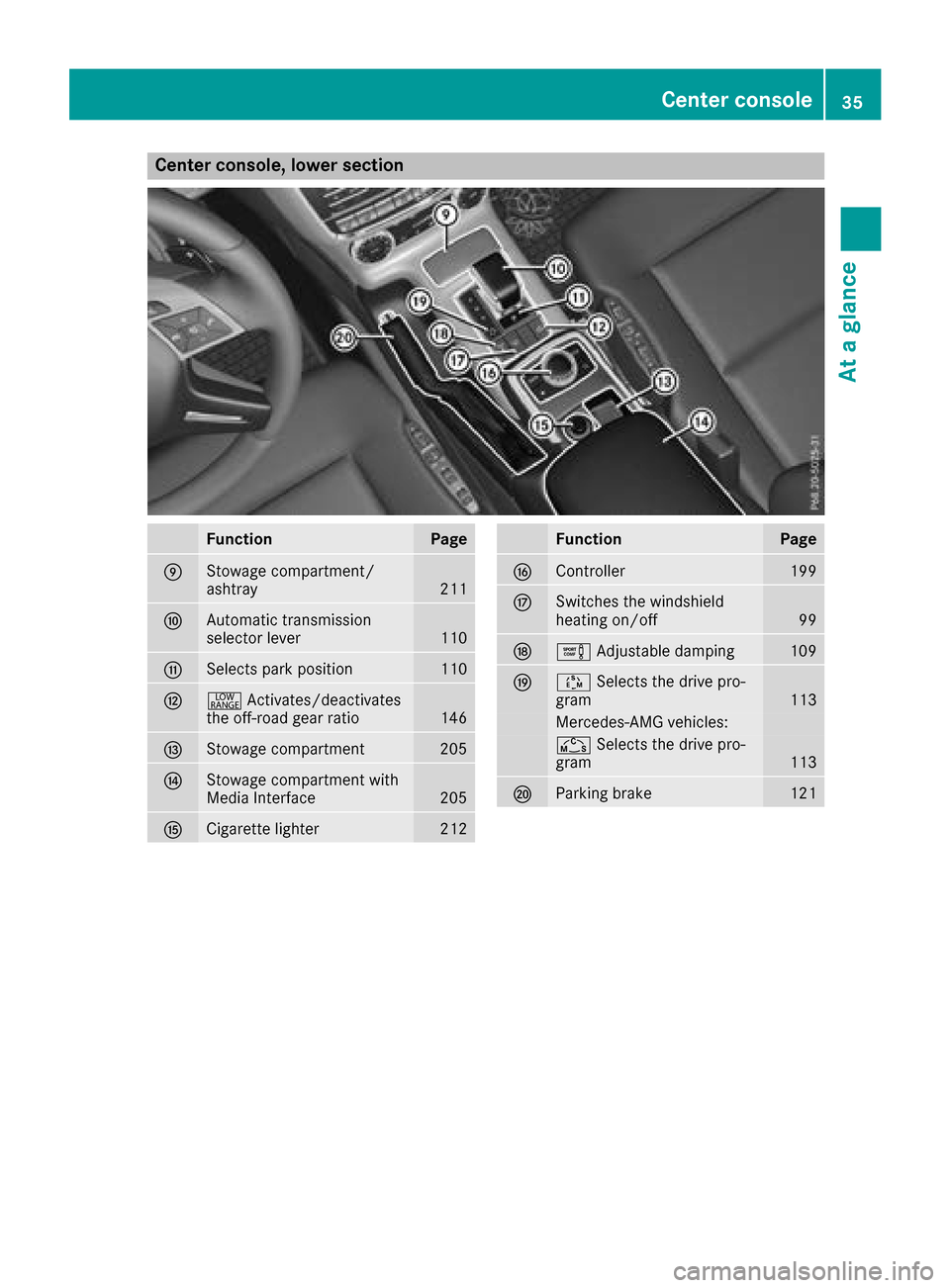
Center console, lower section
FunctionPage
EStowage compartment/
ashtray211
FAutomatic transmission
selectorlever110
GSelect spark position110
H+ Activates/deactivates
th eo ff-road gear ratio146
IStowage compartment205
JStowage compartmen twith
Media Interface205
KCigarett elighter212
FunctionPage
LController199
MSwitches th ewindshield
heating on/off99
Ne Adjustable damping109
OÚSelect sthe driv epro-
gram113
Mercedes-AM Gvehicles:
Ñ Select sthe driv epro-
gram113
PParking brake121
Center console35
At ag lance
Page 48 of 286
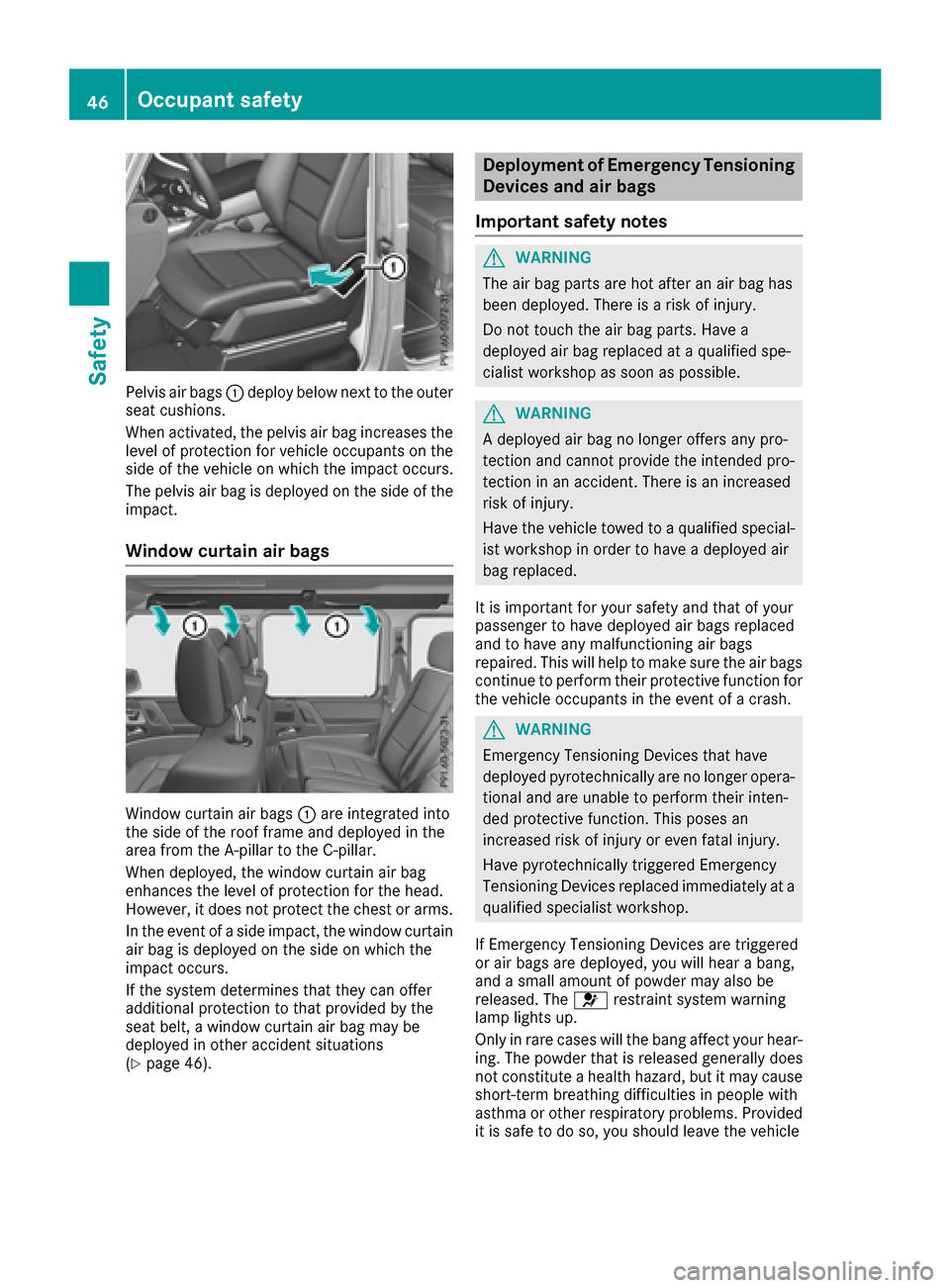
Pelvis air bags:deploy below next to the outer
seat cushions.
When activated, the pelvis air bag increases the
level of protection for vehicle occupantsont he
side of the vehicle on which the impact occurs.
The pelvis air bag is deployed on the side of the
impact.
Window curtain air bags
Window curtain air bags :are integrated into
the side of the roof frame and deployed in the
area from the A-pillar to the C-pillar.
When deployed, the window curtain air bag
enhances the level of protection for the head.
However, it does not protec tthe chest or arms.
In the event of aside impact, the window curtain
air bag is deployed on the side on which the
impact occurs.
If the system determines that they can offer
additional protection to that provided by the
seat belt, awindow curtain air bag may be
deployed in other accident situations
(
Ypage 46).
Deployment of Emergency Tensioning
Devicesa nd air bags
Important safety notes
GWARNING
The air bag parts are hot after an air bag has
been deployed. There is arisk of injury.
Do not touch the air bag parts. Have a
deployed air bag replaced at aqualified spe-
cialist workshop as soon as possible.
GWARNING
Ad eployed air bag no longer offers any pro-
tection and cannot provide the intended pro-
tection in an accident .There is an increased
risk of injury.
Have the vehicle towed to aqualified special-
ist workshop in order to have adeployed air
bag replaced.
It is importan tfor your safety and that of your
passenger to have deployed air bags replaced
and to have any malfunctioning air bags
repaired. This will help to make sure the air bags
continue to perform their protective function for
the vehicle occupantsint he event ofacrash.
GWARNING
Emergency TensioningD evices that have
deployed pyrotechnically are no longer opera-
tional and are unable to perform their inten-
ded protective function. This poses an
increased risk of injury or even fatal injury.
Have pyrotechnically triggered Emergency
TensioningD evices replaced immediately at a
qualified specialist workshop.
If Emergency TensioningD evices are triggered
or air bags are deployed, you will hear abang,
and asmall amount of powder may also be
released. The 6restraint system warning
lamp lights up.
Only in rare cases will the bang affect your hear-
ing. The powder that is released generally does
not constitut eahealth hazard, but it may cause
short-term breathing difficulties in people with
asthma or other respiratory problems. Provided
it is safe to do so, you should leave the vehicle
46Occupant safety
Safety
Page 52 of 286
When leaving the vehicle, alwaystake the
SmartKey with you and lock the vehicle. Never
leave children unsupervised in the vehicle.
GWARNING
If persons, particularly children are subjected to prolonged exposure to extreme heat or
cold, there is arisk of injury, possibly even
fatal. Never leave children unattended in the
vehicle.
GWARNING
If the child restraint system is subjected to
direct sunlight, parts may get very hot. Chil-
dren may burn themselves on these parts,
particularly on the metal parts of the child
restraint system. There is arisk of injury.
If you leave the vehicle, takin gthe child with
you, alwayse nsure that the child restraint
system is not exposed to direct sunlight. Pro- tect it with ablanket ,for example. If the child
restraint system has been exposed to direct
sunlight, let it cool down before securing the
child in it. Never leave children unattended in
the vehicle.
Always ensure that all vehicle occupantsh ave
their seat belts fastened correctly and are sitting
properly. Particular attention must be paid to
children.
Observe the safety notes on the seat belt
(
Ypage 40) and the notes on correct use of seat
belts (Ypage 41).
Ab ooster seat may be necessary to achieve
proper seat belt positionin gfor children over
41 lbs (1 8kg)until they reach aheight where a
three-point seat belt can be properly fastened
without abooster seat.
Special seat belt retractor
GWARNING
If the seat belt is released while driving, the
child restraint system will no longer be
secured properly. The special seat belt retrac- tor is disabled and the inertia real draws in a
portion of the seat belt. The seat belt cannot
be immediately refastened. There is an
increased risk of injury, possibly even fatal.
Stop the vehicle immediately, paying atten-
tion to road and traffic conditions. Reactivate
the special seat belt retractor and secure the
child restraint system properly.
All seat belts except the driver's seat belt are
equipped with aspecial seat belt retractor.
When activated, the special seat belt retractor
ensures that the seat belt will not slacken once
the child restraint system has been secured.
Installing achild restraint system:
XAlways comply with the child restraint system
manufacturer's installation instructions.
XPull the seat belt smoothly out of the belt sash
guide.
XEngage the seat belt tongue in the belt buckle.
Activating the special seat belt retractor:
XPull the seat belt out fully and let the inertia
reel retract it again.
While the seat belt is retracting, you should
hear aratchetin gsound. The special seat belt
retractor is activated.
XPush the child seat restraint system down so
that the seat belt is tight and does not loosen.
Removing achild restraint system and deacti-
vating the special seat belt retractor:
XAlways comply with the child restraint system
manufacturer's installation instructions.
XPress release button of belt buckle, hold the
belt tongue firmly and guide it back towards
the belt sash guide.
The special seat belt retractor is deactivated.
Child restraint system
The use of seat belts and child restraint systems
is required by law in:
Rall 50 states
Rthe U.S .territories
Rthe District of Columbia
Rall Canadian provinces
You can obtain further information about the
correct child restraint system from any author-
ized Mercedes-Benz Center.
50Children in the vehicle
Safety
Page 53 of 286
GWARNING
If the child restraint system is installed incor-
rectly on asuitable seat, it cannot protect as
intended. The child cannot then be restrained
in the event of an accident, heavy braking or
sudden changes of direction. There is an
increased risk of injury ,possibly even fatal.
Make sure that you observe the child restraint
system manufacturer's installation instruc-
tions and the notes on use. Please ensure,
that the base of the child restraint system is
alway sresting completely on the seat cush-
ion. Never place objects, e.g. cushions, under or behind the child restraint system. Only use
child restraint systems with the original cover
designed for them. Only replace damaged
covers with genuine covers.
GWARNING
If the child restraint system is installed incor-
rectly or is not secured, it can come loosei n
the event of an accident, heavy braking or a
sudden change in direction. The child
restraint system coul dbethrown about, strik-
ing vehicleo ccupants. There is an increased
risk of injury ,possibly even fatal.
Always instal lchild restraint systems prop-
erly,e ven if they are not being used .Make
sure that you observe the child restraint sys-
tem manufacturer's installation instructions.
You wil lfind further information on stowing
objects, luggage or loads under "Loading guide-
lines"(
Ypag e204).
GWARNING
Child restraint systems or their securing sys-
tems which have been damaged or subjected
to aloadinana ccident can no longer protect
as intended. The child cannot then be
restrained in the event of an accident, heavy
braking or sudden changes of direction. There is an increased risk of injury ,possibly even
fatal.
Replace child restraint systems which have
been damaged or subjected to aloadina n
accident as soon as possible.H ave the secur-
ing systems on the child restraint system
checked ataqualified specialist workshop,
before you install achild restraint system
again.
The securing systems of child restraint systems
are:
Rthe seat belts ystem
Rthe LATCH-type (ISOFIX) securing rings
Rthe Top Tether anchorages
iIf it is absolutel ynecessary to install achild
restraint system on the front-passenge rseat,
alway sobserve the information on "Child
restraint systems on the front-passenger
seat" (
Ypag e54). There you wil lalsof ind
information on deactivating the front-
passenger front air bag.
All child restraint systems must meet the fol-
lowing standards:
RU.S. FederalM otor Vehicle Safety Standards
213 and 225
RCanadian Motor Vehicle Safety Standards
213 and 210.2
Confirmation that the child restraint system cor-
responds to the standards can be found on an
instruction label on the child restraint system.
This confirmatio ncan als obefound in the instal-
lation instructions that are included with the
child restraint system.
Observe the warning labels in the vehiclei nte-
rior and on the child restraint system.
LATCH-type (ISOFIX) chil dseat secur-
ing system
GWARNING
LATCH-type (ISOFIX) child restraint systems
do not offer sufficient protective effect for
children whosew eight is greater than 48 lbs
(22 kg )who are secure dusing the safety belt
integrated in the child restraint system. In the
event of an accident, achild might not be
restrained correctly. This poses an increased
risk of injury or even fatal injury.
If the child weighs more than 48 lbs (22 kg),
only use LATCH-type (ISOFIX) child restraint
systems with which the child is als osecured
with the vehicles eat belt. Also secure the
Children in the vehicle51
Safety
Z
Page 70 of 286
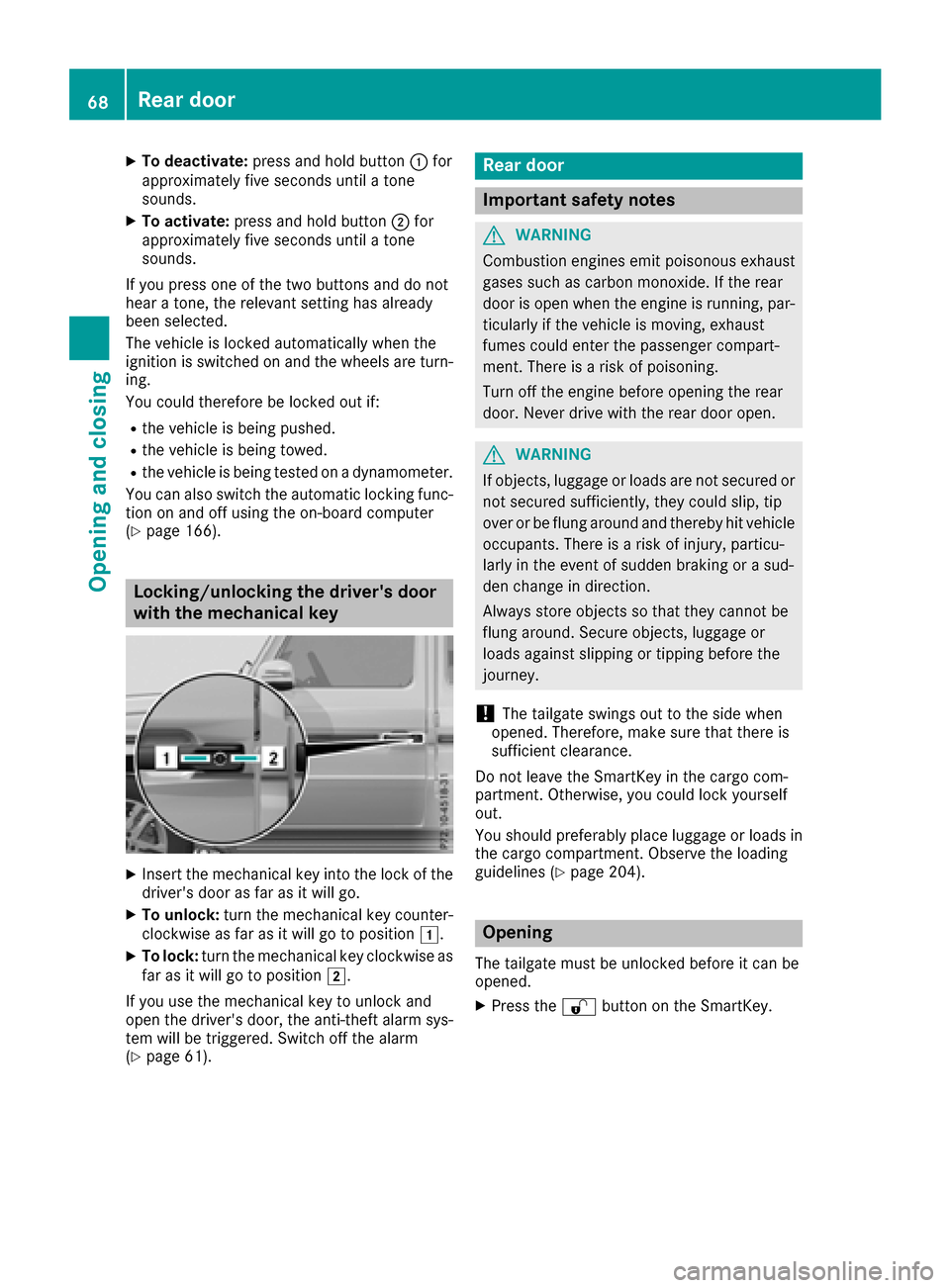
XTo deactivate:press and holdbutton :for
approximatelyf ives econds unti latone
sounds.
XTo activate: press and hol dbutton ;for
approximatelyf ives econds unti latone
sounds.
If yo upress one of the two buttons and do not
hea rat one, the relevant setting hasa lready
been selected.
The vehicl eislocked automaticall ywhent he
ignition is switched on and the wheels are turn-
ing.
Yo uc ould therefore be locked outi f:
Rthe vehicleisbeing pushed.
Rthe vehicl eisbeing towed.
Rthe vehicl eisbeing teste donadynamometer.
Yo uc an also switch the automatic locking func-
tio nona nd off using the on-board computer
(
Ypage 166).
Locking/unlockin gthe driver's door
with the mechanical key
XInsert the mechanical key into the lock of the driver's door as far as it will go.
XTo unlock: turn the mechanical key counter-
clockwise as far as it will go to position 1.
XTo lock:turn the mechanical key clockwise as
far as it will go to position 2.
If yo uusethe mechanical key to unlock and
open the driver's door, the anti-thef talarm sys-
tem will be triggered .Switch off the alarm
(
Ypage 61).
Rear door
Important safety notes
GWARNING
Combustio nengines emi tpoison ouse xhaust
gases such as carbo nmonoxide. If the rear
door is open when the engine is running ,par-
ticularly if the vehicl eismoving, exhaust
fumes could enter the passenger compart-
ment. There is ariskofp oisoning .
Turn off the engine before opening the rear
door. Never drive with the reard ooro pen.
GWARNING
If objects, luggage or load sare not secured or
not secured sufficiently ,they could slip ,tip
overorbef lung around and thereb yhitvehicle
occupants. There is ariskofi njury,p articu-
larly in the event of sudden braking or asud-
de nc hange in direction.
Alway sstoreo bjects so thatt hey cannotbe
flung around .Secure objects, luggage or
load sagain st slipping or tipping before the
journey.
!The tailgate swing soutto the side when
opened. Therefore, make sure thatt hereis
sufficient clearance.
Do not leave the SmartKey in the cargo com-
partment. Otherwise, yo ucould lock yourself
out.
Yo us houl dpreferabl yplace luggage or load sin
the cargo compartment. Observe the loading
guideline s(
Ypage 204).
Opening
The tailgate must be unlockedb efore it can be
opened.
XPress the %button on the SmartKey.
68Rear door
Opening and closing
Page 83 of 286
If somebodybecomes trapped:
Rpress one of the memory function position
buttons, or
Rpress one of the memory function memory
buttons, or
Rmove the switch for steering wheel adjust-
ment in the opposite direction to that in
which the steering wheel is moving
The adjustment process is stopped.
GWARNING
If you drive off whilet he EASY-ENTRY/EXIT
feature is making adjustments, you could lose
control of the vehicle.T here isarisk of an
accident.
Alway swaitu ntil the adjustment process is
complete before driving off.
!Do not activate the EASY-ENTRY/EXIT fea-
ture, if the seat backrest is reclined too far
backwards. This can damage the front or rear
seats. You must first move the backrest to a
vertical position.
The EASY-ENTRY/EXIT feature makes getting in
and out of you rvehicle easier.
You can activate and deactivate the EASY-
ENTRY/EXIT feature in the on-board computer
(
Ypage 166).
Position of the steering whee lwhen the
EASY-ENTRY/EXIT feature is active
The steering wheel moves upwards and towards
the dashboard if:
Ryou remove the SmartKey from the ignition
lock or
Ryou open the driver's door and the SmartKey
is in position 0or 1in the ignition lock
iThe steering wheel only moves upwards and
towards the dashboard if it has not already
reached the uppers teering limiter.
Position of the steering whee lfor driv-
ing
The steering wheel is moved to the last selected positionw hen:
Rthe driver's door is closed
Ryou insert the SmartKey into the ignition lock
The last positionoft he steering column is stored
when you switch off the ignition or when you
store the setting with the memory function
(
Ypage 83).
Mirrors
Rear-view mirror
XAdjust the rear-view mirror in such away that
you have agood view of road and traffic con-
ditions behind you.
Exteriorm irrors
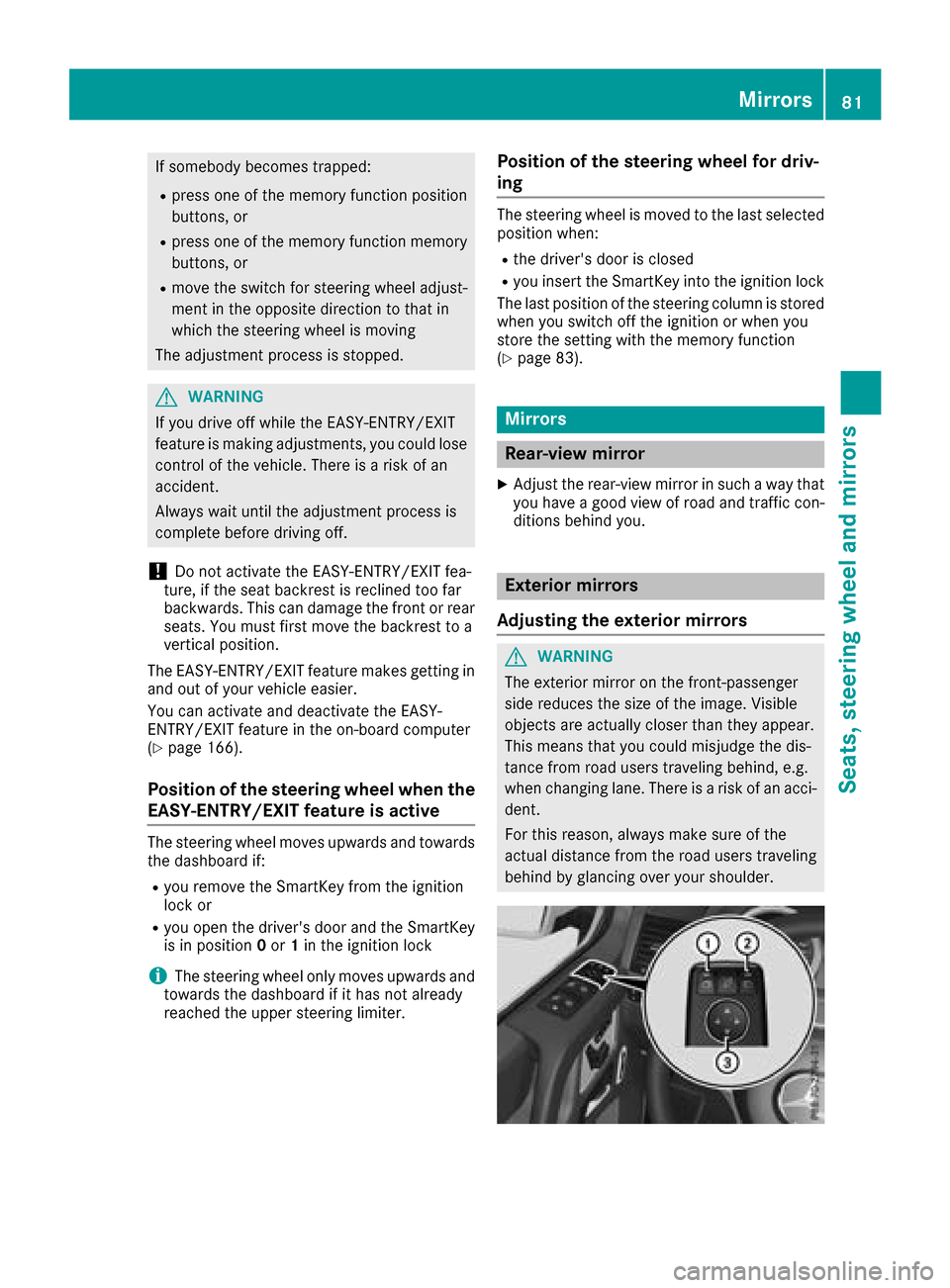
Adjusting the exterio rmirrors
GWARNING
The exterior mirror on the front-passenger
side reduces the size of the image.V isible
objects are actually closer than they appear.
This means that you could misjudge the dis-
tance from road users traveling behind, e.g.
when changing lane. There is arisk of an acci-
dent.
For this reason, always make sure of the
actual distance from the road users traveling
behind by glancing over you rshoulder.
Mirrors81
Seats, steeringw heel and mirrors
Z
Page 105 of 286
Notesonb reaking-in anew vehicle
Important safety notes
Thes ensors ystemofs omedriving and driving
safety systems adjusts automaticall ywhile a
certai ndistance is being driven after the vehicle
ha sb eend elivere dorafter repairs. Full system
effectiveness is not reachedu ntilthe end of this
teach-inp rocedure.
New and replaced brake pads and discs only
reach their optimum braking effect after several hundred kilometers of driving. Compensate for
thi sb yapplyin ggreate rforce to the brake pedal.
The first 1000 miles (150 0km)
Them orey ou look after the engine when it is
new ,the mor esatisfied yo uwillbew ithi ts per-
formance in the future.
RYo us houl dtherefore drive at varying vehicle
and engine speeds for the first 1,000 miles
(1,500 km).
RAvoi dheavy loads, e.g .driving at full throttle,
during thi speriod.
RWhen shifting gear smanually, shift up in good
time, befor ethe tachomete rneedl ereaches
Ô of the wa ytothe red area of the tachom-
ete rdisplay .
RDo not manuall yshift to alower gear to brake
the vehicle.
RTry to avoi ddepressing the accelerator pedal
beyond the pressure point (kickdown).
Additiona lbreaking-i nnote sfor Mercedes-AMG
vehicles:
RDo not drive fastert han85m ph (140km/h)
for the first 1,000 mile s(1,50 0km).
ROnlyb rieflyallow the engine to reach amax-
imum engine spee dof4,500 rpm.
RAvoiddriving off-roa dbefor et he first differ-
ential oi lchange at 2,000 mile s(3,000 km).
RIdeally ,for the first 1,000 mile s(1,50 0km),
drive in program C.
After 1,000 mile s(1,500 km), you can increase
the engine speedg radually and bring the vehicle
to ful lspeed.
You should also observe these notes on break-
i
ng in if the engine or parts of the drive train on
you rvehicle have beenr eplaced.
Always observe the maximu mpermissible
speed.
Axl edifferential transmission
(Mercedes-AMG vehicles)
Change the oil after abreaking-in period of
2,000 miles( 3,000 km) to improve protectiono f
the axle differential transmission.
This oil change prolongs the service life of the
axle differential transmission. Have the oil
change carrie dout at aqualified specialist work-
shop.
Driving
Important safety notes
GWARNING
Objects in the driver's footwell may restrict
the clearance around the pedal sorblock a
depressedp edal.This jeopardizes the oper-
ating and road safety of the vehicle. There is a risk of an accident.
Stow al lobjects securely in the vehicle so that
they do not get into the driver's footwell.
When using floormats or carpets, make sure
that they are properly secured so that they do not sliporo bstruct the pedals. Do not place
severalf loormats or carpets on top of one
another.
GWARNING
Unsuitabl efootwear can hinde rcorrect usage
of the pedals, e.g.:
Rshoesw ith thick soles
Rshoeswith high heels
Rslippers
There is arisk of an accident.
Wears uitablefootwear to ensure correct
usage of the pedals.
GWARNING
If you switch off the ignition while driving,
safety-relevant functions are only available
with limitations, or not at all. This coul daffect,
for example, the power steering and the brake
boosting effect. You wil lrequire considerably
more effort to steer and brake .There is arisk
of an accident.
Driving103
Driving and parking
Z
Page 114 of 286
Transmission positions
BPark position
Thisprevents the vehicl efromr olling
away when stopped.
Onlys hift the transmission into posi-
tion Pwhen the vehicl eisstationary
(
Ypage 110). The parkin gloc k
shoul dnot be used as abrake when
parking. Alway sapply the parking
brake in additio ntothe parkin gloc k
in order to secur ethe vehicle.
The SmartKeyc an onlyberemove dif
the transmission is in position P.
When there is no SmartKeyint he
ignition lock, the selecto rlev er is
locked in position P.
CRevers egear
Onlys hift the transmission into posi-
tion Rwhen the vehicl eisstationary.
A!Coasting in neutral imay
cause damage to the drive train.
Neutral
Do not shift the transmission to N
whil edriving. Otherwise, the auto-
matic transmission could be dam-
aged.
No powe ristransmitted fromt he
engine to the drive wheels.
Releasing the brakes will allo wyouto
mov ethe vehicl efreely, e.g .topush
it or tow it.
If ESP
®is deactivated or faulty and
the vehicl eisindangerofs kidding
e.g .oni cy roads :shift the transmis-
sion to position N.
If yo uengag ethe transferc ase, shift
briefl yinto N(
Ypage 146).
7Drive
The automatic transmission changes
gear automatically. All forward gears
ar ea vailable.
Changin ggear
The automatic transmission shifts to the indi-
vidua lgears automaticall ywhenitisint rans-
mission position D.T hisa utomatic gear shifting
behavio risdetermine dby:
Rashift range restriction, if selected
Rthe positio nofthe transferc ase( HIGH
RANGE orLO WR ANGE )
Rthe positio nofthe accelerator pedal
Rthe roa dspeed
Driving tips
Accelerator peda lposition
Your style of drivin ginfluences how the auto-
matic transmission shifts gear:
Rlittle throttle :early upshifts
Rmor ethrottle :lat eu pshifts
Kickdown
Use kickdow nfor maximum acceleration.
XDepres sthe accelerator peda lbeyond the
pressure point.
The automatic transmission shifts to alower
gear depending on the engine speed.
XEas eoff the accelerator peda lonce the
desired spee disreached.
The automatic transmission shifts back up.
Kickdown is not availabl einthe permanent man-
ua ld rive programonM ercedes-AMG vehicles.
Rockin gthe vehicle free
Rocking freebys hifting back and forth between
transmission positions Dand Rcan help to free
the vehicl eifitgetss tuck. The vehicle's engine
management system limits the spee dtoamax-
imu mof5m ph (9 km/h )whens hifting back and
forth.
Shifting back and forth between transmission
positions Dand R:
XMovethe selecto rlev er forwards or back-
wards past the point of resistance.
112Automati ctransmission
Driving an dparking
Page 115 of 286
Towingatrailer
XDriveint he middl eofthe engine spee drange
on uphill gradients.
XVehicle sexcept Mercedes ‑AMG vehicles:
limit the shift range to 3or 2depending on the
uphill or downhil lgradient (
Ypage 114).T his
also applie sifcruisecontrol, the spee dlim iter
or DISTRONICP LUSisa ctivated.
Mercedes ‑AM Gvehicles: shift down to shift
range 3or 2depending on the uphill or down-
hill gradient (
Ypage 114).T hisa lsoa pplies if
cruis econtrol, the spee dlim ite ro r
DISTRONICP LUSisa ctivated.
XShift the transferc asei nto low-rang edriving
position LOWR ANGE on extreme uphill gra-
dients or stee pdownhil lgradients
(
Ypage 146).
Program selecto rbutton
General notes
The programs electorbutton allows yo uto
choose between drive programs with different
drivin gcharacteristics.
On Mercedes-AMG vehicles, drive program Eis
calle ddrive program C.
The automatic transmission switches to auto-
matic drive program E(driv eprogram Cin
Mercedes-AMG vehicles) each time the engine
is started.
Onlyc hange froma utomatic drive program Cor
S to manua ldrive program Mwhen the vehicl eis
stationary.
Drive programs available forv ehicles
except Mercedes-AMG vehicles
E EconomyComfortable, economical
driving
S SportSporty drivin gstyle
MManualManua lgea rs hifting
Drive programs available for
Mercedes ‑AM Gvehicles
CControlled
EfficiencyComfortable, economical
driving
S SportSporty drivin gstyle
MManualManua lgea rs hifting
For furtheri nformationonthe automatic drive
program, see (Ypage 114).
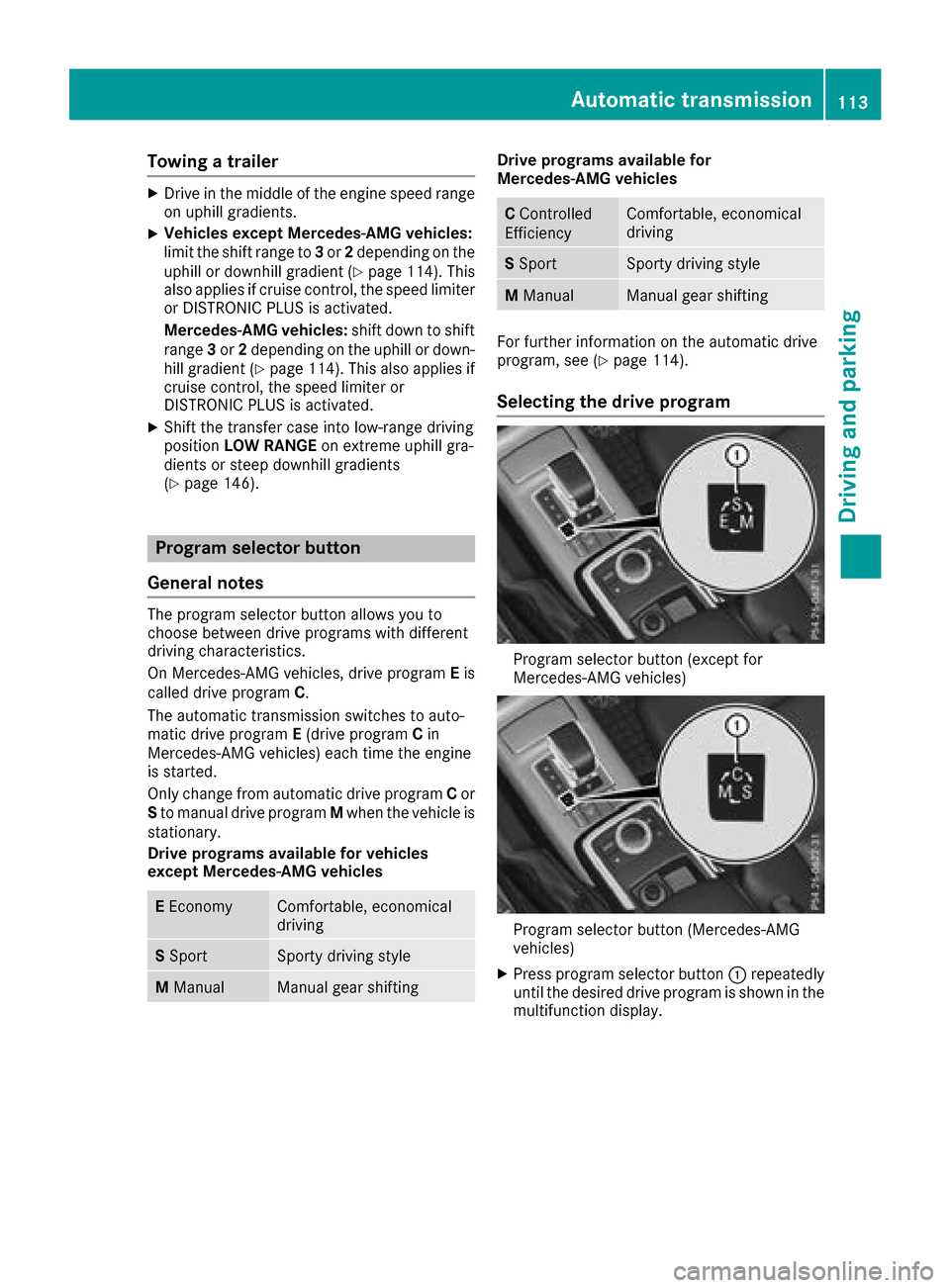
Selecting the driv eprogram
Programs electorbutton (excep tfor
Mercedes-AMG vehicles)
Programs electorbutton (Mercedes-AMG
vehicles)
XPress programs electorbutton :repeatedly
unti lthe desired drive programiss hown in the
multifunctio ndisplay .
Automati ctransmission113
Driving an dparking
Z
Page 123 of 286
To ensure that the vehicle is safeguarded
against rolling away unintentionally:
Rthe parking brake must be applied.
Rthe transmission must be in positionPand the
SmartKey must be removed from the ignition
lock
Rthe transfer case must not be in the neutral
position
Rthe front wheels must be turned towards the
curb on steep uphill or downhill gradients
Rthe empty vehicle must be secured at the
front axle with awheel chock or similar
object ,for example, on uphill or downhill gra-
dients
Ral aden vehicle must also be secured at the
rear axle with awheel chock or similar object,
for example, on uphill or downhill gradients
Switching off the engine
GWARNING
The automatic transmission switches to neu-
tral position Nwhen you switch off the engine.
The vehicle may roll away.T here isarisk of an
accident.
After switching off the engine, alwayss witch
to parking position P.Prevent the parked vehi-
cle from rolling away by applying the parking
brake.
XShift the automatic transmission to position
P.
XTurn the SmartKey to position 0in the ignition
lock and remove it.
The immobilizer is activated.
XApply the parking brake firmly.
XTurn the steerin gwheel until the steering
wheel lock engages.
If you switch the engine off with the transmis-
sion in position Ror D,t he automatic transmis-
sion shifts to Nautomatically.
If you then open the driver's door or the front-
passenger door or remove the SmartKey from
the ignition ,the automatic transmission shifts
to Pautomatically.
If you switch off the engine while the transmis-
sion is in position N,t he automatic transmission
remains in Neven if adoor is opened. The auto-
matic transmission only automatically shifts into neutral
Nwhen you switch off the engine
using the SmartKey.
Parking brake
GWARNING
If you must brake the vehicle with the parking brake, the braking distance is considerably
longer and the wheels could lock. There is an
increased danger of skidding and accidents.
Only use the parking brake to brake the vehi-
cle when the service brake is faulty. Do not
apply the parking brake too firmly. If the
wheels lock, release the parking brake until
the wheels begin turnin gagain.
GWARNING
If you leave children unsupervised in the vehi-
cle, they could set it in motion by, for example:
Rrelease the parking brake.
Rshift the automatic transmission out of the
parking position P.
Rstart the engine.
In addition, they may operate vehicle equip-
ment and become trapped. There is arisk of
an accident and injury.
When leaving the vehicle, alwayst ake the
SmartKey with you and lock the vehicle. Never
leave children unsupervised in the vehicle.
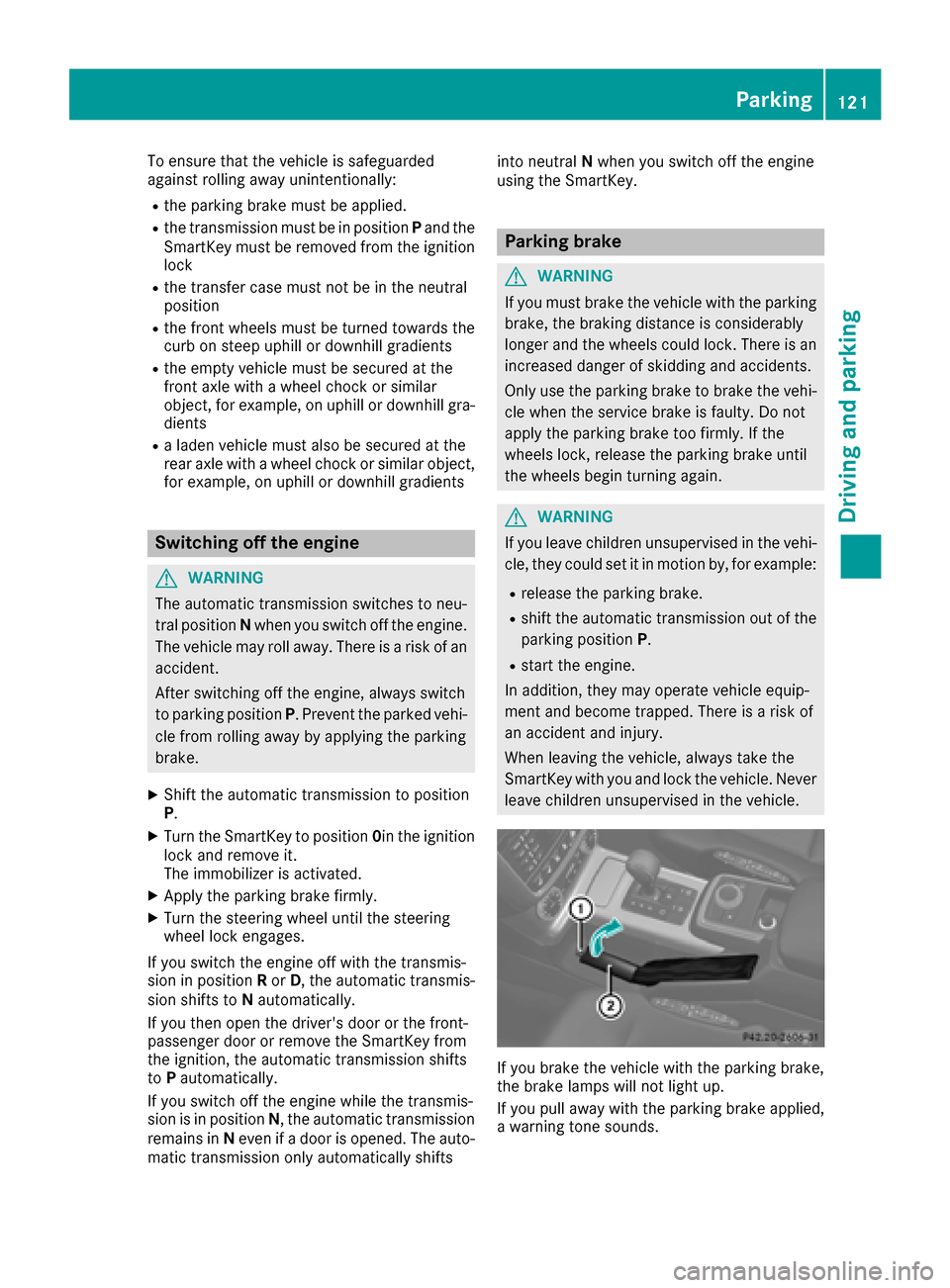
If you brake the vehicle with the parking brake,
the brake lamps will not light up.
If you pull away with the parking brake applied,
aw arning ton esounds.
Parking121
Driving and parking
Z