traction control MERCEDES-BENZ G-Class 2017 W463 Owner's Manual
[x] Cancel search | Manufacturer: MERCEDES-BENZ, Model Year: 2017, Model line: G-Class, Model: MERCEDES-BENZ G-Class 2017 W463Pages: 286, PDF Size: 4.91 MB
Page 6 of 286
1, 2,3...
4ETS (Electronic Traction System)
see ETS/4ETS (Electronic Trac-
tion System)
12 Vsocket
see Socket (12 V)
115 Vsocket ...................................... 213
A
ABS (Anti-lock Braking System)
Display message ............................ 171
Function/notes ................................ 57
Warnin glamp ........................ 190,1 91
Accident
Automatic measures after an acci-
dent .................................................4 9
Activatin gmedia mode
General note s............................... .203
ADAPTIVE BRAKE ................................ .61
Additives (engineo il)........................ 279
Addres sbook
see also Dig ital Operator's Man-
ual .................................................. 198
Adjustabl edampi ng.......................... 109
Adjusting th evolume
COMAND ...................................... .199
Ai rb ags
Deployment ..................................... 46
Display message ............................ 175
Front ai rbag (driver, front
passenger). ...................................... 45
Important safety notes .................... 43
Introduction ..................................... 43
PASSENGER AIR BAG OFF indica-
tor lamp ...........................................3 9
Pelvis air bag ................................... 45
Side impact air bag .......................... 45
Window curtain air bag .................... 46
Air vents
Important safety notes .................. 101
Rear .................. ............................. 102
Set
ting ...........................................1 01
Setting the center ai rvents ........... 102
Setting the sidea irvents ...............1 02
Air-conditionings ystem
see Climate control Alarm
ATA (Anti-Theft Alarm system) ......... 61
Switching off (ATA) .......................... 61
Switching the function on/off
(ATA) ................................................ 61
Alarm system
see ATA (Anti-Theft Alarm system)
All-whee ldrive
Transfe rcase ................................. 145
AMG menu (on-board computer) ..... 167
Anti-theft alarm system
see ATA (Anti-Theft Alarm system)
Approach/departure angle .............. 130
Ashtray ............................................... 211
Assistanced isplay (on-board com-
puter) ..................................................1 64
Assistancem enu (on-board com-
puter) ..................................................1 64
ASSYST service interval display
Service messages .......................... 230
ATA (Anti-Theft Alarm system)
Activating/deactivating ................... 61
Function ...........................................6 1
Switching off the alarm .................... 61
Authorized Mercedes-Benz Center
see Qualifie dspecialist workshop
AUTO lights
Displa ymessage ............................ 176
see Lights
Automatic car was h(care) ............... 231
Automatic engine start (ECO start/
stopf unction) .................................... 107
Automatic engine switch-of f(EC O
start/stopf unction).......................... 106
Automatic headlamp mode ................ 86
Automatic transmission
Displa ymessage ............................ 186
Drive position (ECOs tart/stop
function) ........................................ 111
Drive program. ............................... 114
Driving tip s.................................... 112
Emergency running mode. ............. 117
Engaging drive position .................. 111
Engaging neutral ............................ 111
Engaging reverse gea r................... 110
Engaging the park p
osition ............ 110
Important safety notes .................. 109
4Index
Page 62 of 286
It may be best to deactivate ESP®in the follow-
ing situations:
Rwhen using snow chains
Rin deep snow
Ron sand or gravel
Roff-road
Spinning the wheelsr esults inacutting action
which providesb etter grip.
Activate ESP
®as soon as the situations descri-
bed above no longer apply. ESP®willo therwise
not be abletos tabilize the vehicle if the vehicle
starts to skid or awheel starts to spin.
!Avoid spinning the driven wheelsf or an
extended period with ESP®deactivated. You
could otherwise damage the drivetrain.
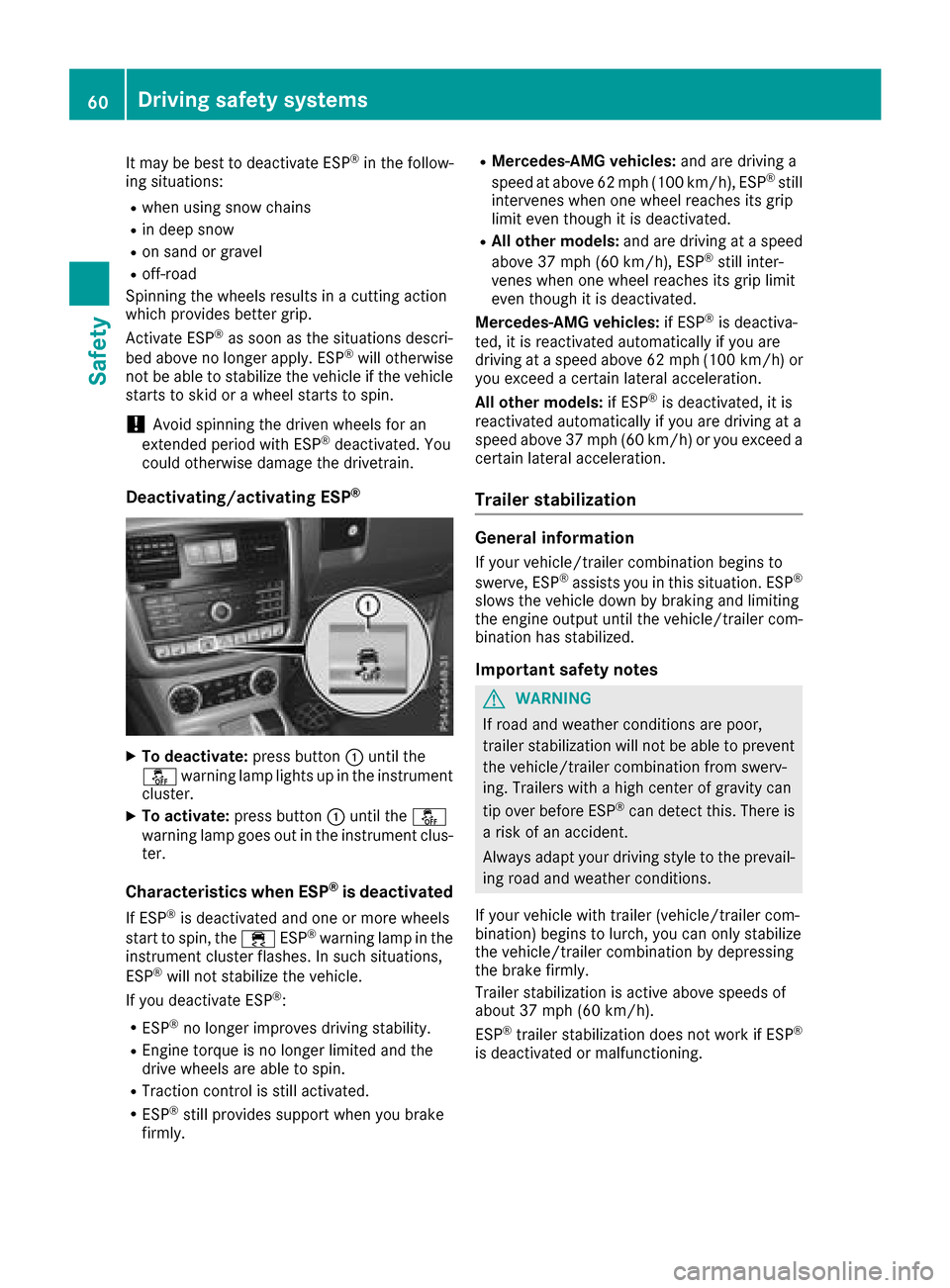
Deactivating/activating ESP®
XTo deactivate: press button:until the
å warning lamp lights up in the instrument
cluster.
XTo activate: press button :until the å
warning lamp goes out in the instrument clus-
ter.
Characteristic swhen ESP®is deactivated
If ESP®is deactivated and one or more wheels
start to spin, the ÷ESP®warning lamp in the
instrument cluster flashes. In such situations,
ESP
®willn ot stabilize the vehicle.
If you deactivate ESP®:
RESP®no longer improves driving stability.
REngine torque is no longer limited and the
drive wheelsa re abletospin.
RTraction control is still activated.
RESP®still providess upport when you brake
firmly.
RMercedes-AMG vehicles: and are driving a
speed at above 62 mph (100 km/h), ESP®still
intervenes when one wheel reaches its grip
limite ven though it is deactivated.
RAll other models: and are driving ataspeed
above 37 mph (60 km/h), ESP®still inter-
venes when one wheel reaches its grip limit
even though it is deactivated.
Mercedes-AMG vehicles: if ESP
®is deactiva-
ted, it is reactivated automatically if you are
driving at aspeed above 62 mph (100 km/h )or
you exceed acertain laterala cceleration.
All other models: if ESP
®is deactivated, it is
reactivated automatically if you are driving at a
speed above 37 mph (60 km/h) or you exceed a certain laterala cceleration.
Trailer stabilization
General information
If yourvehicle/trailer combination begins to
swerve, ESP®assists you in this situation. ESP®
slowst he vehicle down by braking and limiting
the engine outputu ntil the vehicle/trailer com-
bination has stabilized.
Important safety notes
GWARNING
If road and weather conditions are poor,
trailers tabilization willn ot be abletoprevent
the vehicle/trailer combination from swerv-
ing. Trailers with ahigh center of gravity can
tip over before ESP
®can detect this. There is
ar isk of an accident.
Alway sadapt you rdriving style to the prevail-
ing road and weather conditions.
If you rvehicle with trailer( vehicle/trailercom-
bination) begins to lurch, you can only stabilize
the vehicle/trailer combination by depressing
the brake firmly.
Trailer stabilization is active above speedso f
about3 7mph (60 km/h).
ESP
®trailer stabilization does not work if ESP®
is deactivated or malfunctioning.
60Driving safety systems
Safety
Page 125 of 286
Fuelconsumptio nalsoi ncreases whe ndriving in
cold weather, in stop-start traffi cand in hilly ter-
rain.
Drinking and driving
GWARNING
Drinking and driving and/o rtaking drugs and
driving are very dangerous combinations.
Even asmall amount of alcoholord rugs can
affect your reflexes,p erceptions and judg-
ment.
The possibility of aseriousore ven fatalacci-
dent is greatly increased whe nyou drink or
take drugs and drive.
Do not drink or take drugs and drive or allow
anyone to drive who has bee ndrinking or tak-
ing drugs.
Emissionc ontrol
GWARNING
Combustio nengines emitp oisonousexhaust
gases such as carbon monoxide. Inhaling
these exhaust gases leads to poisoning. There
is ar isk of fata linjury. Therefore never leave
the engine running in enclosed spaces with-
outs ufficient ventilation.
Certai nengine systems are designe dtokeep
the level of poisonousc omponents in exhaust
fume swithin legal limits.
These systems only wor katpeakefficiency if
they are serviced exactl yinaccordance with the
manufacturer's specifications. Alway shave
wor kont he engine carried outata qualified
specialist workshop.M ercedes-Benz recom-
mends that yo uuse an authorized Mercedes-
Benz Center for this purpose. In particular, work
relevant to safety or on safety-related systems
mus tbec arried outata qualified specialist
workshop.
The engine setting smustn ot be changed under
any circumstances. Furthermore,a llspecific
service wor kmustb ec arried outatr egular
intervals and in accordance with the Mercedes-
Benz service requirements. You can obtain cur-
rent information concerning the servicing of
your vehicle at any time from aquali fied spe-
cialist workshop.T hiscould be an overvie wof the maintenance wor
korany additional main-
tenance work, for example.
Brakes
Important safety notes
GWARNING
If yo ushift downonaslippery roads urface in
an attemp ttoincrease the engine's braking
effect, the drive wheels could los etheirg rip.
There is an increased danger of skidding and
accidents.
Do not shift downf or additional engine brak-
ing on aslippery roads urface.
GWARNING
If yo uselect the LOW RANG Eoff-roadg earon
as lippery roads urface,the wheels could lose
traction:
Rif yo uremove your foot from the accelera-
tor pedal whe ndriving
Rif off roadA BS intervenes whe nbraking
If the wheels los etraction. the vehicle can no
longer be steered. There is an increased dan-
ger of skidding and accidents.
Nevers elect the LOW RANG Eoff-roadg ear
whe ndriving on slippery roads urfaces.
Information on the parking brake (
Ypage 121).
Downhillg radients
!On long and steep gradients, yo umust
reduce the loa donthe brakes by shifting to a
lower gearing oodtime. Thisa llow syou to
take advantage of the engine's braking effect.
Thish elps yo utoavoid overheating the
brakes and wearing them oute xcessively.
Wheny outake advantage of engine braking, a
drive wheel may not turn for some time, e.g.
on aslippery roads urface.Thisc ould cause
damag etothe drive train. Thist ypeofd amage
is not covered by the Mercedes-Benz war-
ranty.
Thisa lsoa pplies if cruise control or DISTRONIC
PLUS is activated.
Drivin gtips123
Drivin gand parking
Z
Page 128 of 286
erwise, water may enter the vehicle interior or
the engine compartment.This can damage
the electronic component sinthe engine or
the automatic transmission. Water can also
be drawn in by the engine' sair suction nozzles
and this can cause engine damage.
If you have to drive on stretches of road on which
water has collected, please bear in mind that:
Rin the case of standin gwater, the water level
must be no higher than the lower edge of the
vehicle body
Ryou should drive no faster than walking pace
Off-road fording
!Under no circumstances should you accel-
erate before entering the water. The bow
wave could cause water to enter and damage
the engine and other assemblies.
!Do not open any of the vehicle's doors while
fording. Otherwise, water could get into the
vehicle interior and damage the vehicle's
electronics and interior equipment.
iYou may only drive through fresh water.
RObserve the safety notes (Ypage 127) and
general notes (Ypage 127) on driving off-
road.
REstablish how deep the water is and the char-
acteristics of the body of water before ford-
ing.
RSwitc hoff automatic climate control
RShift the transfer case to the off-road driving
position LOW RANGE (Ypage 145).
REngage the differential locks if necessary
(Ypage 148).
RAvoid high engine speeds.
REnter and exit the water at aflat place and at
as teady walking pace.
RDrive slowly and at an even speed through the
water.
REnsure that abow wave does not form as you
drive.
RDo not stop and do not switch off the engine.
Water offers ahigh degree of resistance, and
the ground is slippery and in some cases
unstable. Therefore, it is difficult and danger-
ous to pull away in water.
RClean any mud from the tire tread after ford-
ing.
RApply the brakes to dry them after fording. Always observe the fordingd
epth values
(
Ypage 283).
Winter driving
GWARNING
If you shift down on aslippery road surface in
an attempt to increase the engine' sbraking
effect, the drive wheels could lose their grip.
There is an increased danger of skidding and
accidents.
Do not shift down for additional engine brak-
ing on aslippery road surface.
GWARNING
If you select the LOW RANGE off-road gear on
as lippery road surface, the wheels could lose
traction:
Rif you remove your foot from the accelera-
tor pedal when driving
Rif off road ABS intervenes when braking
If the wheels lose traction .the vehicle can no
longer be steered. There is an increased dan-
ger of skidding and accidents.
Never select the LOW RANGE off-road gear
when driving on slippery road surfaces.
Have your vehicle winter-proofed at aqualified
specialist workshop at the onset of winter.
Drive particularly carefully on slippery road sur-
faces. Avoid sudden acceleration, steerin gand
braking maneuvers. Do not use cruise control or DISTRONIC PLUS.
If the vehicle threatens to skid or cannot be
stopped when moving at low speed:
XShift the automatic transmission to position
N .
The outside temperature indicator is not
designed to serve as an ice-warning device and is therefore unsuitable for that purpose.
Changes in the outside temperature are dis-
played after ashort delay.
Indicated temperatures just above the freezing
point do not guarantee that the road surface is
free of ice. The road may still be icy, especially in
wooded areas or on bridges. The vehicle could
skid if you fail to adapt your driving style. Always
126Driving tips
Driving and parking
Page 133 of 286
sufficient, brake gently. When doing so, make
sure that the vehicle is facing in the direction
of the line of fall.
RObserve the notes on driving in mountainous
terrain (Ypage 130).
RCheck that the service brake is working nor-
mally after along downhill stretch.
When driving at speeds below 37 mph
(60 km/h), off-road ABS is activated and the
front wheels lock cyclically during braking. The
digging-in effect achieved in the process
reduces the stopping distance on off-road ter-
rain. This limits steering capability.
Driving systems
Cruise control
General notes
Cruise control maintains aconstant road speed
for you. It brakes automatically in order to avoid
exceeding the set speed. Change into alower
gear in good time on long and steep downhill
gradients.
This is especiallyi mportant if the vehicle is
laden. By doing so, you will make use of the
braking effect of the engine. This relieves the
load on the brake system and prevents the
brakes from overheating and wearing too
quickly.
Use cruise control only if road and traffic con-
ditions make it appropriate to maintain asteady
speed for aprolonged period. You can store any
road speed above 20 mph (30 km/h).
Do not activate cruise control on off-road jour-
neys.
Important safety notes
Cruise control can neither reduce the risk of an
accident if you fail to adapty our driving style nor
override the laws of physics. Cruise control can-
not take into account the road, traffic and
weather conditions. Cruise control is only an
aid. You are responsible for maintaining asafe
distance to the vehicle in front,f or vehicle
speed, for braking in good time and for staying in
lane.
Do not use cruise control:
Rin road and traffic conditions that do not allow
you to maintain aconstant speed, e.g. in heavy traffic, on winding roads or on rough
terrain
Ron slippery road surfaces. Braking or accel-
erating could cause the drive wheels to lose
traction and the vehicle could then skid
Rin poor visibility, e.g. due to fog, heavy rain or
snow
If there is achange of drivers, advise the new
driver of the speed stored.
iThe speed indicated in the speedometer
may differ slightly from the speed stored.
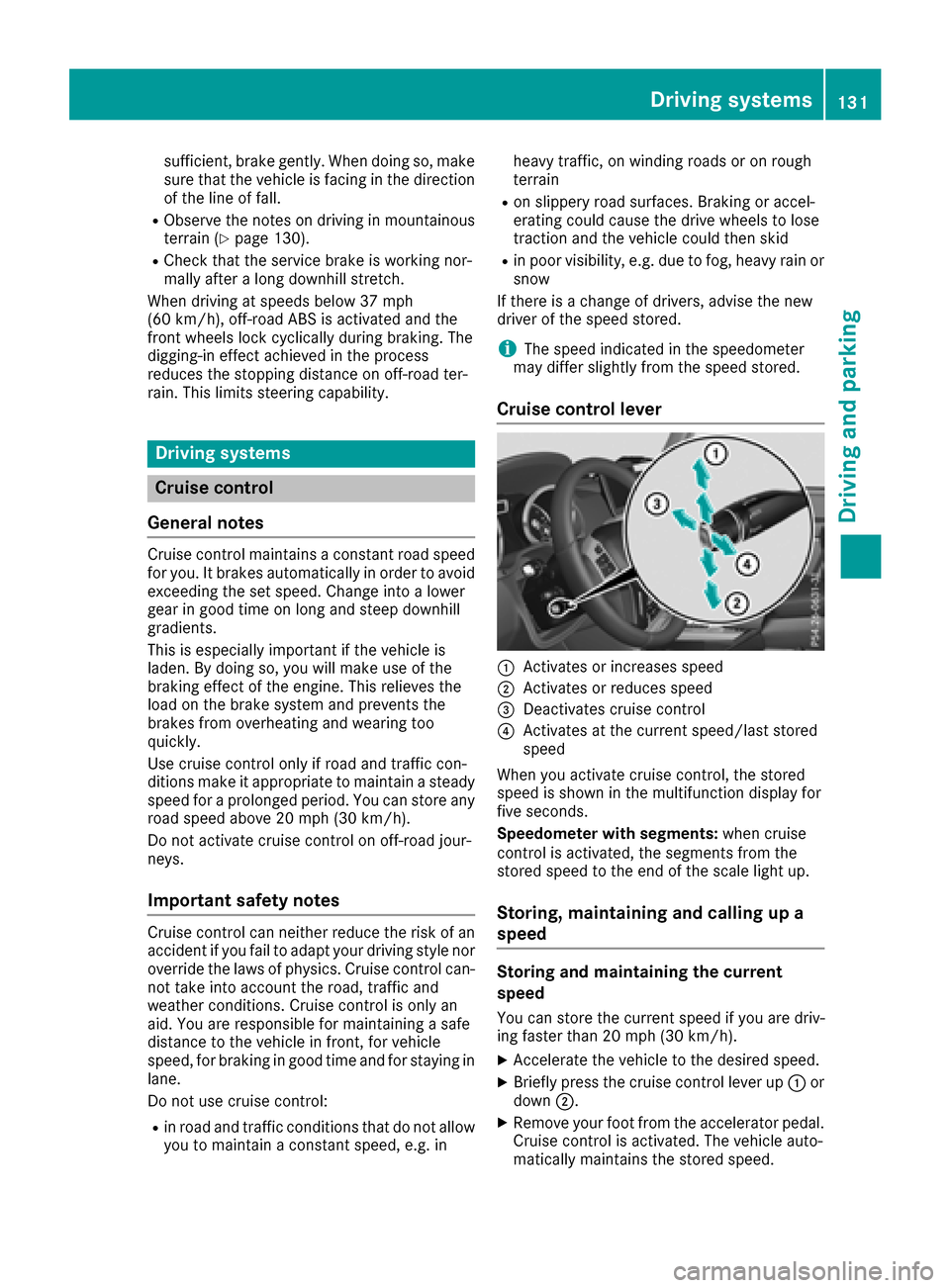
Cruise control lever
:Activates or increases speed
;Activates or reduces speed
=Deactivates cruise control
?Activates at the current speed/last stored
speed
When you activate cruise control, the stored
speed is shown in the multifunction displayf or
five seconds.
Speedometer with segments: when cruise
control is activated, the segments from the
stored speed to the end of the scale light up.
Storing, maintaining and callingupa
speed
Storing and maintaining the current
speed
You can store the current speed if you are driv-
ing faster than 20 mph (30 km/h).
XAccelerate the vehicle to the desired speed.
XBriefly press the cruise control lever up :or
down ;.
XRemove your foot from the accelerator pedal.
Cruise control is activated. The vehicle auto-
matically maintains the stored speed.
Driving systems131
Driving and parking
Z
Page 149 of 286
If the shifting procedure is unsuccessful, the
multifunction display may show the following
messages:
RTC Shift Conditions Not Fulfilled
You have not met one or more shift condi-
tions.
RTC NEUTRAL On
The transfer case has canceled the shifting
procedure and is in positionN.
RTC Shift Canceled
The transfer case has canceled the gear
change process.
XCarry out the gear change process again.
Make sure to meet all conditions for changing
gears.
RTC Malfunction Visit Workshop
There is amalfunction in the transfer case.
XDo not shift the transfer case.
XHave the vehicle checked as soon as possible
ataq ualifieds pecialist workshop.
Shifting to neutral
GWARNING
If you do not wai tfor the transfer case gear
change process to complete, the transfer
case could remain in the neutral position. The powert ransmission to the driven wheelsi s
then interrupted. There is adanger of the
vehicle rolling awa yunintentionally .There is a
risk of an accident.
Waitu ntil the transfer case shift process is
completed.
XTurn the SmartKey to position 2in the ignition
lock.
XApply the parking brake.
XDepress the brake pedal.
XShift the automatic transmission to position
N.
XPress and hold LOW RANGE button ;for
approximately ten seconds.
When the shift procedure is complete, the
multifunction display shows the TC
NEUTRALOnmessagefor five seconds.
If the shifting procedure is unsuccessful, the
multifunction display may show the following
messages (
Ypage 179). If the transfer case is in
Neutral,the SmartKey
is in the ignition lock and you open the driver's
door, the TC NEUTRAL On
messagea ppears in
the multifunction display. If you then release the
parking brake, awarning tone wills ound.
Differential locks
General notes
GWARNING
When the differentiall ocks are engaged,ABS,
4ETS, ESP
®and BAS are deactivated. As a
result, the wheelsc ould lock when braking
and the braking distance is increased.T here is
ar isk of an accident.
Disengage the differentiall ocks immediately
on firm surfaces with good grip.
!In order to avoid damage to the transfer
case, you must operate the vehicle on adyna-
mometer (1-axle dynamometer) only if:
Rthe axle not driven on is jacked up
or
Rthe corresponding propeller shaft is dis-
connected and the transfer case differen-
tial lock is engaged.
Otherwise,t he transfer case can be damaged.
Differential locks improve the traction of the
vehicle.
Your vehicle is equipped with adifferentiall ock
each for:
Rthe transfer case: this controls the balance
betweent he front and rear axles.
Rthe rear axle: this controls the balance
betweenthe wheelsont he rear axle.
Rthe front axle: this controls the balance
betweenthe wheelsont he front axle.
Information on differential gear system
and differential lock
When the vehicle drives around acurve, the
wheelsont he outsideoft he curve must cover a
greater distance. Therefore, the wheelst urn
more rapidly than on the inside. The differential,
ag ear system in the drive train, allows for dif-
fering rotational speedsa nd facilitates corner-
ing.
Off-road driving systems147
Driving and parking
Z
Page 150 of 286
The disadvantage ofadifferential is that the
wheels that have the least grip, get the most
drive. An example: awheel of adriven axle is on
as now-covered surface and therefor edoes not
have any traction. The differential sends most of
the drive force to this wheel because the force
takes the route of the lowest resistance. The
opposite wheel on this axle, however, which
stands on firm ground and could therefor eallow
propulsion, receives no driving power. 4ETS
compensates for this disadvantage. 4ETS pro-
vides good steerability by automatically braking
the spinnin gwheel. 4ETS provides the wheel on
the firm surface with more drive force, which in
turn provides propulsion.
ESP
®and 4ETS are traction systems that are
ideal for road driving and suitable for light off-
road driving. The LOW RANGEoff-road gear
also improves off-road capability.
More challenging off-road conditions require
additional measures such as lockingo ne or
more differential.
Your vehicle is equipped with three differential
locks:
Rfor the transfer case
Rfor the front axle
Rfor the rear axle
Each differential lock can be engaged with the
corresponding switch on the center console. If
the differential in the transfer case is locked, the
front and rear wheels rotateatt he same speed.
If the differential for the rear axle is locked, both
rear wheels rotateatt he same speed, regard-
less of their respective torque. Note, engaging
the differential lock greatly impairs the vehicle's
steerability.
Note, it is imperative to use the differential func-
tion when driving on firm road surfaces. Under
no circumstances should the differential be
locked when driving on firm road surfaces. Oth-
erwise, the vehicle may not be steerable and you
could lose control of the vehicle. Therefore, only
engage the differential lock when driving off-
road. You should only engage the differential
lock if activatin g4ETS and ESP
®driving systems
and LOW RANGE off-road gear prove to be
insufficient.
Engaging the differential locks
General notes
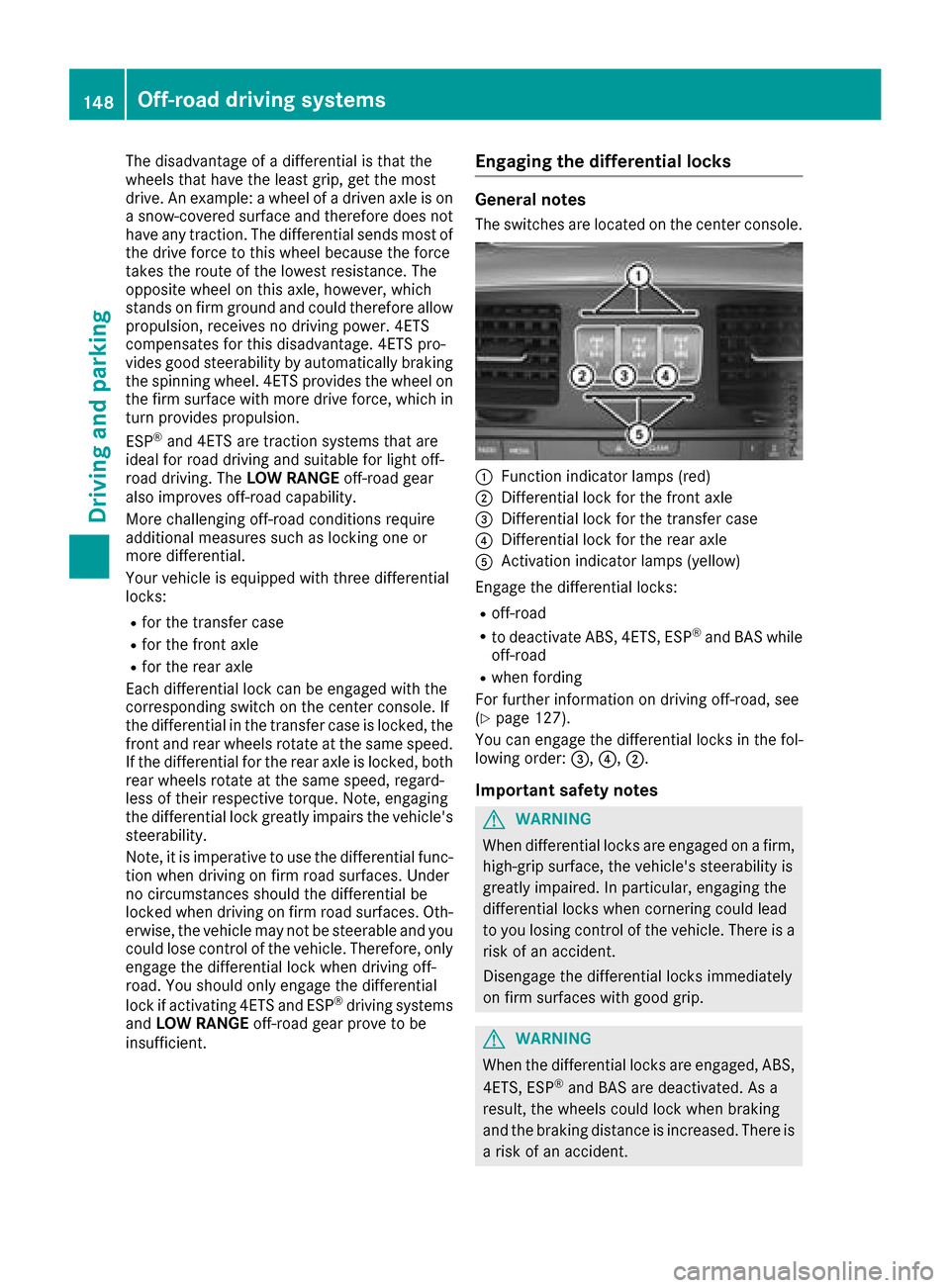
The switches are located on the center console.
:Function indicator lamps (red)
;Differential lock for the front axle
=Differential lock for the transfer case
?Differential lock for the rear axle
AActivation indicator lamps (yellow)
Engage the differential locks:
Roff-road
Rto deactivate ABS,4 ETS,ESP®and BAS while
off-road
Rwhen fording
For further information on driving off-road, see
(
Ypage 127).
You can engage the differential locks in the fol-
lowing order: =,?,;.
Important safety notes
GWARNING
When differential locks are engaged on afirm,
high-grip surface, the vehicle's steerability is
greatly impaired. In particular, engaging the
differential locks when cornering could lead
to you losing control of the vehicle. There is a risk of an accident.
Disengage the differential locks immediately
on firm surfaces with good grip.
GWARNING
When the differential locks are engaged, ABS, 4ETS ,ESP
®and BAS are deactivated. As a
result, the wheels could lock when braking
and the braking distance is increased. There is
ar isk of an accident.
148Off-road driving systems
Driving and parking
Page 187 of 286
Display messagesPossible causes/consequences andMSolutions
h
TirePressure Warn‐ing,TireM alfunc‐tion
The tire pressur einoneor mor etires has dropped suddenly. The whee l
position is shown on th emultifunction display.
Aw arning tone also sounds.
GWARNIN G
Drivin gwithaf lat tire poses ariskoft hefollowin ghazards :
Raflat tire affects th eabilit ytos teer or brak ethe vehicl e
Ryou could lose control of th evehicl e
Rcontinued drivin gwithaf lat tire will caus eexces sive heat build-up
and possibl yafire
There is ariskofana ccident.
XStop thevehicl ewithout making any sudden steering or braking
maneuvers .Pay attention to th etraffic condition sasyou do so.
XSecur ethe vehicl eagainst rollin gaway (Ypage 120).
XIf there is aflat tire, inspec tthe tires (Ypage 240).
h
Check Tir ePressure
The tire pressur einoneor mor etires has dropped significantly. The
whee lposition is shown on th emultifunction display.
Aw arning tone also sounds.
GWARNIN G
Tir ep ressures that are to olow pos ethe followin ghazards :
Rthey may burst, especially as th eload and vehicl espeed increase.
Rthey may wear excessivel yand/o runevenly, whic hmay greatl y
impair tire traction .
Rthed rivin gcharacteristics ,aswell as steering and braking ,may be
greatl yimpaire d
There is ariskofana ccident.
XStop thevehicl ewithout making any sudden steering or braking
maneuvers .Pay attention to th etraffic condition sasyou do so.
XSecur ethe vehicl eagainst rollin gaway (Ypage 120).
XIf there is aflat tire, inspec tthe tires (Ypage 240).
XChec kthe tire pressur e(Ypage 257).
XIf necessary, correc tthe tire pressure.
h
PleaseCorrec tTirePressure
The tire pressur eistoolow in at least on eofthetires ,ort hetire
pressur edifference between th ewheels is to ogreat.
XChec kthe tire pressures at th enexto pportunity (Ypage 257).
XIf necessary, correc tthe tire pressure.
Display messages185
On-boardc omputer andd isplays
Z
Page 193 of 286
Warning/
indicator
lampNSignal type
Possiblec auses/consequences and M
Solutions
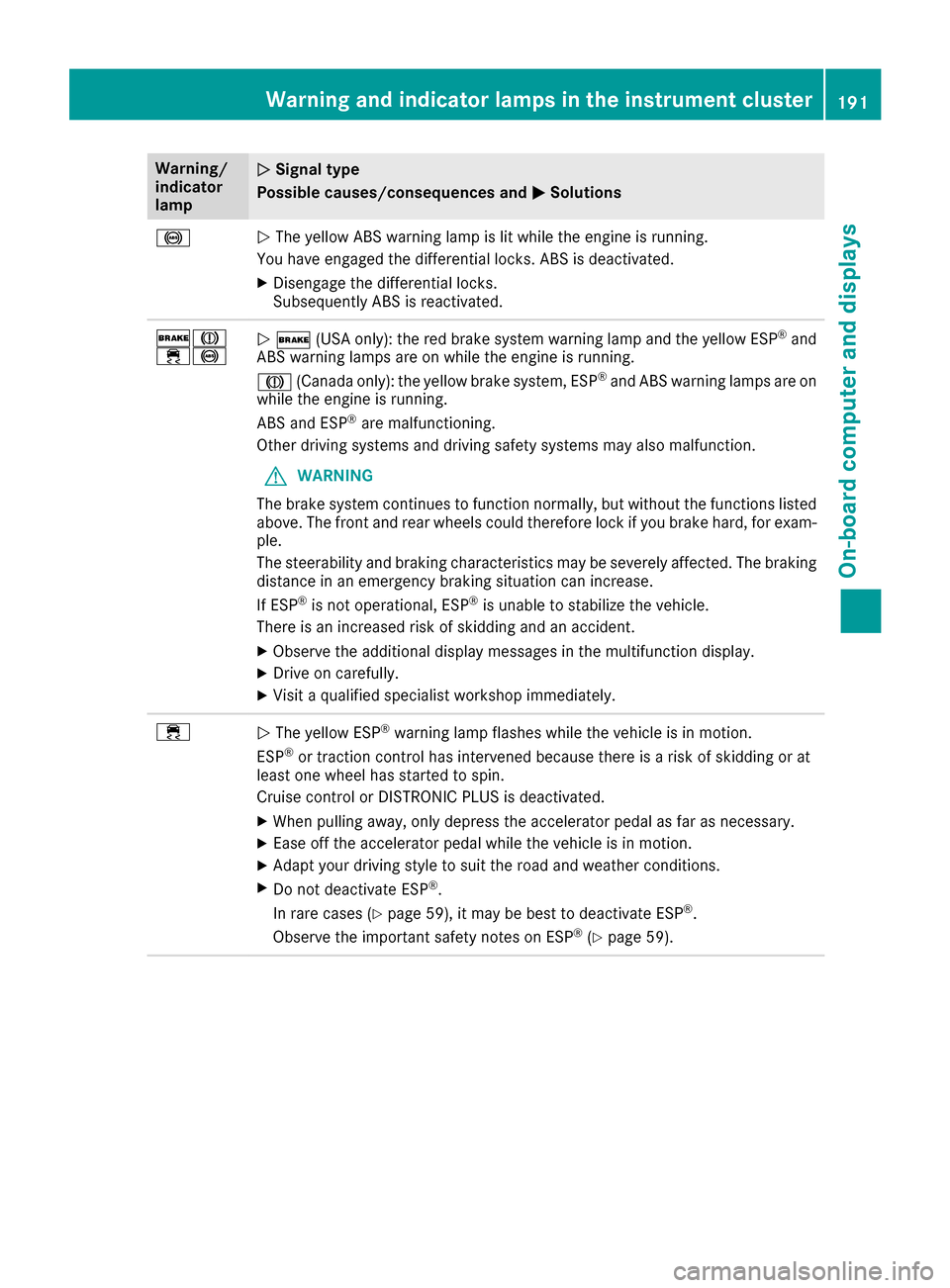
!NThe yellow ABS warning lamp is lit while the engine is running.
You have engaged the differential locks. ABS is deactivated.
XDisengage the differential locks.
Subsequently ABS is reactivated.
$J
÷!N $ (USA only): the red brake system warning lamp and the yellow ESP®and
ABS warning lamp sare on while the engine is running.
J (Canada only): the yellow brake system, ESP
®and ABS warning lamp sare on
while the engine is running.
ABS and ESP
®are malfunctioning.
Other driving systems and driving safety systems may als omalfunction.
GWARNING
The brake system continues to function normally, but without the functions listed
above. The front and rear wheels coul dtherefore lock if you brake hard ,for exam-
ple.
The steerability and braking characteristics may be severely affected. The braking
distance in an emergency braking situation can increase.
If ESP
®is not operational ,ESP®is unable to stabilize the vehicle.
There is an increased risk of skidding and an accident.
XObserve the additionald isplay messages in the multifunction display.
XDrive on carefully.
XVisitaqualified specialist workshopi mmediately.
÷NThe yellow ESP®warning lamp flashes while the vehicleisinm otion.
ESP®or traction control has intervened because there is arisk of skidding or at
least one wheelh as started to spin.
Cruise control or DISTRONIC PLUS is deactivated.
XWhen pulling away, only depress the accelerator pedalasf ar as necessary.
XEase off the accelerator pedalwhile the vehicleisinmotion.
XAdapt yourdriving style to sui tthe road and weather conditions.
XDo not deactivate ESP®.
In rare cases (
Ypage5 9), it may be best to deactivate ESP®.
Observe the important safety notes on ESP®(Ypage5 9).
Warning and indicator lamps in the instrument cluster191
On-board computer and displays
Z
Page 255 of 286
Drivingwiths ummer tires
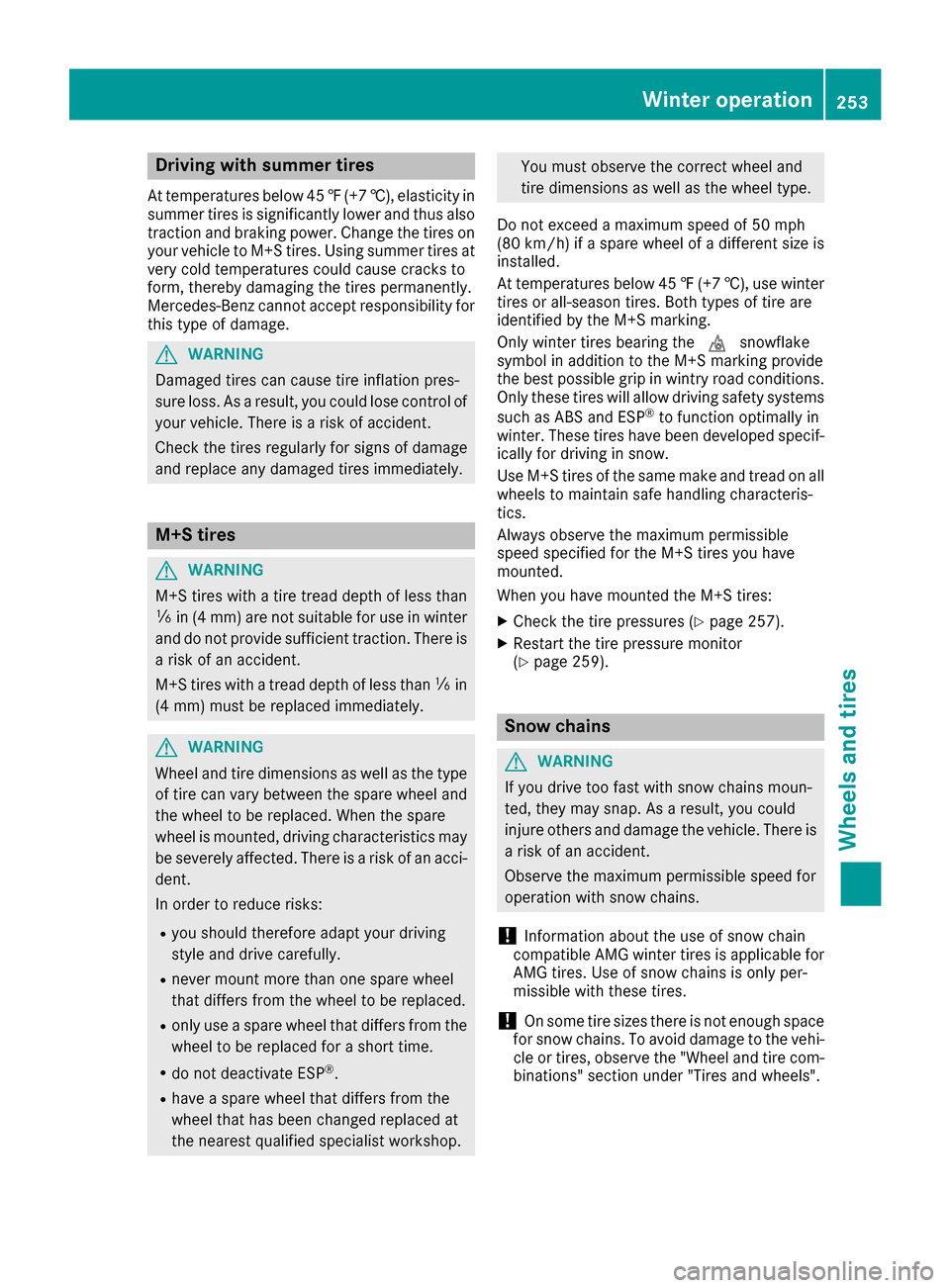
At temperature sbelo w45‡( +7 †), elasticity in
summe rtires is significantly lower and thus also
traction and braking power. Change the tires on
you rvehicle to M+S tires .Using summe rtires at
very cold temperatures coul dcause cracks to
form, therebyd amaging the tires permanently.
Mercedes-Benz cannot accep tresponsibility for
this type of damage.
GWARNING
Damaged tires can cause tire inflation pres-
sure loss.Asar esult, you couldlose control of
you rvehicle. There is arisk of accident.
Check the tires regularly for signs of damage
and replace any damaged tires immediately.
M+S tires
GWARNING
M+S tires with atire tread depth of less than
ã in (4 mm )are not suitabl efor use in winter
and do not provide sufficient traction. There is
ar isk of an accident.
M+S tires with atread depth of less than ãin
(4 mm) must be replaced immediately.
GWARNING
Wheela nd tire dimensions as wel lasthe type
of tire can vary between the spare wheel and
the wheel to be replaced .When the spare
wheel is mounted ,driving characteristics may
be severely affected .There is arisk of an acci-
dent.
In order to reduce risks:
Ryou should thereforea dapt yourdriving
styl eand drive carefully.
Rnever mount more than one spare wheel
that differs from the wheel to be replaced.
Ronly use aspare wheel that differs from the
wheel to be replaced for ashort time.
Rdo not deactivate ESP®.
Rhave aspare wheel that differs from the
wheel that has beenc hangedreplaced at
the nearest qualified specialist workshop.
You must observe the correct wheel and
tire dimensions as wel lasthe wheel type.
Do not exceed amaximu mspeedof50m ph
(80 km/h) if aspare wheel of adifferent size is
installed.
At temperatures below 45 ‡(+7 †), use winter
tires or all-season tires. Both type softire are
identified by the M+S marking.
Only winter tires bearing the isnowflake
symbol in addition to the M+S marking provide
the best possibleg rip in wintry road conditions.
Only these tires wil lallow driving safety systems
such as ABS and ESP
®to function optimally in
winter. Theset ires have beend eveloped specif-
ically for driving in snow.
Use M+S tires of the same make and tread on all
wheels to maintain safe handling characteris-
tics.
Always observe the maximu mpermissible
speeds pecified for the M+S tires you have
mounted.
When you have mounted the M+S tires:
XCheck the tire pressures (Ypag e257).
XRestart the tire pressure monitor
(Ypag e259).
Snowc hains
GWARNING
If you drive too fast with snow chains moun-
ted, they may snap. As aresult, you could
injure others and damage the vehicle. There is
ar isk of an accident.
Observe the maximu mpermissible speedf or
operation with snow chains.
!Information about the use of snow chain
compatibleA MG winter tires is applicable for
AMG tires. Use of snow chains is only per-
missible with these tires.
!On some tire sizes there is not enoug hspace
for snow chains. To avoi ddamage to the vehi-
cle or tires, observe the "Wheel and tire com-
binations" section unde r"Tires and wheels".
Wintero peration253
Wheels and tires
Z