ECU MERCEDES-BENZ G-CLASS SUV 2008 User Guide
[x] Cancel search | Manufacturer: MERCEDES-BENZ, Model Year: 2008, Model line: G-CLASS SUV, Model: MERCEDES-BENZ G-CLASS SUV 2008Pages: 293, PDF Size: 4.49 MB
Page 61 of 293
Opening and closing
58
X
Insert emergency key element into the rear
door lock.
X Turn the emergency key element clockwise
to position 1.
i If the vehicle is not unlocked centrally and
you unlock and open the rear door with the
emergency key element, the anti-theft
alarm system* is triggered. Tailgate (Cabriolet)
G
Risk of poisoning
Exhaust fumes could enter the vehicle inte-
rior if the engine is running and the tailgate
is open. This could poison you. Therefore,
you should make sure that the tailgate is
always closed when the engine is running. G
Risk of accident
While the external spare wheel bracket is
folded to the side, the tail lamps may be
blocked from view. Other road users may
then fail to see you and crash into your
vehicle. Additionally, secure your vehicle
using a warning lamp or a warning triangle.
Do not drive with the spare wheel bracket
folded out. Make sure that the spare wheel bracket is
closed correctly.
Otherwise, the freely moving spare wheel
bracket could injure people or cause an
accident.
Opening from the outside You can only open the tailgate after it has
been unlocked.
X
To unlock centrally: press thekbut-
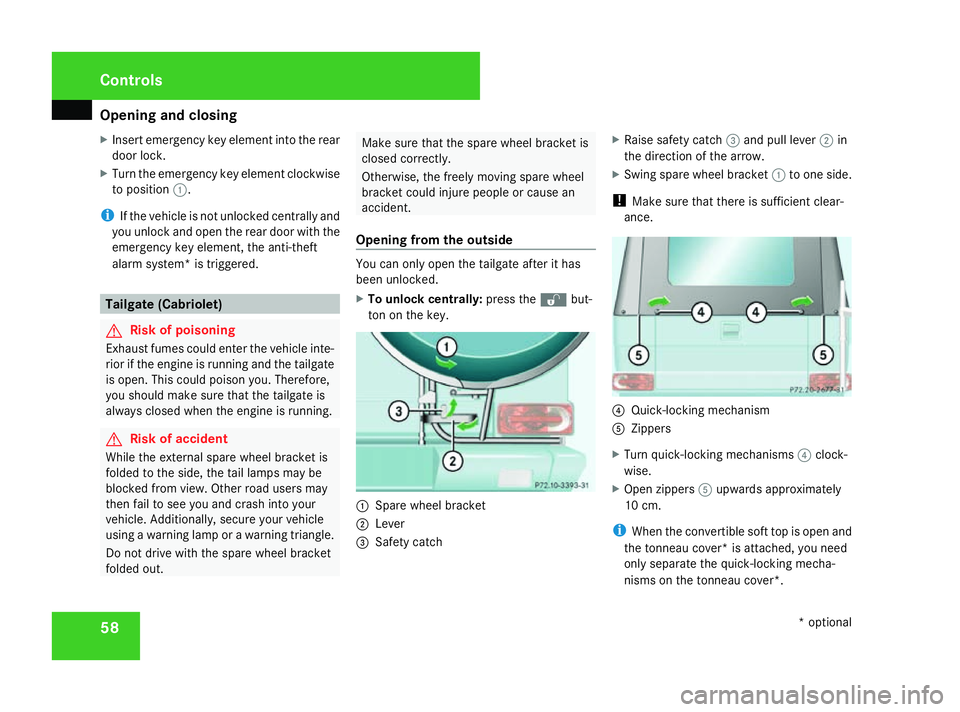
ton on the key. 1
Spare wheel bracket
2 Lever
3 Safety catch X
Raise safety catch 3and pull lever 2in
the direction of the arrow.
X Swing spare wheel bracket 1to one side.
! Make sure that there is sufficient clear-
ance. 4
Quick-locking mechanism
5 Zippers
X Turn quick-locking mechanisms 4clock-
wise.
X Open zippers 5upwards approximately
10 cm.
i When the convertible soft top is open and
the tonneau cover* is attached, you need
only separate the quick-locking mecha-
nisms on the tonneau cover*. Controls
* optional
463_AKB; 1; 8, en-GB
wobuchh,
Version: 2.10.6 2008-07-17T15:19:41+02:00 - Seite 58Dateiname: 6515_4091_02_buchblock.pdf; preflight
Page 63 of 293
Seats
60 Seats
Points to remember
For information about folding the rear bench
seat forward, see the "Luggage compartment
enlargement" section (Y page 141).G
Risk of injury
The seats can still be adjusted when there
is no key in the ignition lock. For this rea-
son, children should never be left unsuper-
vised in the vehicle. They could become
trapped when adjusting a seat. G
Risk of accident
Only adjust the driver's seat when the vehi-
cle is stationary. You will otherwise be dis-
tracted from the road and traffic conditions
and you could lose control of the vehicle as
a result of the seat moving. This could
cause an accident. G
Risk of injury
Make sure that nobody can become trap-
ped when you adjust the seat.
Observe the notes concerning the airbag
system.
Secure children as recommended; see
"Children in the vehicle" section. !
When you move the seats, make sure that
there are no objects in the footwell or
behind the seats. Otherwise, you could
damage the seats and the objects.
! Make sure that the sun visor is folded up
before setting the backrest angle and head
restraint height. Otherwise, the head
restraint and sun visor could collide when
the head restraint is fully extended.
i If the front door is open, the seats can be
adjusted for up 30 minutes after the igni-
tion has been switched off.
i The rear-compartment head restraints
can be removed (Y page 62).
Please contact a Mercedes-Benz Service
Centre for more information. Adjusting the seat
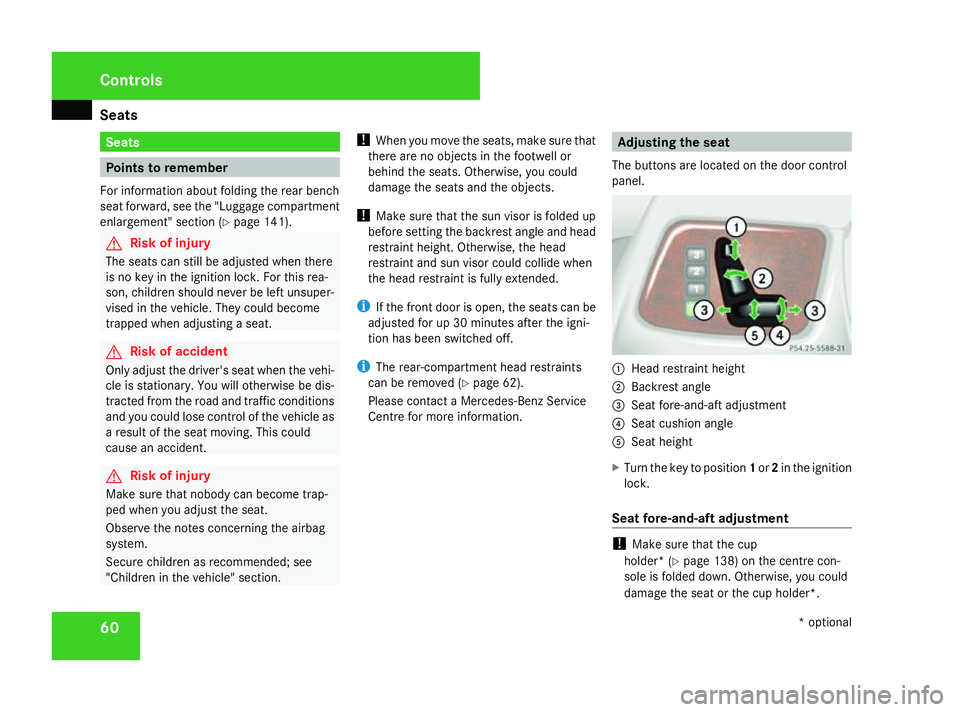
The buttons are located on the door control
panel. 1
Head restraint height
2 Backrest angle
3 Seat fore-and-aft adjustment
4 Seat cushion angle
5 Seat height
X Turn the key to position 1or 2in the ignition
lock.
Seat fore-and-aft adjustment !
Make sure that the cup
holder* (Y page 138) on the centre con-
sole is folded down. Otherwise, you could
damage the seat or the cup holder*. Controls
* optional
463_AKB; 1; 8, en-GB
wobuchh,
Version: 2.10.6 2008-07-17T15:19:41+02:00 - Seite 60Dateiname: 6515_4091_02_buchblock.pdf; preflight
Page 75 of 293

Seat belts
72 hip joints – not across your abdomen. If
necessary, push down the belt strap
slightly and then retighten it in the roll-up
direction.
R Do not route the belt strap across sharp
or fragile objects, especially if these are
located on or in your clothing, e.g. spec-
tacles, pencils, keys, etc. The seat belt
strap could be damaged and tear in an
accident and you or other vehicle occu-
pants could be injured.
R Only one person should use each seat
belt at any one time. Children must never
travel sitting on the lap of other occu-
pants. It would not be possible to restrain
the child in the event of a sudden change
in direction, braking or an accident. This
could result in severe or even fatal inju-
ries to the child and other occupants.
R Persons less than 1.50 m tall cannot
wear the seat belts correctly. For this
reason, secure persons less than 1.50 m
tall in specially designed, suitable
restraint systems.
R Children less than 1.50 m tall or under
12 years of age cannot wear the seat
belts properly. Therefore, always secure
these children in suitable child restraint systems on suitable vehicle seats. You
can find more information under "Chil-
dren in the vehicle" in the "Safety" sec-
tion of the Owner's Manual. Follow the
manufacturer's installation instructions
when fitting the child restraint system.
R Do not secure any objects with a seat belt
if the seat belt is also being used by one
of the vehicle's occupants. G
Risk of injury
The seat belt does not offer the intended
level of protection unless the backrest is
almost vertical. Under certain circumstan-
ces this could cause severe or even fatal
injuries.
Before starting a journey, make sure that
the seat is properly adjusted and that the
backrest is almost vertical. G
Risk of injury
A dirty or damaged seat belt or a seat belt
that has been subjected to a load in an
accident or modified no longer offers the
intended level of protection. Under certain
circumstances this could cause severe or
even fatal injuries. For this reason, check regularly that the
seat belts are not damaged or dirty.
Always have damaged seat belts or seat
belts that have been subjected to a load in
an accident replaced at a qualified special-
ist workshop. Choose a qualified specialist
workshop which has the necessary special-
ist knowledge and tools for the work
required. Mercedes-Benz recommends
that you use a Mercedes-Benz Service
Centre for this purpose.
For safety reasons, Mercedes-Benz recom-
mends that you only use seat belts which
have been approved by Mercedes-Benz for
your vehicle.Controls
463_AKB; 1; 8, en-GB
wobuchh,
Version: 2.10.6 2008-07-17T15:19:41+02:00 - Seite 72Dateiname: 6515_4091_02_buchblock.pdf; preflight
Page 87 of 293
Side windows
84 Side windows
Opening/closing the side windows
G
Risk of injury
Make sure that nobody can become trap-
ped between the side window and the door
frame as a side window is opened. Do not
touch or lean against the side window dur-
ing the opening procedure. You could
become trapped between the side window
and the door frame as the window moves
down. If danger threatens, release the
switch or pull the switch upwards to close
the side window again. G
Risk of injury
Make sure that nobody can become trap-
ped as you close a side window. If danger
threatens, release the switch or press the
switch a second time to open the side win-
dow again. G
Risk of injury
Do not leave children unsupervised in the
vehicle, even if they are secured in a child
restraint system. The children could: R
be seriously or even fatally injured on
parts of the vehicle
R be seriously or even fatally injured by
prolonged exposure to extremely high or
extremely low temperatures
R press the central unlocking switch and
thereby override the child-proof locks
and open the door
If children open a door, they could:
R seriously or even fatally injure other peo-
ple
R get out of the vehicle, thereby injuring
themselves or be seriously or even fatally
injured by a passing vehicle
Activate the child-proof locks if children are
travelling in the vehicle. They could other-
wise open doors or windows while the vehi-
cle is in motion and thereby injure them-
selves or others.
i It is also possible to open and close the
side windows from the outside using the
"Summer opening" (Y page 85) and "Con-
venience closing" (Y page 85) features
respectively. You can disable the controls for the rear
side windows from the driver's seat
(Y
page 46).
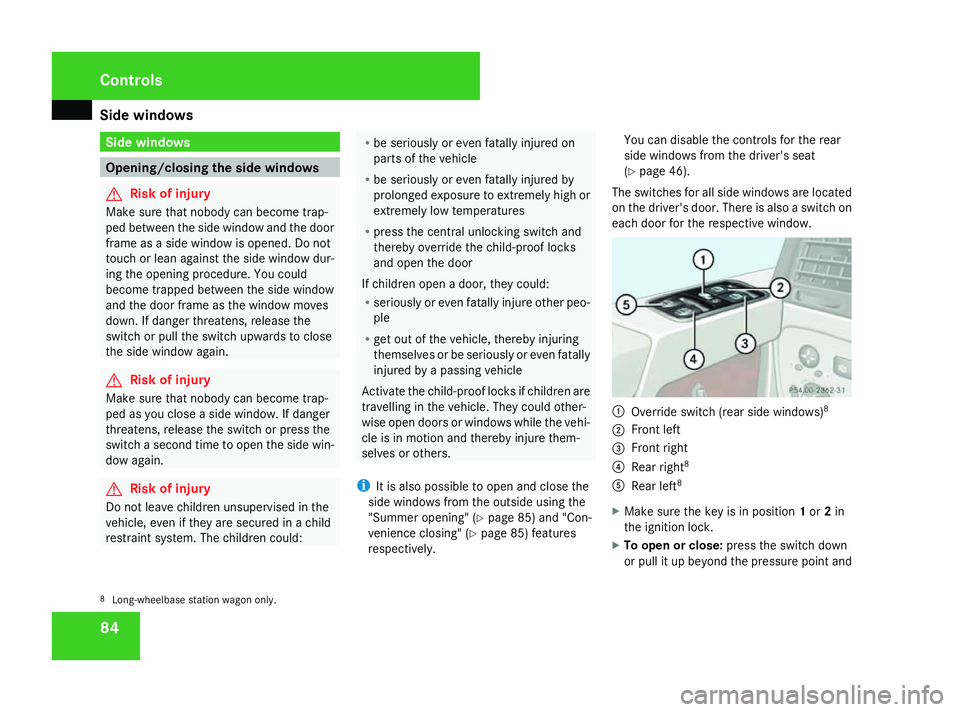
The switches for all side windows are located
on the driver's door. There is also a switch on
each door for the respective window. 1
Override switch (rear side windows) 8
2 Front left
3 Front right
4 Rear right 8
5 Rear left 8
X Make sure the key is in position 1or 2in
the ignition lock.
X To open or close: press the switch down
or pull it up beyond the pressure point and
8 Long-wheelbase station wagon only. Controls
463_AKB; 1; 8, en-GB
wobuchh,
Version: 2.10.6
2008-07-17T15:19:41+02:00 - Seite 84 Dateiname: 6515_4091_02_buchblock.pdf; preflight
Page 89 of 293
Driving and pa
rking 86X
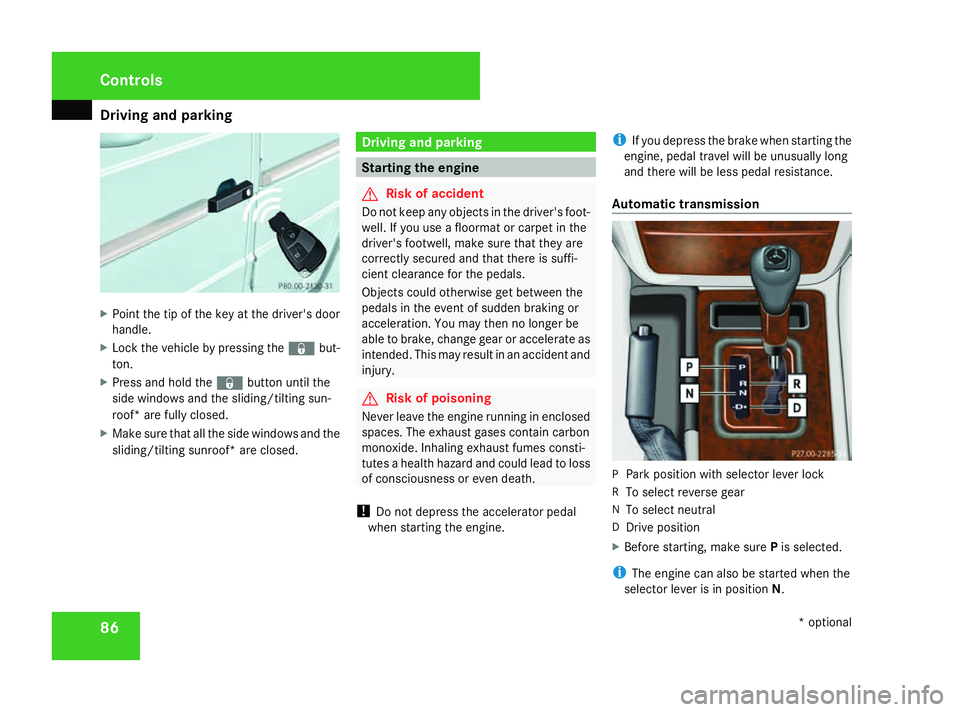
Point the tip of the key at the driver's door
handle.
X Lock the vehicle by pressing the jbut-
ton.
X Press and hold the jbutton until the
side windows and the sliding/tilting sun-
roof* are fully closed.
X Make sure that all the side windows and the
sliding/tilting sunroof* are closed. Driving and parking
Starting the engine
G
Risk of accident
Do not keep any objects in the driver's foot-
well. If you use a floormat or carpet in the
driver's footwell, make sure that they are
correctly secured and that there is suffi-
cient clearance for the pedals.
Objects could otherwise get between the
pedals in the event of sudden braking or
acceleration. You may then no longer be
able to brake, change gear or accelerate as
intended. This may result in an accident and
injury. G
Risk of poisoning
Never leave the engine running in enclosed
spaces. The exhaust gases contain carbon
monoxide. Inhaling exhaust fumes consti-
tutes a health hazard and could lead to loss
of consciousness or even death.
! Do not depress the accelerator pedal
when starting the engine. i
If you depress the brake when starting the
engine, pedal travel will be unusually long
and there will be less pedal resistance.
Automatic transmission P
Park position with selector lever lock
R To select reverse gear
N To select neutral
D Drive position
X Before starting, make sure Pis selected.
i The engine can also be started when the
selector lever is in position N.Cont
rols
* optional
463_AKB; 1; 8, en-GB
wobuchh,
Version: 2.10.6 2008-07-17T15:19:41+02:00 - Seite 86Dateiname: 6515_4091_02_buchblock.pdf; preflight
Page 91 of 293
Driving and pa
rking 88
R
the vehicle is secured with the parking
brake
R ESP ®
is malfunctioning Parking
G
Risk of accident
Only remove the key from the ignition lock
when the vehicle is stationary as you can-
not steer the vehicle with the key removed.
Never leave children unsupervised in the
vehicle. They could release the parking
brake. This could lead to a serious or fatal
accident. G
Risk of fire
Make sure that the exhaust system does
not under any circumstances come into
contact with easily ignitable material such
as dry grass or petrol. The material could
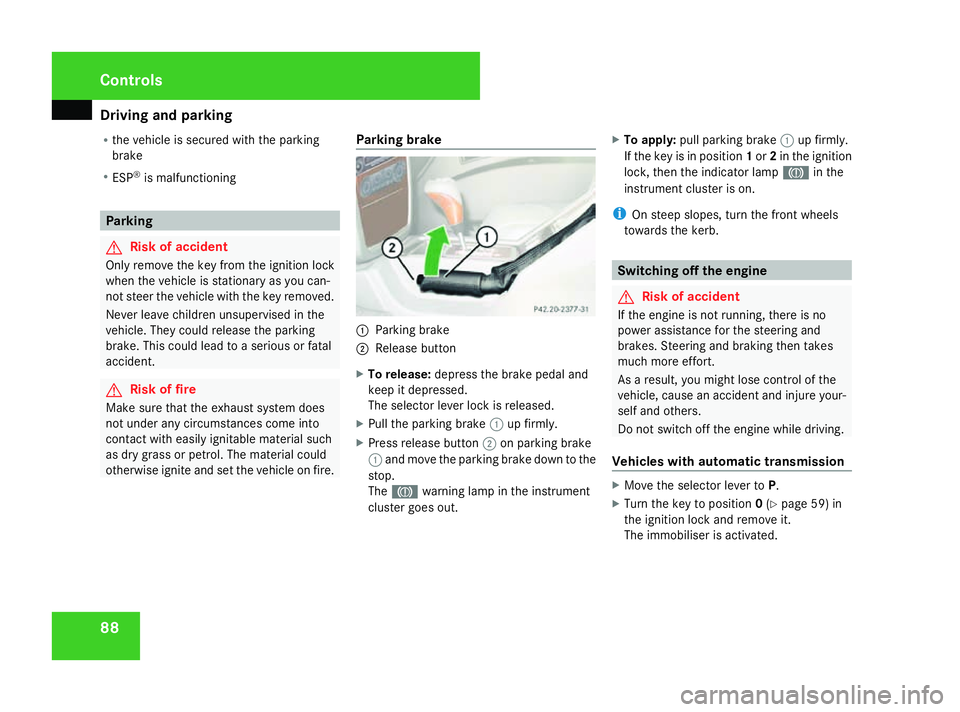
otherwise ignite and set the vehicle on fire. Parking brake 1
Parking brake
2 Release button
X To release: depress the brake pedal and
keep it depressed.
The selector lever lock is released.
X Pull the parking brake 1up firmly.
X Press release button 2on parking brake
1 and move the parking brake down to the
stop.
The 3 warning lamp in the instrument
cluster goes out. X
To apply: pull parking brake 1up firmly.
If the key is in position 1or 2in the ignition
lock, then the indicator lamp 3in the
instrument cluster is on.
i On steep slopes, turn the front wheels
towards the kerb. Switching off the engine
G
Risk of accident
If the engine is not running, there is no
power assistance for the steering and
brakes. Steering and braking then takes
much more effort.
As a result, you might lose control of the
vehicle, cause an accident and injure your-
self and others.
Do not switch off the engine while driving.
Vehicles with automatic transmission X
Move the selector lever to P.
X Turn the key to position 0(Y page 59) in
the ignition lock and remove it.
The immobiliser is activated. Controls
463_AKB; 1; 8, en-GB
wobuchh
,V ersion: 2.10.6
2008-07-17T15:19:41+02:00 - Seite 88 Dateiname: 6515_4091_02_buchblock.pdf; preflight
Page 92 of 293
Transmission
89Transmission
Notes on the transmission
G
Risk of accident
The movement of the pedals must not be
impaired in any way. Do not keep any
objects in the driver's footwell. Make sure
that floormats or carpets are correctly
secured and that there is sufficient clear-
ance for the pedals. G
Risk of accident
Do not change down for additional engine
braking on a slippery road surface. This
could cause the drive wheels to lose their
grip and the vehicle could skid. This could
cause you to lose control of your vehicle
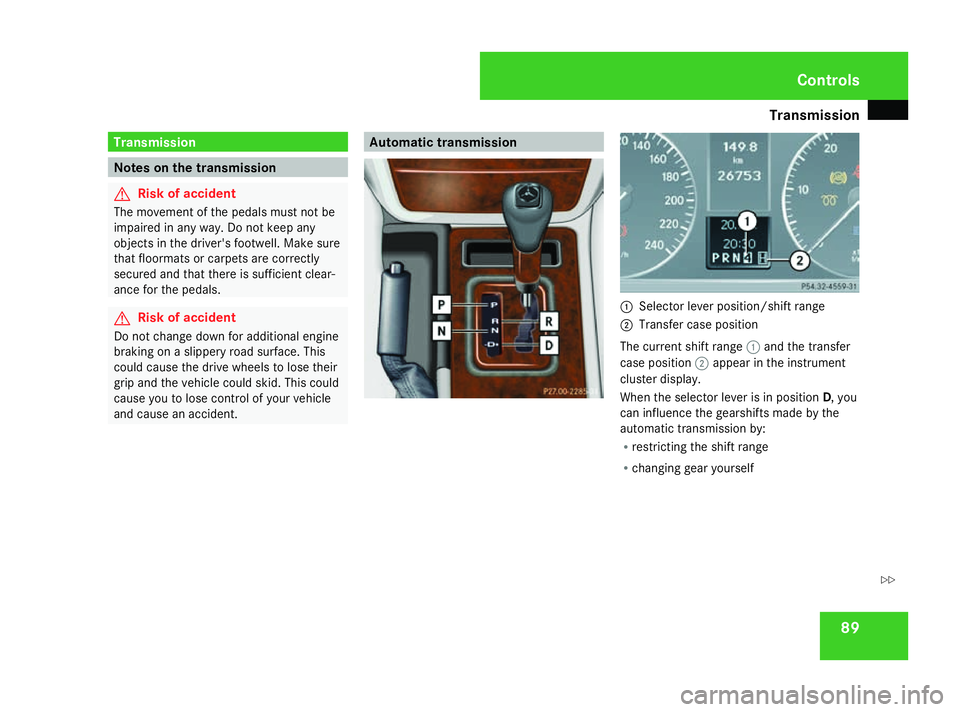
and cause an accident. Automatic transmission
1
Selector lever position/shift range
2 Transfer case position
The current shift range 1and the transfer
case position 2appear in the instrument
cluster display.
When the selector lever is in position D, you
can influence the gearshifts made by the
automatic transmission by:
R restricting the shift range
R changing gear yourself Controls
463_AKB; 1; 8, en-GB
wobuchh
,V ersion: 2.10.6
2008-07-17T15:19:41+02:00 - Seite 89 ZDateiname: 6515_4091_02_buchblock.pdf; preflight
Page 112 of 293
On-board computer
109
The auxiliary heating is switched off automat-
ically after 50 minutes. This time can be
changed. To do this, visit a qualified specialist
workshop, e.g. a Mercedes-Benz Service
Centre.
G
Risk of fire and poisoning
The operation of the auxiliary heating pro-
duces hot, toxic exhaust fumes. The fuel
vapours produced during refuelling could
ignite on the hot exhaust system.
Do not switch on the auxiliary heating at
filling stations or in enclosed spaces, for
instance, a garage, if there is no air extrac-
tion system.
You could otherwise endanger yourself and
others.
The Auxiliary heat. function can be called
up directly.
X Turn the key to position 1or 2in the ignition
lock.
X Press the button for the auxiliary heating on
the centre console (Y page 130).
or
X Press the èor· button to select the
Settings menu.
X Press the jbutton to select submenus. X
Press the æorç button to select the
Heater submenu.
X Press the jbutton to select Auxiliary
heat. .
X Press the æorç button to select
one of the three switch-on times or Timer
off (auxiliary heating switched off).
When a switch-on time is selected, the yel-
low indicator lamp lights up in the auxiliary
heating button.
X Press the j,èorÿ button to
select a different display.
Changing the switch-on time for the
auxiliary heating* This function is only displayed if you have
selected a switch-on time. Here you can enter
the time at which the auxiliary heating is to
be switched on.
X
Press the èor· button to select the
Settings menu.
X Press the jbutton to select submenus.
X Press the æorç button to select the
Heater submenu.
X Press the jbutton to select Sw.-on
time hour. X
Press the æorç button to set the
hour.
X Press the jbutton to select Sw.-on
time minute(s).
X Press the æorç button to set the
minutes.
After changing from one menu to another,
the new time setting is stored. The yellow
indicator lamp lights up on the button for
the auxiliary heating on the centre console.
X Press the j,èorÿ button to
select a different display.
Activating/deactivating the easy-
entry/exit feature i
For more information on the easy-entry/
exit feature, see (Y page 67). G
Risk of injury
The steering wheel moves when the easy-
entry/exit feature is active. There is a risk
of occupants becoming trapped. Before
activating the easy-entry/exit feature,
make sure that nobody can become trap-
ped.
Do not leave children unsupervised in the
vehicle, even if they are secured in a child
restraint system. The children could open Controls
* optional
463_AKB; 1; 8, en-GB
wobuchh
,V ersion: 2.10.6
2008-07-17T15:19:41+02:00 - Seite 109 ZDateiname: 6515_4091_02_buchblock.pdf; preflight
Page 139 of 293
Cabriolet soft top
136 come loose. You could lose control of your
vehicle and injure yourself and other per-
sons.
Do not drive the vehicle with the draught
stop fitted if the rear seat is occupied.
Do not place any objects on top of the fitted
draught stop.
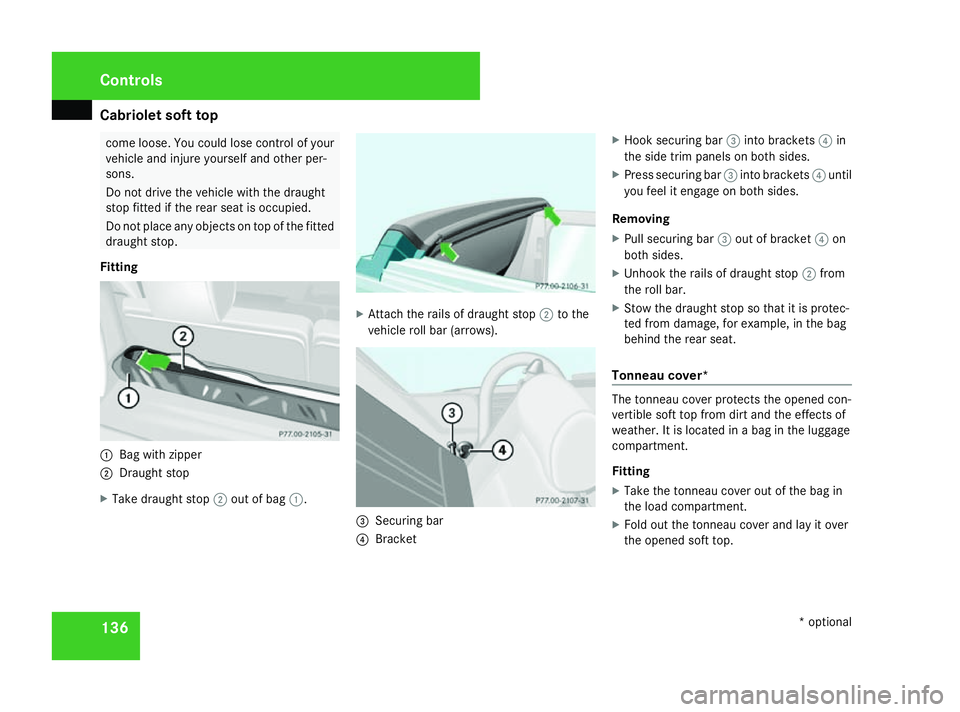
Fitting 1
Bag with zipper
2 Draught stop
X Take draught stop 2out of bag 1. X
Attach the rails of draught stop 2to the
vehicle roll bar (arrows). 3
Securing bar
4 Bracket X
Hook securing bar 3into brackets 4in
the side trim panels on both sides.
X Press securing bar 3into brackets 4until
you feel it engage on both sides.
Removing
X Pull securing bar 3out of bracket 4on
both sides.
X Unhook the rails of draught stop 2from
the roll bar.
X Stow the draught stop so that it is protec-
ted from damage, for example, in the bag
behind the rear seat.
Tonneau cover* The tonneau cover protects the opened con-
vertible soft top from dirt and the effects of
weather. It is located in a bag in the luggage
compartment.
Fitting
X
Take the tonneau cover out of the bag in
the load compartment.
X Fold out the tonneau cover and lay it over
the opened soft top. Controls
* optional
463_AKB; 1; 8, en-GB
wobuchh,
Version: 2.10.6
2008-07-17T15:19:41+02:00 - Seite 136 Dateiname: 6515_4091_02_buchblock.pdf; preflight
Page 140 of 293
Cabriolet soft top
1371
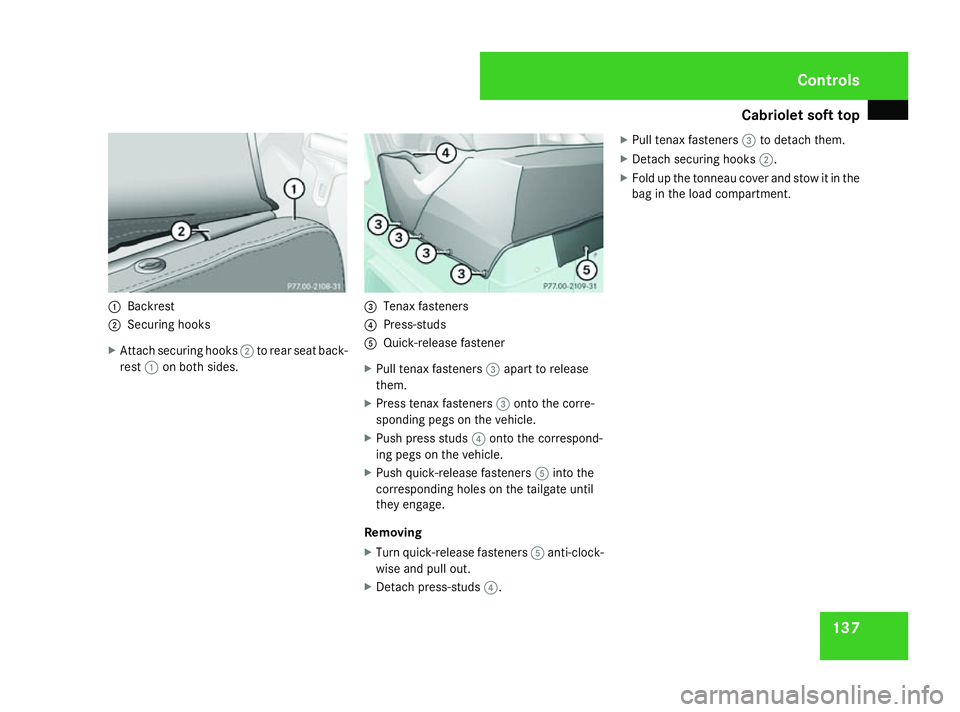
Backrest
2 Securing hooks
X Attach securing hooks 2to rear seat back-
rest 1on both sides. 3
Tenax fasteners
4 Press-studs
5 Quick-release fastener
X Pull tenax fasteners 3apart to release
them.
X Press tenax fasteners 3onto the corre-
sponding pegs on the vehicle.
X Push press studs 4onto the correspond-
ing pegs on the vehicle.
X Push quick-release fasteners 5into the
corresponding holes on the tailgate until
they engage.
Removing
X Turn quick-release fasteners 5anti-clock-
wise and pull out.
X Detach press-studs 4. X
Pull tenax fasteners 3to detach them.
X Detach securing hooks 2.
X Fold up the tonneau cover and stow it in the
bag in the load compartment. Controls
463_AKB; 1; 8, en-GB
wobuchh,
Version: 2.10.6 2008-07-17T15:19:41+02:00 - Seite 137 ZDateiname: 6515_4091_02_buchblock.pdf; preflight