belt MERCEDES-BENZ G-CLASS SUV 2008 User Guide
[x] Cancel search | Manufacturer: MERCEDES-BENZ, Model Year: 2008, Model line: G-CLASS SUV, Model: MERCEDES-BENZ G-CLASS SUV 2008Pages: 293, PDF Size: 4.49 MB
Page 41 of 293
Occupant safety
38
Windowbags
1are deployed:
R at the start of an accident with a high rate
of vehicle acceleration or deceleration in a
lateral direction
R on the side on which an impact occurs
R independently of the front airbags
R regardless of whether the front-passenger
seat is occupied
R independently of the seat belt use
R if the vehicle overturns and the system
determines that windowbag deployment
can offer additional protection to that pro-
vided by the seat belt Rear head restraints
G
Risk of injury
Drive only with the head restraints fitted.
This reduces the risk of injury in the event
of an accident.
Occupants must only travel on seats with
head restraints fitted. Pull the head
restraints up into the upright position. This
reduces the risk of injury to occupants in
the event of an accident.
Ensure that the back of your head is sup-
ported at eye level by the central area of the head restraint. This reduces reduces the
risk of injury to your head or neck in the
event of an accident or a similar situation. Children in the vehicle
If a child is travelling in your vehicle, secure
the child using a child restraint system which
is appropriate to the size and age of the child
and recommended for Mercedes-Benz vehi-
cles. You should preferably fit the restraint
system to a suitable rear seat. Ensure that the
child is strapped in throughout the trip.
You can obtain information about the correct
child restraint system from any Mercedes-
Benz Service Centre.
i It is advisable to use Mercedes-Benz care
products to clean child restraint systems.
Information about this can be obtained
from any Mercedes-Benz Service Centre. G
Risk of injury
Do not leave children unsupervised in the
vehicle, even if they are secured in a child
restraint system. Children could injure
themselves on parts of the vehicle. They
could also be seriously or even fatally injured by prolonged exposure to extreme
heat or cold.
Do not expose the child restraint system to
direct sunlight. The metallic parts of the
child restraint system could heat up and the
child could be burned by them.
If a child opens a door, the child or other
persons could be injured as a result. The
child could get out and be injured in the
process or be injured by a passing vehicle. G
Risk of injury
An unsecured or incorrectly positioned load
increases the risk of injury to the child in
the event of:
R an accident
R a braking manoeuvre
R a sudden change of direction
Do not carry heavy or hard objects inside
the vehicle unless they are secured. You
will find further information under "Loading
guidelines" in the index.
Child restraint systems Mercedes-Benz recommends that you only
use the child restraint systems listed on
(Y
page 43). Safety
463_AKB; 1; 8, en-GB
wobuchh,
Version: 2.10.6 2008-07-17T15:19:41+02:00 - Seite 38Dateiname: 6515_4091_02_buchblock.pdf; preflight
Page 42 of 293
Occupant safety
39G
Risk of injury
To reduce the risk of serious or even fatal
injury to the child in the event of a sudden
change in direction, braking or an accident:
R children less than 1.50 m tall and under
twelve years of age must always be
secured in special child restraint systems
on a suitable vehicle seat. This is neces-
sary because the seat belts are not
designed for children of this size.
R do not secure children under twelve
years of age on the front-passenger seat.
Exception: the child is secured in a vehi-
cle with automatic child seat recognition
on the front-passenger seat and is
secured in a child restraint system with
automatic child seat recognition.
R If you secure a child restraint system to
the front-passenger seat where auto-
matic child seat recognition is not instal-
led, you must move the front-passenger
seat as far back as possible.
R children must never travel sitting on the
lap of another occupant. Due to the
forces occurring in the event of a sudden
change of direction, heavy braking or an
accident, it would not be possible to
restrain the child. The child could be thrown against parts of the vehicle inte-
rior and be seriously or even fatally
injured.
G
Risk of injury
The child restraint system cannot perform
its protective function if is not correctly fit-
ted to a suitable vehicle seat. The child can-
not be restrained in the event of a sudden
change of direction, heavy braking or an
accident. This may lead to serious or even
fatal injuries. For this reason, when fitting
a child restraint system, observe the man-
ufacturer's installation instructions and the
correct use of the child restraint system.
Child restraint systems should preferably
be fitted to the rear seats. Children are gen-
erally better protected there.
The entire base of the child restraint system
must always rest on the seat cushion.
Never place objects, e.g. a cushion, under
the child restraint system.
Only use child restraint systems with their
original covers. Only replace damaged cov-
ers with genuine Mercedes-Benz covers.
For safety reasons, you should only use
child restraint systems which have been approved for use in Mercedes-Benz vehi-
cles.
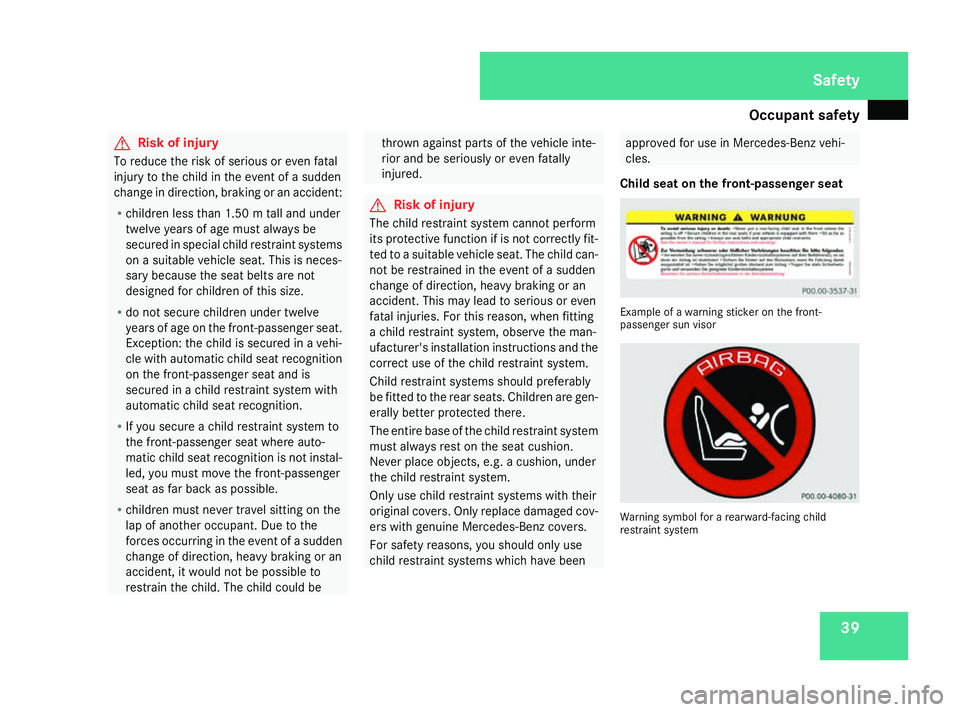
Child seat on the front-passenger seat Example of a warning sticker on the front-
passenger sun visor
Warning symbol for a rearward-facing child
restraint system Safety
463_AKB; 1; 8, en-GB
wobuchh,
Version: 2.10.6
2008-07-17T15:19:41+02:00 - Seite 39 ZDateiname: 6515_4091_02_buchblock.pdf; preflight
Page 44 of 293
Occupant safety
41Proceed as follows:
R
do not use a rearward-facing child
restraint system on the front-passenger
seat.
R fit a rearward-facing child restraint sys-
tem on a suitable rear seat.
or
R only use a forward-facing child restraint
system on the front-passenger seat and
move the front-passenger seat to its rear-
most position.
R have the automatic child seat recognition
checked at a qualified specialist work-
shop.
To ensure that the automatic child seat rec-
ognition on the front-passenger seat func- tions correctly, never place objects (such
as a cushion) under the child restraint sys-
tem. The entire base of the child restraint
system must always rest on the seat cush-
ion. An incorrectly fitted child restraint sys-
tem cannot perform its intended protective
function in the event of an accident, and
could lead to injuries.
i The windowbags and the belt tensioner
on the front-passenger side are still active
even if the front-passenger front airbag is
disabled. G
Risk of injury
Do not place items of electronic equipment
on the front-passenger seat, e.g.:
R laptops, when switched on
R mobile phones
R cards with transponders, e.g. ski passes
or access cards Signals from electronic equipment can
cause interference in the automatic child
seat recognition sensor system. This could
lead to a system malfunction. This may
cause the
5PASSENGER AIRBAG OFF
warning lamp to light up without there
being a child seat with automatic child seat
recognition fitted. This means that the
front-passenger airbag does not deploy
during an accident. It is also possible that
the 5 PASSENGER AIRBAG OFF warning
lamp will not light up briefly if you turn the
key in the ignition lock to position 2. Safety
463_AKB; 1; 8, en-GB
wobuchh,
Version: 2.10.6 2008-07-17T15:19:41+02:00 - Seite 41 ZDateiname: 6515_4091_02_buchblock.pdf; preflight
Page 47 of 293
Occupant safety
44 Weight categories and
ages Manufacturer Type Approval number Daimler order num-
ber Automatic child seat
recognition
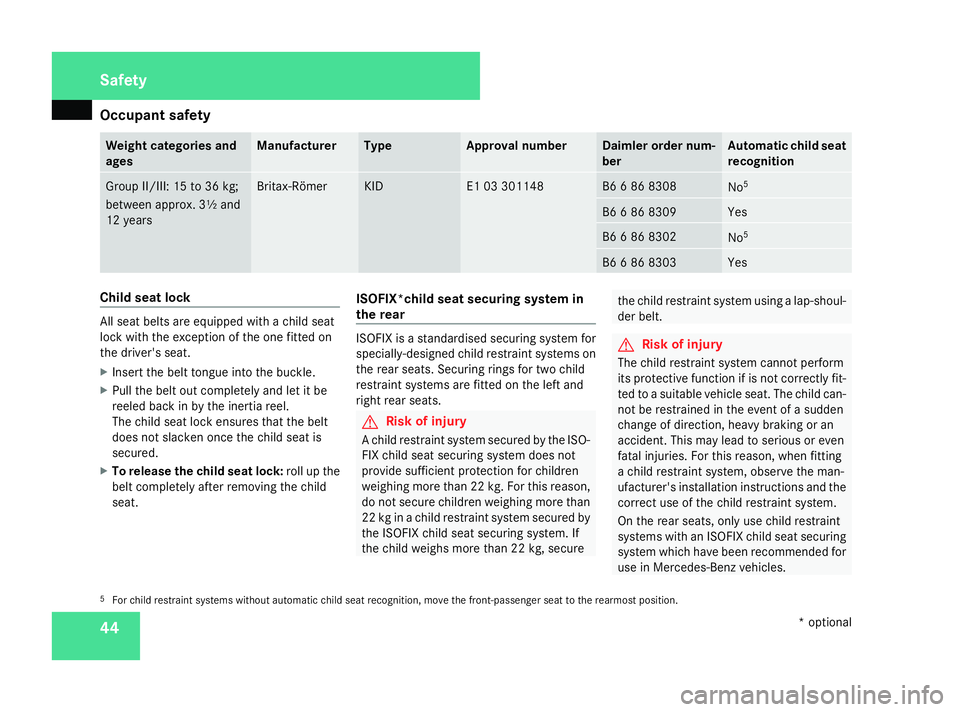
Group II/III: 15 to 36 kg;
between approx. 3½ and
12 years Britax-Römer KID E1 03 301148 B6 6 86 8308
No
5 B6 6 86 8309 Yes
B6 6 86 8302
No
5 B6 6 86 8303 Yes
Child seat lock
All seat belts are equipped with a child seat
lock with the exception of the one fitted on
the driver's seat.
X Insert the belt tongue into the buckle.
X Pull the belt out completely and let it be
reeled back in by the inertia reel.
The child seat lock ensures that the belt
does not slacken once the child seat is
secured.
X To release the child seat lock: roll up the
belt completely after removing the child
seat. ISOFIX*child seat securing system in
the rear ISOFIX is a standardised securing system for
specially-designed child restraint systems on
the rear seats. Securing rings for two child
restraint systems are fitted on the left and
right rear seats. G
Risk of injury
A child restraint system secured by the ISO-
FIX child seat securing system does not
provide sufficient protection for children
weighing more than 22 kg. For this reason,
do not secure children weighing more than
22 kg in a child restraint system secured by
the ISOFIX child seat securing system. If
the child weighs more than 22 kg, secure the child restraint system using a lap-shoul-
der belt.
G
Risk of injury
The child restraint system cannot perform
its protective function if is not correctly fit-
ted to a suitable vehicle seat. The child can-
not be restrained in the event of a sudden
change of direction, heavy braking or an
accident. This may lead to serious or even
fatal injuries. For this reason, when fitting
a child restraint system, observe the man-
ufacturer's installation instructions and the
correct use of the child restraint system.
On the rear seats, only use child restraint
systems with an ISOFIX child seat securing
system which have been recommended for
use in Mercedes-Benz vehicles.
5 For child restraint systems without automatic child seat recognition, move the front-passenger seat to the rearmost position. Safety
* optional
463_AKB; 1; 8, en-GB
wobuchh,
Version: 2.10.6 2008-07-17T15:19:41+02:00 - Seite 44Dateiname: 6515_4091_02_buchblock.pdf; preflight
Page 49 of 293
Occupant safety
464
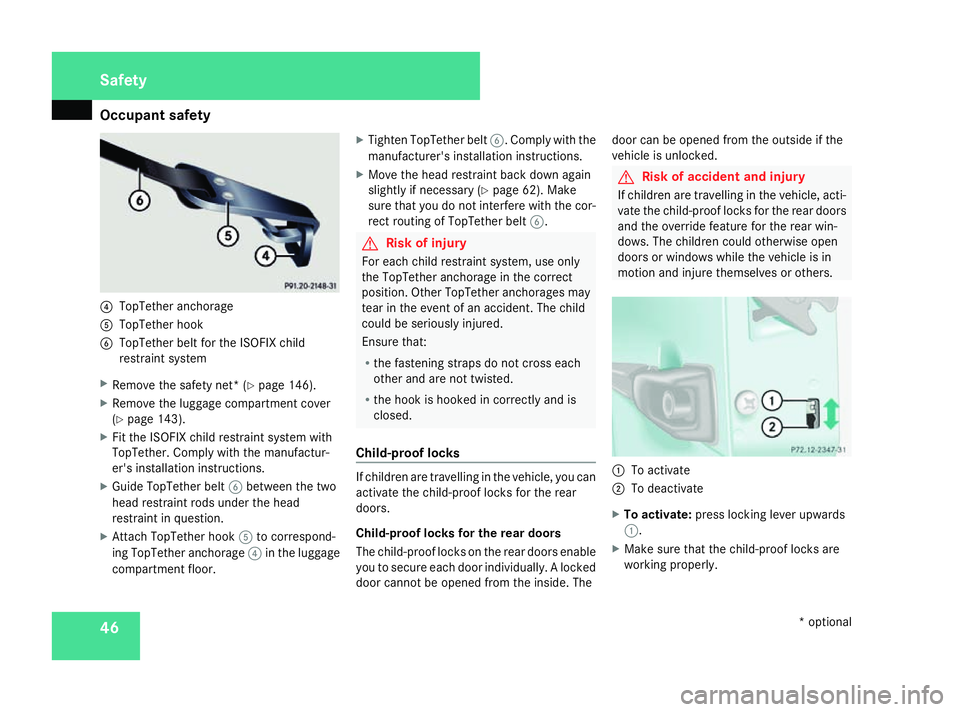
TopTether anchorage
5 TopTether hook
6 TopTether belt for the ISOFIX child
restraint system
X Remove the safety net* (Y page 146).
X Remove the luggage compartment cover
(Y page 143).
X Fit the ISOFIX child restraint system with
TopTether. Comply with the manufactur-
er's installation instructions.
X Guide TopTether belt 6between the two
head restraint rods under the head
restraint in question.
X Attach TopTether hook 5to correspond-
ing TopTether anchorage 4in the luggage
compartment floor. X
Tighten TopTether belt 6. Comply with the
manufacturer's installation instructions.
X Move the head restraint back down again
slightly if necessary (Y page 62). Make
sure that you do not interfere with the cor-
rect routing of TopTether belt 6. G
Risk of injury
For each child restraint system, use only
the TopTether anchorage in the correct
position. Other TopTether anchorages may
tear in the event of an accident. The child
could be seriously injured.
Ensure that:
R the fastening straps do not cross each
other and are not twisted.
R the hook is hooked in correctly and is
closed.
Child-proof locks If children are travelling in the vehicle, you can
activate the child-proof locks for the rear
doors.
Child-proof locks for the rear doors
The child-proof locks on the rear doors enable
you to secure each door individually. A locked
door cannot be opened from the inside. Thedoor can be opened from the outside if the
vehicle is unlocked. G
Risk of accident and injury
If children are travelling in the vehicle, acti-
vate the child-proof locks for the rear doors
and the override feature for the rear win-
dows. The children could otherwise open
doors or windows while the vehicle is in
motion and injure themselves or others. 1
To activate
2 To deactivate
X To activate: press locking lever upwards
1.
X Make sure that the child-proof locks are
working properly. Safety
* optional
463_AKB; 1; 8, en-GB
wobuchh,
Version: 2.10.6
2008-07-17T15:19:41+02:00 - Seite 46 Dateiname: 6515_4091_02_buchblock.pdf; preflight
Page 74 of 293
Seat belts
71
switch. Otherwise, the seat could be dam-
aged. Storing a parking position
To make it easier to park, you can store the
front-passenger side exterior mirror position
in such a way that you can see the rear wheel
on that side as soon as you engage reverse
gear.
Using the storage position switches on the
driver's side, you can store three parking
positions per key.
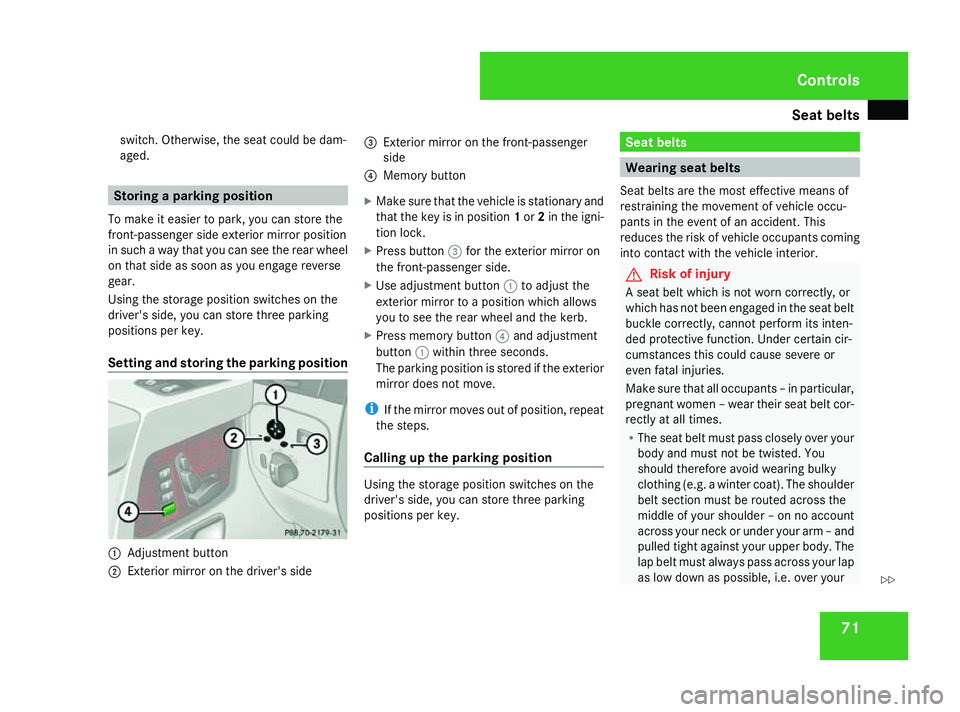
Setting and storing the parking position 1
Adjustment button
2 Exterior mirror on the driver's side 3
Exterior mirror on the front-passenger
side
4 Memory button
X Make sure that the vehicle is stationary and
that the key is in position 1or 2in the igni-
tion lock.
X Press button 3for the exterior mirror on
the front-passenger side.
X Use adjustment button 1to adjust the
exterior mirror to a position which allows
you to see the rear wheel and the kerb.
X Press memory button 4and adjustment
button 1within three seconds.
The parking position is stored if the exterior
mirror does not move.
i If the mirror moves out of position, repeat
the steps.
Calling up the parking position Using the storage position switches on the
driver's side, you can store three parking
positions per key. Seat belts
Wearing seat belts
Seat belts are the most effective means of
restraining the movement of vehicle occu-
pants in the event of an accident. This
reduces the risk of vehicle occupants coming
into contact with the vehicle interior. G
Risk of injury
A seat belt which is not worn correctly, or
which has not been engaged in the seat belt
buckle correctly, cannot perform its inten-
ded protective function. Under certain cir-
cumstances this could cause severe or
even fatal injuries.
Make sure that all occupants – in particular,
pregnant women – wear their seat belt cor-
rectly at all times.
R The seat belt must pass closely over your
body and must not be twisted. You
should therefore avoid wearing bulky
clothing (e.g. a winter coat). The shoulder
belt section must be routed across the
middle of your shoulder – on no account
across your neck or under your arm – and
pulled tight against your upper body. The
lap belt must always pass across your lap
as low down as possible, i.e. over your Controls
463_AKB; 1; 8, en-GB
wobuchh,
Version: 2.10.6 2008-07-17T15:19:41+02:00 - Seite 71 ZDateiname: 6515_4091_02_buchblock.pdf; preflight
Page 75 of 293

Seat belts
72 hip joints – not across your abdomen. If
necessary, push down the belt strap
slightly and then retighten it in the roll-up
direction.
R Do not route the belt strap across sharp
or fragile objects, especially if these are
located on or in your clothing, e.g. spec-
tacles, pencils, keys, etc. The seat belt
strap could be damaged and tear in an
accident and you or other vehicle occu-
pants could be injured.
R Only one person should use each seat
belt at any one time. Children must never
travel sitting on the lap of other occu-
pants. It would not be possible to restrain
the child in the event of a sudden change
in direction, braking or an accident. This
could result in severe or even fatal inju-
ries to the child and other occupants.
R Persons less than 1.50 m tall cannot
wear the seat belts correctly. For this
reason, secure persons less than 1.50 m
tall in specially designed, suitable
restraint systems.
R Children less than 1.50 m tall or under
12 years of age cannot wear the seat
belts properly. Therefore, always secure
these children in suitable child restraint systems on suitable vehicle seats. You
can find more information under "Chil-
dren in the vehicle" in the "Safety" sec-
tion of the Owner's Manual. Follow the
manufacturer's installation instructions
when fitting the child restraint system.
R Do not secure any objects with a seat belt
if the seat belt is also being used by one
of the vehicle's occupants. G
Risk of injury
The seat belt does not offer the intended
level of protection unless the backrest is
almost vertical. Under certain circumstan-
ces this could cause severe or even fatal
injuries.
Before starting a journey, make sure that
the seat is properly adjusted and that the
backrest is almost vertical. G
Risk of injury
A dirty or damaged seat belt or a seat belt
that has been subjected to a load in an
accident or modified no longer offers the
intended level of protection. Under certain
circumstances this could cause severe or
even fatal injuries. For this reason, check regularly that the
seat belts are not damaged or dirty.
Always have damaged seat belts or seat
belts that have been subjected to a load in
an accident replaced at a qualified special-
ist workshop. Choose a qualified specialist
workshop which has the necessary special-
ist knowledge and tools for the work
required. Mercedes-Benz recommends
that you use a Mercedes-Benz Service
Centre for this purpose.
For safety reasons, Mercedes-Benz recom-
mends that you only use seat belts which
have been approved by Mercedes-Benz for
your vehicle.Controls
463_AKB; 1; 8, en-GB
wobuchh,
Version: 2.10.6 2008-07-17T15:19:41+02:00 - Seite 72Dateiname: 6515_4091_02_buchblock.pdf; preflight
Page 76 of 293
Seat belts
73
Front three-point seat belt
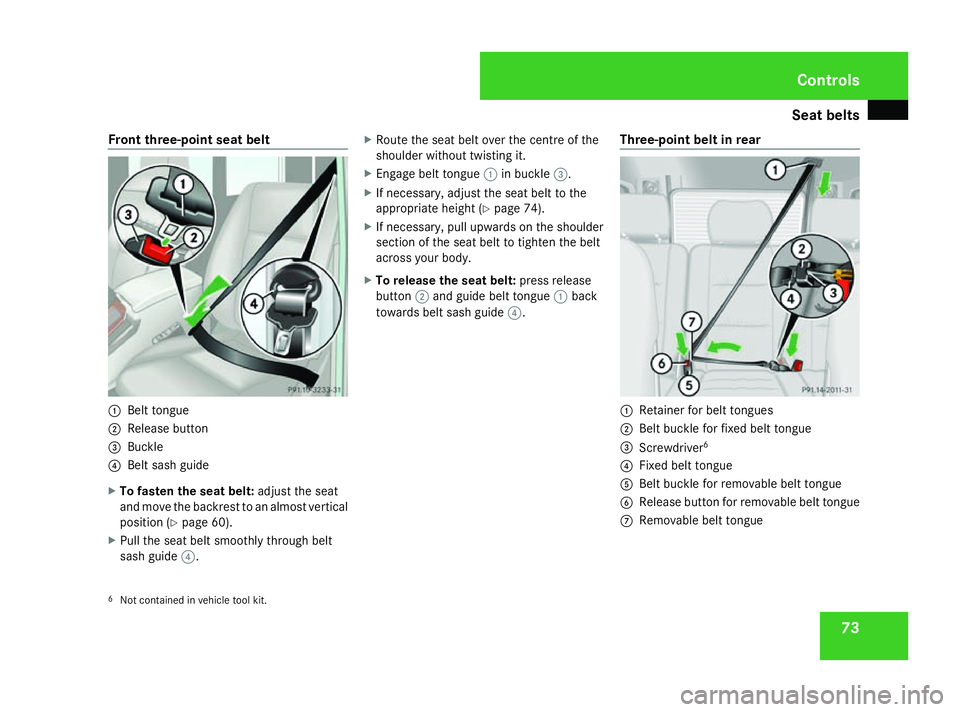
1
Belt tongue
2 Release button
3 Buckle
4 Belt sash guide
X To fasten the seat belt: adjust the seat
and move the backrest to an almost vertical
position (Y page 60).
X Pull the seat belt smoothly through belt
sash guide 4. X
Route the seat belt over the centre of the
shoulder without twisting it.
X Engage belt tongue 1in buckle 3.
X If necessary, adjust the seat belt to the
appropriate height (Y page 74).
X If necessary, pull upwards on the shoulder
section of the seat belt to tighten the belt
across your body.
X To release the seat belt: press release
button 2and guide belt tongue 1back
towards belt sash guide 4.Three-point belt in rear 1
Retainer for belt tongues
2 Belt buckle for fixed belt tongue
3 Screwdriver 6
4 Fixed belt tongue
5 Belt buckle for removable belt tongue
6 Release button for removable belt tongue
7 Removable belt tongue
6 Not contained in vehicle tool kit. Controls
463_AKB; 1; 8, en-GB
wobuchh,
Version: 2.10.6 2008-07-17T15:19:41+02:00 - Seite 73 ZDateiname: 6515_4091_02_buchblock.pdf; preflight
Page 77 of 293
Seat belts
74
X
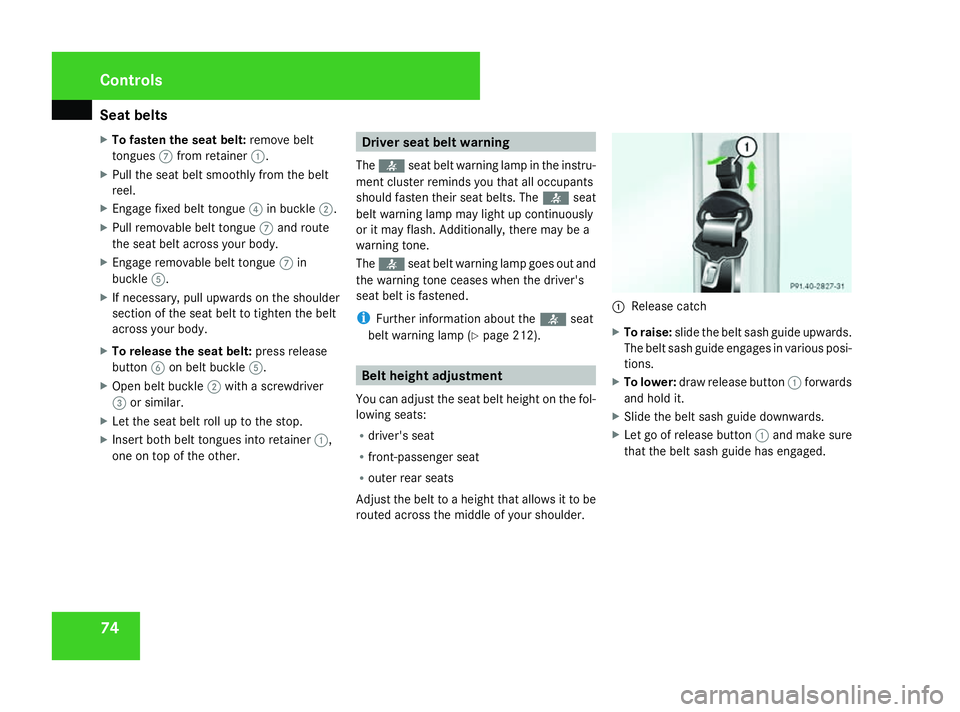
To fasten the seat belt: remove belt
tongues 7from retainer 1.
X Pull the seat belt smoothly from the belt
reel.
X Engage fixed belt tongue 4in buckle 2.
X Pull removable belt tongue 7and route
the seat belt across your body.
X Engage removable belt tongue 7in
buckle 5.
X If necessary, pull upwards on the shoulder
section of the seat belt to tighten the belt
across your body.
X To release the seat belt: press release
button 6on belt buckle 5.
X Open belt buckle 2with a screwdriver
3 or similar.
X Let the seat belt roll up to the stop.
X Insert both belt tongues into retainer 1,
one on top of the other. Driver seat belt warning
The < seat belt warning lamp in the instru-
ment cluster reminds you that all occupants
should fasten their seat belts. The
or it may flash. Additionally, there may be a
warning tone.
The < seat belt warning lamp goes out and
the warning tone ceases when the driver's
seat belt is fastened.
i Further information about the
You can adjust the seat belt height on the fol-
lowing seats:
R driver's seat
R front-passenger seat
R outer rear seats
Adjust the belt to a height that allows it to be
routed across the middle of your shoulder. 1
Release catch
X To raise: slide the belt sash guide upwards.
The belt sash guide engages in various posi-
tions.
X To lower: draw release button 1forwards
and hold it.
X Slide the belt sash guide downwards.
X Let go of release button 1and make sure
that the belt sash guide has engaged. Controls
463_AKB; 1; 8, en-GB
wobuchh,
Version: 2.10.6 2008-07-17T15:19:41+02:00 - Seite 74Dateiname: 6515_4091_02_buchblock.pdf; preflight
Page 78 of 293
Lights
75Correct driver's seat position
G
Risk of accident
Only adjust the driver's seat when the vehi-
cle is stationary. You will otherwise be dis-
tracted from the road and traffic conditions
and you could lose control of the vehicle as
a result of the seat moving. This could
cause an accident. G
Risk of accident
Only adjust the steering wheel when the
vehicle is stationary. Drive only when the
steering wheel is fixed.
X Check whether seat and the head restraint
are adjusted properly (Y page 60).
Make sure that:
R you are as far away from the driver's front
airbag as possible.
R you are sitting in a normal upright posi-
tion.
R you can fasten the seat belt properly.
R you have moved the backrest to an
almost vertical position.
R you have set the seat angle so that your
thighs are gently supported. R
you can depress the pedals properly.
R you have adjusted the head restraint so
that the back of your head is supported
at eye level by the central area of the
head restraint.
X Check whether steering wheel is adjusted
properly (Y page 66).
Make sure that:
R you can hold the steering wheel with your
arms slightly bent.
R you can move your legs freely.
R you can see all the displays in the instru-
ment cluster clearly.
X Check whether you have fastened seat belt
properly (Y page 71).
It should:
R fit snugly across your body
R be routed across the middle of your
shoulder
R routed in your pelvic area across the hip
joints Lights
Light switch
For safety reasons, Mercedes-Benz recom-
mends that you drive with the lights switched
on even during the daytime. In some coun-
tries, daytime operation of headlamps varies
due to legal and voluntary requirements. In
these countries, the dipped-beam headlamps
are automatically switched on when the
engine is started.
i If you drive in countries in which traffic
drives on the opposite side of the road to
the country where the vehicle is registered,
oncoming traffic may be dazzled by the
asymmetrical dipped-beam headlamps.
Have the headlamps changed to symmet-
rical dipped beam when driving in these
countries. You can obtain information
about this from any Mercedes-Benz Service
Centre.
The light switch is located on the dashboard
between the steering wheel and the driver's
door. Controls
463_AKB; 1; 8, en-GB
wobuchh,
Version: 2.10.6 2008-07-17T15:19:41+02:00 - Seite 75 ZDateiname: 6515_4091_02_buchblock.pdf; preflight