belt MERCEDES-BENZ G-CLASS SUV 2008 Owner's Manual
[x] Cancel search | Manufacturer: MERCEDES-BENZ, Model Year: 2008, Model line: G-CLASS SUV, Model: MERCEDES-BENZ G-CLASS SUV 2008Pages: 293, PDF Size: 4.49 MB
Page 81 of 293
Lights
78
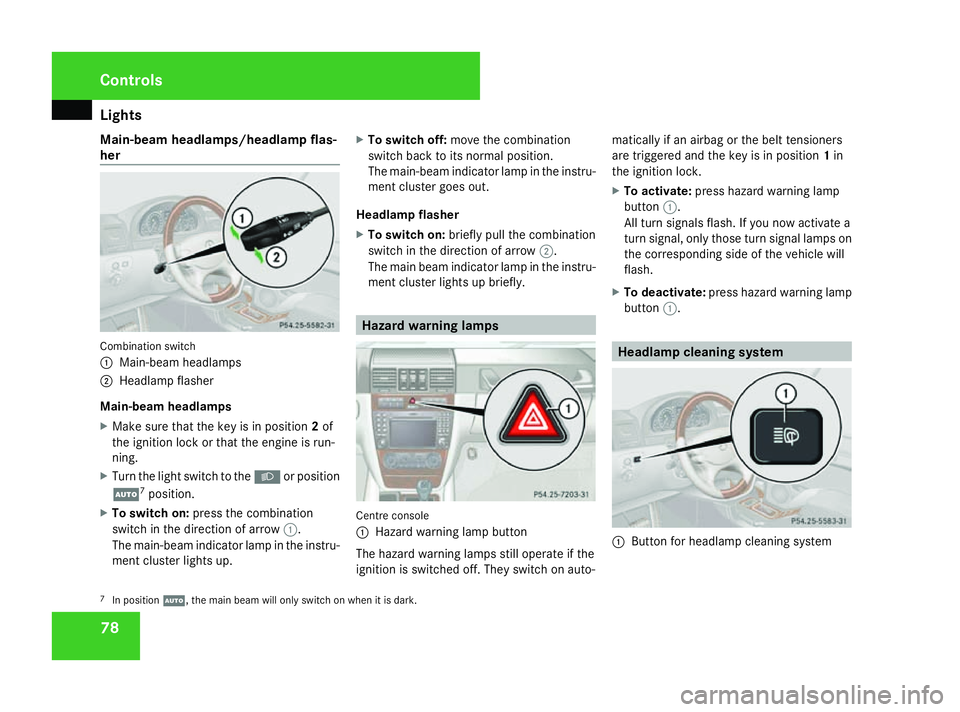
Main-beam headlamps/headlamp flas-
her Combination switch
1
Main-beam headlamps
2 Headlamp flasher
Main-beam headlamps
X Make sure that the key is in position 2of
the ignition lock or that the engine is run-
ning.
X Turn the light switch to the Bor position
U 7
position.
X To switch on: press the combination
switch in the direction of arrow 1.
The main-beam indicator lamp in the instru-
ment cluster lights up. X
To switch off: move the combination
switch back to its normal position.
The main-beam indicator lamp in the instru-
ment cluster goes out.
Headlamp flasher
X To switch on: briefly pull the combination
switch in the direction of arrow 2.
The main beam indicator lamp in the instru-
ment cluster lights up briefly. Hazard warning lamps
Centre console
1
Hazard warning lamp button
The hazard warning lamps still operate if the
ignition is switched off. They switch on auto- matically if an airbag or the belt tensioners
are triggered and the key is in position
1in
the ignition lock.
X To activate: press hazard warning lamp
button 1.
All turn signals flash. If you now activate a
turn signal, only those turn signal lamps on
the corresponding side of the vehicle will
flash.
X To deactivate: press hazard warning lamp
button 1. Headlamp cleaning system
1
Button for headlamp cleaning system
7 In position U, the main beam will only switch on when it is dark. Controls
463_AKB; 1; 8, en-GB
wobuchh,
Version: 2.10.6 2008-07-17T15:19:41+02:00 - Seite 78Dateiname: 6515_4091_02_buchblock.pdf; preflight
Page 135 of 293
Sliding sunroof
132R
whether a signal has been transmitted to
the auxiliary heating or ventilation
R about the remote control's battery
charge status:
If the remote control indicator lamp first
lights up orange when you press one of
the buttons, the battery is almost dis-
charged.
If the remote control indicator lamp only
flashes orange when you press one of the
buttons, the battery is discharged.
Replace the battery (Y page 235).
The signal has been interrupted if the indi-
cator lamp on the remote control flashes
green when switching on or red when
switching off.
In this case, repeat the procedure. Stand
somewhere else or move closer to the vehi-
cle, if necessary.
X To deactivate the auxiliary heating/
ventilation: press and hold the OFFbutton
until indicator lamp 4on the remote con-
trol lights up in red.
The red or the yellow indicator lamp in the
button on the centre console goes out. Sliding sunroof
Sliding/tilting sunroof*
G
Risk of injury
Children could injure themselves if they
operate the sliding/tilting sunroof.
Never leave children unsupervised in the
vehicle. Always take the key with you when
leaving the vehicle, even if you are only
leaving it for a short time. G
Risk of injury
Make sure that nobody can become trap-
ped when you are opening and closing the
sliding/tilting sunroof. If there is a risk of
entrapment, release the switch and push it
briefly in any direction to stop the sliding/
tilting sunroof. G
Risk of injury
If you are not wearing a seat belt, there is
a risk that you could be thrown through the
opening in the event of the vehicle over-
turning. Therefore, always wear a seat belt
to reduce the risk of injuries.
! Only open the sliding/tilting sunroof if it
is free of snow and ice. Otherwise, mal-
functions may occur. Do not allow anything to protrude from the
sliding/tilting sunroof. The seals could oth-
erwise be damaged.
i Resonance noises can occur in addition
to the usual airflow noises when the slid-
ing/tilting sunroof is open. They are caused
by minor pressure fluctuations in the vehi-
cle interior.
Change the position of the sliding/tilting
sunroof or open a side window slightly to
reduce or eliminate these noises.
i It is also possible to open and close the
sliding/tilting sunroof from the outside
using the "Summer opening" and "Conve-
nience closing" features respectively. Controls
* optional
463_AKB; 1; 8, en-GB
wobuchh,
Version: 2.10.6 2008-07-17T15:19:41+02:00 - Seite 132Dateiname: 6515_4091_02_buchblock.pdf; preflight
Page 143 of 293
Loading and stowing
140
R
Always place the load behind unoccupied
seats if possible.
R If possible, always transport the load in the
luggage compartment with the seat backr-
ests folded up and engaged. R
If the rear bench seat is not occupied, insert
the belt tongue on the outer seat belts into
the buckle of the opposite seat belt.
R Secure the load with sufficiently strong and
wear-resistant load restraints. Pad sharp
edges for protection.
i Load restraints are available at any quali-
fied specialist workshop, e.g. a Mercedes-
Benz Service Centre. Securing a load
Lashing eyelets G
Risk of injury
Distribute the load on the lashing eyelets
evenly.
Otherwise, vehicle occupants could be
injured by objects being thrown around if
you:
R brake sharply
R change direction suddenly
R are involved in an accident
Please observe the loading guidelines.
Observe the following points or guidelines
when securing loads:
R Secure the load using the lashing eyelets.
R Do not use elastic straps or nets to secure
a load, as these are only intended as an
anti-slip protection for light loads.
R If you are using tensioning straps, only use
straps with a minimum permissible tensile
strength of 600 daN and a percentage elon-
gation of approximately 7%.
R Do not route lashing materials across sharp
edges or corners. R
Pad sharp edges for protection.
R Load the anchorages evenly.
R Use all the lashing eyelets if possible.
R Do not overload the lashing eyelets if you
are using tensioning devices.
R Please read and observe the operating
instructions for the lashing material used.
Long-wheelbase station wagon
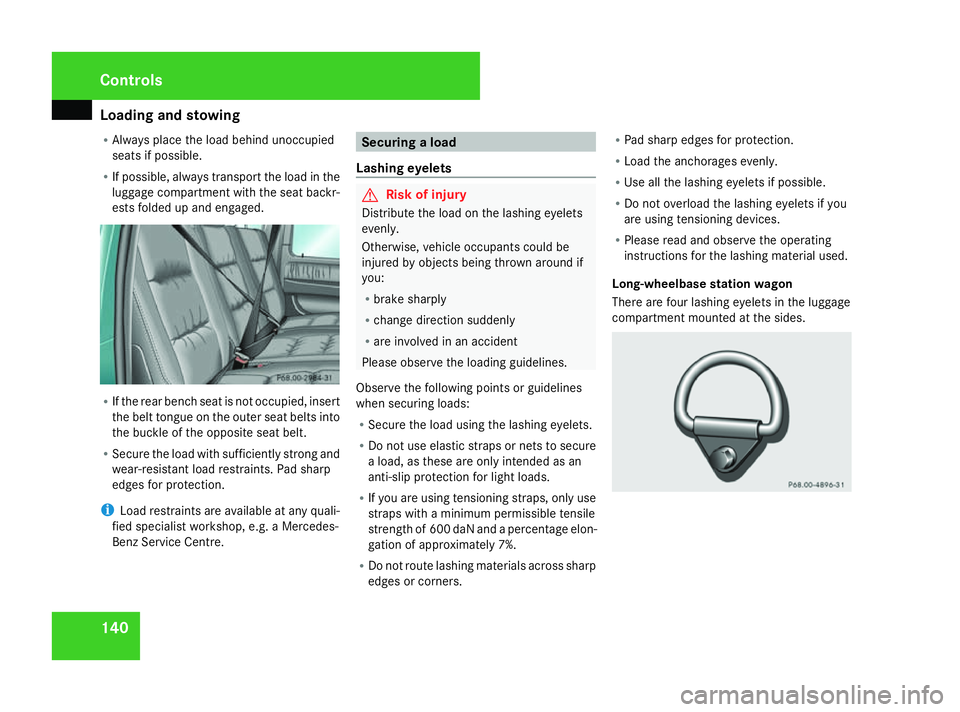
There are four lashing eyelets in the luggage
compartment mounted at the sides. Controls
463_AKB; 1; 8, en-GB
wobuchh,
Version: 2.10.6 2008-07-17T15:19:41+02:00 - Seite 140Dateiname: 6515_4091_02_buchblock.pdf; preflight
Page 145 of 293
Loading and stowing
142
Folding back the seat backrest i
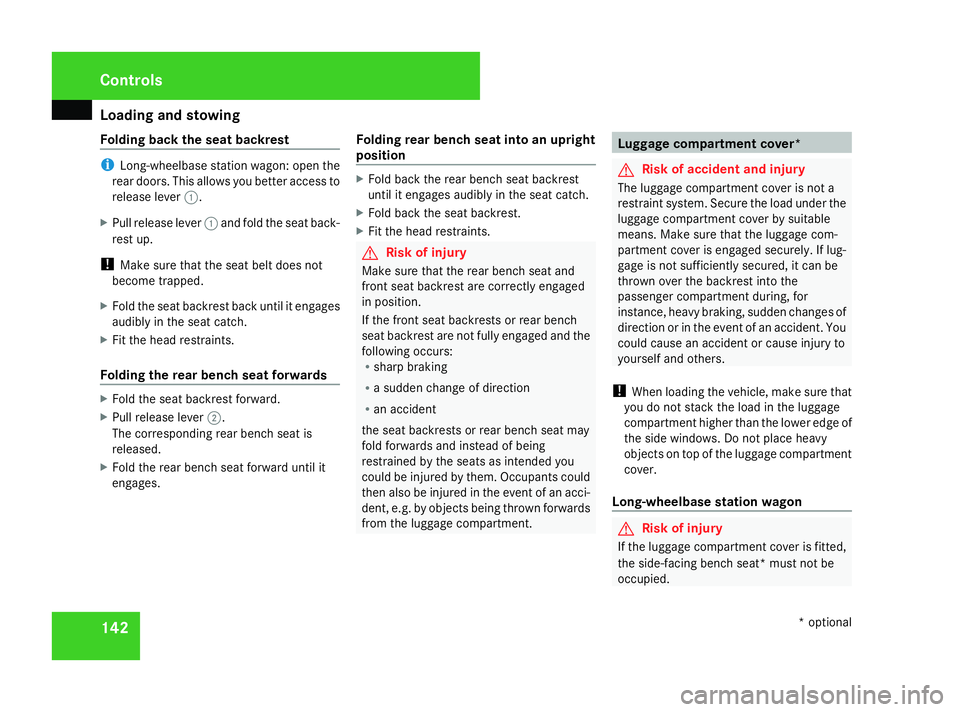
Long-wheelbase station wagon: open the
rear doors. This allows you better access to
release lever 1.
X Pull release lever 1and fold the seat back-
rest up.
! Make sure that the seat belt does not
become trapped.
X Fold the seat backrest back until it engages
audibly in the seat catch.
X Fit the head restraints.
Folding the rear bench seat forwards X
Fold the seat backrest forward.
X Pull release lever 2.
The corresponding rear bench seat is
released.
X Fold the rear bench seat forward until it
engages. Folding rear bench seat into an upright
position X
Fold back the rear bench seat backrest
until it engages audibly in the seat catch.
X Fold back the seat backrest.
X Fit the head restraints. G
Risk of injury
Make sure that the rear bench seat and
front seat backrest are correctly engaged
in position.
If the front seat backrests or rear bench
seat backrest are not fully engaged and the
following occurs:
R sharp braking
R a sudden change of direction
R an accident
the seat backrests or rear bench seat may
fold forwards and instead of being
restrained by the seats as intended you
could be injured by them. Occupants could
then also be injured in the event of an acci-
dent, e.g. by objects being thrown forwards
from the luggage compartment. Luggage compartment cover*
G
Risk of accident and injury
The luggage compartment cover is not a
restraint system. Secure the load under the
luggage compartment cover by suitable
means. Make sure that the luggage com-
partment cover is engaged securely. If lug-
gage is not sufficiently secured, it can be
thrown over the backrest into the
passenger compartment during, for
instance, heavy braking, sudden changes of
direction or in the event of an accident. You
could cause an accident or cause injury to
yourself and others.
! When loading the vehicle, make sure that
you do not stack the load in the luggage
compartment higher than the lower edge of
the side windows. Do not place heavy
objects on top of the luggage compartment
cover.
Long-wheelbase station wagon G
Risk of injury
If the luggage compartment cover is fitted,
the side-facing bench seat* must not be
occupied. Controls
* optional
463_AKB; 1; 8, en-GB
wobuchh,
Version: 2.10.6 2008-07-17T15:19:41+02:00 - Seite 142Dateiname: 6515_4091_02_buchblock.pdf; preflight
Page 204 of 293
Display
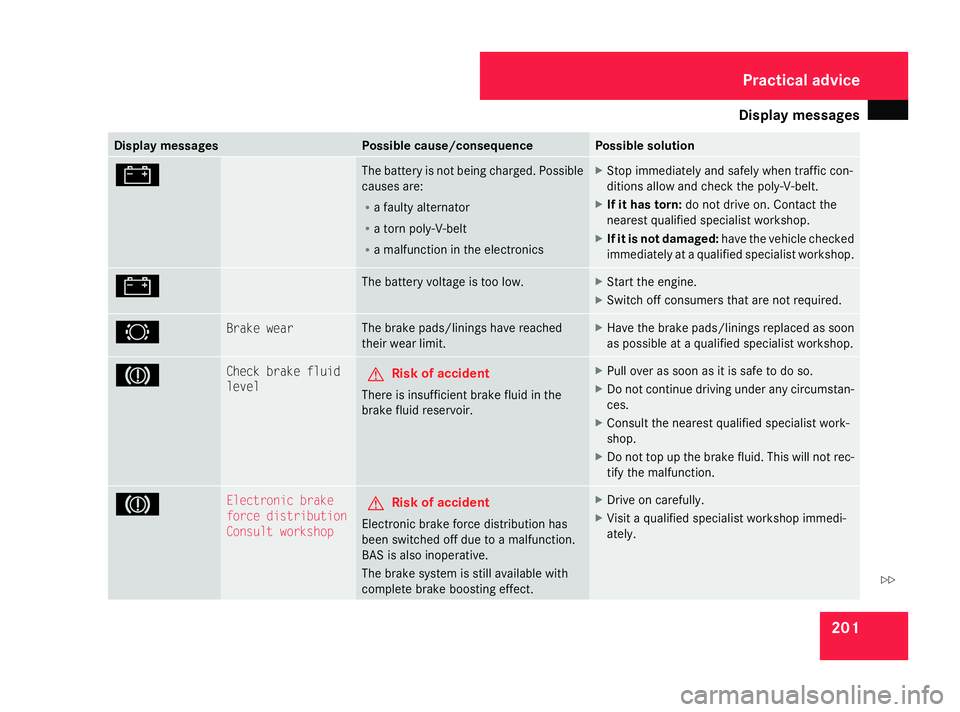
messages 201Display messages Possible cause/consequence Possible solution
# The battery is not being charged. Possible
ca
uses are:
R a faulty alternator
R a torn poly-V-belt
R a malfunction in the electronics X
Stop immediately and safely when traffic con-
ditions allow and check the poly-V-belt.
X If it has torn: do not drive on. Contact the
nearest qualified specialist workshop.
X If it is not damaged: have the vehicle checked
immediately at a qualified specialist workshop. # The battery voltage is too low. X
Start the engine.
X Switch off consumers that are not required. 2 Brake wear The brake pads/linings have reached
their wear limit. X
Have the brake pads/linings replaced as soon
as possible at a qualified specialist workshop. 3 Check brake fluid
level G
Risk of accident
There is insufficient brake fluid in the
brake fluid reservoir. X
Pull over as soon as it is safe to do so.
X Do not continue driving under any circumstan-
ces.
X Consult the nearest qualified specialist work-
shop.
X Do not top up the brake fluid. This will not rec-
tify the malfunction. 3 Electronic brake
force distribution
Consult workshop G
Risk of accident
Electronic brake force distribution has
been switched off due to a malfunction.
BAS is also inoperative.
The brake system is still available with
complete brake boosting effect. X
Drive on carefully.
X Visit a qualified specialist workshop immedi-
ately. Practical advice
463_AKB; 1; 8, en-GB
wobuchh,
Version: 2.10.6 2008-07-17T15:19:41+02:00 - Seite 201 ZDateiname: 6515_4091_02_buchblock.pdf; preflight
Page 206 of 293
Display
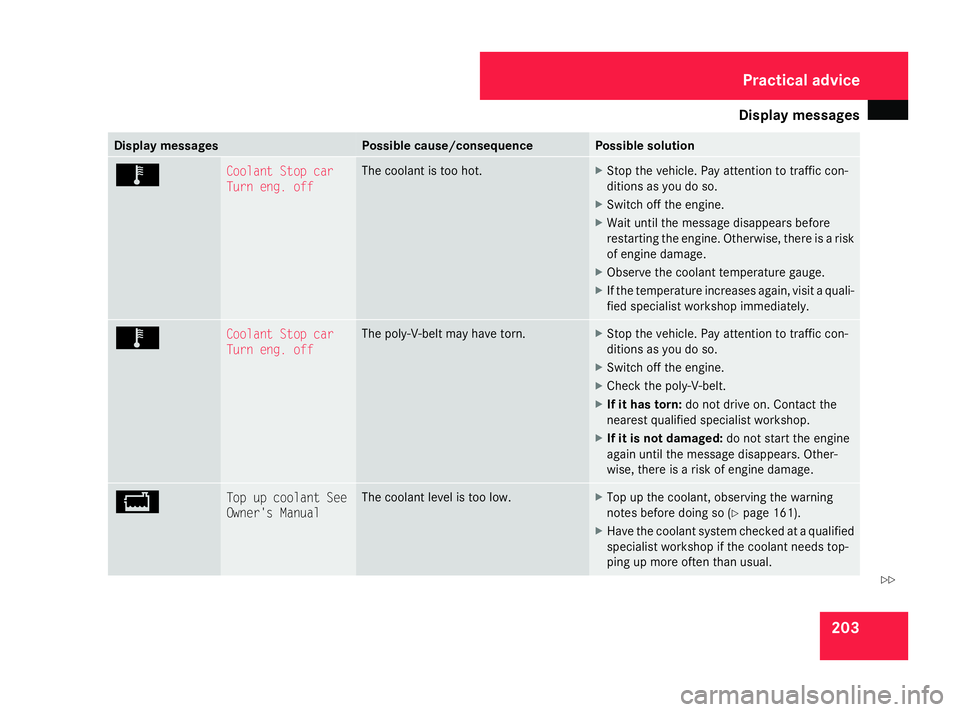
messages 203Display messages Possible cause/consequence Possible solution
Ï Coolant Stop car
Turn eng. off The coolant is too hot. X
Stop the vehicle. Pa y attention to traffic con-
ditions as you do so.
X Switch off the engine.
X Wait until the message disappears before
restarting the engine. Otherwise, there is a risk
of engine damage.
X Observe the coolant temperature gauge.
X If the temperature increases again, visit a quali-
fied specialist workshop immediately. Ï Coolant Stop car
Turn eng. off The poly-V-belt may have torn. X
Stop the vehicle. Pay attention to traffic con-
ditions as you do so.
X Switch off the engine.
X Check the poly-V-belt.
X If it has torn: do not drive on. Contact the
nearest qualified specialist workshop.
X If it is not damaged: do not start the engine
again until the message disappears. Other-
wise, there is a risk of engine damage. B Top up coolant See
Owner's Manual The coolant level is too low. X
Top up the coolant, observing the warning
notes before doing so (Y page 161).
X Have the coolant system checked at a qualified
specialist workshop if the coolant needs top-
ping up more often than usual. Practical advice
463_AKB; 1; 8, en-GB
wobuchh,
Version: 2.10.6 2008-07-17T15:19:41+02:00 - Seite 203 ZDateiname: 6515_4091_02_buchblock.pdf; preflight
Page 212 of 293
Display
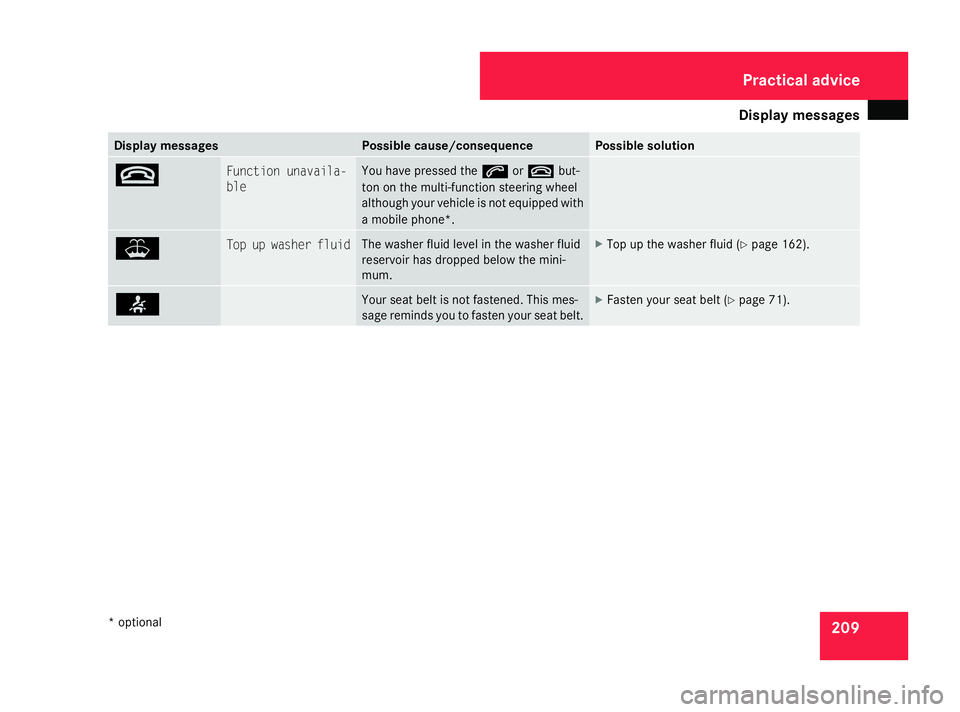
messages 209Display messages Possible cause/consequence Possible solution
t Function unavaila-
ble Yo
u have pressed the sort but-
ton on the multi-function steering wheel
although your vehicle is not equipped with
a mobile phone*. W Top up washer fluid The washer fluid level in the washer fluid
reservoir has dropped below the mini-
mum. X
Top up the washer fluid ( Ypage 162). < Your seat belt is not fastened. This mes-
sage reminds you to fasten your seat belt. X
Fasten your seat belt (Y page 71). Practical advice
* optional
463_AKB; 1; 8, en-GB
wobuchh,
Version: 2.10.6 2008-07-17T15:19:41+02:00 - Seite 209 ZDateiname: 6515_4091_02_buchblock.pdf; preflight
Page 217 of 293
Troubleshooting
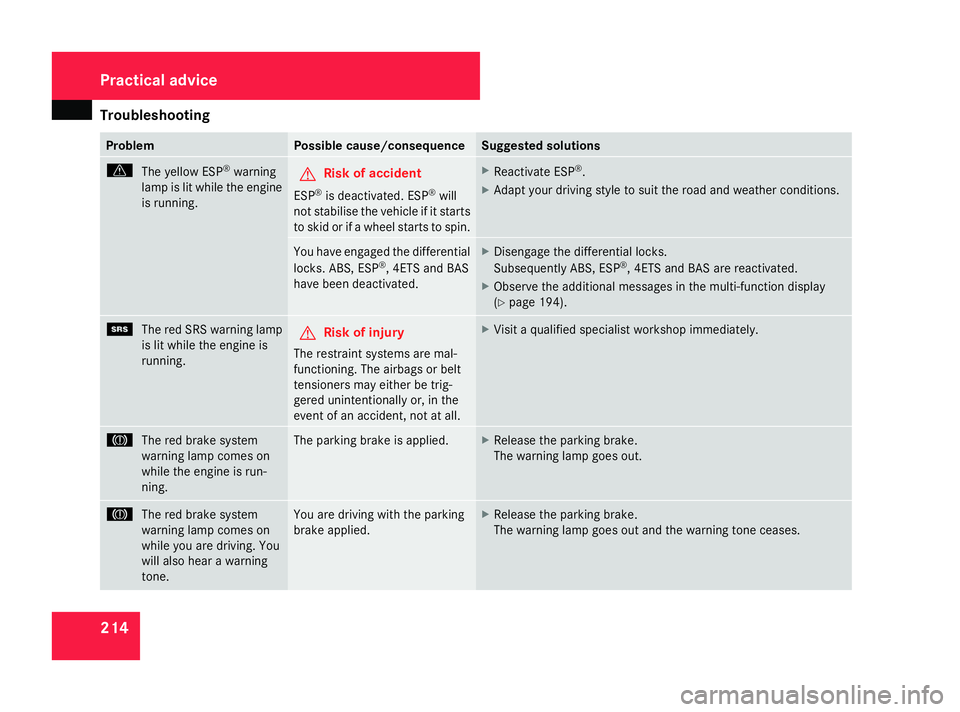
214 Problem Possible cause/consequence Suggested solutions
v
Theyellow ESP ®
warning
lamp is lit while the engine
is running. G
Risk of accident
ESP ®
is deactivated. ESP ®
will
not stabilise the vehicle if it starts
to skid or if a wheel starts to spin. X
Reactivate ESP ®
.
X Adapt your driving style to suit the road and weather conditions. You have engaged the differential
locks. ABS, ESP
®
, 4ETS and BAS
have been deactivated. X
Disengage the differential locks.
Subsequently ABS, ESP ®
, 4ETS and BAS are reactivated.
X Observe the additional messages in the multi-function display
(Y page 194). 1
The red SRS warning lamp
is lit while the engine is
running. G
Risk of injury
The restraint systems are mal-
functioning. The airbags or belt
tensioners may either be trig-
gered unintentionally or, in the
event of an accident, not at all. X
Visit a qualified specialist workshop immediately. 3
The red brake system
warning lamp comes on
while the engine is run-
ning. The parking brake is applied. X
Release the parking brake.
The warning lamp goes out. 3
The red brake system
warning lamp comes on
while you are driving. You
will also hear a warning
tone. You are driving with the parking
brake applied. X
Release the parking brake.
The warning lamp goes out and the warning tone ceases. Practical advice
463_AKB; 1; 8, en-GB
wobuchh,
Version: 2.10.6 2008-07-17T15:19:41+02:00 - Seite 214Dateiname: 6515_4091_02_buchblock.pdf; preflight
Page 219 of 293
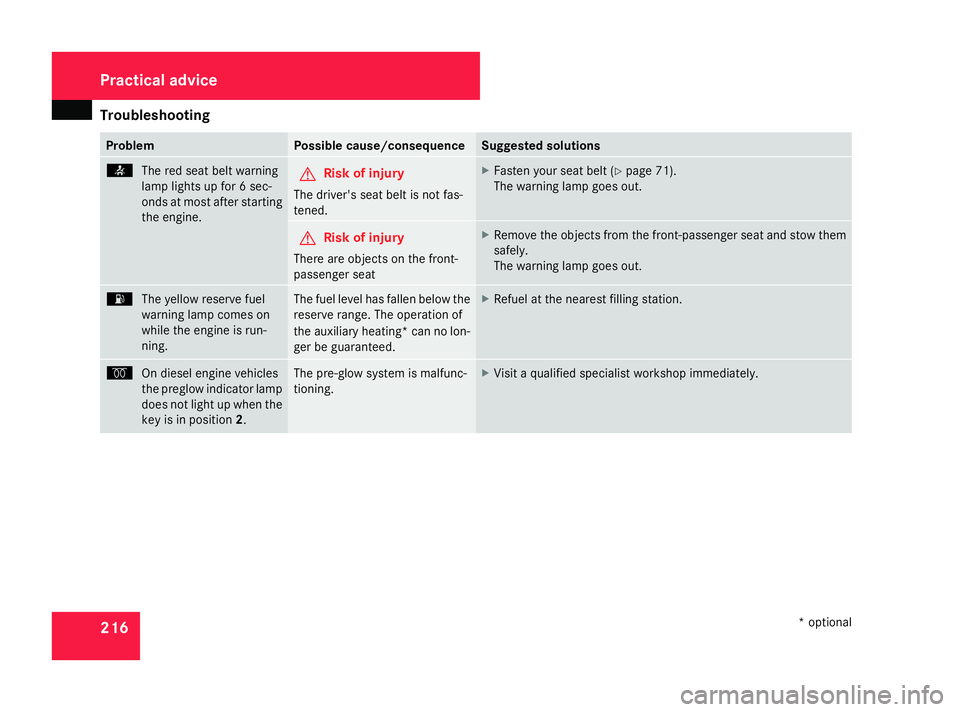
Troubleshooting
216 Problem Possible cause/consequence Suggested solutions
<
The red seat belt warning
lamp lights up for 6 sec-
onds at most after starting
the engine. G
Risk of injury
The driver's seat belt is not fas-
tened. X
Fasten your seat belt ( Ypage 71).
The warning lamp goes out. G
Risk of injury
There are objects on the front-
passenger seat X
Remove the objects from the front-passenger seat and stow them
safely.
The warning lamp goes out. A
The yellow reserve fuel
warning lamp comes on
while the engine is run-
ning. The fuel level has fallen below the
reserve range. The operation of
the auxiliary heating* can no lon-
ger be guaranteed. X
Refuel at the nearest filling station. q
On diesel engine vehicles
the preglow indicator lamp
does not light up when the
key is in position 2. The pre-glow system is malfunc-
tioning. X
Visit a qualified specialist workshop immediately. Practical advice
* optional
463_AKB; 1; 8, en-GB
wobuchh,
Version: 2.10.6 2008-07-17T15:19:41+02:00 - Seite 216Dateiname: 6515_4091_02_buchblock.pdf; preflight
Page 220 of 293
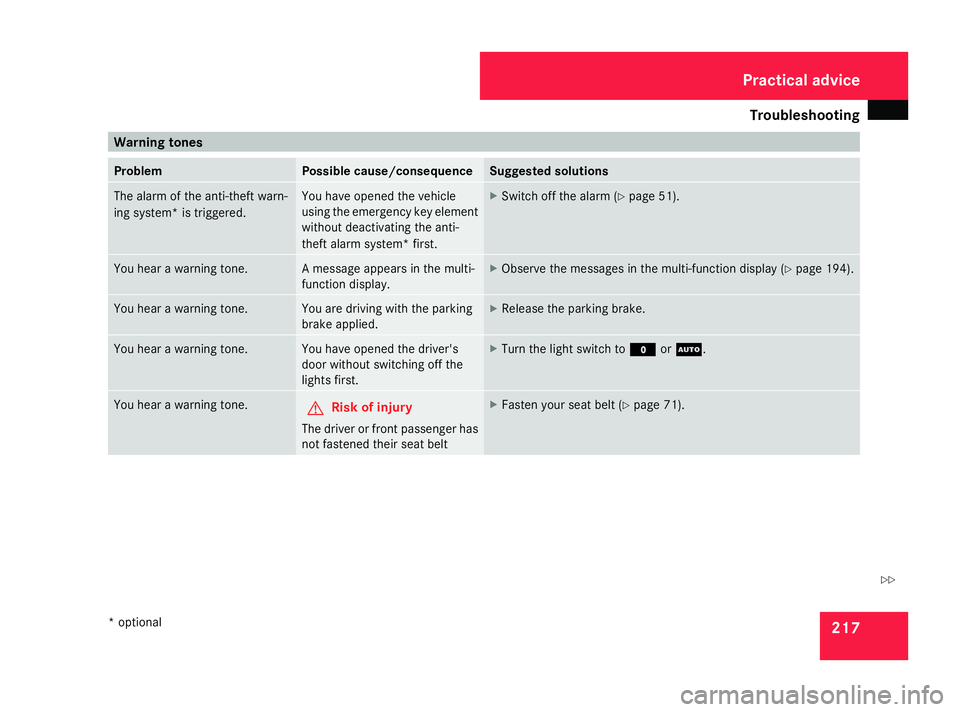
Troubleshooting
217Warning tones
Problem Possible cause/consequence Suggested solutions
The alarm of the anti-theft warn-
ing system* is triggered. You have opened the vehicle
using the emergency key element
without deactivating the anti-
theft alarm system* first. X
Switch off the alarm (Y page 51).You hear a warning tone. A message appears in the multi-
function displa
y. X
Observe the messages in the multi-function display (Y page 194).You hear a warning tone. You are driving with the parking
brake applied. X
Release the parking brake. You hear a warning tone. You have opened the driver's
door without switching off the
lights first. X
Turn the light switch to MorU. You hear a warning tone.
G
Risk of injury
The driver or front passenger has
not fastened their seat belt X
Fasten your seat belt ( Ypage 71). Practical advice
* optional
463_AKB; 1; 8, en-GB
wobuchh,
Version: 2.10.6 2008-07-17T15:19:41+02:00 - Seite 217 ZDateiname: 6515_4091_02_buchblock.pdf; preflight