differential MERCEDES-BENZ G-CLASS SUV 2008 User Guide
[x] Cancel search | Manufacturer: MERCEDES-BENZ, Model Year: 2008, Model line: G-CLASS SUV, Model: MERCEDES-BENZ G-CLASS SUV 2008Pages: 293, PDF Size: 4.49 MB
Page 177 of 293
Off-road driving
174
i
Information about retrofitting special all-
terrain tyres is available from any
Mercedes-Benz Service Centre.
Checklist before driving off-road X
Engine oil level: check the engine oil and
top it up if necessary.
Only then does the engine receive enough
oil when the vehicle is standing on a steep
incline.
X Vehicle toolkit: check that the jack is
working and make sure you have the wheel-
brace, a robust tow cable and a folding
spade in the vehicle.
X Wheels and tyres: check the tyre tread
depth and tyre pressure.
X Check for damage and remove any objects,
e.g. small stones, from the wheels/tyres.
X Replace any missing valve caps.
X Replace dented or damaged wheels.
Checklist after driving off-road Driving over rough terrain places greater
demands on your vehicle than driving on nor-
mal roads. After driving off-road, check the
vehicle. This allows you to detect damage
promptly and reduce the risk of an accident
to yourself and other road users. X
Shift the transfer case to HIGH
(Y page 93).
X Disengage the differential locks
(Y page 95).
X Clean the headlamps and rear lights and
check for damage.
X Clean the front and rear licence plates.
X Clean the wheels/tyres with a water jet and
remove any foreign objects.
X Clean the wheels, wheel arches and the
vehicle underside with a water jet; check
for foreign objects and damage.
X Check whether twigs or other parts of
plants have become trapped. These
increase the risk of fire and can damage
fuel pipes, brake hoses or the rubber bel-
lows of the axle joints and propeller shafts.
X After the trip, examine without fail the
entire undercarriage, wheels, tyres, brakes,
bodywork structure, steering, chassis and
exhaust system for damage.
X After driving for extended periods across
sand, mud, gravel, water or in similarly dirty
conditions, have the brake discs, wheels,
brake pads /linings and axle joints checked
and cleaned.
X If you detect strong vibrations after off-road
travel, check for foreign objects in the
wheels and drive train and remove them if necessary. Foreign objects can disturb the
balance and cause vibrations. Travelling uphill
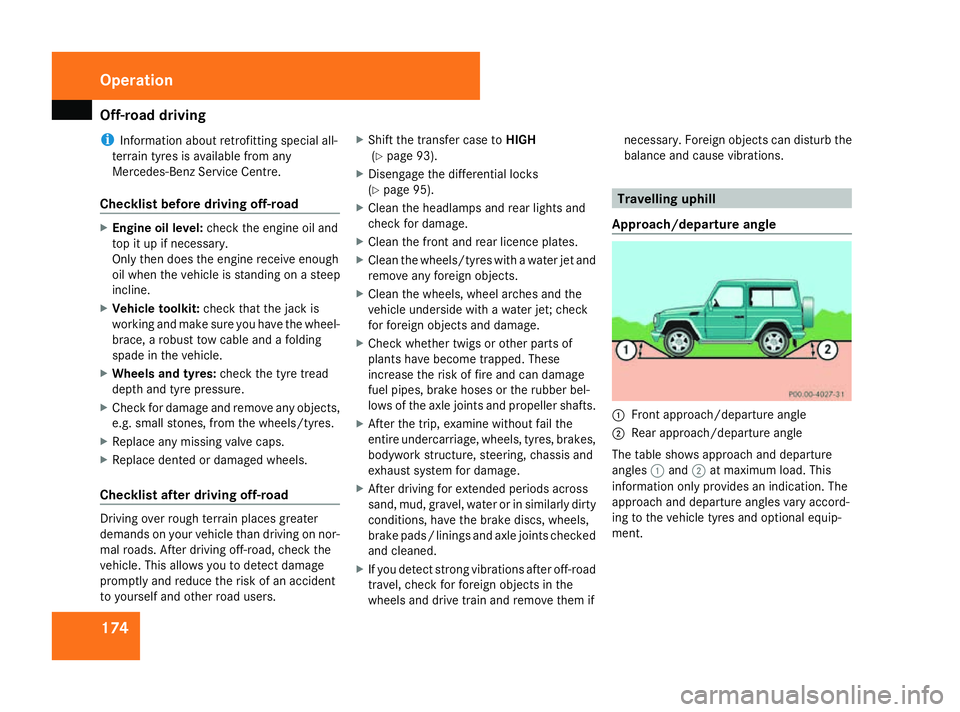
Approach/departure angle 1
Front approach/departure angle
2 Rear approach/departure angle
The table shows approach and departure
angles 1and 2at maximum load. This
information only provides an indication. The
approach and departure angles vary accord-
ing to the vehicle tyres and optional equip-
ment. Operation
463_AKB; 1; 8, en-GB
wobuchh,
Version: 2.10.6 2008-07-17T15:19:41+02:00 - Seite 174Dateiname: 6515_4091_02_buchblock.pdf; preflight
Page 178 of 293
Off-road driving
1751
1 2
2 Long-wheelbase station
wagon
13 37° 31°
G 55 AMG
33° 28°
Short-wheelbase station
wagon
36° 27°
Cabriolet
34° 26°
R
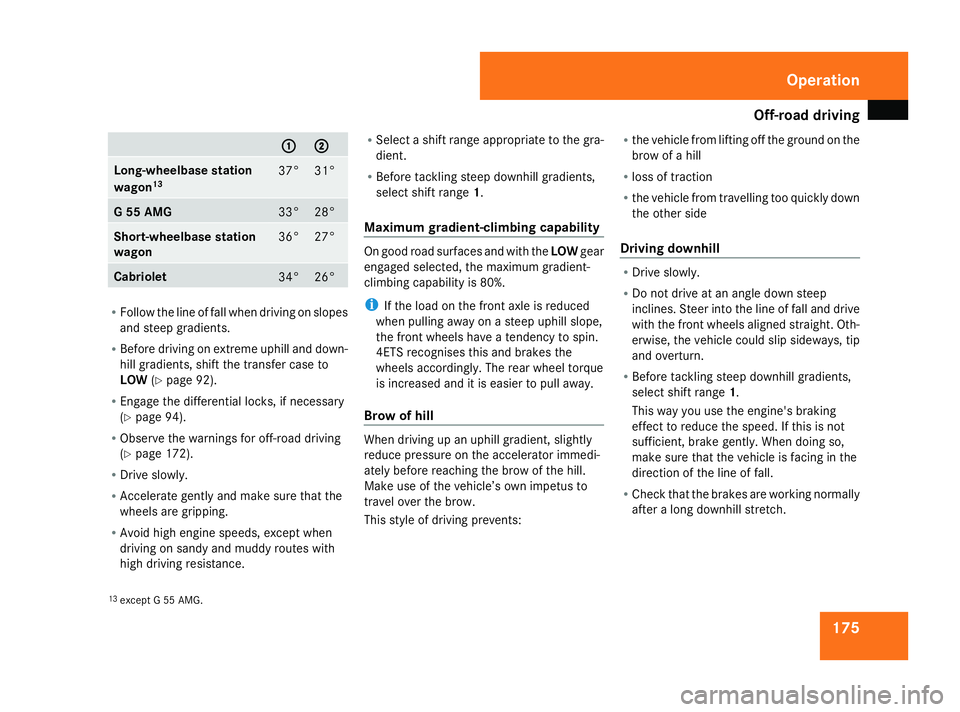
Follow the line of fall when driving on slopes
and steep gradients.
R Before driving on extreme uphill and down-
hill gradients, shift the transfer case to
LOW (Ypage 92).
R Engage the differential locks, if necessary
(Y page 94).
R Observe the warnings for off-road driving
(Y page 172).
R Drive slowly.
R Accelerate gently and make sure that the
wheels are gripping.
R Avoid high engine speeds, except when
driving on sandy and muddy routes with
high driving resistance. R
Select a shift range appropriate to the gra-
dient.
R Before tackling steep downhill gradients,
select shift range 1.
Maximum gradient-climbing capability On good road surfaces and with the
LOWgear
engaged selected, the maximum gradient-
climbing capability is 80%.
i If the load on the front axle is reduced
when pulling away on a steep uphill slope,
the front wheels have a tendency to spin.
4ETS recognises this and brakes the
wheels accordingly. The rear wheel torque
is increased and it is easier to pull away.
Brow of hill When driving up an uphill gradient, slightly
reduce pressure on the accelerator immedi-
ately before reaching the brow of the hill.
Make use of the vehicle’s own impetus to
travel over the brow.
This style of driving prevents:R
the vehicle from lifting off the ground on the
brow of a hill
R loss of traction
R the vehicle from travelling too quickly down
the other side
Driving downhill R
Drive slowly.
R Do not drive at an angle down steep
inclines. Steer into the line of fall and drive
with the front wheels aligned straight. Oth-
erwise, the vehicle could slip sideways, tip
and overturn.
R Before tackling steep downhill gradients,
select shift range 1.
This way you use the engine's braking
effect to reduce the speed. If this is not
sufficient, brake gently. When doing so,
make sure that the vehicle is facing in the
direction of the line of fall.
R Check that the brakes are working normally
after a long downhill stretch.
13 except G 55 AMG. Operation
463_AKB; 1; 8, en-GB
wobuchh,
Version: 2.10.6 2008-07-17T15:19:41+02:00 - Seite 175 ZDateiname: 6515_4091_02_buchblock.pdf; preflight
Page 179 of 293
Off-road driving
176 Driving over obstacles
Observe the following rules when driving over
tree stumps, large stones and other obsta-
cles:
R shift the transfer case to
LOW (Ypage 92).
R avoid high engine speeds.
R select shift range 1.
R drive very slowly.
R try to drive straight over the centre of
obstacles: front wheel first, then rear
wheel.
! Obstacles could damage the floor of the
vehicle or components of the chassis. Ask
passengers for guidance when driving over
large obstacles. Any damage to the vehicle
always increases the risk of an accident. Fording
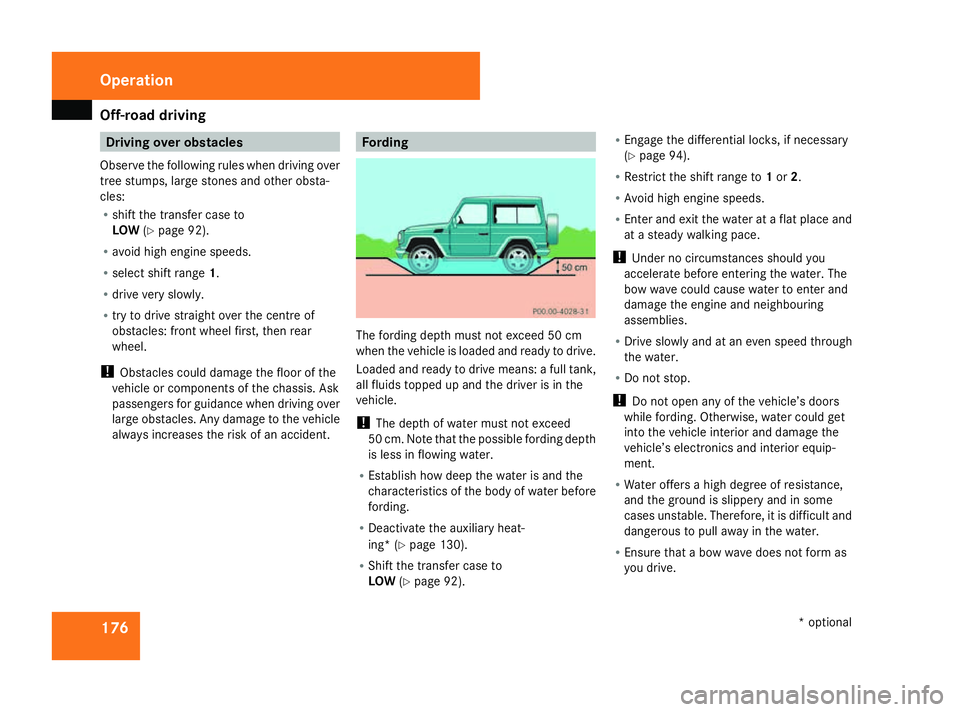
The fording depth must not exceed 50 cm
when the vehicle is loaded and ready to drive.
Loaded and ready to drive means: a full tank,
all fluids topped up and the driver is in the
vehicle.
!
The depth of water must not exceed
50 cm. Note that the possible fording depth
is less in flowing water.
R Establish how deep the water is and the
characteristics of the body of water before
fording.
R Deactivate the auxiliary heat-
ing* (Y page 130).
R Shift the transfer case to
LOW (Ypage 92). R
Engage the differential locks, if necessary
(Y page 94).
R Restrict the shift range to 1or 2.
R Avoid high engine speeds.
R Enter and exit the water at a flat place and
at a steady walking pace.
! Under no circumstances should you
accelerate before entering the water. The
bow wave could cause water to enter and
damage the engine and neighbouring
assemblies.
R Drive slowly and at an even speed through
the water.
R Do not stop.
! Do not open any of the vehicle’s doors
while fording. Otherwise, water could get
into the vehicle interior and damage the
vehicle’s electronics and interior equip-
ment.
R Water offers a high degree of resistance,
and the ground is slippery and in some
cases unstable. Therefore, it is difficult and
dangerous to pull away in the water.
R Ensure that a bow wave does not form as
you drive. Operation
* optional
463_AKB; 1; 8, en-GB
wobuchh,
Version: 2.10.6 2008-07-17T15:19:41+02:00 - Seite 176Dateiname: 6515_4091_02_buchblock.pdf; preflight
Page 216 of 293
Troubleshooting
213Problem Possible cause/consequence Suggested solutions
-
Theyellow ABS warning
lamp comes on while the
engine is running. G
Risk of accident
ABS has been deactivated due to
undervoltage. It is possible that
the battery is not being charged.
Therefore, the following systems
are, for example, also deactiva-
ted: ESP ®
, BAS, 4ETS and the tyre
pressure monitor*.
The brake system continues to
function normally, but without
electronic support. The wheels
could therefore lock if you brake
hard. X
Switch off consumers that are not required, e.g. reading lamps,
interior lighting, etc.
ABS will be available again as soon as the vehicle's electrical sys-
tem voltage increases.
X Observe the additional messages in the multi-function display
(Y page 194). You have engaged the differential
locks. X
Disengage the differential locks.
Subsequently ABS is reactivated. v
The yellow ESP ®
warning
lamp flashes while the
vehicle is in motion. G
Risk of accident
ESP ®
, ABS or traction control has
intervened because at least one
wheel has reached its grip limit
and is threatening to spin or lock. X
Only depress the accelerator pedal as far as necessary when pull-
ing away.
X Release the accelerator pedal while you are driving.
X Adapt your driving style to suit the road and weather conditions.
X Do not deactivate ESP ®
.
Exceptions: (Y page 48) Practical advice
* optional
463_AKB; 1; 8, en-GB
wobuchh,
Version: 2.10.6 2008-07-17T15:19:41+02:00 - Seite 213 ZDateiname: 6515_4091_02_buchblock.pdf; preflight
Page 217 of 293
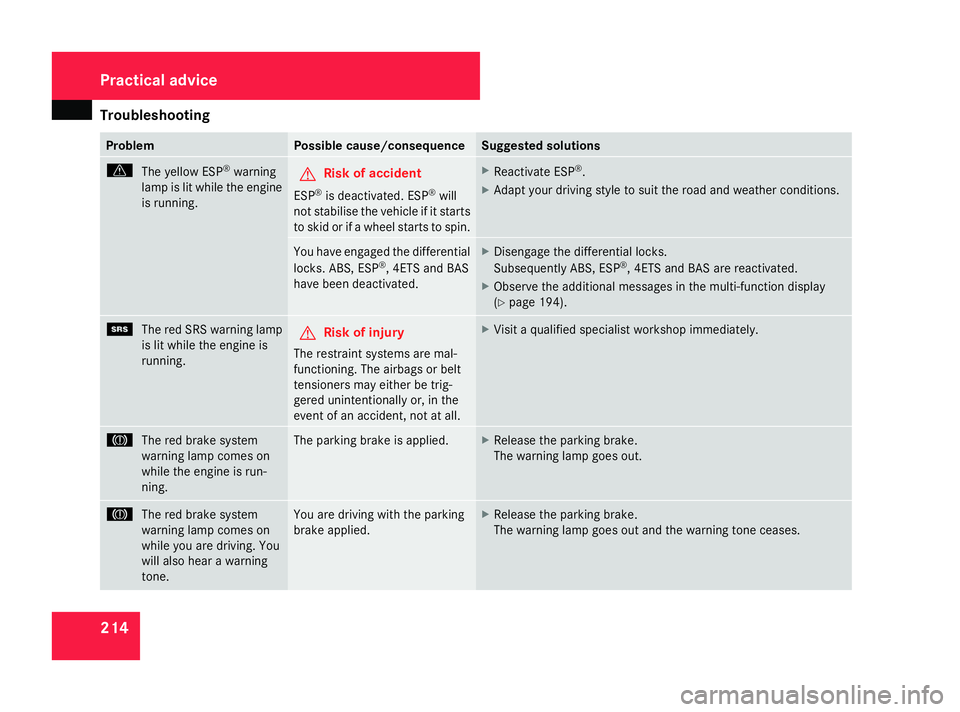
Troubleshooting
214 Problem Possible cause/consequence Suggested solutions
v
Theyellow ESP ®
warning
lamp is lit while the engine
is running. G
Risk of accident
ESP ®
is deactivated. ESP ®
will
not stabilise the vehicle if it starts
to skid or if a wheel starts to spin. X
Reactivate ESP ®
.
X Adapt your driving style to suit the road and weather conditions. You have engaged the differential
locks. ABS, ESP
®
, 4ETS and BAS
have been deactivated. X
Disengage the differential locks.
Subsequently ABS, ESP ®
, 4ETS and BAS are reactivated.
X Observe the additional messages in the multi-function display
(Y page 194). 1
The red SRS warning lamp
is lit while the engine is
running. G
Risk of injury
The restraint systems are mal-
functioning. The airbags or belt
tensioners may either be trig-
gered unintentionally or, in the
event of an accident, not at all. X
Visit a qualified specialist workshop immediately. 3
The red brake system
warning lamp comes on
while the engine is run-
ning. The parking brake is applied. X
Release the parking brake.
The warning lamp goes out. 3
The red brake system
warning lamp comes on
while you are driving. You
will also hear a warning
tone. You are driving with the parking
brake applied. X
Release the parking brake.
The warning lamp goes out and the warning tone ceases. Practical advice
463_AKB; 1; 8, en-GB
wobuchh,
Version: 2.10.6 2008-07-17T15:19:41+02:00 - Seite 214Dateiname: 6515_4091_02_buchblock.pdf; preflight