tailgate MERCEDES-BENZ G-CLASS SUV 2008 User Guide
[x] Cancel search | Manufacturer: MERCEDES-BENZ, Model Year: 2008, Model line: G-CLASS SUV, Model: MERCEDES-BENZ G-CLASS SUV 2008Pages: 293, PDF Size: 4.49 MB
Page 142 of 293
Loading and stowing
139Roof rack system*
G
Risk of accident and injury
An incorrectly secured roof rack, ski rack
or load could become detached from the
vehicle. These objects may then be thrown
around and can injure you or others or
cause an accident. Follow the roof rack/ski
rack manufacturer's installation instruc-
tions and special instructions for use.
The roof load raises the vehicle's centre of
gravity, thereby affecting vehicle handling.
Always observe the maximum roof load
(see the "Technical Data" section). Always
adapt your driving style to the prevailing
road, traffic and weather conditions and
drive with particular care if the roof is laden.
! Mercedes-Benz recommends that you
only use roof rack systems which have
been tested and approved for Mercedes-
Benz vehicles. This helps to prevent dam-
age to the vehicle.
Position the load on the roof rack in such a
way that the vehicle will not sustain dam-
age even when it is in motion.
Make sure that, depending on the vehicle's
equipment, you can fully raise the sliding/ tilting sunroof* and fully open the rear door
(station wagon).
X Follow the manufacturer’s installation
instructions when fitting the roof carrier
system. Luggage net in the front-passenger
footwell G
Risk of injury
Only place lightweight objects in the lug-
gage net. Do not use it to transport heavy,
sharp-edged or fragile objects. The luggage
net cannot secure the objects sufficiently
in the event of an accident. Loading guidelines
G
Risk of poisoning
Keep the boot lid/tailgate closed when the
engine is running. Otherwise, you could be
poisoned by exhaust fumes entering the
vehicle.
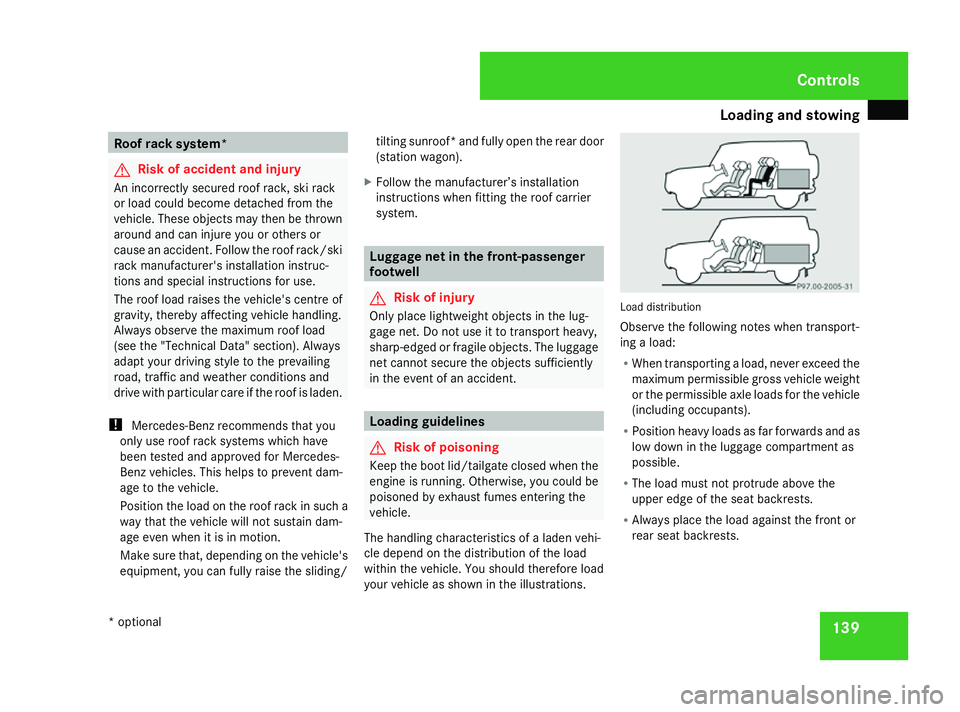
The handling characteristics of a laden vehi-
cle depend on the distribution of the load
within the vehicle. You should therefore load
your vehicle as shown in the illustrations. Load distribution
Observe the following notes when transport-
ing a load:
R When transporting a load, never exceed the
maximum permissible gross vehicle weight
or the permissible axle loads for the vehicle
(including occupants).
R Position heavy loads as far forwards and as
low down in the luggage compartment as
possible.
R The load must not protrude above the
upper edge of the seat backrests.
R Always place the load against the front or
rear seat backrests. Controls
* optional
463_AKB; 1; 8, en-GB
wobuchh,
Version: 2.10.6 2008-07-17T15:19:41+02:00 - Seite 139 ZDateiname: 6515_4091_02_buchblock.pdf; preflight
Page 144 of 293
Loading and stowing
141
Short-wheelbase station wagon and cab-
riolet
There are two further lashing eyelets moun-
ted at the sides in the luggage compartment
and under the rear bench seat. Guide the load restraints in a cross pattern
over the load, as shown in the illustration. Enlarging the luggage compartment
Short-wheelbase station wagon and cabrio-
let: the rear bench seat is split 50/50.
Long-wheelbase station wagon: the rear
bench seat is split 50/50.
The left-hand and right-hand rear seats can
be folded down to increase the luggage com-
partment capacity. You can:
R fold the seat backrests forward
R fold the rear bench seat back fully. G
Risk of injury
Do not carry heavy or hard objects inside
the vehicle or in the luggage compartment
unless they are secured.
Otherwise, you and other vehicle occu-
pants could be injured by objects being
thrown around the vehicle in the event of
sharp braking, a sudden change in direction
or an accident.
When using the luggage compartment
enlargement, you should always clip in the
safety net*, if at hand. G
Risk of poisoning
Keep the boot lid/tailgate closed when the
engine is running. Otherwise, you could be poisoned by exhaust fumes entering the
vehicle.
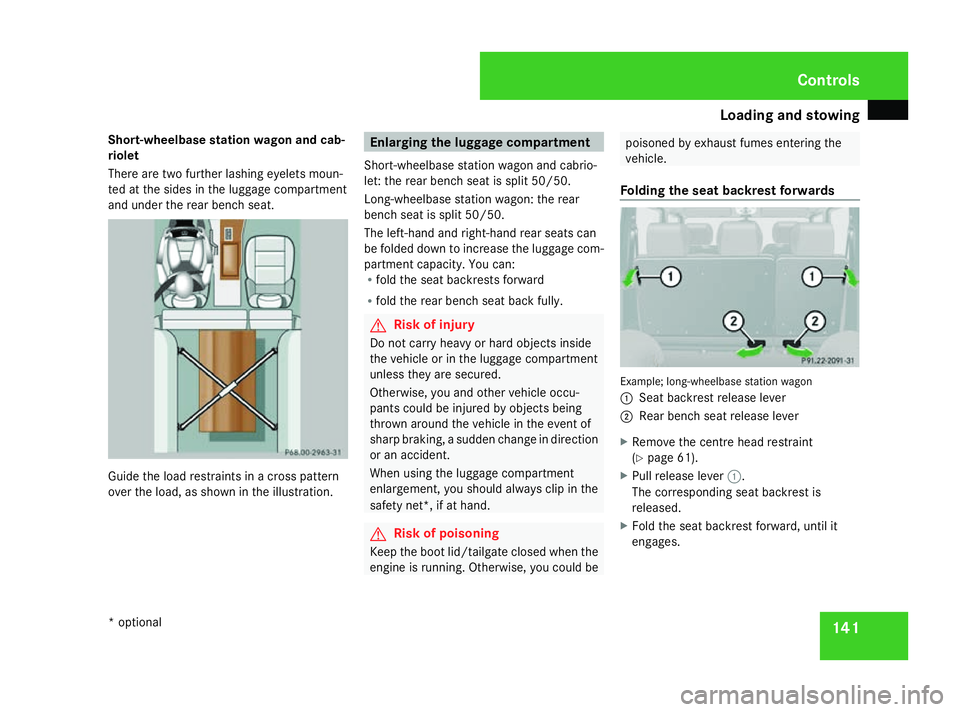
Folding the seat backrest forwards Example; long-wheelbase station wagon
1
Seat backrest release lever
2 Rear bench seat release lever
X Remove the centre head restraint
(Y page 61).
X Pull release lever 1.
The corresponding seat backrest is
released.
X Fold the seat backrest forward, until it
engages. Controls
* optional
463_AKB; 1; 8, en-GB
wobuchh, Version: 2.10.6 2008-07-17T15:19:41+02:00 - Seite 141 ZDateiname: 6515_4091_02_buchblock.pdf; preflight
Page 191 of 293
Where will I find...?
188 Where will I find...?
Warning triangle, first-aid kit and
vehicle tool kit
G
Risk of injury
The jack is designed only to raise and hold
the vehicle for a short time while a wheel
is being changed.
You must use axle stands if you are carrying
out work on the vehicle.
Make sure that the jack is placed on a firm,
non-slip, level surface. Do not use wooden
blocks or similar objects as a jack underlay.
Otherwise, the jack will not be able to ach-
ieve its load-bearing capacity due to the
restricted height.
Do not start the engine at any time while a
wheel is being changed.
Do not lie under the vehicle when it is being
supported by the jack. If you do not raise
the vehicle as described, it could slip off the
jack (e.g. if the engine is started or a door
or the tailgate is opened or closed) and you
could be seriously injured.
i Check the expiry date of the first-aid kit
annually, and replace the contents when
necessary. i
When using the jack, you should also
observe the safety notes in the "Flat tyre"
section (Y page 243).
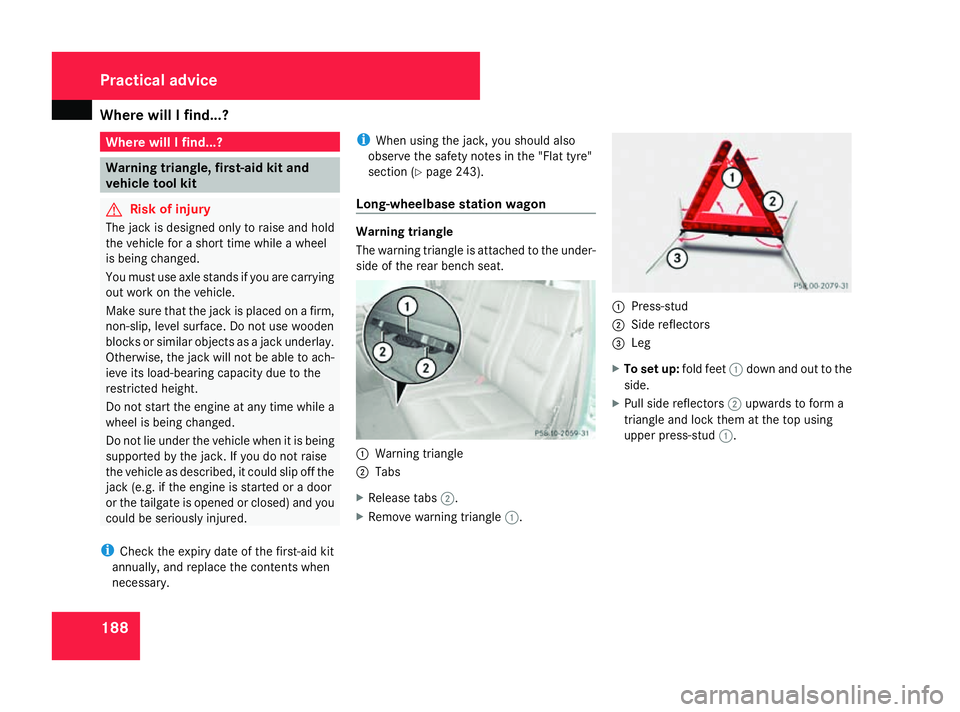
Long-wheelbase station wagon Warning triangle
The warning triangle is attached to the under-
side of the rear bench seat.
1
Warning triangle
2 Tabs
X Release tabs 2.
X Remove warning triangle 1. 1
Press-stud
2 Side reflectors
3 Leg
X To set up: fold feet1down and out to the
side.
X Pull side reflectors 2upwards to form a
triangle and lock them at the top using
upper press-stud 1. Practical advice
463_AKB; 1; 8, en-GB
wobuchh,
Version: 2.10.6 2008-07-17T15:19:41+02:00 - Seite 188Dateiname: 6515_4091_02_buchblock.pdf; preflight
Page 194 of 293
Where will I find...?
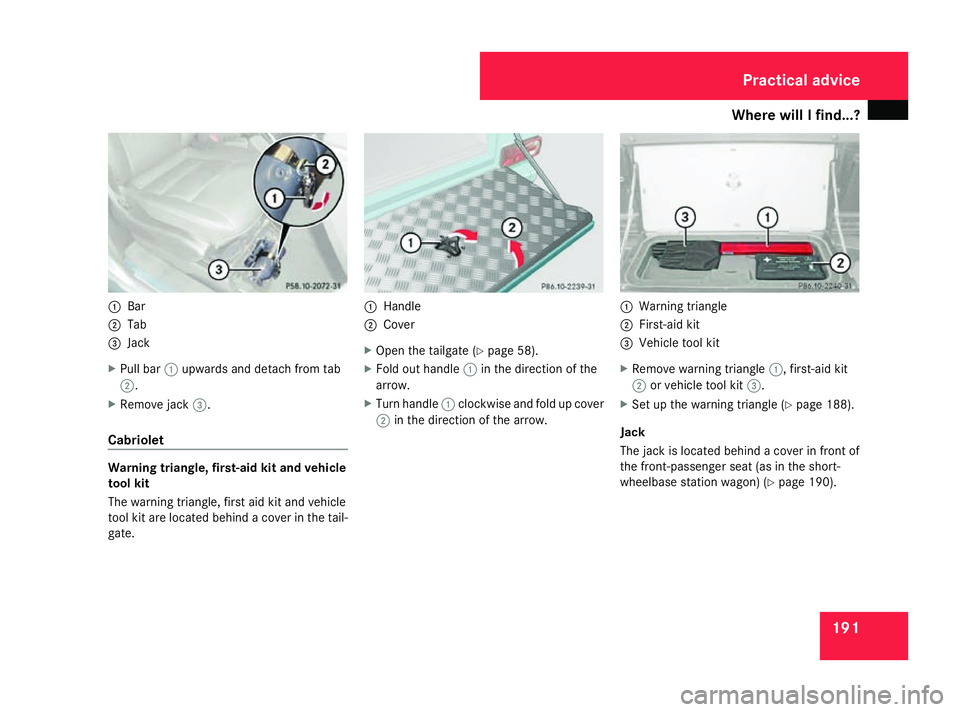
1911
Bar
2 Tab
3 Jack
X Pull bar 1upwards and detach from tab
2.
X Remove jack 3.
Cabriolet Warning triangle, first-aid kit and vehicle
tool kit
The warning triangle, first aid kit and vehicle
tool kit are located behind a cover in the tail-
gate. 1
Handle
2 Cover
X Open the tailgate (Y page 58).
X Fold out handle 1in the direction of the
arrow.
X Turn handle 1clockwise and fold up cover
2 in the direction of the arrow. 1
Warning triangle
2 First-aid kit
3 Vehicle tool kit
X Remove warning triangle 1, first-aid kit
2 or vehicle tool kit 3.
X Set up the warning triangle (Y page 188).
Jack
The jack is located behind a cover in front of
the front-passenger seat (as in the short-
wheelbase station wagon) (Y page 190). Practical advice
463_AKB; 1; 8, en-GB
wobuchh
, Version: 2.10.6 2008-07-17T15:19:41+02:00 - Seite 191 ZDateiname: 6515_4091_02_buchblock.pdf; preflight
Page 195 of 293
Where will I find...?
192 Fire extinguisher*
i Have the fire extinguisher refilled after
each use and checked every two years.
Otherwise, it may fail in an emergency.
Observe the legal requirements in all coun-
tries concerned.
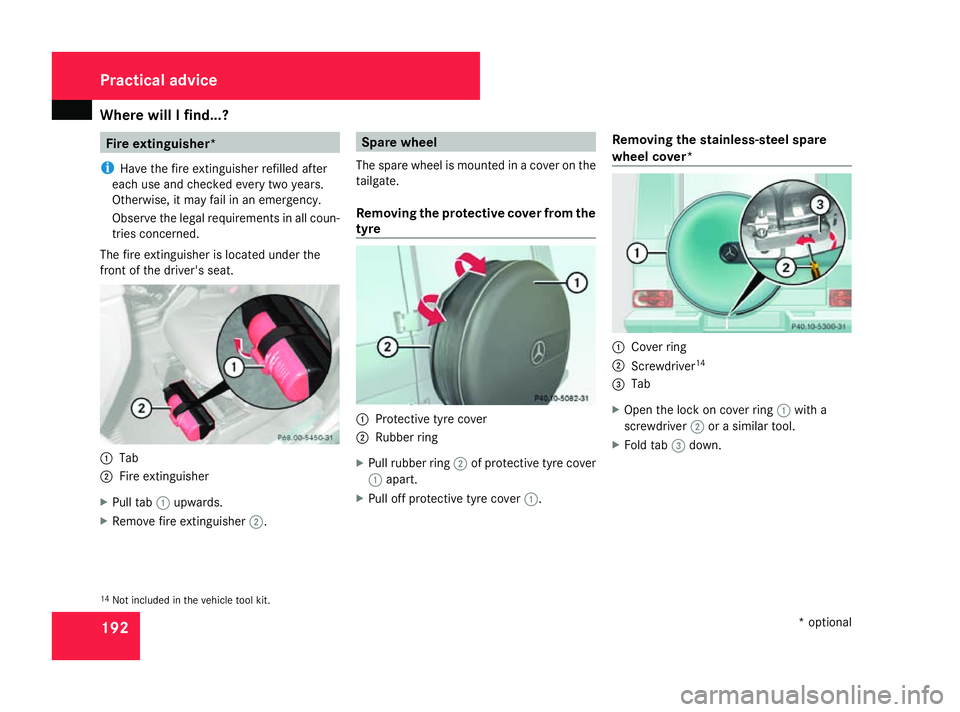
The fire extinguisher is located under the
front of the driver's seat. 1
Tab
2 Fire extinguisher
X Pull tab 1upwards.
X Remove fire extinguisher 2. Spare wheel
The spare wheel is mounted in a cover on the
tailgate.
Removing the protective cover from the
tyre 1
Protective tyre cover
2 Rubber ring
X Pull rubber ring 2of protective tyre cover
1 apart.
X Pull off protective tyre cover 1.Removing the stainless-steel spare
wheel cover* 1
Cover ring
2 Screwdriver 14
3 Tab
X Open the lock on cover ring 1with a
screwdriver 2or a similar tool.
X Fold tab 3down.
14 Not included in the vehicle tool kit. Practical advice
* optional
463_AKB; 1; 8, en-GB
wobuchh,
Version: 2.10.6 2008-07-17T15:19:41+02:00 - Seite 192Dateiname: 6515_4091_02_buchblock.pdf; preflight
Page 233 of 293
Locking/unlocking in an emergency
230 Locking the vehicle
If the vehicle can no longer be locked cen-
trally with the key:
X Close the front-passenger door, the rear
doors and the rear door or tailgate (Cabrio-
let).
X Press the locking button (Y page 55).
X Check whether the locking knobs on the
doors are still visible. Press the locking
knobs down manually if necessary.
X Close the driver's door.
X Remove the emergency key element from
the key (Y page 229).
X Insert the emergency key element into the
lock of the driver's door as far as it will go.
X Turn the emergency key element clockwise
as far as possible.
X Turn the emergency key element back and
remove it.
X Check if the doors including the rear door
or tailgate (Cabriolet) are locked. Emergency fuel filler flap release
G
Risk of injury
The corners of the vehicle walls may be
sharp-edged. You could injure yourself
while carrying out an emergency release of
the fuel filler flap. Avoid contact with the
edges of the vehicle walls.
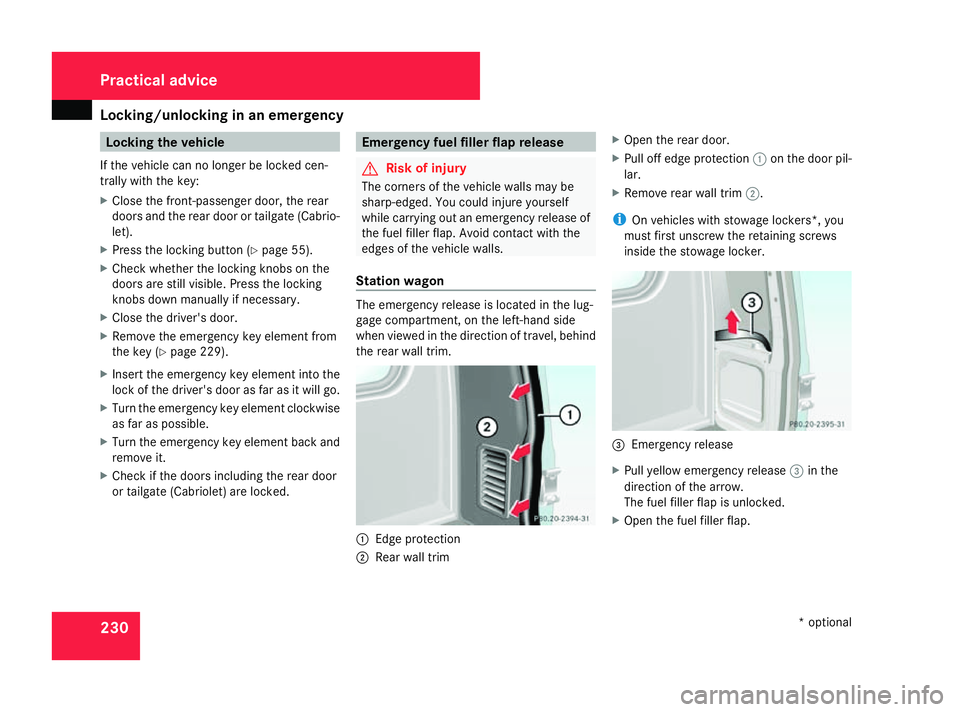
Station wagon The emergency release is located in the lug-
gage compartment, on the left-hand side
when viewed in the direction of travel, behind
the rear wall trim.
1
Edge protection
2 Rear wall trim X
Open the rear door.
X Pull off edge protection 1on the door pil-
lar.
X Remove rear wall trim 2.
i On vehicles with stowage lockers*, you
must first unscrew the retaining screws
inside the stowage locker. 3
Emergency release
X Pull yellow emergency release 3in the
direction of the arrow.
The fuel filler flap is unlocked.
X Open the fuel filler flap. Practical advice
* optional
463_AKB; 1; 8, en-GB
wobuchh
,V ersion: 2.10.6
2008-07-17T15:19:41+02:00 - Seite 230 Dateiname: 6515_4091_02_buchblock.pdf; preflight
Page 247 of 293
Flat tyre
244
X
Close the driver’s door.
X Place the warning triangle ( Ypage 188) or
warning lamps at a suitable distance.
Observe legal requirements. Changing a wheel and fitting the spare
wheel G
Risk of accident
If the spare wheel is more than six years
old, or it does not correspond to the regular
wheel type: have the spare wheel replaced
by a new wheel at the nearest qualified spe-
cialist workshop, e.g. a Mercedes-Benz
Service Centre.
Never drive the vehicle with more than one
spare wheel fitted.
Vehicles with different tyre dimensions on
the front and rear axles: wheel and tyre size
of the spare wheel and normal wheel are
different. When using the spare wheel, the
handling characteristics are compromised.
Do not exceed the maximum speed of 80
km/h. G
Risk of accident
Vehicles with AMG equipment: when you fit
the spare wheel, make sure you observe the
following:
R the maximum speed of 80 km/h
R the prescribed tyre pressure
Preparing the vehicle X
Prepare the vehicle as described
(Y page 243).
X If a trailer is coupled, uncouple it.
X Remove the vehicle tool kit and the jack
(Y page 191).
X Remove the spare wheel from the spare
wheel bracket (Y page 192).
X Secure the vehicle to prevent it from rolling
away.
On level ground: place chocks or similar
items under the front and rear of the wheel
that is diagonally opposite the wheel you
wish to change.
X On downhill gradients: place chocks or
similar items under both wheels of the
other axle. Raising
the vehicle G
Risk of injury
The jack is designed only to raise the vehi-
cle for a short time while a wheel is being
changed.
The vehicle must be placed on stands if you
intend to work under it.
Make sure that the jack is placed on a firm,
non-slip, level surface. Do not use wooden
blocks or similar items as jacking supports.
Otherwise, the jack will not be able to ach-
ieve its load-bearing capacity due to the
restricted height.
Do not start the engine at any time while
the wheel is being changed.
Do not lie under the vehicle when it is being
supported by the jack. If you do not raise
the vehicle as described, it could slip off the
jack (e.g. when starting the engine, opening
or closing a door or the tailgate) and you
could be seriously injured. G
Risk of accident
If you fail to position the jack correctly, the
vehicle may: Practical advice
463_AKB; 1; 8, en-GB
wobuchh
,V ersion: 2.10.6
2008-07-17T15:19:41+02:00 - Seite 244 Dateiname: 6515_4091_02_buchblock.pdf; preflight