check engine MERCEDES-BENZ G-CLASS SUV 2008 Owner's Manual
[x] Cancel search | Manufacturer: MERCEDES-BENZ, Model Year: 2008, Model line: G-CLASS SUV, Model: MERCEDES-BENZ G-CLASS SUV 2008Pages: 293, PDF Size: 4.49 MB
Page 218 of 293
Troubleshooting
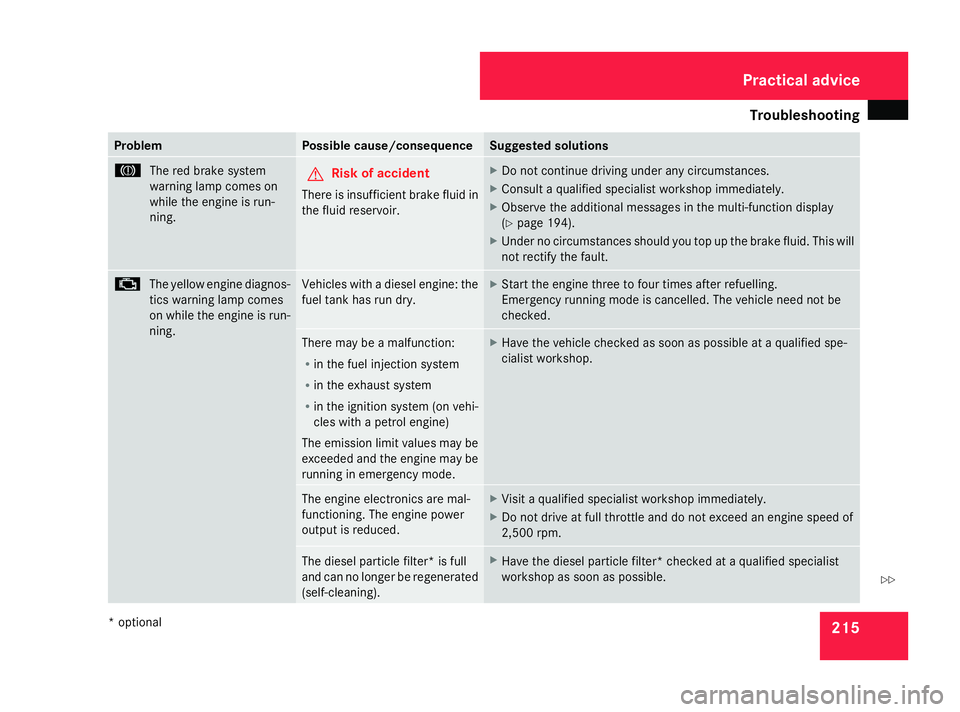
215Problem Possible cause/consequence Suggested solutions
3
The red brake system
warning lamp comes on
while the engine is run-
ning. G
Risk of accident
There is insufficient brake fluid in
the fluid reservoir. X
Do not continue driving under an y circumstances.
X Consult a qualified specialist workshop immediately.
X Observe the additional messages in the multi-function display
(Y page 194).
X Under no circumstances should you top up the brake fluid. This will
not rectify the fault. ±
The yellow engine diagnos-
tics warning lamp comes
on while the engine is run-
ning. Vehicles with a diesel engine: the
fuel tank has run dry. X
Start the engine three to four times after refuelling.
Emergency running mode is cancelled. The vehicle need not be
checked. There may be a malfunction:
R
in the fuel injection system
R in the exhaust system
R in the ignition system (on vehi-
cles with a petrol engine)
The emission limit values may be
exceeded and the engine may be
running in emergency mode. X
Have the vehicle checked as soon as possible at a qualified spe-
cialist workshop. The engine electronics are mal-
functioning. The engine power
output is reduced. X
Visit a qualified specialist workshop immediately.
X Do not drive at full throttle and do not exceed an engine speed of
2,500 rpm. The diesel particle filter* is full
and can no longer be regenerated
(self-cleaning). X
Have the diesel particle filter* checked at a qualified specialist
workshop as soon as possible. Practical advice
* optional
463_AKB; 1; 8, en-GB
wobuchh,
Version: 2.10.6 2008-07-17T15:19:41+02:00 - Seite 215 ZDateiname: 6515_4091_02_buchblock.pdf; preflight
Page 224 of 293
Troubleshooting
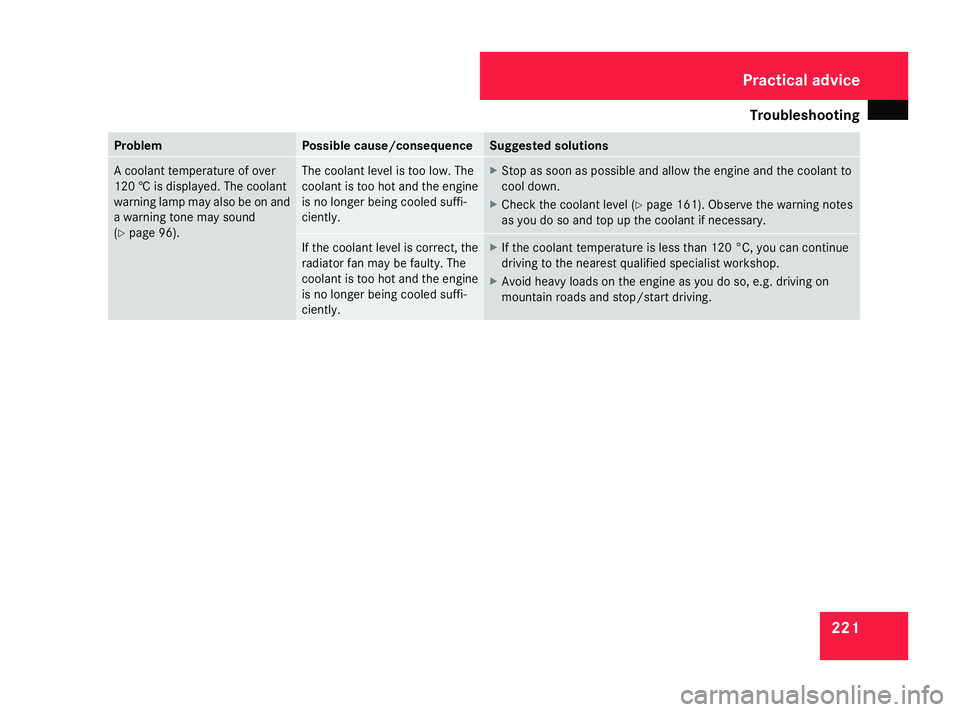
221Problem Possible cause/consequence Suggested solutions
A coolant temperature of over
120 † is displa
yed. The coolant
warning lamp may also be on and
a warning tone may sound
(Y page 96). The coolant level is too low. The
coolant is too hot and the engine
is no longer being cooled suffi-
ciently. X
Stop as soon as possible and allow the engine and the coolant to
cool down.
X Check the coolant level (Y page 161). Observe the warning notes
as you do so and top up the coolant if necessary. If the coolant level is correct, the
radiator fan may be faulty. The
coolant is too hot and the engine
is no longer being cooled suffi-
ciently. X
If the coolant temperature is less than 120 °C, you can continue
driving to the nearest qualified specialist workshop.
X Avoid heavy loads on the engine as you do so, e.g. driving on
mountain roads and stop/start driving. Practical advice
463_AKB; 1; 8, en-GB
wobuchh,
Version: 2.10.6 2008-07-17T15:19:41+02:00 - Seite 221 ZDateiname: 6515_4091_02_buchblock.pdf; preflight
Page 225 of 293
Troubleshooting
222 Automatic transmission
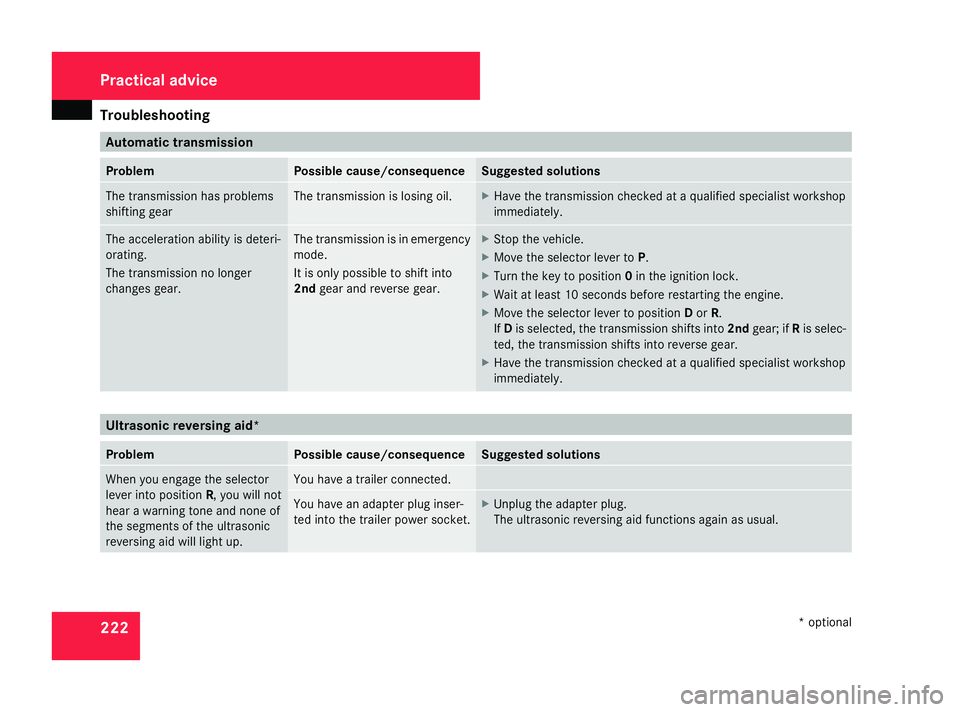
Problem Possible cause/consequence Suggested solutions
The transmission has problems
shifting gear The transmission is losing oil. X
Have the transmission checked at a qualified specialist workshop
immediatel y. The acceleration ability is deteri-
orating.
The transmission no longer
changes gear. The transmission is in emergency
mode.
It is only possible to shift into
2nd
gear and reverse gear. X
Stop the vehicle.
X Move the selector lever to P.
X Turn the key to position 0in the ignition lock.
X Wait at least 10 seconds before restarting the engine.
X Move the selector lever to position Dor R.
If D is selected, the transmission shifts into 2ndgear; if Ris selec-
ted, the transmission shifts into reverse gear.
X Have the transmission checked at a qualified specialist workshop
immediately. Ultrasonic reversing aid*
Problem Possible cause/consequence Suggested solutions
When you engage the selector
lever into position
R, you will not
hear a warning tone and none of
the segments of the ultrasonic
reversing aid will light up. You have a trailer connected.
You have an adapter plug inser-
ted into the trailer power socket. X
Unplug the adapter plug.
The ultrasonic reversing aid functions again as usual. Practical advice
* optional
463_AKB; 1; 8, en-GB
wobuchh,
Version: 2.10.6 2008-07-17T15:19:41+02:00 - Seite 222Dateiname: 6515_4091_02_buchblock.pdf; preflight
Page 229 of 293
Troubleshooting
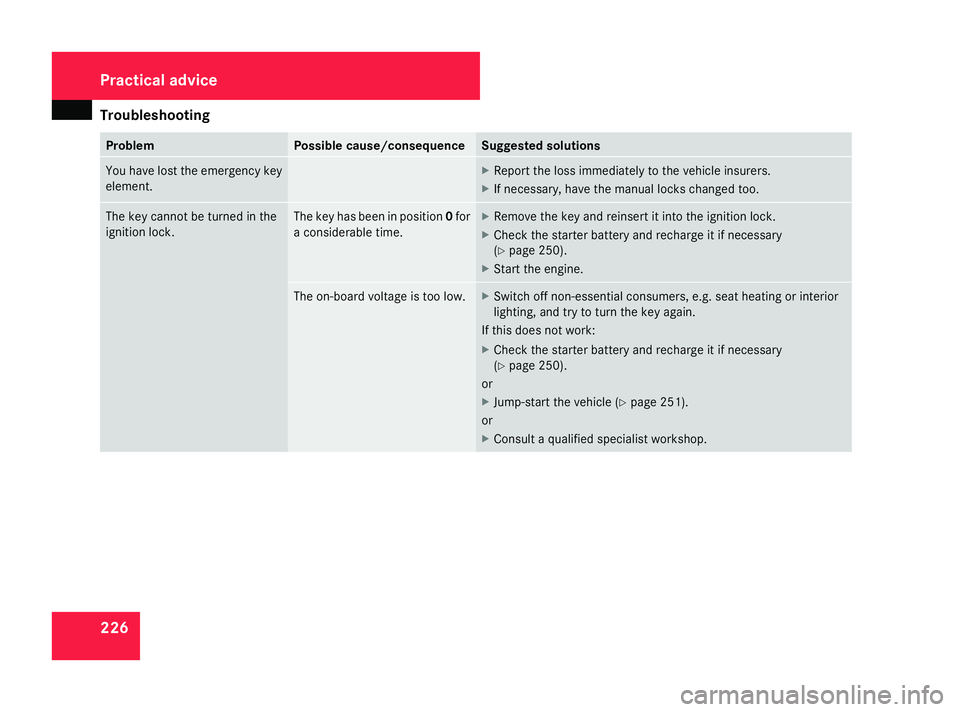
226 Problem Possible cause/consequence Suggested solutions
You have lost the emergency key
element. X
Report the loss immediatel y to the vehicle insurers.
X If necessary, have the manual locks changed too. The key cannot be turned in the
ignition lock. The key has been in position
0for
a considerable time. X
Remove the key and reinsert it into the ignition lock.
X Check the starter battery and recharge it if necessary
(Y page 250).
X Start the engine. The on-board voltage is too low. X
Switch off non-essential consumers, e.g. seat heating or interior
lighting, and try to turn the key again.
If this does not work:
X Check the starter battery and recharge it if necessary
(Y page 250).
or
X Jump-start the vehicle (Y page 251).
or
X Consult a qualified specialist workshop. Practical advice
463_AKB; 1; 8, en-GB
wobuchh,
Version: 2.10.6 2008-07-17T15:19:41+02:00 - Seite 226Dateiname: 6515_4091_02_buchblock.pdf; preflight
Page 251 of 293
Battery
248 Take them to a Mercedes-Benz Service
Centre or to a special collection point for
old batteries. G
Risk of injury
For safety reasons, Mercedes-Benz recom-
mends that you only use batteries which
have been tested and approved for your
vehicle by Mercedes-Benz. These batteries
provide increased impact protection to pre-
vent vehicle occupants from suffering acid
burns should the battery be damaged in the
event of an accident.
To prevent acid burns, observe the follow-
ing safety notes when handling batteries:
R Do not lean over batteries.
R Do not place any metal objects on a bat-
tery. You could otherwise cause a short
circuit and the battery's highly flammable
gas mixture could ignite.
R Make sure that you do not create an elec-
trostatic charge, e.g. by wearing syn-
thetic clothing or as a result of friction on
fabrics. Therefore, you should not pull or
slide the battery over carpets or other
synthetic materials.
R Never touch the battery first. To dis-
charge a possible electrostatic charge, step out of the vehicle first and touch the
bodywork.
R Do not wipe the battery using a cloth. The
battery may explode as a result of elec-
trostatic charge or due to flying sparks.
! Switch off the engine and remove the key
before disconnecting or removing the ter-
minal clamps from the battery. You may
otherwise destroy electronic components,
such as the alternator.
! Have the starter battery checked and, if
necessary, replaced at a qualified specialist
workshop, e.g. a Mercedes-Benz Service
Centre, every two years or at least every
20,000 km.
i Mercedes-Benz recommends that you
have all work involving the battery, e.g.
removing, charging and replacing, carried
out at a qualified specialist workshop, e.g.
a Mercedes-Benz Service Centre.
The battery is located in the vehicle interior
under a cover in the rear footwell. Disconnecting the battery
G
Risk of accident
If the battery is disconnected:
R the brake boosting effect will not be avail-
able. Greater braking force will then be
required and the brake pedal travel will
be longer. If necessary, depress the
brake pedal with maximum force.
R you will no longer be able to turn the key
in the ignition lock
R the selector lever is locked in position P
! Always disconnect the battery in the
order described below. Never swap the ter-
minal clamps. You may otherwise damage
the vehicle electronics.
X Apply the parking brake.
X Move the selector lever to P.
X Switch off all electrical consumers.
X Turn the key to 0and remove it. Practical advice
463_AKB; 1; 8, en-GB
wobuchh,
Version: 2.10.6 2008-07-17T15:19:41+02:00 - Seite 248Dateiname: 6515_4091_02_buchblock.pdf; preflight
Page 255 of 293
Towing and tow-starting
252
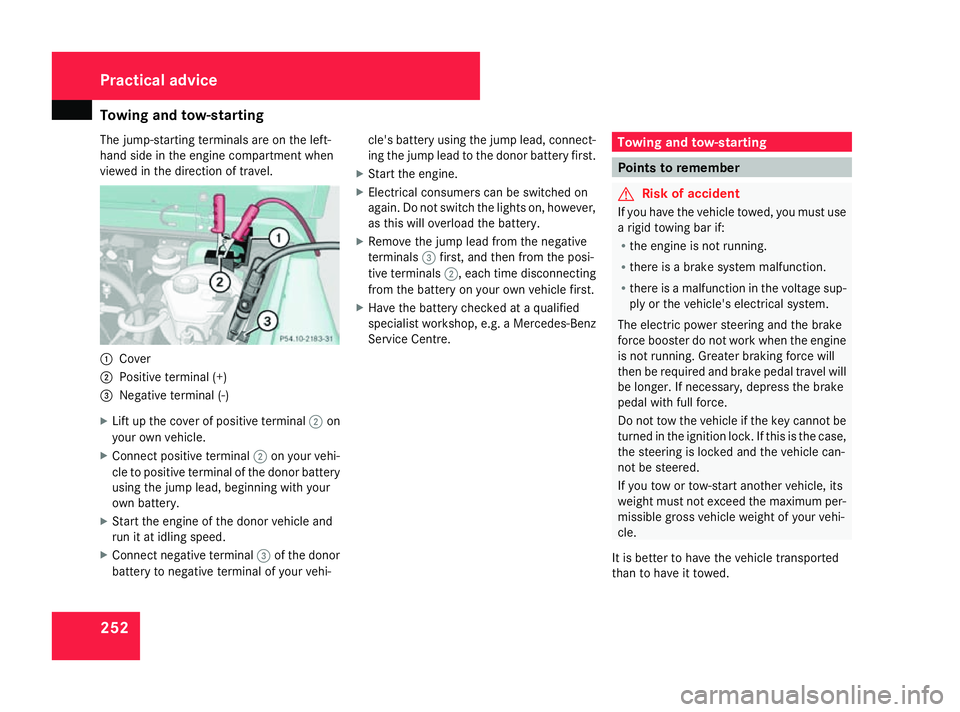
The jump-starting terminals are on the left-
hand side in the engine compartment when
viewed in the direction of travel. 1
Cover
2 Positive terminal (+)
3 Negative terminal (-)
X Lift up the cover of positive terminal 2on
your own vehicle.
X Connect positive terminal 2on your vehi-
cle to positive terminal of the donor battery
using the jump lead, beginning with your
own battery.
X Start the engine of the donor vehicle and
run it at idling speed.
X Connect negative terminal 3of the donor
battery to negative terminal of your vehi- cle's battery using the jump lead, connect-
ing the jump lead to the donor battery first.
X Start the engine.
X Electrical consumers can be switched on
again. Do not switch the lights on, however,
as this will overload the battery.
X Remove the jump lead from the negative
terminals 3first, and then from the posi-
tive terminals 2, each time disconnecting
from the battery on your own vehicle first.
X Have the battery checked at a qualified
specialist workshop, e.g. a Mercedes-Benz
Service Centre. Towing and tow-starting
Points to remember
G
Risk of accident
If you have the vehicle towed, you must use
a rigid towing bar if:
R the engine is not running.
R there is a brake system malfunction.
R there is a malfunction in the voltage sup-
ply or the vehicle's electrical system.
The electric power steering and the brake
force booster do not work when the engine
is not running. Greater braking force will
then be required and brake pedal travel will
be longer. If necessary, depress the brake
pedal with full force.
Do not tow the vehicle if the key cannot be
turned in the ignition lock. If this is the case,
the steering is locked and the vehicle can-
not be steered.
If you tow or tow-start another vehicle, its
weight must not exceed the maximum per-
missible gross vehicle weight of your vehi-
cle.
It is better to have the vehicle transported
than to have it towed. Practical advice
463_AKB; 1; 8, en-GB
wobuchh
, Version: 2.10.6
2008-07-17T15:19:41+02:00 - Seite 252 Dateiname: 6515_4091_02_buchblock.pdf; preflight