check engine MERCEDES-BENZ G-CLASS SUV 2008 User Guide
[x] Cancel search | Manufacturer: MERCEDES-BENZ, Model Year: 2008, Model line: G-CLASS SUV, Model: MERCEDES-BENZ G-CLASS SUV 2008Pages: 293, PDF Size: 4.49 MB
Page 164 of 293
Engine compartment
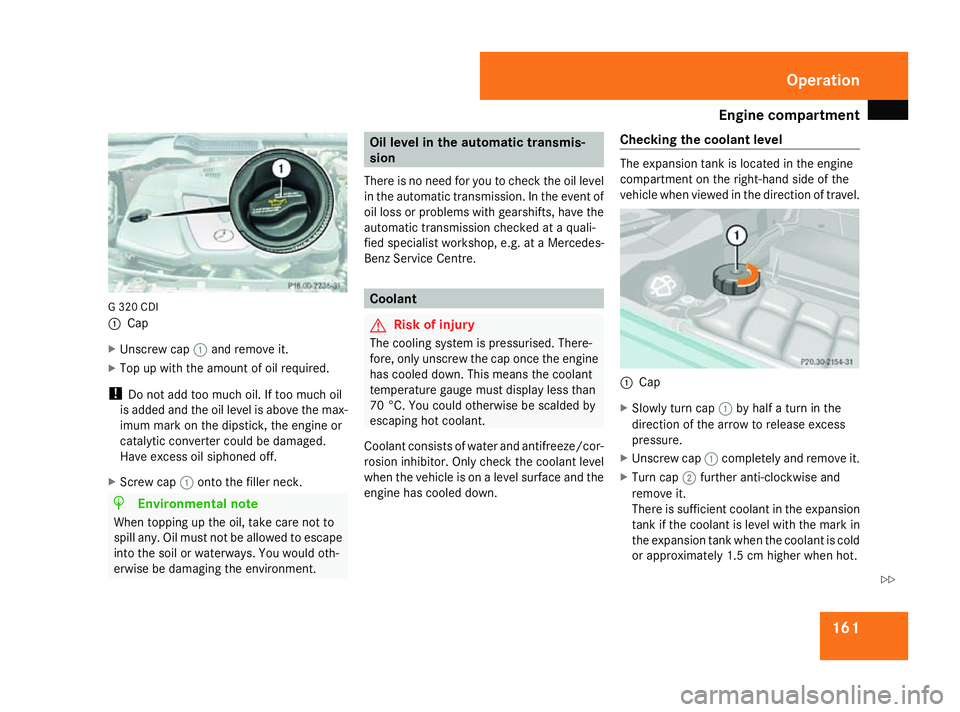
161G 320 CDI
1
Cap
X Unscrew cap 1and remove it.
X Top up with the amount of oil required.
! Do not add too much oil. If too much oil
is added and the oil level is above the max-
imum mark on the dipstick, the engine or
catalytic converter could be damaged.
Have excess oil siphoned off.
X Screw cap 1onto the filler neck. H
Environmental note
When topping up the oil, take care not to
spill any. Oil must not be allowed to escape
into the soil or waterways. You would oth-
erwise be damaging the environment. Oil level in the automatic transmis-
sion
There is no need for you to check the oil level
in the automatic transmission. In the event of
oil loss or problems with gearshifts, have the
automatic transmission checked at a quali-
fied specialist workshop, e.g. at a Mercedes-
Benz Service Centre. Coolant
G
Risk of injury
The cooling system is pressurised. There-
fore, only unscrew the cap once the engine
has cooled down. This means the coolant
temperature gauge must display less than
70 °C. You could otherwise be scalded by
escaping hot coolant.
Coolant consists of water and antifreeze/cor-
rosion inhibitor. Only check the coolant level
when the vehicle is on a level surface and the
engine has cooled down. Checking the coolant level The expansion tank is located in the engine
compartment on the right-hand side of the
vehicle when viewed in the direction of travel.
1
Cap
X Slowly turn cap 1by half a turn in the
direction of the arrow to release excess
pressure.
X Unscrew cap 1completely and remove it.
X Turn cap 2further anti-clockwise and
remove it.
There is sufficient coolant in the expansion
tank if the coolant is level with the mark in
the expansion tank when the coolant is cold
or approximately 1.5 cm higher when hot. Operation
463_AKB; 1; 8, en-GB
wobuchh,
Version: 2.10.6
2008-07-17T15:19:41+02:00 - Seite 161 ZDateiname: 6515_4091_02_buchblock.pdf; preflight
Page 176 of 293
Off-road driving
173After the brakes have been exposed to dirty
conditions, have them checked and
cleaned at a qualified specialist workshop,
e.g. a Mercedes-Benz Service Centre. Oth-
erwise, there is a risk that braking power
may be insufficient in the event of an emer-
gency, or that braking efficiency may be
unpredictable.
Read this section before driving your vehicle
off-road. Practise by travelling over more gen-
tle off-road terrain first.
The following driving systems are specially
adapted to off-road driving:
R transfer case (Y page 92)
R differential locks (Y page 93)
R 4ETS (Y page 50) Off-road driving
G
Risk of accident
Damage to the vehicle creates the risk of
an accident for yourself and other road
users. If in doubt, have your vehicle
checked at a qualified specialist workshop
which has the necessary specialist knowl-
edge and tools to carry out the work
required. Mercedes-Benz recommends
that you use a Mercedes-Benz Service
Centre for this purpose. H
Environmental note
Protection of the environment is of primary
importance. Treat nature with respect.
Observe all prohibiting signs.
General information R
Stop your vehicle and, if necessary, shift
the transfer case to LOW(Ypage 92)
before driving off-road.
R Check that items of luggage and loads are
stowed safely and are well secured
(Y page 139).
R Engage the differential locks, if necessary
(Y page 93). i
When the differential locks are engaged,
ABS is deactivated. This allows the front
wheels to lock briefly, so that these can dig
into a loose surface. However, please note
that locked wheels skid and can no longer
steer.
R Always keep the engine running and in gear
when driving on a downhill gradient.
R Drive slowly and evenly, if necessary at a
walking pace.
R Ensure that the wheels are in contact with
the ground at all times.
R Drive with extreme care on unknown off-
road routes where visibility is poor. For
safety reasons, get out of the vehicle first
and survey the off-road route.
R Check the depth of water before fording
rivers and streams.
R Look out for obstacles such as rocks, holes,
tree stumps and furrows.
R Always keep the side windows and the slid-
ing /tilting sunroof* closed during the jour-
ney.
R Do not stray from marked routes or paths. Operation
* optional
463_AKB; 1; 8, en-GB
wobuchh,
Version: 2.10.6 2008-07-17T15:19:41+02:00 - Seite 173 ZDateiname: 6515_4091_02_buchblock.pdf; preflight
Page 177 of 293
Off-road driving
174
i
Information about retrofitting special all-
terrain tyres is available from any
Mercedes-Benz Service Centre.
Checklist before driving off-road X
Engine oil level: check the engine oil and
top it up if necessary.
Only then does the engine receive enough
oil when the vehicle is standing on a steep
incline.
X Vehicle toolkit: check that the jack is
working and make sure you have the wheel-
brace, a robust tow cable and a folding
spade in the vehicle.
X Wheels and tyres: check the tyre tread
depth and tyre pressure.
X Check for damage and remove any objects,
e.g. small stones, from the wheels/tyres.
X Replace any missing valve caps.
X Replace dented or damaged wheels.
Checklist after driving off-road Driving over rough terrain places greater
demands on your vehicle than driving on nor-
mal roads. After driving off-road, check the
vehicle. This allows you to detect damage
promptly and reduce the risk of an accident
to yourself and other road users. X
Shift the transfer case to HIGH
(Y page 93).
X Disengage the differential locks
(Y page 95).
X Clean the headlamps and rear lights and
check for damage.
X Clean the front and rear licence plates.
X Clean the wheels/tyres with a water jet and
remove any foreign objects.
X Clean the wheels, wheel arches and the
vehicle underside with a water jet; check
for foreign objects and damage.
X Check whether twigs or other parts of
plants have become trapped. These
increase the risk of fire and can damage
fuel pipes, brake hoses or the rubber bel-
lows of the axle joints and propeller shafts.
X After the trip, examine without fail the
entire undercarriage, wheels, tyres, brakes,
bodywork structure, steering, chassis and
exhaust system for damage.
X After driving for extended periods across
sand, mud, gravel, water or in similarly dirty
conditions, have the brake discs, wheels,
brake pads /linings and axle joints checked
and cleaned.
X If you detect strong vibrations after off-road
travel, check for foreign objects in the
wheels and drive train and remove them if necessary. Foreign objects can disturb the
balance and cause vibrations. Travelling uphill
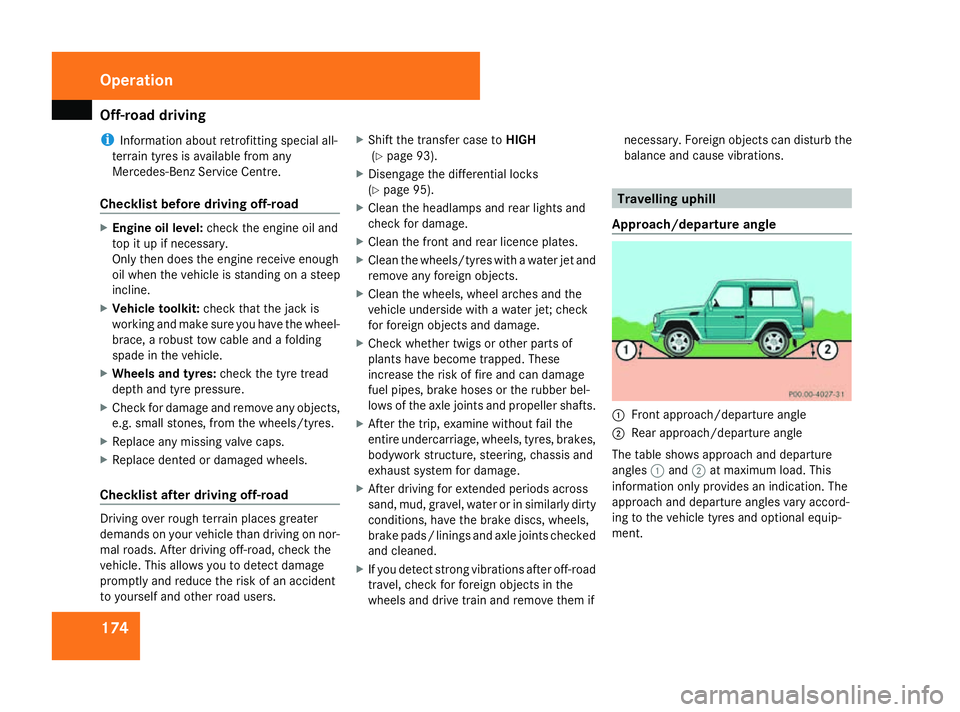
Approach/departure angle 1
Front approach/departure angle
2 Rear approach/departure angle
The table shows approach and departure
angles 1and 2at maximum load. This
information only provides an indication. The
approach and departure angles vary accord-
ing to the vehicle tyres and optional equip-
ment. Operation
463_AKB; 1; 8, en-GB
wobuchh,
Version: 2.10.6 2008-07-17T15:19:41+02:00 - Seite 174Dateiname: 6515_4091_02_buchblock.pdf; preflight
Page 178 of 293
Off-road driving
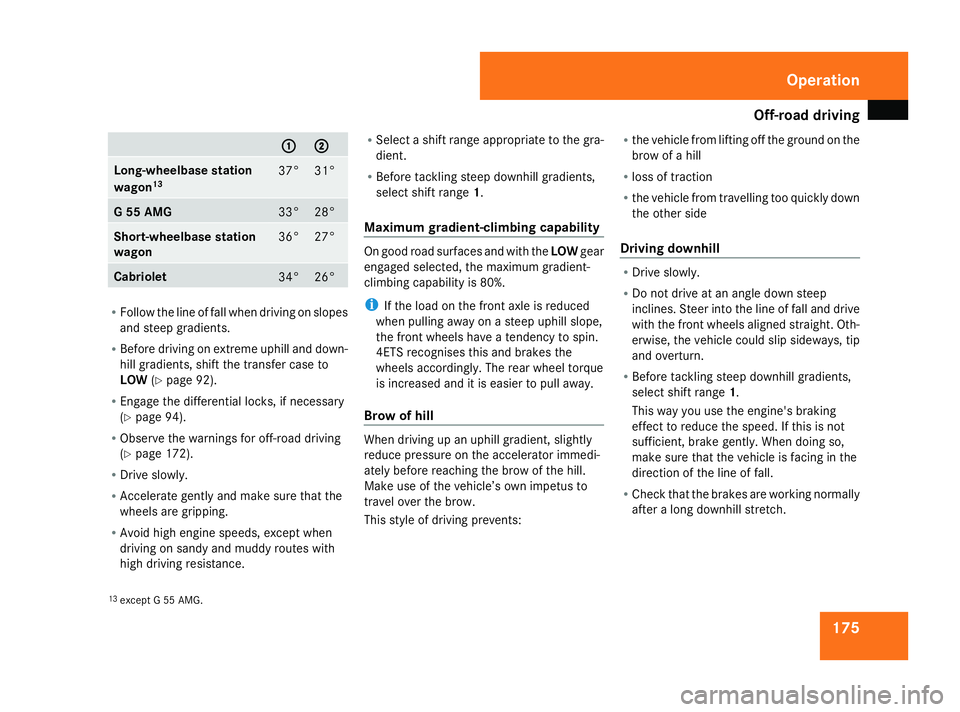
1751
1 2
2 Long-wheelbase station
wagon
13 37° 31°
G 55 AMG
33° 28°
Short-wheelbase station
wagon
36° 27°
Cabriolet
34° 26°
R
Follow the line of fall when driving on slopes
and steep gradients.
R Before driving on extreme uphill and down-
hill gradients, shift the transfer case to
LOW (Ypage 92).
R Engage the differential locks, if necessary
(Y page 94).
R Observe the warnings for off-road driving
(Y page 172).
R Drive slowly.
R Accelerate gently and make sure that the
wheels are gripping.
R Avoid high engine speeds, except when
driving on sandy and muddy routes with
high driving resistance. R
Select a shift range appropriate to the gra-
dient.
R Before tackling steep downhill gradients,
select shift range 1.
Maximum gradient-climbing capability On good road surfaces and with the
LOWgear
engaged selected, the maximum gradient-
climbing capability is 80%.
i If the load on the front axle is reduced
when pulling away on a steep uphill slope,
the front wheels have a tendency to spin.
4ETS recognises this and brakes the
wheels accordingly. The rear wheel torque
is increased and it is easier to pull away.
Brow of hill When driving up an uphill gradient, slightly
reduce pressure on the accelerator immedi-
ately before reaching the brow of the hill.
Make use of the vehicle’s own impetus to
travel over the brow.
This style of driving prevents:R
the vehicle from lifting off the ground on the
brow of a hill
R loss of traction
R the vehicle from travelling too quickly down
the other side
Driving downhill R
Drive slowly.
R Do not drive at an angle down steep
inclines. Steer into the line of fall and drive
with the front wheels aligned straight. Oth-
erwise, the vehicle could slip sideways, tip
and overturn.
R Before tackling steep downhill gradients,
select shift range 1.
This way you use the engine's braking
effect to reduce the speed. If this is not
sufficient, brake gently. When doing so,
make sure that the vehicle is facing in the
direction of the line of fall.
R Check that the brakes are working normally
after a long downhill stretch.
13 except G 55 AMG. Operation
463_AKB; 1; 8, en-GB
wobuchh,
Version: 2.10.6 2008-07-17T15:19:41+02:00 - Seite 175 ZDateiname: 6515_4091_02_buchblock.pdf; preflight
Page 180 of 293
Driving ab
road 177
R
Clean an y mud from the tyre tread after
crossing a ford.
R Apply the brakes to dry them after crossing
a ford. Driving on sand
Observe the following rules when driving on
sand:
R shift the transfer case to
LOW (Ypage 92).
R avoid high engine speeds.
R select a shift range appropriate to the ter-
rain.
R drive quickly to overcome the rolling resist-
ance. Otherwise, the vehicle could dig itself
into the sand.
R drive in the tracks of other vehicles, if pos-
sible. Make sure that the ruts are not too
deep, that the sand is firm enough and that
your vehicle has sufficient ground clear-
ance. Ruts
Observe the following rules when driving
along ruts in off-road terrain or on roads with
loose gravel:
! Check that the ruts are not too deep and
that your vehicle has sufficient clearance.
Otherwise, your vehicle could be damaged
or bottom out and get stuck.
R shift the transfer case to
LOW (Ypage 92).
R avoid high engine speeds.
R select shift range 1.
R drive slowly.
R where ruts are too deep, drive with the
wheels on one side on the middle section
of the road if possible. Driving abroad
Points to remember
An extensive Mercedes-Benz Service network
is also available in other countries. You can
obtain the relevant workshop directories
from any Mercedes-Benz Service Centre.
Only low-octane fuel is available in certain
countries.
You can find further information about fuel
grades on (Y page 154). Symmetrical dipped beam
If your journey takes you to countries where
vehicles are driven on the opposite side of the
road to the country in which the vehicle is
registered, your headlamps must be switched
to symmetrical dipped beam. Oncoming traf-
fic will be dazzled less. G
Risk of injury
Xenon bulbs are under high voltage. You
could get an electric shock and be seriously
or even fatally injured if you touch the elec-
tric contacts on xenon bulbs. Therefore, do
not, remove the cover on xenon bulbs.
Do not change xenon headlamps yourself,
but have them replaced at a qualified spe- Operation
463_AKB; 1; 8, en-GB
wobuchh,
Version: 2.10.6 2008-07-17T15:19:41+02:00 - Seite 177 ZDateiname: 6515_4091_02_buchblock.pdf; preflight
Page 191 of 293
Where will I find...?
188 Where will I find...?
Warning triangle, first-aid kit and
vehicle tool kit
G
Risk of injury
The jack is designed only to raise and hold
the vehicle for a short time while a wheel
is being changed.
You must use axle stands if you are carrying
out work on the vehicle.
Make sure that the jack is placed on a firm,
non-slip, level surface. Do not use wooden
blocks or similar objects as a jack underlay.
Otherwise, the jack will not be able to ach-
ieve its load-bearing capacity due to the
restricted height.
Do not start the engine at any time while a
wheel is being changed.
Do not lie under the vehicle when it is being
supported by the jack. If you do not raise
the vehicle as described, it could slip off the
jack (e.g. if the engine is started or a door
or the tailgate is opened or closed) and you
could be seriously injured.
i Check the expiry date of the first-aid kit
annually, and replace the contents when
necessary. i
When using the jack, you should also
observe the safety notes in the "Flat tyre"
section (Y page 243).
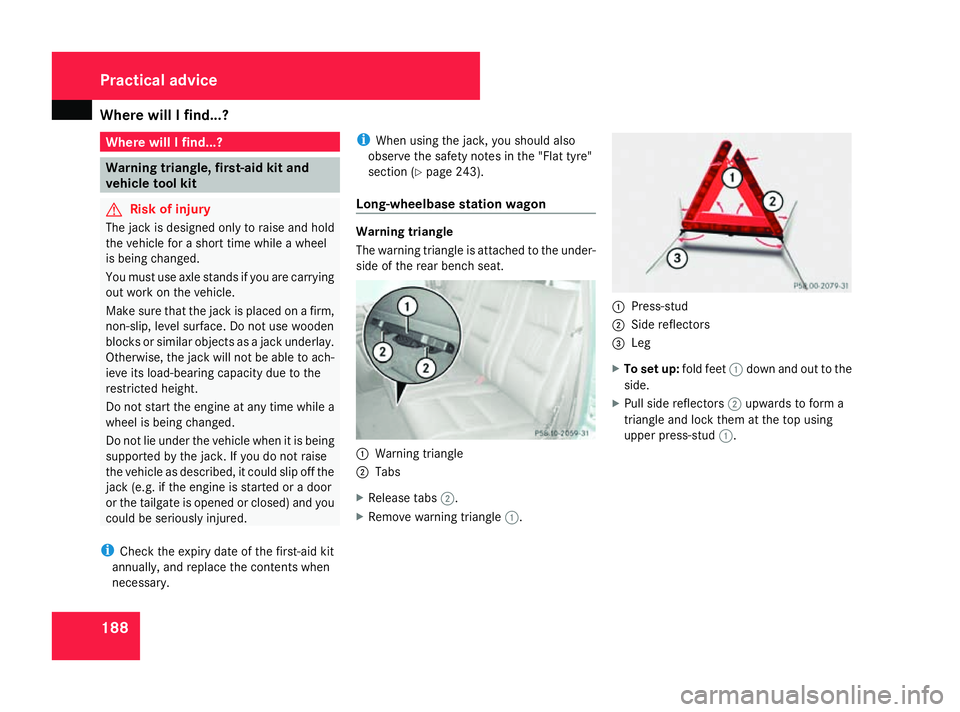
Long-wheelbase station wagon Warning triangle
The warning triangle is attached to the under-
side of the rear bench seat.
1
Warning triangle
2 Tabs
X Release tabs 2.
X Remove warning triangle 1. 1
Press-stud
2 Side reflectors
3 Leg
X To set up: fold feet1down and out to the
side.
X Pull side reflectors 2upwards to form a
triangle and lock them at the top using
upper press-stud 1. Practical advice
463_AKB; 1; 8, en-GB
wobuchh,
Version: 2.10.6 2008-07-17T15:19:41+02:00 - Seite 188Dateiname: 6515_4091_02_buchblock.pdf; preflight
Page 204 of 293
Display
messages 201Display messages Possible cause/consequence Possible solution
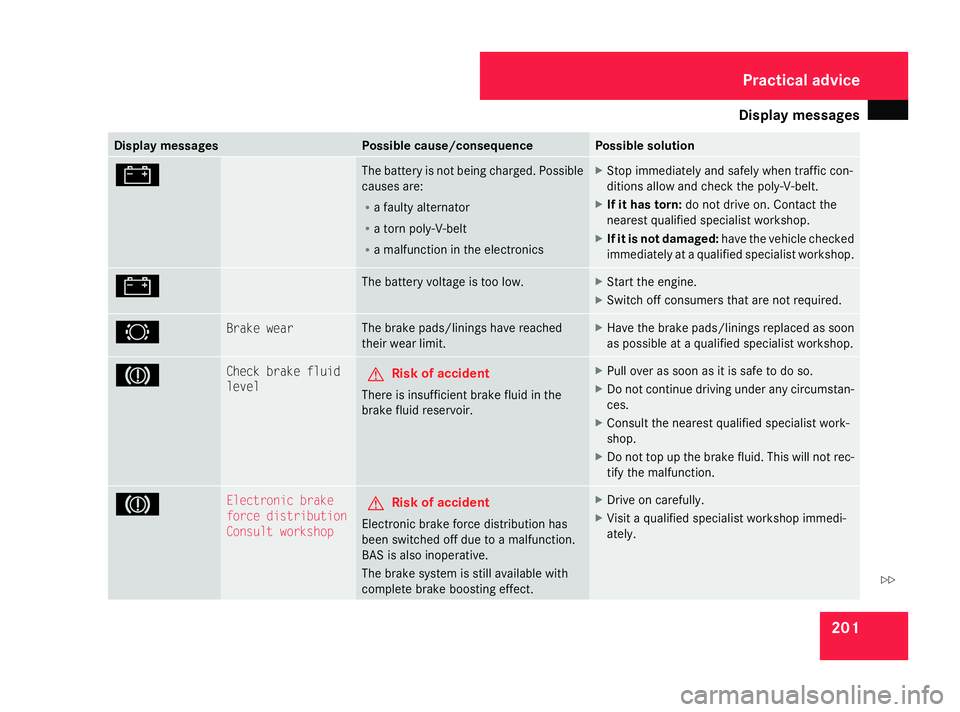
# The battery is not being charged. Possible
ca
uses are:
R a faulty alternator
R a torn poly-V-belt
R a malfunction in the electronics X
Stop immediately and safely when traffic con-
ditions allow and check the poly-V-belt.
X If it has torn: do not drive on. Contact the
nearest qualified specialist workshop.
X If it is not damaged: have the vehicle checked
immediately at a qualified specialist workshop. # The battery voltage is too low. X
Start the engine.
X Switch off consumers that are not required. 2 Brake wear The brake pads/linings have reached
their wear limit. X
Have the brake pads/linings replaced as soon
as possible at a qualified specialist workshop. 3 Check brake fluid
level G
Risk of accident
There is insufficient brake fluid in the
brake fluid reservoir. X
Pull over as soon as it is safe to do so.
X Do not continue driving under any circumstan-
ces.
X Consult the nearest qualified specialist work-
shop.
X Do not top up the brake fluid. This will not rec-
tify the malfunction. 3 Electronic brake
force distribution
Consult workshop G
Risk of accident
Electronic brake force distribution has
been switched off due to a malfunction.
BAS is also inoperative.
The brake system is still available with
complete brake boosting effect. X
Drive on carefully.
X Visit a qualified specialist workshop immedi-
ately. Practical advice
463_AKB; 1; 8, en-GB
wobuchh,
Version: 2.10.6 2008-07-17T15:19:41+02:00 - Seite 201 ZDateiname: 6515_4091_02_buchblock.pdf; preflight
Page 206 of 293
Display
messages 203Display messages Possible cause/consequence Possible solution
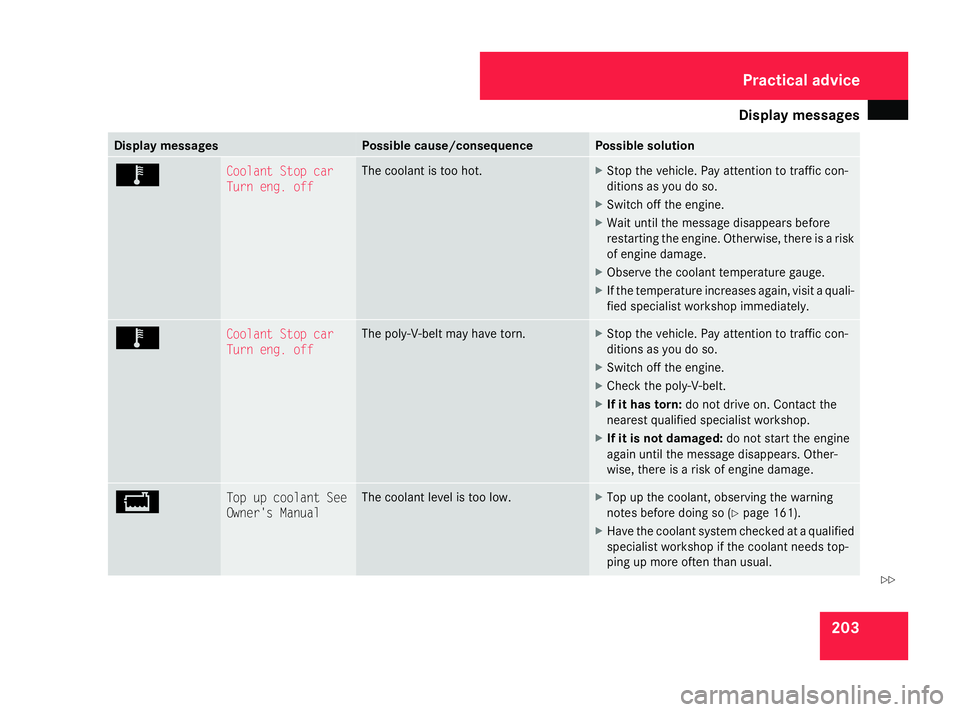
Ï Coolant Stop car
Turn eng. off The coolant is too hot. X
Stop the vehicle. Pa y attention to traffic con-
ditions as you do so.
X Switch off the engine.
X Wait until the message disappears before
restarting the engine. Otherwise, there is a risk
of engine damage.
X Observe the coolant temperature gauge.
X If the temperature increases again, visit a quali-
fied specialist workshop immediately. Ï Coolant Stop car
Turn eng. off The poly-V-belt may have torn. X
Stop the vehicle. Pay attention to traffic con-
ditions as you do so.
X Switch off the engine.
X Check the poly-V-belt.
X If it has torn: do not drive on. Contact the
nearest qualified specialist workshop.
X If it is not damaged: do not start the engine
again until the message disappears. Other-
wise, there is a risk of engine damage. B Top up coolant See
Owner's Manual The coolant level is too low. X
Top up the coolant, observing the warning
notes before doing so (Y page 161).
X Have the coolant system checked at a qualified
specialist workshop if the coolant needs top-
ping up more often than usual. Practical advice
463_AKB; 1; 8, en-GB
wobuchh,
Version: 2.10.6 2008-07-17T15:19:41+02:00 - Seite 203 ZDateiname: 6515_4091_02_buchblock.pdf; preflight
Page 210 of 293
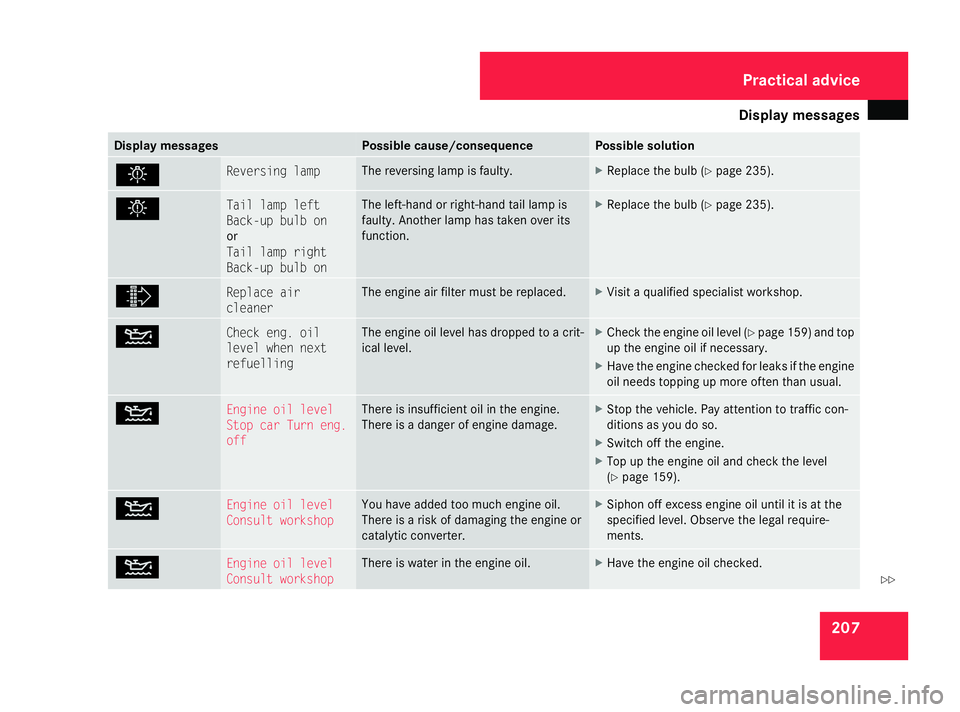
Display
messages 207Display messages Possible cause/consequence Possible solution
. Reversing lamp The reversing lamp is fa
ulty. X
Replace the bulb (Y page 235). . Tail lamp left
Back-up bulb on
or
Tail lamp right
Back-up bulb on The left-hand or right-hand tail lamp is
faulty. Another lamp has taken over its
function. X
Replace the bulb (Y page 235). ò Replace air
cleaner The engine air filter must be replaced. X
Visit a qualified specialist workshop. N Check eng. oil
level when next
refuelling The engine oil level has dropped to a crit-
ical level. X
Check the engine oil level (Y page 159) and top
up the engine oil if necessary.
X Have the engine checked for leaks if the engine
oil needs topping up more often than usual. N Engine oil level
Stop car Turn eng.
off There is insufficient oil in the engine.
There is a danger of engine damage. X
Stop the vehicle. Pay attention to traffic con-
ditions as you do so.
X Switch off the engine.
X Top up the engine oil and check the level
(Y page 159). N Engine oil level
Consult workshop You have added too much engine oil.
There is a risk of damaging the engine or
catalytic converter. X
Siphon off excess engine oil until it is at the
specified level. Observe the legal require-
ments. N Engine oil level
Consult workshop There is water in the engine oil. X
Have the engine oil checked. Practical advice
463_AKB; 1; 8, en-GB
wobuchh,
Version: 2.10.6 2008-07-17T15:19:41+02:00 - Seite 207 ZDateiname: 6515_4091_02_buchblock.pdf; preflight
Page 211 of 293
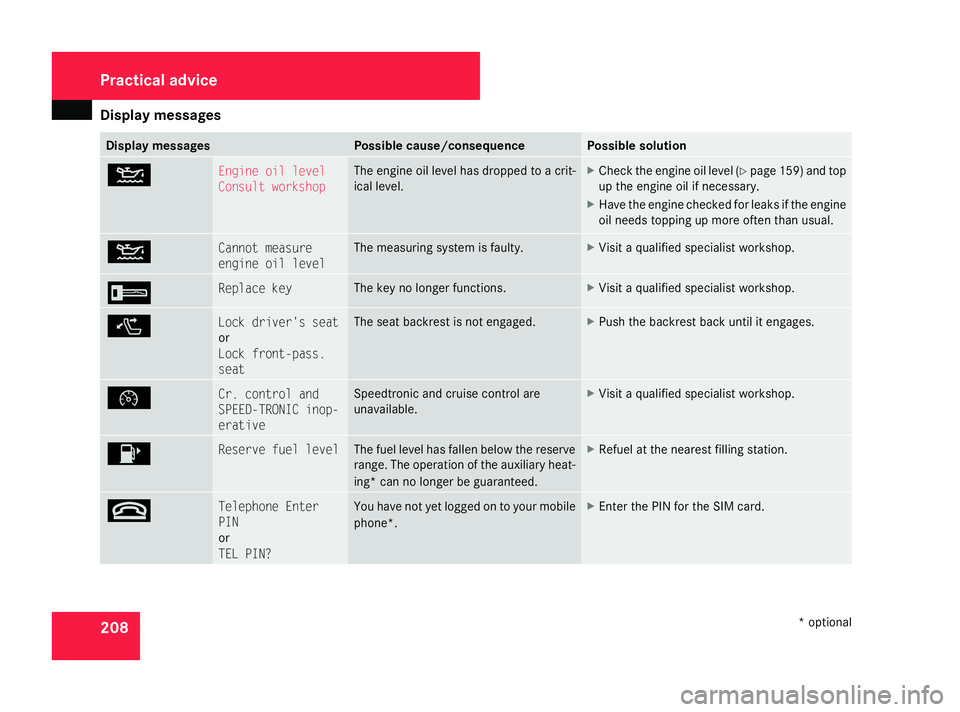
Display
messages 208 Display messages Possible cause/consequence Possible solution
N Engine oil level
Consult workshop The engine oil level has dropped to a crit-
ical level. X
Check the engine oil level (Y page 159) and top
up the engine oil if necessary.
X Have the engine checked for leaks if the engine
oil needs topping up more often than usual. N Cannot measure
engine oil level The measuring system is faulty. X
Visit a qualified specialist workshop. I Replace key The key no longer functions. X
Visit a qualified specialist workshop. ( Lock driver's seat
or
Lock front-pass.
seat The seat backrest is not engaged. X
Push the backrest back until it engages. Ñ Cr. control and
SPEED-TRONIC inop-
erative Speedtronic and cruise control are
unavailable. X
Visit a qualified specialist workshop. 4 Reserve fuel level The fuel level has fallen below the reserve
range. The operation of the auxiliary heat-
ing* can no longer be guaranteed. X
Refuel at the nearest filling station. t Telephone Enter
PIN
or
TEL PIN? You have not yet logged on to your mobile
phone*. X
Enter the PIN for the SIM card. Practical advice
* optional
463_AKB; 1; 8, en-GB
wobuchh,
Version: 2.10.6 2008-07-17T15:19:41+02:00 - Seite 208Dateiname: 6515_4091_02_buchblock.pdf; preflight