steering MERCEDES-BENZ G-CLASS SUV 2008 Owner's Manual
[x] Cancel search | Manufacturer: MERCEDES-BENZ, Model Year: 2008, Model line: G-CLASS SUV, Model: MERCEDES-BENZ G-CLASS SUV 2008Pages: 293, PDF Size: 4.49 MB
Page 162 of 293
Engine compartment
159Engine oil
Depending on driving style, the vehicle con-
sumes a maximum of 0.8 l oil per 1,000 km.
The oil consumption may be higher than this
when the vehicle is new or if you frequently
drive at high engine speeds. You can only
estimate the oil consumption after you have
driven a considerable distance.
You will find further information about engine
oil in the "Technical data" section
(Y page 279).
Checking the engine oil level To do so:
R
the vehicle should be parked on level
ground.
R the engine should be switched off for at
least five minutes if the engine was at nor-
mal operating temperature.
R the engine should be switched off for at
least 30 minutes if the engine was not at
operating temperature (i.e. if you only star-
ted the engine briefly). Via the on-board computer
i
Only possible on the G 55 AMG. On all
other models, a dipstick is used to check
the engine oil level (Y page 160).
X Make sure that the key is in position 2in
the ignition lock (Y page 59).
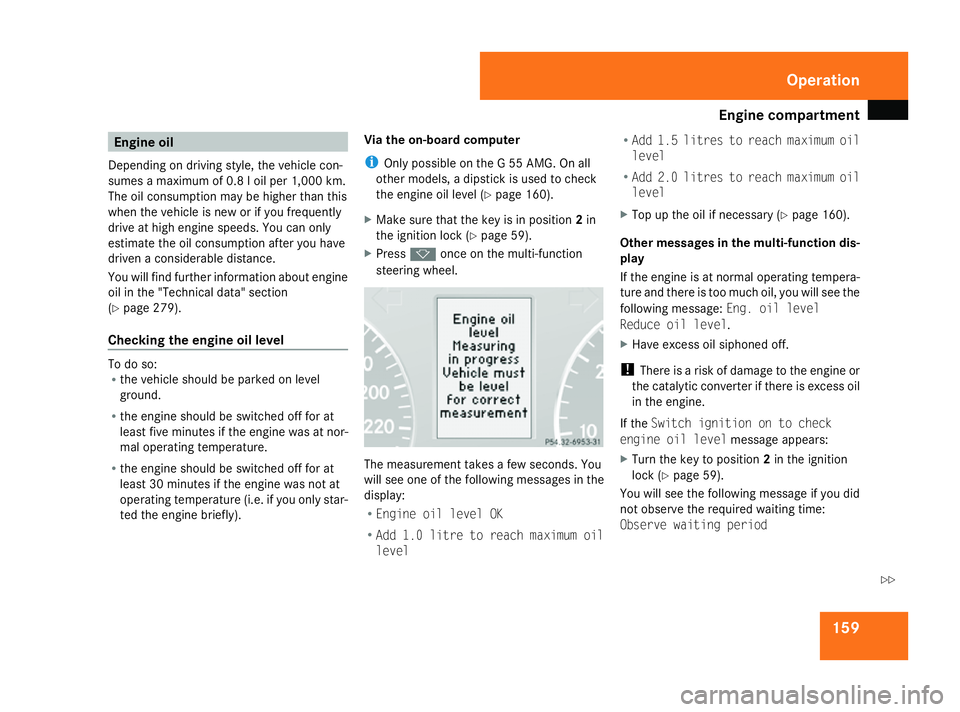
X Press konce on the multi-function
steering wheel. The measurement takes a few seconds. You
will see one of the following messages in the
display:
R
Engine oil level OK
R Add 1.0 litre to reach maximum oil
level R
Add 1.5 litres to reach maximum oil
level
R Add 2.0 litres to reach maximum oil
level
X Top up the oil if necessary ( Ypage 160).
Other messages in the multi-function dis-
play
If the engine is at normal operating tempera-
ture and there is too much oil, you will see the
following message: Eng. oil level
Reduce oil level.
X Have excess oil siphoned off.
! There is a risk of damage to the engine or
the catalytic converter if there is excess oil
in the engine.
If the Switch ignition on to check
engine oil level message appears:
X Turn the key to position 2in the ignition
lock (Y page 59).
You will see the following message if you did
not observe the required waiting time:
Observe waiting period Operation
463_AKB; 1; 8, en-GB
wobuchh,
Version: 2.10.6 2008-07-17T15:19:41+02:00 - Seite 159 ZDateiname: 6515_4091_02_buchblock.pdf; preflight
Page 163 of 293
Engine compartment
160
X
Repeat the measurement after about five
minutes if the engine is at normal operating
temperature.
X Repeat the measurement after about
30 minutes if the engine is not at normal
operating temperature (if the engine was
only started briefly).
If the engine is running, the Engine oil
level Not when engine on message
appears.
X Switch off the engine and wait for five
minutes if the engine is at normal operating
temperature, or for about 30 minutes if the
engine is not at normal operating temper-
ature (if the engine was only started
briefly), before measuring.
i If you wish to cancel the measurement,
press the korj button on the multi-
function steering wheel.
Using the oil dipstick
i Only possible on the G 320 CDI and
G 500. On the G 55 AMG, the oil level is
checked using the on-board computer
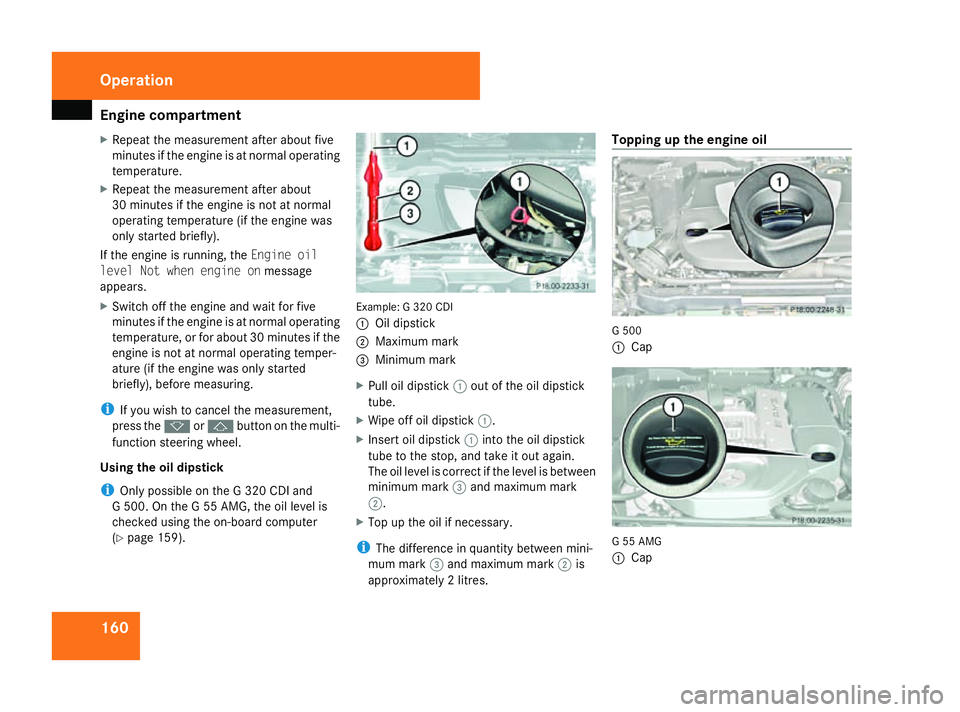
(Y page 159). Example: G 320 CDI
1
Oil dipstick
2 Maximum mark
3 Minimum mark
X Pull oil dipstick 1out of the oil dipstick
tube.
X Wipe off oil dipstick 1.
X Insert oil dipstick 1into the oil dipstick
tube to the stop, and take it out again.
The oil level is correct if the level is between
minimum mark 3and maximum mark
2.
X Top up the oil if necessary.
i The difference in quantity between mini-
mum mark 3and maximum mark 2is
approximately 2 litres. Topping up the engine oil
G 500
1
Cap G 55 AMG
1
Cap Operation
463_AKB; 1; 8, en-GB
wobuchh,
Version: 2.10.6 2008-07-17T15:19:41+02:00 - Seite 160Dateiname: 6515_4091_02_buchblock.pdf; preflight
Page 167 of 293
Tyres and wheels
164reduce your speed and stop the vehicle as
soon as possible to check the wheels and
tyres for damage. Hidden tyre damage
could also be causing the unusual handling
characteristics. If you find no signs of dam-
age, have the tyres and wheels checked at
a specialist workshop, e.g. a Mercedes-
Benz Service Centre.
R when parking your vehicle, make sure that
the tyres do not get deformed by the kerb
or other obstacles. If it is necessary to drive
over kerbs, speed humps or similar eleva-
tions, try to do so slowly and at an obtuse
angle. Otherwise, the tyres, particularly the
sidewalls, could get damaged. Direction of rotation
Tyres with a specified direction of rotation
have additional benefits, e.g. if there is a risk
of aquaplaning. You will only gain these ben-
efits if the correct direction of rotation is
observed.
An arrow on the sidewall of the tyre indicates
its correct direction of rotation.
i You may fit a spare tyre against the direc-
tion of rotation. Tyr
e tread G
Risk of accident
Bear in mind that:
R tyre grip decreases rapidly on wet roads
when the tread depth is less than 3 mm.
Thus, you should replace tyres that have
insufficient tread.
R winter tyres should be replaced when the
tread depth is 4 mm or less as they will
no longer provide adequate grip.
R the tread on a tyre may not wear evenly.
Thus, you should regularly check the
tread depth and the condition of the
tread across the entire width of all tyres.
If necessary, turn the steering wheel so
that you can see the tyre tread more eas-
ily.
Otherwise, you could lose control of the
vehicle and cause an accident due to the
reduced grip of the tyres on the road. Tyre pressures
i You will find a table of tyre pressures for
various operating conditions on the inside
of your vehicle's fuel filler flap
(Y page 154). G
Risk of accident
Tyre pressure that is either too high or too
low has a negative effect on the vehicle’s
driving safety, which could lead you to
cause an accident. You should therefore
regularly check the pressure of all your
tyres (including the spare tyre), particularly
prior to long trips, and correct the pressure
as necessary.
To test tyre pressure, use a suitable pressure
gauge. The outer appearance of a tyre does
not permit any reliable conclusion about the
tyre pressure. On vehicles fitted with the elec-
tronic tyre pressure monitor*, the tyre pres-
sure can be checked in the on-board com-
puter.
If the vehicle is to be heavily laden or driven
at high speeds, the tyre pressure must be
adapted according to the specifications given
in the fuel filler flap. Use the highest specified
tyre pressure for the spare wheel. Operation
* optional
463_AKB; 1; 8, en-GB
wobuchh,
Version: 2.10.6 2008-07-17T15:19:41+02:00 - Seite 164Dateiname: 6515_4091_02_buchblock.pdf; preflight
Page 169 of 293
Tyres and wheels
166 help you decide whether the tyre pressures
should be corrected.
The tyre pressure monitor is not able to
warn you of a sudden loss of pressure, e.g.
if the tyre is penetrated by a foreign object.
In the event of a sudden loss of pressure,
bring the vehicle to a halt by braking care-
fully. Do not make any sudden steering
movements when doing so.
i The operation of the tyre pressure moni-
tor can be affected by interference from
radio transmitting equipment (e.g. radio
headphones, two-way radios) that may be
being operated in or near the vehicle.
i If you are carrying a deflated tyre in the
vehicle, you may only reactivate the tyre
pressure monitor if:
R the deflated tyre is no longer in the vehi-
cle
R you have adjusted the tyre pressure cor-
rectly Calling up the tyre pressure by using
the on-board computer X
Make sure that the key is in position 2in
the ignition lock.
The standard display appears in the multi-
function display (Y page 100).
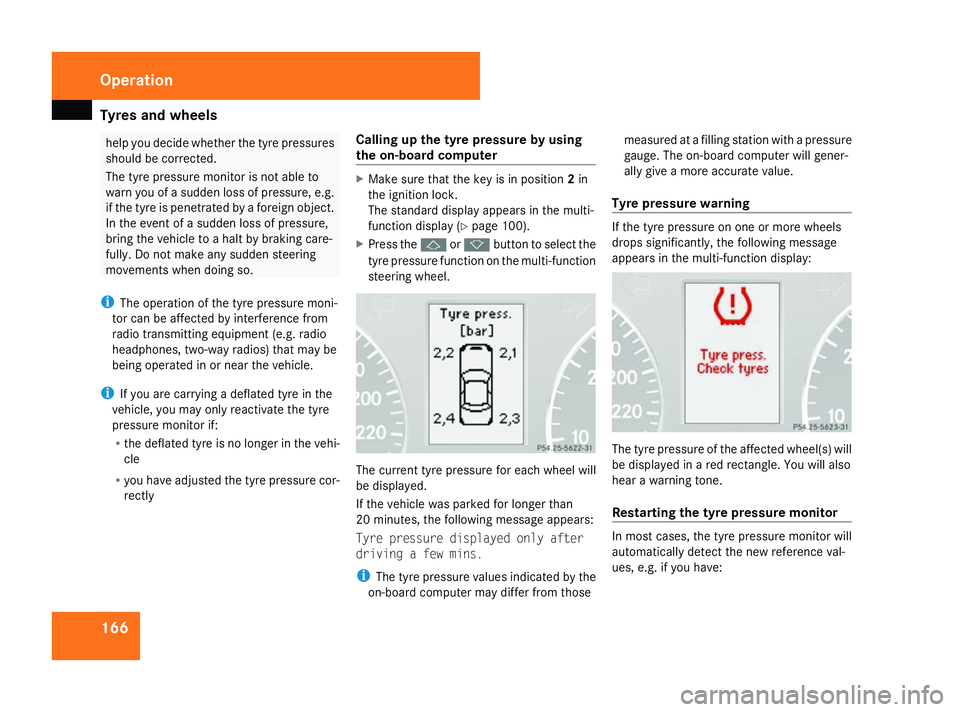
X Press the jork button to select the
tyre pressure function on the multi-function
steering wheel. The current tyre pressure for each wheel will
be displayed.
If the vehicle was parked for longer than
20 minutes, the following message appears:
Tyre pressure displayed only after
driving a few mins.
i
The tyre pressure values indicated by the
on-board computer may differ from those measured at a filling station with a pressure
gauge. The on-board computer will gener-
ally give a more accurate value.
Tyre pressure warning If the tyre pressure on one or more wheels
drops significantly, the following message
appears in the multi-function display:
The tyre pressure of the affected wheel(s) will
be displayed in a red rectangle. You will also
hear a warning tone.
Restarting the tyre pressure monitor
In most cases, the tyre pressure monitor will
automatically detect the new reference val-
ues, e.g. if you have:Operation
463_AKB; 1; 8, en-GB
wobuchh,
Version: 2.10.6 2008-07-17T15:19:41+02:00 - Seite 166Dateiname: 6515_4091_02_buchblock.pdf; preflight
Page 170 of 293
Tyres and wheels
167
R
changed the tyre pressure
R changed the wheels or tyres
R fitted new wheels or tyres
If you wish to define the new reference values
manually:
X Use the table on the inside of the fuel filler
flap to ensure that the tyre pressure is set
correctly in all four tyres for the current
operating conditions.
Also observe the notes in the section on
tyre pressures (Y page 164).
X Make sure that the key is in position 2in
the ignition lock.
The standard display appears in the multi-
function display (Y page 101).
X Press the jork button to select the
Tyre pressure function on the multi-func-
tion steering wheel or wait until the follow-
ing message appears:
Tyre pressure displayed only after
driving a few mins.
X Press the reset button on the left of the
instrument cluster (Y page 96).
The following message appears in the
multi-function display:
Tyre pressure monitor
reactivate?
Yes No
X Press the æbutton on the multi-func-
tion steering wheel.
The following message appears in the
multi-function display:
Tyre pressure monitor restarted
The tyre pressure monitor has stored the
pressure of the tyres as a new reference
value.
If you wish to cancel the restart:
X Press the çbutton on the multi-func-
tion steering wheel.
The tyre pressure values stored at the last
restart will continue to be monitored. Interchanging the wheels
G
Risk of accident
Interchange the front and rear wheels only
if they have the same dimensions: for exam-
ple size, offset, etc.
After every wheel interchange/change,
have the tightening torque checked at a
qualified specialist workshop that has the
necessary specialist knowledge and tools
to carry out the work required. Mercedes-
Benz recommends that you use a Mercedes-Benz Service Centre for this pur-
pose. In particular, work relevant to safety
or on safety-related systems must be car-
ried out at a qualified specialist workshop.
The wheels could work loose if they are not
tightened to a torque of 130 Nm.
For safety reasons, Mercedes-Benz recom-
mends that you only use wheel bolts of the
correct size which have been approved for
Mercedes-Benz vehicles.
The wear patterns on the front and rear tyres
differ depending on the operating conditions.
Interchange the wheels before a clear wear
pattern has formed on the tyres. Front tyres
typically wear more on the shoulders and the
rear tyres in the centre.
Interchange the wheels every 5,000 km to
10,000 km depending on the degree of tyre
wear, provided that the vehicle has the same
size front and rear tyres. Do not reverse the
direction of tyre rotation.
Clean the contact surfaces of the wheel and
the brake disc thoroughly every time a wheel
is interchanged. Check the tyre pressure and
reactivate the tyre pressure monitor* if nec-
essary. Operation
* optional
463_AKB; 1; 8, en-GB
wobuchh
,V ersion: 2.10.6
2008-07-17T15:19:41+02:00 - Seite 167 ZDateiname: 6515_4091_02_buchblock.pdf; preflight
Page 172 of 293
Driving
tips 169Snow chains
For safety reasons, Mercedes-Benz recom-
mends that you only use snow chains which
have been specially approved for your vehicle
by Mercedes-Benz, or are of a corresponding
standard of quality.
! Information about the use of snow chain-
compatible AMG winter tyres is applicable
for AMG tyres. Use of snow chains is only
permissible with these tyres.
If you intend to fit snow chains, please bear
the following points in mind:
R snow chains cannot be fitted to all wheel/
tyre combinations.
R fit the snow chains for maximum tractive
power and driving stability on all four
wheels. Comply with the manufacturer's
installation instructions.
Do not exceed the maximum permissible
speed of 50 km/h.
i You may wish to deactivate ESP ®
when
pulling away with snow chains fitted.
(Y page 49)This way you can allow the
wheels to spin in a controlled manner, ach-
ieving an increased driving force (cutting
action). Winter driving
G
Risk of accident
Do not shift down for additional engine
braking on a slippery road surface. This
could cause the drive wheels to lose their
grip and the vehicle could skid.
You should drive particularly carefully on slip-
pery road surfaces. Avoid sudden accelera-
tion, steering and braking manoeuvres.
If the vehicle threatens to skid or cannot be
stopped when moving at low speed:
X Shift the selector lever to N.
X Try to bring the vehicle under control by
using corrective steering. Driving tips
Pulling away on slippery surfaces
! If possible, do not let the drive wheels
spin. Otherwise, you could damage the
drive train.
X When necessary, engage the differential
locks (Y page 94). Rolling with the engine switched off
G
Risk of accident
Never switch the engine off while the vehi-
cle is in motion.
There is no power assistance for the steer-
ing and the service brake when the engine
is not running.
You will require considerably more effort to
steer and brake and, therefore, you could
lose control of the vehicle and cause an
accident. Operation
463_AKB; 1; 8, en-GB
wobuchh
,V ersion: 2.10.6
2008-07-17T15:19:41+02:00 - Seite 169 ZDateiname: 6515_4091_02_buchblock.pdf; preflight
Page 177 of 293
Off-road driving
174
i
Information about retrofitting special all-
terrain tyres is available from any
Mercedes-Benz Service Centre.
Checklist before driving off-road X
Engine oil level: check the engine oil and
top it up if necessary.
Only then does the engine receive enough
oil when the vehicle is standing on a steep
incline.
X Vehicle toolkit: check that the jack is
working and make sure you have the wheel-
brace, a robust tow cable and a folding
spade in the vehicle.
X Wheels and tyres: check the tyre tread
depth and tyre pressure.
X Check for damage and remove any objects,
e.g. small stones, from the wheels/tyres.
X Replace any missing valve caps.
X Replace dented or damaged wheels.
Checklist after driving off-road Driving over rough terrain places greater
demands on your vehicle than driving on nor-
mal roads. After driving off-road, check the
vehicle. This allows you to detect damage
promptly and reduce the risk of an accident
to yourself and other road users. X
Shift the transfer case to HIGH
(Y page 93).
X Disengage the differential locks
(Y page 95).
X Clean the headlamps and rear lights and
check for damage.
X Clean the front and rear licence plates.
X Clean the wheels/tyres with a water jet and
remove any foreign objects.
X Clean the wheels, wheel arches and the
vehicle underside with a water jet; check
for foreign objects and damage.
X Check whether twigs or other parts of
plants have become trapped. These
increase the risk of fire and can damage
fuel pipes, brake hoses or the rubber bel-
lows of the axle joints and propeller shafts.
X After the trip, examine without fail the
entire undercarriage, wheels, tyres, brakes,
bodywork structure, steering, chassis and
exhaust system for damage.
X After driving for extended periods across
sand, mud, gravel, water or in similarly dirty
conditions, have the brake discs, wheels,
brake pads /linings and axle joints checked
and cleaned.
X If you detect strong vibrations after off-road
travel, check for foreign objects in the
wheels and drive train and remove them if necessary. Foreign objects can disturb the
balance and cause vibrations. Travelling uphill
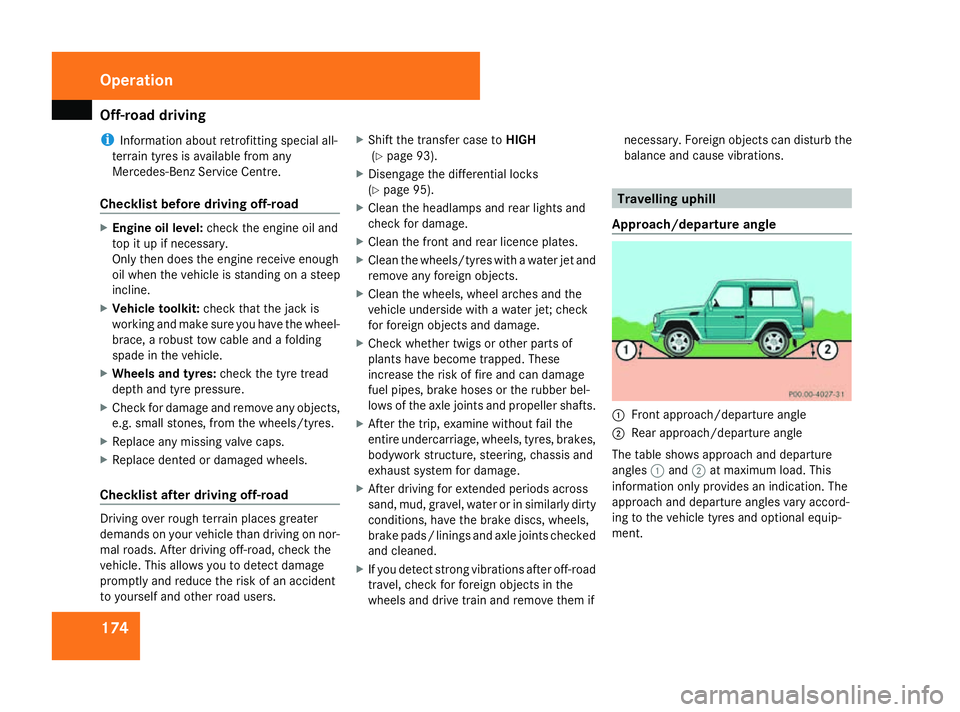
Approach/departure angle 1
Front approach/departure angle
2 Rear approach/departure angle
The table shows approach and departure
angles 1and 2at maximum load. This
information only provides an indication. The
approach and departure angles vary accord-
ing to the vehicle tyres and optional equip-
ment. Operation
463_AKB; 1; 8, en-GB
wobuchh,
Version: 2.10.6 2008-07-17T15:19:41+02:00 - Seite 174Dateiname: 6515_4091_02_buchblock.pdf; preflight
Page 182 of 293
Trailer towing*
179
Coupling up a trailer G
Risk of injury
Do not connect a trailer with an engaged
overrun brake. Otherwise, your hand could
become trapped between the bumper and
drawbar.
! Do not uncouple a trailer with overrun
brake between the bumper and drawbar,
otherwise your vehicle could be damaged
by the spring action of the overrun brake.
X Position the trailer level behind the vehicle.
X Couple up the trailer.
X Establish the electrical connection
between the vehicle and the trailer.
Driving tips In Germany, the maximum permissible speed
for vehicle/trailer combinations is 80 km/h.
! A maximum speed of 80 km/h should not
be exceeded, even in countries where
higher speeds are permitted for vehicle/
trailer combinations.
When towing a trailer, your vehicle's handling
characteristics will be different in comparison
to when driving without a trailer. The vehicle/trailer combination:
R
is heavier
R is restricted in its acceleration and gradi-
ent-climbing capability
R has an increased braking distance
R is affected more by strong crosswinds
R demands more sensitive steering
R consumes more fuel
X On long and steep downhill gradients,
select shift range 1,2or 3in good time.
i This also applies if you have activated
cruise control or Speedtronic.
X If necessary, shift the transfer case to
LOW (Ypage 92).
This will use the braking effect of the
engine, so less braking will be required to
maintain the speed. This relieves the load
on the brake system and prevents the
brakes from overheating and wearing too
quickly. If you need additional braking,
depress the brake pedal repeatedly rather
than continuously. G
Risk of accident
Never depress the brake pedal continu-
ously while the vehicle is in motion, e.g. never cause the brakes to rub by applying
constant slight pedal pressure. This causes
the brake system to overheat, increases
the braking distance and can lead to the
brakes failing completely.
Driving tips
R Maintain a greater distance from the vehi-
cle in front than when driving without a
trailer.
R Avoid braking abruptly. If possible, brake
gently at first to allow the trailer to run on.
Then increase the braking force rapidly.
R The values given for gradient-climbing
capabilities from a standstill refer to sea
level. When driving in mountainous areas,
note that the power output of the engine,
and consequently the vehicle's gradient-
climbing capability, decrease with increas-
ing altitude.
If the trailer swings from side to side:
X Do not accelerate.
X Do not counter-steer.
X Brake if necessary. Operation
* optional
463_AKB; 1; 8, en-GB
wobuchh
,V ersion: 2.10.6
2008-07-17T15:19:41+02:00 - Seite 179 ZDateiname: 6515_4091_02_buchblock.pdf; preflight
Page 188 of 293
Care
185
Cleaning the steering wheel boss and
dashboard X
Moisten a clean lint-free cloth with water.
X Clean the plastic parts and the dashboard.
X If particularly dirty, use a mild detergent. G
Risk of injury
Do not use cleaners and cockpit care
sprays containing solvents to clean the
cockpit and steering wheel boss. Cleaners
containing solvents cause the surface to
become porous and in the event of an air-
bag being triggered, plastic parts that have
become loose could cause considerable
injuries.
Leather upholstery* !
Cleaning
R Clean genuine leather covers using a
damp cloth, then wipe the covers down
using a dry cloth. Make sure that the
leather does not become soaked. For
leather care, use leather care foam A 001 986 59 71 10. You can purchase this
from any Mercedes-Benz Service Centre.
R Clean artificial leather covers with a cloth
moistened with a solution containing 1%
detergent (e. g. washing-up liquid).
R Clean fabric covers with a microfibre
cloth moistened with a solution contain-
ing 1% detergent (e. g. washing-up liquid).
When cleaning, take care not to rub too
vigorously and always wipe entire seat
sections to avoid leaving visible lines.
Leave the seat to dry afterwards. Clean-
ing results depend on the type of dirt and
how long it has been there.
i Note that leather covers are a natural
product and as such are subject to a natural
ageing process and may react differently
(e.g. increased formation of wrinkles) to
certain environmental influences (such as
high humidity, intense heat).
Note that regular care is essential to ensure
that the quality (both appearance and com-
fort) of the covers is retained over time. Cleaning real wood and trim strips X
Moisten a clean lint-free cloth with water.
X Clean the wooden trim.
X If particularly dirty, use a mild detergent.
! Do not use cleaning agents containing
solvents because these can damage the
wooden trim.
Cabriolet Frequent cleaning reduces the soft top's
resistance to dirt.
Intensive treatment with the Mercedes-Benz
convertible soft-top cleaning agents kit can
restore the resistance to dirt.
Incorrect cleaning and care, as well as ageing,
can cause soft-top seams to leak. Have the
soft-top seams sealed at a qualified specialist
workshop, e.g. at a Mercedes-Benz Service
Centre.
i
Cover the soft top with a suitable cover if
you plan to leave the vehicle outside for a
long period of time.
! Remove bird droppings immediately as
they are corrosive and can cause soft top
fabric leaks. Do not wash the vehicle with
a high-pressure cleaner or in an automatic Operation
* optional
463_AKB; 1; 8, en-GB
wobuchh,
Version: 2.10.6 2008-07-17T15:19:41+02:00 - Seite 185 ZDateiname: 6515_4091_02_buchblock.pdf; preflight
Page 201 of 293
Display
messages 198 Display messages Possible cause/consequence Possible solution
ESP unavailable See
Owner's Manual
G
Risk of accident
ESP ®
is unavailable due to undervoltage.
It is possible that the battery is not being
charged.
BAS, 4ETS and the tyre pressure moni-
tor* have also been deactivated.
The brake system continues to function
normally, but without the functions listed
above. X
Drive on carefully.
X Visit a qualified specialist workshop immedi-
ately.
X Observe the additional messages in the multi-
function display ( Ypage 98). Vehicle Consult workshop The operating reliability of the automatic
transmission can no longer be fully guar-
anteed. X
Drive on carefully.
X Have the transmission checked immediately at
a qualified specialist workshop. Please correct Check tyres
G
Risk of accident
The tyre pressure monitor* has detected
a significant pressure loss. X
Stop the vehicle without making any sudden
steering or braking manoeuvres. Pay attention
to traffic conditions as you do so.
X Check the tyres.
X Check the tyre pressure and correct it, if nec-
essary ( Ypage 164).
X Repair or change the faulty wheel as neces-
sary ( Ypage 244).
X Then restart the tyre pressure monitor* once
the tyre pressure is correct (Y page 166).Practical advice
* optional
463_AKB; 1; 8, en-GB
wobuchh,
Version: 2.10.6 2008-07-17T15:19:41+02:00 - Seite 198Dateiname: 6515_4091_02_buchblock.pdf; preflight