ABS MERCEDES-BENZ G-CLASS SUV 2008 Owners Manual
[x] Cancel search | Manufacturer: MERCEDES-BENZ, Model Year: 2008, Model line: G-CLASS SUV, Model: MERCEDES-BENZ G-CLASS SUV 2008Pages: 293, PDF Size: 4.49 MB
Page 6 of 293
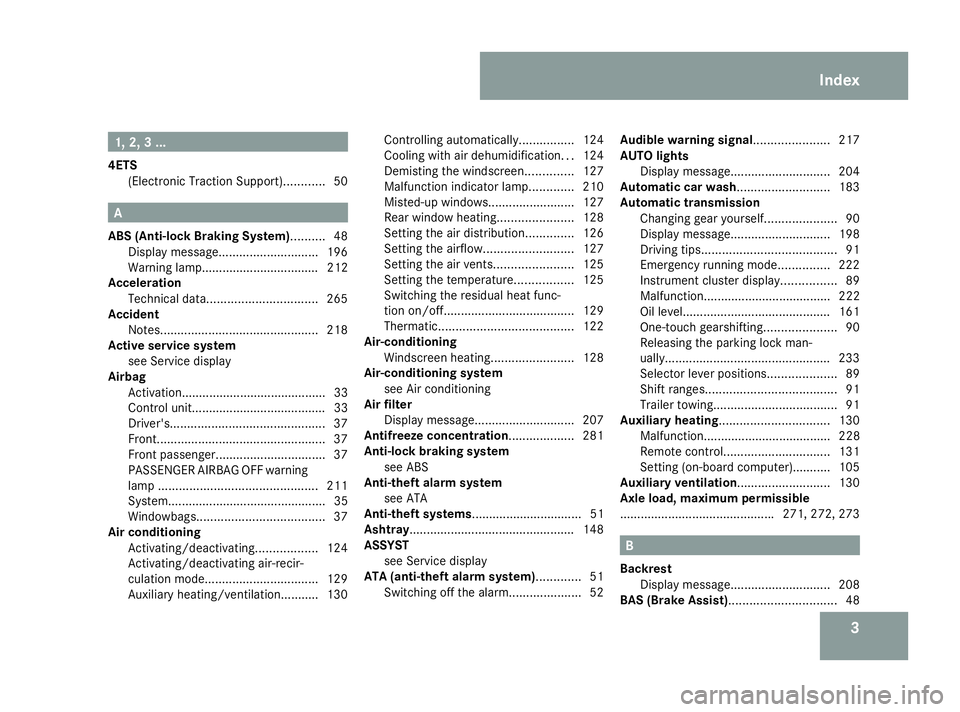
31, 2, 3 ...
4ETS (Electronic Traction Support )............ 50 A
ABS (Anti-lock Braking System) ..........48
Display message ............................. 196
Warning lamp.................................. 212
Acceleration
Technical data. ............................... 265
Accident
Notes. ............................................. 218
Active service system
see Service display
Airbag
Activation.......................................... 33
Control unit....................................... 33
Driver's ............................................. 37
Front. ................................................ 37
Front passenger ................................ 37
PASSENGER AIRBAG OFF warning
lamp .............................................. 211
System.............................................. 35
Windowbags. .................................... 37
Air conditioning
Activating/deactivating ..................124
Activating/deactivating air-recir-
culation mode. ................................ 129
Auxiliary heating/ventilation........... 130 Controlling automatically.
...............124
Cooling with air dehumidification ...124
Demisting the windscreen ..............127
Malfunction indicator lamp. ............210
Misted-up windows. ........................127
Rear window heating ......................128
Setting the air distribution. .............126
Setting the airflow .......................... 127
Setting the air vents .......................125
Setting the temperature .................125
Switching the residual heat func-
tion on/off ...................................... 129
Thermatic. ...................................... 122
Air-conditioning
Windscreen heating. .......................128
Air-conditioning system
see Air conditioning
Air filter
Display message ............................. 207
Antifreeze concentration................... 281
Anti-lock braking system see ABS
Anti-theft alarm system
see ATA
Anti-theft systems................................ 51
Ashtray................................................ 148
ASSYST see Service display
ATA (anti-theft alarm system)............. 51
Switching off the alarm. ....................52Audible warning signal......................
217
AUTO lights Display message ............................. 204
Automatic car wash........................... 183
Automatic transmission Changing gear yoursel f..................... 90
Display message ............................. 198
Driving tips ....................................... 91
Emergency running mode ...............222
Instrument cluster display. ...............89
Malfunction..................................... 222
Oil level.. ......................................... 161
One-touch gearshifting. ....................90
Releasing the parking lock man-
ually. ............................................... 233
Selector lever positions. ...................89
Shift ranges. ..................................... 91
Trailer towing. ................................... 91
Auxiliary heating ................................ 130
Malfunction..................................... 228
Remote control ............................... 131
Setting (on-board computer).......... .105
Auxiliary ventilation ...........................130
Axle load, maximum permissible
............................................ .271, 272, 273 B
Backrest Display message ............................. 208
BAS (Brake Assist)............................... 48 Index
463_AKB; 1; 8, en-GB
wobuchh,
Version: 2.10.6 2008-07-17T15:19:41+02:00 - Seite 3Dateiname: 6515_4091_02_buchblock.pdf; preflight
Page 8 of 293
5
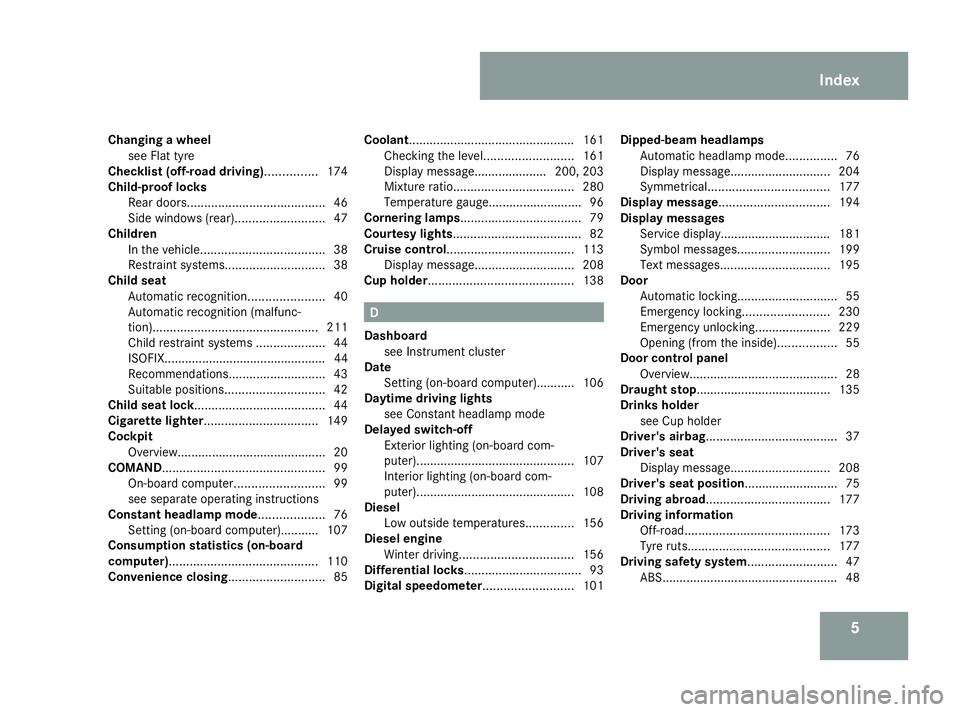
Changing a wheel
see Flat tyre
Checklist (off-road driving)............... 174
Child-proof locks Rear doors. ....................................... 46
Side windows (rear) ..........................47
Children
In the vehicle. ................................... 38
Restraint systems. ............................ 38
Child seat
Automatic recognition ......................40
Automatic recognition (malfunc-
tion). ............................................... 211
Child restraint systems ....................44
ISOFIX............................................... 44
Recommendations. ...........................43
Suitable positions. ............................ 42
Child seat lock...................................... 44
Cigarette lighter................................. 149
Cockpit Overview. .......................................... 20
COMAND............................................... 99
On-board computer. .........................99
see separate operating instructions
Constant headlamp mode................... 76
Setting (on-board computer).......... .107
Consumption statistics (on-board
computer)........................................... 110
Convenience closing............................ 85Coolant................................................
161
Checking the level. .........................161
Display message..................... 200, 203
Mixture ratio ................................... 280
Temperature gauge ...........................96
Cornering lamps................................... 79
Courtesy lights..................................... 82
Cruise control..................................... 113
Display message ............................. 208
Cup holder.......................................... 138 D
Dashboard see Instrument cluster
Date
Setting (on-board computer).......... .106
Daytime driving lights
see Constant headlamp mode
Delayed switch-off
Exterior lighting (on-board com-
puter). ............................................. 107
Interior lighting (on-board com-
puter). ............................................. 108
Diesel
Low outside temperatures. .............156
Diesel engine
Winter driving. ................................ 156
Differential locks.................................. 93
Digital speedometer.......................... 101Dipped-beam headlamps
Automatic headlamp mode. ..............76
Display message ............................. 204
Symmetrical. .................................. 177
Display message ................................ 194
Display messages Service display................................ 181
Symbol messages. ..........................199
Text messages. ............................... 195
Door
Automatic locking ............................. 55
Emergency locking .........................230
Emergency unlocking...................... 229
Opening (from the inside). ................55
Door control panel
Overview. .......................................... 28
Draught stop....................................... 135
Drinks holder
see Cup holder
Driver's airbag...................................... 37
Driver's seat Display message ............................. 208
Driver's seat position........................... 75
Driving abroad.................................... 177
Driving information Off-road .......................................... 173
Tyre ruts. ........................................ 177
Driving safety system.......................... 47
ABS. .................................................. 48 Index
463_AKB; 1; 8, en-GB
wobuchh,
Version: 2.10.6 2008-07-17T15:19:41+02:00 - Seite 5Dateiname: 6515_4091_02_buchblock.pdf; preflight
Page 16 of 293
13
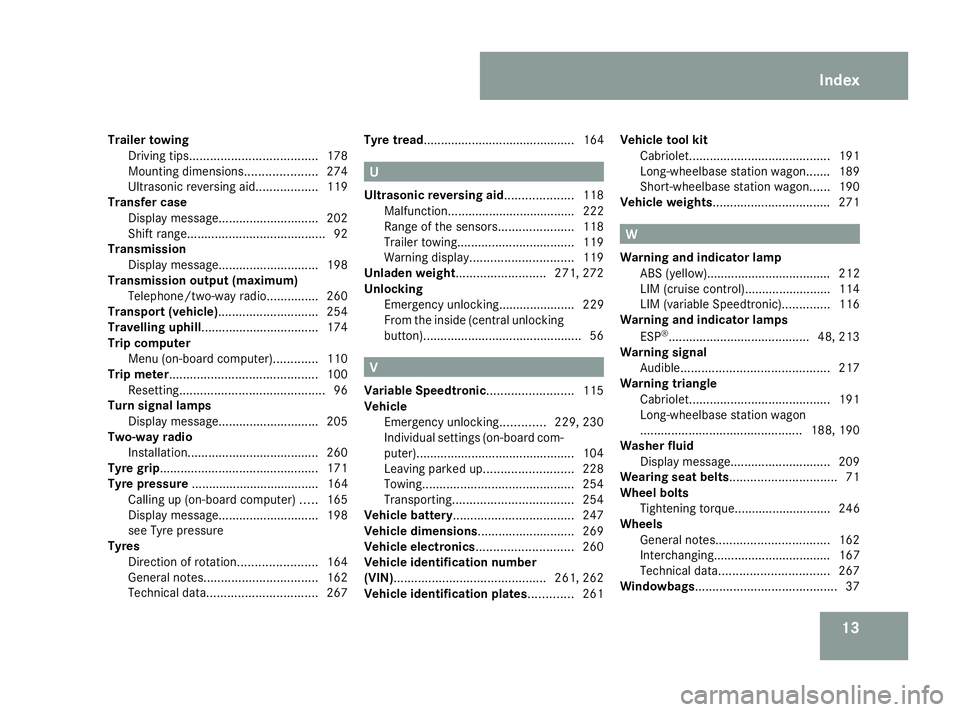
Trailer towing
Driving tips. .................................... 178
Mounting dimensions. ....................274
Ultrasonic reversing aid. .................119
Transfer case
Display message ............................. 202
Shift range ........................................ 92
Transmission
Display message ............................. 198
Transmission output (maximum)
Telephone/two-way radio ...............260
Transport (vehicle)............................. 254
Travelling uphill .................................. 174
Trip computer Menu (on-board computer). ............110
Trip meter........................................... 100
Resetting. ......................................... 96
Turn signal lamps
Display message ............................. 205
Two-way radio
Installation. ..................................... 260
Tyre grip.............................................. 171
Tyre pressure ..................................... 164
Calling up (on-board computer) .....165
Display message ............................. 198
see Tyre pressure
Tyres
Direction of rotatio n....................... 164
General notes. ................................ 162
Technical data. ............................... 267Tyre tread............................................ 164 U
Ultrasonic reversing aid.................... 118
Malfunction..................................... 222
Range of the sensors. .....................118
Trailer towing. ................................. 119
Warning displa y.............................. 119
Unladen weight.......................... 271, 272
Unlocking Emergency unlocking...................... 229
From the inside (central unlocking
button) .............................................. 56 V
Variable Speedtronic .........................115
Vehicle Emergency unlocking .............229, 230
Individual settings (on-board com-
puter). ............................................. 104
Leaving parked up. .........................228
Towing. ........................................... 254
Transporting ................................... 254
Vehicle battery................................... 247
Vehicle dimensions............................ 269
Vehicle electronics............................ 260
Vehicle identification number
(VIN)............................................ 261, 262
Vehicle identification plates............. 261Vehicle tool kit
Cabriolet. ........................................ 191
Long-wheelbase station wagon....... 189
Short-wheelbase station wagon. .....190
Vehicle weights.................................. 271 W
Warning and indicator lamp ABS (yellow).................................... 212
LIM (cruise control)......................... 114
LIM (variable Speedtronic). .............116
Warning and indicator lamps
ESP ®
......................................... 48, 213
Warning signal
Audible. .......................................... 217
Warning triangle
Cabriolet. ........................................ 191
Long-wheelbase station wagon
............................................... 188, 190
Washer fluid
Display message ............................. 209
Wearing seat belts............................... 71
Wheel bolts Tightening torque............................ 246
Wheels
General notes. ................................ 162
Interchanging.................................. 167
Technical data. ............................... 267
Windowbags......................................... 37 Index
463_AKB; 1; 8, en-GB
wobuchh,
Version: 2.10.6 2008-07-17T15:19:41+02:00 - Seite 13Dateiname: 6515_4091_02_buchblock.pdf; preflight
Page 26 of 293
Instrument cluster
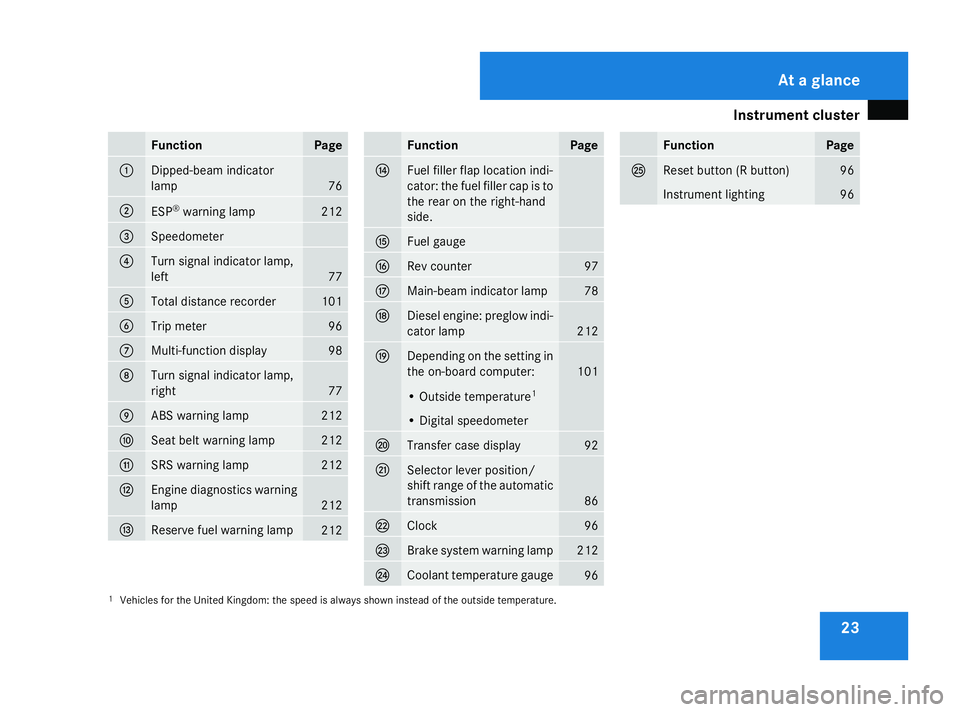
23Function Page
1
Dipped-beam indicator
lamp
76
2
ESP
®
warning lamp 212
3
Speedometer
4
Turn signal indicator lamp,
left 77
5
Total distance recorder 101
6
Trip meter 96
7
Multi-function display 98
8
Turn signal indicator lamp,
right 77
9
ABS warning lamp 212
a
Seat belt warning lamp 212
b
SRS warning lamp 212
c
Engine diagnostics warning
lamp
212
d
Reserve fuel warning lamp
212 Function Page
e
Fuel filler flap location indi-
cator: the fuel filler cap is to
the rear on the right-hand
side. f
Fuel gauge
g
Rev counter 97
h
Main-beam indicator lamp 78
j
Diesel engine: preglow indi-
cator lamp
212
k
Depending on the setting in
the on-board computer:
101
• Outside temperature
1 • Digital speedometer
l
Transfer case display 92
m
Selector lever position/
shift range of the automatic
transmission
86
n
Clock 96
o
Brake system warning lamp 212
p
Coolant temperature gauge
96 Function Page
q
Reset button (R button) 96
Instrument lighting 96
1 Vehicles for the United Kingdom: the speed is always shown instead of the outside temperature. At a glance
463_AKB; 1; 8, en-GB
wobuchh,
Version: 2.10.6 2008-07-17T15:19:41+02:00 - Seite 23Dateiname: 6515_4091_02_buchblock.pdf; preflight
Page 50 of 293
Driving safety sys
tems 47
X
To deactivate: press locking lever down-
wards 2.
Override feature for the rear windows G
Risk of accident and injury
If children are travelling in the vehicle, acti-
vate the child-proof locks for the rear doors
and the override feature for the rear win-
dows. The children could otherwise open
doors or windows while the vehicle is in
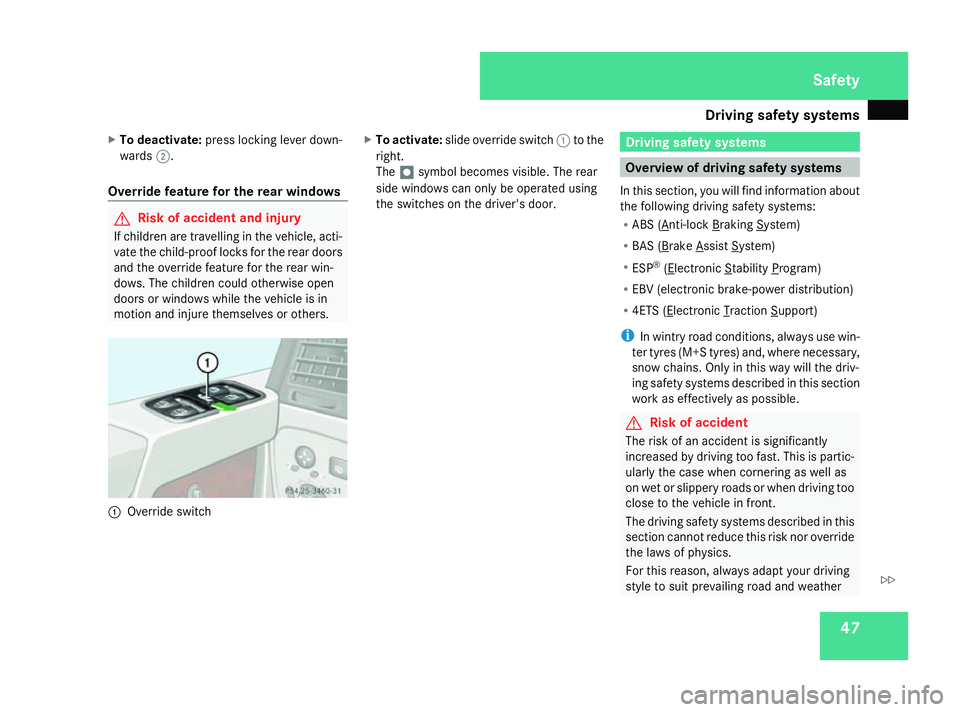
motion and injure themselves or others. 1
Override switch X
To activate: slide override switch 1to the
right.
The 7symbol becomes visible. The rear
side windows can only be operated using
the switches on the driver's door. Driving safety systems
Overview of driving safety systems
In this section, you will find information about
the following driving safety systems:
R ABS ( Anti-lock Braking System)
R BAS ( Brake Assist System)
R ESP ®
( Electronic Stability Program)
R EBV (electronic brake-power distribution)
R 4ETS ( Electronic Traction Support)
i In wintry road conditions, always use win-
ter tyres (M+S tyres) and, where necessary,
snow chains. Only in this way will the driv-
ing safety systems described in this section
work as effectively as possible. G
Risk of accident
The risk of an accident is significantly
increased by driving too fast. This is partic-
ularly the case when cornering as well as
on wet or slippery roads or when driving too
close to the vehicle in front.
The driving safety systems described in this
section cannot reduce this risk nor override
the laws of physics.
For this reason, always adapt your driving
style to suit prevailing road and weather Safety
463_AKB; 1; 8, en-GB
wobuchh
,V ersion: 2.10.6
2008-07-17T15:19:41+02:00 - Seite 47 ZDateiname: 6515_4091_02_buchblock.pdf; preflight
Page 51 of 293
Driving safety sys
tems48 conditions. Maintain sufficient distance
from other road users and objects on the
road. ABS (Anti-lock Braking System)
ABS regulates brake pressure in such a way
that the wheels do not lock when you brake.
This allows you to continue steering the vehi-
cle when braking.
ABS works from a speed of about 8 km/h
upwards, regardless of road surface condi-
tions. ABS works on slippery surfaces, even
when you only brake gently. G
Risk of accident
Do not depress the brake pedal several
times in quick succession (pumping).
Depress the brake firmly and evenly. Pump-
ing the brake pedal reduces the braking
effect.
Braking If ABS intervenes when braking, you will feel
a pulsing in the brake pedal.
X If ABS intervenes: continue to depress the
brake pedal with force until the braking sit-
uation is over. X
To make a full brake application:
depress the brake pedal with full force. G
Risk of accident
If ABS is faulty, the wheels could lock when
braking. This limits the steerability of the
vehicle when braking and the braking dis-
tance may increase.
If ABS is deactivated due to a malfunction,
then BAS, ESP ®
and 4ETS are also deacti-
vated. There is an increased risk of your
vehicle skidding in certain situations.
You should always adapt your driving style
to suit prevailing road and weather condi-
tions. BAS (Brake Assist)
BAS operates in emergency braking situa-
tions. If you depress the brake pedal quickly,
BAS automatically boosts the braking force,
thus shortening the stopping distance.
X Keep the brake pedal firmly depressed until
the emergency braking situation is over.
ABS prevents the wheels from locking.
The brakes will function as usual once you
release the brake pedal. BAS is deactivated. G
Risk of accident
If BAS has malfunctioned, the braking sys-
tem remains available with full brake boost-
ing effect. However, braking force is not
automatically increased in emergency
braking situations and the stopping dis-
tance may increase. ESP
®
(Electronic Stability Program)
ESP ®
monitors driving stability and traction,
i.e. power transmission between tyres and
the road surface.
If ESP ®
detects that the vehicle is deviating
from the direction desired by the driver, one
or more wheels are braked to stabilise the
vehicle. The engine output is also modified, if
necessary, to keep the vehicle on the desired
course within physical limits. ESP ®
assists
the driver when pulling away on wet or slip-
pery roads. ESP ®
can also stabilise the vehi-
cle during braking.
When ESP ®
intervenes, the vwarning
lamp flashes in the speedometer. G
Risk of accident
If the v warning lamp in the speedom-
eter flashes, proceed as follows: Safety
463_AKB; 1; 8, en-GB
wobuchh
,V ersion: 2.10.6
2008-07-17T15:19:41+02:00 - Seite 48 Dateiname: 6515_4091_02_buchblock.pdf; preflight
Page 52 of 293
Driving safety sys
tems 49R
do not deactivate ESP ®
under any cir-
cumstances.
R only depress the accelerator pedal as far
as necessary when pulling away.
R adapt your driving style to suit the pre-
vailing road and weather conditions.
The vehicle could otherwise go into a skid.
ESP ®
cannot reduce the risk of an accident
if you drive too fast. ESP ®
cannot override
the laws of physics.
! If:
R the vehicle is being towed with the front
or rear axle raised,
R the parking brake is being tested using a
dynamometer,
the ignition must be switched off (key in
position 0or 1in the ignition lock). Other-
wise, application of the brakes by ESP ®
could destroy the brake system on the front
or rear axle.
! A function or performance test should
only be carried out on a twin-axle dyna-
mometer. If you wish to operate the vehicle
on such a dynamometer, please consult a
Mercedes-Benz Service Centre in advance. You could otherwise damage the drive train
or the brake system.
i If differential locks are switched on, ABS,
BAS and ESP ®
switch themselves off auto-
matically.
i Only use wheels with the recommended
tyre sizes. Only then will ESP ®
function
properly.
Activating/deactivating ESP ® ESP
®
is activated automatically when the
engine is running.
It may be best to deactivate ESP ®
in the fol-
lowing situations:
R when using snow chains
R in deep snow
R on sand or gravel G
Risk of accident
Activate ESP ®
as soon as the situations
described above no longer apply. ESP ®
will
otherwise not be able to stabilise the vehi-
cle if the vehicle starts to skid or a wheel
starts to spin. If you deactivate ESP
®
:
R ESP ®
no longer improves driving stability.
R the engine's torque is no longer limited and
the drive wheels can spin. Spinning of the
wheels results in a cutting action, which
provides better grip.
R traction control is still activated.
R ESP ®
still provides support when you
brake.
R and are driving at above 60 km/h, ESP ®
still intervenes when one wheel reaches its
grip limit even though it is switched off.
i If ESP ®
is deactivated and one or more
wheels start to spin, the vwarning lamp
in the instrument cluster flashes. In such
situations ESP ®
will not stabilise the vehi-
cle. Safety
463_AKB; 1; 8, en-GB
wobuchh
,V ersion: 2.10.6
2008-07-17T15:19:41+02:00 - Seite 49 ZDateiname: 6515_4091_02_buchblock.pdf; preflight
Page 97 of 293
Transmission
94
!
In order to avoid damage to the transfer
case, you may only operate the vehicle on
a roller dynamometer (single-axle roller
dynamometer), if:
R the undriven axle is raised
or
R the relevant propeller shaft is disconnec-
ted
and
R the differential lock of the transfer case
is engaged
Engaging the differential locks G
Risk of accident
When driving on a firm road surface, never
drive with the differential locks engaged.
Never drive through tight corners with the
differential lock on the front axle engaged.
When differential locks are engaged, the
vehicle's steerability is greatly impaired
and the risk of accident thereby increases.
Do not engage or disengage the differential
locks while cornering. The vehicle motion
could otherwise be jerky. You could lose
control of the vehicle as a result and cause
an accident. If you select a differential lock, ABS, 4ETS,
ESP
®
and BAS are deactivated.
Engage the differential locks:
R when driving off-road
R to deactivate ABS, 4ETS and ESP ®
when
off-road
R when fording
R on snowy, icy or rough road surfaces
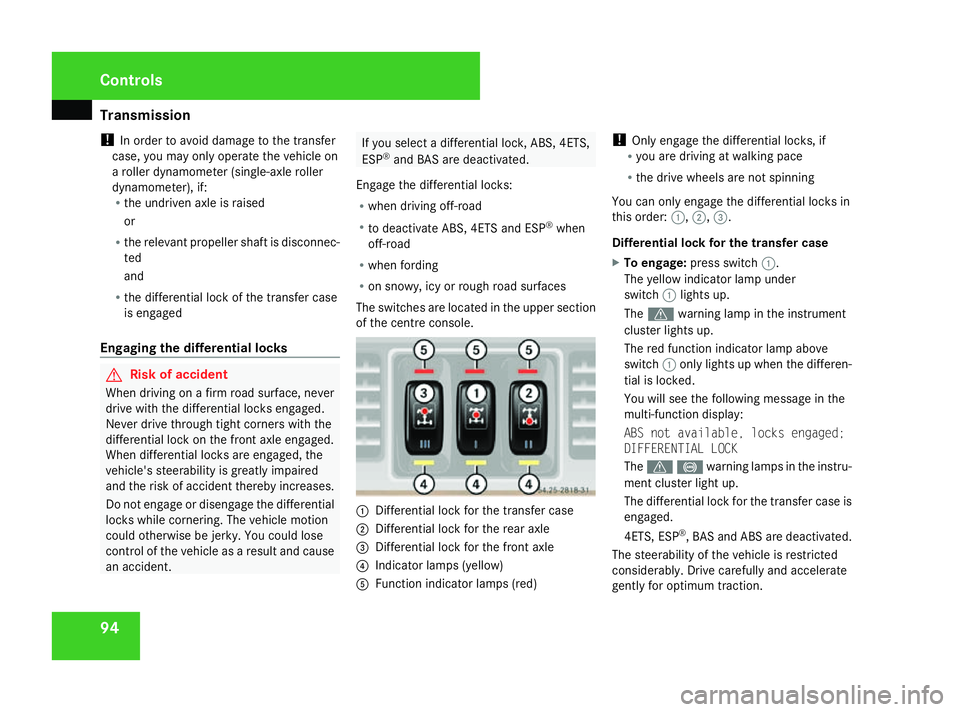
The switches are located in the upper section
of the centre console. 1
Differential lock for the transfer case
2 Differential lock for the rear axle
3 Differential lock for the front axle
4 Indicator lamps (yellow)
5 Function indicator lamps (red) !
Only engage the differential locks, if
R you are driving at walking pace
R the drive wheels are not spinning
You can only engage the differential locks in
this order: 1,2,3.
Differential lock for the transfer case
X To engage: press switch 1.
The yellow indicator lamp under
switch 1lights up.
The v warning lamp in the instrument
cluster lights up.
The red function indicator lamp above
switch 1only lights up when the differen-
tial is locked.
You will see the following message in the
multi-function display:
ABS not available, locks engaged;
DIFFERENTIAL LOCK
The v-warning lamps in the instru-
ment cluster light up.
The differential lock for the transfer case is
engaged.
4ETS, ESP ®
, BAS and ABS are deactivated.
The steerability of the vehicle is restricted
considerably. Drive carefully and accelerate
gently for optimum traction. Cont
rols
463_AKB; 1; 8, en-GB
wobuchh,
Version: 2.10.6 2008-07-17T15:19:41+02:00 - Seite 94Dateiname: 6515_4091_02_buchblock.pdf; preflight
Page 98 of 293
Instrument cluster
95
i
If necessary, you can now engage the dif-
ferential lock for the rear 2and front axle
3.
Differential lock for the rear axle
X To engage: press switch 2.
The yellow indicator lamp lights up first and
then the red function indicator lamp lights
up.
The differential lock of the rear axle is
engaged.
Differential lock for the front axle
X To engage: press switch 3.
The yellow indicator lamp lights up first and
then the red function indicator lamp lights
up.
The differential lock of the front axle is
engaged.
Disengaging differential locks You can disengage the differential locks in the
reverse order (3
,2, 1).
X To disengage all differential locks
simultaneously: press switch1.
Yellow indicator lamps 4go out. Red func-
tion indicator lamps 5go out when the
differentials are no longer locked. After three seconds of normal driving,
4ETS, ESP
®
, BAS and ABS are activated.
The message ABS not available;
locks engaged; DIFFERENTIAL LOCK in
the multi-function display and the v
- warning lamps in the instrument clus-
ter go out.
If red function indicator lamps 5do not go
out when the differential locks are disen-
gaged:
X Pay attention to traffic conditions.
X Only perform slow steering movements
when driving the vehicle.
The red function indicator lamp will then go
out. Instrument cluster
Points to remember
You will find an illustration of the instrument
cluster in the "At a glance" section . G
Risk of accident
No further messages can be displayed if the
instrument cluster and/or the multi-func-
tion display fails.
This means that you will not see information
about the driving situation, such as the
speed, outside temperature, warning/indi-
cator lamps, display messages or system
failures. The vehicle's handling character-
istics may be affected. Adjust your driving
style and speed accordingly.
Immediately consult a qualified specialist
workshop which has the necessary special-
ist knowledge and tools to carry out the
work required. Mercedes-Benz recom-
mends that you use a Mercedes-Benz
Service Centre for this purpose. In particu-
lar, work relevant to safety or on safety-
related systems must be carried out at a
qualified specialist workshop. Cont
rols
463_AKB; 1; 8, en-GB
wobuchh,
Version: 2.10.6 2008-07-17T15:19:41+02:00 - Seite 95 ZDateiname: 6515_4091_02_buchblock.pdf; preflight
Page 165 of 293
Tyres and wheels
162
X
Top up the coolant if necessary.
X Replace cap 1and tighten all the way to
the stop.
You will find further information about coolant
in the "Technical data" section
(Y page 280). Windscreen washer system/head-
lamp cleaning system
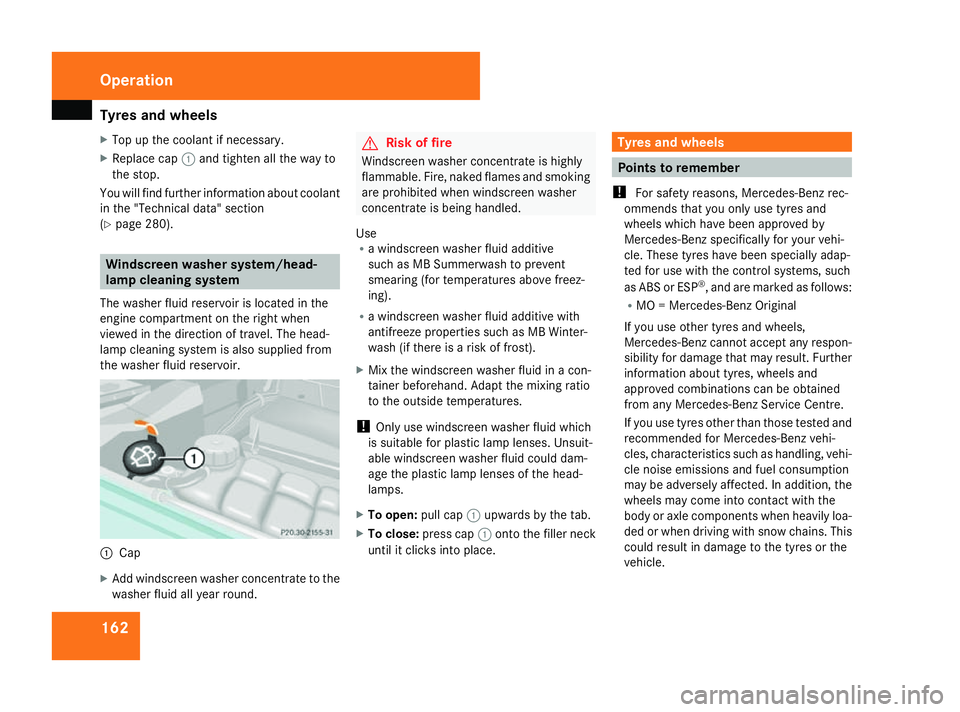
The washer fluid reservoir is located in the
engine compartment on the right when
viewed in the direction of travel. The head-
lamp cleaning system is also supplied from
the washer fluid reservoir. 1
Cap
X Add windscreen washer concentrate to the
washer fluid all year round. G
Risk of fire
Windscreen washer concentrate is highly
flammable. Fire, naked flames and smoking
are prohibited when windscreen washer
concentrate is being handled.
Use
R a windscreen washer fluid additive
such as MB Summerwash to prevent
smearing (for temperatures above freez-
ing).
R a windscreen washer fluid additive with
antifreeze properties such as MB Winter-
wash (if there is a risk of frost).
X Mix the windscreen washer fluid in a con-
tainer beforehand. Adapt the mixing ratio
to the outside temperatures.
! Only use windscreen washer fluid which
is suitable for plastic lamp lenses. Unsuit-
able windscreen washer fluid could dam-
age the plastic lamp lenses of the head-
lamps.
X To open: pull cap1upwards by the tab.
X To close: press cap 1onto the filler neck
until it clicks into place. Tyres and wheels
Points to remember
! For safety reasons, Mercedes-Benz rec-
ommends that you only use tyres and
wheels which have been approved by
Mercedes-Benz specifically for your vehi-
cle. These tyres have been specially adap-
ted for use with the control systems, such
as ABS or ESP ®
, and are marked as follows:
R MO = Mercedes-Benz Original
If you use other tyres and wheels,
Mercedes-Benz cannot accept any respon-
sibility for damage that may result. Further
information about tyres, wheels and
approved combinations can be obtained
from any Mercedes-Benz Service Centre.
If you use tyres other than those tested and
recommended for Mercedes-Benz vehi-
cles, characteristics such as handling, vehi-
cle noise emissions and fuel consumption
may be adversely affected. In addition, the
wheels may come into contact with the
body or axle components when heavily loa-
ded or when driving with snow chains. This
could result in damage to the tyres or the
vehicle. Operation
463_AKB; 1; 8, en-GB
wobuchh
, Version: 2.10.6 2008-07-17T15:19:41+02:00 - Seite 162Dateiname: 6515_4091_02_buchblock.pdf; preflight