ABS MERCEDES-BENZ G-CLASS SUV 2008 User Guide
[x] Cancel search | Manufacturer: MERCEDES-BENZ, Model Year: 2008, Model line: G-CLASS SUV, Model: MERCEDES-BENZ G-CLASS SUV 2008Pages: 293, PDF Size: 4.49 MB
Page 171 of 293
Winter driving
168
!
On vehicles fitted with a tyre pressure
monitor*, electronic components are loca-
ted in the wheel.
Tyre-fitting tools should not be applied in
the area of the valve, as this could damage
the electronic components.
Always have the wheels interchanged/
changed at a qualified specialist workshop,
e.g. a Mercedes-Benz Service Centre.
i Vehicles with a tyre pressure monitor*
If the positions of the wheels on the vehicle
are changed, the tyre pressure may be tem-
porarily displayed at the wrong position.
This is rectified after a few minutes of driv-
ing; the tyre pressures are then displayed
for the correct positions. Winter driving
Points to remember
Have your vehicle winterproofed at a qualified
specialist workshop, e.g. at a Mercedes-Benz
Service Centre, at the onset of winter. Winter tyres
Use winter tyres at temperatures below +7 °C
and on snow or ice-covered roads. Only then
can the effect of the ABS, BAS, 4ETS and
ESP ®
driving systems also be ensured in win-
ter.
Use winter tyres of the same make and tread
on all wheels to maintain safe handling char-
acteristics. G
Risk of accident
Winter tyres with a tread depth of less than
4 mm must be replaced immediately. They
are no longer suitable for winter use and
can no longer provide sufficient grip. This
could cause you to lose control of your
vehicle and cause an accident.
Always observe the maximum permissible
speed specified for the winter tyres you have
fitted. If you fit winter tyres which have a
lower maximum permissible speed than that of the vehicle, affix an appropriate warning
sign in the driver's field of vision. This can be
obtained at a qualified specialist workshop,
e.g. from a Mercedes-Benz Service Centre.
Once you have fitted the winter tyres:
X
Check the tyre pressures (Y page 164).
X Restart the tyre pressure moni-
tor* (Y page 166). G
Risk of accident
If you fit the spare wheel when driving with
winter tyres, bear in mind that driving sta-
bility will be impaired due to unstable cor-
nering characteristics caused by the differ-
ent tyres. Therefore, you should adapt your
driving style and drive even more carefully.
Have the spare wheel replaced at the near-
est qualified specialist workshop which has
the necessary specialist knowledge and
tools to carry out the work required.
Mercedes-Benz recommends that you use
a Mercedes-Benz Service Centre for this
purpose. In particular, work relevant to
safety or on safety-related systems must be
carried out at a qualified specialist work-
shop. Operation
* optional
463_AKB; 1; 8, en-GB
wobuchh,
Version: 2.10.6 2008-07-17T15:19:41+02:00 - Seite 168Dateiname: 6515_4091_02_buchblock.pdf; preflight
Page 176 of 293
Off-road driving
173After the brakes have been exposed to dirty
conditions, have them checked and
cleaned at a qualified specialist workshop,
e.g. a Mercedes-Benz Service Centre. Oth-
erwise, there is a risk that braking power
may be insufficient in the event of an emer-
gency, or that braking efficiency may be
unpredictable.
Read this section before driving your vehicle
off-road. Practise by travelling over more gen-
tle off-road terrain first.
The following driving systems are specially
adapted to off-road driving:
R transfer case (Y page 92)
R differential locks (Y page 93)
R 4ETS (Y page 50) Off-road driving
G
Risk of accident
Damage to the vehicle creates the risk of
an accident for yourself and other road
users. If in doubt, have your vehicle
checked at a qualified specialist workshop
which has the necessary specialist knowl-
edge and tools to carry out the work
required. Mercedes-Benz recommends
that you use a Mercedes-Benz Service
Centre for this purpose. H
Environmental note
Protection of the environment is of primary
importance. Treat nature with respect.
Observe all prohibiting signs.
General information R
Stop your vehicle and, if necessary, shift
the transfer case to LOW(Ypage 92)
before driving off-road.
R Check that items of luggage and loads are
stowed safely and are well secured
(Y page 139).
R Engage the differential locks, if necessary
(Y page 93). i
When the differential locks are engaged,
ABS is deactivated. This allows the front
wheels to lock briefly, so that these can dig
into a loose surface. However, please note
that locked wheels skid and can no longer
steer.
R Always keep the engine running and in gear
when driving on a downhill gradient.
R Drive slowly and evenly, if necessary at a
walking pace.
R Ensure that the wheels are in contact with
the ground at all times.
R Drive with extreme care on unknown off-
road routes where visibility is poor. For
safety reasons, get out of the vehicle first
and survey the off-road route.
R Check the depth of water before fording
rivers and streams.
R Look out for obstacles such as rocks, holes,
tree stumps and furrows.
R Always keep the side windows and the slid-
ing /tilting sunroof* closed during the jour-
ney.
R Do not stray from marked routes or paths. Operation
* optional
463_AKB; 1; 8, en-GB
wobuchh,
Version: 2.10.6 2008-07-17T15:19:41+02:00 - Seite 173 ZDateiname: 6515_4091_02_buchblock.pdf; preflight
Page 191 of 293
Where will I find...?
188 Where will I find...?
Warning triangle, first-aid kit and
vehicle tool kit
G
Risk of injury
The jack is designed only to raise and hold
the vehicle for a short time while a wheel
is being changed.
You must use axle stands if you are carrying
out work on the vehicle.
Make sure that the jack is placed on a firm,
non-slip, level surface. Do not use wooden
blocks or similar objects as a jack underlay.
Otherwise, the jack will not be able to ach-
ieve its load-bearing capacity due to the
restricted height.
Do not start the engine at any time while a
wheel is being changed.
Do not lie under the vehicle when it is being
supported by the jack. If you do not raise
the vehicle as described, it could slip off the
jack (e.g. if the engine is started or a door
or the tailgate is opened or closed) and you
could be seriously injured.
i Check the expiry date of the first-aid kit
annually, and replace the contents when
necessary. i
When using the jack, you should also
observe the safety notes in the "Flat tyre"
section (Y page 243).
Long-wheelbase station wagon Warning triangle
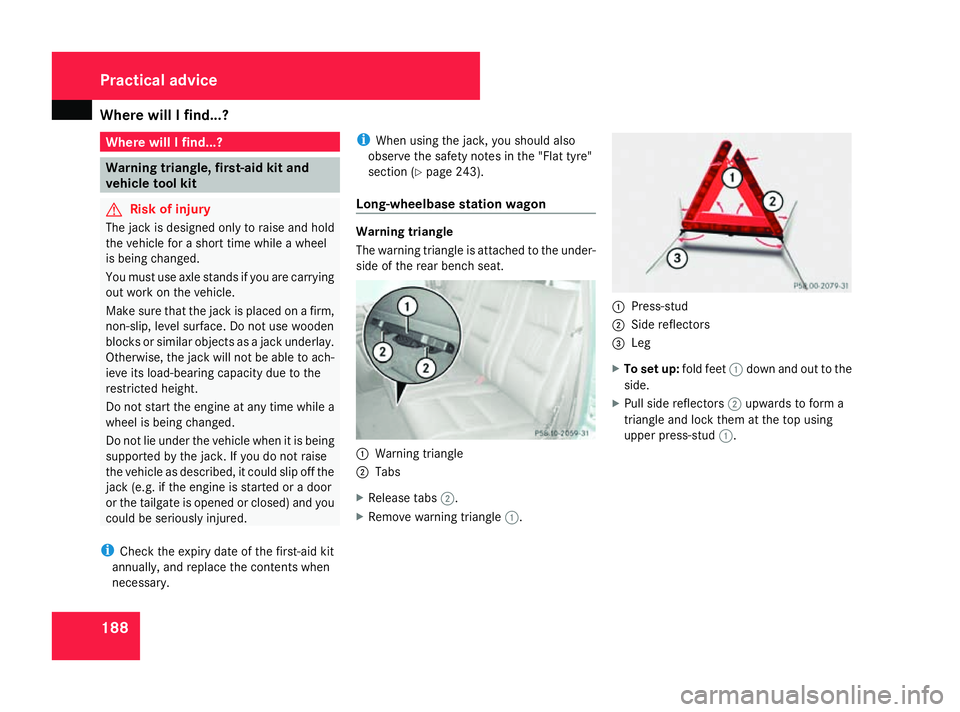
The warning triangle is attached to the under-
side of the rear bench seat.
1
Warning triangle
2 Tabs
X Release tabs 2.
X Remove warning triangle 1. 1
Press-stud
2 Side reflectors
3 Leg
X To set up: fold feet1down and out to the
side.
X Pull side reflectors 2upwards to form a
triangle and lock them at the top using
upper press-stud 1. Practical advice
463_AKB; 1; 8, en-GB
wobuchh,
Version: 2.10.6 2008-07-17T15:19:41+02:00 - Seite 188Dateiname: 6515_4091_02_buchblock.pdf; preflight
Page 199 of 293
Display
messages 196 Display messages Possible cause/consequence Possible solution
ABS, ESP
inoperative See
Owner's Manual
G
Risk of accident
ABS and ESP ®
are unavailable due to a
fault.
BAS, 4ETS and the tyre pressure moni-
tor* have also been deactivated.
The brake system continues to function
normally, but without the functions listed
above. X
Drive on carefully.
X Visit a qualified specialist workshop immedi-
ately. ABS, ESP unavailable See
Owner's Manual
G
Risk of accident
ABS and ESP ®
are temporarily unavaila-
ble. It is possible that self diagnosis is not
yet complete.
BAS, 4ETS and the tyre pressure moni-
tor* have also been deactivated.
The brake system continues to function
normally, but without the functions listed
above. X
Drive on carefully.
X Visit a qualified specialist workshop immedi-
ately. AAS Consult workshop
G
Risk of accident
AAS is unavailable due to a malfunction.
The vehicle may roll back on a gradient as
soon as you remove your foot from the
accelerator pedal. X
Drive on carefully.
X Visit a qualified specialist workshop immedi-
ately. Practical advice
* optional
463_AKB; 1; 8, en-GB
wobuchh,
Version: 2.10.6 2008-07-17T15:19:41+02:00 - Seite 196Dateiname: 6515_4091_02_buchblock.pdf; preflight
Page 215 of 293
Troubleshooting
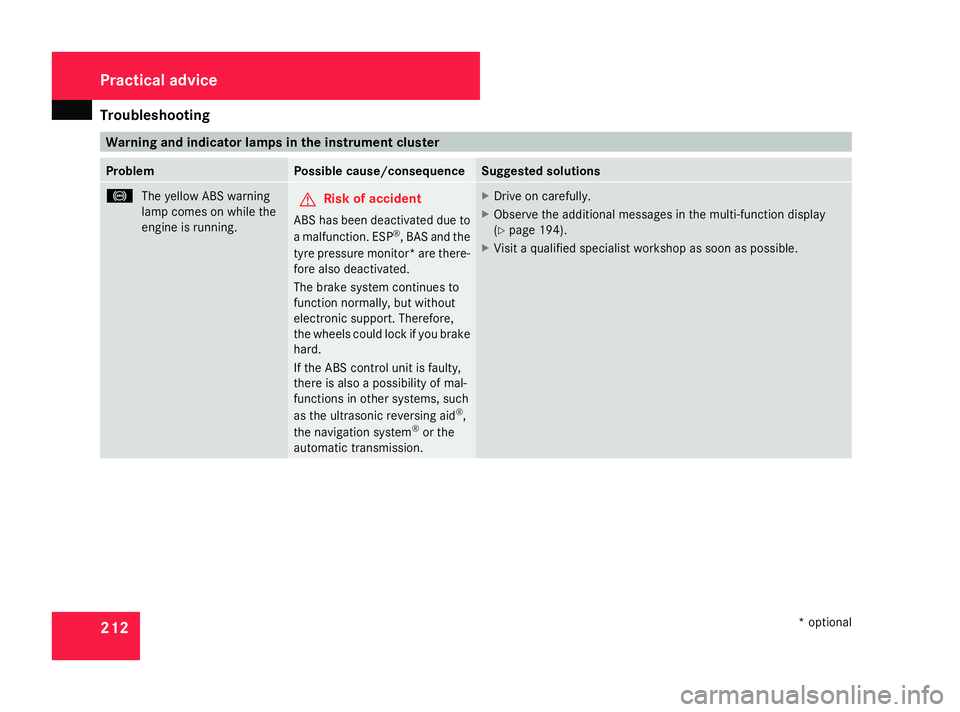
212 Warning and indicator lamps in the instrument cluster
Problem Possible cause/consequence Suggested solutions
-
Theyellow ABS warning
lamp comes on while the
engine is running. G
Risk of accident
ABS has been deactivated due to
a malfunction. ESP ®
, BAS and the
tyre pressure monitor* are there-
fore also deactivated.
The brake system continues to
function normally, but without
electronic support. Therefore,
the wheels could lock if you brake
hard.
If the ABS control unit is faulty,
there is also a possibility of mal-
functions in other systems, such
as the ultrasonic reversing aid ®
,
the navigation system ®
or the
automatic transmission. X
Drive on carefully.
X Observe the additional messages in the multi-function display
(Y page 194).
X Visit a qualified specialist workshop as soon as possible. Practical advice
* optional
463_AKB; 1; 8, en-GB
wobuchh,
Version: 2.10.6 2008-07-17T15:19:41+02:00 - Seite 212Dateiname: 6515_4091_02_buchblock.pdf; preflight
Page 216 of 293
Troubleshooting
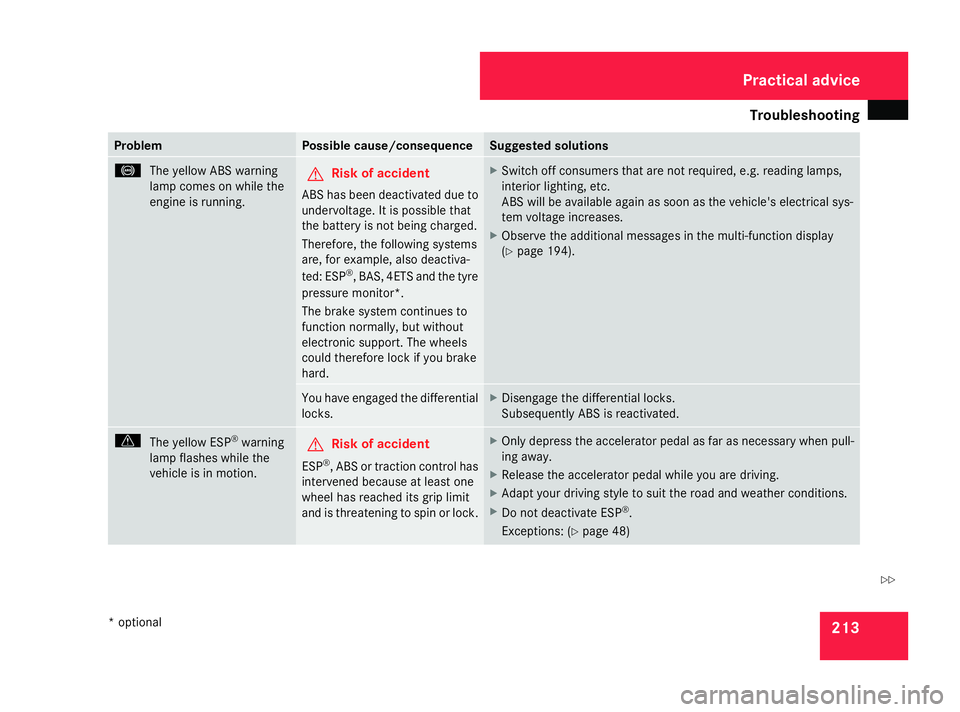
213Problem Possible cause/consequence Suggested solutions
-
Theyellow ABS warning
lamp comes on while the
engine is running. G
Risk of accident
ABS has been deactivated due to
undervoltage. It is possible that
the battery is not being charged.
Therefore, the following systems
are, for example, also deactiva-
ted: ESP ®
, BAS, 4ETS and the tyre
pressure monitor*.
The brake system continues to
function normally, but without
electronic support. The wheels
could therefore lock if you brake
hard. X
Switch off consumers that are not required, e.g. reading lamps,
interior lighting, etc.
ABS will be available again as soon as the vehicle's electrical sys-
tem voltage increases.
X Observe the additional messages in the multi-function display
(Y page 194). You have engaged the differential
locks. X
Disengage the differential locks.
Subsequently ABS is reactivated. v
The yellow ESP ®
warning
lamp flashes while the
vehicle is in motion. G
Risk of accident
ESP ®
, ABS or traction control has
intervened because at least one
wheel has reached its grip limit
and is threatening to spin or lock. X
Only depress the accelerator pedal as far as necessary when pull-
ing away.
X Release the accelerator pedal while you are driving.
X Adapt your driving style to suit the road and weather conditions.
X Do not deactivate ESP ®
.
Exceptions: (Y page 48) Practical advice
* optional
463_AKB; 1; 8, en-GB
wobuchh,
Version: 2.10.6 2008-07-17T15:19:41+02:00 - Seite 213 ZDateiname: 6515_4091_02_buchblock.pdf; preflight
Page 217 of 293
Troubleshooting
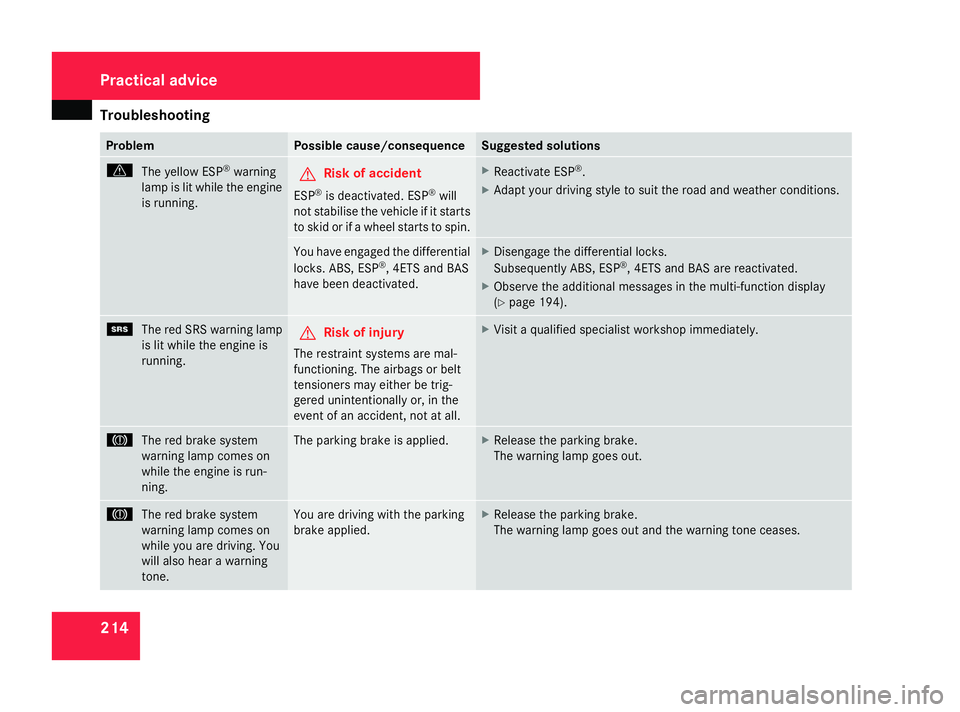
214 Problem Possible cause/consequence Suggested solutions
v
Theyellow ESP ®
warning
lamp is lit while the engine
is running. G
Risk of accident
ESP ®
is deactivated. ESP ®
will
not stabilise the vehicle if it starts
to skid or if a wheel starts to spin. X
Reactivate ESP ®
.
X Adapt your driving style to suit the road and weather conditions. You have engaged the differential
locks. ABS, ESP
®
, 4ETS and BAS
have been deactivated. X
Disengage the differential locks.
Subsequently ABS, ESP ®
, 4ETS and BAS are reactivated.
X Observe the additional messages in the multi-function display
(Y page 194). 1
The red SRS warning lamp
is lit while the engine is
running. G
Risk of injury
The restraint systems are mal-
functioning. The airbags or belt
tensioners may either be trig-
gered unintentionally or, in the
event of an accident, not at all. X
Visit a qualified specialist workshop immediately. 3
The red brake system
warning lamp comes on
while the engine is run-
ning. The parking brake is applied. X
Release the parking brake.
The warning lamp goes out. 3
The red brake system
warning lamp comes on
while you are driving. You
will also hear a warning
tone. You are driving with the parking
brake applied. X
Release the parking brake.
The warning lamp goes out and the warning tone ceases. Practical advice
463_AKB; 1; 8, en-GB
wobuchh,
Version: 2.10.6 2008-07-17T15:19:41+02:00 - Seite 214Dateiname: 6515_4091_02_buchblock.pdf; preflight
Page 269 of 293
Tyres and wheels
266 Tyres and wheels
Points to remember
! For safety reasons, Mercedes-Benz rec-
ommends that you only use tyres which
have been approved specifically for your
vehicle by Mercedes-Benz. These tyres are
specially adapted for use with the control
systems, such as ABS or ESP ®
, and are
marked as follows:
R MO = Mercedes-Benz Original
If you use other tyres, Mercedes-Benz can-
not accept any responsibility for damage
which may occur. Information about tyres
can be obtained from any Mercedes-Benz
Service Centre.
! If you fit tyres other than those tested and
recommended by Mercedes-Benz, charac-
teristics such as handling, noise levels and
fuel consumption, etc. could be adversely
affected. In addition, when driving with a
load, dimensional variations and different
tyre deformation characteristics could
cause the tyres to come into contact with
the bodywork and axle components. This
could result in damage to the tyres or the
vehicle. i
Further information about tyres and
wheels can be obtained from any
Mercedes-Benz Service Centre.
You will find a table of tyre pressures on the
inside of your vehicle's fuel filler flap. You
will find further information about tyre pres-
sures in the "Operation" section
(Y page 164).
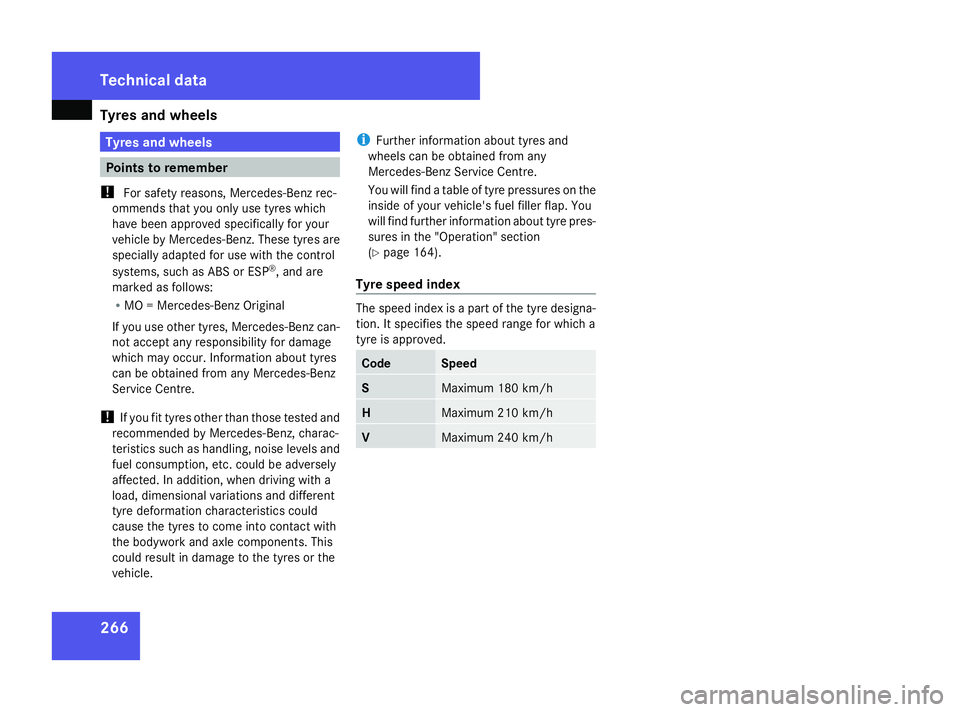
Tyre speed index The speed index is a part of the tyre designa-
tion. It specifies the speed range for which a
tyre is approved.
Code Speed
S
Maximum 180 km/h
H
Maximum 210 km/h
V
Maximum 240 km/hTechni
cal data
463_AKB; 1; 8, en-GB
wobuchh
,V ersion: 2.10.6
2008-07-17T15:19:41+02:00 - Seite 266 Dateiname: 6515_4091_02_buchblock.pdf; preflight
Page 284 of 293
Service products and capacities
281
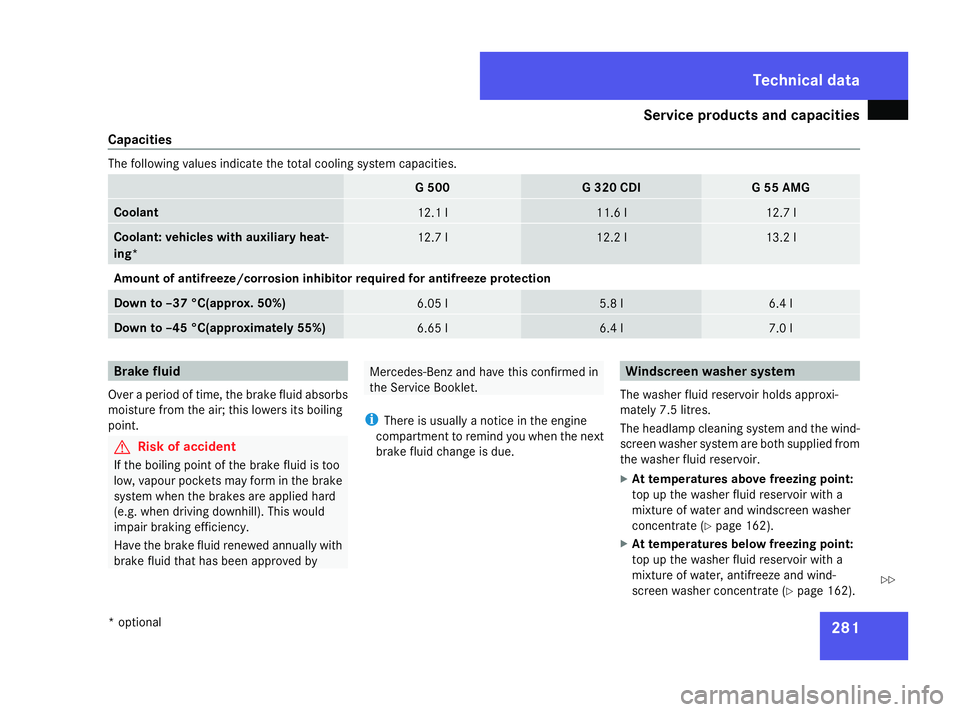
Capacities The following values indicate the total cooling system capacities.
G 500 G 320 CDI G 55 AMG
Coolant
12.1 l 11.6 l 12.7 l
Coolant: vehicles with auxiliary heat-
ing*
12.7 l 12.2 l 13.2 l
Amount of antifreeze/corrosion inhibitor required for antifreeze protection
Down to –37 °C(approx. 50%)
6.05 l 5.8 l 6.4 l
Down to –45 °C(approximately 55%)
6.65 l 6.4 l 7.0 l
Brake fluid
Over a period of time, the brake fluid absorbs
moisture from the air; this lowers its boiling
point. G
Risk of accident
If the boiling point of the brake fluid is too
low, vapour pockets may form in the brake
system when the brakes are applied hard
(e.g. when driving downhill). This would
impair braking efficiency.
Have the brake fluid renewed annually with
brake fluid that has been approved by Mercedes-Benz and have this confirmed in
the Service Booklet.
i There is usually a notice in the engine
compartment to remind you when the next
brake fluid change is due. Windscreen washer system
The washer fluid reservoir holds approxi-
mately 7.5 litres.
The headlamp cleaning system and the wind-
screen washer system are both supplied from
the washer fluid reservoir.
X At temperatures above freezing point:
top up the washer fluid reservoir with a
mixture of water and windscreen washer
concentrate (Y page 162).
X At temperatures below freezing point:
top up the washer fluid reservoir with a
mixture of water, antifreeze and wind-
screen washer concentrate (Y page 162). Technical data
* optional
463_AKB; 1; 8, en-GB
wobuchh,
Version: 2.10.6 2008-07-17T15:19:41+02:00 - Seite 281 ZDateiname: 6515_4091_02_buchblock.pdf; preflight