bonnet MERCEDES-BENZ G-CLASS SUV 2008 Owners Manual
[x] Cancel search | Manufacturer: MERCEDES-BENZ, Model Year: 2008, Model line: G-CLASS SUV, Model: MERCEDES-BENZ G-CLASS SUV 2008Pages: 293, PDF Size: 4.49 MB
Page 7 of 293
4
Battery
Changing (auxiliary heating
remote control) ............................... 235
Changing (key).. .............................. 234
Charging. ........................................ 250
Checking (key). ............................... 234
Check lamp (key). ........................... 234
Disconnecting ................................. 248
Display message ............................. 201
Maintenance (vehicle)..................... 247
Reconnecting.................................. 250
Removing/fitting. ........................... 250
Vehicle battery. .............................. 247
Belt force limiters
Activation.......................................... 33
Belt height adjustment........................ 74
Belt tensioners Activation.......................................... 33
Belt warning.......................................... 74
Bonnet Bonnet catch .................................. 158
Display message ............................. 200
Opening/closing ............................ 157
Bonnet release lever
Release leve r.................................. 158
Brake
Display message ............................. 201
Brake Assist
see BAS Brake fluid..........................................
281
Display message ............................. 201
Brake lamps
Display message ............................. 205
Brakes
Parking brake................................... .88
Warning lamp..................................2 14
Brake system
Display message ............................. 201
Bulbs
Brake lamp. .................................... 240
Cornering light function ..................238
Display messages ........................... 204
Foglamps. ....................................... 238
Licence plate lamp.......................... 241
Overview. ........................................ 236
Parking lamp. ......................... 237, 240
Rear foglamp. ................................. 241
Replacing............................... .237, 240
Reversing lamp. .............................. 241
Side lamp........................................ 237
Tail lamp ......................................... 240
Turn signal lamp. ....................239, 240 C
Cabriolet Draught stop................................... 135
Soft top .................................. 133, 134
Tonneau cover. ............................... 136
Calling up a malfunction
see Message memory menu
Care..................................................... 182
Automatic car wash. .......................183
Headlamps. .................................... 184
High-pressure cleaners. ..................183
Plastic trim. .................................... 184
Rear window. .................................. 184
Side windows.................................. 184
Trailer tow hitch. ............................. 186
Ultrasonic reversing aid. .................186
CD player/CD changer
Operating (on-board computer). .....102
Central locking
Automatic locking (on-board com-
puter). ............................................. 108
Key. .................................................. 54
Central locking/unlocking button...... 56
Central unlocking Key. .................................................. 54
Centre console
Lower section. .................................. 26
Upper section. .................................. 25Index
463_AKB; 1; 8, en-GB
wobuchh,
Version: 2.10.6 2008-07-17T15:19:41+02:00 - Seite 4Dateiname: 6515_4091_02_buchblock.pdf; preflight
Page 22 of 293
Exterior view
19Function Page
1
Opening and closing the
rear door 56
Cabriolet: opening and
closing the tailgate
58
2
Reversing camera* 119
3
Rear window heating 128
4
Rear lights 240
5
Fuel filler flap 154
6
Opening and closing the
doors 54 Function Page
7
Exterior mirrors 68
Parking position 69
8
Front lights 237
9
Opening the bonnet 157
Engine oil 159
Coolant
161 Function Page
a
Windscreen wiper opera-
tion
82
Cleaning the wiper blades 183
Replacing the wiper blades 242
b
Cleaning the windows 184
c
Tyres and wheels 266
Tyre pressure monitor* 165
Flat tyre, fitting the spare
wheel
244
d
Towing eyes 253At a glance
* optional
463_AKB; 1; 8, en-GB
wobuchh,
Version: 2.10.6 2008-07-17T15:19:41+02:00 - Seite 19Dateiname: 6515_4091_02_buchblock.pdf; preflight
Page 24 of 293
Cockpit
21Function Page
1
Combination switch: 78
• main-beam headlamps 78
• turn signals 77
• windscreen wipers 82
2
Cleans the headlamps 162
3
Cruise control lever:
• cruise control 113
• Variable Speedtronic
115 Function Page
4
Instrument cluster 22
5
Linguatronic* lever,
see separate operating
instructions
6
Ignition lock 59
7
Glove compartment
146 Function Page
8
Multi-function steering
wheel
24
9
Horn
a
Opens the bonnet 157
b
Adjusts the steering wheel 66
c
Light switch 75
d
Adjusts the exterior mirrors 68At a glance
* optional
463_AKB; 1; 8, en-GB
wobuchh,
Version: 2.10.6 2008-07-17T15:19:41+02:00 - Seite 21Dateiname: 6515_4091_02_buchblock.pdf; preflight
Page 37 of 293
Occupant safety
34
must be deployed during – and not at the end
of – the collision.
i Airbags are not deployed in all types of
accidents. They are controlled by complex
sensor technology and evaluation logic.
This process is pre-emptive in nature as
airbag deployment must take place during
the impact and must be adapted to provide
calculated, additional protection for the
vehicle occupants. Not all airbags are
deployed in an accident.
The different airbag systems work inde-
pendently of each other. However, the
deployment of each individual system will
depend on the type of accident determined
by the control system in the first stages of
the collision (head-on collision, side impact
and overturn) and the extent of the acci-
dent (in particular, the vehicle's rate of
deceleration or acceleration).
The rate of vehicle deceleration or accelera-
tion and the direction of the force are basi-
cally determined by:
R the distribution of forces during the colli-
sion
R the collision angle R
the deformation characteristics of the vehi-
cle
R the characteristics of the object with which
the vehicle has collided, e.g. the other vehi-
cle
Factors which can only be seen and measured
after a collision has occurred do not play a
decisive role in the deployment of an airbag,
nor do they provide an indication of it.
The vehicle may be deformed significantly,
e. g. on the bonnet or the wing, without an
airbag being deployed. This is the case if only
parts which are relatively easily deformed are
affected and the necessary deceleration does
not occur. Conversely, airbags may be
deployed even though the vehicle suffers only
minor deformations. This is the case if, for
example, very rigid vehicle parts such as lon-
gitudinal body members are affected and suf-
ficient deceleration occurs as a result.
Belt tensioners, belt force limiters The front seat belts and the outer seat belts
in the rear are equipped with belt tensioners
and belt force limiters.
!
Do not engage the seat belt tongue in the
buckle on the front-passenger seat if the
seat is not occupied. Otherwise the belt tensioner could be activated in an emer-
gency.
If the seat belt is also equipped with a belt
force limiter, the force exerted by the seat
belt on the seat occupant is reduced.
Belt tensioners tighten the seat belts in an
accident, pulling them close against the body.
i Belt tensioners do not correct incorrect
seat positions or incorrectly fastened seat
belts.
Belt tensioners do not pull occupants back
towards the backrest.
The front belt force limiters are synchronised
with the front airbags, which distribute the
forces exerted by the belt force limiters on
the occupant over a greater area.
The seat belts have an automatic comfort-fit
feature. This reduces the retraction force of
the seat belts, which results in increased seat
belt comfort.
When the ignition is switched on, the belt ten-
sioner is triggered:
R only when the restraint systems are opera-
tional (the 1warning lamp lights up
when the key is turned to position 1in the Safety
463_AKB; 1; 8, en-GB
wobuchh,
Version: 2.10.6 2008-07-17T15:19:41+02:00 - Seite 34Dateiname: 6515_4091_02_buchblock.pdf; preflight
Page 54 of 293
Anti-theft syste
ms 51G
Risk of accident
If the v warning lamp in the speedom-
eter flashes, proceed as follows:
R only depress the accelerator pedal as far
as necessary when pulling away.
R accelerate less when driving.
R adapt your driving style to suit the pre-
vailing road and weather conditions.
Otherwise, the vehicle could go into a skid.
If you drive too fast, 4ETS cannot reduce
the risk of an accident. 4ETS cannot over-
ride the laws of physics.
! If:
R the vehicle is being towed with the front
or rear axle raised,
R the parking brake is being tested using a
dynamometer,
the ignition must be switched off (key in
position 0or 1in the ignition lock). Other-
wise, application of the brakes by 4ETS
could destroy the brake system on the front
or rear axle. Anti-theft systems
Immobiliser
The immobiliser prevents your vehicle from
being started without the correct key.
X To activate: remove the key from the igni-
tion lock.
X To deactivate: turn the key to position 2
in the ignition lock. ATA* (anti-theft alarm system)
A visual and audible alarm is triggered when
the alarm system is primed and you open:
R a door
R a door using the emergency key element
R the rear door or tailgate (convertible)
R the bonnet
The alarm is also triggered if:
R the position of the vehicle is changed.
R a window is smashed.
The alarm is not switched off even if you close
a door again. 1
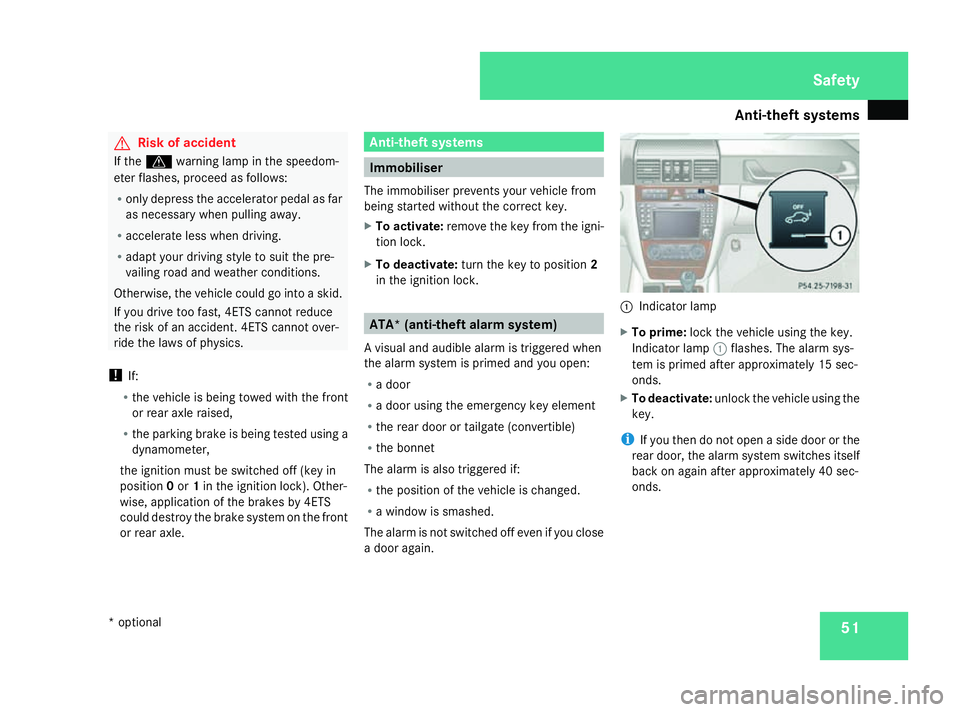
Indicator lamp
X To prime: lock the vehicle using the key.
Indicator lamp 1flashes. The alarm sys-
tem is primed after approximately 15 sec-
onds.
X To deactivate: unlock the vehicle using the
key.
i If you then do not open a side door or the
rear door, the alarm system switches itself
back on again after approximately 40 sec-
onds. Safety
* optional
463_AKB; 1; 8, en-GB
wobuchh
,V ersion: 2.10.6
2008-07-17T15:19:41+02:00 - Seite 51 ZDateiname: 6515_4091_02_buchblock.pdf; preflight
Page 128 of 293
Air conditioning
125Setting the temperature
Different temperatures can be set for the
driver's and front-passenger sides.
X To increase/reduce: turn thumbwheels
2 and 3clockwise or anti-clockwise .
Only change the temperature setting in
small increments. Start at 22 †.
i The temperature of the air from the rear-
compartment air vents and the centre air
vents is the same.
i If you turn the temperature thumbwheel
on one side of the vehicle fully to the right
or left, you will increase or reduce the tem-
perature on the other side of the vehicle at
the same time. Adjusting the air vents
G
Risk of injury
Very hot or very cold air can flow from the
air vents. This could cause burns or frost-
bite to bare skin in the immediate vicinity
of the vents. Keep bare skin away from
these air outlets. If necessary, direct the
airflow away to a different area of the vehi-
cle interior.
Please observe the following notes to ensure
that the air can flow freely through the air
vents:
R keep the air inlet between the windscreen
and the bonnet free of deposits, such as ice
and snow, to guarantee the supply of fresh
air into the vehicle interior.
R never cover the vents or air inlet and outlet
grilles in the vehicle interior.
i Position the sliders for the centre air
vents in the central position to provide vir-
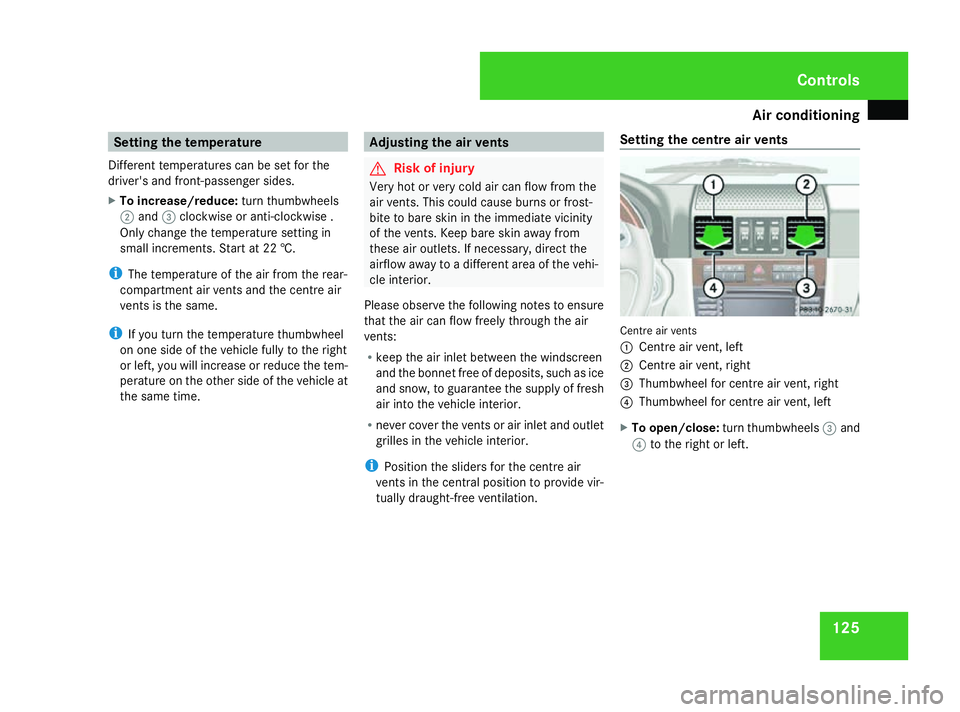
tually draught-free ventilation. Setting the centre air vents Centre air vents
1
Centre air vent, left
2 Centre air vent, right
3 Thumbwheel for centre air vent, right
4 Thumbwheel for centre air vent, left
X To open/close: turn thumbwheels 3and
4 to the right or left. Cont
rols
463_AKB; 1; 8, en-GB
wobuchh,
Version: 2.10.6 2008-07-17T15:19:41+02:00 - Seite 125 ZDateiname: 6515_4091_02_buchblock.pdf; preflight
Page 160 of 293
Engine compartment
157
If only summer diesel fuel or less cold-resist-
ant winter diesel fuel (e.g. in Mediterranean
regions) is available, you should add an
amount of flow improver to the fuel corre-
sponding to the outside temperature.
Mix the additive with the diesel in good time,
before the flow properties of the diesel
become insufficient. Otherwise, malfunctions
can only be rectified by heating the entire fuel
system, e.g. by parking the vehicle in a heated
garage. G
Risk of fire
Do not use petrol to refuel vehicles with a
diesel engine. Never mix diesel with petrol.
This would damage the fuel system and
engine and could result in a vehicle fire.
Flow improver
The effectiveness of a flow improver is not
guaranteed with every fuel. Observe the infor-
mation provided by the manufacturer when
using a flow improver. Only use flow improv-
ers that have been tested and approved by
Mercedes-Benz. Information about flow
improvers that have been tested and
approved by Mercedes-Benz can be obtained
from any Mercedes-Benz Service Centre. Engine compartment
Bonnet
G
Risk of accident
Do not pull the release lever while the vehi-
cle is in motion. The bonnet may otherwise
open and block your view.
Opening G
Risk of injury
There is a risk of injury if the bonnet is open,
even if the engine is not running.
Some engine components can become
very hot.
To avoid the risk of burns, only touch those
components described in the Owner’s Man-
ual and observe the relevant safety notes. G
Risk of injury
The radiator fan between the radiator and
the engine can start automatically, even if
the key has been removed from the ignition
lock. For this reason you must not reach
into the turning area of the fan. You can
otherwise be injured. Vehicles with a petrol engine:
The electronic ignition system uses high
voltage. For this reason, you must never
touch components of the ignition system
(ignition coil, ignition cable, spark plug con-
nector or test socket) when:
R the engine is running
R the engine is being started
R the ignition is switched on and the engine
is being cranked by hand
Vehicles with a diesel engine:
The electronic injection control uses high
voltage. Therefore, never touch fuel injec-
tion system components when:
R the engine is running
R the engine is being started
R the ignition is switched on
X Make sure that the windscreen wipers are
switched off. G
Risk of injury
The windscreen wipers and wiper linkage
could be set in motion.
When the bonnet is open, you or others
could be injured by the wiper rods. Operation
463_AKB; 1; 8, en-GB
wobuchh,
Version: 2.10.6 2008-07-17T15:19:41+02:00 - Seite 157 ZDateiname: 6515_4091_02_buchblock.pdf; preflight
Page 161 of 293
Engine compartment
158 Make sure that the windscreen wipers are
switched off and that the key has been
pulled out of the ignition lock before open-
ing the bonnet.
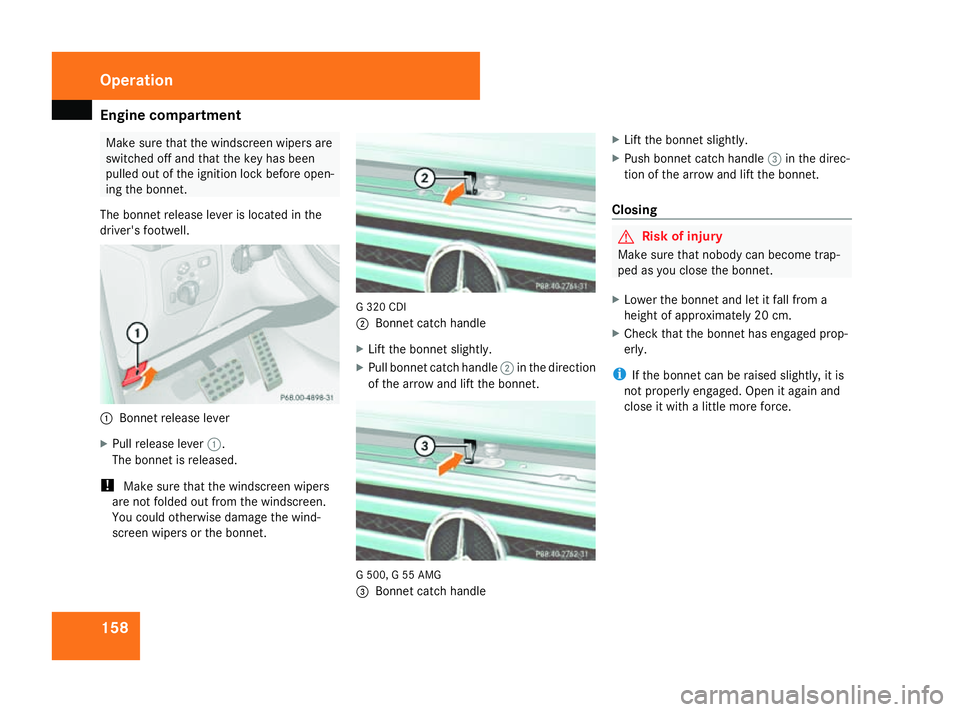
The bonnet release lever is located in the
driver's footwell. 1
Bonnet release lever
X Pull release lever 1.
The bonnet is released.
! Make sure that the windscreen wipers
are not folded out from the windscreen.
You could otherwise damage the wind-
screen wipers or the bonnet. G 320 CDI
2
Bonnet catch handle
X Lift the bonnet slightly.
X Pull bonnet catch handle 2in the direction
of the arrow and lift the bonnet. G 500, G 55 AMG
3
Bonnet catch handle X
Lift the bonnet slightly.
X Push bonnet catch handle 3in the direc-
tion of the arrow and lift the bonnet.
Closing G
Risk of injury
Make sure that nobody can become trap-
ped as you close the bonnet.
X Lower the bonnet and let it fall from a
height of approximately 20 cm.
X Check that the bonnet has engaged prop-
erly.
i If the bonnet can be raised slightly, it is
not properly engaged. Open it again and
close it with a little more force. Operation
463_AKB; 1; 8, en-GB
wobuchh,
Version: 2.10.6 2008-07-17T15:19:41+02:00 - Seite 158Dateiname: 6515_4091_02_buchblock.pdf; preflight
Page 187 of 293
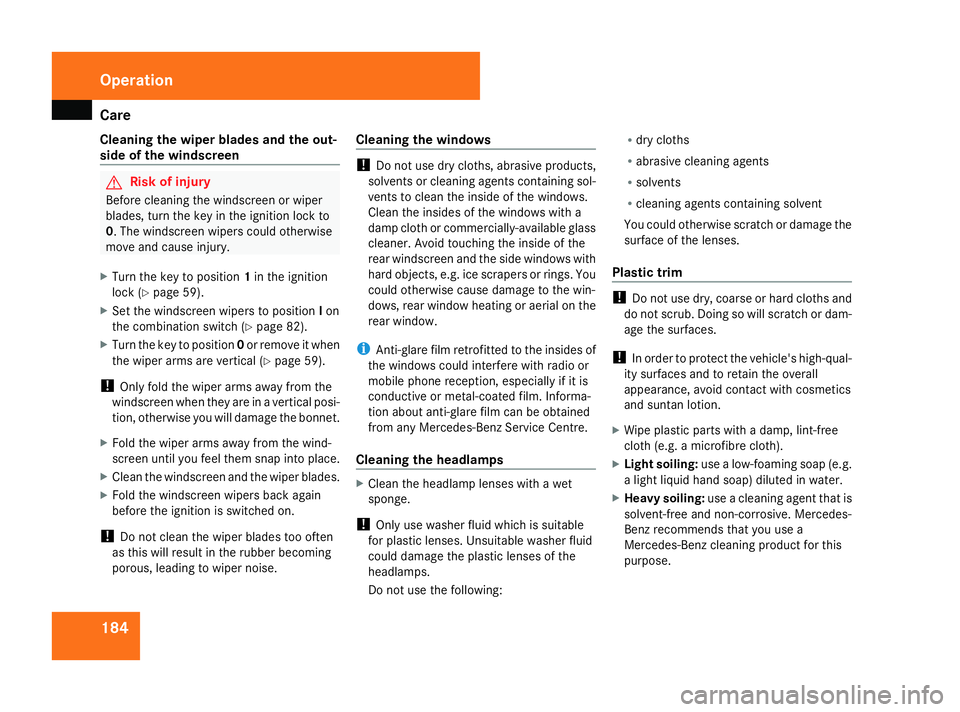
Care
184
Cleaning the wiper blades and the out-
side of the windscreen G
Risk of injury
Before cleaning the windscreen or wiper
blades, turn the key in the ignition lock to
0. The windscreen wipers could otherwise
move and cause injury.
X Turn the key to position 1in the ignition
lock (Y page 59).
X Set the windscreen wipers to position Ion
the combination switch (Y page 82).
X Turn the key to position 0or remove it when
the wiper arms are vertical (Y page 59).
! Only fold the wiper arms away from the
windscreen when they are in a vertical posi-
tion, otherwise you will damage the bonnet.
X Fold the wiper arms away from the wind-
screen until you feel them snap into place.
X Clean the windscreen and the wiper blades.
X Fold the windscreen wipers back again
before the ignition is switched on.
! Do not clean the wiper blades too often
as this will result in the rubber becoming
porous, leading to wiper noise. Cleaning the windows !
Do not use dry cloths, abrasive products,
solvents or cleaning agents containing sol-
vents to clean the inside of the windows.
Clean the insides of the windows with a
damp cloth or commercially-available glass
cleaner. Avoid touching the inside of the
rear windscreen and the side windows with
hard objects, e.g. ice scrapers or rings. You
could otherwise cause damage to the win-
dows, rear window heating or aerial on the
rear window.
i Anti-glare film retrofitted to the insides of
the windows could interfere with radio or
mobile phone reception, especially if it is
conductive or metal-coated film. Informa-
tion about anti-glare film can be obtained
from any Mercedes-Benz Service Centre.
Cleaning the headlamps X
Clean the headlamp lenses with a wet
sponge.
! Only use washer fluid which is suitable
for plastic lenses. Unsuitable washer fluid
could damage the plastic lenses of the
headlamps.
Do not use the following: R
dry cloths
R abrasive cleaning agents
R solvents
R cleaning agents containing solvent
You could otherwise scratch or damage the
surface of the lenses.
Plastic trim !
Do not use dry, coarse or hard cloths and
do not scrub. Doing so will scratch or dam-
age the surfaces.
! In order to protect the vehicle's high-qual-
ity surfaces and to retain the overall
appearance, avoid contact with cosmetics
and suntan lotion.
X Wipe plastic parts with a damp, lint-free
cloth (e.g. a microfibre cloth).
X Light soiling: use a low-foaming soap (e.g.
a light liquid hand soap) diluted in water.
X Heavy soiling: use a cleaning agent that is
solvent-free and non-corrosive. Mercedes-
Benz recommends that you use a
Mercedes-Benz cleaning product for this
purpose. Operation
463_AKB; 1; 8, en-GB
wobuchh,
Version: 2.10.6 2008-07-17T15:19:41+02:00 - Seite 184Dateiname: 6515_4091_02_buchblock.pdf; preflight
Page 203 of 293
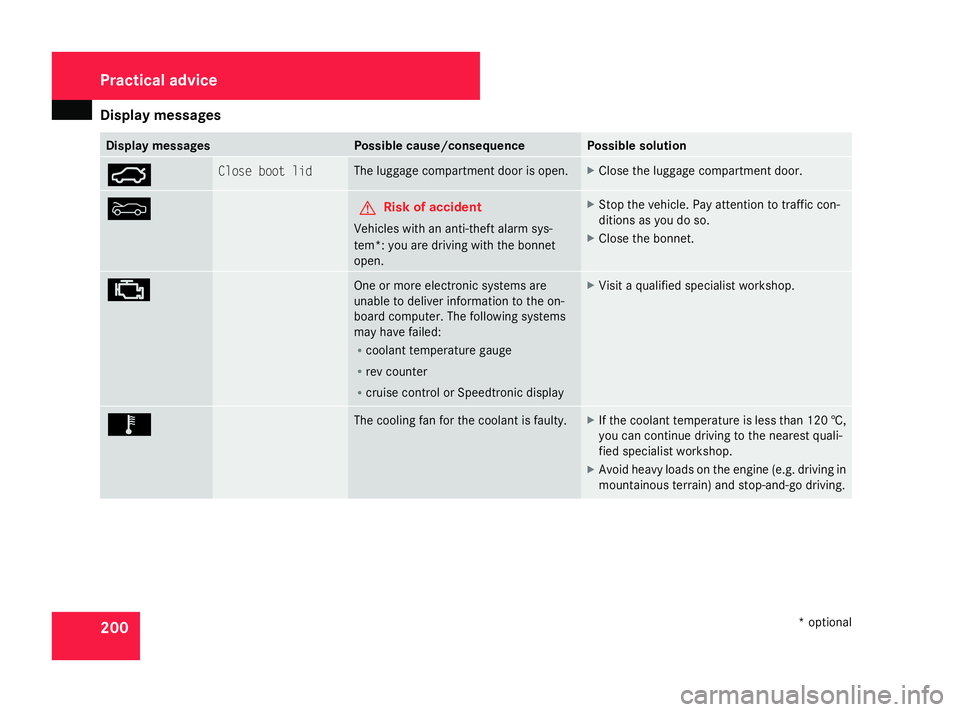
Display
messages 200 Display messages Possible cause/consequence Possible solution
Ê Close boot lid The luggage compartment door is open. X
Close the luggage compartment door. Y G
Risk of accident
Vehicles with an anti-theft alarm sys-
tem*: you are driving with the bonnet
open. X
Stop the vehicle. Pay attention to traffic con-
ditions as you do so.
X Close the bonnet. ± One or more electronic systems are
unable to deliver information to the on-
board computer. The following systems
may have failed:
R
coolant temperature gauge
R rev counter
R cruise control or Speedtronic display X
Visit a qualified specialist workshop. Ï The cooling fan for the coolant is faulty. X
If the coolant temperature is less than 120 †,
you can continue driving to the nearest quali-
fied specialist workshop.
X Avoid heavy loads on the engine (e.g. driving in
mountainous terrain) and stop-and-go driving. Practical advice
* optional
463_AKB; 1; 8, en-GB
wobuchh,
Version: 2.10.6 2008-07-17T15:19:41+02:00 - Seite 200Dateiname: 6515_4091_02_buchblock.pdf; preflight