height MERCEDES-BENZ G-CLASS SUV 2013 User Guide
[x] Cancel search | Manufacturer: MERCEDES-BENZ, Model Year: 2013, Model line: G-CLASS SUV, Model: MERCEDES-BENZ G-CLASS SUV 2013Pages: 364, PDF Size: 9.62 MB
Page 207 of 364
R
The bumpers of your vehicle are not
suitable for installing detachable trailer
couplings.
R Do not install hired trailer couplings or
other detachable trailer couplings on the
bumpers of your vehicle.
R If you do not
need the ball coupling, remove
the ball coupling from the ball coupling
recess. This reduces the risk of damage to
the ball coupling.
i When towing a trailer, set the tire
pressure on the rear axle of the towing
vehicle for a maximum load; see the tire
pressure table in the fuel filler flap
(Y page 322).
You will find installation dimensions and loads
in the technical data (Y page 358).
The maximum permissible trailer drawbar
noseweight on the ball coupling for up to 3
persons is 562 lbs (255 kg). The maximum
permissible trailer drawbar noseweight for
more than 3 persons and the maximum load
in the trunk can be found in the trailer
drawbar noseweight table ( Y page 358).
However, the actual noseweight must not
exceed the value given on the trailer tow hitch
or trailer identification plates. The lowest
weight applies.
i When towing a trailer, set the tire
pressure on the rear axle of the towing
vehicle for a maximum load; see the tire
pressure table in the fuel filler flap
(Y page 322).
Please note that when towing a trailer,
PARKTRONIC ( Y page 194) and Blind Spot
Assist (Y page 186) are only available with
limitations, or not at all.
i On vehicles without level control, the
height of the ball coupling will alter
according to the load placed on the vehicle.
If necessary, use a trailer with a height-
adjustable drawbar. Driving tips X
On long and steep downhill gradients,
select shift range 1, 2
or 3 (Y page 150) in
good time.
i This also applies if you have activated
cruise control or SPEEDTRONIC.
X If necessary, shift the transfer case to LOW
RANGE(Y page 199).
This will use the braking effect of the
engine, so that less
braking will be required
to maintain the speed. which relieves the
load on the brake system and prevents the
brakes from overheating and wearing too
quickly. If you need additional braking,
depress the brake pedal repeatedly rather
than continuously.
The maximum permissible speed for vehicle/
trailer combinations depends on the type of
trailer. Before beginning the journey, check
the trailer's documents to see what the
maximum permitted speed is. Observe the
legally prescribed maximum speed in the
relevant country.
For certain Mercedes-Benz vehicles, the
maximum permissible rear axle load is
increased when towing a trailer. Refer to the
"Technical data" section to find out whether
this applies to your vehicle. If you utilize any
of the added maximum rear axle load when
towing a trailer, the vehicle/trailer
combination may not exceed a maximum
speed of 60 mph (100 km/h) for reasons
concerning the operating permit. This also
applies in countries in which the permissible
maximum speed for vehicle/trailer
combinations is above 60 mph (100 km/h).
When towing a trailer,
your vehicle's handling
characteristics will be different in comparison
to when driving without a trailer and it will
consume more fuel.
On long and steep downhill gradients, you
must select shift range 1, 2 or 3 in good time.
i This also applies if you have activated
cruise control or DISTRONIC PLUS. Towing a trailer
205
Driving and parking Z
Page 270 of 364
The roof is not suited for transporting loads.
Never use roof rails or other accessories
mounted on the roof.
Features
Cup holders
Important safety notes G
WARNING
In order to help prevent spilling liquids on
vehicle occupants and/or vehicle
equipment,
only use containers that fit into the cup
holder. Use lids on open containers and do
not fill containers to a height where the
contents, especially hot liquids, could spill
during braking, vehicle maneuvers, or in an
accident. Liquids spilled on vehicle occupants
may cause serious personal injury. Liquids
spilled on vehicle equipment may cause
damage not covered by the Mercedes-Benz
Limited Warranty.
When not in use, keep the cup holder closed.
An open cup holder may cause injury to you
or others when contacted during braking,
vehicle maneuvers, or in an accident.
Keep in mind that objects placed in the cup
holder may come loose during braking,
vehicle maneuvers, or in an accident and be
thrown around in the vehicle interior. Objects
thrown around in the vehicle interior may
cause an accident and/or serious personal
injury.
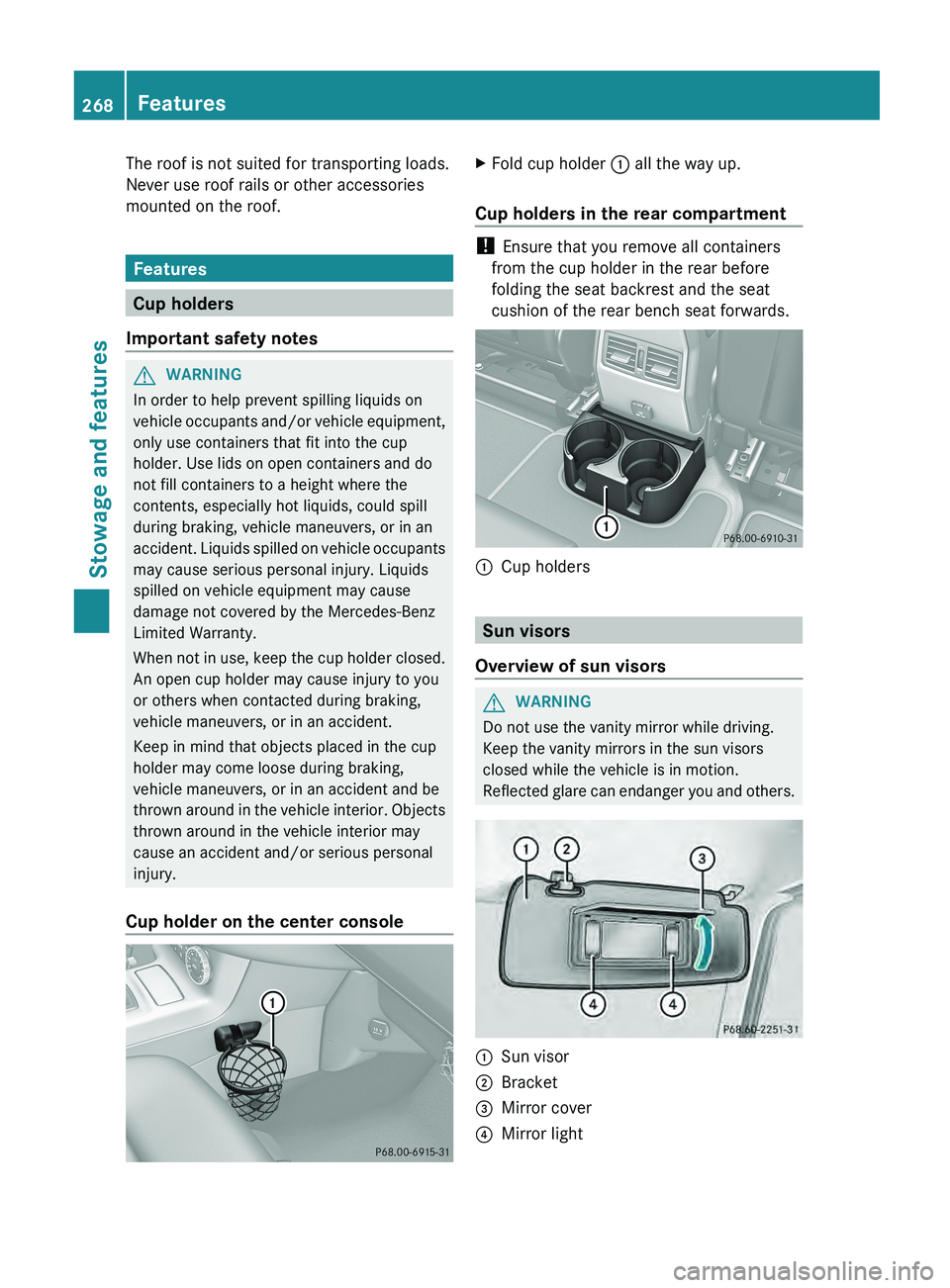
Cup holder on the center console X
Fold cup holder 0043 all the way up.
Cup holders in the rear compartment !
Ensure that you remove all containers
from the cup holder in the rear before
folding the seat backrest and the seat
cushion of the rear bench seat forwards. 0043
Cup holders Sun visors
Overview of sun visors G
WARNING
Do not use the vanity mirror while driving.
Keep the vanity mirrors in the sun visors
closed while the vehicle is in motion.
Reflected glare can endanger
you and others. 0043
Sun visor
0044 Bracket
0087 Mirror cover
0085 Mirror light268
Features
Stowage and features
Page 291 of 364
Opening the hood
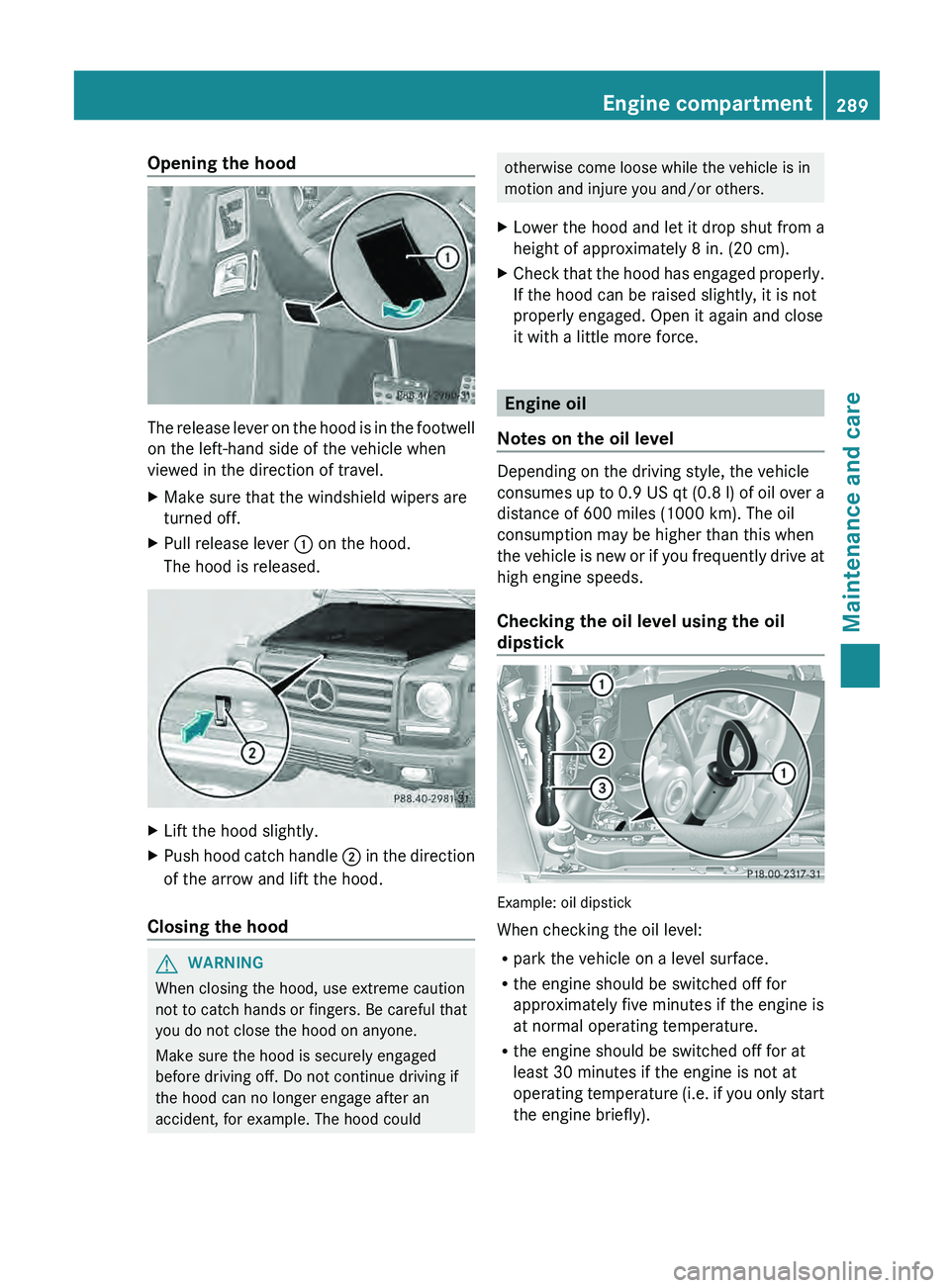
The release lever on the hood is in the footwell
on the left-hand side of the vehicle when
viewed in the direction of travel.
X
Make sure that the windshield wipers are
turned off.
X Pull release lever 0043 on the hood.
The hood is released. X
Lift the hood slightly.
X Push hood catch handle 0044 in the direction
of the arrow and lift the hood.
Closing the hood G
WARNING
When closing the hood, use extreme caution
not to catch hands or fingers. Be careful that
you do not close the hood on anyone.
Make sure the hood is securely engaged
before driving off. Do not continue driving if
the hood can no longer engage after an
accident, for example. The hood could otherwise come loose while the vehicle is in
motion and injure you and/or others.
X Lower the hood and let it drop shut from a
height of approximately 8 in. (20 cm).
X Check that
the hood has engaged properly.
If the hood can be raised slightly, it is not
properly engaged. Open it again and close
it with a little more force. Engine oil
Notes on the oil level Depending on the driving style, the vehicle
consumes up to
0.9
US qt (0.8 l) of oil over a
distance of 600 miles (1000 km). The oil
consumption may be higher than this when
the vehicle is new or if you frequently drive at
high engine speeds.
Checking the oil level using the oil
dipstick Example: oil dipstick
When checking the oil level:
R
park the vehicle on a level surface.
R the engine should be switched off for
approximately five minutes if the engine is
at normal operating temperature.
R the engine should be switched off for at
least 30 minutes if the engine is not at
operating temperature
(i.e. if
you only start
the engine briefly). Engine compartment
289
Maintenance and care Z
Page 336 of 364
excessive temperature can lead to sudden
tire failure. The
grade
C corresponds to a level
of performance which all passenger car tires
must meet under the Federal Motor Vehicle
Safety Standard No. 109. Grades B and A
represent higher levels of performance on the
laboratory test wheel than the minimum
required by law. Tire labeling
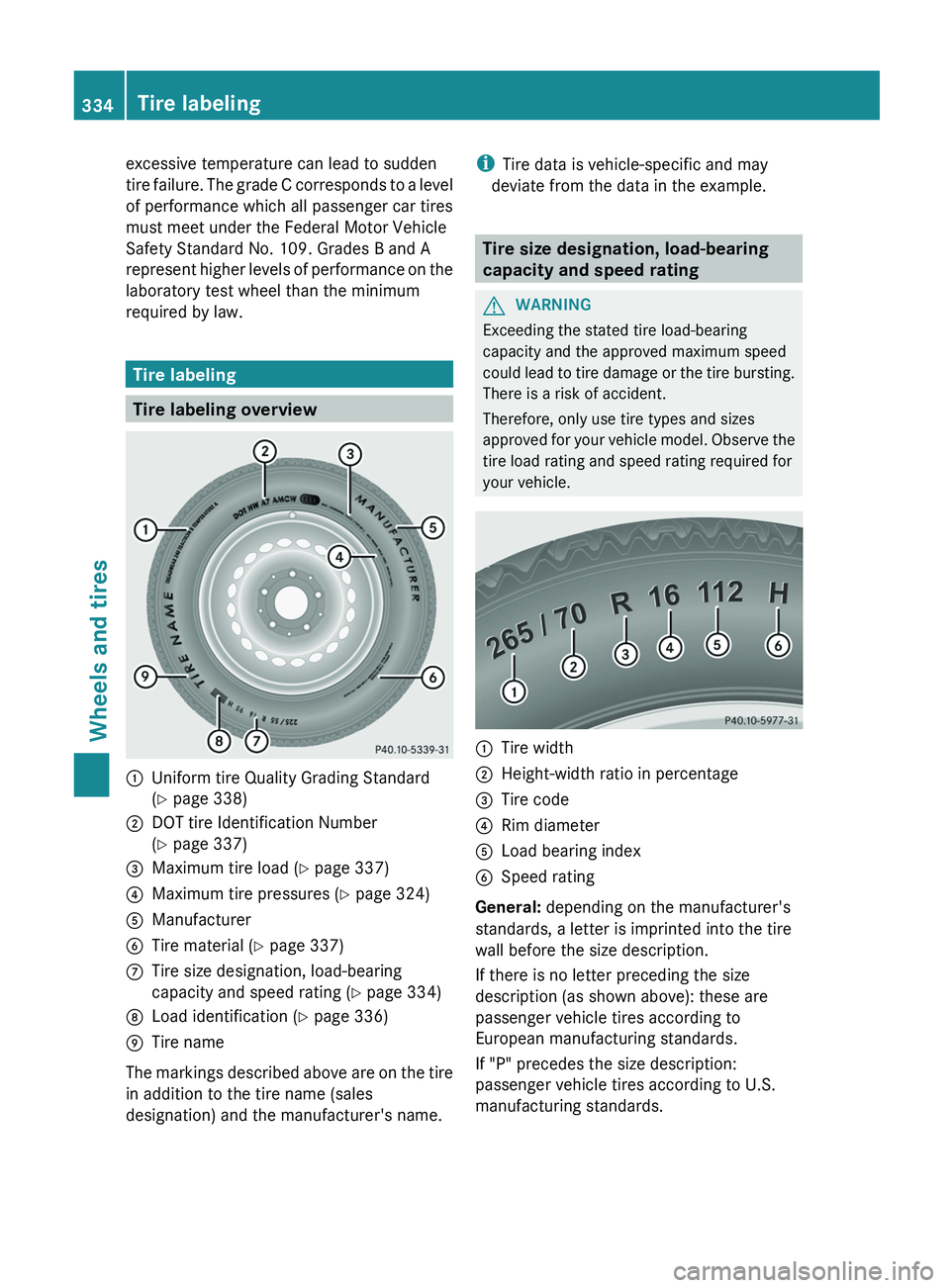
Tire labeling overview
0043
Uniform tire Quality Grading Standard
(Y page 338)
0044 DOT tire Identification Number
(Y page 337)
0087 Maximum tire load ( Y page 337)
0085 Maximum tire pressures (Y page 324)
0083 Manufacturer
0084 Tire material ( Y page 337)
006B Tire size designation, load-bearing
capacity and speed rating (
Y page 334)
006C Load identification ( Y page 336)
006D Tire name
The
markings described above are on the tire
in addition to the tire name (sales
designation) and the manufacturer's name. i
Tire data is vehicle-specific and may
deviate from the data in the example. Tire size designation, load-bearing
capacity and speed rating
G
WARNING
Exceeding the stated tire load-bearing
capacity and the approved maximum speed
could lead to tire
damage or the tire bursting.
There is a risk of accident.
Therefore, only use tire types and sizes
approved for your vehicle model. Observe the
tire load rating and speed rating required for
your vehicle. 0043
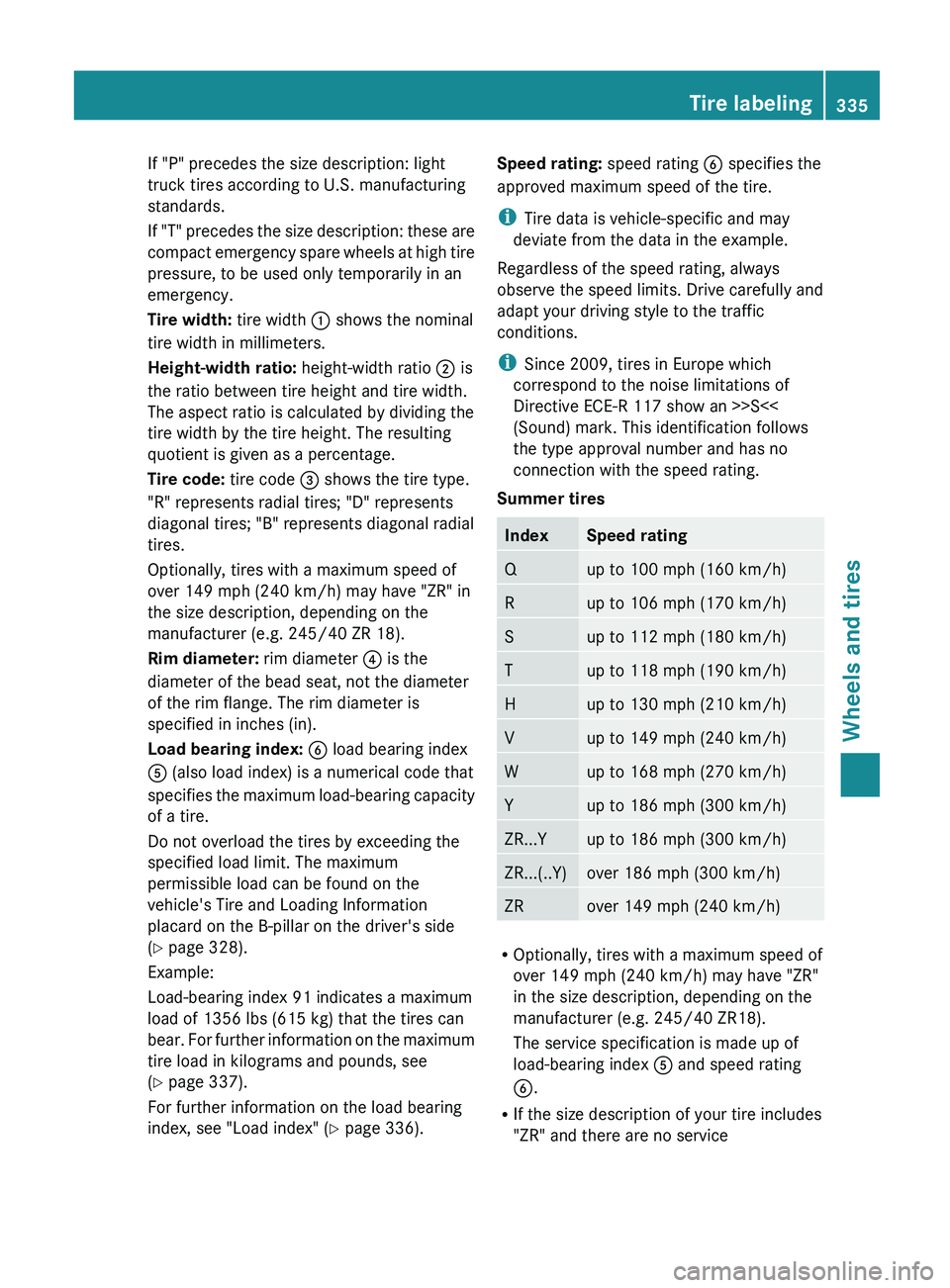
Tire width
0044 Height-width ratio in percentage
0087 Tire code
0085 Rim diameter
0083 Load bearing index
0084 Speed rating
General: depending on the manufacturer's
standards, a letter is imprinted into the tire
wall before the size description.
If there is no letter preceding the size
description (as shown above): these are
passenger vehicle tires according to
European manufacturing standards.
If "P" precedes the size description:
passenger vehicle tires according to U.S.
manufacturing standards. 334
Tire labeling
Wheels and tires
Page 337 of 364
If "P" precedes the size description: light
truck tires according to U.S. manufacturing
standards.
If "T" precedes
the
size description: these are
compact emergency spare wheels at high tire
pressure, to be used only temporarily in an
emergency.
Tire width: tire width 0043 shows the nominal
tire width in millimeters.
Height-width ratio: height-width ratio 0044 is
the ratio between tire height and tire width.
The aspect ratio is calculated by dividing the
tire width by the tire height. The resulting
quotient is given as a percentage.
Tire code: tire code 0087 shows the tire type.
"R" represents radial tires; "D" represents
diagonal tires; "B" represents diagonal radial
tires.
Optionally, tires with a maximum speed of
over 149 mph (240 km/h) may have "ZR" in
the size description, depending on the
manufacturer (e.g. 245/40 ZR 18).
Rim diameter: rim diameter 0085 is the
diameter of the bead seat, not the diameter
of the rim flange. The rim diameter is
specified in inches (in).
Load bearing index: 0084 load bearing index
0083 (also load index) is a numerical code that
specifies the maximum load-bearing capacity
of a tire.
Do not overload the tires by exceeding the
specified load limit. The maximum
permissible load can be found on the
vehicle's Tire and Loading Information
placard on the B-pillar on the driver's side
(Y page 328).
Example:
Load-bearing index 91 indicates a maximum
load of 1356 lbs (615 kg) that the tires can
bear. For further information on the maximum
tire load in kilograms and pounds, see
(Y page 337).
For further information on the load bearing
index, see "Load index" ( Y page 336).Speed rating:
speed rating 0084 specifies the
approved maximum speed of the tire.
i Tire data is vehicle-specific and may
deviate from the data in the example.
Regardless of the speed rating, always
observe the speed limits. Drive carefully and
adapt your driving style to the traffic
conditions.
i Since 2009, tires in Europe which
correspond to the noise limitations of
Directive ECE-R 117 show an >>S<<
(Sound) mark. This identification follows
the type approval number and has no
connection with the speed rating.
Summer tires Index Speed rating
Q up to 100 mph (160 km/h)
R up to 106 mph (170 km/h)
S up to 112 mph (180 km/h)
T up to 118 mph (190 km/h)
H up to 130 mph (210 km/h)
V up to 149 mph (240 km/h)
W up to 168 mph (270 km/h)
Y up to 186 mph (300 km/h)
ZR...Y up to 186 mph (300 km/h)
ZR...(..Y) over 186 mph (300 km/h)
ZR over 149 mph (240 km/h)
R
Optionally, tires with a maximum speed of
over 149 mph (240 km/h) may have "ZR"
in the size description, depending on the
manufacturer (e.g. 245/40 ZR18).
The service specification is made up of
load-bearing index 0083 and speed rating
0084
.
R If the size description of your tire includes
"ZR" and there are no service Tire labeling
335
Wheels and tires Z
Page 341 of 364
exceed the gross vehicle weight rating GVWR
as specified on
the
vehicle identification plate
on the B-pillar on the driver's side.
GVWR (Gross Vehicle Weight Rating) The GVWR is the maximum permissible gross
weight of a
fully
loaded vehicle (the weight of
the vehicle including all accessories,
occupants, fuel, luggage and the drawbar
noseweight, if applicable). The gross vehicle
weight rating is specified on the vehicle
identification plate on the B-pillar on the
driver's side.
Maximum loaded vehicle weight The maximum weight is the sum of:
R
the curb weight of the vehicle
R the weight of the accessories
R the load limit
R the weight of the factory installed optional
equipment
Kilopascal (kPa) Metric unit for tire pressure. 6.9 kPa
corresponds to 1 psi. Another unit for tire
pressure is bar.
100
kilopascals (kPa) are the
equivalent of 1 bar.
Load index In addition to the load-bearing index, the load
index may also be imprinted on the sidewall
of the tire. This specifies the load-bearing
capacity more precisely.
Curb weight
The weight of a vehicle with standard
equipment including the maximum capacity
of
fuel, oil
and
coolant. It also includes the air-
conditioning system and optional equipment
if these are installed in the vehicle, but does
not include passengers or luggage. Maximum load rating The maximum tire load is the maximum
permissible weight in kilograms or lbs for
which a tire is approved.
Maximum permissible tire pressure
Maximum permissible tire pressure for one
tire.
Maximum load on one tire
Maximum load on one tire. This is calculated
by dividing the
maximum
axle load of one axle
by two.
PSI (pounds per square inch) A standard unit of measure for tire pressure.
Aspect ratio
Relationship between tire height and tire
width in percent.
Tire pressure
This is pressure inside the tire applying an
outward force to
each
square inch of the tire's
surface. The tire pressure is specified in
pounds per square inch (psi), in kilopascal
(kPa) or in bar. The tire pressure should only
be corrected when the tires are cold.
Cold tire pressure The tires are cold:
R
if the vehicle has been parked without
direct sunlight on the
tires for at least three
hours and
R if the vehicle has not been driven further
than 1 mile (1.6 km)
Tread The part of the tire that comes into contact
with the road. Tire labeling
339
Wheels and tires Z
Page 344 of 364
the wheel that is diagonally opposite the
wheel you wish to change.
X On downhill gradients: place chocks or
other suitable items in front of the wheels
of the front and rear axle.
Raising the vehicle G
WARNING
If you do not position the jack correctly at the
appropriate jacking point of the vehicle, the
jack could tip over with the vehicle raised.
There is a risk of injury.
Only position the jack at the appropriate
jacking point of the vehicle. The base of the
jack must be positioned vertically, directly
under the jacking point of the vehicle.
! The jack is designed exclusively for
jacking up the vehicle
at the jacking points.
Otherwise, your vehicle could be damaged.
The following must be observed when raising
the vehicle:
R to raise the vehicle, only use the vehicle-
specific jack that has been tested and
approved by Mercedes-Benz. If used
incorrectly, the jack could tip over with the
vehicle raised.
R the jack is designed only to raise and hold
the vehicle for a short time while a wheel
is being changed. It is not suited for
performing maintenance work under the
vehicle.
R avoid changing the wheel on uphill and
downhill slopes.
R before raising the vehicle, secure it from
rolling away by applying the parking brake
and inserting wheel chocks. Never
disengage the parking brake while the
vehicle is raised.
R the jack must be placed on a firm, flat and
non-slip surface. On a loose surface, a
large, load-bearing underlay must be used.
On a slippery surface, a non-slip underlay
must be used, e.g. rubber mats. R
do not use wooden blocks or similar
objects as a jack underlay. Otherwise, the
jack will not be able to achieve its load-
bearing capacity due to the restricted
height.
R make sure that the distance between the
underside of the tires
and the ground does
not exceed 1.2 inches (3 cm).
R never place your hands and feet under the
raised vehicle.
R never lie under the raised vehicle.
R never start the engine when the vehicle is
raised.
R never open or close a door or the tailgate
when the vehicle is raised.
R make sure that no persons are present in
the vehicle when the vehicle is raised. X
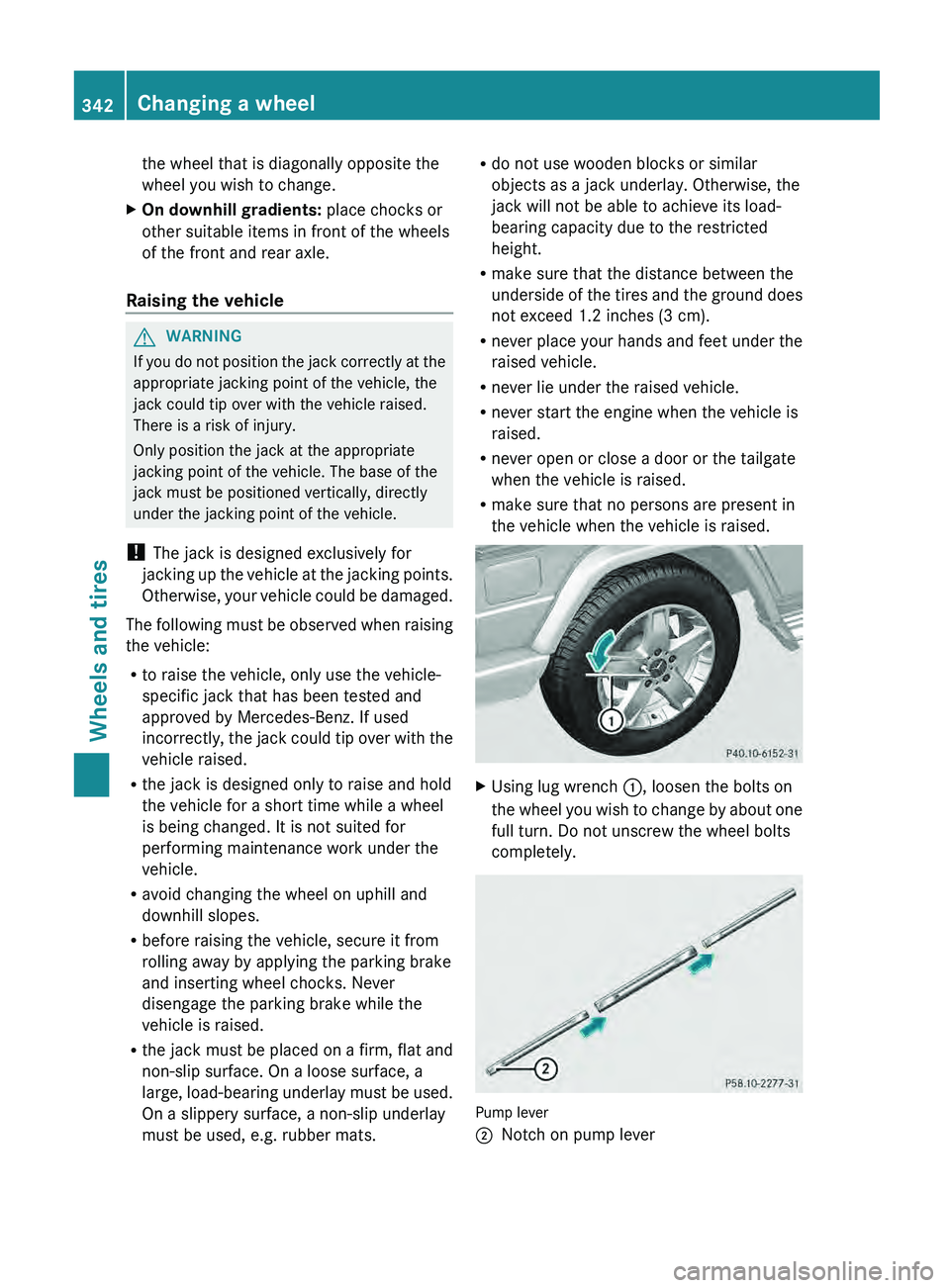
Using lug wrench 0043, loosen the bolts on
the wheel you wish
to change by about one
full turn. Do not unscrew the wheel bolts
completely. Pump lever
0044
Notch on pump lever342
Changing a wheel
Wheels and tires
Page 359 of 364
Vehicle data
General notes
Please note that for the specified vehicle
data:
R the heights specified may vary as a result
of:
-Tires
- Load
- Condition of the suspension
- Optional equipment
R the vehicle length specified includes the
front license plate adapter. Dimensions and weights
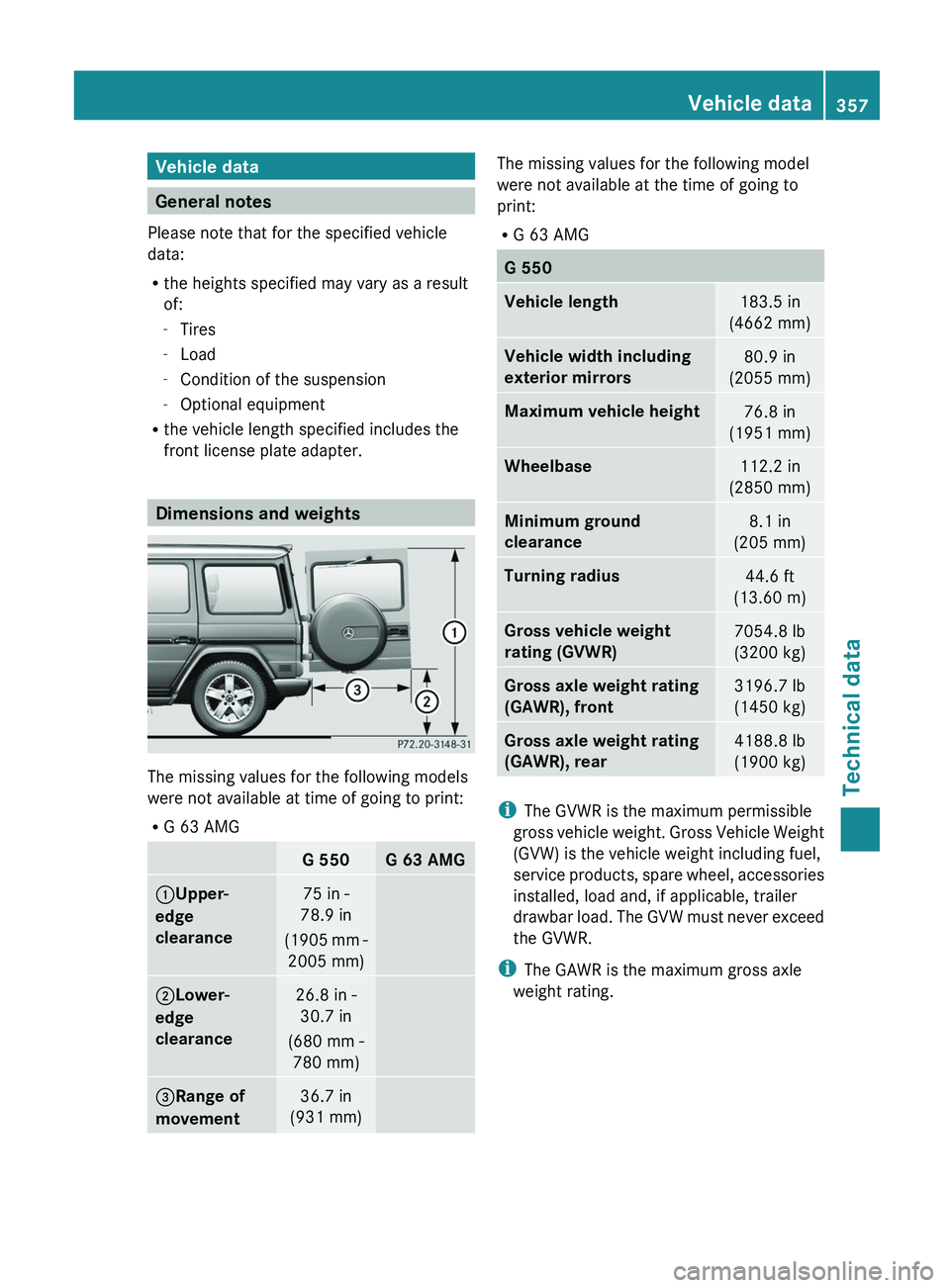
The missing values for the following models
were not available at time of going to print:
R
G 63 AMG G 550 G 63 AMG
0043Upper-
edge
clearance 75 in -
78.9 in
(1905 mm -
2005 mm
) 0044Lower-
edge
clearance 26.8 in -
30.7 in
(680 mm - 780 mm) 0087Range of
movement 36.7 in
(931 mm) The missing values for the following model
were not available at the time of going to
print:
R
G 63 AMG G 550
Vehicle length
183.5 in
(4662 mm) Vehicle width including
exterior mirrors
80.9 in
(2055 mm) Maximum vehicle height
76.8 in
(1951 mm) Wheelbase
112.2 in
(2850 mm) Minimum ground
clearance
8.1 in
(205 mm) Turning radius
44.6 ft
(13.60 m) Gross vehicle weight
rating (GVWR)
7054.8 lb
(3200 kg) Gross axle weight rating
(GAWR), front
3196.7 lb
(1450 kg) Gross axle weight rating
(GAWR), rear
4188.8 lb
(1900 kg) i
The GVWR is the maximum permissible
gross vehicle weight. Gross
Vehicle Weight
(GVW) is the vehicle weight including fuel,
service products, spare wheel, accessories
installed, load and, if applicable, trailer
drawbar load. The GVW must never exceed
the GVWR.
i The GAWR is the maximum gross axle
weight rating. Vehicle data
357Technical data Z