display MERCEDES-BENZ G-CLASS SUV 2013 Service Manual
[x] Cancel search | Manufacturer: MERCEDES-BENZ, Model Year: 2013, Model line: G-CLASS SUV, Model: MERCEDES-BENZ G-CLASS SUV 2013Pages: 364, PDF Size: 9.62 MB
Page 134 of 364
X
Turn the SmartKey to position
2 (Y page 139) in the ignition lock.
X To activate: press the 0064 button.
The indicator lamp in
the 0064 button lights
up.
The climate control system switches to the
following functions:
R cooling with air dehumidification (only
with engine running)
R high airflow (depending on the outside
temperature)
R high temperature (depending on the
outside temperature)
R air distribution to the windshield and
front side windows
R air-recirculation mode off
X To deactivate: press the 0064 button.
The indicator lamp in
the 0064 button goes
out. The previously selected settings are
restored. The cooling with air
dehumidification function remains on. Air-
recirculation mode remains deactivated.
or
X Press the 0058 button.
The indicator lamp in
the 0064 button goes
out. Airflow and air distribution are set to
automatic mode.
or
X Turn controls 0043 or 0084 clockwise or
counter-clockwise ( Y page 119).
or
X Press the 0097 or 0095 button. Activating/deactivating MAX COOL
maximum cooling
The MAX COOL function is only available in
vehicles for the USA. MAX COOL is only operational when the
engine is running.
X
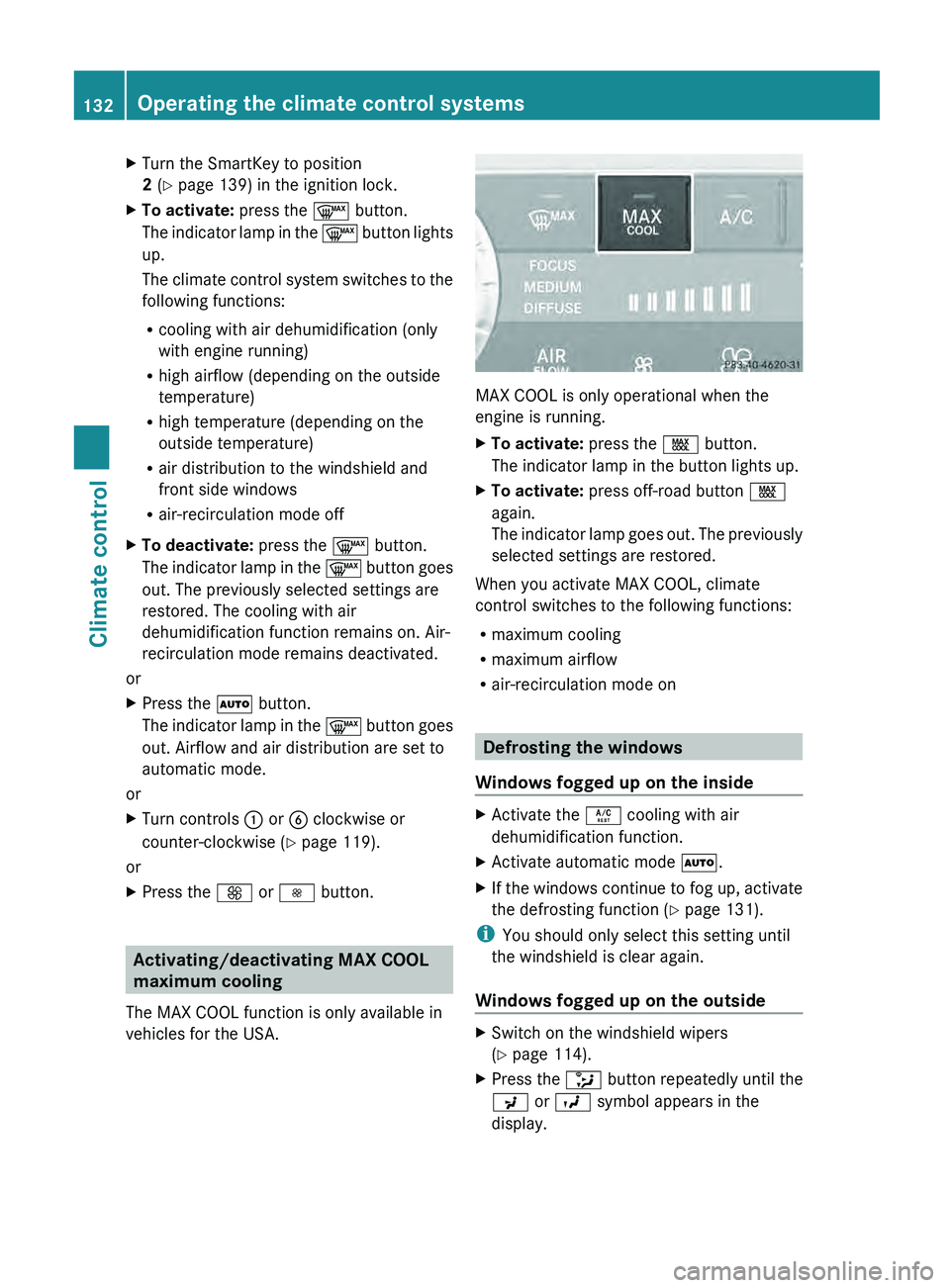
To activate: press the 00C9 button.
The indicator lamp in the button lights up.
X To activate: press off-road button 00C9
again.
The indicator lamp goes
out. The previously
selected settings are restored.
When you activate MAX COOL, climate
control switches to the following functions:
R maximum cooling
R maximum airflow
R air-recirculation mode on Defrosting the windows
Windows fogged up on the inside X
Activate the 0056 cooling with air
dehumidification function.
X Activate automatic mode 0058.
X If the windows continue to fog up, activate
the defrosting function (Y page 131).
i You should only select this setting until
the windshield is clear again.
Windows fogged up on the outside X
Switch on the windshield wipers
(Y page 114).
X Press the 008F button repeatedly until the
009C or 009B symbol appears in the
display. 132
Operating the climate control systems
Climate control
Page 142 of 364
X
Remove the SmartKey when the engine is
switched off.
The starter battery could otherwise be
discharged.
If you cannot turn the SmartKey in the ignition
lock, the starter battery may not be charged
sufficiently.
X Check the starter battery and charge it if
necessary ( Y page 307).
or
X Jump-start the vehicle (Y page 308).
i You can only remove the SmartKey if:
R the SmartKey is in position 0 in the
ignition lock.
R the automatic transmission selector
lever is in P.Starting the engine
Important safety notes G
WARNING
Combustion engines emit poisonous exhaust
gases such as carbon monoxide. Inhaling
these exhaust gases leads
to poisoning. There
is a risk of fatal injury. Therefore never leave
the engine running in enclosed spaces
without sufficient ventilation. G
WARNING
Inhalation of exhaust gas is hazardous to your
health. All exhaust gas contains carbon
monoxide (CO), and inhaling it can cause
unconsciousness and possible death.
Do not run the
engine in confined areas (such
as a garage) which are not properly ventilated.
If you think that exhaust gas fumes are
entering the vehicle while driving, have the
cause determined and corrected
immediately. If you must drive under these
conditions, drive only with at least one
window fully open at all times.
! Do not depress the accelerator pedal
when starting the engine. Starting procedure X
Shift the automatic transmission to
position P.
The transmission position display in the
multifunction display shows P.
i For further information about the
automatic transmission, see
(Y page 145).
i If you depress the
brake when starting the
engine, pedal travel is unusually long and
there is less pedal resistance.
X Make sure that the parking brake is
applied.
X Turn the SmartKey in the ignition lock to
position 3 (Y page 139) and release it as
soon as the engine is running.
i You can also use
the touch-start function.
To do this, turn the SmartKey to position 3
(Y page 139) and release it immediately.
The engine then starts automatically. Pulling away
Automatic transmission G
WARNING
If the engine speed is above the idling speed
and you engage transmission position D or
R, the vehicle could
pull away suddenly. There
is a risk of an accident.
When engaging transmission position D or R,
always firmly depress the brake pedal and do
not simultaneously accelerate.
! Only shift the automatic transmission to
reverse gear R or park position P when the
vehicle is stationary. Otherwise, the
automatic transmission could be damaged.
! Do not depress the accelerator pedal
while depressing the brake pedal. This
impairs engine performance and results in
premature wear on the brake system and
drivetrain. 140
Driving
Driving and parking
Page 143 of 364
!
If a warning tone sounds and the
Release Park. Brake message appears
in the multifunction display, the parking
brake is still applied. Release the parking
brake.
X Depress the brake pedal and keep it
depressed.
X Shift the automatic transmission to
position D or R.
i Before driving off, wait until the gear
change is fully completed.
X Release the parking brake ( Y page 157).
X Release the brake pedal.
X Carefully depress the accelerator pedal.
i It is only possible to shift the automatic
transmission from position P to a different
position if you depress the brake pedal.
Only then is the selector lever lock
released.
i The vehicle locks centrally
once you have
pulled away. The locking knobs in the doors
drop down.
You can open the doors from the inside at
any time.
You can also deactivate the automatic
locking feature (Y page 220).
i Upshifts take place at higher engine
speeds after a cold start. This helps the
catalytic converter to reach its operating
temperature more quickly.
Hill start assist G
WARNING
After a short time, hill start assist will no
longer brake your vehicle and it could roll
away. There is a
risk of an accident and injury.
Therefore, quickly move your foot from the
brake pedal to the accelerator pedal. Never
leave the vehicle when it is held by hill start
assist.
Hill start assist helps you when pulling away
forwards or in reverse on an uphill gradient. It holds the vehicle for a short time after you
have
removed your foot
from the brake pedal.
This gives you enough time to move your foot
from the brake pedal to the accelerator pedal
and to depress it before the vehicle begins to
roll.
X Take your foot off the brake pedal.
i Once you have taken your foot off the
brake pedal, the vehicle is held for around
one second.
X Pull away.
Hill start assist will not function if:
R you are pulling away on a level road or on
a downhill gradient.
R the transmission is in position N.
R the parking brake is applied.
R ESP ®
is malfunctioning. ECO start/stop function (AMG
vehicles)
Important safety notes G
WARNING
If the engine is switched off automatically and
you exit the vehicle, the engine is restarted
automatically. The vehicle may
begin moving.
There is a risk of accident and injury.
If you wish to exit the vehicle, always turn off
the ignition and secure the vehicle against
rolling away.
General notes The ECO start/stop function is only available
for the G 63 AMG.
The ECO start/stop function switches the
engine off automatically when the vehicle
stops moving.
The engine starts automatically when the
driver wants to pull away again. The ECO
start/stop function thereby helps you to
reduce the fuel consumption and emissions
of your vehicle. Driving
141
Driving and parking Z
Page 144 of 364
The ECO start/stop function is activated each
time the engine is switched on.
The ECO start/stop
function
is only available
in drive program C.
The system is operational when the 00A7
symbol is shown in green in the multifunction
display.
The system is operational if all conditions for
automatic engine switch-off have been
fulfilled ( Y page 142) and the 00A7 symbol is
shown in green in the multifunction display.
In addition, the Stop/Start active
message is shown in the AMG menu in the
multifunction display.
If not all conditions for automatic engine
switch-off ( Y page 142) are fulfilled, the
00A7 symbol is shown in yellow in the
multifunction display.
In addition, the Stop/Start inactive
message is shown in the AMG menu in the
multifunction display.
If the ECO start/stop function has been
manually deactivated ( Y page 142) or a
malfunction has caused the system to be
deactivated, the 00A7 symbol is not
displayed.
The Stop/Start active or Stop/Start
inactive message in the AMG menu in the
multifunction display goes out.
Deactivating/activating the ECO start/
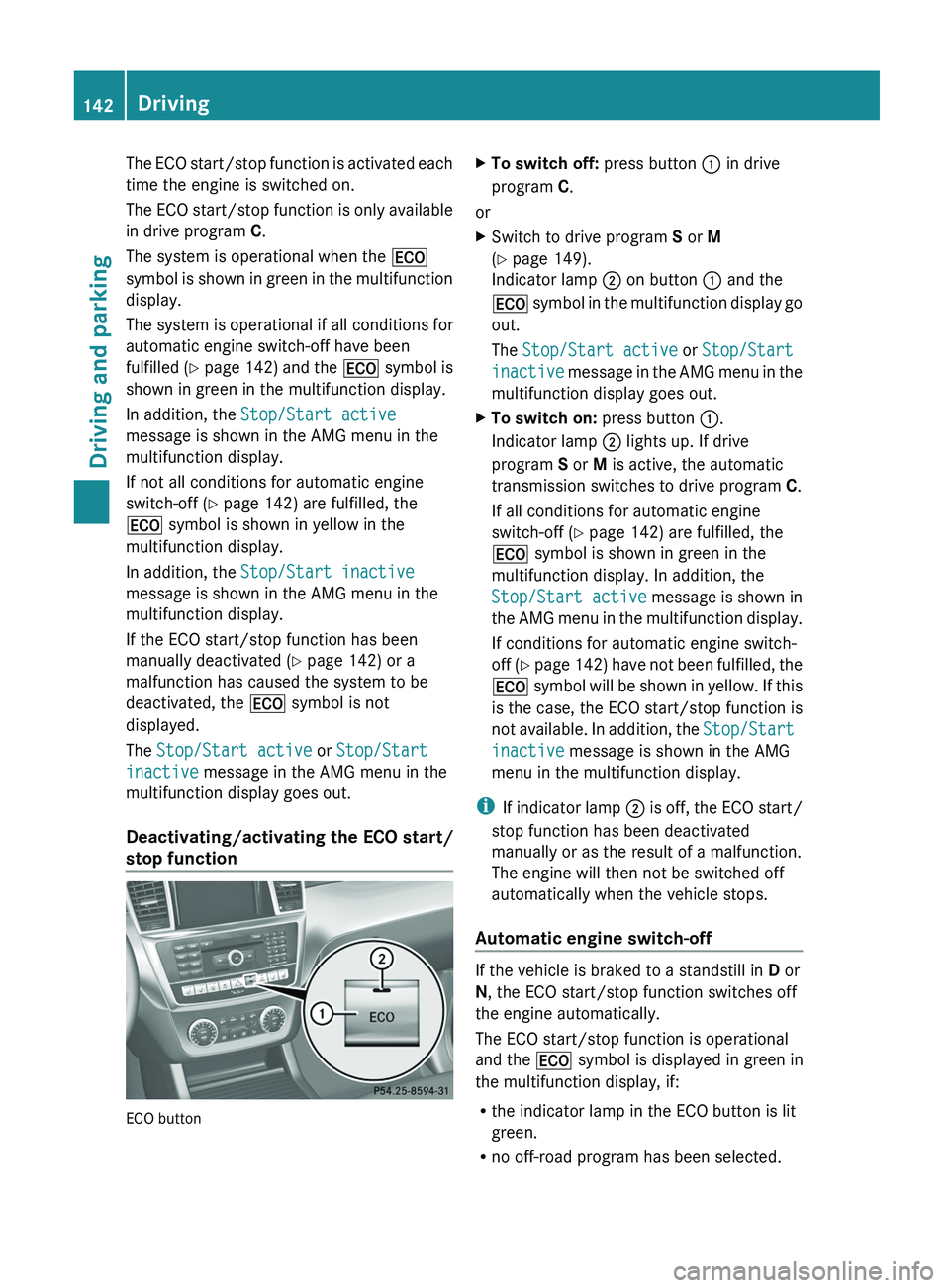
stop function ECO button X
To switch off: press button 0043 in drive
program C.
or
X Switch to drive program S or M
(Y page 149).
Indicator lamp 0044 on button 0043 and the
00A7 symbol in the
multifunction display go
out.
The Stop/Start active or Stop/Start
inactive message in the AMG menu in the
multifunction display goes out.
X To switch on: press button 0043.
Indicator lamp 0044 lights up. If drive
program S or M is active, the automatic
transmission switches to drive program C.
If all conditions for automatic engine
switch-off ( Y page 142) are fulfilled, the
00A7 symbol is shown in green in the
multifunction display. In addition, the
Stop/Start active message
is shown
in
the AMG menu in the multifunction display.
If conditions for automatic engine switch-
off (Y page 142) have not been fulfilled, the
00A7 symbol will be shown in yellow. If this
is the case, the ECO start/stop function is
not available. In addition, the Stop/Start
inactive message is shown in the AMG
menu in the multifunction display.
i If indicator lamp
0044
is off, the ECO start/
stop function has been deactivated
manually or as the result of a malfunction.
The engine will then not be switched off
automatically when the vehicle stops.
Automatic engine switch-off If the vehicle is braked to a standstill in
D or
N, the ECO start/stop function switches off
the engine automatically.
The ECO start/stop function is operational
and the 00A7 symbol is displayed in green in
the multifunction display, if:
R the indicator lamp in the ECO button is lit
green.
R no off-road program has been selected.142
Driving
Driving and parking
Page 145 of 364
R
the vehicle is stationary.
R the outside temperature is within the
comfort range.
R the engine is at normal operating
temperature.
R the set temperature for
the vehicle interior
has been reached.
R the battery is sufficiently charged.
R the system detects that the windshield is
not fogged up when the air-conditioning
system is switched on.
R the hood is closed.
R the driver's door is closed and the driver's
seat belt is fastened.
If conditions for automatic engine switch-off
have not been fulfilled, the 00A7 symbol will
be shown in yellow.
In addition, the Stop/Start inactive
message is shown in the AMG menu in the
multifunction display.
i If you shift the transmission from R to D,
the ECO start/stop function is available
again once the 00A7 symbol reappears in
green in the multifunction display.
i The engine can be automatically switched
off an unlimited number of times.
i You can still activate the HOLD function
when the vehicle is stationary, even if the
engine has been switched off
automatically. It is then not necessary to
continue applying the brakes during the
automatic stop phase. When you depress
the accelerator pedal, the engine starts
automatically and the braking effect of the
HOLD function is deactivated. Depress the
accelerator pedal carefully, as the engine
must be started first.
i During automatic engine switch-off, the
climate control system only operates at a
reduced capacity. If you require full climate
control capacity, the ECO start/stop
function can be deactivated by pressing the
ECO button ( Y page 142). Automatic engine start The engine starts automatically if:
R
In general:
-you switch off the ECO start/stop
function by pressing the ECO button.
- you release the brakes when in
transmission position D or N and when
the HOLD function is not active.
R By the driver:
-you release the brakes when in
transmission position D or N.
- you depress the accelerator pedal.
- you engage reverse gear R.
- you move the transmission out of
position P.
- you switch to drive program S or M.
- you unfasten your seat belt or open the
driver's door.
R By the system:
-the vehicle starts to roll.
- the brake system requires this.
- the temperature in the vehicle interior
deviates from the set range.
- the system detects moisture on the
windshield when the air-conditioning
system is switched on.
- the charge level of
the battery is too low.
i Shifting the transmission to position P
does not start the engine. Driving
143
Driving and parking Z
Page 146 of 364
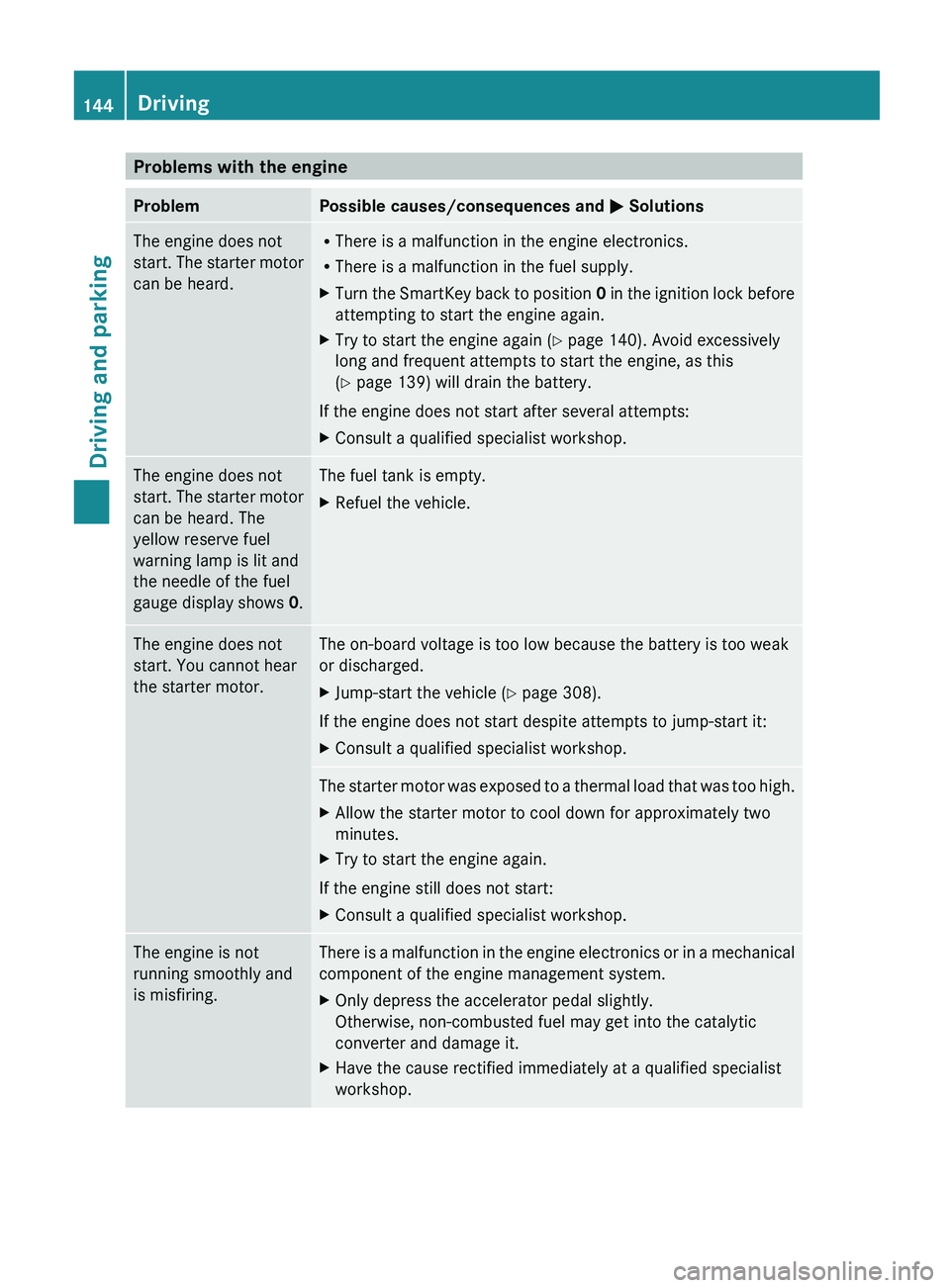
Problems with the engine
Problem Possible causes/consequences and
0050 SolutionsThe engine does not
start.
The starter
motor
can be heard. R
There is a malfunction in the engine electronics.
R There is a malfunction in the fuel supply.
X Turn the SmartKey back to position 0
in the
ignition lock before
attempting to start the engine again.
X Try to start the engine again (Y page 140). Avoid excessively
long and frequent attempts to start the engine, as this
(Y page 139) will drain the battery.
If the engine does not start after several attempts:
X Consult a qualified specialist workshop. The engine does not
start. The starter
motor
can be heard. The
yellow reserve fuel
warning lamp is lit and
the needle of the fuel
gauge
display shows 0. The fuel tank is empty.
X
Refuel the vehicle. The engine does not
start. You cannot hear
the starter motor. The on-board voltage is too low because the battery is too weak
or discharged.
X
Jump-start the vehicle (Y page 308).
If the engine does not start despite attempts to jump-start it:
X Consult a qualified specialist workshop. The starter motor was exposed to a thermal load that was too high.
X
Allow the starter motor to cool down for approximately two
minutes.
X Try to start the engine again.
If the engine still does not start:
X Consult a qualified specialist workshop. The engine is not
running smoothly and
is misfiring. There is a malfunction in the engine electronics or in a mechanical
component of the engine management system.
X
Only depress the accelerator pedal slightly.
Otherwise, non-combusted fuel may get into the catalytic
converter and damage it.
X Have the cause rectified immediately at a qualified specialist
workshop.144
DrivingDriving and parking
Page 147 of 364
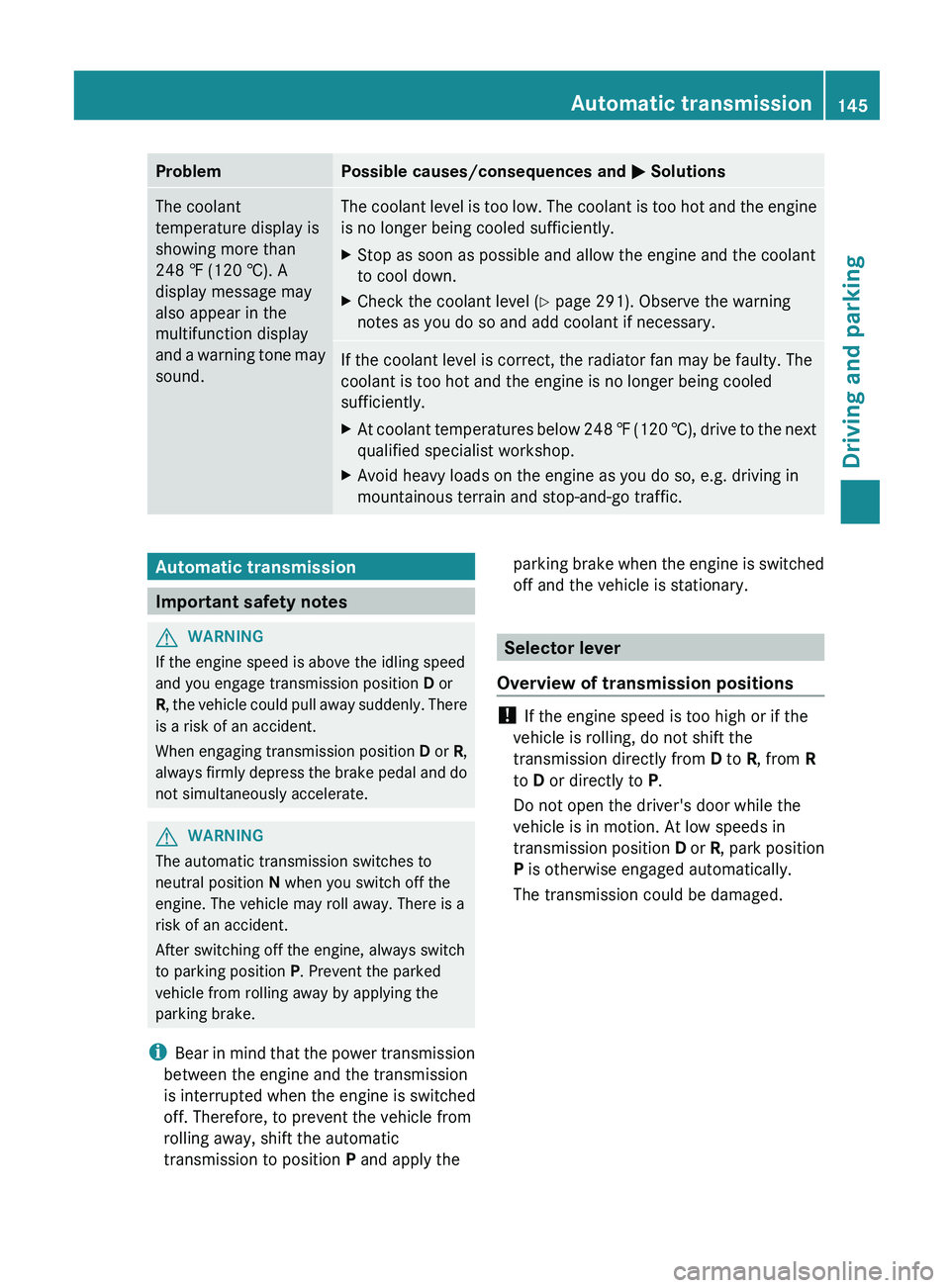
Problem Possible causes/consequences and
0050 SolutionsThe coolant
temperature display is
showing more than
248 ‡
(120 †). A
display message may
also appear in the
multifunction display
and a
warning
tone may
sound. The coolant level is too low. The coolant is too hot and the engine
is no longer being cooled sufficiently.
X
Stop as soon as possible and allow the engine and the coolant
to cool down.
X Check the coolant level (Y page 291). Observe the warning
notes as you do so and add coolant if necessary. If the coolant level is correct, the radiator fan may be faulty. The
coolant is too hot and the engine is no longer being cooled
sufficiently.
X
At coolant temperatures below 248 ‡ (120 †),
drive
to the next
qualified specialist workshop.
X Avoid heavy loads on the engine as you do so, e.g. driving in
mountainous terrain and stop-and-go traffic. Automatic transmission
Important safety notes
G
WARNING
If the engine speed is above the idling speed
and you engage transmission position D or
R, the vehicle could
pull away suddenly. There
is a risk of an accident.
When engaging transmission position D or R,
always firmly depress the brake pedal and do
not simultaneously accelerate. G
WARNING
The automatic transmission switches to
neutral position N when you switch off the
engine. The vehicle may roll away. There is a
risk of an accident.
After switching off the engine, always switch
to parking position P. Prevent the parked
vehicle from rolling away by applying the
parking brake.
i Bear in mind that
the power transmission
between the engine and the transmission
is interrupted when the engine is switched
off. Therefore, to prevent the vehicle from
rolling away, shift the automatic
transmission to position P and apply theparking brake when the engine is switched
off and the vehicle is stationary.
Selector lever
Overview of transmission positions !
If the engine speed is too high or if the
vehicle is rolling, do not shift the
transmission directly from D to R, from R
to D or directly to P.
Do not open the driver's door while the
vehicle is in motion. At low speeds in
transmission position D or R
, park position
P is otherwise engaged automatically.
The transmission could be damaged. Automatic transmission
145
Driving and parking Z
Page 148 of 364
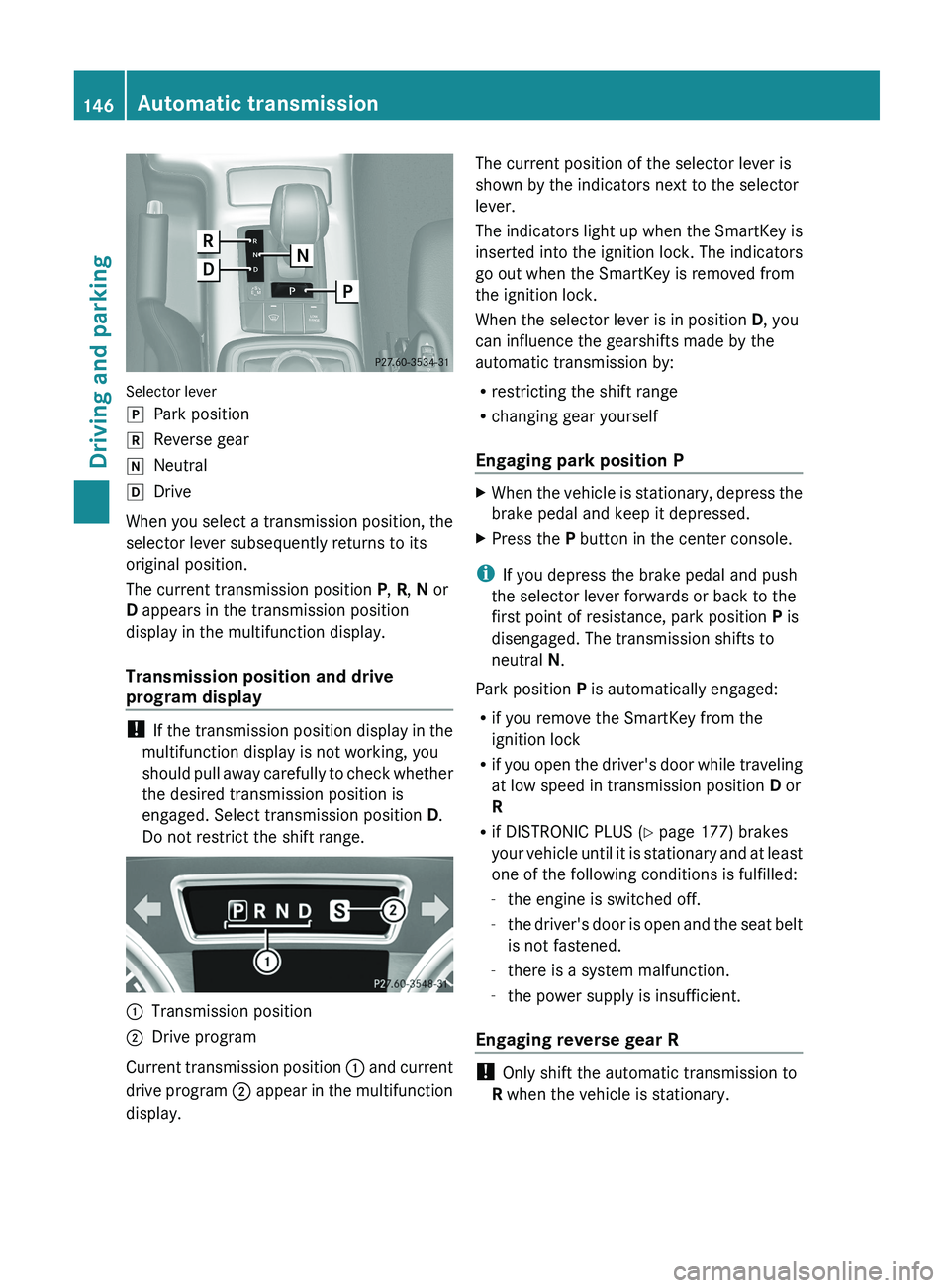
Selector lever
005D
Park position
005E Reverse gear
005C Neutral
005B Drive
When you select a transmission position, the
selector lever subsequently returns to its
original position.
The current transmission position P, R, N or
D appears in the transmission position
display in the multifunction display.
Transmission position and drive
program display !
If the transmission position
display in the
multifunction display is not working, you
should pull away carefully to check whether
the desired transmission position is
engaged. Select transmission position D.
Do not restrict the shift range. 0043
Transmission position
0044 Drive program
Current transmission position 0043 and current
drive program 0044
appear in the multifunction
display. The current position of the selector lever is
shown by the indicators next to the selector
lever.
The
indicators
light up
when the SmartKey is
inserted into the ignition lock. The indicators
go out when the SmartKey is removed from
the ignition lock.
When the selector lever is in position D, you
can influence the gearshifts made by the
automatic transmission by:
R restricting the shift range
R changing gear yourself
Engaging park position P X
When the vehicle is stationary, depress the
brake pedal and keep it depressed.
X Press the P button in the center console.
i If you depress the brake pedal and push
the selector lever forwards or back to the
first point of resistance, park position P is
disengaged. The transmission shifts to
neutral N.
Park position P is automatically engaged:
R if you remove the SmartKey from the
ignition lock
R if you open the
driver's door while traveling
at low speed in transmission position D or
R
R if DISTRONIC PLUS (Y page 177) brakes
your vehicle until it is stationary and at least
one of the following conditions is fulfilled:
-the engine is switched off.
- the driver's door is open and the seat belt
is not fastened.
- there is a system malfunction.
- the power supply is insufficient.
Engaging reverse gear R !
Only shift the automatic transmission to
R when the vehicle is stationary. 146
Automatic transmission
Driving and parking
Page 152 of 364
gearshift program appears in the
multifunction display.
i Only change from automatic drive
program E or S to manual drive program
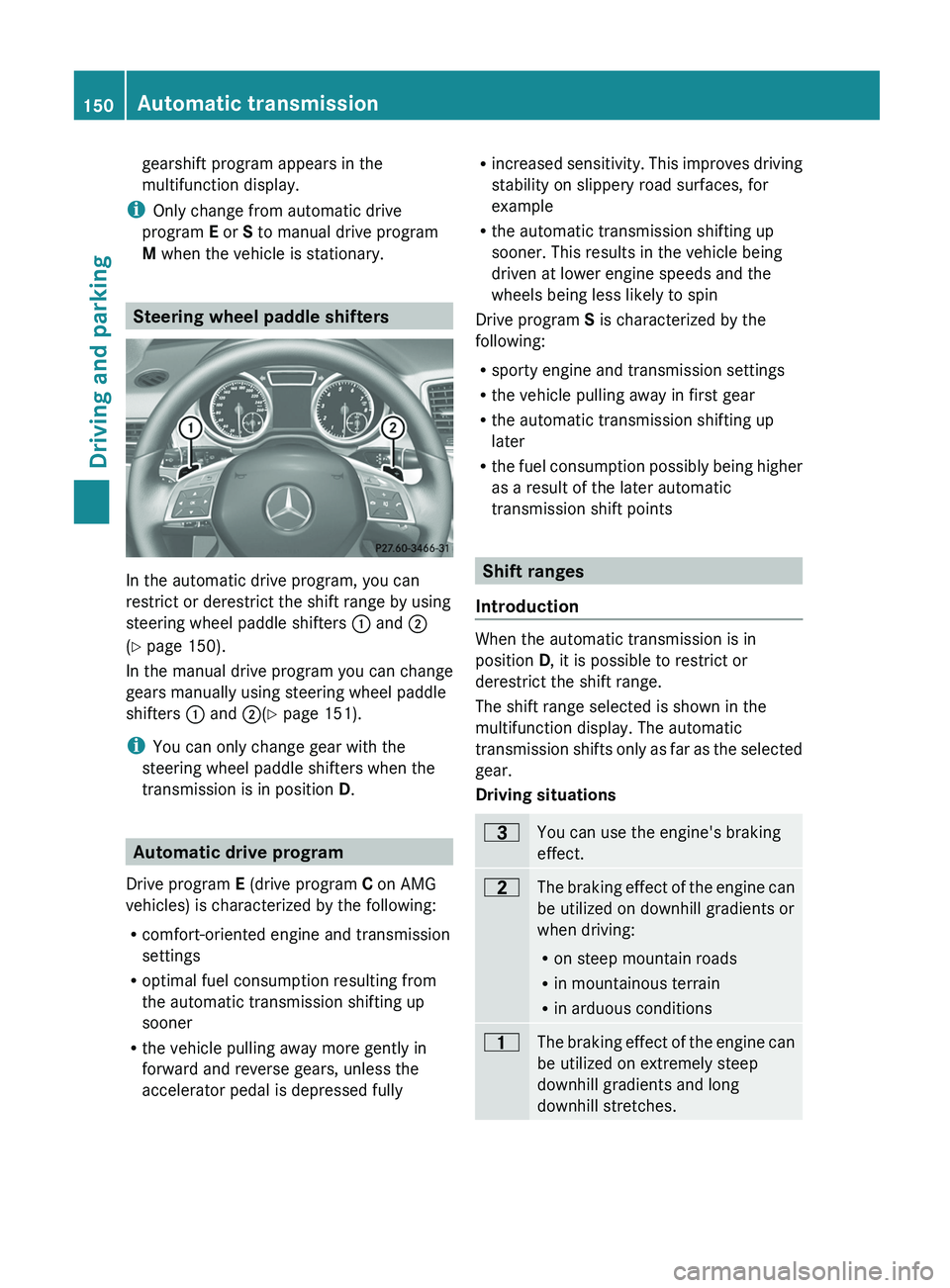
M when the vehicle is stationary. Steering wheel paddle shifters
In the automatic drive program, you can
restrict or derestrict the shift range by using
steering wheel paddle shifters
0043 and 0044
(Y page 150).
In the manual drive program you can change
gears manually using steering wheel paddle
shifters 0043 and 0044(Y page 151).
i You can only change gear with the
steering wheel paddle shifters when the
transmission is in position D. Automatic drive program
Drive program E (drive program C on AMG
vehicles) is characterized by the following:
R comfort-oriented engine and transmission
settings
R optimal fuel consumption resulting from
the automatic transmission shifting up
sooner
R the vehicle pulling away more gently in
forward and reverse gears, unless the
accelerator pedal is depressed fully R
increased sensitivity. This improves
driving
stability on slippery road surfaces, for
example
R the automatic transmission shifting up
sooner. This results in the vehicle being
driven at lower engine speeds and the
wheels being less likely to spin
Drive program S is characterized by the
following:
R sporty engine and transmission settings
R the vehicle pulling away in first gear
R the automatic transmission shifting up
later
R the fuel consumption possibly being higher
as a result of the later automatic
transmission shift points Shift ranges
Introduction When the automatic transmission is in
position D, it is possible to restrict or
derestrict the shift range.
The shift range selected is shown in the
multifunction display. The automatic
transmission shifts only as
far as the selected
gear.
Driving situations 0040
You can use the engine's braking
effect.
0038
The braking effect of the engine can
be utilized on downhill gradients or
when driving:
R
on steep mountain roads
R in mountainous terrain
R in arduous conditions 0037
The braking effect of the engine can
be utilized on extremely steep
downhill gradients and long
downhill stretches.150
Automatic transmission
Driving and parking
Page 153 of 364
Restricting the shift range
X
Pull the left-hand steering wheel paddle
shifter (Y page 150).
The automatic transmission shifts down
one gear and restricts
the shift range to the
relevant gear.
i If the engine exceeds the maximum
engine speed when shifting down, the
automatic transmission protects against
engine damage by not shifting down.
i If the maximum engine
speed for the shift
range is reached and you continue to
accelerate, the automatic transmission
shifts up in order to prevent the engine
from overrevving, even if the shift range is
restricted.
Derestricting the shift range X
Pull the right-hand steering wheel paddle
shifter (Y page 150).
The automatic transmission shifts up one
gear and restricts the shift range to the
relevant gear.
Clearing the shift range restriction X
Pull and hold the right-hand steering wheel
paddle shifter ( Y
page 150) until D is shown
again in the multifunction display.
The automatic transmission shifts from the
current shift range directly to D.
Selecting the ideal shift range X
Pull the left-hand steering wheel paddle
shifter ( Y page
150) and hold it in position.
The automatic transmission shifts to the
gear which allows optimum acceleration
and deceleration. To do this, the automatic
transmission shifts down one or more
gears.
i The automatic transmission cannot shift
down beyond second gear. To shift to first
gear, you have to pull the left steering
wheel paddle shifter. Manual drive program
Introduction In drive program M, you can change gear
manually using the steering wheel paddle
shifters. For this,
the
transmission must be in
position D. The gear currently selected and
engaged is shown in the multifunction
display.
Manual drive program M differs from drive
programs E and S with regard to spontaneity,
responsiveness and smoothness of gear
changes.
Switching on the manual drive program X
Press the program selector button
(Y page 149) repeatedly
until M appears in
the multifunction display.
Upshifting (except AMG vehicles) X
Pull the right-hand paddle ( Y page 150).
The automatic transmission shifts
up to the
next gear.
Shifting up (AMG vehicles) !
In manual drive program M
, the automatic
transmission does not shift up
automatically even when the engine
limiting speed for the current gear is
reached. When the engine limiting speed is
reached, the fuel supply is cut to prevent
the engine from overrevving. Always make
sure that the engine speed does not reach
the red area of the tachometer. There is
otherwise a risk of engine damage.
X Pull the right-hand paddle ( Y page 150).
The automatic transmission shifts
up to the
next gear.
Before the engine speed reaches the red area,
an upshift indicator will be shown in the
multifunction display.
X If the color in the speedometer
multifunction display changes to red and Automatic transmission
151
Driving and parking Z