weight MERCEDES-BENZ G-CLASS SUV 2014 Owners Manual
[x] Cancel search | Manufacturer: MERCEDES-BENZ, Model Year: 2014, Model line: G-CLASS SUV, Model: MERCEDES-BENZ G-CLASS SUV 2014Pages: 272, PDF Size: 39.13 MB
Page 12 of 272
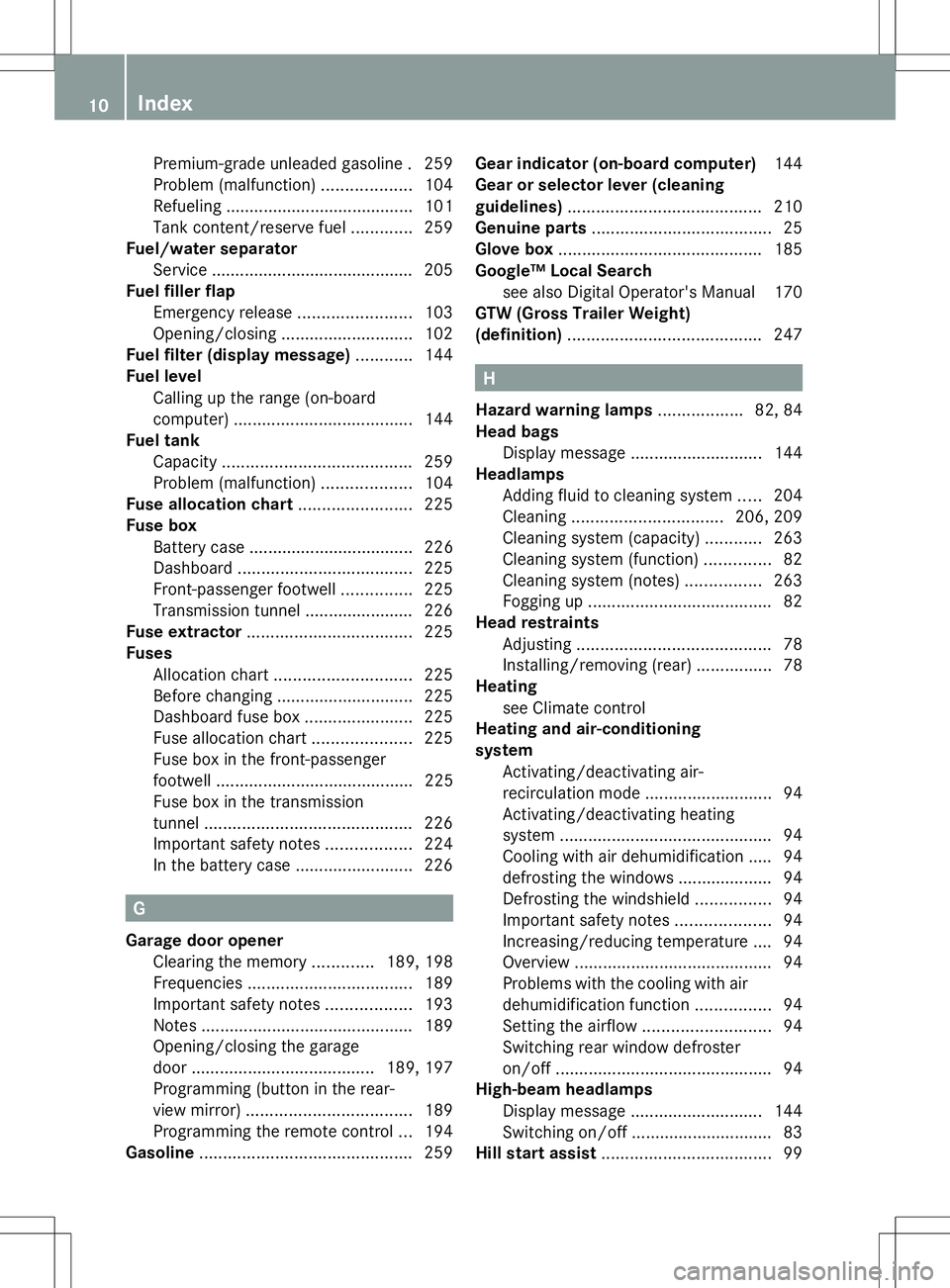
Premium-grade unleaded gasoline
.259
Problem (malfunction) ...................104
Refueling ........................................ 101
Tank content/reserve fuel .............259
Fuel/water separator
Service .......................................... .205
Fuel filler flap
Emergency release ........................103
Opening/closing ............................ 102
Fuel filter (display message) ............144
Fuel level Calling up the range (on-board
computer) ...................................... 144
Fuel tank
Capacity ........................................ 259
Problem (malfunction) ...................104
Fuse allocation chart ........................225
Fuse box Battery case ................................... 226
Dashboard ..................................... 225
Front-passenger footwell ...............225
Transmission tunnel ....................... 226
Fuse extractor ................................... 225
Fuses Allocation chart ............................. 225
Before changing ............................. 225
Dashboard fuse box .......................225
Fuse allocation chart .....................225
Fuse box in the front-passenger
footwell .......................................... 225
Fuse box in the transmission
tunnel ............................................ 226
Important safety notes ..................224
In the battery case .........................226 G
Garage door opener Clearing the memory .............189, 198
Frequencies ................................... 189
Important safety notes ..................193
Notes ............................................. 189
Opening/closing the garage
door ....................................... 189, 197
Programming (button in the rear-
view mirror) ................................... 189
Programming the remote control ...194
Gasoline ............................................. 259Gear indicator (on-board computer)
144
Gear or selector lever (cleaning
guidelines) ......................................... 210
Genuine parts ...................................... 25
Glove box ........................................... 185
Google™ Local Search see also Digital Operator's Manual 170
GTW (Gross Trailer Weight)
(definition) ......................................... 247 H
Hazard warning lamps ..................82, 84
Head bags Display message ............................ 144
Headlamps
Adding fluid to cleaning system .....204
Cleaning ................................ 206, 209
Cleaning system (capacity )............ 263
Cleaning system (function) ..............82
Cleaning system (notes) ................263
Fogging up ....................................... 82
Head restraints
Adjusting ......................................... 78
Installing/removing (rear) ................78
Heating
see Climate control
Heating and air-conditioning
system
Activating/deactivating air-
recirculation mode ...........................94
Activating/deactivating heating
system ............................................. 94
Cooling with air dehumidification ..... 94
defrosting the windows .................... 94
Defrosting the windshield ................94
Important safety notes ....................94
Increasing/reducing temperature .... 94
Overview .......................................... 94
Problems with the cooling with air
dehumidification function ................94
Setting the airflow ........................... 94
Switching rear window defroster
on/off .............................................. 94
High-beam headlamps
Display message ............................ 144
Switching on/off .............................. 83
Hill start assist .................................... 9910
Index
Page 19 of 272
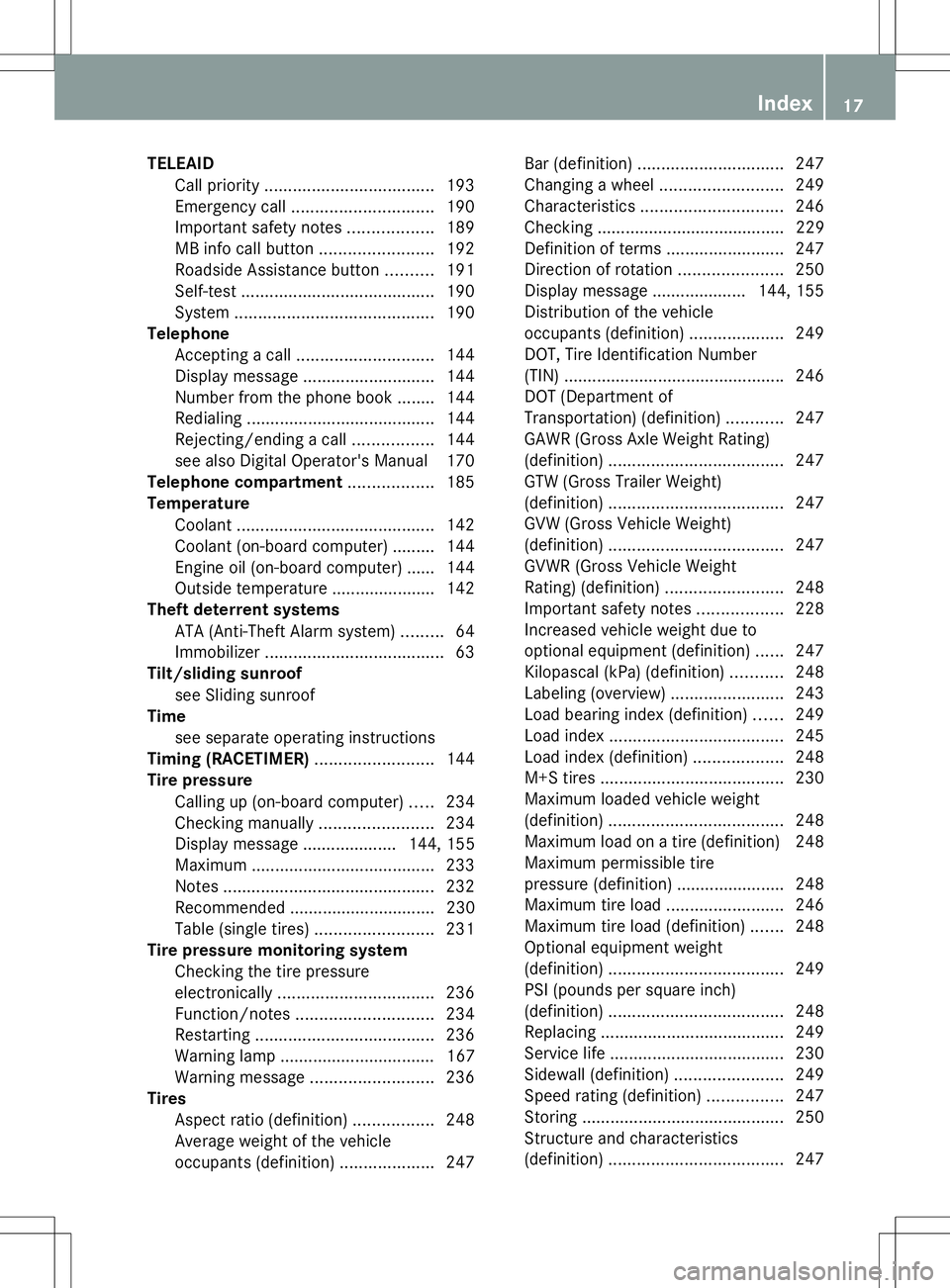
TELEAID
Call priority .................................... 193
Emergency call .............................. 190
Important safety notes ..................189
MB info call button ........................192
Roadside Assistance button ..........191
Self-test ......................................... 190
System .......................................... 190
Telephone
Accepting a call ............................. 144
Display message ............................ 144
Number from the phone book ....... .144
Redialing ........................................ 144
Rejecting/ending a call .................144
see also Digital Operator's Manual 170
Telephone compartment ..................185
Temperature Coolant .......................................... 142
Coolant (on-board computer) ......... 144
Engine oil (on-board computer) ...... 144
Outside temperature ..................... .142
Theft deterrent systems
ATA (Anti-Theft Alarm system) .........64
Immobilizer ...................................... 63
Tilt/sliding sunroof
see Sliding sunroof
Time
see separate operating instructions
Timing (RACETIMER) .........................144
Tire pressure Calling up (on-board computer) .....234
Checking manually ........................234
Display message .................... 144, 155
Maximum ....................................... 233
Notes ............................................. 232
Recommended ............................... 230
Table (single tires) .........................231
Tire pressure monitoring system
Checking the tire pressure
electronically ................................. 236
Function/notes ............................. 234
Restarting ...................................... 236
Warning lamp ................................. 167
Warning message .......................... 236
Tires
Aspect ratio (definition) .................248
Average weight of the vehicle
occupants (definition) ....................247Bar (definition)
............................... 247
Changing a wheel .......................... 249
Characteristics .............................. 246
Checking ........................................ 229
Definition of terms .........................247
Direction of rotatio n...................... 250
Display message .................... 144, 155
Distribution of the vehicle
occupants (definition) ....................249
DOT, Tire Identification Number
(TIN) .............................................. .246
DOT (Department of
Transportation) (definition) ............247
GAWR (Gross Axle Weight Rating)
(definition) ..................................... 247
GTW (Gross Trailer Weight)
(definition) ..................................... 247
GVW (Gross Vehicle Weight)
(definition) ..................................... 247
GVWR (Gross Vehicle Weight
Rating) (definition) .........................248
Important safety notes ..................228
Increased vehicle weight due to
optional equipment (definition) ......247
Kilopascal (kPa) (definition) ...........248
Labeling (overview )........................ 243
Load bearing index (definition) ......249
Load index ..................................... 245
Load index (definition) ...................248
M+S tires ....................................... 230
Maximum loaded vehicle weight
(definition) ..................................... 248
Maximum load on a tire (definition) 248
Maximum permissible tire
pressure (definition) ....................... 248
Maximum tire loa d......................... 246
Maximum tire load (definition) .......248
Optional equipment weight
(definition) ..................................... 249
PSI (pounds per square inch)
(definition) ..................................... 248
Replacing ....................................... 249
Service life ..................................... 230
Sidewall (definition) .......................249
Speed rating (definition) ................247
Storing ........................................... 250
Structure and characteristics
(definition) ..................................... 247 Index
17
Page 20 of 272
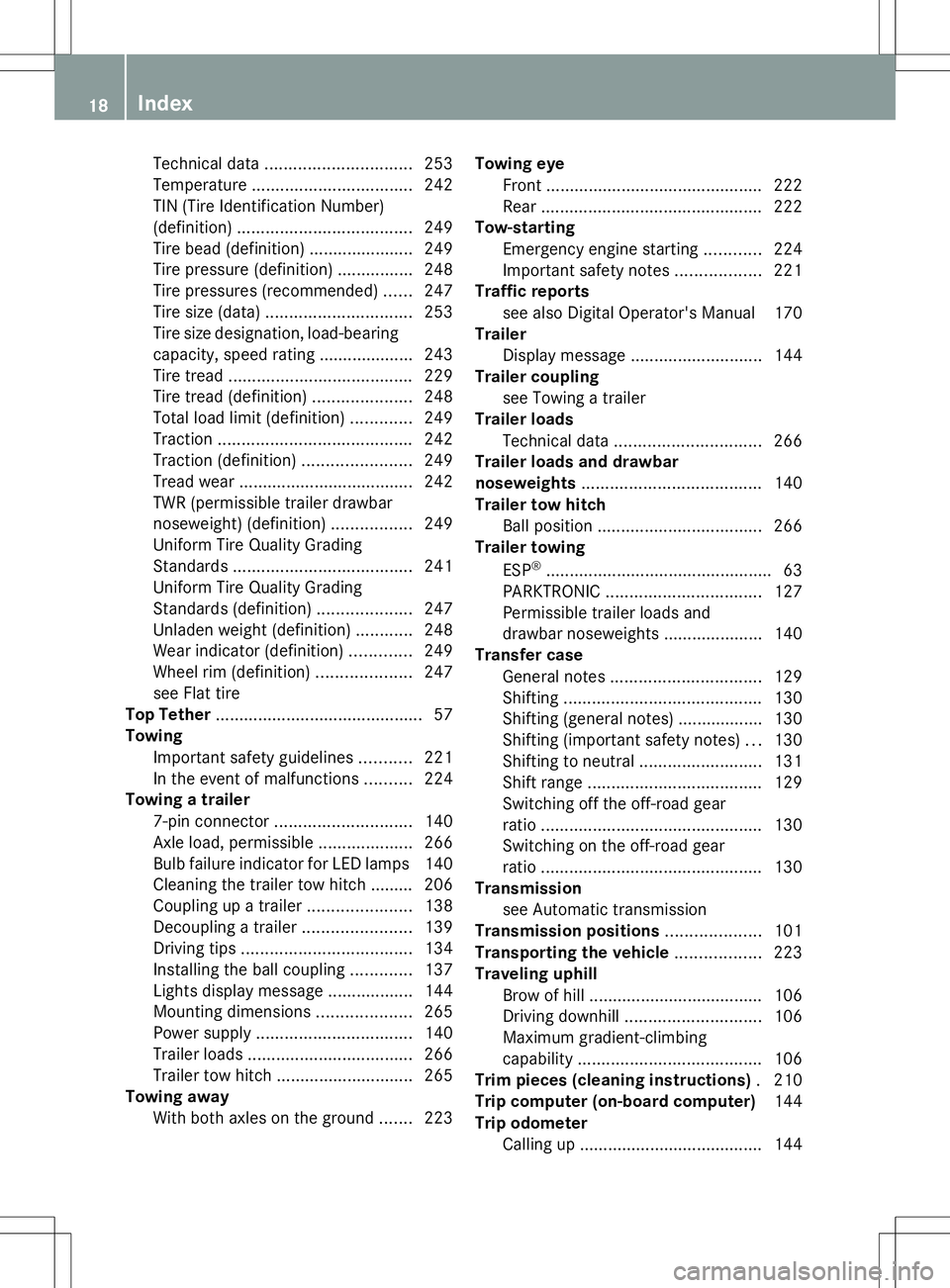
Technical data
............................... 253
Temperature .................................. 242
TIN (Tire Identification Number)
(definition) ..................................... 249
Tire bead (definition) ......................249
Tire pressure (definition) ................248
Tire pressures (recommended )...... 247
Tire size (data) ............................... 253
Tire size designation, load-bearing
capacity, speed rating .................... 243
Tire tread ....................................... 229
Tire tread (definition) .....................248
Total load limit (definition) .............249
Traction ......................................... 242
Traction (definition) .......................249
Tread wea r..................................... 242
TWR (permissible trailer drawbar
noseweight) (definition) .................249
Uniform Tire Quality Grading
Standards ...................................... 241
Uniform Tire Quality Grading
Standards (definition) ....................247
Unladen weight (definition) ............248
Wear indicator (definition) .............249
Wheel rim (definition) ....................247
see Flat tire
Top Tether ............................................ 57
Towing Important safety guidelines ...........221
In the event of malfunctions ..........224
Towing a trailer
7-pin connector ............................. 140
Axle load, permissible ....................266
Bulb failure indicator for LED lamps 140
Cleaning the trailer tow hitch ......... 206
Coupling up a trailer ......................138
Decoupling a trailer .......................139
Driving tips .................................... 134
Installing the ball coupling .............137
Lights display message ..................144
Mounting dimensions ....................265
Power supply ................................. 140
Trailer loads ................................... 266
Trailer tow hitch ............................. 265
Towing away
With both axles on the ground .......223 Towing eye
Front .............................................. 222
Rear ............................................... 222
Tow-starting
Emergency engine starting ............224
Important safety notes ..................221
Traffic reports
see also Digital Operator's Manual 170
Trailer
Display message ............................ 144
Trailer coupling
see Towing a trailer
Trailer loads
Technical data ............................... 266
Trailer loads and drawbar
noseweights ...................................... 140
Trailer tow hitch Ball position ................................... 266
Trailer towing
ESP ®
................................................ 63
PARKTRONIC ................................. 127
Permissible trailer loads and
drawbar noseweights .....................140
Transfer case
General notes ................................ 129
Shifting .......................................... 130
Shifting (general notes) .................. 130
Shifting (important safety notes) ...130
Shifting to neutral ..........................131
Shift range ..................................... 129
Switching off the off-road gear
ratio ............................................... 130
Switching on the off-road gear
ratio ............................................... 130
Transmission
see Automatic transmission
Transmission positions ....................101
Transporting the vehicle ..................223
Traveling uphill Brow of hill ..................................... 106
Driving downhill ............................. 106
Maximum gradient-climbing
capability ....................................... 106
Trim pieces (cleaning instructions) .210
Trip computer (on-board computer) 144
Trip odometer Calling up ....................................... 144 18
Index
Page 21 of 272
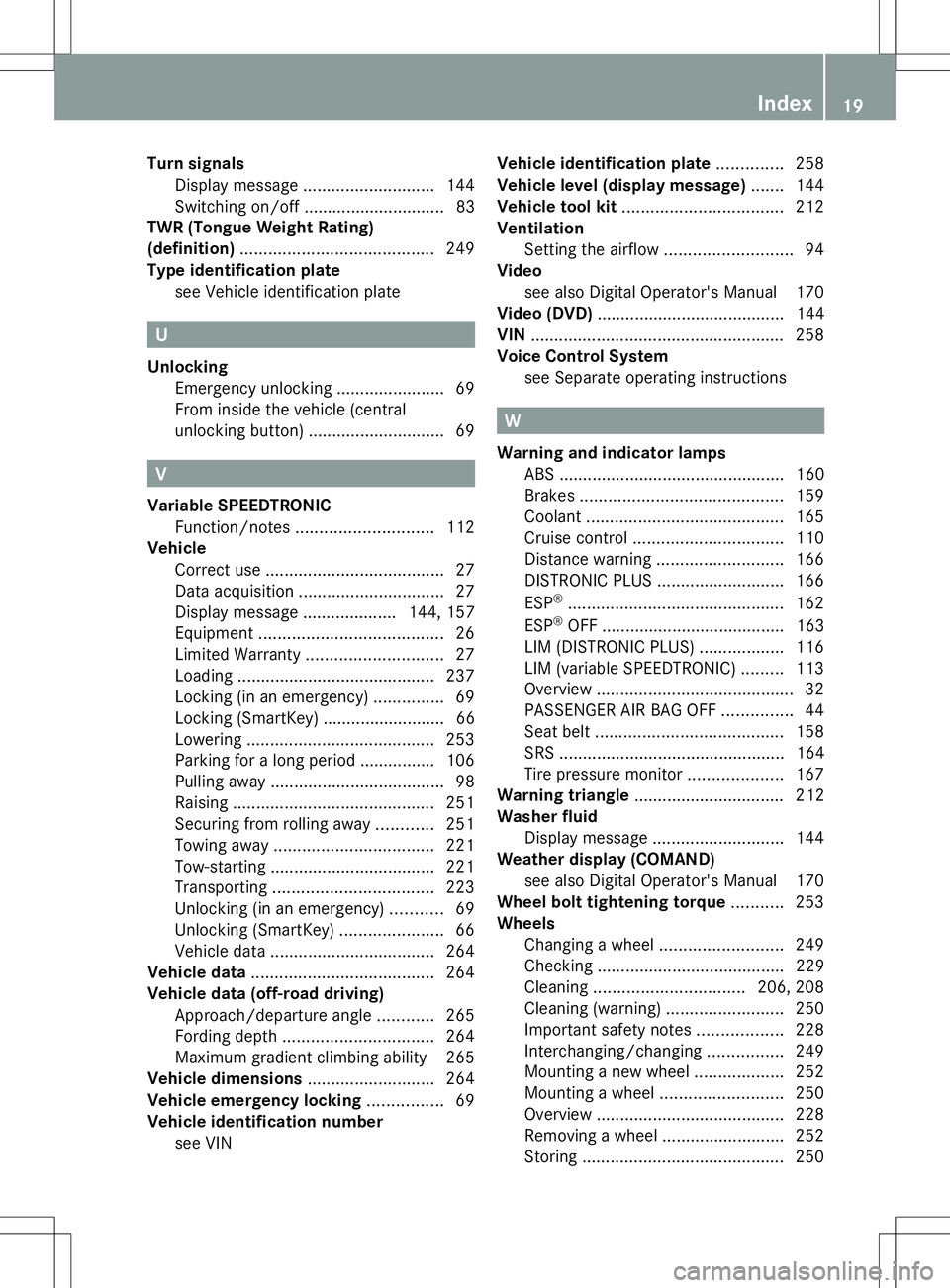
Turn signals
Display message ............................ 144
Switching on/off .............................. 83
TWR (Tongue Weight Rating)
(definition) ......................................... 249
Type identification plate see Vehicle identification plate U
Unlocking Emergency unlocking .......................69
From inside the vehicle (central
unlocking button) ............................. 69 V
Variable SPEEDTRONIC Function/notes ............................. 112
Vehicle
Correct use ...................................... 27
Data acquisition ............................... 27
Display message .................... 144, 157
Equipment ....................................... 26
Limited Warranty ............................. 27
Loading .......................................... 237
Locking (in an emergency) ...............69
Locking (SmartKey) .......................... 66
Lowering ........................................ 253
Parking for a long period ................ 106
Pulling away ..................................... 98
Raising ........................................... 251
Securing from rolling away ............251
Towing away .................................. 221
Tow-starting ................................... 221
Transporting .................................. 223
Unlocking (in an emergency) ...........69
Unlocking (SmartKey) ......................66
Vehicle data ................................... 264
Vehicle data ....................................... 264
Vehicle data (off-road driving) Approach/departure angl e............ 265
Fording depth ................................ 264
Maximum gradient climbing ability 265
Vehicle dimensions ...........................264
Vehicle emergency locking ................69
Vehicle identification number see VIN Vehicle identification plate
..............258
Vehicle level (display message) .......144
Vehicle tool kit .................................. 212
Ventilation Setting the airflow ........................... 94
Video
see also Digital Operator's Manual 170
Video (DVD) ........................................ 144
VIN ...................................................... 258
Voice Control System see Separate operating instructions W
Warning and indicator lamps ABS ................................................ 160
Brakes ........................................... 159
Coolant .......................................... 165
Cruise control ................................ 110
Distance warning ........................... 166
DISTRONIC PLUS ........................... 166
ESP ®
.............................................. 162
ESP ®
OFF ....................................... 163
LIM (DISTRONIC PLUS) ..................116
LIM (variable SPEEDTRONIC )......... 113
Overview .......................................... 32
PASSENGER AIR BAG OFF ...............44
Seat belt ........................................ 158
SRS ................................................ 164
Tire pressure monitor ....................167
Warning triangle ................................ 212
Washer fluid Display message ............................ 144
Weather display (COMAND)
see also Digital Operator's Manual 170
Wheel bolt tightening torque ...........253
Wheels Changing a wheel .......................... 249
Checking ........................................ 229
Cleaning ................................ 206, 208
Cleaning (warning) .........................250
Important safety notes ..................228
Interchanging/changing ................249
Mounting a new wheel ...................252
Mounting a wheel .......................... 250
Overview ........................................ 228
Removing a wheel ..........................252
Storing ........................................... 250 Index
19
Page 27 of 272
Protection of the environment
General notes
H
Environmental note
Daimler's declared policy is one of
comprehensive environmental protection.
The objectives are for the natural resources
that form the basis of our existence on this
planet to be used sparingly and in a manner
that takes the requirements of both nature
and humanity into account.
You too can help to protect the environment
by operating your vehicle in an
environmentally responsible manner.
Fuel consumption and the rate of engine,
transmission, brake and tire wear are affected
by these factors:
R operating conditions of your vehicle
R your personal driving style
You can influence both factors. You should
bear the following in mind:
Operating conditions:
R avoid short trips as these increase fuel
consumption.
R always make sure that the tire pressures
are correct.
R do not carry any unnecessary weight.
R remove roof racks once you no longer need
them.
R a regularly serviced vehicle will contribute
to environmental protection. You should
therefore adhere to the service intervals.
R always have service work carried out at a
qualified specialist workshop.
Personal driving style:
R do not depress the accelerator pedal when
starting the engine.
R do not warm up the engine when the vehicle
is stationary.
R drive carefully and maintain a safe distance
from the vehicle in front.
R avoid frequent, sudden acceleration and
braking. R
change gear in good time and use each gear
only up to Ôof its maximum engine speed.
R switch off the engine in stationary traffic.
R keep an eye on the vehicle's fuel
consumption. Genuine Mercedes-Benz parts
H
Environmental note
Daimler AG also supplies reconditioned major
assemblies and parts which are of the same
quality as new parts. They are covered by the
same Limited Warranty entitlements as new
parts.
! Air bags and Emergency Tensioning
Devices, as well as control units and
sensors for these restraint systems, may be
installed in the following areas of your
vehicle:
R doors
R door pillars
R door sills
R seats
R cockpit
R instrument cluster
R center console
Do not install accessories such as audio
systems in these areas. Do not carry out
repairs or welding. You could impair the
operating efficiency of the restraint
systems.
Have aftermarket accessories installed at
a qualified specialist workshop.
You could jeopardize the operating safety of
your vehicle if you use parts, tires and wheels
as well as accessories relevant to safety
which have not been approved by Mercedes.
This could lead to malfunctions in safety-
relevant systems, e.g. the brake system. Use
only genuine Mercedes-Benz parts or parts of
equal quality. Only use tires, wheels and Introduction
25 Z
Page 43 of 272
Air bags
Important safety notes G
WARNING
Air bags are designed to reduce the potential
of injury and fatality in certain
R frontal impacts (front air bags)
R side impacts (window curtain air bags)
However, no system available today can
completely eliminate injuries and fatalities.
Deployment of the air bags temporarily
releases a small amount of dust from the air
bags. This dust, however, is neither harmful
to your health, nor does it indicate a fire in the
vehicle. The dust might cause some
temporary breathing difficulty for people with
asthma or other breathing trouble. To avoid
this, you may wish to get out of the vehicle as
soon as it is safe to do so. If you have any
breathing difficulty but cannot get out of the
vehicle after the air bag inflates, then get fresh
air by opening a window or door. G
WARNING
To reduce the risk of injury when the front air
bags inflate, it is very important for the driver
and front passenger to always be in a properly
seated position and to wear their respective
seat belt.
For maximum protection in the event of a
collision always be in normal seated position
with your back against the seat backrest.
Fasten your seat belt and make sure it is
properly positioned on your body. Since the air bag inflates with considerable
speed and force, a proper seating position
and correct positioning of the hands on the
steering wheel will help to keep you at a safe
distance from the air bag. Occupants who are
not wearing their seat belt, are not seated
properly or are too close to the air bag can be
seriously injured or killed by an air bag as it
inflates with great force instantaneously:
R
Sit with the seat belt properly fastened in a
position that is as upright as possible with
your back against the seat backrest.
R Move the driver's seat as far back as
possible, still permitting proper operation
of vehicle controls. The distance from the
center of the driver's chest to the center of
the air bag cover on the steering wheel
must be at least 10 inches (25 cm) or more.
You should be able to accomplish this by
adjusting the seat and steering wheel. If
you have any difficulties, please contact an
authorized Mercedes-Benz Center.
R Do not lean your head or chest close to the
steering wheel or dashboard.
R Keep hands on the outside of the steering
wheel rim. Placing hands and arms inside
the rim can increase the risk and potential
severity of hand/arm injury when the driver
front air bag inflates.
R Adjust the front passenger seat as far as
possible rearward from the dashboard
when the seat is occupied.
R Occupants, especially children, should
never place their bodies or lean their heads
in the area of the door where the window
curtain air bag inflates. This could result in
serious injuries or death should the window
curtain air bag be deployed. Always sit as
upright as possible, wear the seat belt
properly and use an appropriately sized
infant restraint, toddler restraint, or
booster seat recommended for the size and
weight of the child.
R Children 12 years old and under must never
ride in the front seat, except in a Mercedes-
Benz authorized BabySmart™ compatible Occupant safety
41Safety
Z
Page 44 of 272
child seat, which operates with the
BabySmart™ air bag deactivation system
installed in the vehicle to deactivate the
front passenger front air bag when it is
installed properly. Otherwise they will be
struck by the air bag when it inflates in a
crash. If this happens, serious or fatal injury
will result.
Failure to follow these instructions can result
in severe injuries to you or other occupants.
If you sell your vehicle, it is important that you
make the buyer aware of this safety
information. Be sure to give the buyer this
Operator's Manual. G
WARNING
Accident research shows that the safest place
for children in an automobile is in a rear seat.
Should you choose to place a child 12 years
old or under in the front passenger seat of
your vehicle, you must properly use a
BabySmart TM
child restraint which will turn off
the front passenger front air bag.
To help avoid the possibility of injury, please
follow these guidelines:
(1) Always sit as upright as possible, wear the seat belt properly, and for
children 12 years old and under,
use an appropriately sized infant
restraint, toddler restraint, or
booster seat recommended for the
size and weight of the child.
(2) Always wear seat belts properly. G
WARNING
The service life of the air bag is limited to 15
years. After a maximum of 15 years, have the
air bag replaced at a qualified specialist
workshop that has the necessary specialist
knowledge and tools to carry out the work
required. Mercedes-Benz recommends that
you use an authorized Mercedes-Benz Center
for this purpose. In particular, work relevant to safety or on
safety-related systems must be carried out at
a qualified specialist workshop.
The air bags are deployed if the air bag control
unit detects the need for deployment. Only in
the event of such a situation will the air bags
provide their supplemental protection.
If the driver and front passenger do not wear
their seat belts, it is not possible for the air
bags to provide their supplemental
protection.
In the event of other types of impacts and
impacts below air bag deployment
thresholds, the air bags will not deploy. The
driver and passenger will then be protected
to the extent possible by a properly fastened
seat belt. A properly fastened seat belt is also
needed to provide the best possible
protection if the vehicle rolls over.
Air bags provide additional protection; they
are not, however, a substitute for seat belts.
All vehicle occupants must fasten their seat
belts regardless of whether your vehicle is
equipped with air bags or not.
It is important for your safety and that of your
passenger to have deployed air bags replaced
and to have any malfunctioning air bags
repaired. This will help to make sure the air
bags continue to provide supplemental crash
protection for occupants.
Front air bags G
WARNING
Observe "Important safety notes"
(Y page 41). G
WARNING
Your vehicle is equipped with air bag
technology which disables the front-
passenger air bag if the system recognizes
that the front-passenger seat is empty .
If the front-passenger seat is occupied by an
adult or young person and the 4/
indicator lamp is lit up, the front-passenger air 42
Occupant safetySafety
Page 46 of 272
This indicates the operational readiness of
the front-passenger air bag.
Note that objects placed on the front-
passenger seat may cause the system to
recognize the seat as occupied. This can
result in the deployment of the front-
passenger air bag if the impact fulfills the
specified criteria. If the 45indicator
lamp lights up, the front-passenger front air
bag is disabled and will not be deployed in
certain situations. If the 45indicator
lamp does not light up, the front-passenger
front air bag is enabled and can be deployed.
Window curtain air bags G
WARNING
Observe "Important safety notes"
(Y page 41). Window curtain air bags
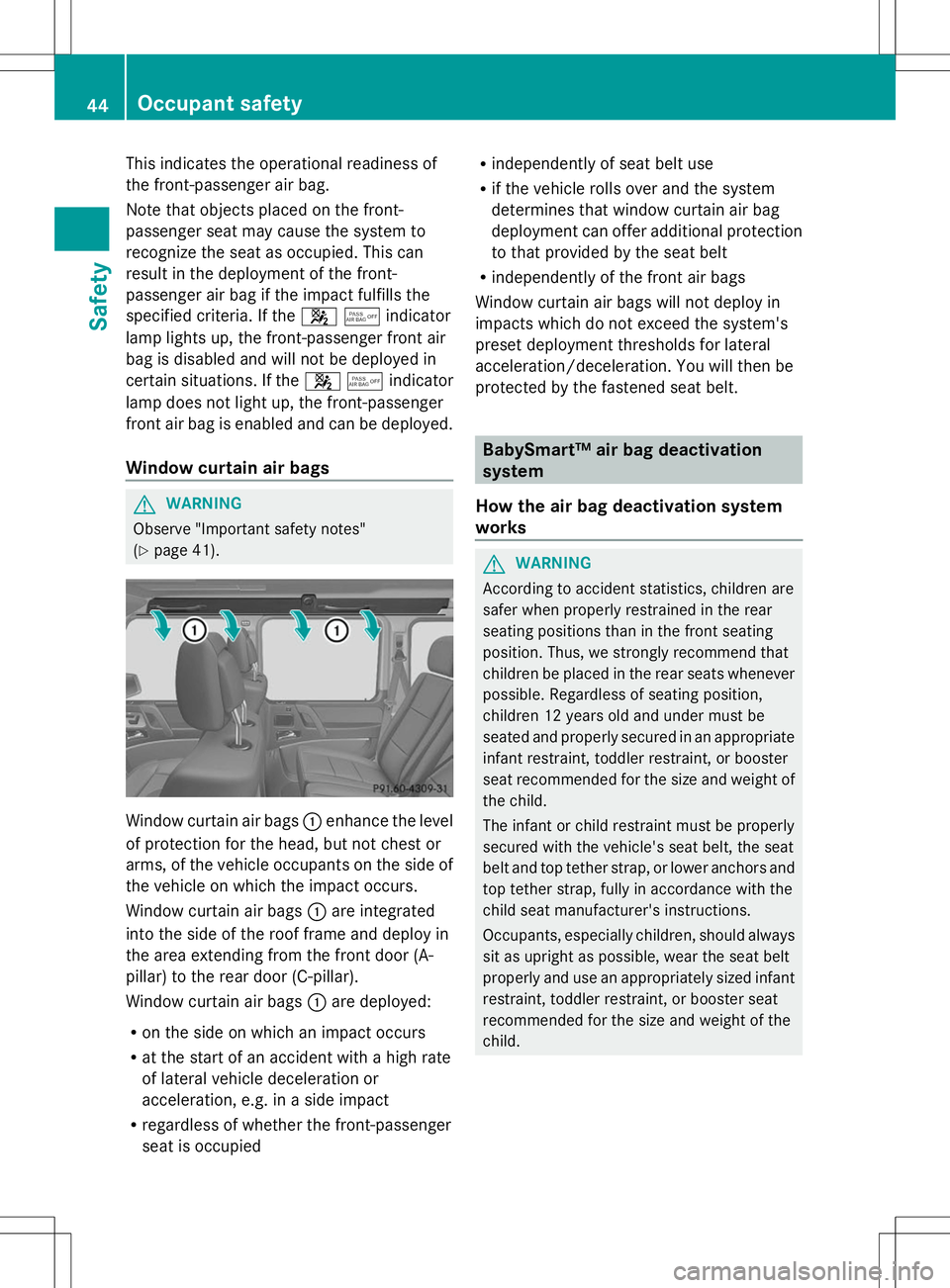
:enhance the level
of protection for the head, but not chest or
arms, of the vehicle occupants on the side of
the vehicle on which the impact occurs.
Window curtain air bags :are integrated
into the side of the roof frame and deploy in
the area extending from the front door (A-
pillar) to the rear door (C-pillar).
Window curtain air bags :are deployed:
R on the side on which an impact occurs
R at the start of an accident with a high rate
of lateral vehicle deceleration or
acceleration, e.g. in a side impact
R regardless of whether the front-passenger
seat is occupied R
independently of seat belt use
R if the vehicle rolls over and the system
determines that window curtain air bag
deployment can offer additional protection
to that provided by the seat belt
R independently of the front air bags
Window curtain air bags will not deploy in
impacts which do not exceed the system's
preset deployment thresholds for lateral
acceleration/deceleration. You will then be
protected by the fastened seat belt. BabySmart™ air bag deactivation
system
How the air bag deactivation system
works G
WARNING
According to accident statistics, children are
safer when properly restrained in the rear
seating positions than in the front seating
position. Thus, we strongly recommend that
children be placed in the rear seats whenever
possible. Regardless of seating position,
children 12 years old and under must be
seated and properly secured in an appropriate
infant restraint, toddler restraint, or booster
seat recommended for the size and weight of
the child.
The infant or child restraint must be properly
secured with the vehicle's seat belt, the seat
belt and top tether strap, or lower anchors and
top tether strap, fully in accordance with the
child seat manufacturer's instructions.
Occupants, especially children, should always
sit as upright as possible, wear the seat belt
properly and use an appropriately sized infant
restraint, toddler restraint, or booster seat
recommended for the size and weight of the
child. 44
Occupant safetySafety
Page 47 of 272
Children can be killed or seriously injured by
an inflating air bag. Note the following
important information when circumstances
require you to place a child in the front
passenger seat:
R Children 12 years old and under must never
ride in the front seat, except in a Mercedes-
Benz authorized BabySmart™ compatible
child seat, which operates with the
BabySmart™ system installed in the vehicle
to deactivate the front passenger front air
bag when it is installed properly. Otherwise
they will be struck by the air bag when it
inflates in a crash. If this happens, serious
or fatal injury will result.
R A child in a rear-facing child restraint on the
front passenger seat will be seriously
injured or even killed if the front passenger
front air bag inflates in a collision which
could occur under some circumstances,
even with the air bag technology installed
in your vehicle. The only means to
completely eliminate this risk is to never
place a child in a rear-facing child restraint
in the front seat. We therefore strongly
recommend that you always place a child
in a rear-facing child restraint in a backseat.
R If you must install a BabySmart™
compatible rear-facing child restraint on
the front passenger seat because
circumstances require you to do so, make
sure the 4/indicator lamp is
illuminated, indicating that the front
passenger front air bag is deactivated.
Should the 4/indicator lamp not
illuminate or go out while the restraint is
installed, please check installation.
Periodically check the 4/indicator
lamp while driving to make sure the
4/indicator lamp is illuminated. If
the 4/indicator lamp goes out or
remains out, do not transport a child on the
front passenger seat until the system has
been repaired.
A child in a rear-facing child restraint on the
front passenger seat will be seriously injured or even killed if the front passenger
front air bag inflates.
R If you have to place a child in a forward-
facing child restraint on the front passenger
seat, move the seat as far back as possible,
use the proper child restraint
recommended for the age, size and weight
of the child, and secure child restraint with
the vehicle's seat belt according to the
child seat manufacturer's instructions. G
WARNING
When using a BabySmart™ compatible child
seat on the front passenger seat, the front
passenger front air bag will not deploy only if
the 4/indicator lamp remains
illuminated.
Please be sure to check the 4/
indicator lamp every time you use a
BabySmart™ compatible child seat on the
front passenger seat. Should the 4/
indicator lamp go out while the restraint is
installed, please check installation. If the
4/indicator lamp remains out, do not
use the BabySmart™ restraint to transport a
child on the front passenger seat until the
system has been repaired. G
WARNING
The BabySmart™ air bag disabling system
ONLY works with specially adapted child
restraint systems. It does not work with child
restraint systems that are not compatible with
BabySmart™.
Never place anything between the seat
cushion and the child restraint system (e.g. a
cushion), as this reduces the effectiveness of
the BabySmart™ air bag deactivation system.
The underside of the child restraint system
must lie against the seat cushion of the front-
passenger seat. In the event of an accident,
an incorrectly installed child restraint system
could injure the child instead of offering
protection. Occupant safety
45Safety
Z
Page 49 of 272
Problems with the air bag deactivation system
G
WARNING
If the 45 indicator lamp illuminates and remains illuminated when the weight of a typical
adult or someone larger than a small individual has been detected on the passenger seat, do not
allow any occupant to use the passenger seat until the system has been repaired. Problem Possible causes/consequences and
M MSolutions The
45
indicator lamp is
continuously lit. A special BabySmart™-compatible child restraint system is
mounted on the front-passenger seat.
The front-passenger air bag is therefore disabled.
There is no BabySmart™-compatible child restraint system
mounted on the front-passenger seat. The BabySmart™ system is
malfunctioning.
X
Have the BabySmart™ system checked as soon as possible at
an authorized Mercedes-Benz Center. The
45
indicator lamp does not
light up and/or remain
lit when a BabySmart™-
compatible child
restraint system is
installed on the front-
passenger seat. The BabySmart™ system is malfunctioning.
X
Make sure there is nothing between the seat cushion and the
child restraint system.
X Check that the child restraint system is installed correctly.
X If the 45 indicator lamp does not light up, have the
BabySmart™ system checked as soon as possible at an
authorized Mercedes-Benz Center.
Do not transport a child on the front-passenger seat until the
air bag deactivation system has been repaired. Seat belts
Important safety notes Mercedes-Benz recommends that you only
use seat belts which have been approved
specifically for your vehicle by Mercedes-
Benz. G
WARNING
Always fasten your seat belt before driving off.
Always make sure all of your passengers are
properly restrained. You and your passengers
should always wear seat belts.
Failure to wear and properly fasten and
position your seat belt greatly increases your risk of injuries and their likely severity in an
accident.
If you are ever in an accident, your injuries can
be considerably more severe without your
seat belt properly buckled. Without your seat
belt buckled, you are much more likely to hit
the interior of the vehicle or be ejected from
it. You can be seriously injured or killed.
In the same crash, the possibility of injury or
death is lessened if you are properly wearing
your seat belt. The air bags can only protect
as intended if the occupants are properly
wearing their seat belts. Occupant safety
47Safety Z