light MERCEDES-BENZ G-CLASS SUV 2016 User Guide
[x] Cancel search | Manufacturer: MERCEDES-BENZ, Model Year: 2016, Model line: G-CLASS SUV, Model: MERCEDES-BENZ G-CLASS SUV 2016Pages: 261, PDF Size: 6.01 MB
Page 27 of 261
about possible vehicle damage
.Damage to
your vehicle that arise sfromc ulpable contra-
ventions against these instruction sare not
covered either by Mercedes-Ben zimplied
warrant yorbyt heNew or Used-Vehicle War-
ranty. QR code for rescu
ecards
The QR code is secured in the fuel filler flap and
on the opposite side on the B-pillar. In the event of an accident ,rescue services can use the QR
code to quickly find the appropriate rescue card
for your vehicle. The curren trescue card con-
tains, in acompact form, the most important
information about your vehicle, e.g. the routing
of the electric cables.
You can find more information under
www.mercedes-benz.de/qr-code. Data stored in the vehicle
Many of the ele ctroniccom ponent sinyour vehi-
cl ec an stor edata.
These dat amemories temporarily or perma-
nently stor etechnic al information about:
R thev ehicle' soperatin gstate
R events
R faults
In general, this technical information docu-
ments th estate ofac om ponent ,amodule, a
syste mort hesurroundings.
These include, fo rexample:
R operatin gconditi onsofs ystemcomponent s–
fo re xample, flui dlevels
R status messages concernin gthe vehicle and
it si nd ividual component s–forexample,
whee lrotationa lspeed, vehicle speed, decel-
eration in movement, latera lacceleration,
accelerator peda lposition
R malfunction sand defects in important system
components, fo rexample, lights ,brakes
R vehicle reaction sand operatin gconditi onsin
special drivin gsituation s–forexample, air-
bag deployment, intervention of stability con-
trol systems
R ambien tconditi ons–f orexample, outside
temperature These dat
aare of an exclusively technical nature
and can be used to:
R assist in detecting and rectifying faults and
defects
R analyse vehicle functions, e.g. after an acci-
dent
R optimise vehicle functions
The data cannot be used to trace the vehicle's
movements.
When your vehicle is serviced, technical infor-
mation can be read from the event data memory
and fault data memory.
Services include, for example:
R repair services
R service processes
R warranty events
R quality assurance
The information is read out by employees of the service network (including the manufacturer)
using special diagnostic testers. You can obtain more information there, if required.
After afault has been rectified, the information
is deleted from the fault memory or is continu-
ally overwritten.
During vehicle operation, certain situations may
arise in which these technical data –inconjunc-
tion with other information and, if applicable,
after consultation with an approved assessor –
may be linked to an individual person.
Examples include:
R accident reports
R damage to the vehicle
R witness statements
Further additional functions that have been con-
tractually agreed upon with the customer allow
certain vehicle data to be conveyed by the vehi-
cle as well. The additional functions include, for example, vehicle location in the event of an
emergency. Copyright info
rmation
Information on licences for free and open-
source softwar eused in your vehicle can be
foun dont hedat acarrier in your vehicle docu-
men twallet and ,includin gupdates, on th efol-
lowin gwebsite:
http://www.mercedes-benz.com/opensource 24
Introduction
Page 28 of 261
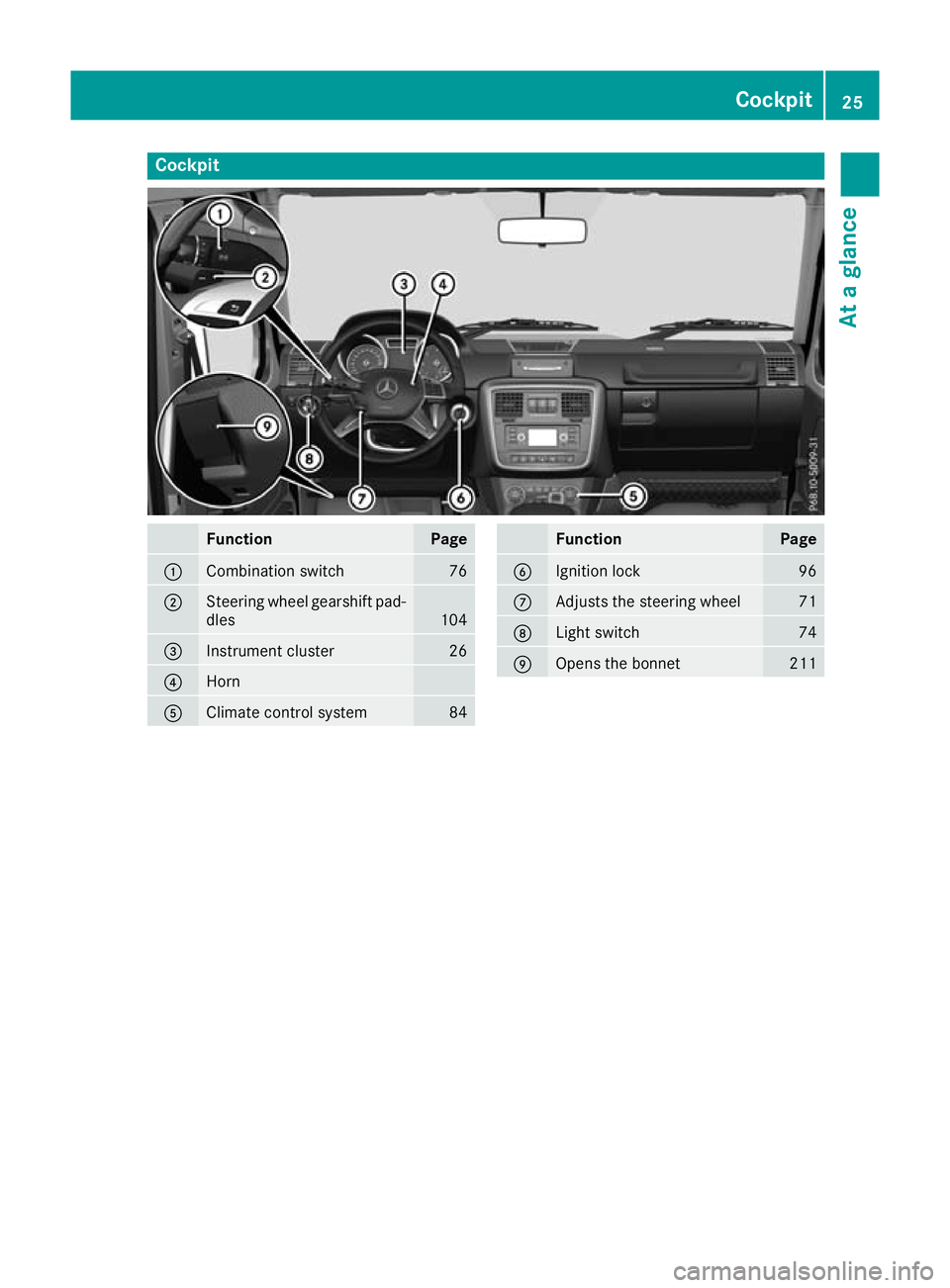
Cockpit
Function Page
:
Combination switch 76
;
Steerin
gwheel gearshift pad-
dles 104
=
Instrument cluster 26
?
Horn
A
Climate control system 84 Function Page
B
Ignition lock 96
C
Adjusts the steering wheel 71
D
Light switch 74
E
Open
sthe bonnet 211Cockpit
25Atag lance
Page 29 of 261
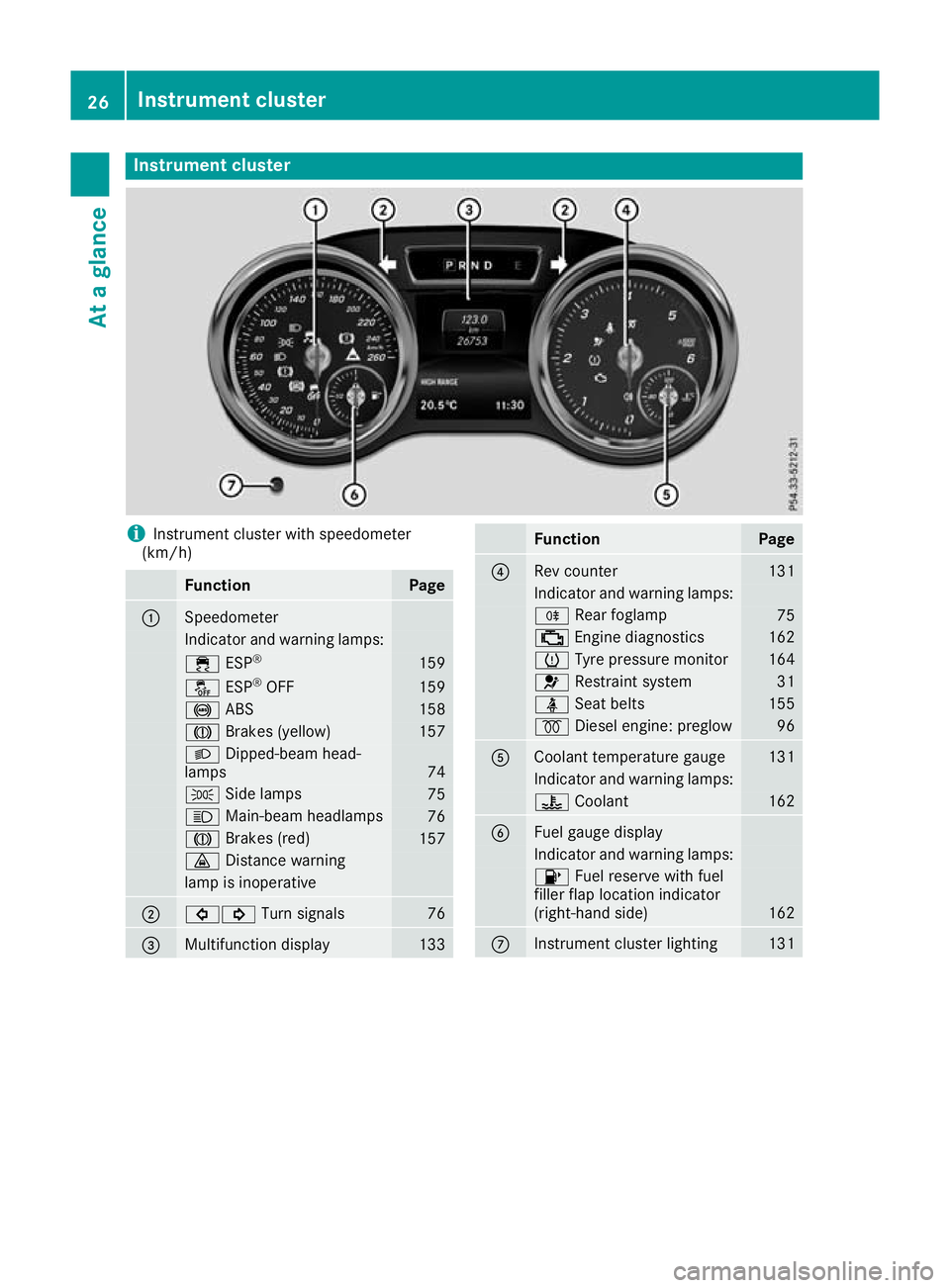
Instrumen
tcluster i
Instrument cluste
rwith speedometer
(km/h) Function Page
:
Speedometer
Indicator and warning lamps:
÷
ESP® 159
å
ESP®
OFF 159
!
ABS 158
J
Brakes (yellow) 157
L
Dipped-bea mhead-
lamps 74
T
Sidelam ps 75
K
Main-beam headlamps 76
J
Brakes(red) 157
·
Distance warning lamp is inoperative
;
#!
Turn signals 76
=
Multifunctio
ndisplay 133 Function Page
?
Rev counter 131
Indicato
rand warning lamps: R
Rear foglamp 75
;
Engine diagnost ics 162
h
Tyre pressure monitor 164
6
Restraint system 31
ü
Seat belts 155
%
Diesel engine: preglow 96
A
Coolant temperature gauge 131
Indicator and warning lamps:
?
Coolant 162
B
Fuel gaug
edisplay Indicator and warnin
glamps: 8
Fuel reserve with fuel
filler flap location indicator
(right-hand side) 162
C
Instrument cluster lighting 13126
Instrument clusterAt
ag lance
Page 32 of 261
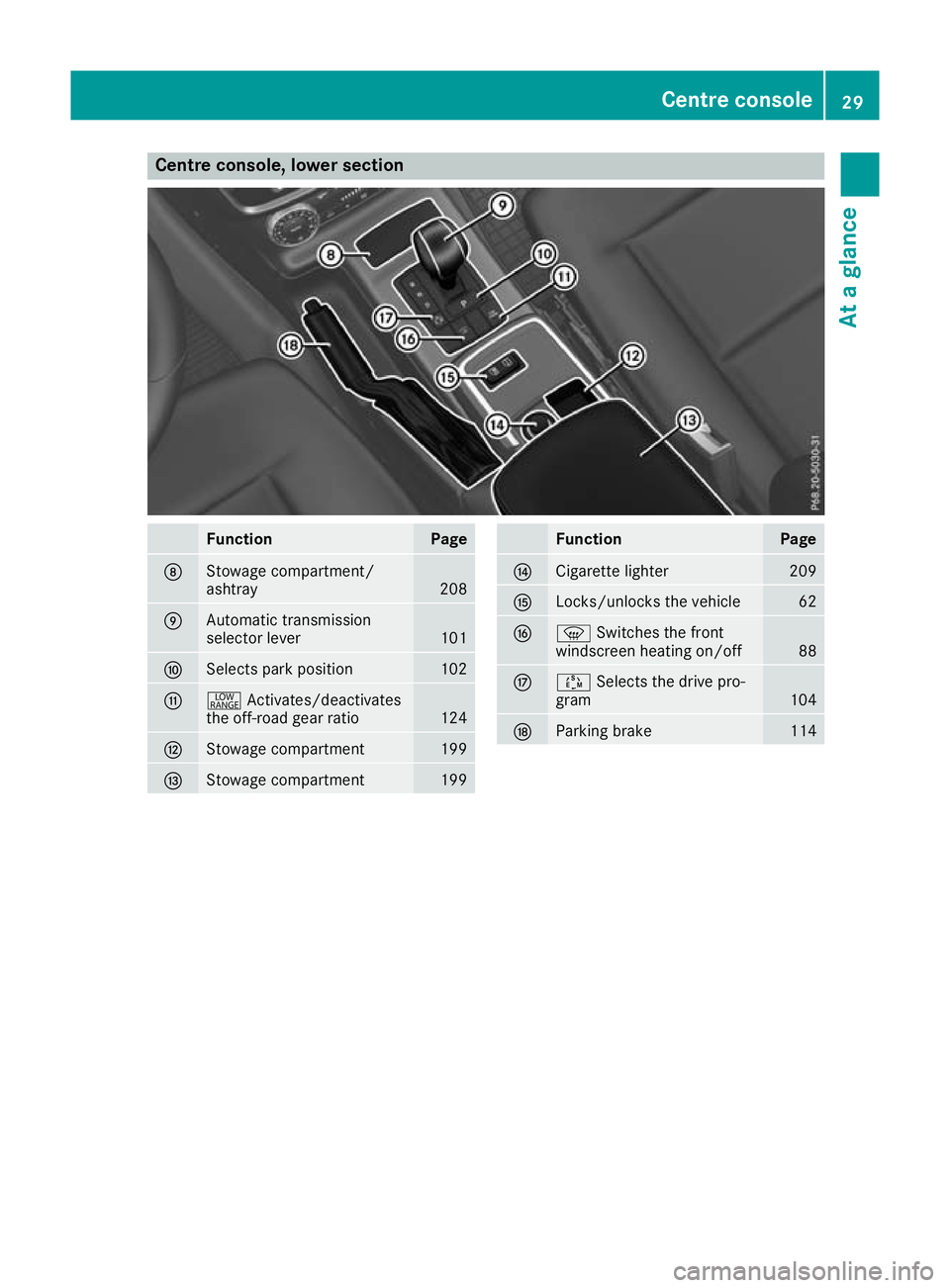
Centre console, lower section
Function Page
D
Stowage compartment/
ashtray
208
E
Automati
ctransmission
selecto rlev er 101
F
Selects park position 102
G
+
Activates/deactivates
the off-roa dgearratio 124
H
Stowage compartment 199
I
Stowage compartment 199 Function Page
J
Cigarette lighter 209
K
Locks/unlock
sthe vehicle 62
L
z
Switches the front
windscreen heating on/off 88
M
Ú
Selects the drive pro-
gram 104
N
Parkin
gbrake 114Centrec
onsole
29Atag lance
Page 33 of 261

Overhea
dcontrol panel Function Page
:
p
Switches the left-hand reading lamp on/off 77
;
c
Switches the front interior lighting on 77
=
u
Switches the luggage compartment/rear interior lighting
on/off 77
?
|
Switches the front interior lighting/automatic interior
lighting contro loff 77
A
p
Switches the right-hand reading lamp on/off 77
B
¡
Opens/closes the sliding sunroof 65
C
Rear-view mirror 7330
Overhead contro
lpan elAt ag lance
Page 34 of 261
Occupant safety
Introduction to the restraint system
The restraint system can reduce the risk of vehi- cle occupant scom ingi ntoc ontac twithp artsof
th ev ehicle's interio rintheevent of an accident.
The restrain tsystem can also reduce th eforces
to whic hvehicl eoccupant sare subjecte dduring
an accident.
The restrain tsystem includes the:
R seat belt system
R airbags
R child restrain tsystem
R child seat securin gsystem
The component softherestrain tsystem wor kin
conjunction wit heacho ther.T hey can only offer
protection if all vehicl eoccupant salways:
R have th eseat belt correctl yfastened
(Y page 33)
R have th eseat and head restrain tadjusted
properly (Y page 67)
As th edriver, you must also mak esuret hatthe
steering whee lisalso adjusted properly.
Observ ethe information on th ecorrect driver's
seat position (Y page 67).
In addition ,you must mak esuret ha tthe airbags
can inflat eproperly if they are deployed
(Y page 36).
An airbag supplement sacorrectly wornseat
belt .Asana dditional safet ydevice ,the airbag
increases th elevel of protection for vehicle
occupant sintheevent of an accident. The air-
bags are no tdeployed, for example, in th eevent
of an acciden tinwhichs ufficien tprotection is
offere dbytheseat belt .Inaddition ,onlyt ho se
airbags, whic hintheapplicable acciden tsitua-
tion soffer additional protection ,are deployed in
th ee vent of an accident. However, th eseat belt
and airbag generally do no tprotect against
objects penetrating th evehicl efromt heout-
side.
Information on how th erestrain tsystem oper-
ate scan be foun dunder "Deploymen tofbelt
tensioners and airbags" (Y page 37).
Se e" Children in th evehicle" for information on
children travellin gwithy ou in th evehicl easw ell
as on child restrain tsystems (Y page 38). Important safety notes
G
WARNING
If th erestraint system is modified, it may no
longer work as intended. The restraint system
may then not perform its intended protective function by failing in an accident or triggering
unexpectedly,f or example. There is an
increased risk of injury ,possibly even fatal.
Never modify parts of the restraint system. Do not attempt to modify the wiring as wellas
electronic components or their software.
If it is necessary to adjust the vehicl etoaccom-
modate aperso nwith disabilities, contact a
qualified specialist workshop. Mercedes-Benz
recommends that you use aMercedes-Benz
Service Centre for this. Restraint system warnin
glamp
The functions of the restraint system are
checke dafterthe ignition is switched on and at
regular interval swhile the engine is running.
Therefore, malfunctions can be detected in
goo dtime.
The 6 restraint system warning lamp on the
instrument cluster lights up when the ignition is switched on. It goe soutno later than afew sec-
onds afte rthe vehicl eisstarted. The compo-
nents of the restraint system are in operational
readiness.
Am alfunction ha soccurred if the 6restraint
system warning lamp:
R doe snot light up afte rthe ignition is switched
on
R doe snot go ou tafte raf ew seconds with the
engine running
R lights up agai nwhile the engine is running G
WARNING
If the restra ints ystem is malfunctioning,
restraint system components may be trig-
gered unintentionally or may not deploy as
intended during an accident. This may affect
the seat beltt ensioner or airbag, for example.
This poses an increased risk of injury or even
fatal injury. Occupant safety
31Safety
Z
Page 39 of 261
can no longer fulfil thei
rprotective function
and mus tbereplaced. Visit aquali fied spe-
cialist workshop.
X Press release button in bel tbuckle, hol dbelt
tongu efirmly and guid ethe sea tbeltb ack.
Seat belt warnin gfor the drive rand
front-passenger The
7 seatbelt warning lamp in the instru-
ment cluster is areminder that all vehicle occu-
pants must wear their seat belts. It may light up
continuously or flash. In addition, awarning tone
may sound.
The 7 seat belt warning lamp goes out and
the warning tonec eases when the driver and the
front passenger have fastened their seat belts. Airbags
Introduction The installation location of an airbag is identified
by the AIRBA Gsymbol.
An airbag supplements acorrectly worn seat
belt. It is not areplacement for the seat belt. The
airbag offers additional protection in corre-
sponding accident situations.
Not all airbags are deployed in an accident .The
different airbag systems work independently of
each other (Y page 37).
However, no system availabl etoday can com-
pletely eliminate injuries and fatalities.
It is also not possible to completely rule out a
risk of injury caused by an airbag due to the
speed at which the airbag must be deployed.
Important safety notes G
WARNING
If you deviate from the correct seat position,
the airbag canno tperform its intended pro-
tective function and can even caus eaddi-
tional injurie swhen deployed. There is an
increased risk of serious or even fatal injuries. In order to avoid such risks, always ensure
that all vehicle occupants:
R fasten their seatbelts correctly, including
pregnant women
R are seated correctly and maintain the fur-
thest possible distance from the airbags
R observe the following notes
Alway sensure that there are no objects loca-
ted betwee nthe airbag and the vehicle occu-
pant.
R Adjust the seats properl ybefore beginning
yourj ourney. Alwaysm ake sure that the seat
is in an almostu pright position. The head
restraint must be as close as possible to the
back of yourh ead.
R Move the driver's and front-passenger seats
as far back as possible. The driver's seat posi- tion must allow the vehicle to be driven safely.
R Hold the steering wheel only by the rim. This
allows the airbag to be fullyd eployed.
R Alwaysl eana gainst the backrest whiled riv-
ing. Do not leanf orwards. You may otherwise
be in the deployment area of the airbag.
R Alwaysk eep yourf eet in the footwell in front
of the seat. Do not put yourf eet on the dash-
board,f or example .Your feet may otherwise
be in the deployment area of the airbag.
R Alwayss ecure persons less than 1.50 mtall in
suitable restraint systems .Uptothish eight,
th es eat belt canno tbeworn correctly.
If ac hild is travelling in your vehicle, also
observe th efollowin gnotes:
R Always secure childre nunde rtwelve years of
age and less than 1.50 mtall in suitable child
restraint systems.
R Child restraint systems shoul dpreferabl ybe
fitte dtot herear seats.
R Secure achild to th efront-pa ssenger seat
only when th efront-pa ssenger fron tairbag is
disabled, and then only in arearward-facing
child restraint system. If th ePASSENG ER AIR
BA GO FFindicator lamp is permanently lit ,the
front-passenger fron tairbag is disabled
(Y page 32).
R Be sure to observ ethe instruction sand safety
note son" Children in th evehicle"
(Y page 38 )and on th e"Child restraint sys-
te mont hefront-passenger seat"
(Y page 43 )inaddition to th emanufactur- 36
Occupant safetySafety
Page 40 of 261
er's operatin
gand installation instructions for
the child restraint system.
Objects in the vehicle interior may prevent
the airba gfrom functioning correctly. Before
starting your journey and to avoid risks resulting from the speed of the airbag as it deploys, make
sure that:
R there are no people, animals or objects
between the vehicle occupant sand an airbag
R no accessories, such as cup holders, are
attached to the vehicle within the deployment
area of an airbag, e.g. to the steerin gwheel or
doors
R no heavy, sharp-edged or fragile objects are in
the pockets of your clothing. Store such
objects in asuitable place. G
WARNING
If you modify an airbag cove roraffix objects
such as stickers to it, the airbag can no longer function correctly. There is an increased risk
of injury.
Never modify an airbag cover or affix objects
to it.
Fron tairbags !
Do not place heavy objects on the front-
passenger seat. This could cause the system
to identif ythe seat as being occupied. In the
event of an accident, the restraint systems on the front-passenger side may be triggered
and have to be replaced. Driver's airbag
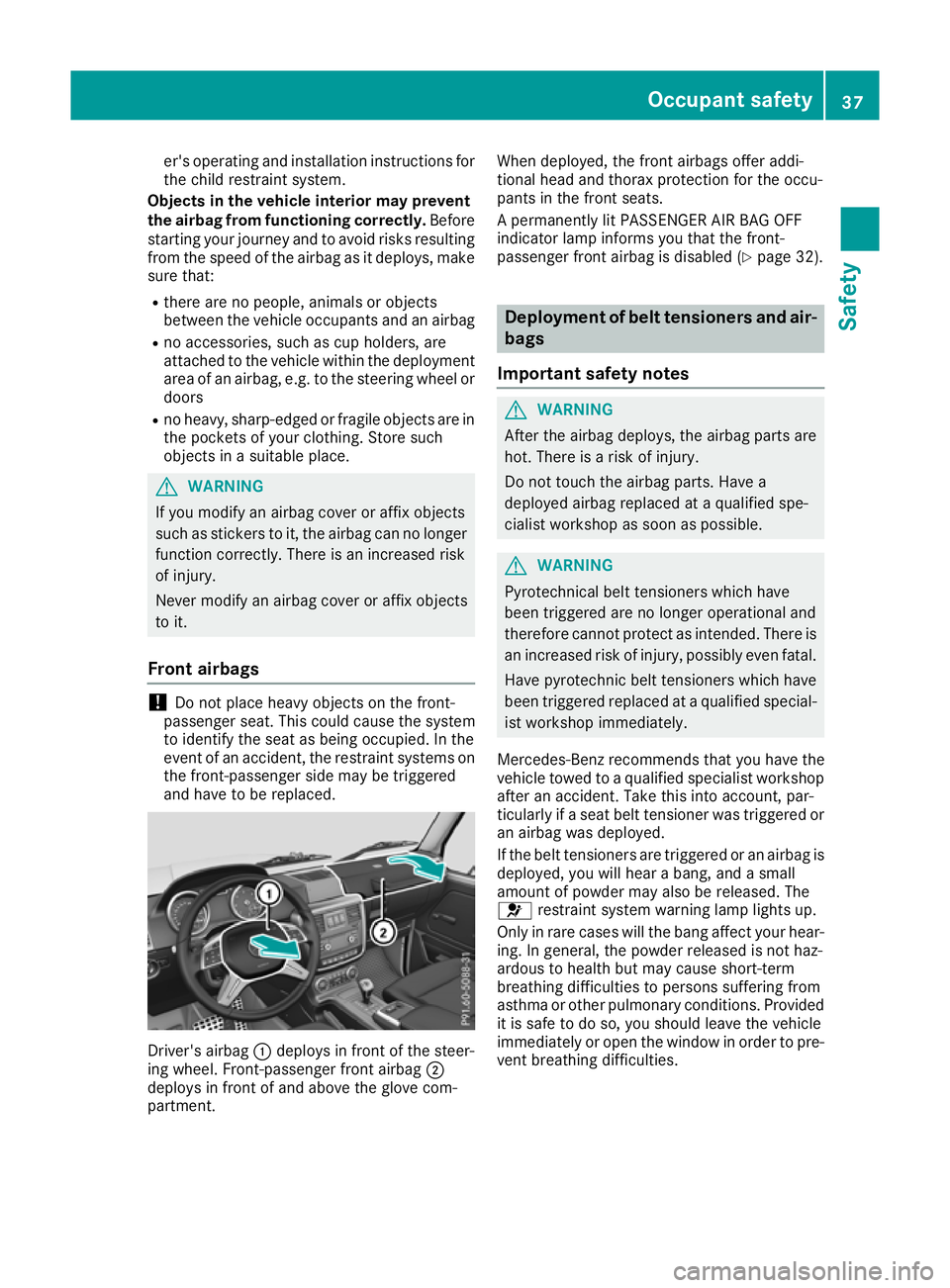
:deploysinf ront of the steer-
ing wheel. Front-passenge rfront airbag ;
deploy sinfront of and above the glove com-
partment. When deployed
,the fron tairbags offer addi-
tional head and thorax protection for the occu-
pants in the fron tseats.
Ap ermanently lit PASSENGE RAIR BAG OFF
indicator lamp inform syou that the front-
passenger fron tairbag is disabled (Y page 32). Deployment of beltt
ensioner sand air-
bags
Important safet ynotes G
WARNING
Afte rthe airbag deploys, the airbag parts are
hot. There is arisk of injury.
Do not touch the airbag parts. Have a
deployeda irbag replaced at aqualified spe-
cialist worksho passoon as possible. G
WARNING
Pyrotechnical beltt ensioners which have
been triggere dare no longer operational and
therefore cannot protect as intended. There is an increased risk of injury ,possibly even fatal.
Have pyrotechnic beltt ensioners which have
been triggere dreplaced at aqualified special-
ist worksho pimmediately.
Mercedes-Benz recommends that you have the
vehicl etowed to aqualified specialist workshop
after an accident. Take this into account, par-
ticularly if aseat beltt ensioner was triggere dor
an airbag was deployed.
If the beltt ensioners are triggere doranairbag is
deployed, you willh earabang, and asmall
amount of powder may alsober eleased.The
6 restraint system warning lamp lights up.
Only in rare cases willt he bang affect yourhear-
ing. In general, the powder released is not haz-
ardous to health but may caus eshort-term
breathing difficultie stopersons suffering from
asthma or other pulmonary conditions. Provided it is safe to do so, you should leave the vehicle
immediatel yoropen the windo winorder to pre-
vent breathing difficulties. Occupant safety
37Safety Z
Page 42 of 261
Mercedes-Ben
zstrongly advises that you install
the child restraint system on arear seat. Chil-
dren are generally better protected there.
If ac hild younger than twelve years old and
under 1.50 minh eight is travellin ginthe vehi-
cle:
R always secur ethe child in achild restraint
system suitable for Mercedes-Ben zvehicles.
The child restraint system must be appropri-
ate to the age, weight and size of the child.
R be sure to observe the instructions and safety
notes in this section in addition to the child
restraint system manufacturer' sinstallation
instructions. G
WARNING
If you leave children unattende dint he vehi-
cle, they may be abletos et the vehiclein
motion if, for example, they:
R release the parking brake
R shift the automatic transmission out of park
position P
R start the engine
In addition, they may operate vehicl eequip-
ment and become trapped. There is arisk of
an accident and injury.
When leaving the vehicle, alwayst ake the key
with you and lock the vehicle. Never leave
children unattended in the vehicle. G
WARNING
If persons (particularly children) are exposed
to heatorc old foraprolonged period, there is
ar isk of serious or even fatal injuries. Never
leave persons (particularly children) unatten-
ded in the vehicle. G
WARNING
If the child restraint system is placed in direct sunlight, the parts coul dbecome very hot.
Childre ncouldbes uffer burns by touching
these parts, in particular on the metallic parts
of the child restraint system. There is arisk of
injury.
If you and yourc hild leave the vehicle, always
make sure that the child restraint system is
not in direct sunlight. Cove ritwithablanket, for example. If the child restraint system has
been expose
dtodirect sunlight, leave it to
cool dow nbefore securing the child in it.
Never leave children unattende dinthe vehi-
cle.
Always ensure that all vehicl eoccupants have
their sea tbelts fastened correctly and are sitting
properly .Particular attention must be pai dto
children.
Observ ethe safety notes on the sea tbelt
(Y pag e32) and the information on the correct
use of the sea tbelt( Y pag e33). Chil
dseat lock G
WARNING
If th eseat beltisr eleased while driving, the
child restraint system willnol onger be
secure dproperly.T he child seat lock is disa-
bleda nd the inertia real draw sinaportion of
the seat belt. The seat beltc annot be imme-
diately refastened. There is an increased risk
of injury ,possibly even fatal.
Stop the vehicl eimmediately, paying atten-
tion to road and traffic conditions. Reactivate the child seat lock and secure the child
restraint system properly.
All seat belts except the driver's seat belta re
equipped with achild seat lock. When enabled,
the child seat lock function ensure sthat the seat
beltd oes not slacken once the child restraint
system is secured.
Installing achild restraint system:
X Always comply with the child restraint system
manufacturer's installation instructions.
X Pullt he seat belts moothly out of the belts ash
guide.
X Engage the seat beltt ongue in the beltbuckle.
Activating the child seat lock: X Pullt he seat belto ut fullyand let the inertia
reel retract it again.
Whil ethe seat beltisr etracting, you should
hear aratcheting sound .The child seat lock
function is enabled.
X Push the child seat restraint system downso
that the seat beltist ight and does not loosen. Children in the vehicle
39Safety Z
Page 45 of 261
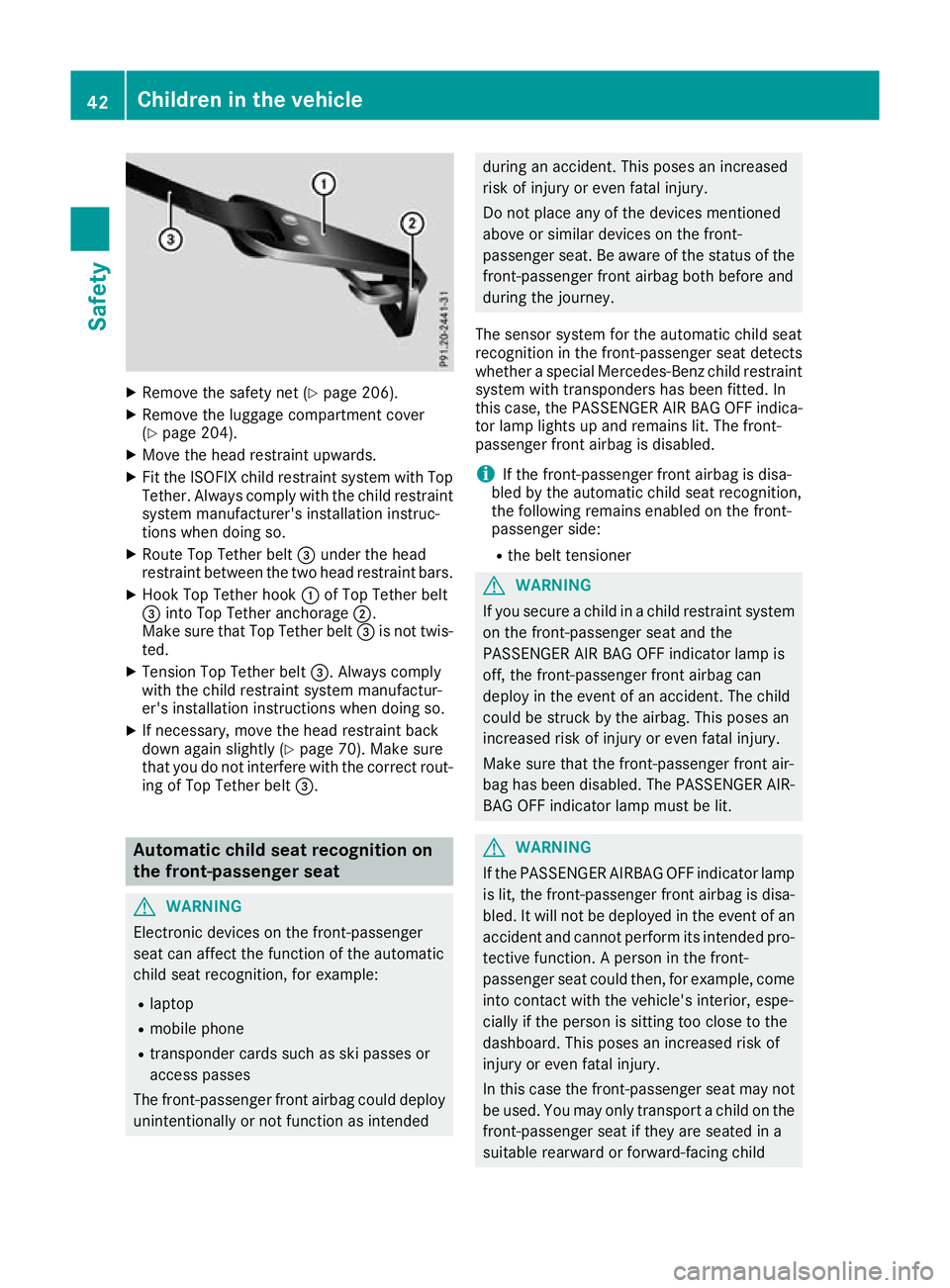
X
Remove th esafet ynet ( Ypage 206).
X Remove th eluggag ecom partmen tcover
(Y page 204).
X Mov ethe head restrain tupwards.
X Fit th eISOFI Xchild restrain tsystem wit hTop
Tether .Always comply wit hthe child restraint
system manufacturer' sinstallation instruc-
tion swhen doin gso.
X Rout eTop Tether belt =under th ehead
restrain tbetween th etwo head restrain tbars.
X Hook Top Tether hook :of Top Tether belt
= intoT op Tether anchorage ;.
Mak esuret hatT op Tether belt =is no ttwis-
ted.
X Tension Top Tether belt =.Always comply
wit hthe child restrain tsystem manufactur-
er' sinstallation instruction swhen doin gso.
X If necessary, mov ethe head restrain tback
down again slightly (Y page 70). Makesure
that you do no tinterfere wit hthe correc trout-
ing of Top Tether belt =.Automati
cchild sea trecognition on
th ef ront-passenger seat G
WARNING
Electronic device sonthe front-passenger
seat can affect the function of the automatic
child seat recognition, for example:
R laptop
R mobil ephone
R transponde rcards such as ski passes or
access passes
The front-passenge rfront airbag coul ddeploy
unintentionally or not function as intended during an accident. This pose
sanincreased
risk of injury or even fatal injury.
Do not place any of the devices mentioned
above or similar devices on the front-
passenger seat. Be aware of the status of the front-passenger fron tairbag both before and
during the journey.
The sensor system for the automatic child seat
recognition in the front-passenger seat detects
whether aspecial Mercedes-Benz child restraint
system with transponder shas been fitted. In
this case, the PASSENGER AIR BAGO FF indica-
tor lamp lights up and remains lit. The front-
passenger fron tairbag is disabled.
i If the front-passenger fron tairbag is disa-
bled by the automatic child seat recognition,
the following remains enabled on the front-
passenger side:
R the belt tensioner G
WARNING
If you secure achild in achild restraint system
on the front-passenge rseat and the
PASSENGER AIR BAG OFF indicator lamp is
off, the front-passenge rfront airbag can
deploy in the event of an accident. The child
coul dbes truck by the airbag. This poses an
increased risk of injury or even fatal injury.
Make sure that the front-passenge rfront air-
bag has been disabled. The PASSENGER AIR- BAG OFF indicator lamp must be lit. G
WARNING
If the PASSENGER AIRBAG OFF indicator lamp is lit, the front-passenge rfront airbag is disa-
bled. It willn ot be deployedint he event of an
accident and cannot perform its intended pro-
tective function. Aperso nint he front-
passenger seat coul dthen, for example, come
into contact with the vehicle's interior, espe-
cially if the perso nissitting too close to the
dashboard. This poses an increased risk of
injury or even fatal injury.
In this case the front-passenge rseat may not
be used .You may only transport achild on the
front-passenge rseat if they are seated in a
suitable rearward or forward-facing child 42
Children in the vehicleSafety