light MERCEDES-BENZ G-CLASS SUV 2016 Owner's Manual
[x] Cancel search | Manufacturer: MERCEDES-BENZ, Model Year: 2016, Model line: G-CLASS SUV, Model: MERCEDES-BENZ G-CLASS SUV 2016Pages: 261, PDF Size: 6.01 MB
Page 46 of 261
restraint system. Always observe the infor-
mation about suitable positioning of the child restraint system in this Owner's Manua las
wellast he child restraint system manufac-
turer's installation instructions. G
WARNING
If you secure achild in aforward-facing child
restraint system on the front-passenge rseat
and you position the front-passenge rseat too
close to the dashboard, in the event of an
accident, the child could:
R come into contact with the vehicle's inte-
rior if the PASSENGER AIR BAG OFF indi-
cator lamp is lit, for example
R be struck by the airbag if the PASSENGER
AIR BAG OFF indicator lamp is off
This poses an increased risk of injury or even fatal injury.
Move the front-passenge rseat as far back as
possible.A lways make sure that the shoulder
belts trap is correctly routed from the vehicle
belts ash guide to the shoulderb eltg uide on
the child restraint system. The shoulderb elt
strap must be routed forwards and down-
wards from the belts ash guide. If necessary,
adjust the belts ash guide and the front-
passenger seat accordingly .Always observe
the information about suitable positioning of
the child restraint system in this Owner's
Manual as wellast he child restraint system
manufacturer's installation instructions.
i Ensure that yourv
ehicleise quipped with
automatic child seat recognitio nfor the front-
passenger seat (Y page43).Ift his is not the
case, alwaysi nstallachild restraint system on
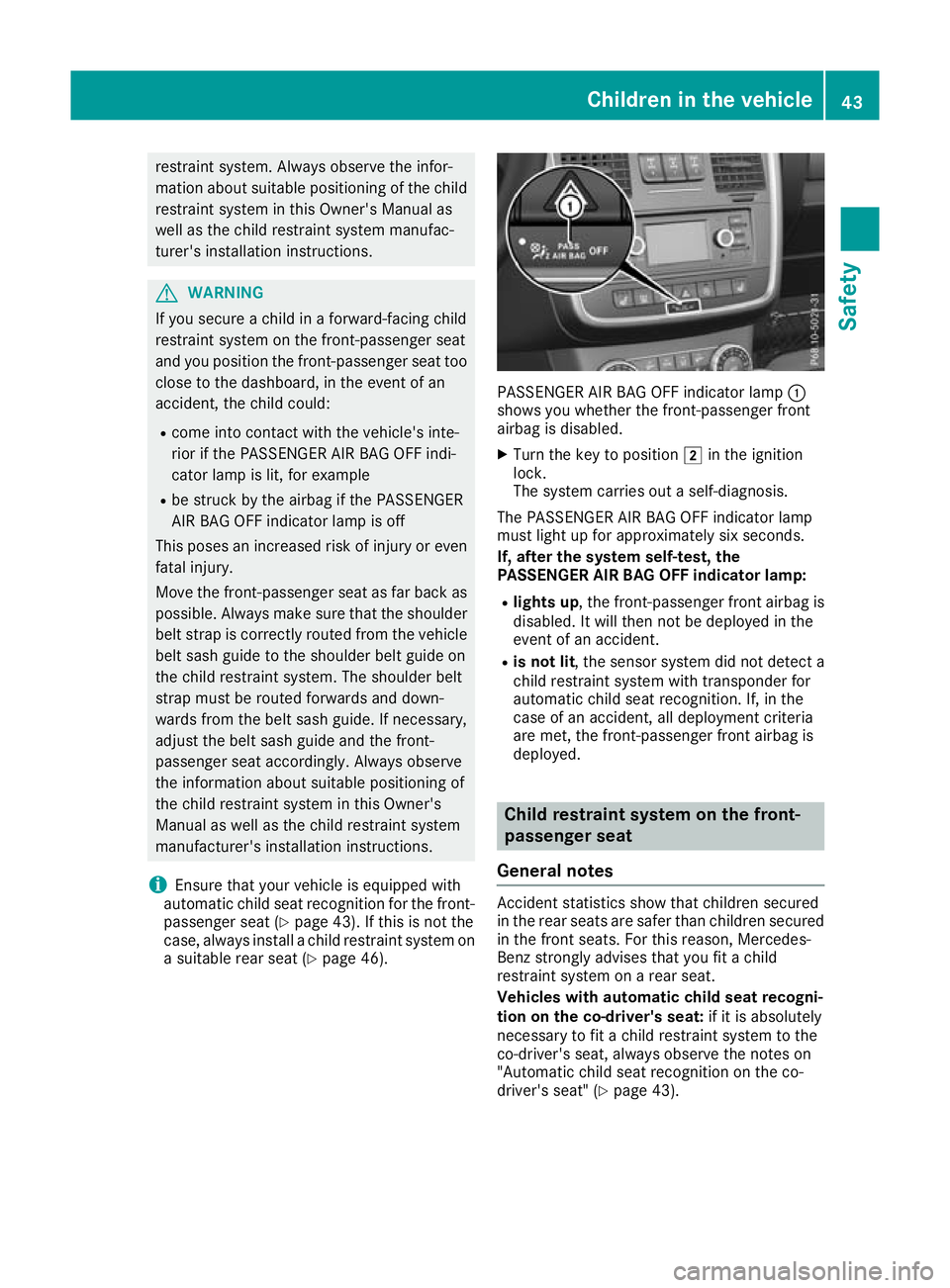
as uitable rear seat (Y page46). PASSENGER AIR BAG OFF indicato
rlamp :
shows you whether the front-passenger front
airbag is disabled.
X Turn the key to position 2in the ignition
lock.
The system carries out aself-diagnosis.
The PASSENGER AIR BAG OFF indicator lamp
must light up for approximately six seconds.
If, after the system self-test, the
PASSENGER AIR BAG OFF indicator lamp:
R lights up ,the front-passenger fronta irbag is
disabled. It will then not be deployed in the
event of an accident.
R is not lit ,the sensor system did not detect a
child restraint system with transponder for
automatic child seat recognition. If, in the
case of an accident ,all deployment criteria
are met, the front-passenger fronta irbag is
deployed. Childr
estraint system on th efront-
passenge rseat
General notes Accident statistics show that childre
nsecured
in the rea rseats ar esafer tha nchildren secured
in the front seats. For thi sreason, Mercedes-
Benz strongl yadvises tha tyou fitac hild
restraint system on arears eat.
Vehicles with automatic child seat recogni-
tio nont he co-driver' sseat:if it is absolutely
necessary to fit achild restraint system to the
co-driver' sseat, always observe the notes on
"Automatic child sea trecognitio nonthe co-
driver's seat" (Y page 43). Child
renint hevehicle
43Safety Z
Page 47 of 261
You can thus avoid the risk
sthat could arise as
ar esult of:
R ac hild restraint syste mthat is not detected
by the automatic child seat recognition' ssen-
sor system
R the unintentional disabling of the co-driver's
fron tairbag
R the unsuitable positionin gofthe child
restraint system, e.g. too close to the dash-
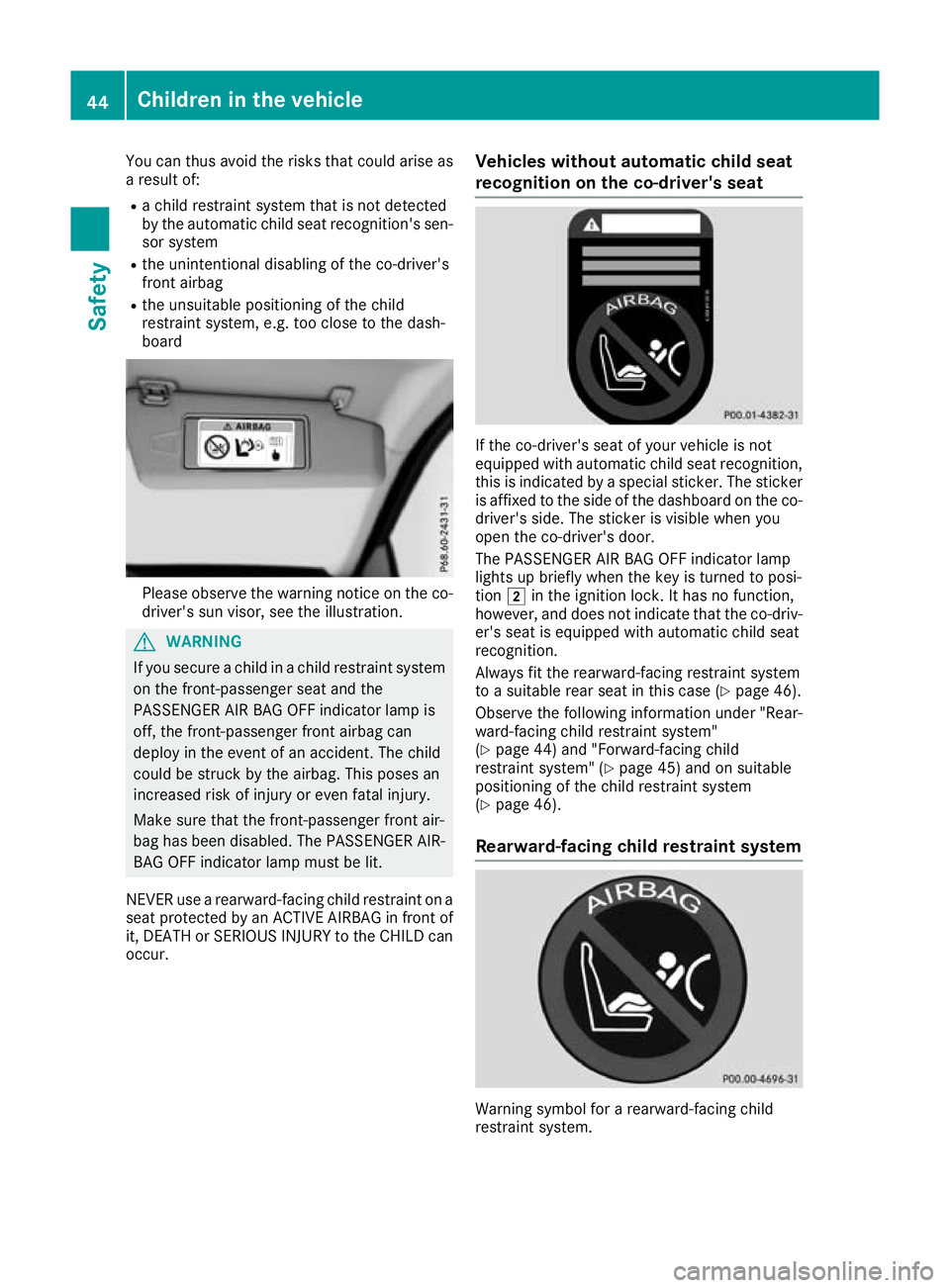
board Please observe the warning notice on the co-
driver' ssun visor, see the illustration. G
WARNING
If you secure achild in achild restraint system
on the front-passenge rseat and the
PASSENGER AIR BAG OFF indicator lamp is
off, the front-passenge rfront airbag can
deploy in the event of an accident. The child
coul dbes truck by the airbag. This poses an
increased risk of injury or even fatal injury.
Make sure that the front-passenge rfront air-
bag has been disabled. The PASSENGER AIR- BAG OFF indicator lamp must be lit.
NEVER use arearward-facing child restraint on a
seat protected by an ACTIVE AIRBAG in front of
it, DEATH or SERIOUS INJUR Ytothe CHILD can
occur. Vehicles without automatic child seat
recognitio nonthe co-driver' sseat If th
eco-driver's seat of yourv ehicle is not
equipped with automatic child seat recognition,
this is indicated by aspecia lsticker. The sticker
is affixed to the side of the dashboard on the co-
driver's side. The sticker is visible when you
open the co-driver's door.
The PASSENGER AIR BAG OFF indicator lamp
lights up briefl ywhen the key is turned to posi-
tion 2in the ignition lock. It has no function,
however, and does not indicate that the co-driv-
er's seat is equipped with automatic child seat
recognition.
Alwaysf it the rearward-facing restraint system
to as uitable rear seat in this case (Y page 46).
Observe the following information under "Rear-
ward-facing child restraint system"
(Y page 44) and "Forward-facing child
restraint system" (Y page 45) and on suitable
positioning of the child restraint system
(Y page 46).
Rearward-facing childr estraint system Warning symbo
lfor arearward-facing child
restraint system. 44
Children in the vehicleSafety
Page 49 of 261
Problems with automatic child seat recognition
Problem
Possible causes/consequences and
M
MSolutions The PASSENGER AIR
BAG OFF indicator lamp
on the centre console is
lit. As
pecia lMercedes-Benz child restraint system with atransponde rfor
automatic child sea trecognitio nhasbeen fitte dtothe front-
passenge rseat. The front-passenger front airba ghastherefore been
disabled as desired. G
WARNING
There is no child restraint syste mfitted to the front-passenge rseat.
Automatic child seat recognitio nismalfunctioning, for exampl edue to
electronic devices on the front-passenge rseat.
There is arisk of injury.
X Remove electroni cequipment from the front-passenge rseat, e.g.:
R laptop
R mobil ephone
R ac ard with atransponder, such as aski pass or access pass
If the PASSENGER AIR BAG OFF indicator lamp remains lit, the front- passenger seat may not be used.
X Consult aqualified specialist workshop. When you switch the
ignition on, the
6
restraint system warning lamp lights up and/or
the PASSENGER AIR
BAG OFF indicato rlamp
does not light up briefly. G
WARNING
Automati cchild seat recognitio nismalfunctioning.
Do not install achild restraint system on the front-passenge rseat.
It is recommende dthat you fit the child restraint system to asuitable
rear seat.
X Consult aqualified specialist workshop.
X Please alsor efer to the notes about the restraint system warning
lamp (Y page161). Suitable positioningoft
he child
restraint system
Introduction Only child restraint systems that are approved in
accordance with ECE standard ECE R44 are per-
mitted for use in the vehicle.
"Universal" category child restraint systems can
be recognised by their orange approval label and
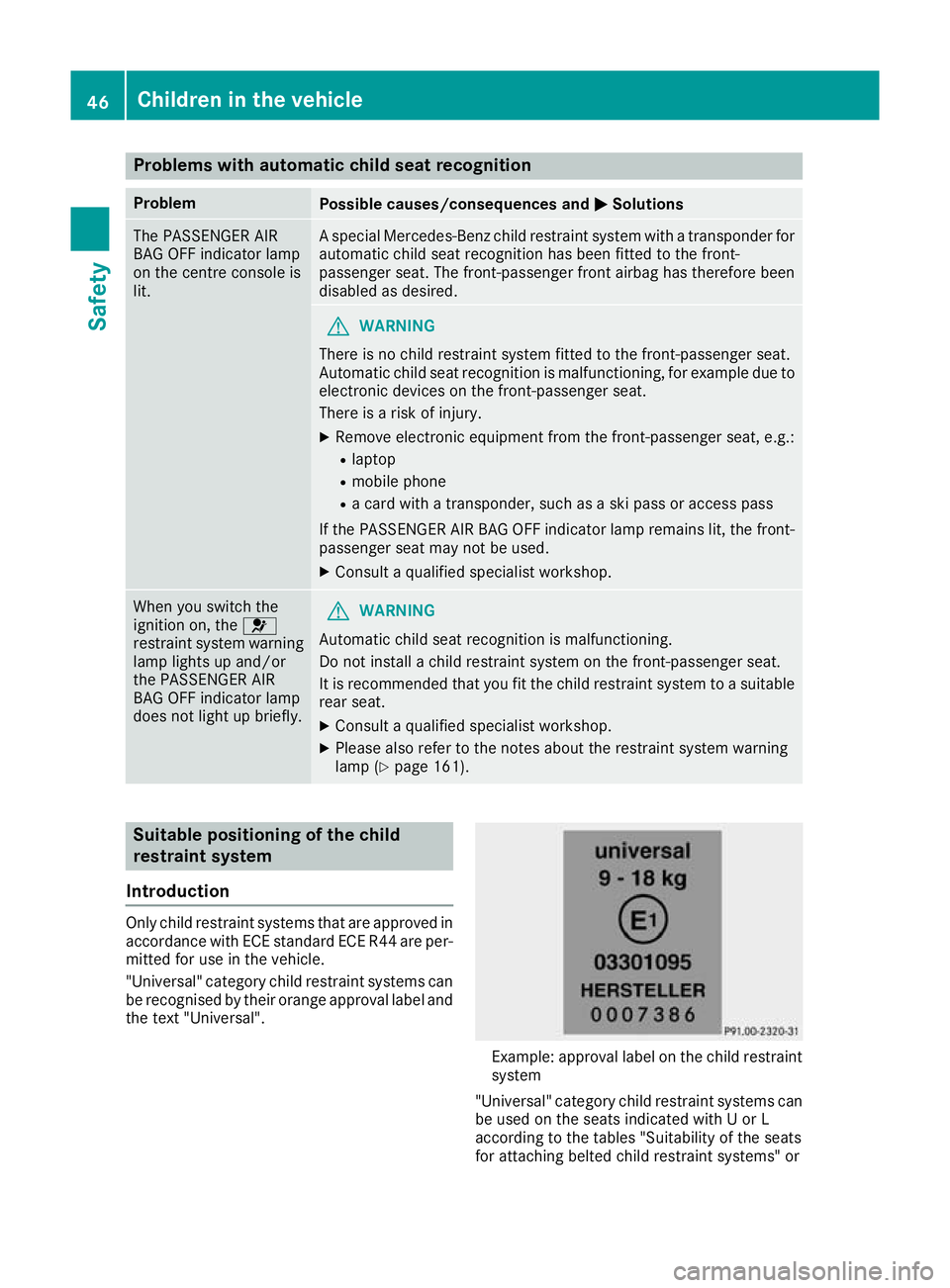
the text "Universal". Example: approval label on the child restraint
system
"Universal "category child restraint system scan
be used on the seats indicated with UorL
according to the table s"Suitability of the seats
for attaching belte dchild restraint systems" or 46
Children in the vehicleSafety
Page 50 of 261
"Suitabilit
yoftheseat sfor attaching an ISOFIX
child restraint system".
Semi-universal child restraint systems are indi-
cated by th etext"semi-universal" on the
approval label. Thes ecan be used if th evehicle
and th eseat are listed in th echild restraint sys-
te mm anufacturer' svehicle model list .For more
information, contact th echild restraint system
manufacturer or visit their website.
Child restrain tsystem on th efront-
passenger seat – if it is absolutely necessary to
secure achild in achild restraint system on the
front-passenger seat:
X Always pay attentio ntotheinstruction sunder
"Child restraint system on th efront-
passenger seat "(Ypage 43).
Ther eyou will fin dinstruction sonhow to cor-
rectly rout ethe shoulder belt strap from the belt sash guide to the shoulder belt guide on
the child restraint syste
m(Ypage 45).
X Move the front-passenger seat as far back as
possible and int othe lowest position.
X Move the backrest to an almost vertical posi-
tion.
The entire base of the child restraint system
must always rest on the seat cushion of the
front-passenger seat. The backrest of a
forward-facin gchild restraint system must, as
far as possible, rest flat against the backrest
of the front-passenger seat. The child
restraint system must not touch the roof or be
put under strain by the head restraint .Adjust
the angle of the seat backrest and the head
restraint position accordingly. Also observe
the child restraint system manufacturer's
installation instructions.
Suitability of the seats for attaching belt-secured child restraint systems If you use
ababy car seat of category 0or0+orarearward-facing child restraint system of category
Ionar ear seat, you must adjust the driver's or front-passenger seat so that the seat does not touch
the child restraint system.
If you use acategory I, forward-facing child restraint system, you shouldr emove the head restraint
from the respective seat, if possible (Y page 70). The backrest of the child restraint system must,
as far as possible, lie flat against the backrest of the seat.
Make sure that the child's feet do not touch the front seat. If necessary ,move the front seat forward
slightly.
For certain child restraint systems in weight categories II or III, this can mean that the area of use
is restricted. The maximum size setting of the child restraint system may not be possible due to
possible contact with the roof.
Alwayso bserve the notes in the "Child restraint system" section (Y page 40) and the child restraint
system manufacturer's installation instructions.
When you remove the child restraint system, you must replace the head restraints again immedi-
ately (Y page 70). All vehicle occupants must adjust their head restraints correctly before begin-
ning the journey.
Legend for the table:
XS eat that is unsuitable for children in this weight category.
US uitable for child restraint systems in th e"Universal" categor ytha ta re approve dfor use in this
weigh tcategory.
LS uitable for child restraint systems as recommended; see th e"Recommended child restraint
systems "table (Y page 49). Children in th
evehicle
47Safety Z
Page 51 of 261
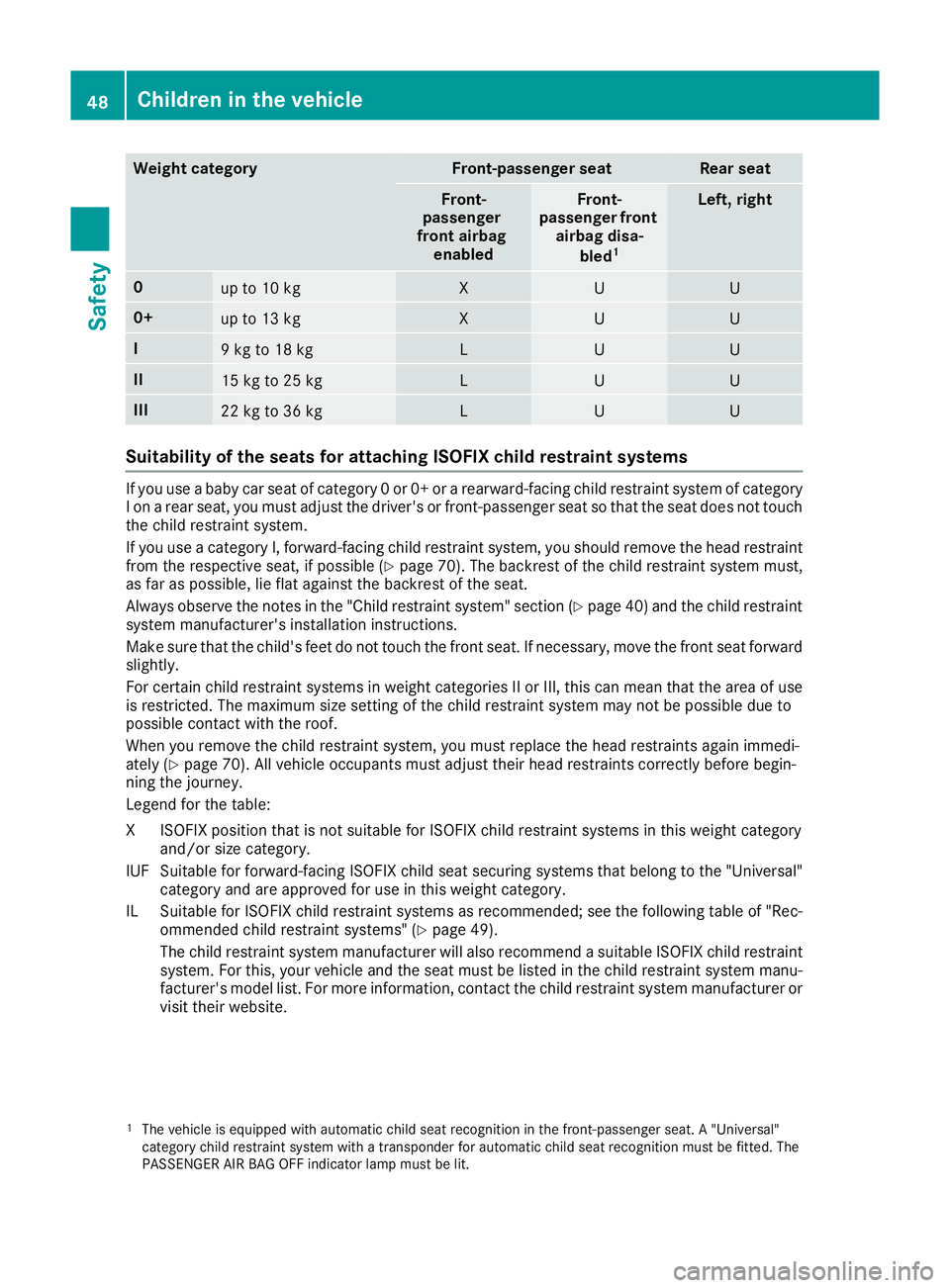
Weight category Front-passenger seat Rear seat
Front-
passenger
front airbag enabled Front-
passenger front airbag disa-
bled 1 Left, right
0
up to 10 kg X U U
0+
up to 13 kg X U U
I
9kgto18kg L U U
II
15 kg to 25 kg L U U
III
22 kg to 36 kg L U U
Suitability of the seat
sfor attaching ISOFIXc hild restraint systemsIf you use
ababy car seat of category 0or0+orarearward-facing child restraint system of category
Ionar ear seat, you must adjust the driver's or front-passenger seat so that the seat does not touch
the child restraint system.
If you use acategory I, forward-facing child restraint system, you shouldr emove the head restraint
from the respective seat, if possible (Y page 70). The backrest of the child restraint system must,
as far as possible, lie flat against the backrest of the seat.
Alwayso bserve the notes in the "Child restraint system" section (Y page 40) and the child restraint
system manufacturer's installation instructions.
Make sure that the child's feet do not touch the front seat. If necessary ,move the front seat forward
slightly.
For certain child restraint systems in weight categories II or III, this can mean that the area of use
is restricted. The maximum size setting of the child restraint system may not be possible due to
possible contact with the roof.
When you remove the child restraint system, you must replace the head restraints again immedi-
ately (Y page 70). All vehicle occupants must adjust their head restraints correctly before begin-
ning the journey.
Legend for the table:
XI SOFIX position that is not suitabl efor ISOFIX chil drestraint systems in this weight category
and/or size category.
IUF Suitable for forward-facing ISOFIX chil dseats ecuring systems that belong to the "Universal"
categor yand are approved for us einthis weight category.
IL Suitable for ISOFIX chil drestraint systems as recommended; see the following table of "Rec-
ommended chil drestraint systems "(Y page 49).
The chil drestraint system manufacturer will also recommend asuitabl eISOFIX chil drestraint
system. For this ,you rvehicl eand the sea tmustb elisted in the chil drestraint system manu-
facturer' smodel list. For more information, contac tthe chil drestraint system manufacturer or
visit thei rwebsite.
1 The vehicl eisequipped with automatic child seat recognition in the front-passenger seat. A"Universal"
category child restraint system with atransponder for automatic child seat recognition must be fitted. The
PASSENGER AIR BAG OFF indicator lamp must be lit. 48
Children in the vehicleSafety
Page 54 of 261
Child-proof locks
Important safety notes G
WARNING
If children ar etravelling in the vehicle, they
could:
R open doors, thus endangering other people
or road users
R exit the vehicl eand be caught by oncoming
traffic
R operate vehicl eequipment and become
trapped, for example
There is arisk of an accident and injury.
Always activate the child-proof locks and
overrid efeature if children are travelling in the
vehicle. When leaving the vehicle, alwayst ake
the key with you and lock the vehicle. Never
leave children unattended in the vehicle.
Child-proof locks for the rear doors
(Y page5 1).
Observe the important safety notes on the dou-
ble-lock function (Y page57). G
WARNING
If you leave children unattended in the vehi-
cle, they may be abletos et the vehiclein
motion if, for example, they:
R release the parking brake
R shift the automatic transmission out of park
position P
R start the engine
In addition, they may operate vehicl eequip-
ment and become trapped. There is arisk of
an accident and injury.
When leaving the vehicle, alwayst ake the key
with you and lock the vehicle. Never leave
children unattended in the vehicle. G
WARNING
If persons (particularly children) are exposed
to heatorc old foraprolonged period, there is
ar isk of serious or even fatal injuries. Never
leave persons (particularly children) unatten-
ded in the vehicle. G
WARNING
If the child restraint system is placed in direct sunlight, the parts coul dbecome very hot.
Childre ncouldbes uffer burns by touching
these parts, in particular on the metallic parts
of the child restraint system. There is arisk of
injury.
If you and yourc hild leave the vehicle, always
make sure that the child restraint system is
not in direct sunlight. Cove ritwithablanket,
for example. If the child restraint system has
been expose dtodirect sunlight, leave it to
cool downb efore securing the child in it.
Never leave children unattended in the vehi-
cle.
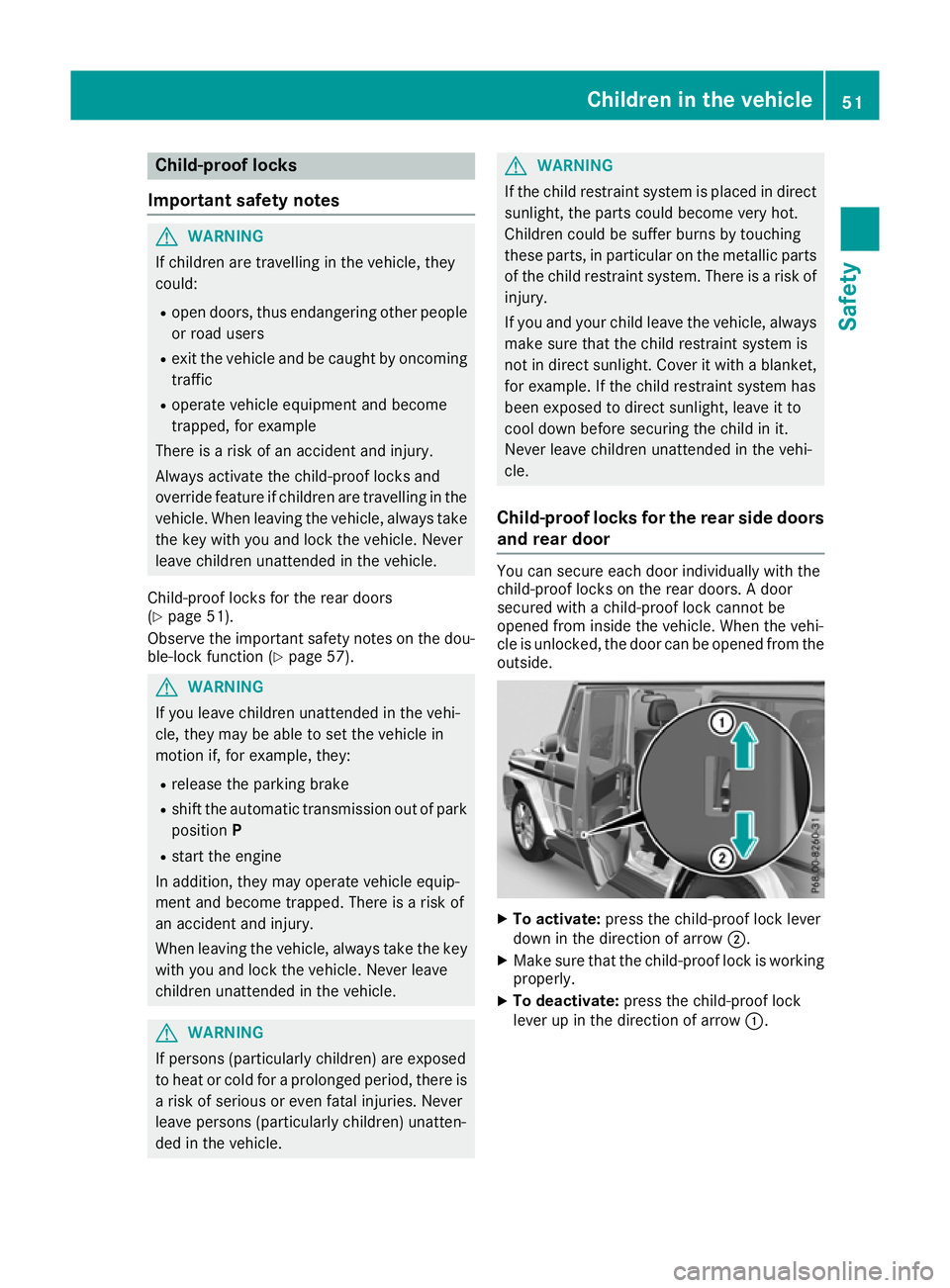
Child-proof locks for the rear side doors
and rear door You can secure eac
hdoor individually with the
child-proof lock sonthe rear doors .Adoor
secured with achild-proof lock cannot be
opene dfrom inside the vehicle. When the vehi-
cle is unlocked, the door can be opene dfrom the
outside. X
To activate: press thechild-proof lock lever
down in the direction of arrow ;.
X Make sure tha tthe child-proof lock is working
properly.
X To deactivate: press the child-proof lock
lever up in the direction of arrow :. Child
renint hevehicle
51Safety Z
Page 55 of 261
Pets in the vehicle
G
WARNING
If you leave animals unsupervised or unse-
cured in the vehicle, they may push abutton
or as witch, for example.
They could:
R activate vehicl eequipment and become
trapped, for example
R switch vehicl esystems on or off, thus
endangering other road users
In the event of an accident, sudden braking or
abrupt changes of direction, unsecured ani-
mals coul dbeflung around the vehicle, injur-
ing the vehicl eoccupants. There is arisk of an
accident and injury.
Never leave animals unattended in the vehi-
cle. Always secure animals correctly during a
journey ,e.g. in an anima ltransport box. Driving safe
tysystems Drivin
gsafet ys ystems overview
In this section ,you will fin dinformati on about
th ef ollowin gdrivin gsafet ysystems:
R AB S(Anti-lock Braking System)
(Y page 52)
R BA S(Brake Assist System) (Y page 53)
R Adaptive brake lights (Y page 53)
R ESP ®
(Electronic Stability Program)
(Y page 53)
R EB D( electronic brak eforce distributi on)
(Y page 55)
R ADAPTIV EBRAKE (Y page 56) Important safety notes
If you fail to adapt your driving style or if you are
inattentive, th edriving safet ysystems can nei-
ther reduce th eriskofana ccidentnor override
th el aws of physics .Drivin gs afet ysystems are
merely aids designed to assist driving .You are
responsible for maintainin gthe distanc etothe
vehicl einfront,for vehicl espeed, for braking in
goo dtime, and for staying in lane. Always adapt
your driving style to suit th eprevailing road and weather conditions and maintain
asafe distance
fro mt hevehicle in front .Drive carefully.
The driving safet ysystems described work as
effectively as possible only when there is ade-
quate contac tbetween th etyres and th eroad
surface. Pay particular attention to th einforma-
tio nr egarding tyres, recommended minimum
tyr etread depths etc .inthe"Wheels and tyres"
sectio n(Ypage 235).
In wintry driving conditions ,always use winter
tyres (M+S tyres) and, if necessary, snow
chains. Only in this way will th edriving safety
systems described in this sectio nwork as effec-
tively as possible. ABS (Anti-lock Braking System)
Genera linformation AB
Sregulate sbrake pressure in such awaythat
the wheels do not lock when yo ubrake. This
allows yo utocontinue steering the vehicl ewhen
braking.
The yellow !ABS warning lamp in the instru-
ment cluster lights up when the ignition is
switched on. It goe soutwhen the engine is run-
ning.
ABS works from aspeed of abou t8km/h,
regardless of road-surface conditions. ABS
works on slippery surfaces ,evenw heny ou
brake onl ygently.
Important safety notes i
Observ
ethe "Important safety notes" sec-
tion (Y page 52). G
WARNING
If ABS is faulty, the wheels could lock when
braking. The steerability and braking charac-
teristics may be severely impaired.A ddition-
ally, further driving safety systems are deac-
tivated. There is an increased dange rofskid-
ding and accidents.
Drive on carefully.H ave ABS checked imme-
diately at aqualified specialist workshop.
If ABS is malfunctioning, other systems ,includ-
ing driving safety systems ,willa lsob ecome
inoperative. Observe the information on the ABS warning lamp (Y page158) and display mes- 52
Driving safety systemsSafety
Page 56 of 261
sages which may be shown in the instrument
cluster (Y page 142).
Braking X
If ABS intervenes: continue to depress the
bra kepedal with force until th ebraking sit-
uatio niso ver.
X To make afullb rake application: depress
th eb rak epedal with full force.
If AB Sintervene swhen braking ,you will fee la
pulsin ginthebrak epedal.
The pulsating brak epedal can be an indication
of hazardous road conditions; this serves as a
reminder to tak eextra car ewhile driving.
Off-road ABS An ESP
®
syste mspecifically suite dtooff-road
terrain is activated automaticall yonce the off-
roa dprogra misa ctivated.
At speed sbelow 60 km/h ,the front wheels lock
cyclically during braking .The digging-i neffect
achieved in the proces sreduce sthe stopping
distance during off-roa ddriving .Thisl im its
steering capability. BAS (Brak
eAssis tSystem)
General information BAS operate
sinemergency braking situations.
If yo udepress the brake pedal quickly ,BAS
automaticall yboosts the braking force ,thus
shortening the stopping distance.
Important safety notes i
Observe the "Important safety notes" sec-
tion (Y page 52). G
WARNING
If BAS is malfunctioning, the braking distance
in an emergency braking situation is
increased. There is arisk of accident.
In an emergency braking situation, depress
the brake peda lwith full force. ABS prevents
the wheels from locking. Braking X
Keep the brake pedald epressed firmly until
the emergency braking situation is over.
ABS prevents the wheels from locking.
The brakes willf unction as usual once you
release the brake pedal. BAS is deactivated. Adaptiv
ebrake lights
The adaptive brak elights warn followin gtraffic
in an emergenc ybraking situation by:
R flashin gbrak elamps
R activating th ehazard warning lamps
If you brak esharply from aspee dofm oret han
50 km/h or if braking is assisted by BAS, the
brak elamp sflas hrapidly. In this way, traffic
travellin gbehind you is warned in an eve nmore
noticeable manner.
If you brak esharply from aspee dofm oret han
70 km/h to astandstill, th ehazard warning
lamp sare activated automatically. If th ebrakes
are applie dagain ,the brak elamp sligh tupc on-
tinuously. The hazard warning lamp sswitch off
automatically if you travel faste rtha n1 0k m/ h.
You can also switch off th ehazard warning
lamp susingthe hazard warning button
(Y page 76). ESP
®
(Electronic Stability Program)
General notes i
Observ
ethe "Important safety notes" sec-
tion (Y page 52).
ESP ®
monitors driving stability and traction, i.e.
power transmission between the tyres and the
road surface.
If ESP ®
detects that the vehicle is deviating from
the direction desired by the driver, one or more
wheels are braked to stabilise the vehicle. The
engine output is also modified to keep the vehi- cle on the desired course within physical limits.
ESP ®
assists the driver when pulling awayon
wet or slippery roads. ESP ®
can also stabilise
the vehicle during braking. Driving safe
tysystems
53Safety Z
Page 57 of 261
4ETS (Electronic Traction System)
i
Observ
ethe "Important safety notes" sec-
tion (Y page 52).
4ETS traction control is part of ESP ®
.
4ETS traction control is no longer active above a
speed of approximately 60 km/h.
Traction control brakes the drive wheels indi-
vidually if they spin. This enables you to pull
awaya nd accelerate on slippery surfaces, e.g. if
the road surface is slippery on one side. In addi-
tion, more drive torque is transferred to the
wheel or wheels with traction.
Traction control remains active if you deactivate
ESP ®
.
Important safety notes i
Observe the "Important safety notes" sec-
tion (Y page 52). G
WARNING
If ESP ®
is malfunctioning, ESP ®
is unable to
stabilise the vehicle. In addition, other driving
safety systems are switched off. This increa-
ses the risk of skidding and an accident.
Drive on carefully.H ave ESP®
checked at a
qualified specialist workshop.
! Only operate the vehicl
efor am aximu mof
ten seconds on abrake dynamometer. Switch
off the ignition.
Application of the brakes by ESP ®
may oth-
erwise destroy the brake system.
! Af
unction or performance test should only
be carrie dout on atwin-axle dynamometer.
Before you operate the vehicl eonsuch a
dynamometer, please consult aqualified
workshop. You coul dotherwise damage the
drive train or the brake system.
If the å ESP®
OFF warning lamp lights up
continuously,E SP®
is deactivated.
If the ÷ ESP®
warning lamp lights up contin-
uously,E SP®
is not available due to amalfunc-
tion.
Observe the information on warning lamps
(Y page1 59) and display messages which may
be displayed in the instrument cluster
(Y page1 42). Use only wheels with the recommended tyre
sizes. Only then will ESP ®
functio nproperly.
If differential locks are switched on, ABS,B AS
and ESP ®
switch off automatically.
Characteristics of ESP ® General information
If the ÷ ESP warning lamp goes out before
you begin the journey, ESP ®
is automatically
active.
If ESP ®
intervenes,t he÷ ESP®
warning lamp
flashes on the instrument cluster.
If ESP ®
intervenes:
X Do not deactivate ESP ®
under any circum-
stances.
X When pulling away, depress the accelerator
pedalo nly as far as is necessary.
X Adapt yourd riving style to suit the prevailing
road and weather conditions.
ECO start/stop function
The ECO start/stop function switches the
engine off automaticall yifthe vehicle stops
moving. When the vehicle pulls awaya gain, the
engine starts automatically. ESP ®
remains in its
previously selected status, e.g. if ESP ®
was
deactivated before the engine was automati-
callys witched off.
Deactivating/activating ESP ® Im
portant safety notes
i Observ
ethe "Importan tsafety notes" sec-
tio n(Ypage 52).
You can select between th efollowin gESP®
sta-
tuses:
R ESP ®
is activated
R ESP ®
is deactivated G
WARNING
If yo udeactivate ESP ®
,E SP ®
no longer sta-
bilises the vehicle. There is an increased risk
of skidding and an accident.
Only deactivate ESP ®
in the situations descri-
bed in the following. 54
Driving safety systemsSafety
Page 58 of 261
It may be best to deactivate ESP
®
in the follow-
ing situations:
R when snow chains are used
R in deep snow
R on sand or gravel
R off-road
Spinning the wheelsr esults inacutting action,
which enhances traction.
Activate ESP ®
as soon as the situations descri-
bed above no longer apply. ESP ®
willo therwise
not be abletos tabilise the vehicle if the vehicle
starts to skid or awheel starts to spin.
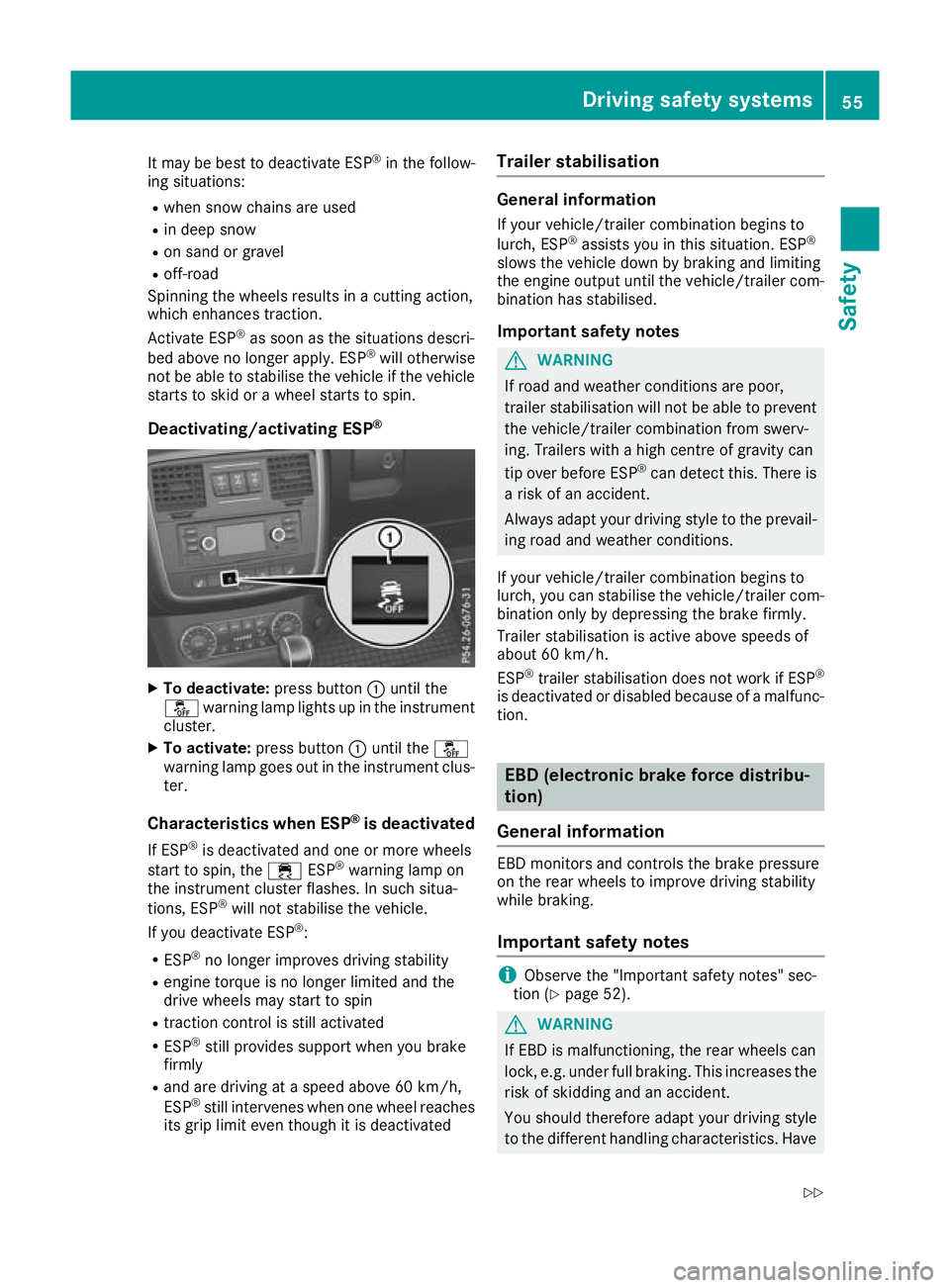
Deactivating/activating ESP ®X
To deactivate: press button:until the
å warning lamp lights up in the instrument
cluster.
X To activate: press button :until the å
warning lamp goes out in the instrument clus-
ter.
Characteristic swhenE SP®
is deactivated
If ESP ®
is deactivate dand one or more wheels
start to spin, the ÷ESP®
warning lamp on
the instrument cluster flashes. In such situa-
tions, ESP ®
will not stabilise the vehicle.
If yo udeactivate ESP ®
:
R ESP ®
no longer improve sdriving stability
R engine torque is no longer limite dand the
drive wheels may start to spin
R tractio ncontro lisstilla ctivated
R ESP ®
stil lprovides support when yo ubrake
firmly
R and are driving at aspeed above 60 km/h,
ESP ®
stil lintervene swheno ne whee lreaches
its gri plim it eve nthough it is deactivated Trailer stabilisation General information
If you rvehicle/trailer combinatio nbegins to
lurch, ESP ®
assists you in this situation. ESP ®
slowst he vehicle down by braking and limiting
the engine outpu tuntil the vehicle/trailer com-
binatio nhas stabilised.
Important safety notes G
WARNING
If road and weather conditions are poor,
trailer stabilisation willn ot be abletoprevent
the vehicle/trailer combination from swerv-
ing. Trailers with ahigh centre of gravity can
tip over before ESP ®
can detect this. There is
ar isk of an accident.
Always adapt yourd riving style to the prevail-
ing road and weather conditions.
If yourv ehicle/trailer combination begins to
lurch ,you can stabilise the vehicle/trailer com-
bination only by depressing the brake firmly.
Trailer stabilisation is active above speeds of
about 60 km/h.
ESP ®
trailer stabilisation does not work if ESP ®
is deactivated or disabledb ecause ofamalfunc-
tion. EB
D( electronic brak eforce distribu-
tion)
General information EB
Dm onitors and controls the brake pressure
on the rea rwheel stoi mprov edrivin gstability
whil ebraking.
Important safety notes i
Observ
ethe "Important safety notes" sec-
tion (Y page 52). G
WARNING
If EBD is malfunctioning, the rear wheels can
lock, e.g. under full braking. This increases the risk of skidding and an accident.
You should therefore adapt your driving style
to the different handling characteristics. Have Driving safe
tysystems
55Safety
Z