ABS MERCEDES-BENZ G55AMG 2010 W463 Owner's Guide
[x] Cancel search | Manufacturer: MERCEDES-BENZ, Model Year: 2010, Model line: G55AMG, Model: MERCEDES-BENZ G55AMG 2010 W463Pages: 272, PDF Size: 7.04 MB
Page 187 of 272
Off-road driving rules
REngage the transfer case in position LOW
before driving under off-road conditions
( Y page 93).
R If necessary, activate differential locks
( Y page 95).
The ABS, BAS and ESP ®
are switched off
automatically when the differential locks
are activated.
R Fasten items being carried as securely as
possible ( Y page 129).
! Observe the following during off-road
driving:
R Keep doors, tailgate, windows, and tilt/
sliding sunroof closed whenever driving
off-road.
R Switch the cruise control off.
R Adjust vehicle speed to condition of
terrain. The more uneven, rutty and
steeper the terrain, the lower the speed
should be. Drive through water slowly at
an even speed, avoiding a bow wave.
R Be especially careful when driving in
unknown territory. It may be necessary
to get out of the vehicle and scout the
path you intend to take.
R Watch out for obstacles, such as rocks,
holes, tree stumps and ruts.
R Avoid excessive engine speeds – drive at
moderate engine speeds (max. 3 000
rpm).
R Before driving through water, determine
its depth.
R Do not stop vehicle while immersed in
water, and do not shut off the engine.
R In sandy soil, drive at a steady speed as
allowed by conditions. This helps
overcome the vehicle rolling resistance
and reduces the likelihood of the vehicle
sinking into the ground.
R Do not initiate jumps with the vehicle. It
interrupts the forward momentum of the
vehicle.
R Always drive onto slopes with the engine
running and the vehicle in gear.
R Do not shift automatic transmission into
neutral position N.
R Inspect the vehicle for possible damage
after each off-road trip.GWarning!
Do not reduce the tire inflation pressure
before driving through sand. However, if you
do so, remember to correct the tire inflation
pressure before continuing your trip. Driving
with reduced tire inflation pressure increases
the risk of losing control of the vehicle and
rolling over.
Checklist before off-road driving
Engine oil level
R Check the engine oil level ( Y page 153).
Only with a proper oil level can the vehicle
obtain a trouble-free oil supply, even on
steep gradients.
! If an engine oil level warning message
appears in the multifunction display while
driving, stop the vehicle in a safe location
or as soon at is safe to do so. Check the
engine oil level.
The engine oil level warning messages
should not be ignored. Extended driving
with the message displayed could result in
serious engine damage that is not covered
by the Mercedes-Benz Limited Warranty.
Tires
R Check the tread depth and maintain
specified tire inflation pressure. A placard
with the recommended tire inflation
Driving instructions185Operation463_AKB; 3; 35, en-USd2ureepe,Version: 2.11.8.12009-07-16T20:59:56+02:00 - Seite 185Z
Page 189 of 272
Use the momentum of the vehicle to drive
across the hilltop.
After climbing a hill, driving in this manner
prevents the vehicle from:
Rlosing ground contact when cresting hills
Rlosing its forward momentum
Rspeeding up too much after climbing the hill
Driving downhill
RShift automatic transmission into gear
range 1 (Y page 92).
RDrive downhill observing the same rules as
driving uphill (Y page 186).
iThe special LOW RANGE – ABS
(Y page 53) setting allows for precise and
brief (cyclical) blocking of the front wheels,
permitting them to dig into loose ground.
Remember that, when stopped, the front
wheels slide across a surface and thus lose
their ability to steer the vehicle.
Driving through water
:Fording depth, 20 in (50 cm)
RBefore driving through water, determine its
depth.
! The water depth must not exceed 20 in
(50 cm). The ground under the water might
not be firm which could result the water
being deeper than expected when driving
the vehicle through it. Please note that the
water level is correspondingly lower for
flowing water.
RComply with the warnings (Y page 184) and
rules for off-road driving (Y page 185).
RSwitch off the exterior lamps as well as the
climate control.
RShift automatic transmission into gear
range 1 or 2 (Y page 92).
RAvoid high engine speeds.
REnter and leave the water only at a shallow
spot, driving at walking speed.
! Never accelerate before driving into the
water. The bow wave could force water into
the engine and auxiliary equipment, thus
damaging them.
RDrive through the water slowly and at a
constant speed.
RDo not stop vehicle while immersed in
water, and do not shut off the engine.
! Do not open any of the vehicle’s doors
while driving through water. Water could
otherwise enter the vehicle interior and
damage the vehicle’s electronics, as well as
the interior equipment.
RThere is a very high level of driving
resistance in water. The surface is slippery
and may not be firm, making pulling away
in water difficult and dangerous.
RMake sure that only small bow waves are
formed when driving the vehicle through
water.
RClean mud off the tire tread after driving
through water.
RTo dry the brakes, apply pressure to the
brake pedal several times while driving
after leaving the water.
Driving instructions187Operation463_AKB; 3; 35, en-USd2ureepe,Version: 2.11.8.12009-07-16T20:59:56+02:00 - Seite 187Z
Page 206 of 272
Text messages
Safety systemsDisplay messagesPossible causes/consequences and M SolutionsABSABS not
available
Differenti
al LockedYou have engaged the differential locks.XThe ABS switches on again after the differential locks have
been disengaged.ABSABS, ESP
Inoperativ
e See
Operator’s
ManualThe brake system is still functioning normally but due to a
malfunction, the ABS, the BAS, the EBB, the ESP ®
, and the
4-ETS are unavailable.XContinue driving with added caution. Wheels may lock
during hard braking, reducing steering capability.XHave the system checked at an authorized Mercedes-Benz
Center as soon as possible.
Failure to follow these instructions increases the risk of an
accident.
ESPInoperativ
e See
Operator's
ManualThe brake system is still functioning normally but due to a
malfunction or an interruption in the power supply the ABS,
the BAS, EBB, the ESP ®
, and the 4-ETS are unavailable.XContinue driving with added caution. Wheels may lock
during hard braking, reducing steering capability.XHave the system checked at an authorized Mercedes-Benz
Center as soon as possible.
Failure to follow these instructions increases the risk of an
accident.
204Vehicle status messages in the multifunction displayPractical hints
463_AKB; 3; 35, en-USd2ureepe,Version: 2.11.8.12009-07-16T20:59:56+02:00 - Seite 204
Page 222 of 272
BrakeProblemPossible causes/consequences and M Solutions!The yellow ABS
indicator lamp
comes on while
the engine is
running.The ABS has detected a malfunction and switched off. The BAS,
the EBB, the ESP ®
, and the 4-ETS are also switched off.
The brake system is still functioning normally but without the
systems specified above available.
If the ABS control unit is malfunctioning, other systems such as
the navigation system or the automatic transmission may also be
malfunctioning.XContinue driving with added caution. Wheels may lock during
hard braking, reducing steering capability.XAdjust driving to be consistent with reduced braking
responsiveness.XRead and observe messages that may appear in the
multifunction display ( Y page 203).XHave the system checked at an authorized Mercedes-Benz
Center as soon as possible.
Failure to follow these instructions increases the risk of an
accident.
!The yellow ABS
indicator lamp
comes on while
the engine is
running.The ABS has switched off due to insufficient power supply.
The battery might not be charged sufficiently.
When the voltage is above the required value again, the ABS is
operational again. The ABS indicator lamp should go out.XContinue driving with added caution. Wheels may lock during
hard braking, reducing steering capability.XAdjust driving to be consistent with reduced braking
responsiveness.XRead and observe messages that may appear in the
multifunction display ( Y page 203).XIf the ABS indicator lamp does not go out: Have the alternator
and the battery checked.!The yellow ABS
indicator lamp
comes on while
the engine is
running.You have engaged the differential locks. The ABS, the BAS, the
EBB, the ESP ®
, and the 4-ETS are switched off.XThe driving systems will switch on again after the differential
locks have been disengaged.220What to do if …Practical hints
463_AKB; 3; 35, en-USd2ureepe,Version: 2.11.8.12009-07-16T20:59:56+02:00 - Seite 220
Page 223 of 272
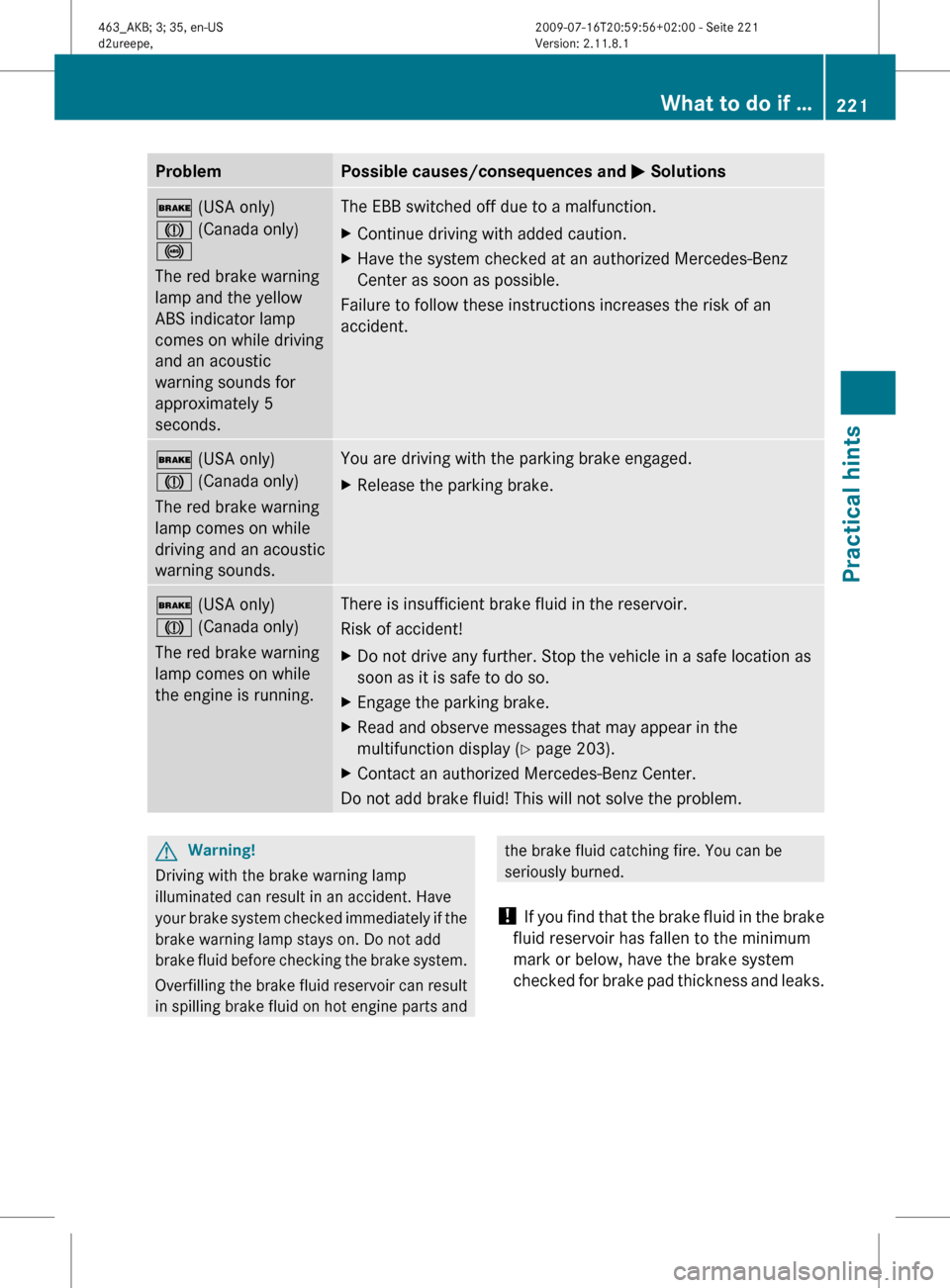
ProblemPossible causes/consequences and M Solutions$ (USA only)
J (Canada only)
!
The red brake warning
lamp and the yellow
ABS indicator lamp
comes on while driving
and an acoustic
warning sounds for
approximately 5
seconds.The EBB switched off due to a malfunction.XContinue driving with added caution.XHave the system checked at an authorized Mercedes-Benz
Center as soon as possible.
Failure to follow these instructions increases the risk of an
accident.
$ (USA only)
J (Canada only)
The red brake warning
lamp comes on while
driving and an acoustic
warning sounds.You are driving with the parking brake engaged.XRelease the parking brake.$ (USA only)
J (Canada only)
The red brake warning
lamp comes on while
the engine is running.There is insufficient brake fluid in the reservoir.
Risk of accident!XDo not drive any further. Stop the vehicle in a safe location as
soon as it is safe to do so.XEngage the parking brake.XRead and observe messages that may appear in the
multifunction display ( Y page 203).XContact an authorized Mercedes-Benz Center.
Do not add brake fluid! This will not solve the problem.
GWarning!
Driving with the brake warning lamp
illuminated can result in an accident. Have
your brake system checked immediately if the
brake warning lamp stays on. Do not add
brake fluid before checking the brake system.
Overfilling the brake fluid reservoir can result
in spilling brake fluid on hot engine parts and
the brake fluid catching fire. You can be
seriously burned.
! If you find that the brake fluid in the brake
fluid reservoir has fallen to the minimum
mark or below, have the brake system
checked for brake pad thickness and leaks.What to do if …221Practical hints463_AKB; 3; 35, en-USd2ureepe,Version: 2.11.8.12009-07-16T20:59:56+02:00 - Seite 221Z
Page 225 of 272
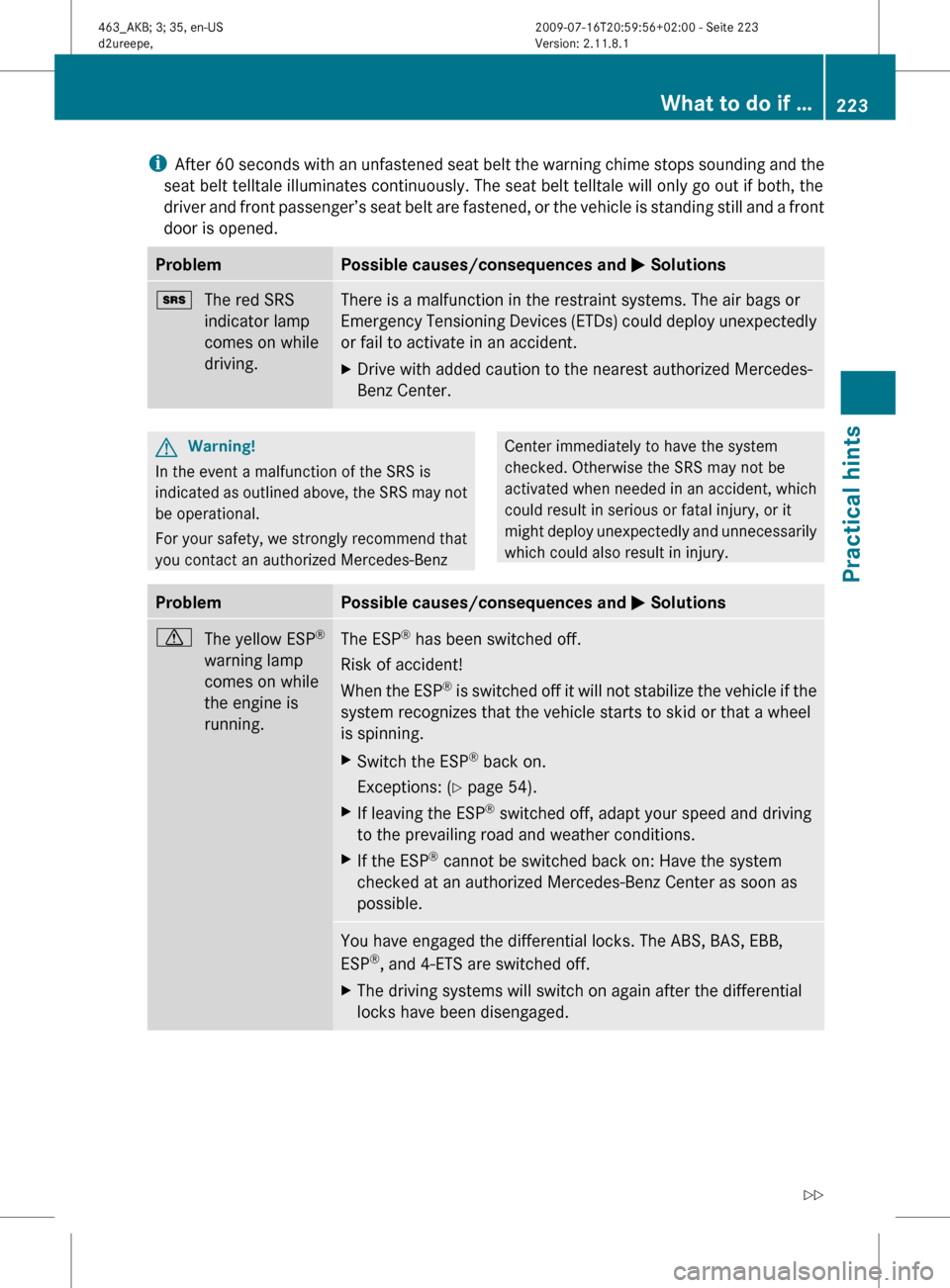
iAfter 60 seconds with an unfastened seat belt the warning chime stops sounding and the
seat belt telltale illuminates continuously. The seat belt telltale will only go out if both, the
driver and front passenger’s seat belt are fastened, or the vehicle is standing still and a front
door is opened.ProblemPossible causes/consequences and M Solutions+The red SRS
indicator lamp
comes on while
driving.There is a malfunction in the restraint systems. The air bags or
Emergency Tensioning Devices (ETDs) could deploy unexpectedly
or fail to activate in an accident.XDrive with added caution to the nearest authorized Mercedes-
Benz Center.GWarning!
In the event a malfunction of the SRS is
indicated as outlined above, the SRS may not
be operational.
For your safety, we strongly recommend that
you contact an authorized Mercedes-Benz
Center immediately to have the system
checked. Otherwise the SRS may not be
activated when needed in an accident, which
could result in serious or fatal injury, or it
might deploy unexpectedly and unnecessarily
which could also result in injury.ProblemPossible causes/consequences and M SolutionsdThe yellow ESP ®
warning lamp
comes on while
the engine is
running.The ESP ®
has been switched off.
Risk of accident!
When the ESP ®
is switched off it will not stabilize the vehicle if the
system recognizes that the vehicle starts to skid or that a wheel
is spinning.XSwitch the ESP ®
back on.
Exceptions: ( Y page 54).XIf leaving the ESP ®
switched off, adapt your speed and driving
to the prevailing road and weather conditions.XIf the ESP ®
cannot be switched back on: Have the system
checked at an authorized Mercedes-Benz Center as soon as
possible.You have engaged the differential locks. The ABS, BAS, EBB,
ESP ®
, and 4-ETS are switched off.XThe driving systems will switch on again after the differential
locks have been disengaged.What to do if …223Practical hints463_AKB; 3; 35, en-USd2ureepe,Version: 2.11.8.12009-07-16T20:59:56+02:00 - Seite 223Z
Page 235 of 272
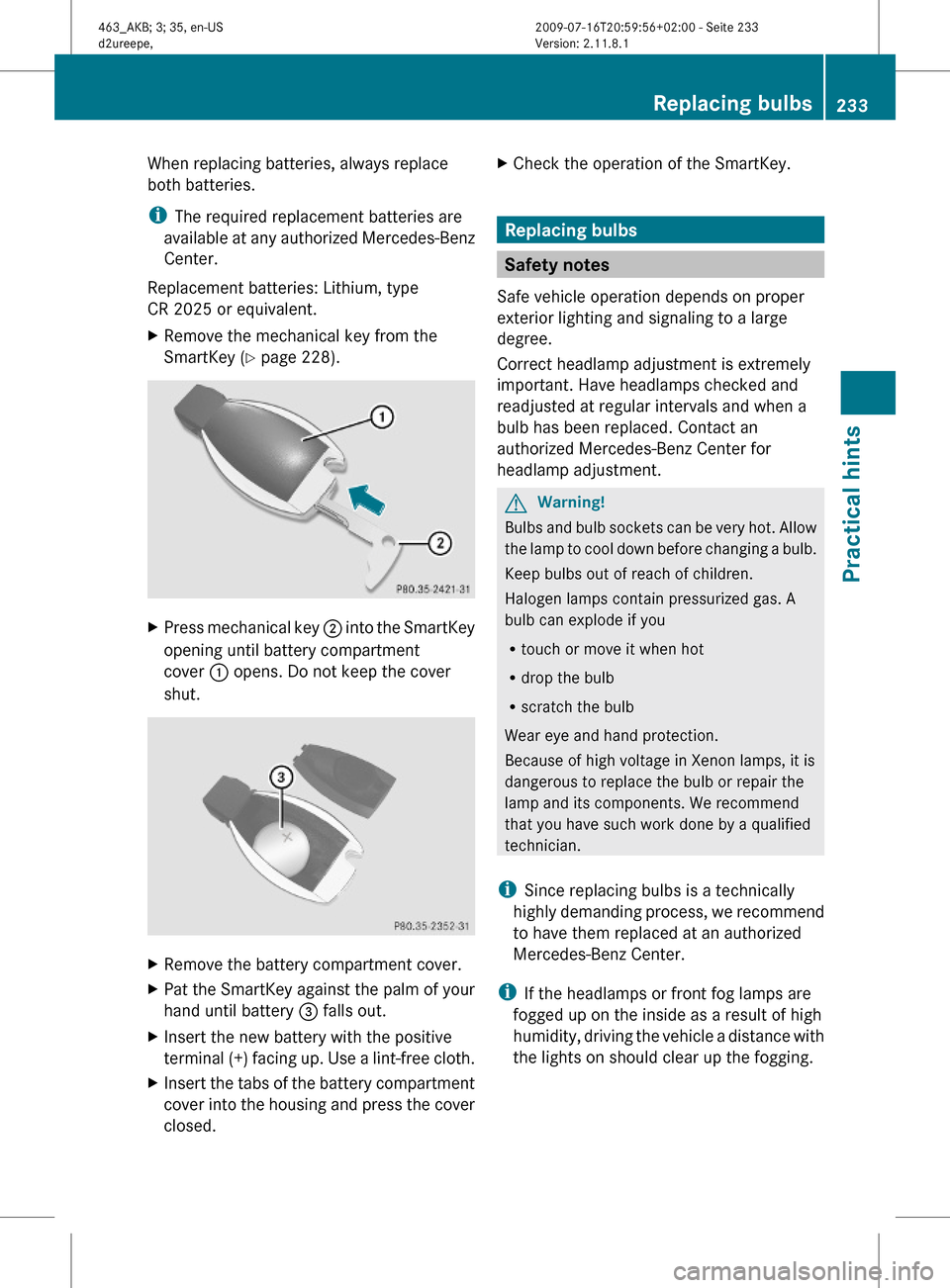
When replacing batteries, always replace
both batteries.
iThe required replacement batteries are
available at any authorized Mercedes-Benz
Center.
Replacement batteries: Lithium, type
CR 2025 or equivalent.
XRemove the mechanical key from the
SmartKey (Y page 228).
XPress mechanical key ; into the SmartKey
opening until battery compartment
cover : opens. Do not keep the cover
shut.
XRemove the battery compartment cover.XPat the SmartKey against the palm of your
hand until battery = falls out.
XInsert the new battery with the positive
terminal (+) facing up. Use a lint-free cloth.
XInsert the tabs of the battery compartment
cover into the housing and press the cover
closed.
XCheck the operation of the SmartKey.
Replacing bulbs
Safety notes
Safe vehicle operation depends on proper
exterior lighting and signaling to a large
degree.
Correct headlamp adjustment is extremely
important. Have headlamps checked and
readjusted at regular intervals and when a
bulb has been replaced. Contact an
authorized Mercedes-Benz Center for
headlamp adjustment.
GWarning!
Bulbs and bulb sockets can be very hot. Allow
the lamp to cool down before changing a bulb.
Keep bulbs out of reach of children.
Halogen lamps contain pressurized gas. A
bulb can explode if you
Rtouch or move it when hot
Rdrop the bulb
Rscratch the bulb
Wear eye and hand protection.
Because of high voltage in Xenon lamps, it is
dangerous to replace the bulb or repair the
lamp and its components. We recommend
that you have such work done by a qualified
technician.
iSince replacing bulbs is a technically
highly demanding process, we recommend
to have them replaced at an authorized
Mercedes-Benz Center.
iIf the headlamps or front fog lamps are
fogged up on the inside as a result of high
humidity, driving the vehicle a distance with
the lights on should clear up the fogging.
Replacing bulbs233Practical hints463_AKB; 3; 35, en-USd2ureepe,Version: 2.11.8.12009-07-16T20:59:56+02:00 - Seite 233Z
Page 260 of 272
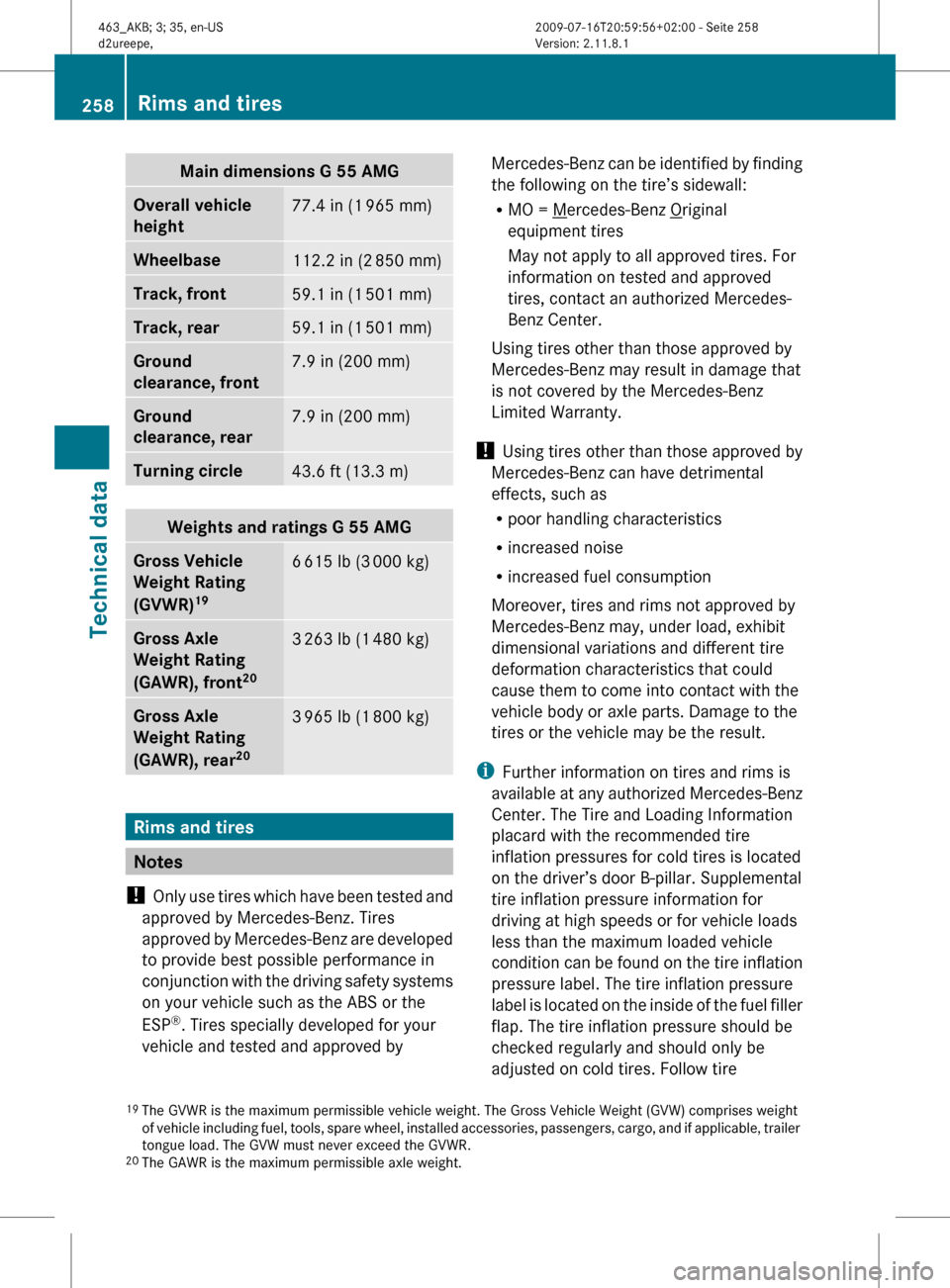
Main dimensions G 55 AMGOverall vehicle
height77.4 in (1 965 mm)Wheelbase112.2 in (2 850 mm)Track, front59.1 in (1 501 mm)Track, rear59.1 in (1 501 mm)Ground
clearance, front7.9 in (200 mm)Ground
clearance, rear7.9 in (200 mm)Turning circle43.6 ft (13.3 m)Weights and ratings G 55 AMGGross Vehicle
Weight Rating
(GVWR) 196
615 lb (3 000 kg)Gross Axle
Weight Rating
(GAWR), front 203
263 lb (1 480 kg)Gross Axle
Weight Rating
(GAWR), rear 203
965 lb (1 800 kg)
Rims and tires
Notes
! Only use tires which have been tested and
approved by Mercedes-Benz. Tires
approved by Mercedes-Benz are developed
to provide best possible performance in
conjunction with the driving safety systems
on your vehicle such as the ABS or the
ESP ®
. Tires specially developed for your
vehicle and tested and approved by
Mercedes-Benz can be identified by finding
the following on the tire’s sidewall:
R MO =
Mercedes-Benz Original
equipment tires
May not apply to all approved tires. For
information on tested and approved
tires, contact an authorized Mercedes-
Benz Center.
Using tires other than those approved by
Mercedes-Benz may result in damage that
is not covered by the Mercedes-Benz
Limited Warranty.
! Using tires other than those approved by
Mercedes-Benz can have detrimental
effects, such as
R poor handling characteristics
R increased noise
R increased fuel consumption
Moreover, tires and rims not approved by
Mercedes-Benz may, under load, exhibit
dimensional variations and different tire
deformation characteristics that could
cause them to come into contact with the
vehicle body or axle parts. Damage to the
tires or the vehicle may be the result.
i Further information on tires and rims is
available at any authorized Mercedes-Benz
Center. The Tire and Loading Information
placard with the recommended tire
inflation pressures for cold tires is located
on the driver’s door B-pillar. Supplemental
tire inflation pressure information for
driving at high speeds or for vehicle loads
less than the maximum loaded vehicle
condition can be found on the tire inflation
pressure label. The tire inflation pressure
label is located on the inside of the fuel filler
flap. The tire inflation pressure should be
checked regularly and should only be
adjusted on cold tires. Follow tire
19 The GVWR is the maximum permissible vehicle weight. The Gross Vehicle Weight (GVW) comprises weight
of vehicle including fuel, tools, spare wheel, installed accessories, passengers, cargo, and if applicable, trailer
tongue load. The GVW must never exceed the GVWR.
20 The GAWR is the maximum permissible axle weight.258Rims and tiresTechnical data
463_AKB; 3; 35, en-USd2ureepe,Version: 2.11.8.12009-07-16T20:59:56+02:00 - Seite 258
Page 264 of 272
iMB sheet numbers are printed on the
outside of oil containers.
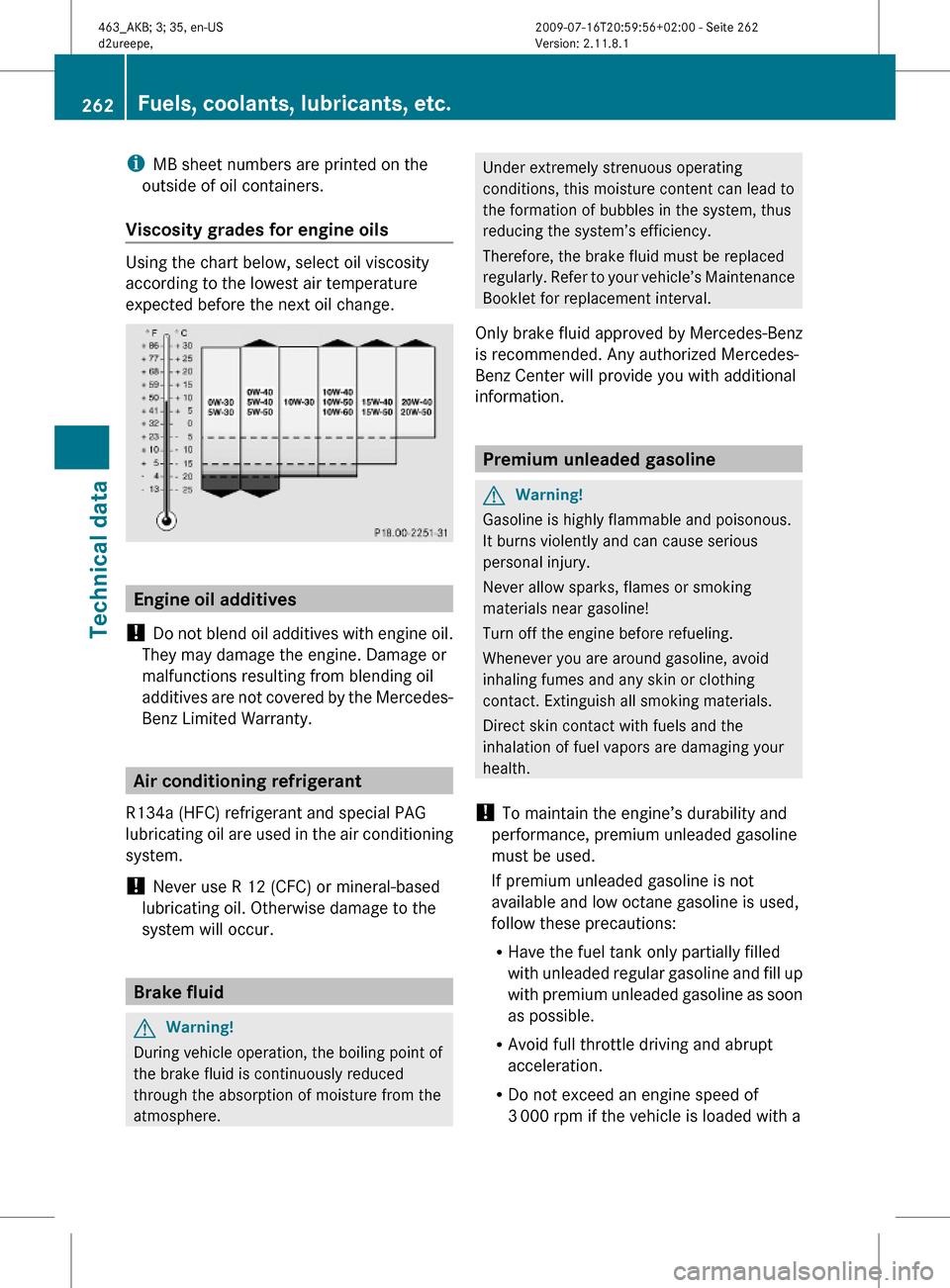
Viscosity grades for engine oils
Using the chart below, select oil viscosity
according to the lowest air temperature
expected before the next oil change.
Engine oil additives
! Do not blend oil additives with engine oil.
They may damage the engine. Damage or
malfunctions resulting from blending oil
additives are not covered by the Mercedes-
Benz Limited Warranty.
Air conditioning refrigerant
R134a (HFC) refrigerant and special PAG
lubricating oil are used in the air conditioning
system.
! Never use R 12 (CFC) or mineral-based
lubricating oil. Otherwise damage to the
system will occur.
Brake fluid
GWarning!
During vehicle operation, the boiling point of
the brake fluid is continuously reduced
through the absorption of moisture from the
atmosphere.
Under extremely strenuous operating
conditions, this moisture content can lead to
the formation of bubbles in the system, thus
reducing the system’s efficiency.
Therefore, the brake fluid must be replaced
regularly. Refer to your vehicle’s Maintenance
Booklet for replacement interval.
Only brake fluid approved by Mercedes-Benz
is recommended. Any authorized Mercedes-
Benz Center will provide you with additional
information.
Premium unleaded gasoline
GWarning!
Gasoline is highly flammable and poisonous.
It burns violently and can cause serious
personal injury.
Never allow sparks, flames or smoking
materials near gasoline!
Turn off the engine before refueling.
Whenever you are around gasoline, avoid
inhaling fumes and any skin or clothing
contact. Extinguish all smoking materials.
Direct skin contact with fuels and the
inhalation of fuel vapors are damaging your
health.
! To maintain the engine’s durability and
performance, premium unleaded gasoline
must be used.
If premium unleaded gasoline is not
available and low octane gasoline is used,
follow these precautions:
RHave the fuel tank only partially filled
with unleaded regular gasoline and fill up
with premium unleaded gasoline as soon
as possible.
RAvoid full throttle driving and abrupt
acceleration.
RDo not exceed an engine speed of
3 000 rpm if the vehicle is loaded with a
262Fuels, coolants, lubricants, etc.Technical data
463_AKB; 3; 35, en-USd2ureepe,Version: 2.11.8.12009-07-16T20:59:56+02:00 - Seite 262