engine MERCEDES-BENZ GL 2010 User Guide
[x] Cancel search | Manufacturer: MERCEDES-BENZ, Model Year: 2010, Model line: GL, Model: MERCEDES-BENZ GL 2010Pages: 380, PDF Size: 9.81 MB
Page 18 of 380
Self-test
BabySmart™ .................................... 47
OCS (Occupant Classification
System) ........................................... 45
Tele Aid .......................................... 215
Service
see Maintenance
Service, parts .................................... 360
Service and warranty information ..... 20
Service intervals see Maintenance System, Service
indicator message
Service life (tires) .............................. 247
Settings
Factory setting (KEYLESS-GO) .........72
Factory setting (SmartKey) ..............71
Memory function .............................. 96
Menu ............................................. 132
Selective setting (KEYLESS-GO) .......73
Selective setting (SmartKey) ............71
Side impact air bags ........................... 41
Side marker lamps
Cleaning lenses ............................. 277
Messages in the multifunction
display ........................................... 311
Sidewall (tires) .................................. 256
Side windows see Power windows
SmartKey
see Key, SmartKey
SmartKey with KEYLESS-GO
see Key, SmartKey
Snow chains ...................................... 258
Snow tires see Winter tires
Spare wheel ....................................... 365
Mounting ....................................... 340
Storage location ............................ 286
Speedometer ............................... 28, 149
Speed settings
Cruise control ................................ 145
Distronic ........................................ 151
Resume function ...................147, 152
Sport Utility Vehicle
see SUV SRS
Indicator lamp ...................29, 36, 318
Messages in the multifunction
display ........................................... 301
Standing water, driving through ...... 262
Starter switch positions
KEYLESS-GO .................................... 80
SmartKey ......................................... 80
Starting difficulties (engine) ............ 110
Starting the engine ........................... 108
Steering column see Multifunction steering wheel,
Adjustment
Steering wheel
see Multifunction steering wheel
Steering wheel gearshift control ..... 118
Stolen Vehicle Recovery Services ... 219
Storage compartments ..................... 207
Storing tires ....................................... 248
Stranded vehicle ............................... 355
Sunroof see Power tilt/sliding sunroof
Sunshade
Rear panorama roof .......................211
Sun visors .......................................... 210
Suspension tuning see Air suspension program
SUV (Sport Utility Vehicle) ................. 22
T
Tachometer .................................. 29, 125
Overspeed range ........................... 125
Tailgate
Closing ............................................. 75
Messages in the multifunction
display ........................................... 304
Opening ........................................... 75
Power tailgate .................................. 76
Tail lamps ........................................... 329
Cleaning lenses ............................. 277
Messages in the multifunction
display ........................................... 312
Tar stains ........................................... 276
Technical data
Air conditioning refrigerant ............371
Brake fluid ..................................... 371
16IndexX164_AKB; 5; 31, en-USd2ureepe,Version: 2.11.8.12009-09-11T12:30:16+02:00 - Seite 16
Page 19 of 380
Capacities fuels, coolants,
lubricants etc. ................................ 368
Coolant .......................................... 373
Engine oil additives ........................371
Engine oils ..................................... 370
Fuel requirements .......................... 371
Gasoline additives .......................... 372
Identification labels .......................360
Premium unleaded gasoline ...........371
Rims and tires ................................ 365
Spare wheel ................................... 368
Vehicle specification
GL 350 BlueTEC ............................. 362
Vehicle specification GL 450 .........362
Vehicle specification GL 550 .........363
Washer and headlamp cleaning
system ................................... 370, 375
Technical data (dimensions)
see Vehicle specification
Technical data (electrical system)
see Vehicle specification
Technical data (engine)
see Vehicle specification
Technical data (weights)
see Vehicle specification
Tele Aid ............................................... 214
Emergency calls ............................. 215
Information button .........................217
Initiating an emergency call
manually ........................................ 216
Messages in the multifunction
display ........................................... 301
Remote door unlock ......................219
Roadside Assistance button ..........216
Search & Send ............................... 218
SOS button .................................... 216
Stolen Vehicle Recovery Services ..219
System self-test ............................. 215
Telephone ............................................. 30
Answering/ending a call ................143
Hands-free microphone ...................34
Menu ............................................. 142
Operation ....................................... 142
Phone book .................................... 143
Redialing ........................................ 144
Temperature
Interior temperature ..............178, 187
Outside .................................. 129, 135Tether anchorage points
see Children in the vehicle
Tie-down rings ................................... 200
Tightening torque
Wheels ........................................... 344
Time setting ....................................... 135
TIN (Tire Identification Number) ...... 256
Tire and Loading Information
placard ............................................... 242
Tire and loading terminology ........... 254
TIREFIT ............................................... 337
Tire Identification Number see TIN
Tire inflation pressure
Checking ........................................ 237
Important notes on ........................235
Label on the inside of fuel filler
flap ................................................ 236
Placard on driver’s door B-pillar .....242
Tire labeling ....................................... 250
Tire load rating .................................. 255
Tire ply composition and material
used .................................................... 256
Tire pressure loss warning system . 237
Tire repair kit see TIREFIT
Tires ........................................... 233, 365
Advanced Tire Pressure
Monitoring System (Advanced
TPMS) ............................................ 239
Air pressure ................................... 234
Care and maintenance ...................247
Cleaning ......................................... 248
Direction of rotation, spinning .......246
Important notes on tire inflation
pressure ........................................ 235
Inflation pressure ..................236, 237
Information placard .......................242
Inspection ...................................... 247
Labeling ......................................... 250
Load index ............................. 251, 255
Load rating .................................... 255
Messages in the multifunction
display ................................... 297, 313
MOExtended .................................. 365
Ply composition and material
used ............................................... 256Index17X164_AKB; 5; 31, en-USd2ureepe,Version: 2.11.8.12009-09-11T12:30:16+02:00 - Seite 17
Page 20 of 380
Problems under-/overinflation ......236
Retreads ........................................ 233
Rims and tires (technical data) ......365
Rotation ......................................... 249
Service life ..................................... 247
Sizes .............................................. 365
Snow chains .................................. 258
Speed rating .......................... 252, 256
Storing ........................................... 248
Temperature .......................... 235, 249
Terminology ................................... 254
TIREFIT (tire repair kit) ...................337
Tire Identification Number .............256
Tire pressure loss warning system . 237
TPMS low tire pressure/
malfunction telltale ........................321
Traction ................................. 248, 256
Tread ............................................. 257
Tread depth ........................... 247, 257
Treadwear ...................................... 248
Treadwear indicators .............247, 257
Vehicle maximum load on ..............257
Wear pattern .................................. 249
Winter tires ............................ 257, 365
Tire speed rating ....................... 252, 256
Tongue Weight Rating see TWR
Top tether
see Children in the vehicle
Total load limit ................................... 256
Towing
Towing eye bolt .............................. 353
Trailer .................................... 118, 269
Vehicle ........................................... 352
Towing eye bolt ................................. 353
Traction ...................................... 248, 256
Trailer towing ............................ 118, 269
Coupling a trailer ........................... 270
Decoupling ..................................... 271
Electrical connections .................... 269
Towing ........................................... 270
Trailer hitch ................................... 269
Weights and ratings .......................269
Transfer case ..................................... 119
Gear ranges ................................... 120
LOW RANGE mode ......................... 120
Switching LOW RANGE mode ........121Transmission
see Automatic transmission
Transmission fluid level .................... 231
Transmission gear selector lever see Gear selector lever
Transmission positions .................... 116
Traveling abroad ............................... 272
Tread (tires) ....................................... 257
Tread depth (tires) .................... 247, 257
Treadwear .......................................... 248
Treadwear indicators (tires) .... 247, 257
Trip computer menu ......................... 141
Trip odometer, resetting ................... 125
Turning off the engine ...................... 113
Turn signals ....................................... 100
Cleaning lenses ............................. 277
Indicator lamps ................................ 28
Messages in the multifunction
display ........................................... 313
TWR (Tongue Weight Rating) ........... 257
U
Uniform Tire Quality Grading
Standards .................................. 248, 257
Units
Selecting digital speedometer
display mode ................................. 134
Selecting speedometer/
odometer display mode .................134
Unleaded gasoline, premium ........... 371
Unlocking the vehicle
KEYLESS-GO .................................... 71
Manually ........................................ 323
SmartKey ......................................... 70
Upholstery, cleaning ......................... 280
Useful features .................................. 209
V
Vehicle
Battery ........................................... 348
Care ............................................... 275
Control system .............................. 125
Identification Number (VIN) ...........360
Locking/unlocking ........................... 70
Lowering (wheel change) ...............344
18IndexX164_AKB; 5; 31, en-USd2ureepe,Version: 2.11.8.12009-09-11T12:30:16+02:00 - Seite 18
Page 23 of 380
Rhode Island, and Vermont Emission
Control System Warranty 1
R State Warranty Enforcement Laws (Lemon
Laws)
Important notice for California retail
buyers and lessees of Mercedes-Benz
automobiles
Under California law you may be entitled to a
replacement of your vehicle or a refund of the
purchase price or lease price, if after a
reasonable number of repair attempts
Mercedes-Benz USA, LLC and/or its
authorized repair or service facilities fail to fix
one or more substantial defects or
malfunctions in the vehicle that are covered
by its express warranty. During the period of
18 months from original delivery of the
vehicle or the accumulation of 18 000 miles
(approximately 29 000 km) on the odometer
of the vehicle, whichever occurs first, a
reasonable number of repair attempts is
presumed for a retail buyer or lessee if one or
more of the following occurs:
(1)the same substantial defect or
malfunction results in a condition that is
likely to cause death or serious bodily
injury if the vehicle is driven, that defect
or malfunction has been subject to repair
two or more times, and you have directly
notified Mercedes-Benz USA, LLC in
writing of the need for its repair,(2)the same substantial defect or
malfunction of a less serious nature than
category (1) has been subject to repair
four or more times and you have directly
notified us in writing of the need for its
repair, or(3)the vehicle is out of service by reason of
repair of the same or different substantial
defects or malfunctions for a cumulative
total of more than 30 calendar days.Written notification should not be sent to a
dealer, it should be addressed to
Mercedes-Benz USA, LLC
Customer Assistance Center
One Mercedes Drive
Montvale, NJ 07645-0350
Maintenance
The Maintenance Booklet describes all the
necessary maintenance work which should
be performed at regular intervals.
Always have the Maintenance Booklet with
you when you take the vehicle to an
authorized Mercedes-Benz Center for
service. The service advisor will record each
service in the booklet for you.
Roadside Assistance
The Mercedes-Benz Roadside Assistance
Program provides factory-trained technical
help in the event of a breakdown. Calls to the
toll-free Roadside Assistance number
1-800-FOR-MERCedes (in the USA)
1-800-387-0100 (in Canada)
will be answered by Mercedes-Benz
Customer Assistance Representatives
24 hours a day, 365 days a year.
Roadside Assistance will be provided in
accordance with standard program
guidelines which include providing service to
the vehicle up to a reasonable distance from
a paved roadway. We will make every effort
to assist in a breakdown situation, however,
the accessibility of your vehicle will be
determined by our authorized Mercedes-Benz
Center technician or the tow service provider
on a case-by-case basis and may be a factor
in our ability to respond.
Additional charges may be applicable for a
breakdown location determined not to be a
reasonably accessible roadside location as
1 Applicable to vehicles with gasoline engine only.Introduction21X164_AKB; 5; 31, en-USd2ureepe,Version: 2.11.8.12009-09-11T12:30:16+02:00 - Seite 21Z
Page 24 of 380
determined by our authorized technician and
tow service provider.
For additional information refer to the
Mercedes-Benz Roadside Assistance
Program brochure (in the USA) or the
Roadside Assistance section of the Service
and Warranty Information Booklet (in
Canada) in your vehicle literature portfolio.
Change of address or ownership
If you change your address, be sure to send
in the “Change of Address Notice” found in
the Service and Warranty Information
Booklet, or simply call the Mercedes-Benz
Customer Assistance Center (in the USA) at
1-800-FOR-MERCedes (1-800-367-6372), or
Customer Service (in Canada) at
1-800-387-0100. This will assist us in
contacting you in a timely manner should the
need arise.
If you sell your Mercedes, please leave all
literature with the vehicle to make it available
to the next operator.
If you bought this vehicle used, be sure to
send in the “Notice of Purchase of Used
Truck” found in the Service and Warranty
Information Booklet, or call the Mercedes-
Benz Customer Assistance Center (in the
USA) at 1-800-FOR-MERCedes
(1-800-367-6372), or Customer Service (in
Canada) at 1-800-387-0100.
Operating your vehicle outside the
USA or Canada
If you plan to operate your vehicle in foreign
countries, please be aware that:
R Service facilities or replacement parts may
not be readily available.
R Unleaded gasoline for vehicles with
catalytic converters may not be available;
the use of leaded fuels will damage the
catalysts.
R Gasoline may have a considerably lower
octane rating, and improper fuel can cause
engine damage.
Sport Utility Vehicle
GWarning!
This Sport Utility Vehicle is designed for both
on-road and off-road use. It can go places and
perform tasks for which conventional 2-wheel
drive passenger cars are not intended. This
vehicle will handle and maneuver differently
from conventional passenger cars in driving
conditions which may occur on streets,
highways and off-road use.
This vehicle has a higher ground clearance
and a higher center of gravity than many
passenger cars. As with other vehicles of this
type, if you make sharp turns at excessive
speeds or abrupt maneuvers, the vehicle may
roll over or may go out of control and crash.
Utility vehicles have a significantly higher
rollover rate than other types of vehicles.
Failure to operate this vehicle safely may
result in an accident, rollover of the vehicle,
and severe or fatal injury.
Before you start to drive this vehicle, read the
Operator’s Manual. Take time to become
familiar with the driving characteristics of this
vehicle. Be sure you are familiar with all
vehicle controls. Learn how your vehicle
handles on different road surfaces. Do not
attempt sharp turns at excessive speeds or
abrupt maneuvers or other unsafe driving
actions that can cause loss of vehicle control.
When driving off-road or working the vehicle
hard, do not overload it. And, always wear
your seat belts at all times. In a rollover crash,
an unbelted person is significantly more likely
to die than a person wearing a seat belt.
22IntroductionX164_AKB; 5; 31, en-USd2ureepe,Version: 2.11.8.12009-09-11T12:30:16+02:00 - Seite 22
Page 25 of 380
Operating safetyGWarning!
Work improperly carried out on electronic
components and associated software could
cause them to cease functioning. Because the
vehicle’s electronic components are
interconnected, any modifications made may
produce an undesired effect on other
systems. Electronic malfunctions could
seriously impair the operating safety of your
vehicle.
Contact an authorized Mercedes-Benz Center
for repairs or modifications to electronic
components.
Other improper work or modifications on the
vehicle could also have a negative impact on
the operating safety of the vehicle.
Some safety systems only function while the
engine is running. You should therefore never
turn off the engine while driving.
GWarning!
Heavy blows against the vehicle underbody or
tires/wheels may cause serious damage and
impair the operating safety of your vehicle.
Such blows can be caused, for example, by
running over an obstacle, road debris or a
pothole. If you feel a sudden significant
vibration or ride disturbance, or you suspect
that damage to your vehicle as occurred:
R turn on your hazard warning flashers
R slow down carefully
R drive with caution to an area which is a safe
distance from the road
Inspect the vehicle underbody and tires/
wheels for possible damage. If the vehicle
appears unsafe, have it towed to the nearest
authorized Mercedes-Benz Center or other
qualified maintenance or repair facility for
further inspection or repairs.
Proper use of the vehicle
Proper use of the vehicle requires that you are
familiar with the following information and
rules:
R the safety precautions in this manual
R the “Technical data” section in this manual
R traffic rules and regulations
R motor vehicle laws and safety standardsGWarning!
Various warning labels are attached to your
vehicle. These warning labels are intended to
make you and others aware of various risks.
Do not remove any of these warning labels
unless explicitly instructed to do so by
information on the label itself. Removing
warning labels may cause you and others to
be unaware of certain risks which may result
in an accident and/or personal injury.
Problems with your vehicle
If you should experience a problem with your
vehicle, particularly one that you believe may
affect its safe operation, we urge you to
contact an authorized Mercedes-Benz Center
immediately to have the problem diagnosed
and corrected if required. If the matter is not
handled to your satisfaction, please discuss
the problem with the Mercedes-Benz Center
management or, if necessary, contact us at
one of the following addresses:
In the USA:
Customer Assistance Center
Mercedes-Benz USA, LLC
One Mercedes Drive
Montvale, NJ 07645-0350
In Canada:
Customer Relations Department
Mercedes-Benz Canada, Inc.
98 Vanderhoof Avenue
Toronto, Ontario M4G 4C9
Introduction23X164_AKB; 5; 31, en-USd2ureepe,Version: 2.11.8.12009-09-11T12:30:16+02:00 - Seite 23Z
Page 30 of 380
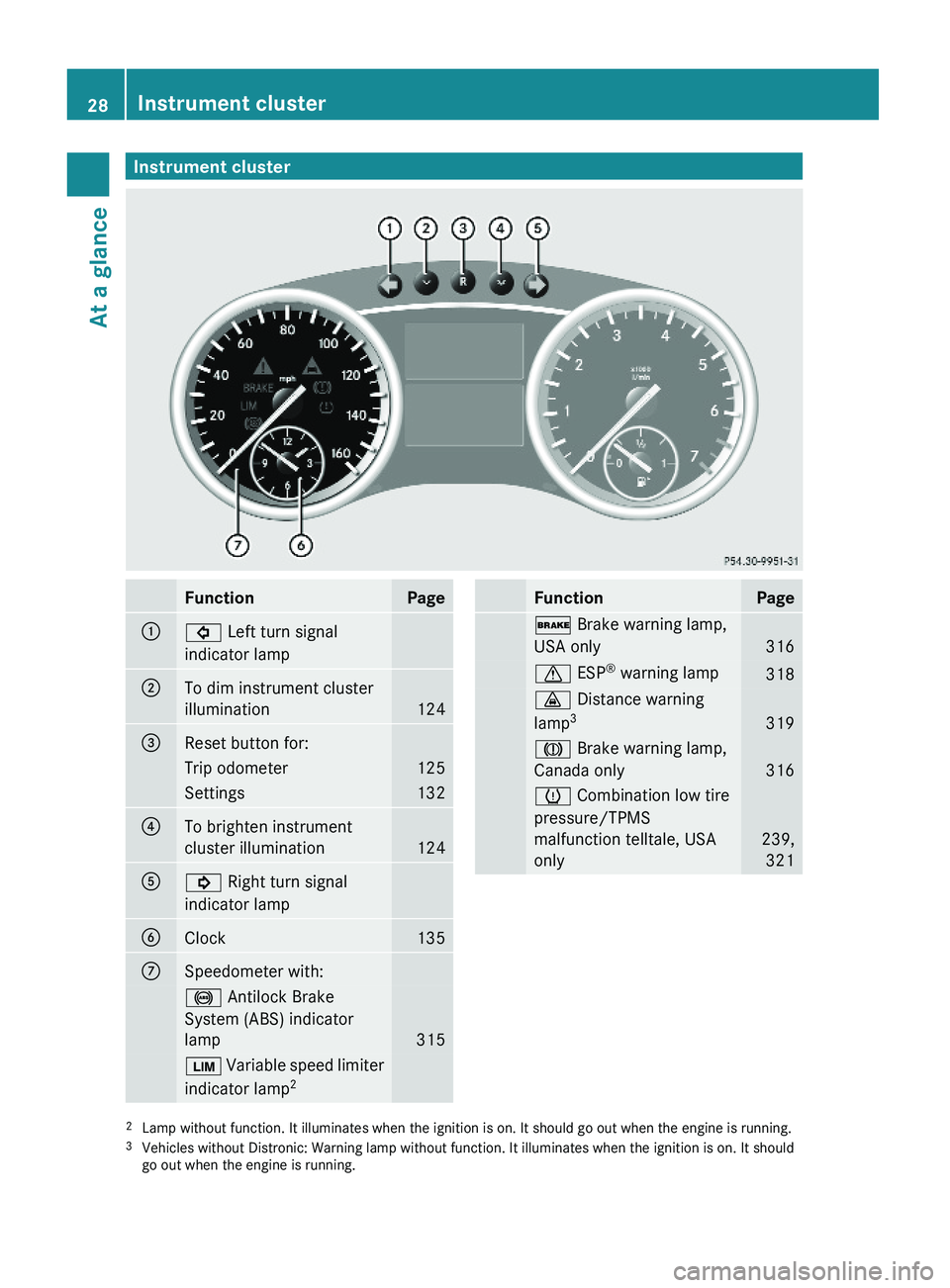
Instrument clusterFunctionPage:# Left turn signal
indicator lamp
;To dim instrument cluster
illumination124
=Reset button for: Trip odometer125Settings132?To brighten instrument
cluster illumination124
A! Right turn signal
indicator lamp
BClock 135CSpeedometer with: ! Antilock Brake
System (ABS) indicator
lamp 315
È Variable speed limiter
indicator lamp2FunctionPage$ Brake warning lamp,
USA only 316
d ESP® warning lamp 318· Distance warning
lamp3319
J Brake warning lamp,
Canada only316
h Combination low tire
pressure/TPMS
malfunction telltale, USA
only
239,
321
2Lamp without function. It illuminates when the ignition is on. It should go out when the engine is running.3Vehicles without Distronic: Warning lamp without function. It illuminates when the ignition is on. It shouldgo out when the engine is running.
28Instrument clusterAt a glance
X164_AKB; 5; 31, en-USd2ureepe,Version: 2.11.8.12009-09-11T12:30:16+02:00 - Seite 28
Page 31 of 380
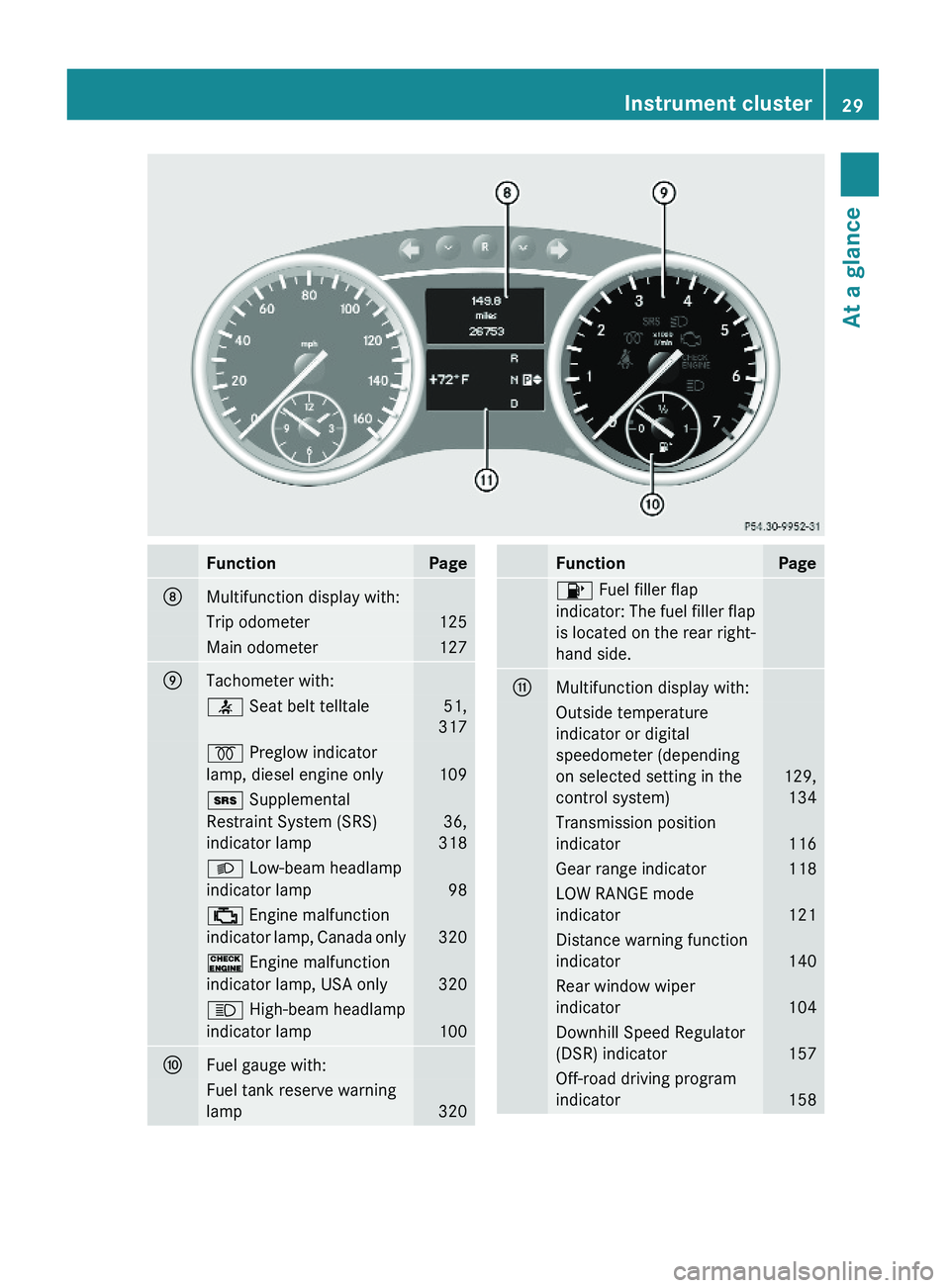
FunctionPageDMultifunction display with:Trip odometer125Main odometer127ETachometer with: 7 Seat belt telltale 51,
317
% Preglow indicator
lamp, diesel engine only 109
+ Supplemental
Restraint System (SRS)
indicator lamp
36,
318
L Low-beam headlamp
indicator lamp 98
; Engine malfunction
indicator lamp, Canada only320
! Engine malfunction
indicator lamp, USA only 320
K High-beam headlamp
indicator lamp 100
FFuel gauge with:Fuel tank reserve warning
lamp 320
FunctionPage8 Fuel filler flap
indicator: The fuel filler flap
is located on the rear right-
hand side.
GMultifunction display with:Outside temperature
indicator or digital
speedometer (depending
on selected setting in the
control system)
129,
134
Transmission position
indicator116
Gear range indicator118LOW RANGE mode
indicator121
Distance warning function
indicator140
Rear window wiper
indicator104
Downhill Speed Regulator
(DSR) indicator157
Off-road driving program
indicator158
Instrument cluster29At a glanceX164_AKB; 5; 31, en-USd2ureepe,Version: 2.11.8.12009-09-11T12:30:16+02:00 - Seite 29Z
Page 38 of 380
Vehicle equipment
i This Operator’s Manual describes all
features, standard or optional, potentially
available for your vehicle at the time of
purchase. Please be aware that your
vehicle might not be equipped with all
features described in this manual.
Occupant safety
Introduction
In this section you will learn the most
important facts about the restraint system
components of the vehicle.
The restraint systems are:
R Seat belts
R Child restraints
R
Lower Anchors and Tethers for CHildren
(LATCH)
Additional protection potential is provided by:
R
Supplemental Restraint System (SRS) with
- Air bags
- Air bag control unit (with crash sensors)
-
Emergency Tensioning Device (ETD) for
seat belts
- Seat belt force limiter
R NECK-PRO active front head restraints
R Preventive occupant safety (PRE-SAFE ®
)
R Air bag system components with
- Front passenger front air bag off
indicator lamp
- USA only: Front passenger seat with
Occupant Classification System (OCS)
- Canada only: Front passenger seat with
BabySmart™ air bag deactivation system
Although the systems are independent, their
protective functions work in conjunction with
each other.
GWarning!
Modifications to or work improperly
conducted on restraint system components
or their wiring, as well as tampering with
interconnected electronic systems, can lead
to the restraint systems no longer functioning
as intended.
Air bags or Emergency Tensioning Devices
(ETDs), for example, could deploy
inadvertently or fail to deploy in accidents
although the deceleration threshold for air
bag deployment is exceeded. Therefore,
never modify the restraint systems. Do not
tamper with electronic components or their
software.
i See “Children in the vehicle”
( Y page 55) for information on
R infants and children traveling with you in
the vehicle
R restraint systems for infants and children
SRS indicator lamp
The SRS system conducts a self-test when
the ignition is switched on and in regular
intervals while the engine is running. This
facilitates detection of system malfunctions.
The SRS indicator lamp + in the
instrument cluster comes on when the
ignition is switched on. It goes out no later
than a few seconds after the engine has been
started.
The SRS components are in operational
readiness when the SRS indicator lamp
+ is not lit while the engine is running.
A malfunction in the system has been
detected if the SRS indicator lamp +
R fails to go out after approximately
4 seconds after the engine was started
R does not come on at all
R comes on after the engine was started or
while driving
36Occupant safetySafety and security
X164_AKB; 5; 31, en-USd2ureepe,Version: 2.11.8.12009-09-11T12:30:16+02:00 - Seite 36
Page 39 of 380
GWarning!
The SRS self-check has detected a
malfunction when the SRS indicator lamp
+ :
R does not come on at all
R does not go out after 4 seconds after the
engine was started
R comes on while driving
For your safety, we strongly recommend that
you contact an authorized Mercedes-Benz
Center immediately to have the system
checked. Otherwise the SRS may not be
activated when needed in an accident, which
could result in serious or fatal injury. The SRS
might also deploy unexpectedly and
unnecessarily which could also result in injury
as well.
In addition, improper work on the SRS creates
a risk of rendering the SRS inoperative or
causing unintended air bag deployment. Work
on the SRS must therefore only be performed
by qualified technicians. Contact an
authorized Mercedes-Benz Center.
If it is necessary to modify an air bag system
to accommodate a person with disabilities,
contact an authorized Mercedes-Benz Center.
USA only: Call our Customer Assistance
Center at 1-800-FOR-MERCedes
(1-800-367-6372) for details.
Air bags
GWarning!
Air bags are designed to reduce the potential
of injury and fatality in certain
R frontal impacts (front air bags and driver’s
side knee bag)
R side impacts (side impact air bags and
window curtain air bags)
R rollovers (window curtain air bags)
However, no system available today can
completely eliminate injuries and fatalities.
Deployment of the air bags temporarily
releases a small amount of dust from the air
bags. This dust, however, is neither harmful
to your health, nor does it indicate a fire in the
vehicle. The dust might cause some
temporary breathing difficulty for people with
asthma or other breathing trouble. To avoid
this, you may wish to get out of the vehicle as
soon as it is safe to do so. If you have any
breathing difficulty but cannot get out of the
vehicle after the air bag inflates, then get fresh
air by opening a window or door.GWarning!
To reduce the risk of injury when the front air
bags inflate, it is very important for the driver
and front passenger to always be in a properly
seated position and to wear their respective
seat belt.
For maximum protection in the event of a
collision always be in normal seated position
with your back against the seat backrest.
Fasten your seat belt and make sure it is
properly positioned on your body.
Since the air bag inflates with considerable
speed and force, a proper seating position
and correct positioning of the hands on the
steering wheel will help to keep you at a safe
distance from the air bag. Occupants who are
not wearing their seat belt, are not seated
properly or are too close to the air bag can be
seriously injured or killed by an air bag as it
inflates with great force instantaneously:
R Sit with the seat belt properly fastened in a
position that is as upright as possible with
your back against the seat backrest.
R Move the driver’s seat as far back as
possible, still permitting proper operation
of vehicle controls. The distance from the
center of the driver’s chest to the center of
the air bag cover on the steering wheel
must be at least 10 inches (25 cm) or more.
You should be able to accomplish this by
adjusting the seat and steering wheel. If
Occupant safety37Safety and securityX164_AKB; 5; 31, en-USd2ureepe,Version: 2.11.8.12009-09-11T12:30:16+02:00 - Seite 37Z