center console MERCEDES-BENZ GL 2011 Owners Manual
[x] Cancel search | Manufacturer: MERCEDES-BENZ, Model Year: 2011, Model line: GL, Model: MERCEDES-BENZ GL 2011Pages: 376, PDF Size: 17.39 MB
Page 7 of 376
B
BAS (Brake Assist System) ................. 66
Battery Charging ........................................ 323
Checking (SmartKey) .......................76
Display message ............................ 242
Important safety guidelines
(SmartKey) ....................................... 75
Jump-starting ................................. 325
Replacing (SmartKey) ......................76
Safety notes .................................. 322
Belt
see Seat belts
Blind Spot Assist
Activating/deactivating (on-
board computer) ............................ 226
Display message ............................ 246
Function/notes ............................. 200
Trailer towing ................................. 202
BlueTEC
AdBlue ®
......................................... 367
Adding AdBlue ®
............................. 163
Brake fluid
Notes ............................................. 369
Brake fluid level ................................ 298
Brake lamp (display message) ......... 238
Brakes ABS .................................................. 65
BAS .................................................. 66
Brake fluid (notes) .........................369
Display message ............................ 236
Maintenance .................................. 169
Parking brake ........................ 166, 170
Warning lamp ................................. 254
Braking
Important safety instructions ......... 168
Breakdown
see Accident (notes)
see Flat tire
Bulbs
Backup lamp .................................. 123
High-beam headlamps ...................122
License plate lamp .........................124
Low-beam headlamps ....................121
Overview ........................................ 120
Parking lamps ................................ 122
Rear fog lamp ................................ 123Replacing ....................................... 123
Standing lamps (front) ...................122
Turn signals (front) ......................... 122
C
CAC (Customer Assistance Center) .........22
California
Important notice for retail
customers and lessees ....................20
Calling up a malfunction
see Display messages
Care
Carpets .......................................... 305
Car wash ........................................ 300
Display ........................................... 303
Gear or selector lever ....................304
Headlamps ..................................... 302
Notes ............................................. 299
Paint .............................................. 301
Plastic trim .................................... 304
Power washer ................................ 301
Rear view camera .......................... 303
Roof lining ...................................... 305
Seat belt ........................................ 305
Seat covers .................................... 304
Sensors ......................................... 303
Steering wheel ............................... 304
Tail pipes ....................................... 303
Trim strips ..................................... 304
Washing by hand ........................... 301
Wheels ........................................... 301
Windows ........................................ 302
Wiper blades .................................. 302
Wooden trim .................................. 304
Cargo compartment cover ............... 269
Cargo compartment enlargement ... 266
Cargo compartment floor ................. 310
Cargo net Attaching ....................................... 270
Important safety information .........270
Cargo tie down rings ......................... 268
CD player/CD changer (on-board
computer) .......................................... 219
Center console ..................................... 31
Index5BA 164.8 USA, CA Edition B 2011; 1; 2, en-USd2sboikeVersion: 3.0.3.52010-04-21T15:08:44+02:00 - Seite 5
Page 8 of 376
Central lockingAutomatic locking (on-board
computer) ...................................... 224
SmartKey ......................................... 72
Changing bulbs
Headlamps ..................................... 120
Changing gears .................................. 154
Changing the programming SmartKey ......................................... 75
Checklist
After driving off-road ...................... 175
Before driving off-road ...................175
Child-proof locks
Rear doors ....................................... 64
Special seat belt retractor ...............61
Children
In the vehicle ................................... 59
Restraint systems ............................ 59
Child seat
Automatic recognition .....................48
Automatic recognition/air bag
deactivation, self-test ......................50
ISOFIX (LATCH-type child seat
anchors) ........................................... 62
Special seat belt retractor ...............61
Top Tether ....................................... 62
Troubleshooting ............................... 51
Cigarette lighter ................................ 280
Climate control Activating/deactivating .................136
Activating/deactivating air-
recirculation mode .........................141
Controlling automatically ...............138
Cooling with air dehumidification ..137
Defrosting the windshield ..............140
Demisting the windows .................. 141
Dual-zone automatic climate
control ........................................... 131
Important safety information .........130
Indicator lamp ................................ 138
Multi-zone automatic climate
control ........................................... 132
Problems with "cooling with air
dehumidification" ........................... 138
Problems with the rear window
heating .......................................... 141
Rear control panel .................133, 136
Refrigerant ..................................... 369Setting the air distribution .............140
Setting the airflow .........................140
Setting the air vents ......................143
Setting the temperature ................139
Setting the temperature (rear
compartment) ................................ 139
Switching the MONO function on/
off .................................................. 140
Switching the rear window
heating on/off ............................... 141
Switching the residual heat
function on/off .............................. 142
Clock (on-board computer) ............... 222
Cockpit ................................................. 27
Combination switch .......................... 117
Compass ............................................ 291
Calling up ....................................... 291
Consumption statistics (on-board
computer) .......................................... 227
Convenience closing feature .............. 87
Convenience opening feature ............ 86
Coolant (engine) Checking the level .........................297
Display message ............................ 240
Notes ............................................. 369
Temperature gauge ........................ 218
Cooling
see Climate control
Cornering light (display message) ... 237
Crash-responsive emergency
lighting ............................................... 119
Crossbar Installing ........................................ 274
Setting the span width ...................276
Cross bar ............................................ 273
Cruise control .................................... 179
Cruise control lever .......................179
Display message ............................ 246
Cup holder ......................................... 277
Center console .............................. 277
Rear compartment .........................278
third row of seats ........................... 278
Current fuel consumption (on-
board computer) ............................... 227
Customer Assistance Center (CAC) ............................................... 22
Customer Relations Department ....... 236IndexBA 164.8 USA, CA Edition B 2011; 1; 2, en-USd2sboikeVersion: 3.0.3.52010-04-21T15:08:44+02:00 - Seite 6
Page 17 of 376
Warning lamp ................................. 258
Warning lamp (function) ................... 36
Standard display (on-board
computer) .......................................... 218
Starting the engine Important safety instructions ......... 148
Station
see Radio
Status line (on-board computer)
Multifunction display .....................216
Selecting the display ...................... 222
Steering (display message) .............. 251
Steering wheel Adjusting (electrically) ...................106
Adjusting (manually) ......................106
Buttons (on-board computer) ......... 215
Cleaning ......................................... 304
Important safety instructions ......... 105
Memory function (storing
settings) ......................................... 106
Steering wheel heating ..................106
Storing settings (memory
function) ........................................ 110
Steering wheel heating
Indicator lamp (Malfunction) ..........107
Steering wheel paddle shifters ........ 155
Stowage compartments Armrest (under) ............................. 265
Glove box ....................................... 265
Stowage space
Center console .............................. 265
Center console (rear) .....................266
Cup holders ................................... 277
Important safety information .........264
Submenu (on-board computer)
Convenience .................................. 225
Instrument cluster .........................221
Lighting .......................................... 223
Time/Date ..................................... 222
Vehicle ........................................... 224
Summer opening
see Convenience opening feature
Sun visor ............................................ 278
Supplemental Restraint System see SRS
Surround lighting (on-board
computer) .......................................... 223SUV
(Sport Utility Vehicle) .......................21
Switching off the alarm (ATA) ............ 69
T
Tachometer ........................................ 214
Tailgate Display message ............................ 251
Important safety guidelines .............80
Limiting the opening angle ...............84
Taillight
see Tail lamps
Tank contents
Gauge .............................................. 28
Technical data ................................... 362
GL 350 BlueTEC ............................. 370
GL 450 ........................................... 371
GL 550 ........................................... 371
Tires/wheels ................................. 357
TELEAID
Call priority .................................... 287
Display message ............................ 231
Downloading destinations
(COMAND) ..................................... 287
Emergency call .............................. 284
Important safety notes ..................283
Locating a stolen vehicle ...............288
MB info call button ........................286
Roadside Assistance button ..........285
Self-test ......................................... 283
System .......................................... 283
Vehicle remote unlocking ..............287
Telephone
Accepting a call ............................. 228
Display message ............................ 252
Menu (on-board computer) ............227
Number from the phone book ........ 228
Redialing ........................................ 228
Rejecting/ending a call .................228
Telephone compartment .................. 265
Telescopic rod (EASY-PACK load-
securing kit) ....................................... 272
Temperature Coolant (on-board computer) ......... 218
Displaying the outside
temperature ................................... 218
Index15BA 164.8 USA, CA Edition B 2011; 1; 2, en-USd2sboikeVersion: 3.0.3.52010-04-21T15:08:44+02:00 - Seite 15
Page 27 of 376
Exterior view ....................................... 26
Cockpit ................................................. 27
Instrument cluster ..............................28
Multifunction steering wheel .............30
Center console .................................... 31
Overhead control panel ......................33
Door control panel .............................. 3425At a glanceBA 164.8 USA, CA Edition B 2011; 1; 2, en-USd2sboikeVersion: 3.0.3.52010-04-21T15:08:44+02:00 - Seite 25
Page 33 of 376
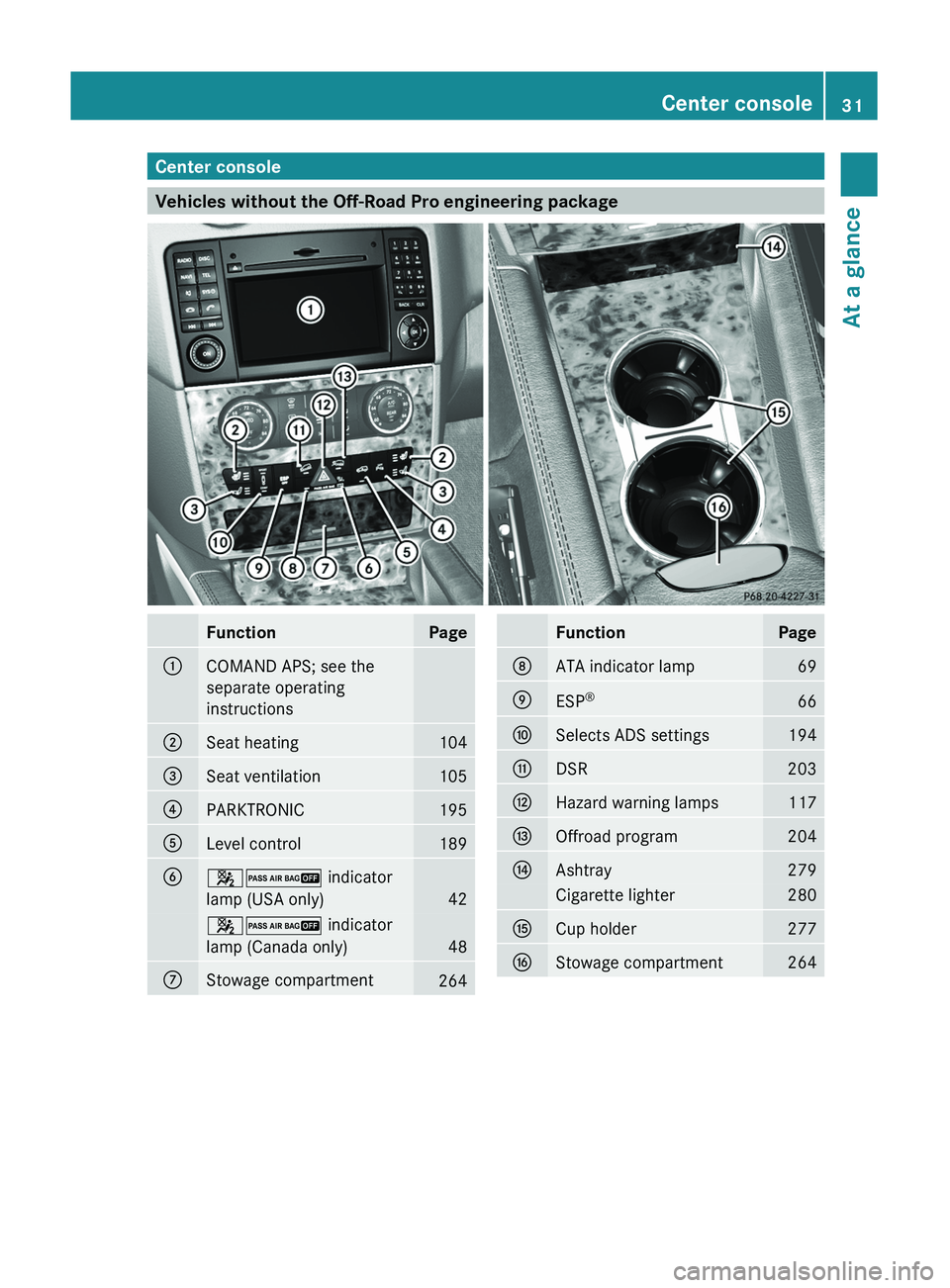
Center console
Vehicles without the Off-Road Pro engineering package
FunctionPage:COMAND APS; see the
separate operating
instructions
;Seat heating104=Seat ventilation105?PARKTRONIC195ALevel control189B42 indicator
lamp (USA only)42
42 indicator
lamp (Canada only)48
CStowage compartment264FunctionPageDATA indicator lamp69EESP®66FSelects ADS settings194GDSR203HHazard warning lamps117IOffroad program204JAshtray279Cigarette lighter280KCup holder277LStowage compartment264Center console31At a glanceBA 164.8 USA, CA Edition B 2011; 1; 2, en-USd2sboikeVersion: 3.0.3.52010-04-21T15:08:44+02:00 - Seite 31
Page 34 of 376
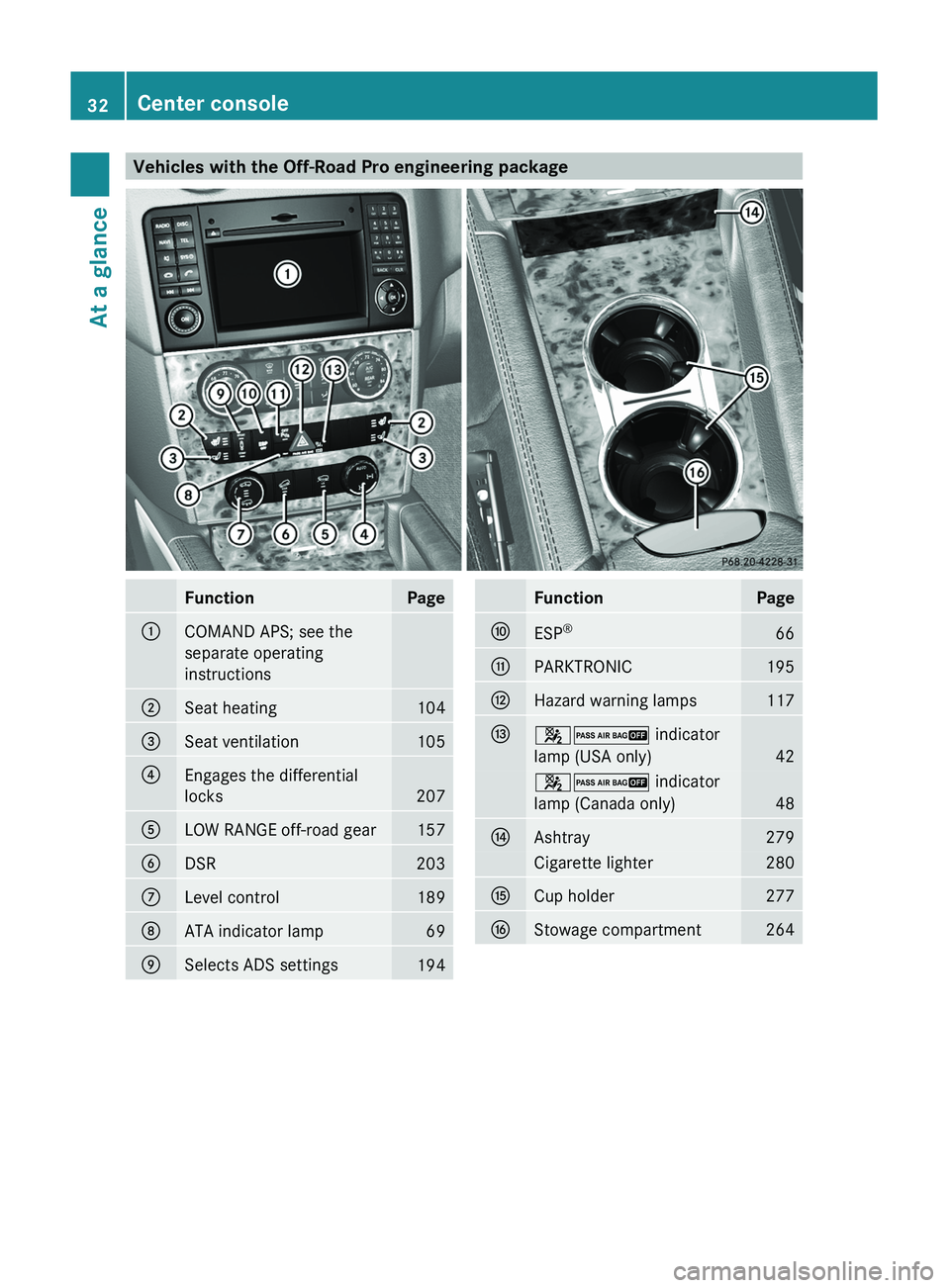
Vehicles with the Off-Road Pro engineering packageFunctionPage:COMAND APS; see the
separate operating
instructions
;Seat heating104=Seat ventilation105?Engages the differential
locks207
ALOW RANGE off-road gear157BDSR203CLevel control189DATA indicator lamp69ESelects ADS settings194FunctionPageFESP®66GPARKTRONIC195HHazard warning lamps117I42 indicator
lamp (USA only)42
42 indicator
lamp (Canada only)48
JAshtray279Cigarette lighter280KCup holder277LStowage compartment26432Center consoleAt a glance
BA 164.8 USA, CA Edition B 2011; 1; 2, en-USd2sboikeVersion: 3.0.3.52010-04-21T15:08:44+02:00 - Seite 32
Page 42 of 376
The front air bags increase protection for the
driver's and front-passenger's head and
chest.
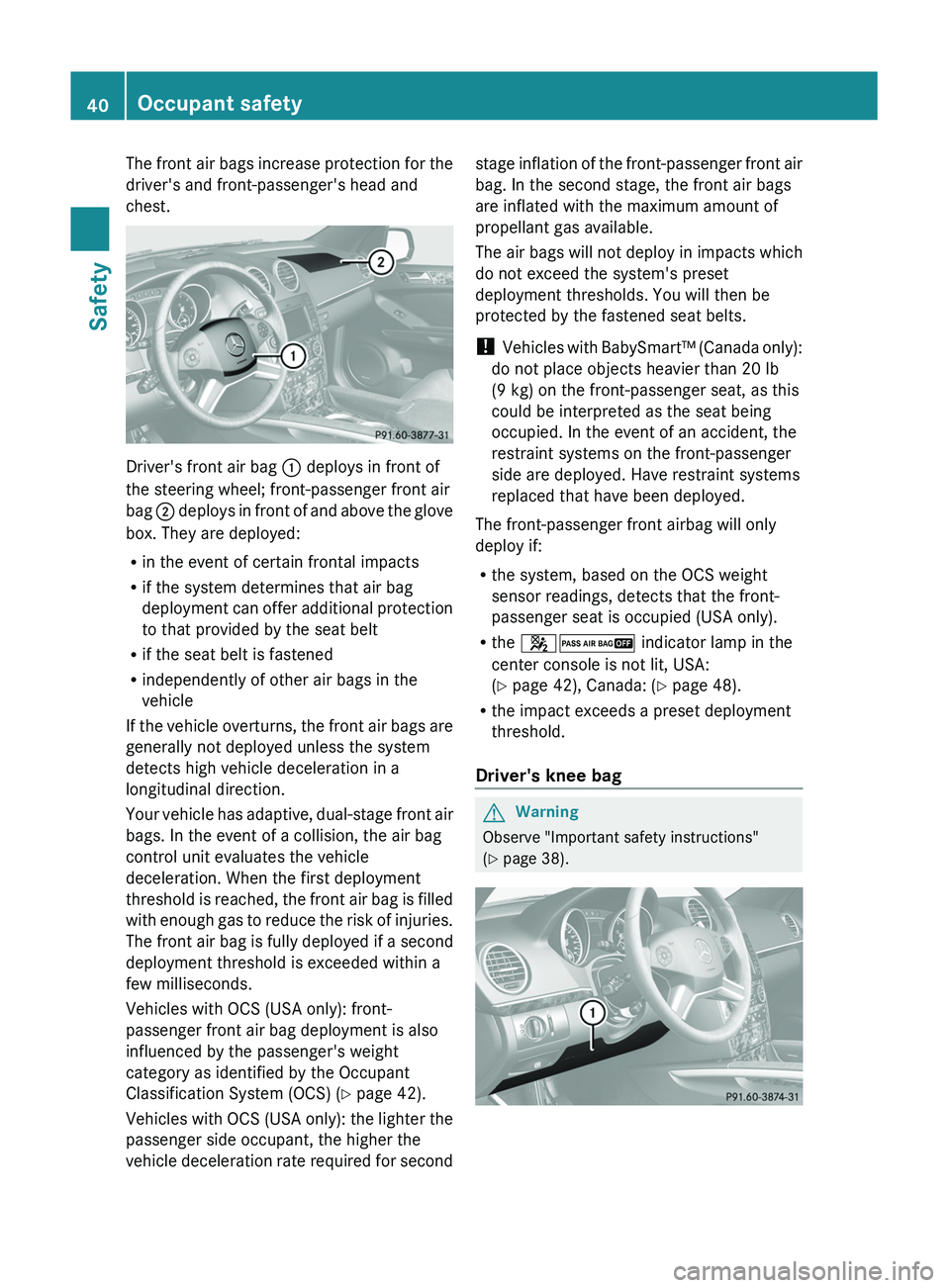
Driver's front air bag : deploys in front of
the steering wheel; front-passenger front air
bag ; deploys in front of and above the glove
box. They are deployed:
R in the event of certain frontal impacts
R if the system determines that air bag
deployment can offer additional protection
to that provided by the seat belt
R if the seat belt is fastened
R independently of other air bags in the
vehicle
If the vehicle overturns, the front air bags are
generally not deployed unless the system
detects high vehicle deceleration in a
longitudinal direction.
Your vehicle has adaptive, dual-stage front air
bags. In the event of a collision, the air bag
control unit evaluates the vehicle
deceleration. When the first deployment
threshold is reached, the front air bag is filled
with enough gas to reduce the risk of injuries.
The front air bag is fully deployed if a second
deployment threshold is exceeded within a
few milliseconds.
Vehicles with OCS (USA only): front-
passenger front air bag deployment is also
influenced by the passenger's weight
category as identified by the Occupant
Classification System (OCS) ( Y page 42).
Vehicles with OCS (USA only): the lighter the
passenger side occupant, the higher the
vehicle deceleration rate required for second
stage inflation of the front-passenger front air
bag. In the second stage, the front air bags
are inflated with the maximum amount of
propellant gas available.
The air bags will not deploy in impacts which
do not exceed the system's preset
deployment thresholds. You will then be
protected by the fastened seat belts.
! Vehicles with BabySmart™ (Canada only):
do not place objects heavier than 20 lb
(9 kg) on the front-passenger seat, as this
could be interpreted as the seat being
occupied. In the event of an accident, the
restraint systems on the front-passenger
side are deployed. Have restraint systems
replaced that have been deployed.
The front-passenger front airbag will only
deploy if:
R the system, based on the OCS weight
sensor readings, detects that the front-
passenger seat is occupied (USA only).
R the 42 indicator lamp in the
center console is not lit, USA:
( Y page 42), Canada: ( Y page 48).
R the impact exceeds a preset deployment
threshold.
Driver's knee bagGWarning
Observe "Important safety instructions"
( Y page 38).
40Occupant safetySafety
BA 164.8 USA, CA Edition B 2011; 1; 2, en-USd2sboikeVersion: 3.0.3.52010-04-21T15:08:44+02:00 - Seite 40
Page 45 of 376
In addition, the occupant weight may appear
to increase or decrease due to the following:
R objects hanging on the seat
R objects lodged underneath the seat
R objects lodged between the seat and the
center console
R objects lodged between the seat and the
door
R other passengers exerting weight on the
seat
R objects applying pressure to the back of
the seat
Make sure that the seat always has clearance
in all directions.
If the front-passenger seat, the seat cover or
the seat cushion are damaged, have the
necessary repair work carried out at an
authorized Mercedes-Benz Center.
For safety reasons, Mercedes-Benz
recommends that you only use seat
accessories which have been approved by
Mercedes-Benz.
Both the driver and the front passenger
should observe the 42 indicator
lamp to determine whether or not the front
passenger is positioned correctly.GWarning!
If the 4 2 indicator lamp
illuminates when an adult or someone larger
than a small individual is in the front
passenger seat, have the front passenger
reposition himself or herself in the seat until
the 4 2 indicator lamp goes out,
or check whether objects are caught under or
around the seat.
In the event of a collision, the air bag control
unit will not allow front passenger front air bag
deployment when the OCS has classified the
front passenger seat occupant as weighting
as much as or less than a typical 12-month-
old child in a standard child restraint or if the
front passenger seat is classified as being
empty.
When the OCS senses that the front
passenger seat occupant is classified as
being up to or less than the weight of a typical
12-month-old child in a standard child
restraint, the 4 2 indicator lamp
will illuminate when the engine is started and
remain illuminated, indicating that the front
passenger front air bag is deactivated.
When the OCS senses that the front
passenger seat is classified as being empty,
the 4 2 indicator lamp will
illuminate when the engine is started and
remain illuminated, indicating that the front
passenger front air bag is deactivated.
When the OCS senses that the front
passenger seat occupant is classified as
being heavier than the weight of a typical
12-month-old child seated in a standard child
restraint or as being a small individual (such
as a young teenager or a small adult), the
4 2 indicator lamp will illuminate
for approximately 6 seconds when the engine
is started and then, depending on occupant
weight sensor readings from the seat, remain
illuminated or go out. With the 4
2 indicator lamp illuminated, the
front passenger front air bag is deactivated.
With the 4 2 indicator lamp out,
the front passenger front air bag is activated.
When the OCS senses that the front
passenger seat occupant is classified as an
adult or someone larger than a small
individual, the 4 2 indicator lamp
will illuminate for approximately 6 seconds
when the engine is started and then goes out,
indicating that the front passenger front air
bag is activated.
If the 4 2 indicator lamp is
illuminated, the front passenger front air bag
is deactivated and will not be deployed.Occupant safety43SafetyBA 164.8 USA, CA Edition B 2011; 1; 2, en-USd2sboikeVersion: 3.0.3.52010-04-21T15:08:44+02:00 - Seite 43Z
Page 47 of 376
Rwhen securing a child in a child restraint
system on the front-passenger seat, you
must:
- move the front-passenger seat as far
back as possible
- use a child restraint system that is
suitable for the age, size and weight of
the child
- observe the manufacturer's installation
instructions in order to install and secure
the child restraint system correctly.
R for children larger than the typical 12-
month-old child, the passenger front air bag
is activated.
Deployment of the driver front air bag does
not mean that the front-passenger front air
bag also should have deployed. The OCS may
have determined:
R that the seat was empty or occupied by a
person with a weight up to or less than that
of a typical 12 month-old child seated in a
standard child restraint
R that the seat was occupied by a small
person (e.g. a young teenager or a small
adult) or a child that weighs more than a
typical 12 month old child in a child
restraint system
These are examples of when OCS disables the
front-passenger front air bag. This occurs
even though the impact fulfills the criteria for
deployment of the driver's front air bag.
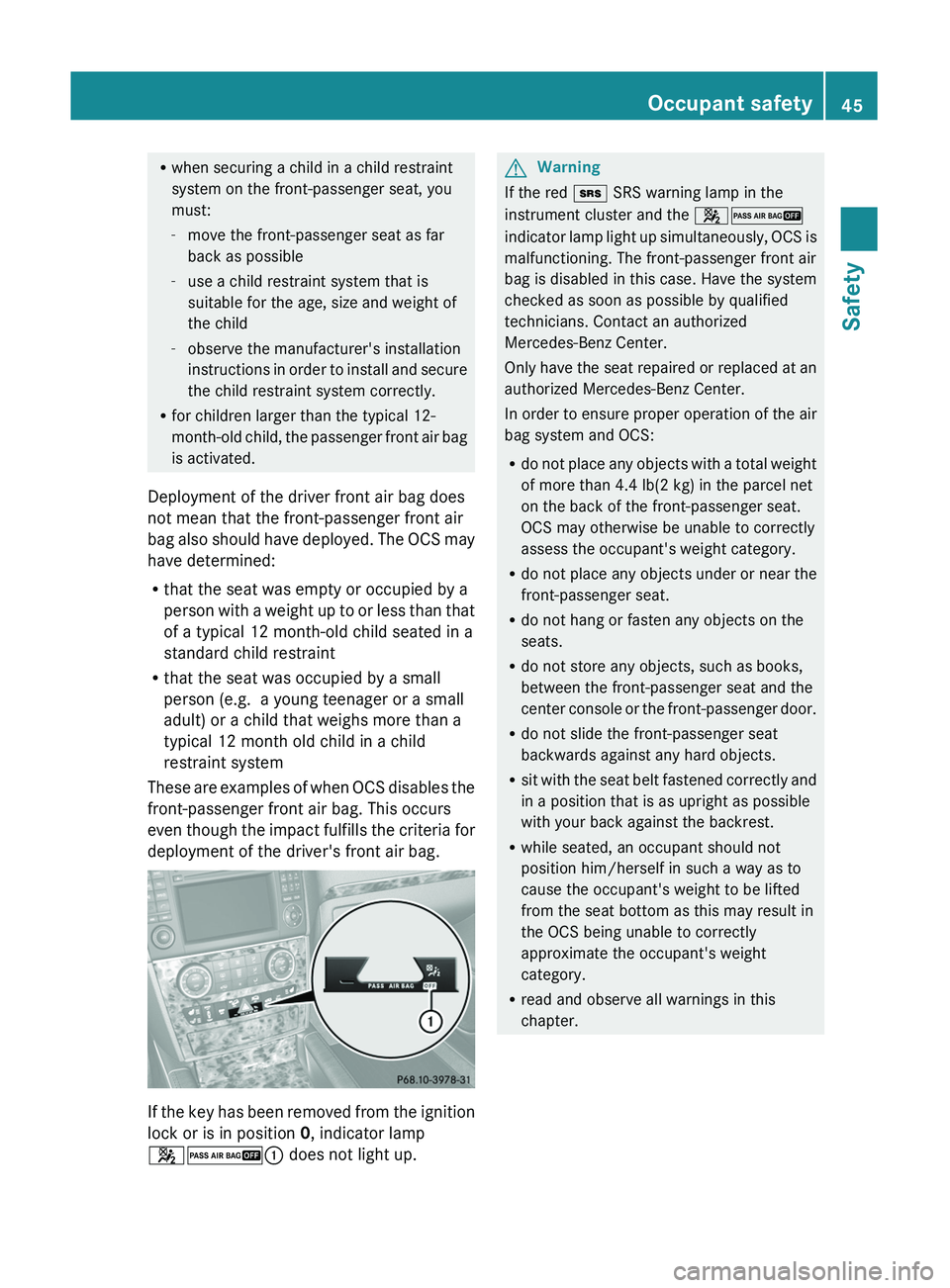
If the key has been removed from the ignition
lock or is in position 0, indicator lamp
42 : does not light up.
GWarning
If the red + SRS warning lamp in the
instrument cluster and the 42
indicator lamp light up simultaneously, OCS is
malfunctioning. The front-passenger front air
bag is disabled in this case. Have the system
checked as soon as possible by qualified
technicians. Contact an authorized
Mercedes-Benz Center.
Only have the seat repaired or replaced at an
authorized Mercedes-Benz Center.
In order to ensure proper operation of the air
bag system and OCS:
R do not place any objects with a total weight
of more than 4.4 lb(2 kg) in the parcel net
on the back of the front-passenger seat.
OCS may otherwise be unable to correctly
assess the occupant's weight category.
R do not place any objects under or near the
front-passenger seat.
R do not hang or fasten any objects on the
seats.
R do not store any objects, such as books,
between the front-passenger seat and the
center console or the front-passenger door.
R do not slide the front-passenger seat
backwards against any hard objects.
R sit with the seat belt fastened correctly and
in a position that is as upright as possible
with your back against the backrest.
R while seated, an occupant should not
position him/herself in such a way as to
cause the occupant's weight to be lifted
from the seat bottom as this may result in
the OCS being unable to correctly
approximate the occupant's weight
category.
R read and observe all warnings in this
chapter.
Occupant safety45SafetyBA 164.8 USA, CA Edition B 2011; 1; 2, en-USd2sboikeVersion: 3.0.3.52010-04-21T15:08:44+02:00 - Seite 45Z
Page 209 of 376
Differential lock
General notes
i Differential locks are available only in
vehicles with the Off-Road Pro engineering
package.
Your vehicle is equipped with the following:
R A differential lock for the transfer box: this
controls the balance between the front and
rear axles.
R A differential lock for the rear axle: this
controls the balance between the wheels
and the rear axle.
Differential locks improve the vehicle's
traction. 4ETS ( Y page 67)controls the
balance between the wheels on the front axle.
Information on "Off-road driving"; see
( Y page 173).
Information about the differential and
differential locks
When the vehicle is driving around a curve,
the wheels on the outside of the curve have
to cover a greater distance and therefore
have to turn faster than the wheels on the
inside. The differential, a transmission in the
drive train, balances these different rotational
speeds out, making cornering possible.
The disadvantage of a differential: the wheels
with the least grip are driven the hardest.
Example: one wheel on a driven axle is on a
snow-covered surface and therefore has no
traction. This wheel has the most driving
force, since the differential distributes most
of the force to the wheel with the least
resistance. The wheel on the opposite side of
this axle, which is on a solid surface and could
therefore enable traction, does not have any
driving force. 4ETS eliminates this
disadvantage and ensures good steerability
by braking the spinning wheel automatically
and thereby directing more force to the wheel
that is on a solid surface and can provide
traction.
ESP ®
and 4ETS are traction systems that are
ideally suited to road driving and driving on
easily negotiable off-road terrain. The LOW
RANGE off-road gear also improves off-road
capability.
Difficult off-road conditions require additional
measures, such as locking one or more
differentials. Your vehicle has two differential
locks: one (central) differential lock for the
transfer case and one differential lock for the
rear axle. Both differential locks can be
activated using the selector wheel on the
center console. When the (central)
differential for the transfer case is locked, the
speed of the front wheels is the same as the
speed of the rear wheels. When the
differential for the rear axle is locked, both of
the rear wheels turn at the same speed,
independent of their individual torques. Note
that activating the differential locks
significantly reduces the steerability of the
vehicle.
For your safety, the safety of others and to
prevent damage to the vehicle, the
differential locks must not be activated on
paved roads. Note that the differential
function is necessary when driving on paved
roads and that the differentials must never be
locked on paved roads. Otherwise, the
vehicle can no longer be steered. The
differential locks must therefore only be
activated when driving off-road, and then only
if activating the other driving systems (4ETS,
ESP ®
and LOW RANGE off-road gear) is no
longer sufficient.
Engaging the differential locks
! Drive off slowly when the differential
locks are engaged.
Function or performance tests may only be
performed on a 2-axle dynamometer. If you
wish to operate the vehicle on such a
dynamometer, please consult an
authorized Mercedes-Benz Center
beforehand. You could otherwise damage
the drive train or the brake system.
Off-road driving systems207Driving and parkingBA 164.8 USA, CA Edition B 2011; 1; 2, en-USd2sboikeVersion: 3.0.3.52010-04-21T15:08:44+02:00 - Seite 207Z